

Paper Menu >>
Journal Menu >>
 Vol.2, No.4, 544-550 (2011) doi:10.4236/as.2011.24071 C opyright © 2011 SciRes. Openly accessible at http://www.scirp.org/journal/AS/ Agricultural Scienc es Hydrogel amendment to sandy soil reduces irrigation frequency and improves the biomass of Agrostis stolonifera Hillary Agaba1*, Lawrence J. B. Orikiriza2, Joseph Obua3, John. D. Kabasa4, Martin Worbes5, Aloys Hüttermann6 1National Forestry Resources Research Institute, Kampala, Uganda; *Corresponding Author: [email protected] 2Department of Forestry, Biodiversity and Tourism, School of Forestry, Environmental and Geographical Sciences, Makerere Uni- versity, Kampala, Uganda; 3Interuniversity Council of East Africa, Kampala, Uganda; 4School of Veterinary Medicine Makerere University, Kampala, Uganda; 5Department for Crop Sciences, Tropical Agriculture Universität, Göttingen, Germany; 6Institute of Forest Botany, University of Goettingen, Goettingen, Germany. Received 8 September 2011; revised 15 October 2011; accepted 26 October 2011. ABSTRACT Soil water potential indicates the w at e r status of the soil and the need for irrigation. The effect of hydrogel amendment to the upper sand soil layer on water infiltration into the lower un-amended sand layer, irrigation frequency, water use effi- ciency and biomass production of Agrostis stolo- nifera was investigated. The upper 25 cm sand layer in three identical buckets was amended at 0.4%, 0.2% and a control (no hydrogel) while the lower 25 cm sand layer separated from the up- per layer by a wire mesh in the same buckets was un-amended. Agrostis stolonifera seeds were sown in each bucket and adequately irri- gated using a hand sprayer. Potential meter electrodes were inserted at three random posi- tions in each of the buckets and subsequent irrigations were done when a pressure of 600 bars was recorded in any of the three t reatments. Data were collected on irrigation frequency, water content in the lower layer, water use efficiency and biomass production of Agrostis stolonifera. The mean water potential in the lower 25 cm layer un-amended sand was significantly more negative in the 0.4% hydrogel than in the control. More water content (10%) was recorded in the lower layer under the control bucket than in ei- ther the 0.2% and 0.4% hydrogel amended buck- ets. The frequency of irrigation was three-fold in the control compared to the 0.4% hydrogel amended sand. The h ydrogel amende d sand sig- nificantly increased the shoot and root biomass of Agrostis stolonifera by 2.2 and 4 times re- spectively compared to the control. The 0.4% hydrogel amendment in sand increased the water use efficiency of grass eight fold with re- spect to the control. The hydrogel stimulated development of a dense root network and root aggregation that increased contact of the roots with moisture thus improving water use effi- ciency of hydrogel amended soil. The results suggest that hydrogels can improve sandy soil properties for plant growth by absorbing and keeping water longer in the soil matrix thus re- ducing watering frequency. Keywords: Sand; Water Use Efficiency; Hydrogel; Irrigation; Biomass; Agrostis Stolonifera 1. INTRODUCTION Moisture retention in the soil is fundamental in plan- tation forest establishment [1-3]. Soil water affects plant growth directly because it influences aeration, tempera- ture, nutrient transport, uptake and transformation [4]. Large pore spaces in sandy soils prevent water retention, make water dry out easily and escalates leaching of pre- cious nutrients past plant roots [1], thus hindering plant growth. There have been claims though, that addition of crosslinked polyacrylamide hydrogels to sandy soils reduces the rate of water percolation while increasing the water availability to plants [5]. The amount of soil water is usually measured in terms of percentage by volume or mass [6] or as soil water potential. Water content does not necessarily imply the  H. Agaba et al. / Agricultural Sciences 2 (2011) 544-550 Copyright © 2011 SciRes. Openly accessible at http://www.scirp.org/journal/AS/ 545545 availability of water to plants, nor does it indicate how the water moves within the soil profile but rather, it is the relative amount of water in soil. Soil water potential, which is the energy required to remove water from the soil, does not show the amount of water present in the root zone [4]. Therefore, soil water content and soil wa- ter potential should be considered when planning irriga- tion and taking measures to improve plant growth [4]. Hydrophilic polymers potentially influence infiltration rates, density, soil structure, compaction, soil texture, aggregate stability, crust hardness [7], and evaporation rates [8]. They increase the plant available water in the soil which prolongs plant survival under water stress [2,9,10]. While irrigation is critical in overcoming water stress, the timing (which includes measurement of soil water, estimation of loss by evapo-transpiration, and measurement of plant water status) is important [4,11, 12]. The low water holding capacity of sand soil causes rapid infiltration and deep percolation below the root zone. The use of gel-forming hydrophilic polymers (hy- drogels) has been tested for some years and found to increase the water holding capacity of sandy soils [13, 14]. High water infiltration in sandy soils has been ob- served to lead to deep percolation and inefficient fertil- izer and water use thus posing a significant problem in arid and semi arid regions [1]. Super Absorbent Poly- mers (SAPs) can store water in the upper horizons of the soil where plant roots are found. Significant reductions in irrigation requirements of many plants due to an in- crease in water holding capacity by hydrogel-amended soils have been reported [13]. Soil water potential shows the water status of soil and the need for irrigation. At both high (360 L/m2) and low (36 L/m2) irrigation speeds, [2] demonstrated that soil moisture was higher in the upper than lower horizons of soils amended with hydrogels after two weeks. Conventional irrigation usu- ally experiences the problem of losing a significant por- tion of the water to the aquifer [15,16]. As noted above, super absorbent hydrogels increase water storage of soils in the upper horizons of the soil thereby saving water and labor requirements in irrigation due to reduced irri- gation frequencies. The overall objective of this study was to examine the effect of hydrogel amendment to the upper sand soil layer on water uptake by that layer, irri- gation frequency and water availability for the growth of Agrostis stolonifera, a grass species commonly used in golf courses. The specific objectives were to 1) deter- mine the influence of hydrogel amendment on biomass development of Agrostis stolonifera under water poten- tial controlled irrigation timing and 2) determine the effect of hydrogel amendment to the upper sandy soil layer on water infiltration into the lower un-amended sand layer. The following hypotheses were tested: 1) Hydrogel amendment to sand has no effect on the bio- mass of Agrostis stolonifera, 2) Hydrogel amendment to the upper sand layer does not reduce water infiltration into the lower un-amended layer and 3) Hydrogel amend- ment does not affect irrigation frequency and saves no water during growth of Agrostis stolonifera. Agrostis stolonifera (bent grass) was traditionally confined almost entirely to golf greens. Now many homeowners prefer bentgrass lawns because of their beautiful carpet like turf. 2. MATERIALS AND METHODS 2.1. Materials The materials used in this experiment were Grass seeds (Agrostis stolonifera) luquasorb hydrogel, three identical plastic buckets measuring 51 and 41.3 cm top and lower diameters respectively, and 50 cm in height (Volume 83,595 cm3) and a potential meter (DMG 900) for measuring water potential in cm bars. The sand was obtained from a sand pit in Schoningen in the Solling mountains close to Goettingen. Luquasorb hydrogel manufactured by the BASF SE Chemical Company, Ludwigshafen, Germany was used as the soil amend- ment at the following concentrations: 0 (as control), 0.2% and 0.4%. The 0.2% and 0.4% hydrogel concentra- tions were made by mixing 2 and 4 kg of hydrogel pow- der respectively with 1000 kg of soil in a concrete mixer (Mini Concrete Mixer, Model: CM 180 - MZ2; Mixing capacity 180 L). The control had no hydrogel added. The amount of hydrogel used and the mixing procedures were according to [6,17] 2.2. Methods The experiment was conducted in a glass house set up at a temperature range of 25˚C - 32˚C and relative hu- midity of 50% - 95%. The three identical buckets were weighed and filled with sand to the 25 cm mark from the bottom of each bucket, and a wire mesh placed on top of this sand layer. The remaining top 25 cm layer in each bucket was then filled with sand amended with 0 (Con- trol—no hydrogel), 0.2% and 0.4% hydrogel and labeled accordingly. Using a water sprayer (Trigger sprayer, ca- pacity 1.5 litres—Spray flow: 240 ml/min), the buckets were irrigated until full saturation. Any water collecting on the surface was allowed to fully infiltrate. The weights of the fully irrigated buckets were recorded on a Sartorius scale. About 200 g of Agrostis stolonifera grass seeds were then sown in each bucket containing the various hydrogel treatments (control, 0.2% and 0.4%) by uniformly sprinkling them on the surface of each bucket 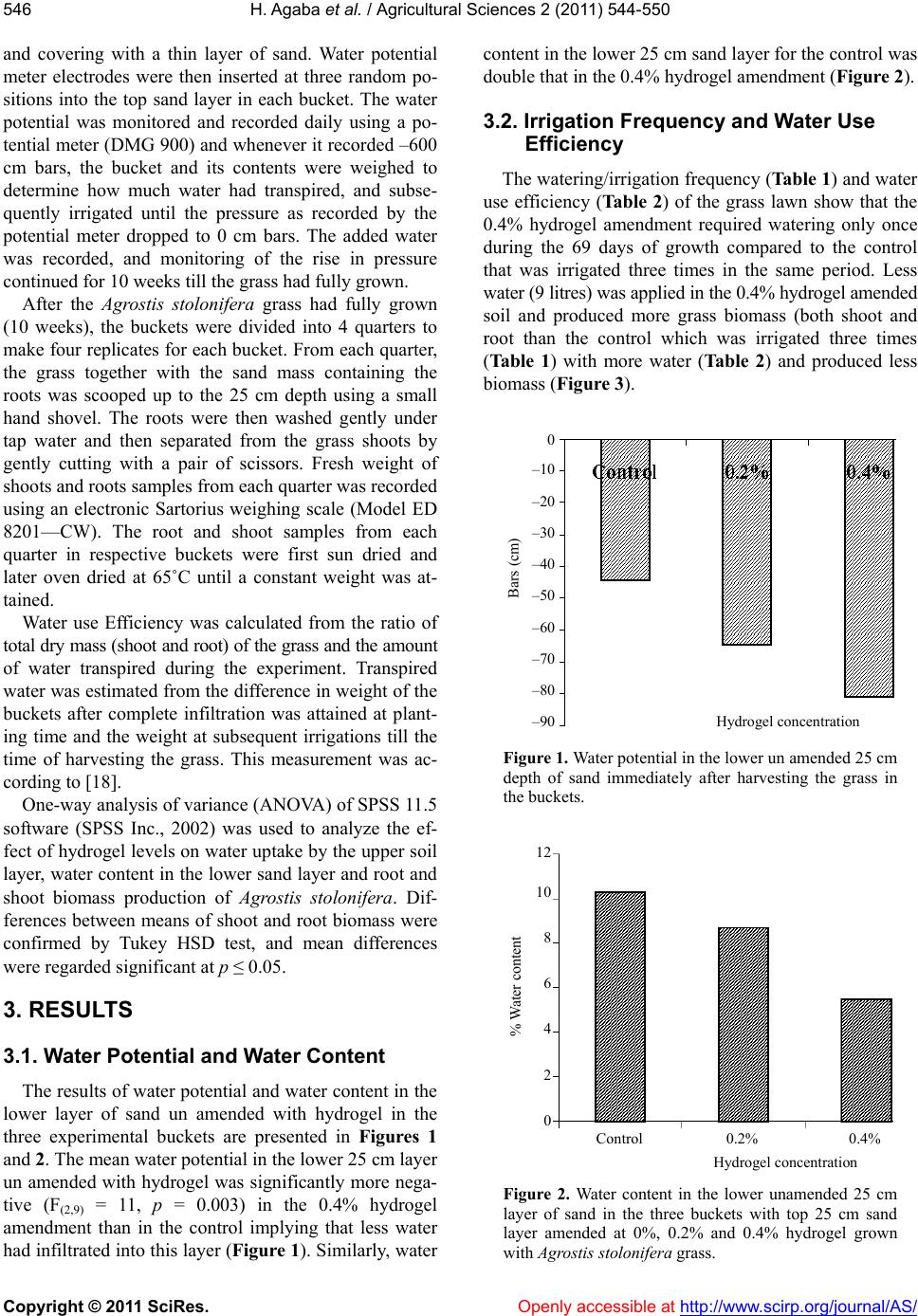 H. Agaba et al. / Agricultural Sciences 2 (2011) 544-550 Copyright © 2011 SciRes. Openly accessible at http://www.scirp.org/journal/AS/ 546 and covering with a thin layer of sand. Water potential meter electrodes were then inserted at three random po- sitions into the top sand layer in each bucket. The water potential was monitored and recorded daily using a po- tential meter (DMG 900) and whenever it recorded –600 cm bars, the bucket and its contents were weighed to determine how much water had transpired, and subse- quently irrigated until the pressure as recorded by the potential meter dropped to 0 cm bars. The added water was recorded, and monitoring of the rise in pressure continued for 10 weeks till the grass had fully grown. After the Agrostis stolonifera grass had fully grown (10 weeks), the buckets were divided into 4 quarters to make four replicates for each bucket. From each quarter, the grass together with the sand mass containing the roots was scooped up to the 25 cm depth using a small hand shovel. The roots were then washed gently under tap water and then separated from the grass shoots by gently cutting with a pair of scissors. Fresh weight of shoots and roots samples from each quarter was recorded using an electronic Sartorius weighing scale (Model ED 8201—CW). The root and shoot samples from each quarter in respective buckets were first sun dried and later oven dried at 65˚C until a constant weight was at- tained. Water use Efficiency was calculated from the ratio of total dry mass (shoot and root) of the grass and the amount of water transpired during the experiment. Transpired water was estimated from the difference in weight of the buckets after complete infiltration was attained at plant- ing time and the weight at subsequent irrigations till the time of harvesting the grass. This measurement was ac- cording to [18]. One-way analysis of variance (ANOVA) of SPSS 11.5 software (SPSS Inc., 2002) was used to analyze the ef- fect of hydrogel levels on water uptake by the upper soil layer, water content in the lower sand layer and root and shoot biomass production of Agrostis stolonifera. Dif- ferences between means of shoot and root biomass were confirmed by Tukey HSD test, and mean differences were regarded significant at p ≤ 0.05. 3. RESULTS 3.1. Water Potential and Water Content The results of water potential and water content in the lower layer of sand un amended with hydrogel in the three experimental buckets are presented in Figures 1 and 2. The mean water potential in the lower 25 cm layer un amended with hydrogel was significantly more nega- tive (F(2,9) = 11, p = 0.003) in the 0.4% hydrogel amendment than in the control implying that less water had infiltrated into this layer (Figure 1). Similarly, water content in the lower 25 cm sand layer for the control was double that in the 0.4% hydrogel amendment (Figure 2). 3.2. Irrigation Frequency and Water Use Efficiency The watering/irrigation frequency (Table 1) and water use efficiency (Ta bl e 2) of the grass lawn show that the 0.4% hydrogel amendment required watering only once during the 69 days of growth compared to the control that was irrigated three times in the same period. Less water (9 litres) was applied in the 0.4% hydrogel amended soil and produced more grass biomass (both shoot and root than the control which was irrigated three times (Ta b l e 1 ) with more water (Ta ble 2) and produced less biomass (Figure 3). Hydrogel concentration Bars (cm) 0 –10 –20 –30 –40 –50 –60 –70 –80 –90 Figure 1. Water potential in the lower un amended 25 cm depth of sand immediately after harvesting the grass in the buckets. Hydrogel concentration % Water content 12 10 8 6 4 2 0 Control 0.2% 0.4% Figure 2. Water content in the lower unamended 25 cm layer of sand in the three buckets with top 25 cm sand layer amended at 0%, 0.2% and 0.4% hydrogel grown with Agrostis stolonifera grass. 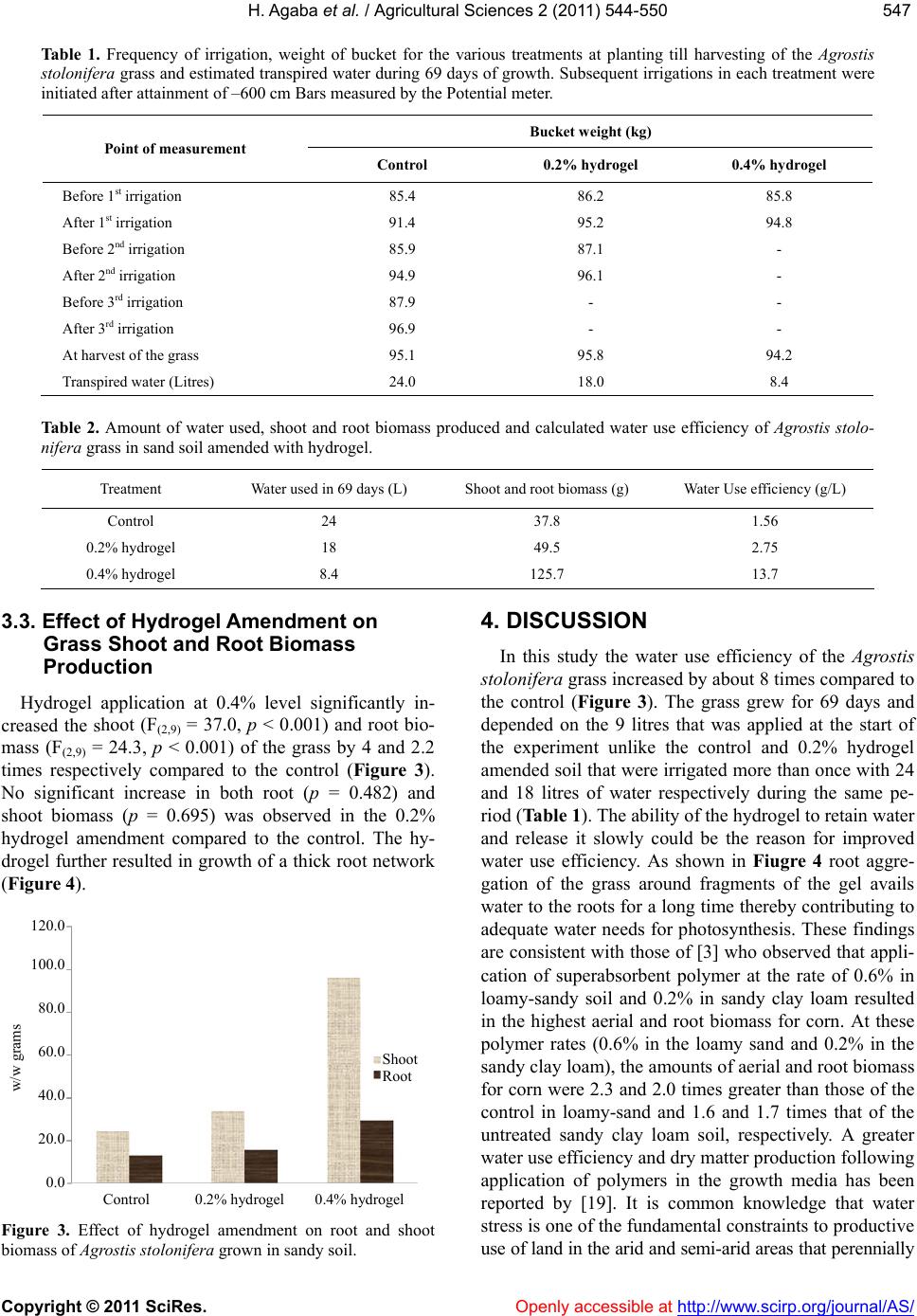 H. Agaba et al. / Agricultural Sciences 2 (2011) 544-550 Copyright © 2011 SciRes. http://www.scirp.org/journal/AS/ 547547 Table 1. Frequency of irrigation, weight of bucket for the various treatments at planting till harvesting of the Agrostis stolonifera grass and estimated transpired water during 69 days of growth. Subsequent irrigations in each treatment were initiated after attainment of –600 cm Bars measured by the Potential meter. Bucket weight (kg) Point of measurement Control 0.2% hydrogel 0.4% hydrogel Before 1st irrigation 85.4 86.2 85.8 After 1st irrigation 91.4 95.2 94.8 Before 2nd irrigation 85.9 87.1 - After 2nd irrigation 94.9 96.1 - Before 3rd irrigation 87.9 - - After 3rd irrigation 96.9 - - At harvest of the grass 95.1 95.8 94.2 Transpired water (Litres) 24.0 18.0 8.4 Ta ble 2 . Amount of water used, shoot and root biomass produced and calculated water use efficiency of Agrostis stolo- nifera grass in sand soil amended with hydrogel. Treatment Water used in 69 days (L) Shoot and root biomass (g) Water Use efficiency (g/L) Control 24 37.8 1.56 0.2% hydrogel 18 49.5 2.75 0.4% hydrogel 8.4 125.7 13.7 4. DISCUSSION 3.3. Effect of Hydrogel Amendment on Grass Shoot and Root Biomass Production In this study the water use efficiency of the Agrostis stolonifera grass increased by about 8 times compared to the control (Figure 3). The grass grew for 69 days and depended on the 9 litres that was applied at the start of the experiment unlike the control and 0.2% hydrogel amended soil that were irrigated more than once with 24 and 18 litres of water respectively during the same pe- riod (Table 1). The ability of the hydrogel to retain water and release it slowly could be the reason for improved water use efficiency. As shown in Fiugre 4 root aggre- gation of the grass around fragments of the gel avails water to the roots for a long time thereby contributing to adequate water needs for photosynthesis. These findings are consistent with those of [3] who observed that appli- cation of superabsorbent polymer at the rate of 0.6% in loamy-sandy soil and 0.2% in sandy clay loam resulted in the highest aerial and root biomass for corn. At these polymer rates (0.6% in the loamy sand and 0.2% in the sandy clay loam), the amounts of aerial and root biomass for corn were 2.3 and 2.0 times greater than those of the control in loamy-sand and 1.6 and 1.7 times that of the untreated sandy clay loam soil, respectively. A greater water use efficiency and dry matter production following application of polymers in the growth media has been reported by [19]. It is common knowledge that water stress is one of the fundamental constraints to productive use of land in the arid and semi-arid areas that perennially Hydrogel application at 0.4% level significantly in- creased the shoot (F(2,9) = 37.0, p < 0.001) and root bio- mass (F(2,9) = 24.3, p < 0.001) of the grass by 4 and 2.2 times respectively compared to the control (Figure 3). No significant increase in both root (p = 0.482) and shoot biomass (p = 0.695) was observed in the 0.2% hydrogel amendment compared to the control. The hy- drogel further resulted in growth of a thick root network (Figure 4). Shoot Root w/w g rams 120.0 100.0 80.0 60.0 40.0 20.0 0.0 Control 0.2% hydrogel 0.4% hydrogel Figure 3. Effect of hydrogel amendment on root and shoot biomass of Agrostis stolonifera grown in sandy soil. Openly accessible at 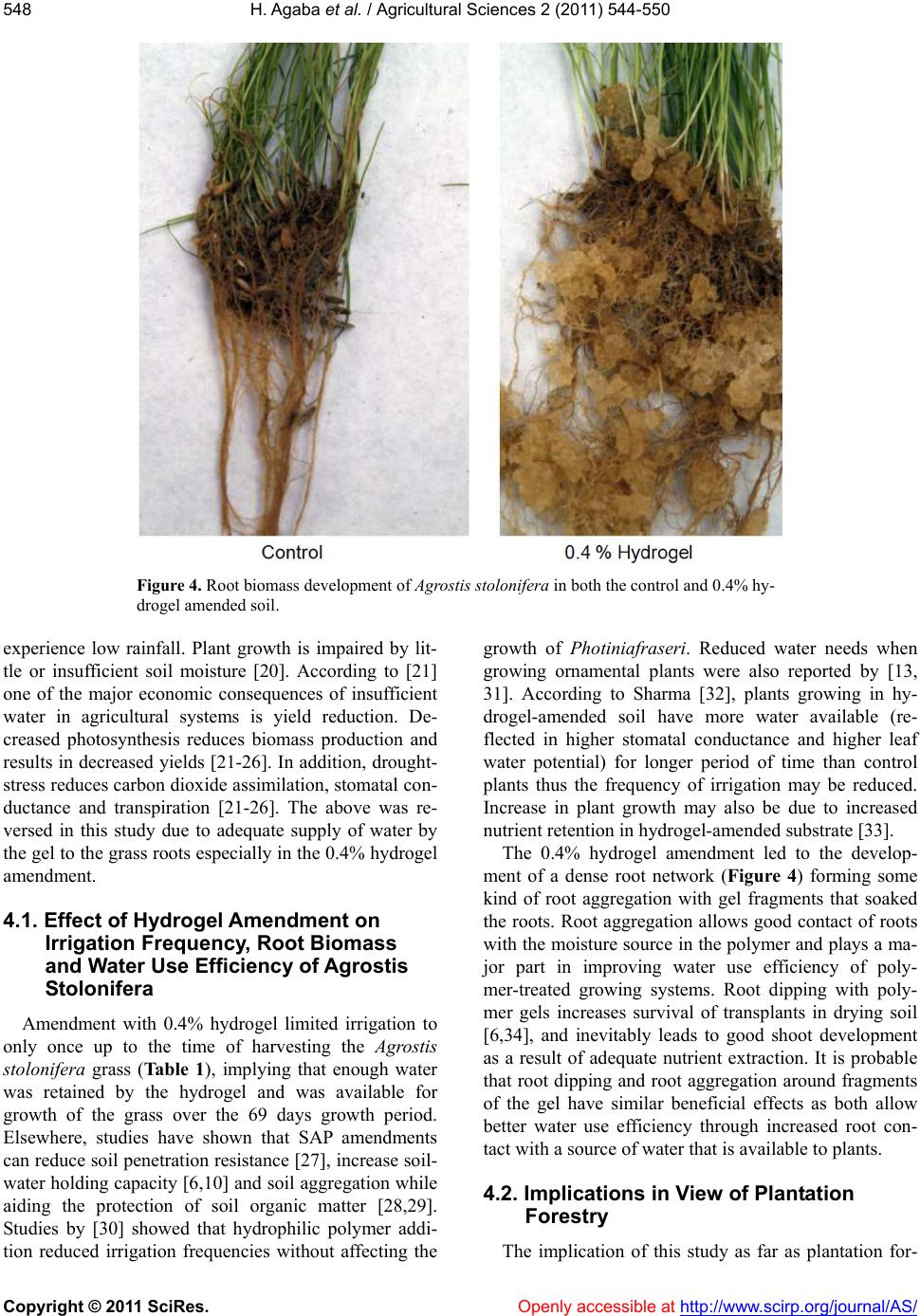 H. Agaba et al. / Agricultural Sciences 2 (2011) 544-550 Copyright © 2011 SciRes. Openly accessible at http://www.scirp.org/journal/AS/ 548 Figure 4. Root biomass development of Agrostis stolonifera in both the control and 0.4% hy- drogel amended soil. experience low rainfall. Plant growth is impaired by lit- tle or insufficient soil moisture [20]. According to [21] one of the major economic consequences of insufficient water in agricultural systems is yield reduction. De- creased photosynthesis reduces biomass production and results in decreased yields [21-26]. In addition, drought- stress reduces carbon dioxide assimilation, stomatal con- ductance and transpiration [21-26]. The above was re- versed in this study due to adequate supply of water by the gel to the grass roots especially in the 0.4% hydrogel amendment. 4.1. Effect of Hydrogel Amendment on Irrigation Frequency, Root Biomass and Water Use Efficiency of Agrostis Stolonifera Amendment with 0.4% hydrogel limited irrigation to only once up to the time of harvesting the Agrostis stolonifera grass (Ta b l e 1 ), implying that enough water was retained by the hydrogel and was available for growth of the grass over the 69 days growth period. Elsewhere, studies have shown that SAP amendments can reduce soil penetration resistance [27], increase soil- water holding capacity [6,10] and soil aggregation while aiding the protection of soil organic matter [28,29]. Studies by [30] showed that hydrophilic polymer addi- tion reduced irrigation frequencies without affecting the growth of Photiniafraseri. Reduced water needs when growing ornamental plants were also reported by [13, 31]. According to Sharma [32], plants growing in hy- drogel-amended soil have more water available (re- flected in higher stomatal conductance and higher leaf water potential) for longer period of time than control plants thus the frequency of irrigation may be reduced. Increase in plant growth may also be due to increased nutrient retention in hydrogel-amended substrate [33]. The 0.4% hydrogel amendment led to the develop- ment of a dense root network (Figure 4) forming some kind of root aggregation with gel fragments that soaked the roots. Root aggregation allows good contact of roots with the moisture source in the polymer and plays a ma- jor part in improving water use efficiency of poly- mer-treated growing systems. Root dipping with poly- mer gels increases survival of transplants in drying soil [6,34], and inevitably leads to good shoot development as a result of adequate nutrient extraction. It is probable that root dipping and root aggregation around fragments of the gel have similar beneficial effects as both allow better water use efficiency through increased root con- tact with a source of water that is available to plants. 4.2. Implications in View of Plantation Forestry The implication of this study as far as plantation for- 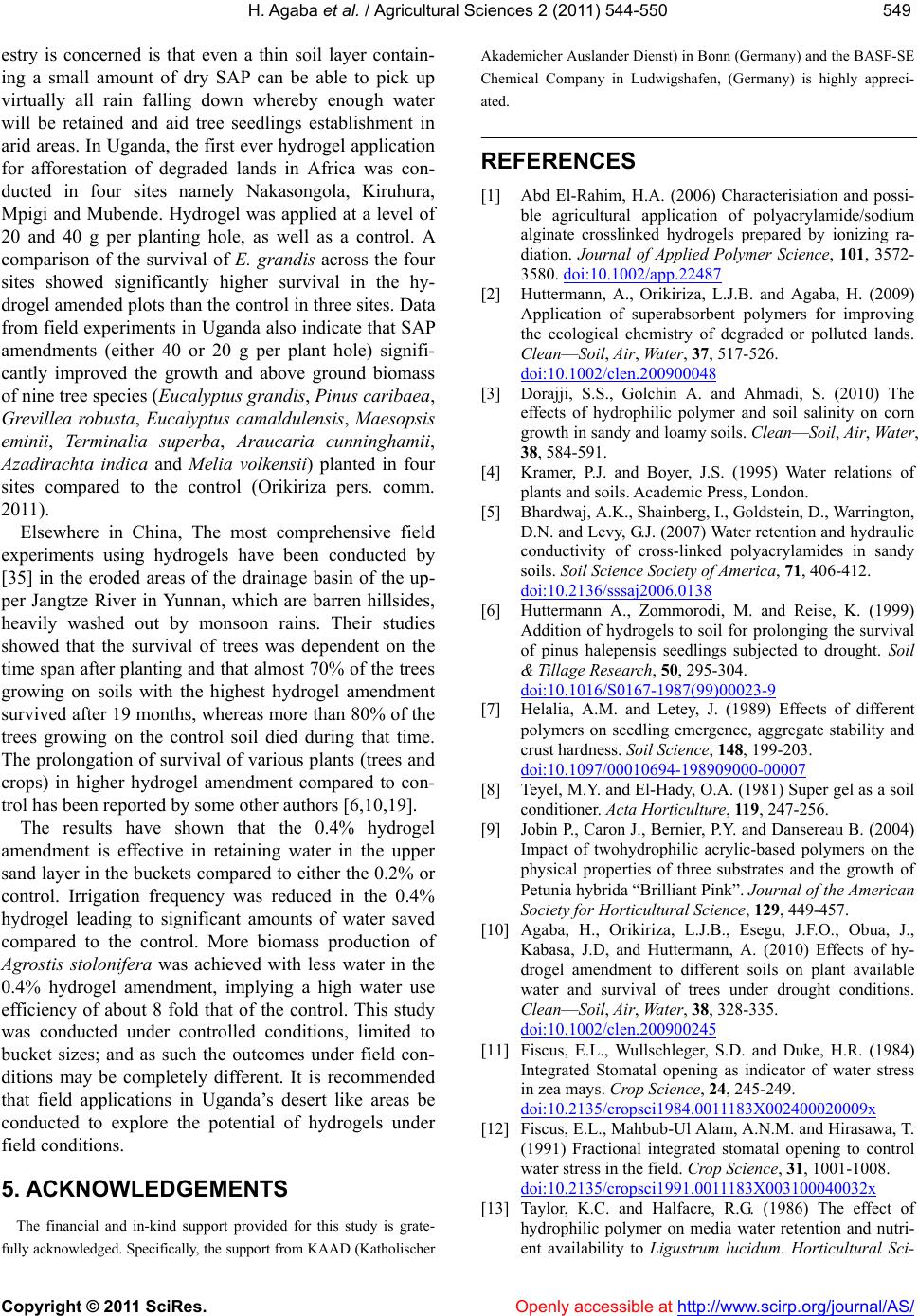 H. Agaba et al. / Agricultural Sciences 2 (2011) 544-550 Copyright © 2011 SciRes. Openly accessible at http://www.scirp.org/journal/AS/ 549549 estry is concerned is that even a thin soil layer contain- ing a small amount of dry SAP can be able to pick up virtually all rain falling down whereby enough water will be retained and aid tree seedlings establishment in arid areas. In Uganda, the first ever hydrogel application for afforestation of degraded lands in Africa was con- ducted in four sites namely Nakasongola, Kiruhura, Mpigi and Mubende. Hydrogel was applied at a level of 20 and 40 g per planting hole, as well as a control. A comparison of the survival of E. grandis across the four sites showed significantly higher survival in the hy- drogel amended plots than the control in three sites. Data from field experiments in Uganda also indicate that SAP amendments (either 40 or 20 g per plant hole) signifi- cantly improved the growth and above ground biomass of nine tree species (Eucalyptus grandis, Pinus caribaea, Grevillea robusta, Eucalyptus camaldulensis, Maesopsis eminii, Terminalia superba, Araucaria cunninghamii, Azadirachta indica and Melia volkensii) planted in four sites compared to the control (Orikiriza pers. comm. 2011). Elsewhere in China, The most comprehensive field experiments using hydrogels have been conducted by [35] in the eroded areas of the drainage basin of the up- per Jangtze River in Yunnan, which are barren hillsides, heavily washed out by monsoon rains. Their studies showed that the survival of trees was dependent on the time span after planting and that almost 70% of the trees growing on soils with the highest hydrogel amendment survived after 19 months, whereas more than 80% of the trees growing on the control soil died during that time. The prolongation of survival of various plants (trees and crops) in higher hydrogel amendment compared to con- trol has been reported by some other authors [6,10,19]. The results have shown that the 0.4% hydrogel amendment is effective in retaining water in the upper sand layer in the buckets compared to either the 0.2% or control. Irrigation frequency was reduced in the 0.4% hydrogel leading to significant amounts of water saved compared to the control. More biomass production of Agrostis stolonifera was achieved with less water in the 0.4% hydrogel amendment, implying a high water use efficiency of about 8 fold that of the control. This study was conducted under controlled conditions, limited to bucket sizes; and as such the outcomes under field con- ditions may be completely different. It is recommended that field applications in Uganda’s desert like areas be conducted to explore the potential of hydrogels under field conditions. 5. ACKNOWLEDGEMENTS The financial and in-kind support provided for this study is grate- fully acknowledged. Specifically, the support from KAAD (Katholischer Akademicher Auslander Dienst) in Bonn (Germany) and the BASF-SE Chemical Company in Ludwigshafen, (Germany) is highly appreci- ated. REFERENCES [1] Abd El-Rahim, H.A. (2006) Characterisiation and possi- ble agricultural application of polyacrylamide/sodium alginate crosslinked hydrogels prepared by ionizing ra- diation. Journal of Applied Polymer Science, 101, 3572- 3580. doi:10.1002/app.22487 [2] Huttermann, A., Orikiriza, L.J.B. and Agaba, H. (2009) Application of superabsorbent polymers for improving the ecological chemistry of degraded or polluted lands. Clean—Soil, Air, Water, 37, 517-526. doi:10.1002/clen.200900048 [3] Dorajji, S.S., Golchin A. and Ahmadi, S. (2010) The effects of hydrophilic polymer and soil salinity on corn growth in sandy and loamy soils. Clean—Soil, Air, Water, 38, 584-591. [4] Kramer, P.J. and Boyer, J.S. (1995) Water relations of plants and soils. Academic Press, London. [5] Bhardwaj, A.K., Shainberg, I., Goldstein, D., Warrington, D.N. and Levy, G.J. (2007) Water retention and hydraulic conductivity of cross-linked polyacrylamides in sandy soils. Soil Science Society of America, 71, 406-412. doi:10.2136/sssaj2006.0138 [6] Huttermann A., Zommorodi, M. and Reise, K. (1999) Addition of hydrogels to soil for prolonging the survival of pinus halepensis seedlings subjected to drought. Soil & Tillage Research, 50, 295-304. doi:10.1016/S0167-1987(99)00023-9 [7] Helalia, A.M. and Letey, J. (1989) Effects of different polymers on seedling emergence, aggregate stability and crust hardness. Soil Scienc e , 148, 199-203. doi:10.1097/00010694-198909000-00007 [8] Teyel, M.Y. and El-Hady, O.A. (1981) Super gel as a soil conditioner. Acta Horticulture, 119 , 247-256. [9] Jobin P., Caron J., Bernier, P.Y. and Dansereau B. (2004) Impact of twohydrophilic acrylic-based polymers on the physical properties of three substrates and the growth of Petunia hybrida “Brilliant Pink”. Journal of the American Society for Horticultural Science, 129, 449-457. [10] Agaba, H., Orikiriza, L.J.B., Esegu, J.F.O., Obua, J., Kabasa, J.D, and Huttermann, A. (2010) Effects of hy- drogel amendment to different soils on plant available water and survival of trees under drought conditions. Clean—Soil, Air, Water, 38, 328-335. doi:10.1002/clen.200900245 [11] Fiscus, E.L., Wullschleger, S.D. and Duke, H.R. (1984) Integrated Stomatal opening as indicator of water stress in zea mays. Crop Science, 24, 245-249. doi:10.2135/cropsci1984.0011183X002400020009x [12] Fiscus, E.L., Mahbub-Ul Alam, A.N.M. and Hirasawa, T. (1991) Fractional integrated stomatal opening to control water stress in the field. Crop Science, 31, 1001-1008. doi:10.2135/cropsci1991.0011183X003100040032x [13] Taylor, K.C. and Halfacre, R.G. (1986) The effect of hydrophilic polymer on media water retention and nutri- ent availability to Ligustrum lucidum. Horticultural Sci-  H. Agaba et al. / Agricultural Sciences 2 (2011) 544-550 Copyright © 2011 SciRes. http://www.scirp.org/journal/AS/Openly accessible at 550 ence, 21, 1159-1161. [14] Bai, W., Zhang, H., Liu, B., Wu, Y. and Song, J. (2010) Effects of super-absorbent polymers on the physical and chemical properties of soil following different wetting and drying cycles. Soil Use and Management, 26, 253- 260. doi:10.1111/j.1475-2743.2010.00271.x [15] Wallace, J.S. (1991) The measurement and modelling of evaporation from semiarid land. In: Sivakumar, M.V.K., Wallace, J.S., Renard, C. and Giroux, C., Eds., Soil Water Balance in the Sudano-Sahelian Zone. Proceedings of Niamey Workshop, IAHS Publication No. 199, 131-148 [16] Wallace, J.S. (1996) The water balance of mixed tree- crop systems. In: Ong, C.K. and Huxley, P., Eds., Tree- Crop Interactions: A Physiological Approach, CAB In- ternational, Wallingford. [17] Huttermann, A., Reise, K., Zommorodi, M. and Wang, S. (1997) The use of hydogels for afforestation of difficult stands: Water and salt stress, in semi-arid regions. In: H. Zhou and H. Weisgerber, Eds., Afforestation in Semi-Arid Regions, Datong. [18] Graciano, C., Guiamet, J.J. and Goya, J.F. (2005) Impact of nitrogen and phosphorus fertilization on drought re- sponses in Eucalyptus grandis seedlings. Forest Ecology and Management, 212, 40-49. doi:10.1016/j.foreco.2005.02.057 [19] Woodhouse, J. and Johnson, M.S. (1991) Effect of su- perabsorbent polymers on survival and growth of crop seedlings. Agricul tural Wa ter Management , 20, 63-70. doi:10.1016/0378-3774(91)90035-H [20] Ciais, P.H., Reichstein, M., Viovy, N., Granier, A., Allard, V. , et al. (2005) Europe-wide reduction in primary pro- ductivity caused by the heat and drought in 2003. Nature, 437, 529-533. doi:10.1038/nature03972 [21] Gomez-Cadenas, A., Tadeo, F.R., Talon, M. and Primo- Millo, E. (1996) Leaf abscission induced by ethylene in water stressed intact seedling of Citrus reshni Hort exTan requires previous abscisic acid accumulation in roots. Plant Physiology, 112, 401-408. [22] Sinclair, T.R. and Allen, L.H.Jr. (1982) Carbon dioxide and water vapour exchange of leaves on field-grown cit- rus trees. Journal of Experimental Botany, 33, 1166- 1175. doi:10.1093/jxb/33.6.1166 [23] Syvertsen, J.P., Lloyd, J. and Kriedemann, P.E. (1988) Salinity and drought stress effects on ion concentration, water relations and photosynthetic characteristics of or- chard citrus. Australian Journal of Agricultural Research, 39, 619-627. doi:10.1071/AR9880619 [24] Arbona, V., Iglesias, D.J., Jacas, J., Primo-Millo, E. and Talon, M. (2005) Hydrogel substrate amendment allevi- ates drought effects on young citrus plants. Plant Soil, 270, 73-82. doi:10.1007/s11104-004-1160-0 [25] Perez-Perez, J.G., Syvertsen, J.P., Botia, P. and Gar- cia-Sanchez, F. (2007) Leaf water relations and net gas exchange responses of salinized Carrizo citrange seed- lings during drought stress and recovery. Annals of Bot- any, 100, 335-345. doi:10.1093/aob/mcm113 [26] Garcia-Sanchez, F., Syvertsen, J.P., Gimeno, V., Botia, P. and Perez-Perez, J.G. (2007) Responses to flooding and drought stress by two citrus rootstocks seedlings with different water-use efficiency. Physiology and Plantarum, 130, 532-542. doi:10.1111/j.1399-3054.2007.00925.x [27] Busscher, W.J., Bjorneberg, D.L. and Sojka, R.E. (2009) Field application of PAM as an amendment in deep-tilled US southeastern coastal plain soils. Soil & Tillage Re- search, 104, 215-220. doi:10.1016/j.still.2009.02.009 [28] Goebel, M.O., Bachmann, J., Woche, S.K. and Fischer, W.R. (2005) Soil wettability, aggregate stability, and the decomposition of soil organic matter. Geoderma, 128, 80-93. doi:10.1016/j.geoderma.2004.12.016 [29] John, B., Yamashita, T., Ludwig, B. and Flessa, H. (2005) Storage of organic carbon in aggregate and density frac- tions of silty soils under different types of land use. Ge- oderma, 128, 63-79. doi:10.1016/j.geoderma.2004.12.013 [30] Dehgan, B., Yeager T.H. and Almira, F.C. (1994) Podo- carpus growth response to a hydrophilic polymer-am- ended medium. Horticultural Science, 29, 641-644. [31] Flannery, R.L. and Busscher, W.J. (1982) Use of a syn- thetic polymer in potting soil to improve water holding capacity. Soil Science and Plant Analysis, 13, 103-111. doi:10.1080/00103628209367249 [32] Sharma, J. (2004) Establishment of perennials in hydro- philic polymer amended soil. SNA Research Conference, 42, 30-532. [33] Orikiriza, J.L.B., Agaba, H., Tweheyo, M., Eilu G., Ka- basa, J.D. and Hutterman, A. (2009) Amending soils with hydrogels increases the biomass of nine tree species un- der non-water stress conditions. Clean—Soil, Air, Wate r, 37, 615-620. doi:10.1002/clen.200900128 [34] Hamilton, J.L. and Lowe, R.H. (1982) Use of a water absorbent polymer in tobacco seedling production and transplanting. Tobacco Science, 26, 17-20. [35] Ma, H.C., and Nelles-Schwelm, E. (2004) Application of hydrogels for vegetation recovery in dry—Hot Valley of Yangtze. Yunnan Academy of Sciences, Yunnan. |