

Paper Menu >>
Journal Menu >>
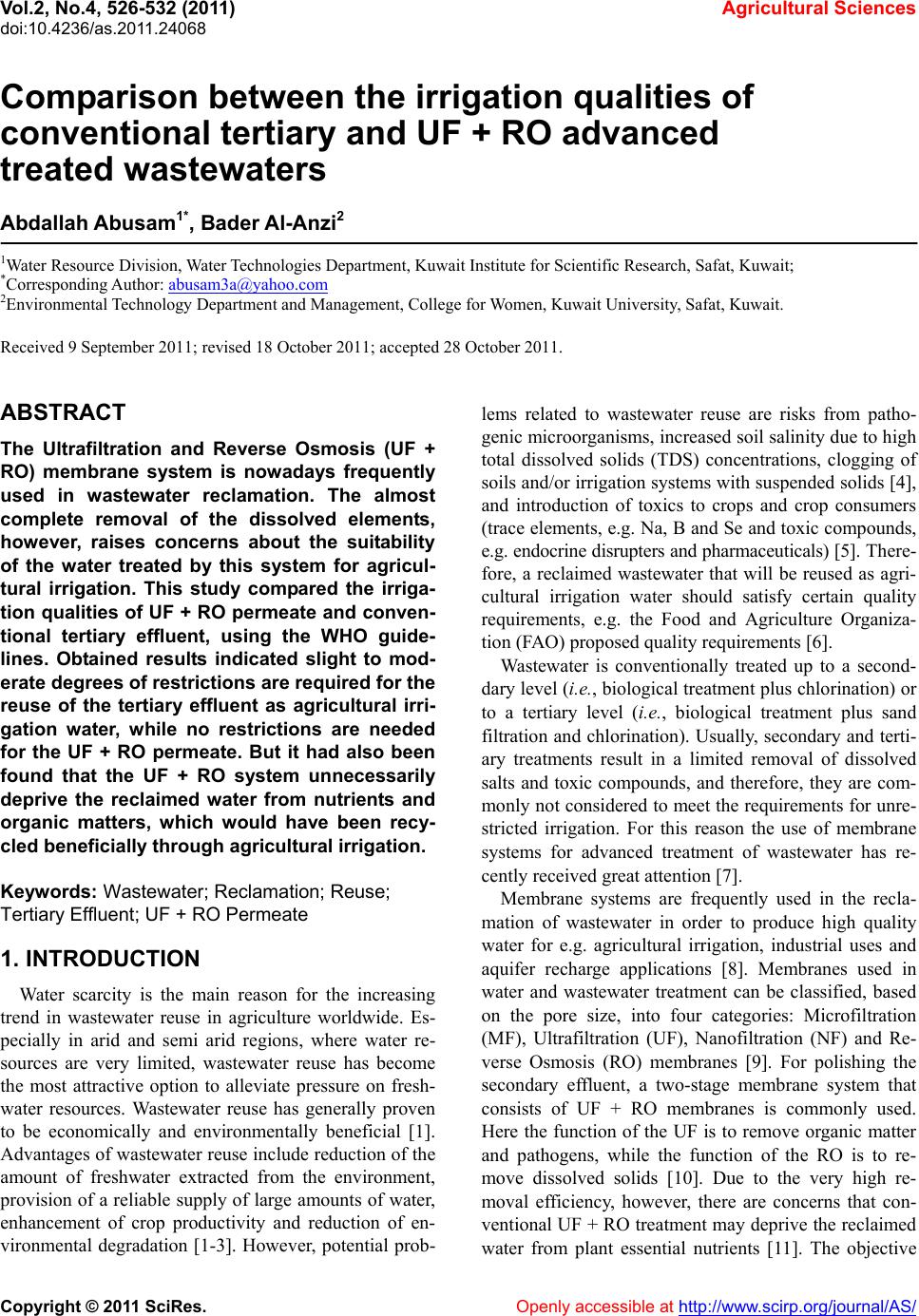 Vol.2, No.4, 526-532 (2011) doi:10.4236/as.2011.24068 C opyright © 2011 SciRes. Openly accessible at http://www.scirp.org/journal/AS/ Agricultural Scienc es Comparison between the irrigation qualities of conventional tertiary and UF + RO advanced treated wastewaters Abdallah Abusam1*, Bader Al-Anzi2 1Water Resource Division, Water Technologies Department, Kuwait Institute for Scientific Research, Safat, Kuwait; *Corresponding Author: [email protected] 2Environmental Technology Department and Management, College for Women, Kuwait University, Safat, Kuwait. Received 9 September 2011; revised 18 October 2011; accepted 28 October 2011. ABSTRACT The Ultrafiltration and Reverse Osmosis (UF + RO) membrane system is nowadays frequently used in wastewater reclamation. The almost complete removal of the dissolved elements, however, raises concerns about the suitability of the water treated by this system for agricul- tural irrigation. This study compared the irriga- tion qualities of UF + RO permeate and conven- tional tertiary effluent, using the WHO guide- lines. Obtained results indicated slight to mod- erate degrees of restrictions are required for the reuse of the tertiary effluent as agricultural irri- gation water, while no restrictions are needed for the UF + RO permeate. But it had also been found that the UF + RO system unnecessarily deprive the reclaimed water from nutrients and organic matters, which would have been recy- cled benefic ially through agricultural irrigation. Keywords: Wastewater; Reclamation; Reuse; Tertiary Effluent; UF + RO Permeate 1. INTRODUCTION Water scarcity is the main reason for the increasing trend in wastewater reuse in agriculture worldwide. Es- pecially in arid and semi arid regions, where water re- sources are very limited, wastewater reuse has become the most attractive option to alleviate pressure on fresh- water resources. Wastewater reuse has generally proven to be economically and environmentally beneficial [1]. Advantages of wastewater reuse include reduction of the amount of freshwater extracted from the environment, provision of a reliable supply of large amounts of water, enhancement of crop productivity and reduction of en- vironmental degradation [1-3]. However, potential prob- lems related to wastewater reuse are risks from patho- genic microorganisms, increased soil salinity due to high total dissolved solids (TDS) concentrations, clogging of soils and/or irrigation systems with suspended solids [4], and introduction of toxics to crops and crop consumers (trace elements, e.g. Na, B and Se and toxic compounds, e.g. endocrine disrupters and pharmaceuticals) [5]. There- fore, a reclaimed wastewater that will be reused as agri- cultural irrigation water should satisfy certain quality requirements, e.g. the Food and Agriculture Organiza- tion (FAO) proposed quality requirements [6]. Wastewater is conventionally treated up to a second- dary level (i.e., biological treatment plus chlorination) or to a tertiary level (i.e., biological treatment plus sand filtration and chlorination). Usually, secondary and terti- ary treatments result in a limited removal of dissolved salts and toxic compounds, and therefore, they are com- monly not considered to meet the requirements for unre- stricted irrigation. For this reason the use of membrane systems for advanced treatment of wastewater has re- cently received great attention [7]. Membrane systems are frequently used in the recla- mation of wastewater in order to produce high quality water for e.g. agricultural irrigation, industrial uses and aquifer recharge applications [8]. Membranes used in water and wastewater treatment can be classified, based on the pore size, into four categories: Microfiltration (MF), Ultrafiltration (UF), Nanofiltration (NF) and Re- verse Osmosis (RO) membranes [9]. For polishing the secondary effluent, a two-stage membrane system that consists of UF + RO membranes is commonly used. Here the function of the UF is to remove organic matter and pathogens, while the function of the RO is to re- move dissolved solids [10]. Due to the very high re- moval efficiency, however, there are concerns that con- ventional UF + RO treatment may deprive the reclaimed water from plant essential nutrients [11]. The objective 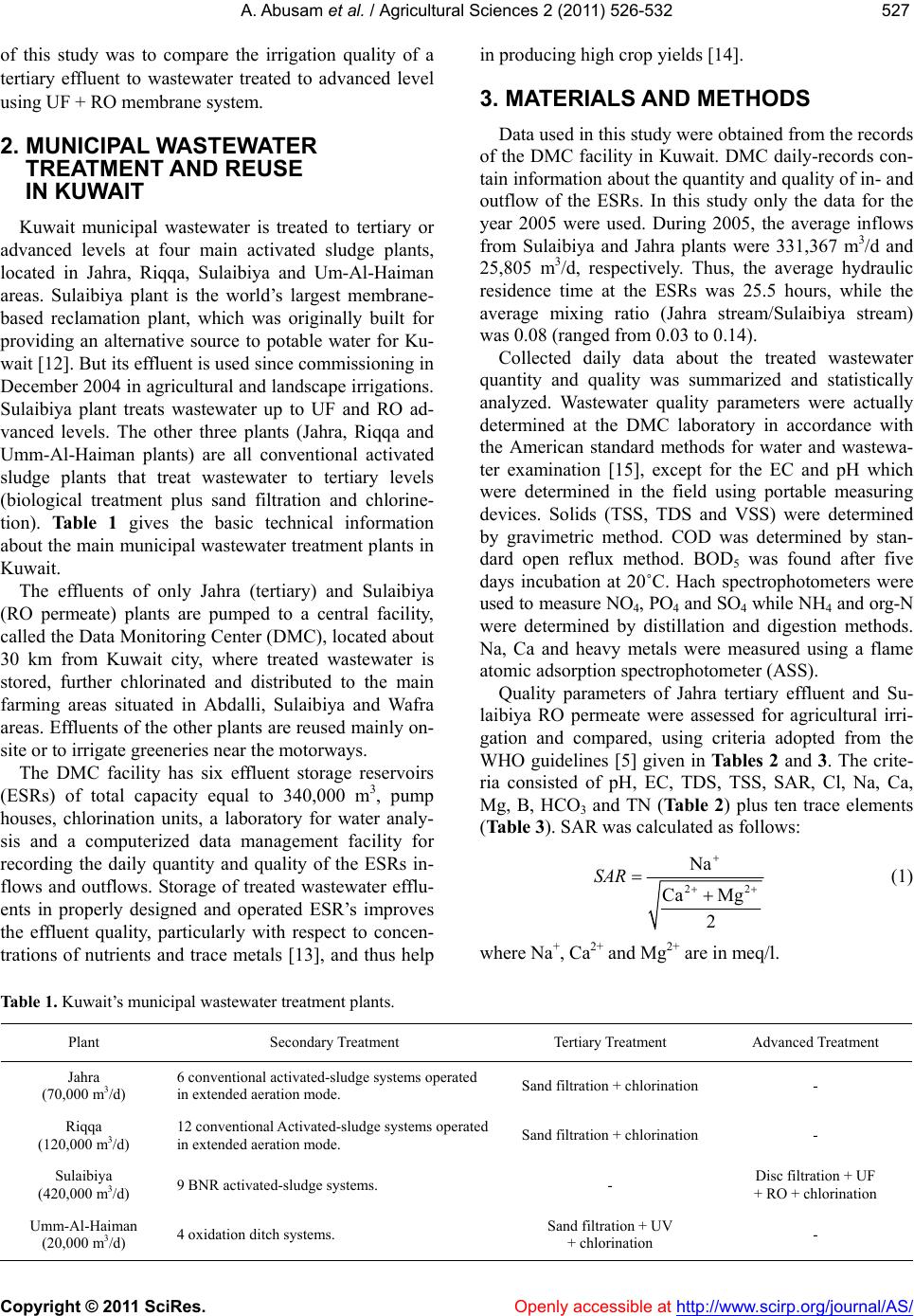 A. Abusam et al. / Agricultural Sciences 2 (2011) 526-532 Copyright © 2011 SciRes. Openly accessible at http://www.scirp.org/journal/AS/ 527527 of this study was to compare the irrigation quality of a tertiary effluent to wastewater treated to advanced level using UF + RO membrane system. 2. MUNICIPAL WASTEWATER TREATMENT AND REUSE IN KUWAIT Kuwait municipal wastewater is treated to tertiary or advanced levels at four main activated sludge plants, located in Jahra, Riqqa, Sulaibiya and Um-Al-Haiman areas. Sulaibiya plant is the world’s largest membrane- based reclamation plant, which was originally built for providing an alternative source to potable water for Ku- wait [12]. But its effluent is used since commissioning in December 2004 in agricultural and landscape irrigations. Sulaibiya plant treats wastewater up to UF and RO ad- vanced levels. The other three plants (Jahra, Riqqa and Umm-Al-Haiman plants) are all conventional activated sludge plants that treat wastewater to tertiary levels (biological treatment plus sand filtration and chlorine- tion). Table 1 gives the basic technical information about the main municipal wastewater treatment plants in Kuwait. The effluents of only Jahra (tertiary) and Sulaibiya (RO permeate) plants are pumped to a central facility, called the Data Monitoring Center (DMC), located about 30 km from Kuwait city, where treated wastewater is stored, further chlorinated and distributed to the main farming areas situated in Abdalli, Sulaibiya and Wafra areas. Effluents of the other plants are reused mainly on- site or to irrigate greeneries near the motorways. The DMC facility has six effluent storage reservoirs (ESRs) of total capacity equal to 340,000 m3, pump houses, chlorination units, a laboratory for water analy- sis and a computerized data management facility for recording the daily quantity and quality of the ESRs in- flows and outflows. Storage of treated wastewater efflu- ents in properly designed and operated ESR’s improves the effluent quality, particularly with respect to concen- trations of nutrients and trace metals [13], and thus help in producing high crop yields [14]. 3. MATERIALS AND METHODS Data used in this study were obtained from the records of the DMC facility in Kuwait. DMC daily-records con- tain information about the quantity and quality of in- and outflow of the ESRs. In this study only the data for the year 2005 were used. During 2005, the average inflows from Sulaibiya and Jahra plants were 331,367 m3/d and 25,805 m3/d, respectively. Thus, the average hydraulic residence time at the ESRs was 25.5 hours, while the average mixing ratio (Jahra stream/Sulaibiya stream) was 0.08 (ranged from 0.03 to 0.14). Collected daily data about the treated wastewater quantity and quality was summarized and statistically analyzed. Wastewater quality parameters were actually determined at the DMC laboratory in accordance with the American standard methods for water and wastewa- ter examination [15], except for the EC and pH which were determined in the field using portable measuring devices. Solids (TSS, TDS and VSS) were determined by gravimetric method. COD was determined by stan- dard open reflux method. BOD5 was found after five days incubation at 20˚C. Hach spectrophotometers were used to measure NO4, PO4 and SO4 while NH4 and org-N were determined by distillation and digestion methods. Na, Ca and heavy metals were measured using a flame atomic adsorption spectrophotometer (ASS). Quality parameters of Jahra tertiary effluent and Su- laibiya RO permeate were assessed for agricultural irri- gation and compared, using criteria adopted from the WHO guidelines [5] given in Ta ble s 2 and 3. The crite- ria consisted of pH, EC, TDS, TSS, SAR, Cl, Na, Ca, Mg, B, HCO3 and TN (Tab le 2 ) plus ten trace elements (Table 3). SAR was calculated as follows: 2 Na Ca Mg 2 SAR 2 (1) where Na+, Ca2+ and Mg2+ are in meq/l. Table 1. Kuwait’s municipal wastewater treatment plants. Plant Secondary Treatment Tertiary Treatment Advanced Treatment Jahra (70,000 m3/d) 6 conventional activated-sludge systems operated in extended aeration mode. Sand filtration + chlorination - Riqqa (120,000 m3/d) 12 conventional Activated-sludge systems operated in extended aeration mode. Sand filtration + chlorination - Sulaibiya (420,000 m3/d) 9 BNR activated-sludge systems. - Disc filtration + UF + RO + chlorination Umm-Al-Haiman (20,000 m3/d) 4 oxidation ditch systems. Sand filtration + UV + chlorination - 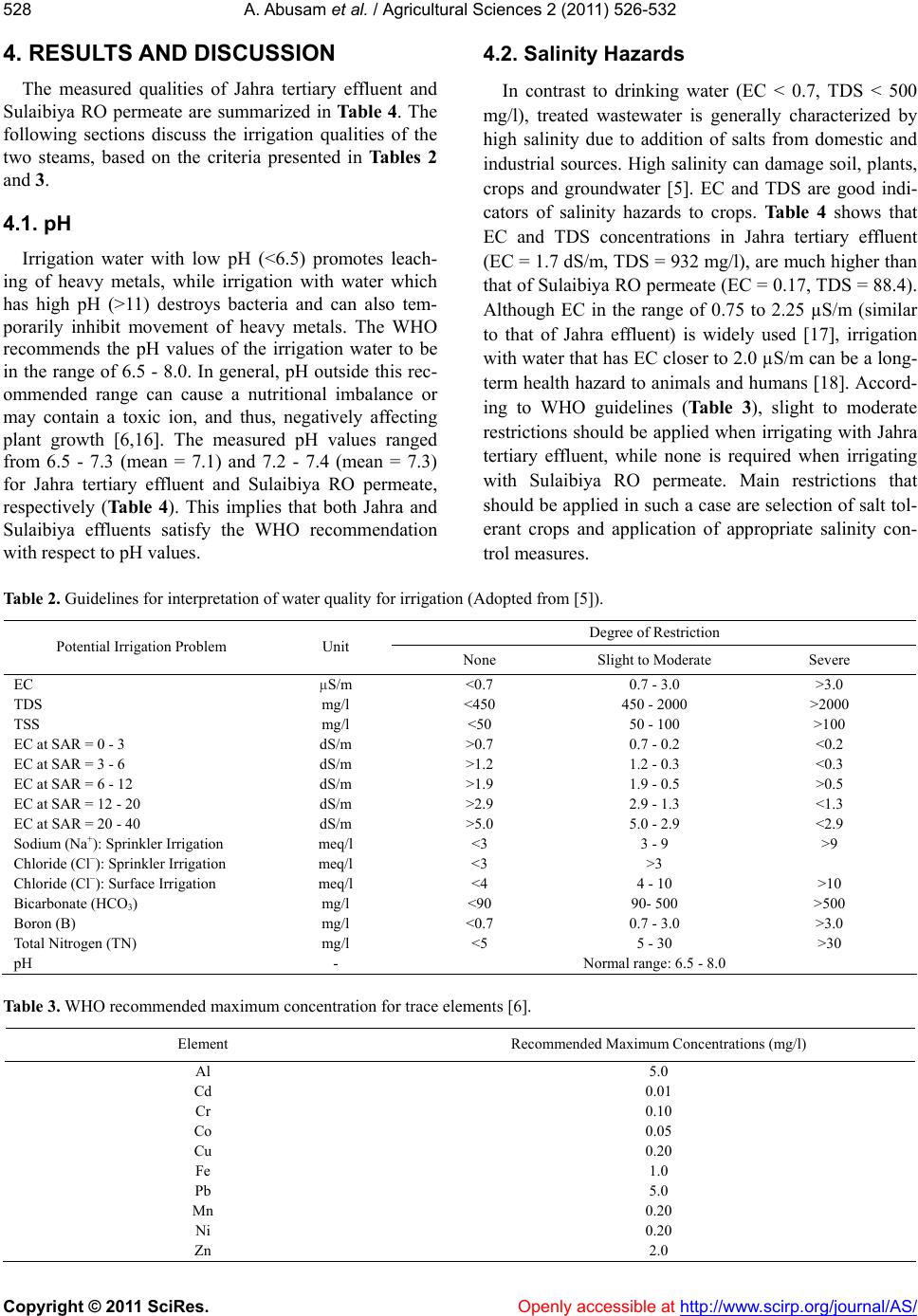 A. Abusam et al. / Agricultural Sciences 2 (2011) 526-532 Copyright © 2011 SciRes. Openly accessible at http://www.scirp.org/journal/AS/ 528 4. RESULTS AND DIS CUSSION The measured qualities of Jahra tertiary effluent and Sulaibiya RO permeate are summarized in Tab le 4. The following sections discuss the irrigation qualities of the two steams, based on the criteria presented in Ta bles 2 and 3. 4.1. pH Irrigation water with low pH (<6.5) promotes leach- ing of heavy metals, while irrigation with water which has high pH (>11) destroys bacteria and can also tem- porarily inhibit movement of heavy metals. The WHO recommends the pH values of the irrigation water to be in the range of 6.5 - 8.0. In general, pH outside this rec- ommended range can cause a nutritional imbalance or may contain a toxic ion, and thus, negatively affecting plant growth [6,16]. The measured pH values ranged from 6.5 - 7.3 (mean = 7.1) and 7.2 - 7.4 (mean = 7.3) for Jahra tertiary effluent and Sulaibiya RO permeate, respectively (Ta b l e 4 ). This implies that both Jahra and Sulaibiya effluents satisfy the WHO recommendation with respect to pH values. 4.2. Salinity Hazards In contrast to drinking water (EC < 0.7, TDS < 500 mg/l), treated wastewater is generally characterized by high salinity due to addition of salts from domestic and industrial sources. High salinity can damage soil, plants, crops and groundwater [5]. EC and TDS are good indi- cators of salinity hazards to crops. Table 4 shows that EC and TDS concentrations in Jahra tertiary effluent (EC = 1.7 dS/m, TDS = 932 mg/l), are much higher than that of Sulaibiya RO permeate (EC = 0.17, TDS = 88.4). Although EC in the range of 0.75 to 2.25 µS/m (similar to that of Jahra effluent) is widely used [17], irrigation with water that has EC closer to 2.0 µS/m can be a long- term health hazard to animals and humans [18]. Accord- ing to WHO guidelines (Table 3), slight to moderate restrictions should be applied when irrigating with Jahra tertiary effluent, while none is required when irrigating with Sulaibiya RO permeate. Main restrictions that should be applied in such a case are selection of salt tol- erant crops and application of appropriate salinity con- trol measures. Table 2. Guidelines for interpretation of water quality for irrigation (Adopted from [5]). Degree of Restriction Potential Irrigation Problem Unit None Slight to Moderate Severe EC µS/m <0.7 0.7 - 3.0 >3.0 TDS mg/l <450 450 - 2000 >2000 TSS mg/l <50 50 - 100 >100 EC at SAR = 0 - 3 dS/m >0.7 0.7 - 0.2 <0.2 EC at SAR = 3 - 6 dS/m >1.2 1.2 - 0.3 <0.3 EC at SAR = 6 - 12 dS/m >1.9 1.9 - 0.5 >0.5 EC at SAR = 12 - 20 dS/m >2.9 2.9 - 1.3 <1.3 EC at SAR = 20 - 40 dS/m >5.0 5.0 - 2.9 <2.9 Sodium (Na+): Sprinkler Irrigation meq/l <3 3 - 9 >9 Chloride (Cl−): Sprinkler Irrigation meq/l <3 >3 Chloride (Cl−): Surface Irrigation meq/l <4 4 - 10 >10 Bicarbonate (HCO3) mg/l <90 90- 500 >500 Boron (B) mg/l <0.7 0.7 - 3.0 >3.0 Total Nitrogen (TN) mg/l <5 5 - 30 >30 pH - Normal range: 6.5 - 8.0 Table 3. WHO recommended maximum concentration for trace elements [6]. Element Recommended Maximum Concentrations (mg/l) Al 5.0 Cd 0.01 Cr 0.10 Co 0.05 Cu 0.20 Fe 1.0 Pb 5.0 Mn 0.20 Ni 0.20 Zn 2.0 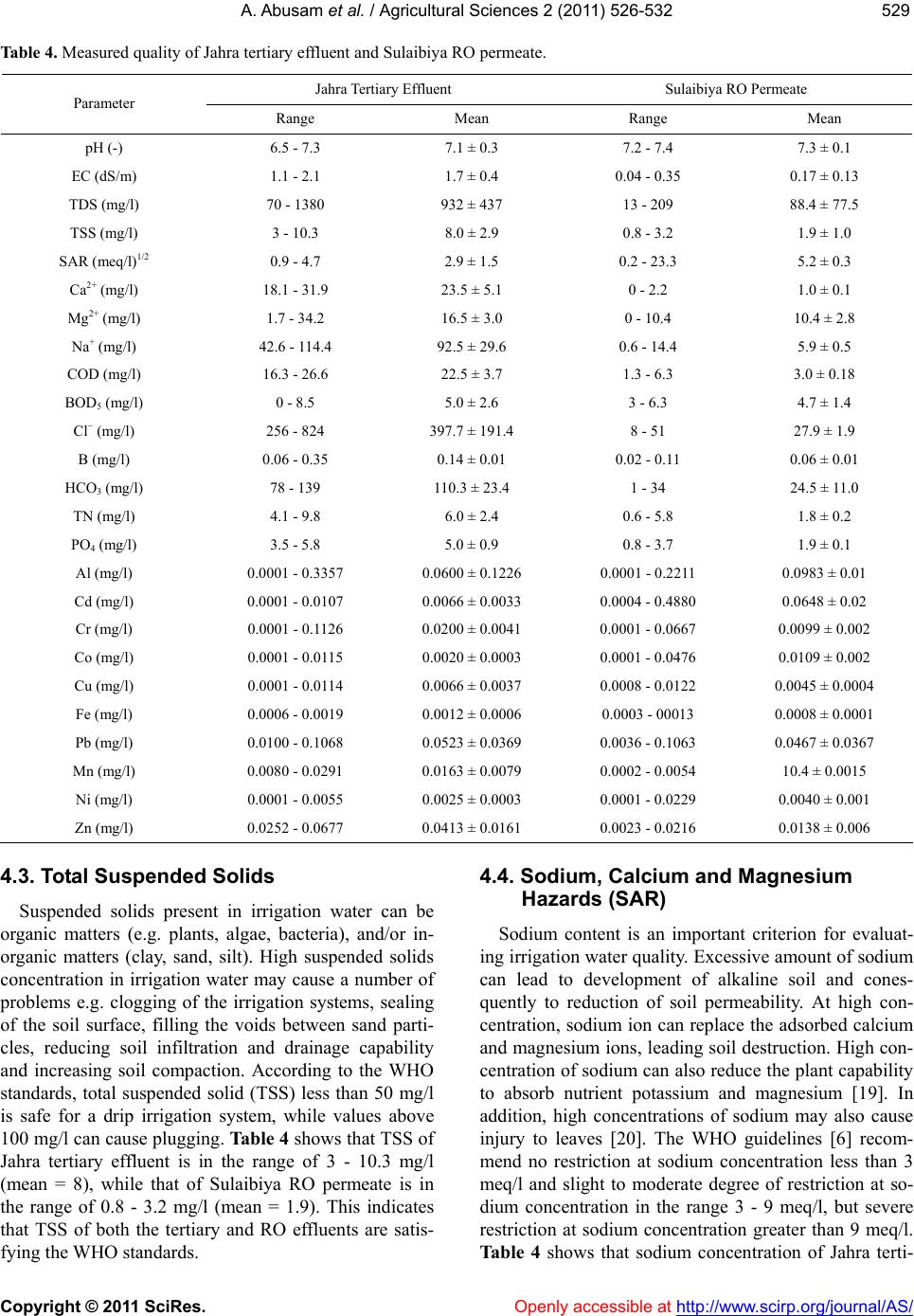 A. Abusam et al. / Agricultural Sciences 2 (2011) 526-532 Copyright © 2011 SciRes. Openly accessible at http://www.scirp.org/journal/AS/ 529529 Table 4. Measured quality of Jahra tertiary effluent and Sulaibiya RO permeate. Jahra Tertiary Effluent Sulaibiya RO Permeate Parameter Range Mean Range Mean pH (-) 6.5 - 7.3 7.1 ± 0.3 7.2 - 7.4 7.3 ± 0.1 EC (dS/m) 1.1 - 2.1 1.7 ± 0.4 0.04 - 0.35 0.17 ± 0.13 TDS (mg/l) 70 - 1380 932 ± 437 13 - 209 88.4 ± 77.5 TSS (mg/l) 3 - 10.3 8.0 ± 2.9 0.8 - 3.2 1.9 ± 1.0 SAR (meq/l)1/2 0.9 - 4.7 2.9 ± 1.5 0.2 - 23.3 5.2 ± 0.3 Ca2+ (mg/l) 18.1 - 31.9 23.5 ± 5.1 0 - 2.2 1.0 ± 0.1 Mg2+ (mg/l) 1.7 - 34.2 16.5 ± 3.0 0 - 10.4 10.4 ± 2.8 Na+ (mg/l) 42.6 - 114.4 92.5 ± 29.6 0.6 - 14.4 5.9 ± 0.5 COD (mg/l) 16.3 - 26.6 22.5 ± 3.7 1.3 - 6.3 3.0 ± 0.18 BOD5 (mg/l) 0 - 8.5 5.0 ± 2.6 3 - 6.3 4.7 ± 1.4 Cl− (mg/l) 256 - 824 397.7 ± 191.4 8 - 51 27.9 ± 1.9 B (mg/l) 0.06 - 0.35 0.14 ± 0.01 0.02 - 0.11 0.06 ± 0.01 HCO3 (mg/l) 78 - 139 110.3 ± 23.4 1 - 34 24.5 ± 11.0 TN (mg/l) 4.1 - 9.8 6.0 ± 2.4 0.6 - 5.8 1.8 ± 0.2 PO4 (mg/l) 3.5 - 5.8 5.0 ± 0.9 0.8 - 3.7 1.9 ± 0.1 Al (mg/l) 0.0001 - 0.3357 0.0600 ± 0.1226 0.0001 - 0.2211 0.0983 ± 0.01 Cd (mg/l) 0.0001 - 0.0107 0.0066 ± 0.0033 0.0004 - 0.4880 0.0648 ± 0.02 Cr (mg/l) 0.0001 - 0.1126 0.0200 ± 0.0041 0.0001 - 0.0667 0.0099 ± 0.002 Co (mg/l) 0.0001 - 0.0115 0.0020 ± 0.0003 0.0001 - 0.0476 0.0109 ± 0.002 Cu (mg/l) 0.0001 - 0.0114 0.0066 ± 0.0037 0.0008 - 0.0122 0.0045 ± 0.0004 Fe (mg/l) 0.0006 - 0.0019 0.0012 ± 0.0006 0.0003 - 00013 0.0008 ± 0.0001 Pb (mg/l) 0.0100 - 0.1068 0.0523 ± 0.0369 0.0036 - 0.1063 0.0467 ± 0.0367 Mn (mg/l) 0.0080 - 0.0291 0.0163 ± 0.0079 0.0002 - 0.0054 10.4 ± 0.0015 Ni (mg/l) 0.0001 - 0.0055 0.0025 ± 0.0003 0.0001 - 0.0229 0.0040 ± 0.001 Zn (mg/l) 0.0252 - 0.0677 0.0413 ± 0.0161 0.0023 - 0.0216 0.0138 ± 0.006 4.3. Total Suspended Solids Suspended solids present in irrigation water can be organic matters (e.g. plants, algae, bacteria), and/or in- organic matters (clay, sand, silt). High suspended solids concentration in irrigation water may cause a number of problems e.g. clogging of the irrigation systems, sealing of the soil surface, filling the voids between sand parti- cles, reducing soil infiltration and drainage capability and increasing soil compaction. According to the WHO standards, total suspended solid (TSS) less than 50 mg/l is safe for a drip irrigation system, while values above 100 mg/l can cause plugging. Table 4 shows that TSS of Jahra tertiary effluent is in the range of 3 - 10.3 mg/l (mean = 8), while that of Sulaibiya RO permeate is in the range of 0.8 - 3.2 mg/l (mean = 1.9). This indicates that TSS of both the tertiary and RO effluents are satis- fying the WHO standards. 4.4. Sodium, Calcium and Magnesium Hazards (SAR) Sodium content is an important criterion for evaluat- ing irrigation water quality. Excessive amount of sodium can lead to development of alkaline soil and cones- quently to reduction of soil permeability. At high con- centration, sodium ion can replace the adsorbed calcium and magnesium ions, leading soil destruction. High con- centration of sodium can also reduce the plant capability to absorb nutrient potassium and magnesium [19]. In addition, high concentrations of sodium may also cause injury to leaves [20]. The WHO guidelines [6] recom- mend no restriction at sodium concentration less than 3 meq/l and slight to moderate degree of restriction at so- dium concentration in the range 3 - 9 meq/l, but severe restriction at sodium concentration greater than 9 meq/l. Ta b l e 4 shows that sodium concentration of Jahra terti- 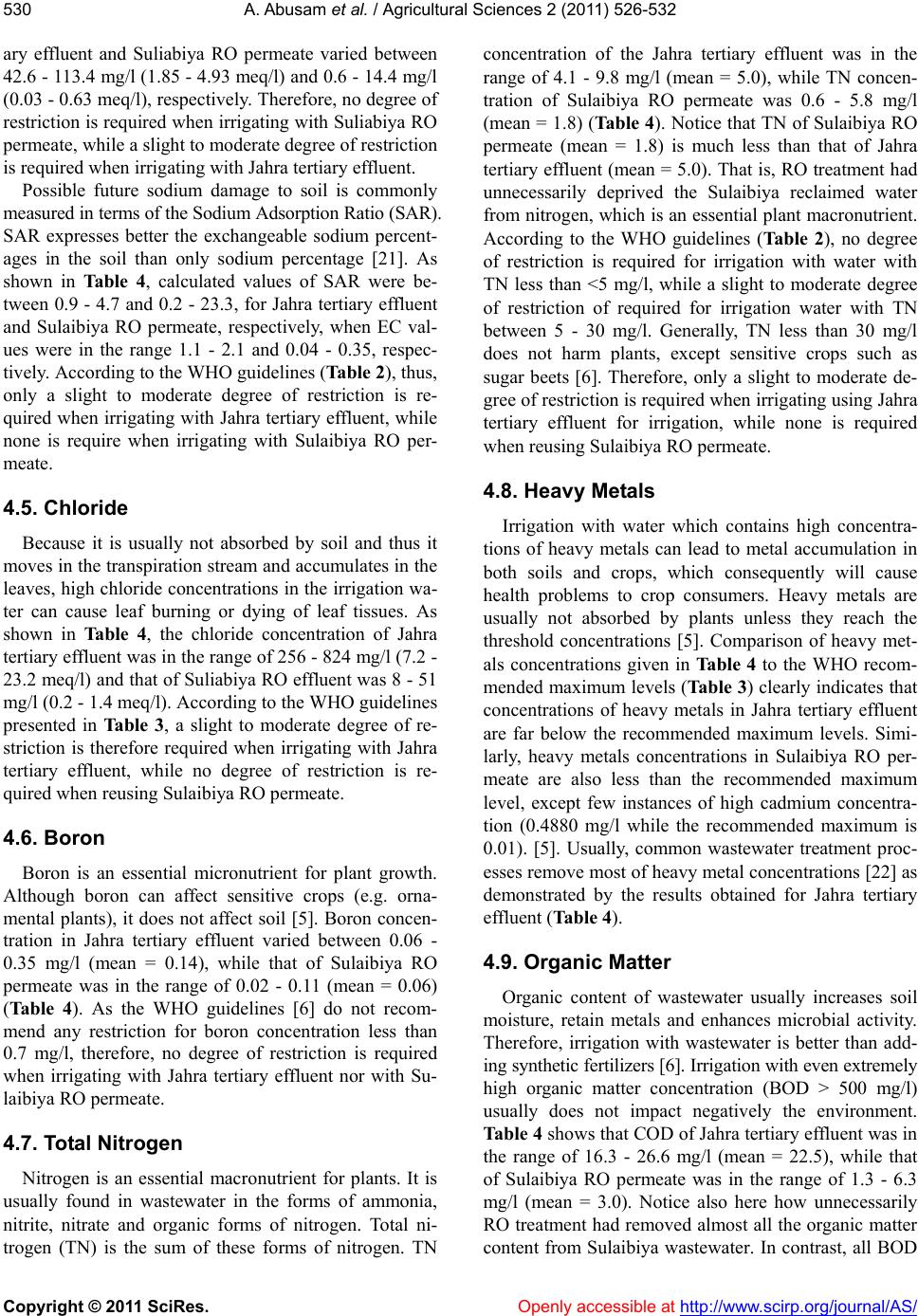 A. Abusam et al. / Agricultural Sciences 2 (2011) 526-532 Copyright © 2011 SciRes. Openly accessible at http://www.scirp.org/journal/AS/ 530 ary effluent and Suliabiya RO permeate varied between 42.6 - 113.4 mg/l (1.85 - 4.93 meq/l) and 0.6 - 14.4 mg/l (0.03 - 0.63 meq/l), respectively. Therefore, no degree of restriction is required when irrigating with Suliabiya RO permeate, while a slight to moderate degree of restriction is required when irrigating with Jahra tertiary effluent. Possible future sodium damage to soil is commonly measured in terms of the Sodium Adsorption Ratio (SAR). SAR expresses better the exchangeable sodium percent- ages in the soil than only sodium percentage [21]. As shown in Table 4, calculated values of SAR were be- tween 0.9 - 4.7 and 0.2 - 23.3, for Jahra tertiary effluent and Sulaibiya RO permeate, respectively, when EC val- ues were in the range 1.1 - 2.1 and 0.04 - 0.35, respec- tively. According to the WHO guidelines (Table 2), thus, only a slight to moderate degree of restriction is re- quired when irrigating with Jahra tertiary effluent, while none is require when irrigating with Sulaibiya RO per- meate. 4.5. Chloride Because it is usually not absorbed by soil and thus it moves in the transpiration stream and accumulates in the leaves, high chloride concentrations in the irrigation wa- ter can cause leaf burning or dying of leaf tissues. As shown in Table 4, the chloride concentration of Jahra tertiary effluent was in the range of 256 - 824 mg/l (7.2 - 23.2 meq/l) and that of Suliabiya RO effluent was 8 - 51 mg/l (0.2 - 1.4 meq/l). According to the WHO guidelines presented in Ta b l e 3 , a slight to moderate degree of re- striction is therefore required when irrigating with Jahra tertiary effluent, while no degree of restriction is re- quired when reusing Sulaibiya RO permeate. 4.6. Boron Boron is an essential micronutrient for plant growth. Although boron can affect sensitive crops (e.g. orna- mental plants), it does not affect soil [5]. Boron concen- tration in Jahra tertiary effluent varied between 0.06 - 0.35 mg/l (mean = 0.14), while that of Sulaibiya RO permeate was in the range of 0.02 - 0.11 (mean = 0.06) (Table 4). As the WHO guidelines [6] do not recom- mend any restriction for boron concentration less than 0.7 mg/l, therefore, no degree of restriction is required when irrigating with Jahra tertiary effluent nor with Su- laibiya RO permeate. 4.7. Total Nitrogen Nitrogen is an essential macronutrient for plants. It is usually found in wastewater in the forms of ammonia, nitrite, nitrate and organic forms of nitrogen. Total ni- trogen (TN) is the sum of these forms of nitrogen. TN concentration of the Jahra tertiary effluent was in the range of 4.1 - 9.8 mg/l (mean = 5.0), while TN concen- tration of Sulaibiya RO permeate was 0.6 - 5.8 mg/l (mean = 1.8) (Tabl e 4). Notice that TN of Sulaibiya RO permeate (mean = 1.8) is much less than that of Jahra tertiary effluent (mean = 5.0). That is, RO treatment had unnecessarily deprived the Sulaibiya reclaimed water from nitrogen, which is an essential plant macronutrient. According to the WHO guidelines (Tab le 2), no degree of restriction is required for irrigation with water with TN less than <5 mg/l, while a slight to moderate degree of restriction of required for irrigation water with TN between 5 - 30 mg/l. Generally, TN less than 30 mg/l does not harm plants, except sensitive crops such as sugar beets [6]. Therefore, only a slight to moderate de- gree of restriction is required when irrigating using Jahra tertiary effluent for irrigation, while none is required when reusing Sulaibiya RO permeate. 4.8. Heavy Metals Irrigation with water which contains high concentra- tions of heavy metals can lead to metal accumulation in both soils and crops, which consequently will cause health problems to crop consumers. Heavy metals are usually not absorbed by plants unless they reach the threshold concentrations [5]. Comparison of heavy met- als concentrations given in Tabl e 4 to the WHO recom- mended maximum levels (Table 3) clearly indicates that concentrations of heavy metals in Jahra tertiary effluent are far below the recommended maximum levels. Simi- larly, heavy metals concentrations in Sulaibiya RO per- meate are also less than the recommended maximum level, except few instances of high cadmium concentra- tion (0.4880 mg/l while the recommended maximum is 0.01). [5]. Usually, common wastewater treatment proc- esses remove most of heavy metal concentrations [22] as demonstrated by the results obtained for Jahra tertiary effluent (Table 4). 4.9. Organic Matter Organic content of wastewater usually increases soil moisture, retain metals and enhances microbial activity. Therefore, irrigation with wastewater is better than add- ing synthetic fertilizers [6]. Irrigation with even extremely high organic matter concentration (BOD > 500 mg/l) usually does not impact negatively the environment. Table 4 shows that COD of Jahra tertiary effluent was in the range of 16.3 - 26.6 mg/l (mean = 22.5), while that of Sulaibiya RO permeate was in the range of 1.3 - 6.3 mg/l (mean = 3.0). Notice also here how unnecessarily RO treatment had removed almost all the organic matter content from Sulaibiya wastewater. In contrast, all BOD 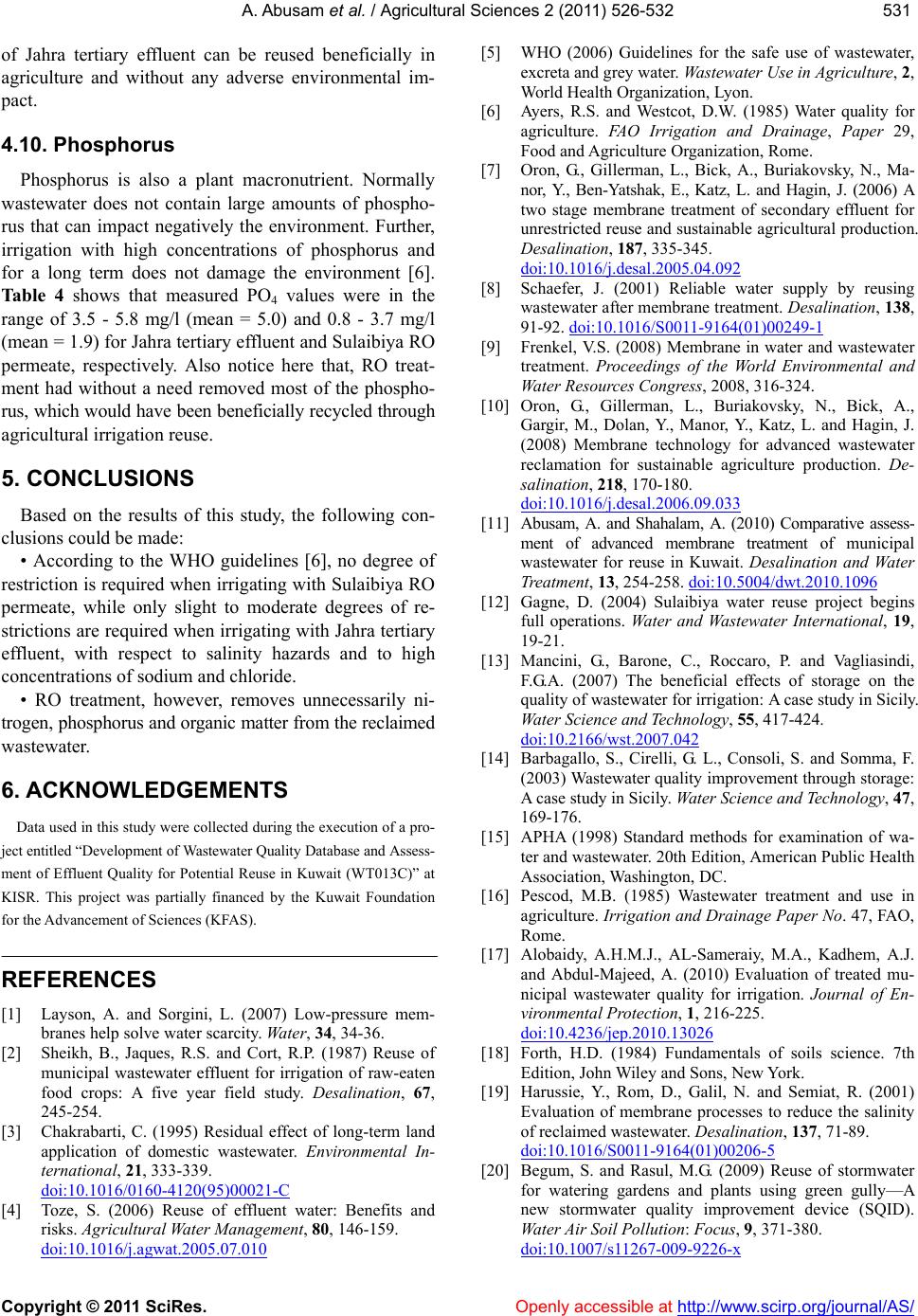 A. Abusam et al. / Agricultural Sciences 2 (2011) 526-532 Copyright © 2011 SciRes. Openly accessible at http://www.scirp.org/journal/AS/ 531531 of Jahra tertiary effluent can be reused beneficially in agriculture and without any adverse environmental im- pact. 4.10. Phosphorus Phosphorus is also a plant macronutrient. Normally wastewater does not contain large amounts of phospho- rus that can impact negatively the environment. Further, irrigation with high concentrations of phosphorus and for a long term does not damage the environment [6]. Table 4 shows that measured PO4 values were in the range of 3.5 - 5.8 mg/l (mean = 5.0) and 0.8 - 3.7 mg/l (mean = 1.9) for Jahra tertiary effluent and Sulaibiya RO permeate, respectively. Also notice here that, RO treat- ment had without a need removed most of the phospho- rus, which would have been beneficially recycled through agricultural irrigation reuse. 5. CONCLUSIONS Based on the results of this study, the following con- clusions could be made: • According to the WHO guidelines [6], no degree of restriction is required when irrigating with Sulaibiya RO permeate, while only slight to moderate degrees of re- strictions are required when irrigating with Jahra tertiary effluent, with respect to salinity hazards and to high concentrations of sodium and chloride. • RO treatment, however, removes unnecessarily ni- trogen, phosphorus and organic matter from the reclaimed wastewater. 6. ACKNOWLEDGEMENTS Data used in this study were collected during the execution of a pro- ject entitled “Development of Wastewater Quality Database and Assess- ment of Effluent Quality for Potential Reuse in Kuwait (WT013C)” at KISR. This project was partially financed by the Kuwait Foundation for the Advancement of Sciences (KFAS). REFERENCES [1] Layson, A. and Sorgini, L. (2007) Low-pressure mem- branes help solve water scarcity. Water , 34, 34-36. [2] Sheikh, B., Jaques, R.S. and Cort, R.P. (1987) Reuse of municipal wastewater effluent for irrigation of raw-eaten food crops: A five year field study. Desalination, 67, 245-254. [3] Chakrabarti, C. (1995) Residual effect of long-term land application of domestic wastewater. Environmental In- ternational, 21, 333-339. doi:10.1016/0160-4120(95)00021-C [4] Toze, S. (2006) Reuse of effluent water: Benefits and risks. Agricultural Wa ter Management, 80, 146-159. doi:10.1016/j.agwat.2005.07.010 [5] WHO (2006) Guidelines for the safe use of wastewater, excreta and grey water. Wastewater Use in Agriculture, 2, World Health Organization, Lyon. [6] Ayers, R.S. and Westcot, D.W. (1985) Water quality for agriculture. FAO Irrigation and Drainage, Paper 29, Food and Agriculture Organization, Rome. [7] Oron, G., Gillerman, L., Bick, A., Buriakovsky, N., Ma- nor, Y., Ben-Yatshak, E., Katz, L. and Hagin, J. (2006) A two stage membrane treatment of secondary effluent for unrestricted reuse and sustainable agricultural production. Desalination, 187, 335-345. doi:10.1016/j.desal.2005.04.092 [8] Schaefer, J. (2001) Reliable water supply by reusing wastewater after membrane treatment. Desalination, 138, 91-92. doi:10.1016/S0011-9164(01)00249-1 [9] Frenkel, V.S. (2008) Membrane in water and wastewater treatment. Proceedings of the World Environmental and Water Resources Congress, 2008, 316-324. [10] Oron, G., Gillerman, L., Buriakovsky, N., Bick, A., Gargir, M., Dolan, Y., Manor, Y., Katz, L. and Hagin, J. (2008) Membrane technology for advanced wastewater reclamation for sustainable agriculture production. De- salination, 218, 170-180. doi:10.1016/j.desal.2006.09.033 [11] Abusam, A. and Shahalam, A. (2010) Comparative assess- ment of advanced membrane treatment of municipal wastewater for reuse in Kuwait. Desalination and Water Treatment, 13, 254-258. doi:10.5004/dwt.2010.1096 [12] Gagne, D. (2004) Sulaibiya water reuse project begins full operations. Water and Wastewater International, 19, 19-21. [13] Mancini, G., Barone, C., Roccaro, P. and Vagliasindi, F.G.A. (2007) The beneficial effects of storage on the quality of wastewater for irrigation: A case study in Sicily. Water Science and Technology, 55, 417-424. doi:10.2166/wst.2007.042 [14] Barbagallo, S., Cirelli, G. L., Consoli, S. and Somma, F. (2003) Wastewater quality improvement through storage: A case study in Sicily. Water Science and Technology, 47, 169-176. [15] APHA (1998) Standard methods for examination of wa- ter and wastewater. 20th Edition, American Public Health Association, Washington, DC. [16] Pescod, M.B. (1985) Wastewater treatment and use in agriculture. Irrigation and Drainage Paper No. 47, FAO, Rome. [17] Alobaidy, A.H.M.J., AL-Sameraiy, M.A., Kadhem, A.J. and Abdul-Majeed, A. (2010) Evaluation of treated mu- nicipal wastewater quality for irrigation. Journal of En- vironmental Protection, 1, 216-225. doi:10.4236/jep.2010.13026 [18] Forth, H.D. (1984) Fundamentals of soils science. 7th Edition, John Wiley and Sons, New York. [19] Harussie, Y., Rom, D., Galil, N. and Semiat, R. (2001) Evaluation of membrane processes to reduce the salinity of reclaimed wastewater. Desalination, 137, 71-89. doi:10.1016/S0011-9164(01)00206-5 [20] Begum, S. and Rasul, M.G. (2009) Reuse of stormwater for watering gardens and plants using green gully—A new stormwater quality improvement device (SQID). Water Air Soil Pollution: Focus, 9, 371-380. doi:10.1007/s11267-009-9226-x  A. Abusam et al. / Agricultural Sciences 2 (2011) 526-532 Copyright © 2011 SciRes. http://www.scirp.org/journal/AS/Openly accessible at 532 [21] Tiwari, T.N. and Manzoor, A. (1988) Pollution of su- barnarekha river near Jamshedpur and the suitability of its water for irrigation. Indian Journal of Environmental Protection, 8, 494-497. [22] Shiekh, B., Jaques, R.S. and Cort, R.P. (1987) Reuse of tertiary municipal wastewater effluent for irrigation of raw eaten food crops: A 5 year study. Desalination, 67, 245-254. |