

Paper Menu >>
Journal Menu >>
 Vol.2, No.4, 518-525 (2011) doi:10.4236/as.2011.24067 C opyright © 2011 SciRes. Openly accessible at http://www.scirp.org/journal/AS/ Agricultural Scienc es Justification of public investment initiatives on water transfer systems as an instrument for water balances in Spain: the case of the Júcar-Vinalopó water transfer system Martin Sevilla*, Teresa Torregrosa* Applied Economic Depart me n t, Water Institute, University of Alicante, Alicante, Spain; *Corresponding Aut hor: [email protected], [email protected] Received 5 September 2011; revised 16 October 2011; accepted 23 October 2011. ABSTRACT One of the most controversial issues in recent years in water management has been finding a balance between available resources and water needs related to certain territories. The changes brought about by a new awareness over the need to preserve the environment, the social perception of the ownership of the river chan- nels, the need for adjust financial costs arising from the waterworks and the compliance with European standards urgently require redesign of water supply policies in force at this time. The Júcar-Vinalopó water transfer, considered as an historic aspiration for many years in the region, has been regarded as a key element for solving the depletion of groundwater in a large area lo- cated in the southeast of the Iberian Peninsula, mainly for irrigation purposes. In this paper we present an approach to the economic aspects related to the implementation of the project, its investment and financing arrangements and the question of the subsequent management with the impact of the well-known “recovery cost principle”, highlighting the current difficulties in carrying out projects of this size, due to severe limitations, as social and economic conditions of the transfer. Keywords: Water Transfer; Cost Recovery; Groundwater; Water Cos t 1. INTRODUCTION Unlike what happens in other neighboring countries like the United Kingdom [1] or even the OECD’s re- commendations for additional capital investments on into the urban infrastructures by institutional investors [2], in Spain, public investment on water infrastructures such as water transfers remains essential. Throughout history there has been a constant desire to provide the Vinalopó river basin in the south of the prov- ince of Alicante with external water supplies, matched by an equal desire to design initiatives to achieve this. The Júcar-Vinalopó water transfer, considered as an his- toric aspiration for many years in the region, has been regarded as a key element for solving the depletion of groundwater in a large area located in the southeast of the Iberian Peninsula. From an institutional and territo- rial point of view, these demands have largely been con- centrated in the coastal areas, especially in the municipal area of Elche, although more recently Alicante has also started to request resources. The beginning of the 20th century saw firstly the transfer of sign ifican t vo lu mes o f water to the coast, o rig i- nating in the aquifers of the Villena area, and secondly, an increase in water transferred from the mouth of the River Segura by the irrigation companies of the area; El Porvenir, El Progreso and Riegos de Levante S.A. The gradual drying out of the River Segura prompted the first projects related to the Tajo-Segura Water Trans- fer System1 at the end of the 1960s. Also at this time the towns of Alicante and Elche joined the Mancomunidad de Canales del Taibilla (MCT)2 (District Association of the Canales del Taibilla) in order to address the drinking 1The Tajo-Segura water transfer system, one of the largest in Spain, was initially designed to transport up to 600 Hm3 per year from the centre to the south-east of the country, although only on one occasion, the water year of 2000/2001, was this maximum volume of water transferred. The General Preliminary Project of exploiting the Tajo- Segura contemplated a maximum volume of 600 Hm3 per year “and i t has been commented that in a second phase, a further 400 Hm3may be added.” 2The Mancomunidad de Canales del Taibilla (hereafter MCT) created in 1927, is a public body responsible for the high-level network supply to several towns in South-East Spain [3].  M. Sevilla et al. / Agricultural Sciences 2 (2011) 518-525 Copyright © 2011 SciRes. Openly accessible at http://www.scirp.org/journal/AS/ 519519 water needs of a continuously growing population. Both circumstances relaxed the demands on the volumes originating in the Upper Vinalopó area for many years, and it was even sugg ested that the waters from the Tajo- Segura could alleviate the pressure on the aquifers of Vinalopó, contributing to balancing out the system. However, the supplies from the Tajo-Segura were un- stable (experiencing restrictions in supplies and irriga- tion for some years), the costs of extracting resources from the Vinalopó aquifers were lower than the rates applied by the MCT and there was a gradual increase in the extractions from the Vinalopó to be used for the ex- tended irrigated land in the Upper and Middle areas of the Vinalopó. All of these factors gave rise to the re- emergence of the historical demands, this time, from the inland towns of the area of the Vinalopó. 2. THE JÚCAR VINALOPÓ WATER TRANSFER SYSTEM IN TERMS OF THE ECONOMICJUSTIFICATION OF PUBLIC INVESTMENT Do water transfer systems make sense from an eco- nomic point of view? Does the Júcar-Vinalopó Transfer System (JVT) make sense? What are the reasons that justify undertaking works of this size? If the existing literature agrees on anything in this field it is the dis- crepancy in both the alternatives to the problems raised and in the solutions. This type of infrastructure is not new in Spain (the Tajo-Segura water transfer system, the largest in Spain, has been op er ating fo r mor e th an 30 years), neith er is the debate in terms of its appropriateness and whether it should be publicly financed [4]. Some authors provide support for the hypothesis that private infrastructure owners operate more efficiently than public ones [5]. In general terms, the public decisions regarding the creation of water transfer systems attempt to address the structural problems of receiving basins, where structural water problems are understood as those where ordinary needs and their provisions exceed current and forecast resources. Although this concept seems simple as a gen- eral criterion, contemplating it in Spain, where the dis- tinction between a dry and wet Spain implies more than one variable, and where prices applied to water far from acknowledge the water scarcity indexes in each case, makes it a highly complex task. But this question is not so far removed from the issue of costs and prices applied to the use of water. Can the crops in the receiving areas assume all the costs incurred by transferring water from one territory to another? If we only contemplate this variable (and set aside other issues such as environmental costs or the repercussions on ar- eas from where the water originates)—to what extend should the construction costs of the Transfer System be subsidised with public funds? 3. THE FINANCIAL ECONOMIC PROBLEM OF THE JÚCAR-VINALOPÓ WATER TRANSFER SYSTEM Although the issues surrounding the need to supply the Vinalopó basin with external sources have been on- going for some time, as previously mentioned, the con- servation of the new areas transformed into irrigated land in the area since the 1960s is one of the key argu- ments for justifying the transfer pro ject. Nevertheless, while the problem of water resources imbalance and the overexploitation of the Vinalopó basin has predominantly been caused by private enterprises, although strongly p romoted by p ublic in itiativ e [6,7 ], the solution to the p roblems basically lie in the hands of the public sector. Although this public involvement has not been a determining factor in the medium and long-term unsustainability of these systems3, it has been incapable of implementing limiting measures. The fundamental milestone in th e recent history of the Júcar-Vinalopó water transfer system was the Júcar Ba- sin Plan in 1998 which not only sought to resolve the Vinalopó problem but also included the neighbouring area of Marina Baja as a water receiving area. It should be taken into account that the authorities of the Marina Baja area responded to their own problem independently of the possible solution derived from the provision of external supplies from the Júcar. As already demonstrated [7,9], the action taken by the Consorcio de Aguas de la Marina Baja (CAMB) in the integrated management of all of its water resources has ensured that no external water resources are requ ired to cover its needs4. However, the same does not apply to the Vi- nalopó basin. Neither the new organisations of users, nor the combining of uses has reduced the demand for ex- ternal supplies. The State has also expressed its com- mitment to constructing the system, basically because it 3Neither the IGME [8] (Spanish Geological and Mining Institute) Reports during the 1970s that raised the need to adjust the uses to renewable resources of the water resource system of Vinalopó, nor the new Water Law of 1985, or the declarations regarding some overex- p loited aquifers forming part of this system (Sierra de Crevillente y Jumilla-Vilena) led tothe incorporation of measures to resolve the p roblems, and are still not being dev eloped today, 201 1. 4A centralised management of the different resources and an internal compensations system between all the users has enabled the problems to be resolved with relatively low costs compared to those incurred by transferring external supplies. In practice, although there is still a demand for external resources, this demand corresponds to a safety margin to cover water needs in an extraordinary situation. It is for this p ur p ose that external water is demanded, not for ordinar y water needs. 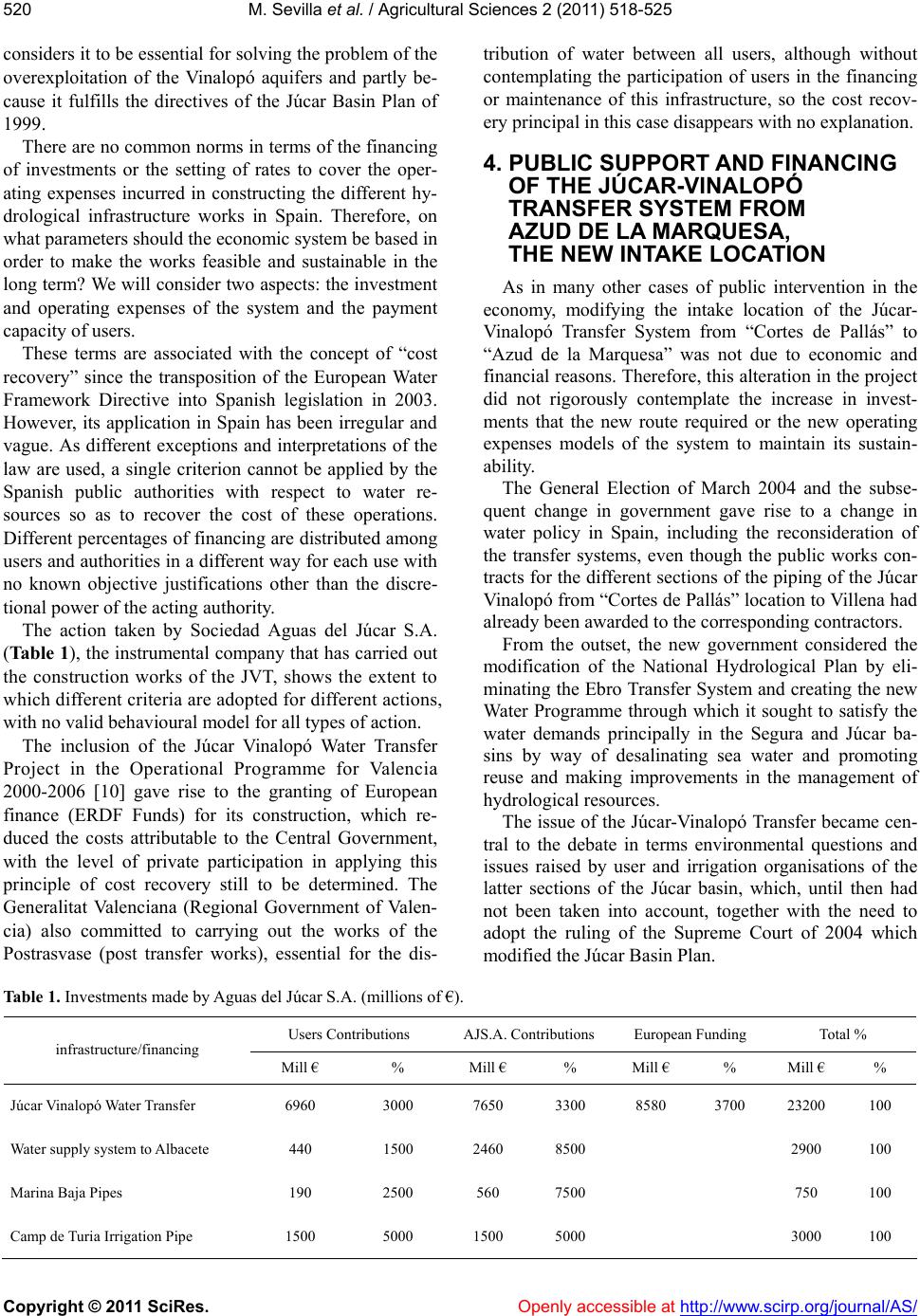 M. Sevilla et al. / Agricultural Sciences 2 (2011) 518-525 Copyright © 2011 SciRes. http://www.scirp.org/journal/AS/Openly accessible at 520 considers it to be essential for so lving the problem of the overexploitation of the Vinalopó aquifers and partly be- cause it fulfills the directives of the Júcar Basin Plan of 1999. There are no common norms in terms of the financing of investments or the setting of rates to cover the oper- ating expenses incurred in constructing the different hy- drological infrastructure works in Spain. Therefore, on what parameters should the economic system be based in order to make the works feasible and sustainable in the long term? We will consider two asp ects: the investment and operating expenses of the system and the payment capacity of users. These terms are associated with the concept of “cost recovery” since the transposition of the European Water Framework Directive into Spanish legislation in 2003. However, its application in Spain has been irregular and vague. As different exceptions and interpretations of the law are used, a single criterion cannot be applied by the Spanish public authorities with respect to water re- sources so as to recover the cost of these operations. Different percentages of financing are distributed among users and author ities in a different way for each use with no known objective justifications other than the discre- tional power of the acting au thority. The action taken by Sociedad Aguas del Júcar S.A. (Table 1), the instrumental company that has carried out the construction works of the JVT, shows the extent to which different criteria are adopted for different actions, with no valid behavioural model for all types of action. The inclusion of the Júcar Vinalopó Water Transfer Project in the Operational Programme for Valencia 2000-2006 [10] gave rise to the granting of European finance (ERDF Funds) for its construction, which re- duced the costs attributable to the Central Government, with the level of private participation in applying this principle of cost recovery still to be determined. The Generalitat Valenciana (Regional Government of Valen- cia) also committed to carrying out the works of the Postrasvase (post transfer works), essential for the dis- tribution of water between all users, although without contemplating the participation of users in the financing or maintenance of this infrastructure, so the cost recov- ery principal in this case disappears with no explanation. 4. PUBLIC SUPPORT AND FINANCING OF THE JÚCAR-VINALOPÓ TRANSFER SYSTEM FROM AZUD DE LA MARQUESA, THE NEW INTAKE LOCATION As in many other cases of public intervention in the economy, modifying the intake location of the Júcar- Vinalopó Transfer System from “Cortes de Pallás” to “Azud de la Marquesa” was not due to economic and financial reasons. Therefore, this alteration in the project did not rigorously contemplate the increase in invest- ments that the new route required or the new operating expenses models of the system to maintain its sustain- ability. The General Election of March 2004 and the subse- quent change in government gave rise to a change in water policy in Spain, including the reconsideration of the transfer systems, even though the public works con- tracts for the different sections of the piping of the Júcar Vinalopó from “Cortes de Pallás” location to Villena had already been awarded to the corresponding contractors. From the outset, the new government considered the modification of the National Hydrological Plan by eli- minating the Ebro Tr ansfer System and creating the new Water Programme through which it sought to satisfy the water demands principally in the Segura and Júcar ba- sins by way of desalinating sea water and promoting reuse and making improvements in the management of hydrologic al resources. The issue of the Júcar-Vinalopó Transfer became cen- tral to the debate in terms environmental questions and issues raised by user and irrigation organisations of the latter sections of the Júcar basin, which, until then had not been taken into account, together with the need to adopt the ruling of the Supreme Court of 2004 which modified the Júcar Basin Plan. Table 1. Investments made by Aguas del Júcar S.A. (millions of €). Users Contributions AJS.A. Contributions European Funding Total % infrastructure/financing Mill € % Mill € % Mill € % Mill € % Júcar Vinalopó Water Trans fer 6960 3000 7650 3300 8580 3700 23200 100 Water supply system to Albacete 440 1500 2460 8500 2900 100 Marina Baja Pipes 190 2500 560 7500 750 100 Camp de Turia Irrigation Pipe 1500 5000 1500 5000 3000 100  M. Sevilla et al. / Agricultural Sciences 2 (2011) 518-525 Copyright © 2011 SciRes. Openly accessible at http://www.scirp.org/journal/AS/ 521521 The change in intake location also generated conflict with the Junta Central and altered the whole financing model which had been agreed with this organisation through the 200 1 Agreement on 28/2/2005, which estab- lished: 1) The Syndicated Loan will not be awarded to cover the part corresponding to the users for the construction works of the Júcar-Vinalopó Transfer until the adminis- trative and legal controversies regarding the availability of water to transfer from the Júcar that justifies the pro- ject are resolved. The forecast annual transferred vol- umes and their use (irrigation and supply) should be maintained at the levels stipulated in the Júcar Basin Plan and in the Agreement sign ed with AJSA on 13 July 2001. The content of the ruling (…) passed by the Su- preme Courte on 20-10-2004 (…) advises that the syn- dicated loans should not be granted until the availability of the water resources for the Júcar-Vinalopó Transfer has been guaranteed through the corresponding legal provision. 2) To urge the modification of the Agreement signed with Aguas del Júcar S.A. so that the agreed contributio n of the users is produ ced through pricing the water that is effectively received. This new situation led the Ministry to modify the “Direct management agreement with respect to the con- struction and/or operation of hydrological works be- tween MIMAM-Aguas del Júcar SA”. Modification No. 1 of March 2006, changed the financing system of the works, which from that moment and at the expense of the new contributions of the ERDF funds from the EU were distributed as follows: 26.4% with EDRF Funds (€80 million); 24.7% (€75 million, the same amount as in the preceding agreement) would be financed by Aguas del Júcar through a loan operation passed onto the users during the operation of the transfer through prices; and 48.9% of the cost of the activity (€148 million) would be financed throug h funds coming from the share capital of Aguas del Júca r. The EC took the Decision on the 12/12/2006 to mod- ify both its final contribution to the “Júcar-Vinalopó Transfer” which increased to €120,121,000 (50% of the total subsidisable cost), and the corresponding condi- tions, which were extend ed basically to ensure the effec- tive improvement of the aquifer recovery in Vinalopó and the eastern part of Castilla-la Mancha, the resources supplied to the Júcar, the situation of Albufera and the savings in the traditional irrigated areas of the Júcar. It also proposed the creation of a technical monitoring group, dependent on the Monitoring Committee for the Operating Programme of the Region of Valencia [10], composed of representatives from the government, users, NPO and the Commission, in order to determine the degree of compliance with clauses of the Decision. The greater participation from the EDRF funds re- duced the contribution of Aguas del Júcar, which now amounted to €108 million. Also at that time the company calculated the operating expenses according to the fol- lowing table, which show that the repercussion of the transferred water costs with average transferrable vol- umes of 70 Hm3 was €0.196/m3. This calculation of costs transferred to the users is possibly one of the key elements in the ensuing discus- sions which have taken place in public debate. The most critical opponents of t he change in intake locati on claimed that these calculations were unreal, especially those cor- responding to energy costs, because with the new intake there are parts above sea level that must be overcome in order to carry the water from “Azud de la Marquesa” to the “San Diego” reservoir in Villena. As the change in intake location to “Azud de la Mar- quesa” was rejected by the Junta Central, this organisa- tion did not sign the new Agreement necessary for set- ting the new project into operation, which could lead to the absurd situation of carrying out infrastructure works that did not have any final users. During this period, Aguas del Júcar S.A. tried to sign individual contracts with final users of the water in order to ensure the exis- tence of a demand for these resources, although only a few of them (including the Town Council of Elch e or the Main Irrigation Channel of the Elche Reservoir, which are not represented by the Junta Central) signed these agreements. The final solution to th is dilemma was sought through the signing in January 2007 of an Agreement between the Júcar Hydrological Confederation (CHJ) and Aguas del Júcar S.A. which includes in its explanatory pream- ble: “That to facilitate the investment recovery of this project, the CHJ, as the competent body responsible for the management of the hydrological resources of the Basin which it administrates does not oppose to being the intermediary between Aguas del Júcar S.A. and the final holders of the rights to use the transferred water, or the final users of the afore-mentioned project” [11-13]. In this way it is the CHJ who is obliged to assume the operating and conservation costs of the project, which subsequently recovers these expenses from the final us- ers of the water. 5. THE IMPLICATIONS ON FINANCING OF THE COSTS OF THE JÚCAR-VINALOPÓ WATER TRANSFER SYSTEM We have already seen that the change in the water in- take location of the Júcar altered the whole balance 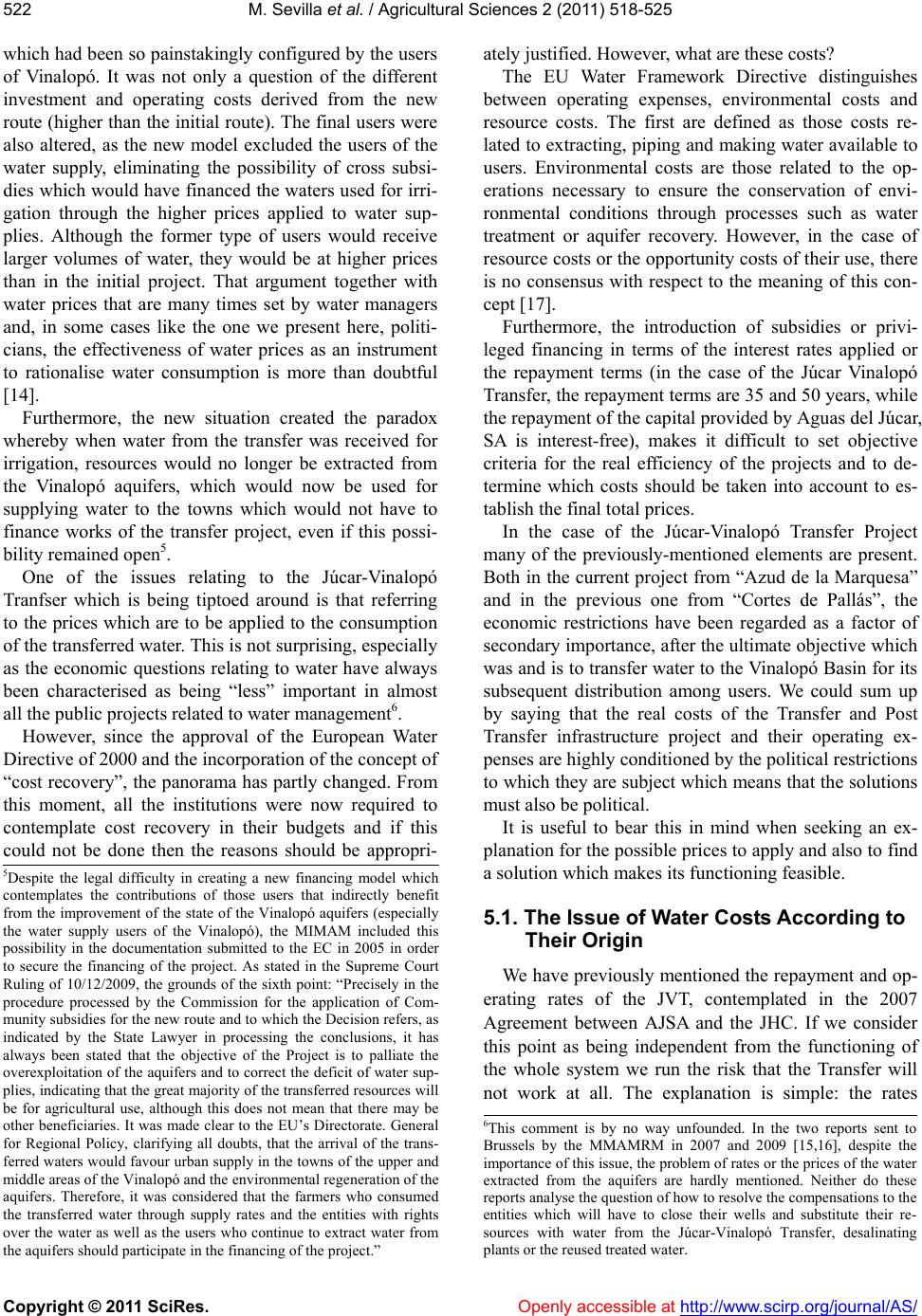 M. Sevilla et al. / Agricultural Sciences 2 (2011) 518-525 Copyright © 2011 SciRes. Openly accessible at http://www.scirp.org/journal/AS/ 522 which had been so painstakingly configured by the users of Vinalopó. It was not only a question of the different investment and operating costs derived from the new route (higher than the initial route). The final users were also altered, as the new model excluded the users of the water supply, eliminating the possibility of cross subsi- dies which would have financed the waters used for irri- gation through the higher prices applied to water sup- plies. Although the former type of users would receive larger volumes of water, they would be at higher prices than in the initial project. That argument together with water prices that are many times set by water managers and, in some cases like the one we present here, politi- cians, the effectiveness of water prices as an instrument to rationalise water consumption is more than doubtful [14]. Furthermore, the new situation created the paradox whereby when water from the transfer was received for irrigation, resources would no longer be extracted from the Vinalopó aquifers, which would now be used for supplying water to the towns which would not have to finance works of the transfer project, even if this possi- bility remained open5. One of the issues relating to the Júcar-Vinalopó Tranfser which is being tiptoed around is that referring to the prices which are to be applied to the consumption of the transferred water. This is not surprising, especially as the economic questions relating to water have always been characterised as being “less” important in almost all the public projects related to water management6. However, since the approval of the European Water Directive of 2000 an d th e in corpo r ation of the concep t of “cost recovery”, the panorama has partly changed. From this moment, all the institutions were now required to contemplate cost recovery in their budgets and if this could not be done then the reasons should be appropri- ately justified. However, what are these costs? The EU Water Framework Directive distinguishes between operating expenses, environmental costs and resource costs. The first are defined as those costs re- lated to extracting, piping and making water available to users. Environmental costs are those related to the op- erations necessary to ensure the conservation of envi- ronmental conditions through processes such as water treatment or aquifer recovery. However, in the case of resource costs or the opportun ity costs of their use, there is no consensus with respect to the meaning of this con- cept [17]. Furthermore, the introduction of subsidies or privi- leged financing in terms of the interest rates applied or the repayment terms (in the case of the Júcar Vinalopó Transfer, the repayment terms are 35 and 50 years, while the repayment of th e capital prov id ed b y Aguas d el Júcar, SA is interest-free), makes it difficult to set objective criteria for the real efficiency of the projects and to de- termine which costs should be taken into account to es- tablish the final total prices. In the case of the Júcar-Vinalopó Transfer Project many of the previously-mentioned elements are present. Both in the current project from “Azud de la Marquesa” and in the previous one from “Cortes de Pallás”, the economic restrictions have been regarded as a factor of secondary importance, after the ultimate objective wh ich was and is to transfer water to the Vinalopó Basin for its subsequent distribution among users. We could sum up by saying that the real costs of the Transfer and Post Transfer infrastructure project and their operating ex- penses are highly condition ed by the political restriction s to which they are subject which means that the solutions must also be political. It is useful to bear this in mind when seeking an ex- planation for the possible prices to apply and also to find a solution which makes its functio ning feasible. 5.1. The Issue of Water Costs According to Their Origin We have previously mentioned the repayment and op- erating rates of the JVT, contemplated in the 2007 Agreement between AJSA and the JHC. If we consider this point as being independent from the functioning of the whole system we run the risk that the Transfer will not work at all. The explanation is simple: the rates 5Despite the legal difficulty in creating a new financing model which contemplates the contributions of those users that indirectly benefit from the improvement of the state of the Vinalopó aquifers (especially the water supply users of the Vinalopó), the MIMAM included this p ossibility in the documentation submitted to the EC in 2005 in orde r to secure the financing of the project. As stated in the Supreme Court Ruling of 10/12/2009, the grounds of the sixth point: “Precisely in the p rocedure processed by the Commission for the application of Com- munity subsidies for the new route and to which the Decision refers, as indicated by the State Lawyer in processing the conclusions, it has always been stated that the objective of the Project is to palliate the overexploitation of the aquifers and to correct the deficit of water sup- p lies, indicating that the great majority of the transferred resources will b e for agricultural use, although this does not mean that there may be other beneficiaries. It was made clear to the EU’s Directorate. General for Regional Policy, clarifying all doubts, that the arrival of the trans- ferred waters would favour urban supply in the towns of the upper and middle areas of the Vinalopó and the environmental regeneration of the aquifers. Therefore, it was considered that the farmers who consumed the transferred water through supply rates and the entities with rights over the water as well as the users who continue to extract water from the aquifers should parti c ip a te in the financing of the proj ect.” 6This comment is by no way unfounded. In the two reports sent to Brussels by the MMAMRMin 2007 and 2009 [15,16], despite the importance of this issue, the problem of rates or the prices of the water extracted from the aquifers are hardly mentioned. Neither do these reports analyse the question of how to resolve the compensations to the entities which will have to close their wells and substitute their re- sources with water from the Júcar-Vinalopó Transfer, desalinating p lants or the reused treated water.  M. Sevilla et al. / Agricultural Sciences 2 (2011) 518-525 Copyright © 2011 SciRes. http://www.scirp.org/journal/AS/ 523523 passed on to the agricultural users in some years may reach 0.80 Euros per m3, including the repayment and operating costs, a figure that is way above the price of obtaining water through other methods and one which is unacceptable for irrigation. Openly accessible at In the following Table 2 we have made an estimate of these rates in accordance with the forecast of costs made by AJSA in 2006 for a Transfer of 70 Hm3 (the operating costs are at this year’s prices) and applying them to hy- pothetical trans fers of between 10 and 50 Hm3. The actual prices for this system may be higher than the values obtained herein depending on variations in actual costs. 5.2. The Implications of Reorganising Water Extractions in the Vinalopó Basin The Public Authorities responsible for water-related issues have always taken into account that in developing the Júcar-Vinalopó Transfer the transfer of resources should imply a reduction in the pressur e on the Vinalopó aquifers and, therefore, the closing of many wells in the area. All of the reports and studies carried out in order to obtain European Commission funds have observed this question [15,16 ,18,19] From a technical and hydrological point of view, the overexploitation of the aquifers may only be resolved by adapting extractions to replenishments, therefore, the optimum operating level would be that which produces a long-term equilibrium between the two. While some studies explore the possibilities that replenishing the aquifers would generate [8], this alternative would only work in situ ation s when ther e was exce ss water an d with the government assuming the costs of the whole opera- tion7. In the two projects contemplated (“Cortes de Pallás” and “Azud de la Marquesa”), the logic of the solution to overexploitation is the same: to reduce the pressure on the aquifers and increase their sustainability, although the ways of doing this have changed considerably. In the Transfer Project from “Cortes de Pallás”, the water was to be used for both agriculture and urban sup- ply (in the Vinalopó region, Alicante and the Marina Baja area), whereby the water that was no longer ex- tracted from the closed wells was substituted by that from the Transfer at the prices agreed by the users and AJSA in 20018. With respect to the Transfer Project from “Azud de la Marquesa”, the extractions for urban con- sumption are not replaced by the transferred waters as their quality is inferior, with resources generated by the desalinisation plants on the coast being used for this purpose, particularly those of Mutxamel and Alicante I and II. Although from a material point of view they may be equivalent, their costs can vary considerably. Fur- thermore, the negotiations for resolving these exchanges involve several Central Government bodies9; namely the CHJ and the Water Agency, ACUAMED and the MCT. While the former are concerned with harmonising the water rights of the users, the MCT are responsible for providing alternative supplies and closing wells and es- tablishing consumer prices. According to the Rep orts issued by the European C o m- mission, the plans for closing wells have changed (Table 3). As we can observe, the planned substitutions have risen from 65 Hm3 for 2003 to 76.76 Hm3 for 2007 and are calculated at 79.5 Hm3 for 2009. These changes have not been explained in the ensuing reports. Table 2. Costs transferred to the users of the Transfer. 70 Hm3 50 Hm3 30 Hm3 10 Hm3 Return of Investment (€/year) 3,490,000 3,490,000 3,490,000 3,490,000 Energy (€/año) 7,351,449 5,251,035 3,150,621 1,050,207 Turbine stations incomes (€/year) 711,030 507,875 304,725 101,575 Conservation and maintenance (€/year) 3,559,867 3,559,867 3,559,867 3,559,867 Total exploitation costs (€/year) 10,200,286 8,303,027 6,405,763 4,508,499 Total retroceded costs (€/year) 13,690,286 11,793,027 9,895,763 7,998,499 Retroceded Costs (Hm3/year) 0.20 0.23 0.33 0.80 7Although it may seem far removed from reality, this situation could arise if the possibilities of transferring water from the Júcar were higher than the irrigation demands in the area. In this case, these studies would be useful to ascertain which aquifers could store this water which could be subse- quently used. The issue of the costs (which in this case are double due to the Transfer rates and the cost of its construction) and quality would deter- mine the feasibility of the operation. 8It should be noted t h a t t h e s e r a tes ar e out of d ate, although they are still used as a reference. 9Part of this problem has been eliminated with the integration of AJSA into ACUAMED in 2010. 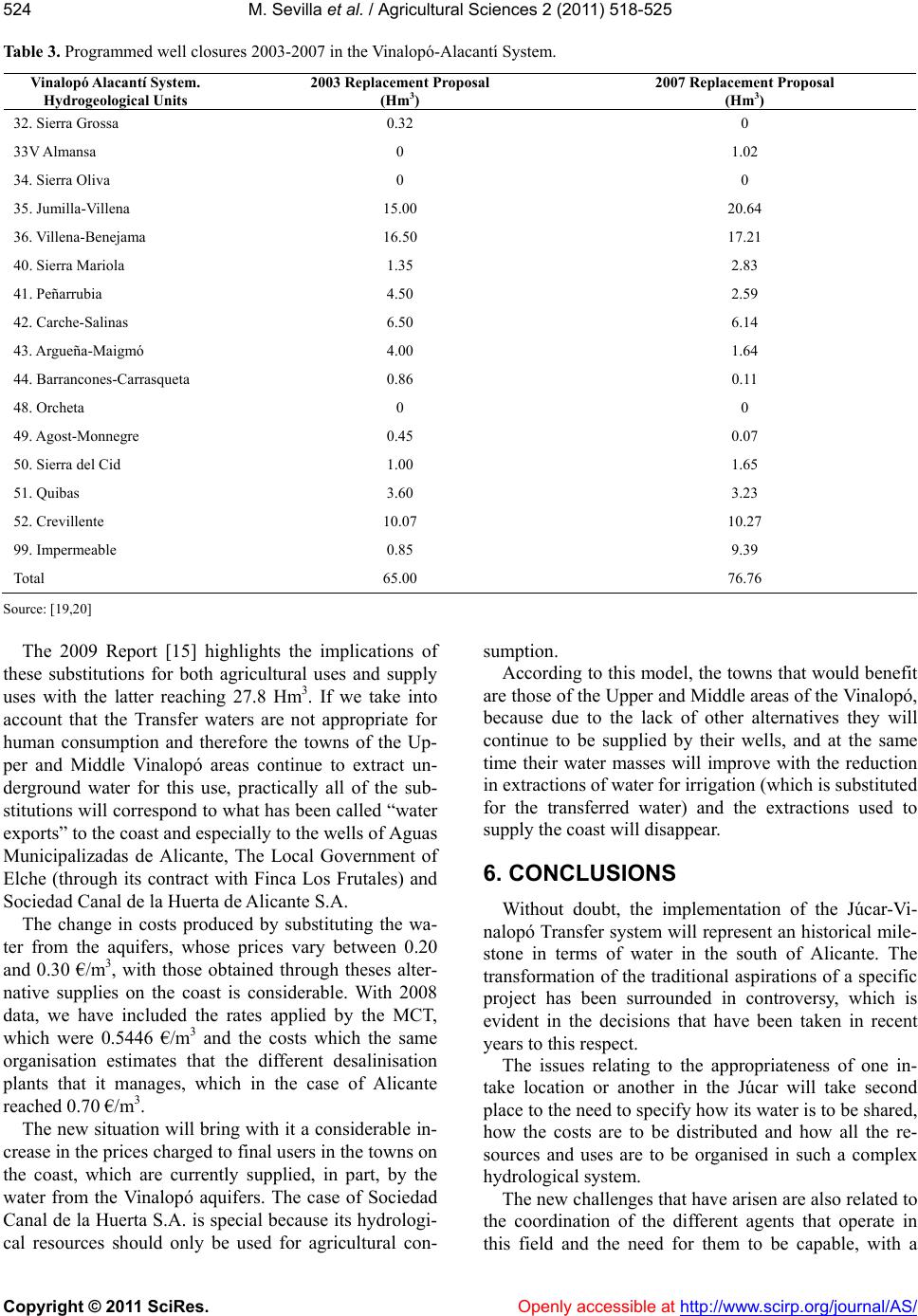 M. Sevilla et al. / Agricultural Sciences 2 (2011) 518-525 Copyright © 2011 SciRes. Openly accessible at http://www.scirp.org/journal/AS/ 524 Table 3. Programmed well closures 2003-2007 in the Vinalopó-Alacantí System. V inalopó Alacantí System. Hydrogeologica l Unit s 2003 Replacement Proposal (Hm3) 2007 Replacement Proposal (Hm3) 32. Sierra Grossa 0.32 0 33V Alm ansa 0 1.02 34. Sierra Oliva 0 0 35. Jumilla-Villena 15.00 20.64 36. Villena-Benejama 16.50 17.21 40. Sierra Mariola 1.35 2.83 41. Peñarrubia 4.50 2.59 42. Carche-Salinas 6.50 6.14 43. Argue ña-Maigmó 4.00 1.64 44. Barrancon e s-Carrasqueta 0.86 0.11 48. Orcheta 0 0 49. Agost-Monneg re 0.45 0.07 50. Sierra del Cid 1.00 1.65 51. Quibas 3.60 3.23 52. Crevillente 10.07 10.27 99. Impermeable 0.85 9.39 Total 65.00 76.76 Source: [19,20] The 2009 Report [15] highlights the implications of these substitutions for both agricultural uses and supply uses with the latter reaching 27.8 Hm3. If we take into account that the Transfer waters are not appropriate for human consumption and therefore the towns of the Up- per and Middle Vinalopó areas continue to extract un- derground water for this use, practically all of the sub- stitutions will corresp ond to what has b een called “water exports” to the coast and especially to the wells of Aguas Municipalizadas de Alicante, The Local Government of Elche (through its contract with Finca Los Frutales) and Sociedad Canal de la Huerta de Alicante S.A. The change in costs produced by substituting the wa- ter from the aquifers, whose prices vary between 0.20 and 0.30 €/m3, with those obtained through theses alter- native supplies on the coast is considerable. With 2008 data, we have included the rates applied by the MCT, which were 0.5446 €/m3 and the costs which the same organisation estimates that the different desalinisation plants that it manages, which in the case of Alicante reached 0.70 €/m3. The new situation will bring with it a considerable in- crease in the prices charged to final users in the towns on the coast, which are currently supplied, in part, by the water from the Vinalopó aquifers. The case of Sociedad Canal de la Huerta S.A. is special because its hydrologi- cal resources should only be used for agricultural con- sumption. According to this model, th e towns that would benefit are those of the Upper and Middle areas of the Vinalopó, because due to the lack of other alternatives they will continue to be supplied by their wells, and at the same time their water masses will improve with the reduction in extractions of water for irrigation (which is substituted for the transferred water) and the extractions used to supply the coast will d isappear. 6. CONCLUSIONS Without doubt, the implementation of the Júcar-Vi- nalopó Transfer system will represent an historical mile- stone in terms of water in the south of Alicante. The transformation of the traditional aspirations of a specific project has been surrounded in controversy, which is evident in the decisions that have been taken in recent years to this respect. The issues relating to the appropriateness of one in- take location or another in the Júcar will take second place to the need to specify how its water is to be shared, how the costs are to be distributed and how all the re- sources and uses are to be organised in such a complex hydrological system. The new challenges that have arisen are also related to the coordination of the different agents that operate in this field and the need for them to be capable, with a 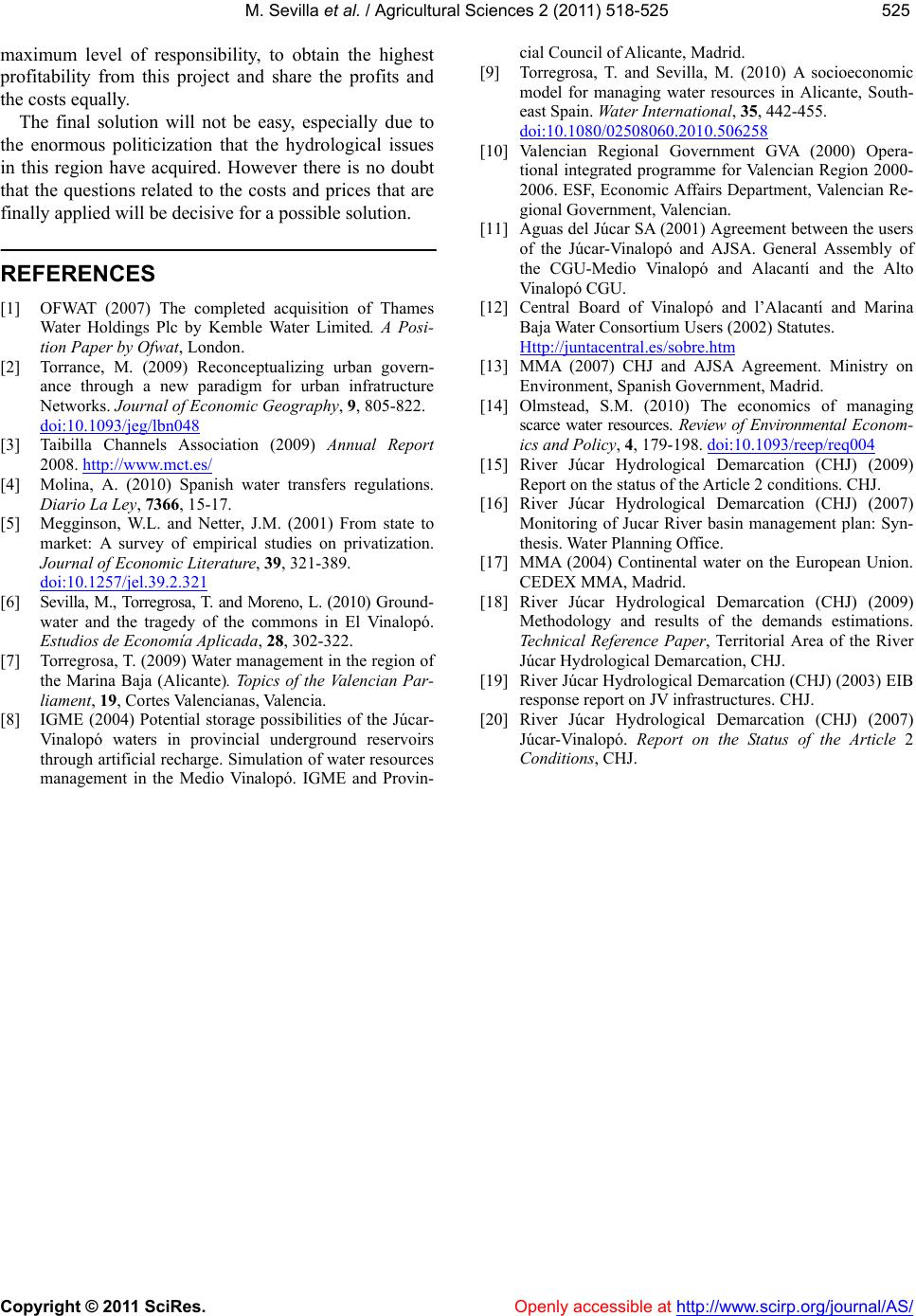 M. Sevilla et al. / Agricultural Sciences 2 (2011) 518-525 Copyright © 2011 SciRes. Openly accessible at http://www.scirp.org/journal/AS/ 525525 maximum level of responsibility, to obtain the highest profitability from this project and share the profits and the costs equally. The final solution will not be easy, especially due to the enormous politicization that the hydrological issues in this region have acquired. However there is no doubt that the questions related to the costs and prices that are finally applied will be decisive for a possible solution. REFERENCES [1] OFWAT (2007) The completed acquisition of Thames Water Holdings Plc by Kemble Water Limited. A Posi- tion Paper by Ofwat, London. [2] Torrance, M. (2009) Reconceptualizing urban govern- ance through a new paradigm for urban infratructure Networks. Journal of Economic Geography, 9, 805-822. doi:10.1093/jeg/lbn048 [3] Taibilla Channels Association (2009) Annual Report 2008. http://www.mct.es/ [4] Molina, A. (2010) Spanish water transfers regulations. Diario La Ley, 7366, 15-17. [5] Megginson, W.L. and Netter, J.M. (2001) From state to market: A survey of empirical studies on privatization. Journal of Economic Literature, 39, 321-389. doi:10.1257/jel.39.2.321 [6] Sevilla, M., Torregrosa, T. and Moreno, L. (2010) Ground- water and the tragedy of the commons in El Vinalopó. Estudios de Economía Aplicada, 28, 302-322. [7] Torregrosa, T. (2009) Water management in the region of the Marina Baja (Alicante). Topics of the Valencian Par- liament, 19, Cortes Valencianas, Valencia. [8] IGME (2004) Potential storage possibilities of the Júcar- Vinalopó waters in provincial underground reservoirs through artificial recharge. Simulation of water resources management in the Medio Vinalopó. IGME and Provin- cial Council of Alicante, Madrid. [9] Torregrosa, T. and Sevilla, M. (2010) A socioeconomic model for managing water resources in Alicante, South- east Spain. Water International, 35, 442-455. doi:10.1080/02508060.2010.506258 [10] Valencian Regional Government GVA (2000) Opera- tional integrated programme for Valencian Region 2000- 2006. ESF, Economic Affairs Department, Valencian Re- gional Government, Valencian. [11] Aguas del Júcar SA (2001) Agreement between the users of the Júcar-Vinalopó and AJSA. General Assembly of the CGU-Medio Vinalopó and Alacantí and the Alto Vinalopó CGU. [12] Central Board of Vinalopó and l’Alacantí and Marina Baja Water Consortium Users (2002) Statutes. Http://juntacentral.es/sobre.htm [13] MMA (2007) CHJ and AJSA Agreement. Ministry on Environment, Spanish Government, Madrid. [14] Olmstead, S.M. (2010) The economics of managing scarce water resources. Review of Environmental Econom- ics and Policy, 4, 179-198. doi:10.1093/reep/req004 [15] River Júcar Hydrological Demarcation (CHJ) (2009) Report on the status of the Article 2 conditions. CHJ. [16] River Júcar Hydrological Demarcation (CHJ) (2007) Monitoring of Jucar River basin management plan: Syn- thesis. Water Planning Office. [17] MMA (2004) Continental water on the European Union. CEDEX MMA, Madrid. [18] River Júcar Hydrological Demarcation (CHJ) (2009) Methodology and results of the demands estimations. Technical Reference Paper, Territorial Area of the River Júcar Hydrological Demarcation, CHJ. [19] River Júcar Hydrological Demarcation (CHJ) (2003) EIB response report on JV infrastructures. CHJ. [20] River Júcar Hydrological Demarcation (CHJ) (2007) Júcar-Vinalopó. Report on the Status of the Article 2 Conditions, CHJ. |