

Paper Menu >>
Journal Menu >>
 J. Biomedical Science and Engineering, 2011, 4, 692-698 doi:10.4236/jbise.2011.411086 Published Online November 2011 (http://www.SciRP.org/journal/jbise/ JBiSE ). Published Online November 2011 in SciRes. http://www.scirp.org/journal/JBiSE Increase in thermal stability of proteins adsorbed on biomass charcoal powder prepared from plant biomass wastes Hidetaka Noritomi1, Ryotaro Kai1, Daiki Iwai1, Hirotaka Tanaka1, Reo Kamiya1, Masahiko Tanaka2, Kohichiroh Muneki3, Satoru Kato1 1Department of Applied Chemistry, Tokyo Metropolitan University, Minami-Ohsawa, Hachioji, Tokyo, Japan; 2EEN Co., Ltd., 2-1-2 Koishikawa Bunkyo-ku, Tokyo, Japan; 3Industry-Academic-Public Cooperation Center, Tokyo Metropolitan University, Minami-Ohsawa, Hachioji, Tokyo, Japan. Email: [email protected] Received 2 August 2011; 6 September 2011; accepted 9 October 2011. ABSTRACT Thermal stability of lysozyme adsorbed on biomass charcoal powder (BCP), which was prepared from plant biomass wastes such as dumped adzuki bean, bamboo, and wood by pyrolysis without combustion under nitrogen atmosphere and comminution with a jet mill, was examined. Adsorbing lysozyme on BCP could sufficiently prevent proteins from denaturing and aggregating in an aqueous solution at high tem- peratures, and enhanced the refolding of thermally denatured proteins by cooling treatment. The re- maining activities of lysozyme adsorbed on BCP of adzuki bean exhibited 51% by cooling treatment af- ter the heat treatment at 90˚C for 30 min, although that of native lysozyme was almost lost under the same experimental conditions. The thermostabiliza- tion effect of BCP on the remaining activity of ad- sorbed lysozyme was markedly dependent upon the kind of plant biomass wastes. Keywords: Adsorption; Biomass Charcoal Powder; Ly- sozyme; Refolding; Remaining Activity; Thermal Stabil- ity 1. INTRODUCTION Proteins are biomolecules of great importance in the medical, pharmaceutical, and food fields, since they ex- hibit their outstanding biological activities under mild condition. However, most of proteins dissolved in an aqueous solution are immediately denatured and inacti- vated at high temperatures due to the disruption of weak interactions, including ionic bonds, hydrogen bonds, and hydrophobic interactions, which are prime determinants of protein tertiary structures [1,2]. In particular, protein aggregation easily occurs upon the exposure of the hy- drophobic surfaces of a denatured protein, and this phe- nomenon becomes the major problem because of the irreversible inactivation. Thermal denaturation of pro- teins is a serious problem not only in the separation and storage of proteins but also in the processes of biotrans- formation, biosensing, drug production, and food manu- facturing. Several strategies have so far been proposed in order to prevent thermal denaturation of proteins. They include chemical modification, immobilization, genetic modification, and addition of stabilizing agents. The addition of stabilizing agents is one of the most conven- ient methods for minimizing thermal denaturation [3-11]. It has been reported that inorganic salts, polyols, sugars, amino acids, amino acid derivatives, chaotropic reagents, and water-miscible organic solvents are available for im- proving protein stability. However, these additives do not sufficiently prevent irreversible protein aggregation or some of them are no longer stable at high tempera- tures. We have reported that adding water-miscible aprotic ionic liquids into an aqueous solution of proteins can effectively hinder the formation of protein aggrega- tion at high temperatures, and keep high remaining ac- tivities of proteins [12]. At present, ionic liquids are at high costs, and their use is limited, since ionic liquids are organic salts. On the other hand, immobilization of pro- teins on a support noncovalently and covalently has ex- tensively been studied [13,14]. Enzymes immobilized within carbon paste electrodes exhibit the improvement of thermal stability [15]. Enzymes enhance thermal sta- bility by adsorbing them onto C60 fullerenes [16]. In or- der to develop the practical process, the factors such as the cost of the process, the need for a specific support material, ensuring that the substrates are not sterically hindered from diffusing to active site of the immobilized enzyme where they react at a suitable rate, and so on must be taken into account [17]. The development of technologies for recycling wastes is one of the most important challenges to establish re- 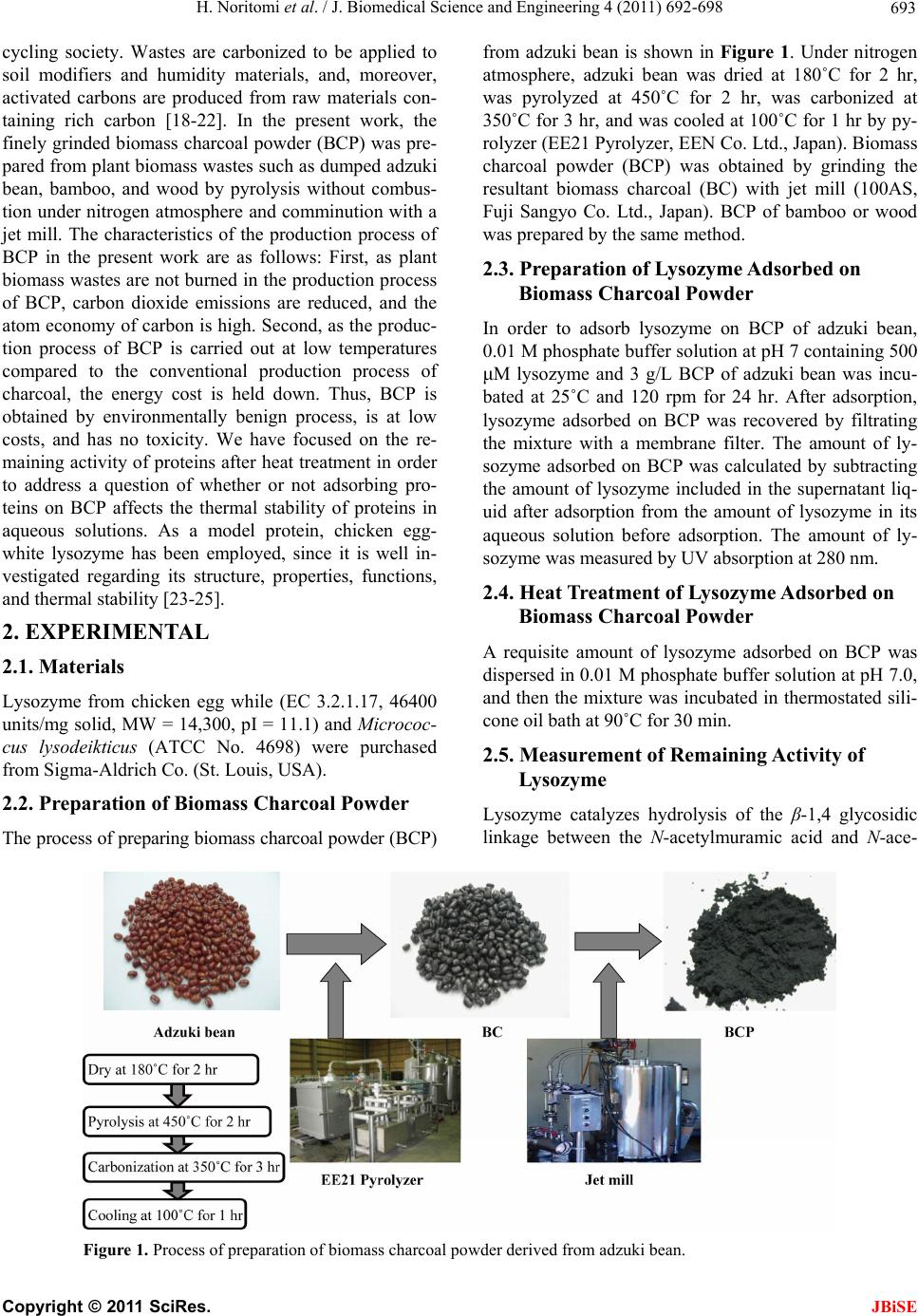 H. Noritomi et al. / J. Biomedical Science and Engineering 4 (2011) 692-698 693 cycling society. Wastes are carbonized to be applied to soil modifiers and humidity materials, and, moreover, activated carbons are produced from raw materials con- taining rich carbon [18-22]. In the present work, the finely grinded biomass charcoal powder (BCP) was pre- pared from plant biomass wastes such as dumped adzuki bean, bamboo, and wood by pyrolysis without combus- tion under nitrogen atmosphere and comminution with a jet mill. The characteristics of the production process of BCP in the present work are as follows: First, as plant biomass wastes are not burned in the production process of BCP, carbon dioxide emissions are reduced, and the atom economy of carbon is high. Second, as the produc- tion process of BCP is carried out at low temperatures compared to the conventional production process of charcoal, the energy cost is held down. Thus, BCP is obtained by environmentally benign process, is at low costs, and has no toxicity. We have focused on the re- maining activity of proteins after heat treatment in order to address a question of whether or not adsorbing pro- teins on BCP affects the thermal stability of proteins in aqueous solutions. As a model protein, chicken egg- white lysozyme has been employed, since it is well in- vestigated regarding its structure, properties, functions, and thermal stability [23-25]. 2. EXPERIMENTAL 2.1. Materials Lysozyme from chicken egg while (EC 3.2.1.17, 46400 units/mg solid, MW = 14,300, pI = 11.1) and Micrococ- cus lysodeikticus (ATCC No. 4698) were purchased from Sigma-Aldrich Co. (St. Louis, USA). 2.2. Preparation of Biomass Charcoal Powder The process of preparing biomass charcoal powder (BCP) from adzuki bean is shown in Figure 1. Under nitrogen atmosphere, adzuki bean was dried at 180˚C for 2 hr, was pyrolyzed at 450˚C for 2 hr, was carbonized at 350˚C for 3 hr, and was cooled at 100˚C for 1 hr by py- rolyzer (EE21 Pyrolyzer, EEN Co. Ltd., Japan). Biomass charcoal powder (BCP) was obtained by grinding the resultant biomass charcoal (BC) with jet mill (100AS, Fuji Sangyo Co. Ltd., Japan). BCP of bamboo or wood was prepared by the same method. 2.3. Preparation of Lysozyme Adsorbed on Biomass Charcoal Powder In order to adsorb lysozyme on BCP of adzuki bean, 0.01 M phosphate buffer solution at pH 7 containing 500 μM lysozyme and 3 g/L BCP of adzuki bean was incu- bated at 25˚C and 120 rpm for 24 hr. After adsorption, lysozyme adsorbed on BCP was recovered by filtrating the mixture with a membrane filter. The amount of ly- sozyme adsorbed on BCP was calculated by subtracting the amount of lysozyme included in the supernatant liq- uid after adsorption from the amount of lysozyme in its aqueous solution before adsorption. The amount of ly- sozyme was measured by UV absorption at 280 nm. 2.4. Heat Treatment of Lysozyme Adsorbed on Biomass Charcoal Powder A requisite amount of lysozyme adsorbed on BCP was dispersed in 0.01 M phosphate buffer solution at pH 7.0, and then the mixture was incubated in thermostated sili- cone oil bath at 90˚C for 30 min. 2.5. Measurement of Remaining Activity of Lysozyme Lysozyme catalyzes hydrolysis of the β-1,4 glycosidic linkage between the N-acetylmuramic acid and N-ace- Figure 1. Process of preparation of biomass charcoal powder derived from adzuki bean. C opyright © 2011 SciRes. JBiSE 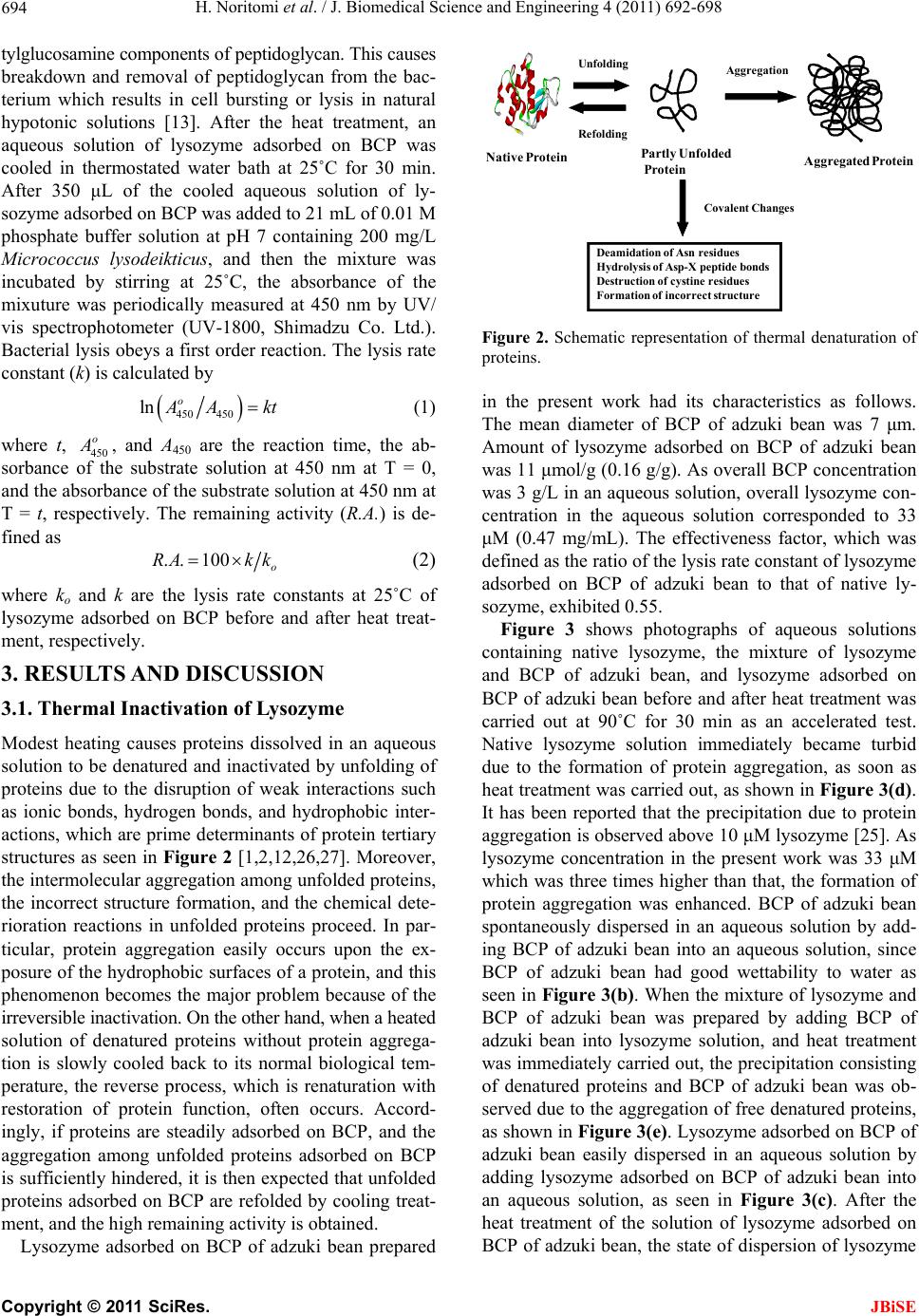 H. Noritomi et al. / J. Biomedical Science and Engineering 4 (2011) 692-698 694 tylglucosamine components of peptidoglycan. This causes breakdown and removal of peptidoglycan from the bac- terium which results in cell bursting or lysis in natural hypotonic solutions [13]. After the heat treatment, an aqueous solution of lysozyme adsorbed on BCP was cooled in thermostated water bath at 25˚C for 30 min. After 350 μL of the cooled aqueous solution of ly- sozyme adsorbed on BCP was added to 21 mL of 0.01 M phosphate buffer solution at pH 7 containing 200 mg/L Micrococcus lysodeikticus, and then the mixture was incubated by stirring at 25˚C, the absorbance of the mixuture was periodically measured at 450 nm by UV/ vis spectrophotometer (UV-1800, Shimadzu Co. Ltd.). Bacterial lysis obeys a first order reaction. The lysis rate constant (k) is calculated by 450 450 ln o A Akt (1) where t, 450 o A , and A450 are the reaction time, the ab- sorbance of the substrate solution at 450 nm at T = 0, and the absorbance of the substrate solution at 450 nm at T = t, respectively. The remaining activity (R.A.) is de- fined as .. 100o RAk k (2) where ko and k are the lysis rate constants at 25˚C of lysozyme adsorbed on BCP before and after heat treat- ment, respectively. 3. RESULT S AND DISCUSSION 3.1. Thermal Inactivation of Lysozyme Modest heating causes proteins dissolved in an aqueous solution to be denatured and inactivated by unfolding of proteins due to the disruption of weak interactions such as ionic bonds, hydrogen bonds, and hydrophobic inter- actions, which are prime determinants of protein tertiary structures as seen in Figure 2 [1,2,12,26,27]. Moreover, the intermolecular aggregation among unfolded proteins, the incorrect structure formation, and the chemical dete- rioration reactions in unfolded proteins proceed. In par- ticular, protein aggregation easily occurs upon the ex- posure of the hydrophobic surfaces of a protein, and this phenomenon becomes the major problem because of the irreversible inactivation. On the other hand, when a heated solution of denatured proteins without protein aggrega- tion is slowly cooled back to its normal biological tem- perature, the reverse process, which is renaturation with restoration of protein function, often occurs. Accord- ingly, if proteins are steadily adsorbed on BCP, and the aggregation among unfolded proteins adsorbed on BCP is sufficiently hindered, it is then expected that unfolded proteins adsorbed on BCP are refolded by cooling treat- ment, and the high remaining activity is obtained. Lysozyme adsorbed on BCP of adzuki bean prepared Aggregation Unfolding Partly Unfolded Protein Aggregated Protein Native Protein Refolding Covalent C han ges Deamidation of Asn residues Hydrolysis of Asp-X peptide bonds Destruction of cystine residues Format ion of incorrect structure Figure 2. Schematic representation of thermal denaturation of proteins. in the present work had its characteristics as follows. The mean diameter of BCP of adzuki bean was 7 μm. Amount of lysozyme adsorbed on BCP of adzuki bean was 11 μmol/g (0.16 g/g). As overall BCP concentration was 3 g/L in an aqueous solution, overall lysozyme con- centration in the aqueous solution corresponded to 33 μM (0.47 mg/mL). The effectiveness factor, which was defined as the ratio of the lysis rate constant of lysozyme adsorbed on BCP of adzuki bean to that of native ly- sozyme, exhibited 0.55. Figure 3 shows photographs of aqueous solutions containing native lysozyme, the mixture of lysozyme and BCP of adzuki bean, and lysozyme adsorbed on BCP of adzuki bean before and after heat treatment was carried out at 90˚C for 30 min as an accelerated test. Native lysozyme solution immediately became turbid due to the formation of protein aggregation, as soon as heat treatment was carried out, as shown in Figure 3(d). It has been reported that the precipitation due to protein aggregation is observed above 10 μM lysozyme [25]. As lysozyme concentration in the present work was 33 μM which was three times higher than that, the formation of protein aggregation was enhanced. BCP of adzuki bean spontaneously dispersed in an aqueous solution by add- ing BCP of adzuki bean into an aqueous solution, since BCP of adzuki bean had good wettability to water as seen in Figure 3(b). When the mixture of lysozyme and BCP of adzuki bean was prepared by adding BCP of adzuki bean into lysozyme solution, and heat treatment was immediately carried out, the precipitation consisting of denatured proteins and BCP of adzuki bean was ob- served due to the aggregation of free denatured proteins, as shown in Figure 3(e). Lysozyme adsorbed on BCP of adzuki bean easily dispersed in an aqueous solution by adding lysozyme adsorbed on BCP of adzuki bean into an aqueous solution, as seen in Figure 3(c). After the heat treatment of the solution of lysozyme adsorbed on BCP of adzuki bean, the state of dispersion of lysozyme C opyright © 2011 SciRes. JBiSE 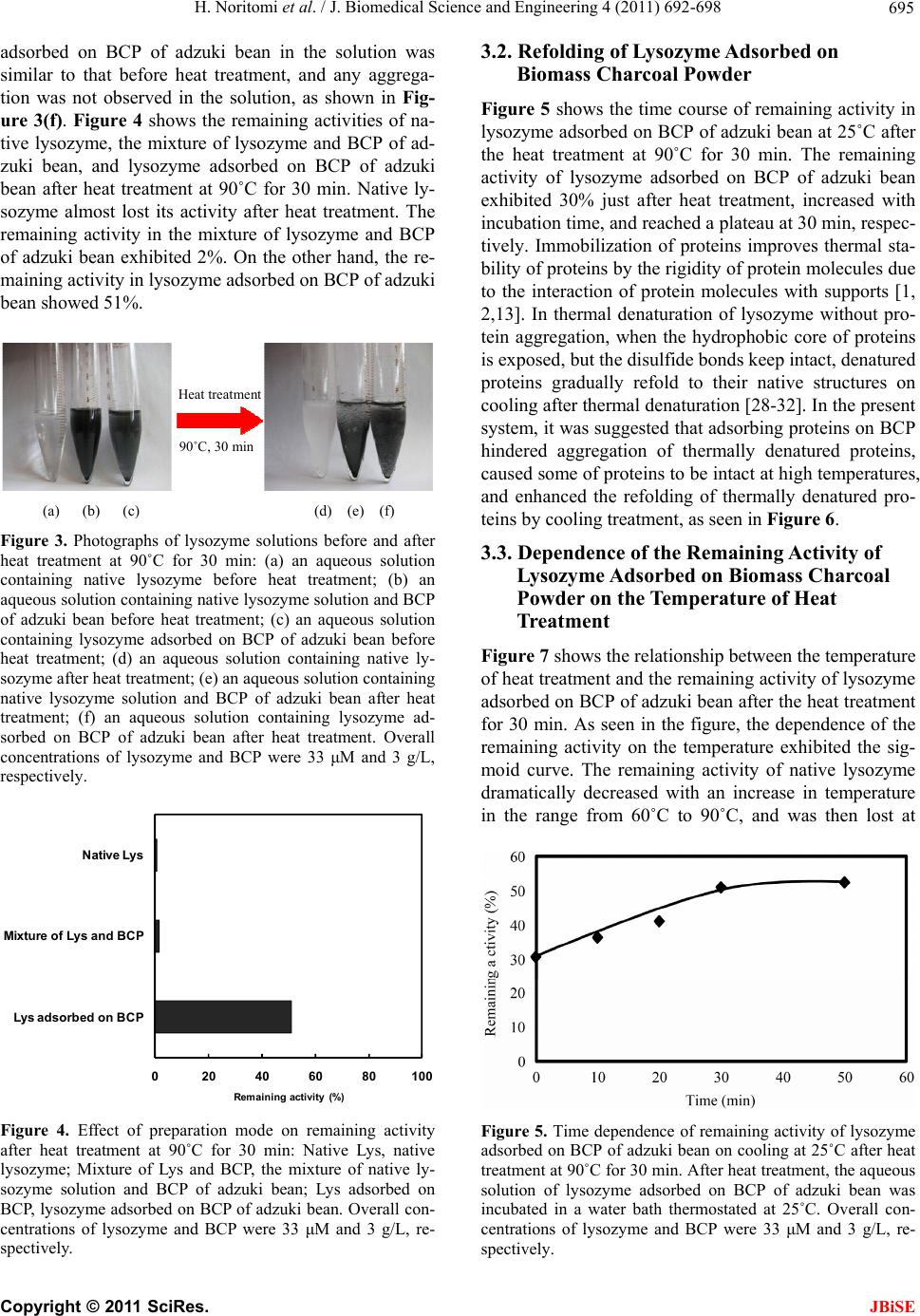 H. Noritomi et al. / J. Biomedical Science and Engineering 4 (2011) 692-698 695 adsorbed on BCP of adzuki bean in the solution was similar to that before heat treatment, and any aggrega- tion was not observed in the solution, as shown in Fig- ure 3(f). Figure 4 shows the remaining activities of na- tive lysozyme, the mixture of lysozyme and BCP of ad- zuki bean, and lysozyme adsorbed on BCP of adzuki bean after heat treatment at 90˚C for 30 min. Native ly- sozyme almost lost its activity after heat treatment. The remaining activity in the mixture of lysozyme and BCP of adzuki bean exhibited 2%. On the other hand, the re- maining activity in lysozyme adsorbed on BCP of adzuki bean showed 51%. Heat treatment 90˚C, 30 min (a) (b) (c) (d) (e) (f) Figure 3. Photographs of lysozyme solutions before and after heat treatment at 90˚C for 30 min: (a) an aqueous solution containing native lysozyme before heat treatment; (b) an aqueous solution containing native lysozyme solution and BCP of adzuki bean before heat treatment; (c) an aqueous solution containing lysozyme adsorbed on BCP of adzuki bean before heat treatment; (d) an aqueous solution containing native ly- sozyme after heat treatment; (e) an aqueous solution containing native lysozyme solution and BCP of adzuki bean after heat treatment; (f) an aqueous solution containing lysozyme ad- sorbed on BCP of adzuki bean after heat treatment. Overall concentrations of lysozyme and BCP were 33 μM and 3 g/L, respectively. 0 204060801 L y s ads or bed on BCP M i x t ur e of Lys and BCP Nat ive L ys Rema in in g activity (%) 00 Figure 4. Effect of preparation mode on remaining activity after heat treatment at 90˚C for 30 min: Native Lys, native lysozyme; Mixture of Lys and BCP, the mixture of native ly- sozyme solution and BCP of adzuki bean; Lys adsorbed on BCP, lysozyme adsorbed on BCP of adzuki bean. Overall con- centrations of lysozyme and BCP were 33 μM and 3 g/L, re- spectively. 3.2. Refolding of Lysozyme Adsorbed on Biomass Charcoal Powder Figure 5 shows the time course of remaining activity in lysozyme adsorbed on BCP of adzuki bean at 25˚C after the heat treatment at 90˚C for 30 min. The remaining activity of lysozyme adsorbed on BCP of adzuki bean exhibited 30% just after heat treatment, increased with incubation time, and reached a plateau at 30 min, respec- tively. Immobilization of proteins improves thermal sta- bility of proteins by the rigidity of protein molecules due to the interaction of protein molecules with supports [1, 2,13]. In thermal denaturation of lysozyme without pro- tein aggregation, when the hydrophobic core of proteins is exposed, but the disulfide bonds keep intact, denatured proteins gradually refold to their native structures on cooling after thermal denaturation [28-32]. In the present system, it was suggested that adsorbing proteins on BCP hindered aggregation of thermally denatured proteins, caused some of proteins to be intact at high temperatures, and enhanced the refolding of thermally denatured pro- teins by cooling treatment, as seen in Figure 6. 3.3. Dependence of the Remaining Activity of Lysozyme Adsorbed on Biomass Charcoal Powder on the Temperatu re of Heat Treatment Figure 7 shows the relationship between the temperature of heat treatment and the remaining activity of lysozyme adsorbed on BCP of adzuki bean after the heat treatment for 30 min. As seen in the figure, the dependence of the remaining activity on the temperature exhibited the sig- moid curve. The remaining activity of native lysozyme dramatically decreased with an increase in temperature in the range from 60˚C to 90˚C, and was then lost at Figure 5. Time dependence of remaining activity of lysozyme adsorbed on BCP of adzuki bean on cooling at 25˚C after heat treatment at 90˚C for 30 min. After heat treatment, the aqueous solution of lysozyme adsorbed on BCP of adzuki bean was incubated in a water bath thermostated at 25˚C. Overall con- centrations of lysozyme and BCP were 33 μM and 3 g/L, re- pectively. s C opyright © 2011 SciRes. JBiSE 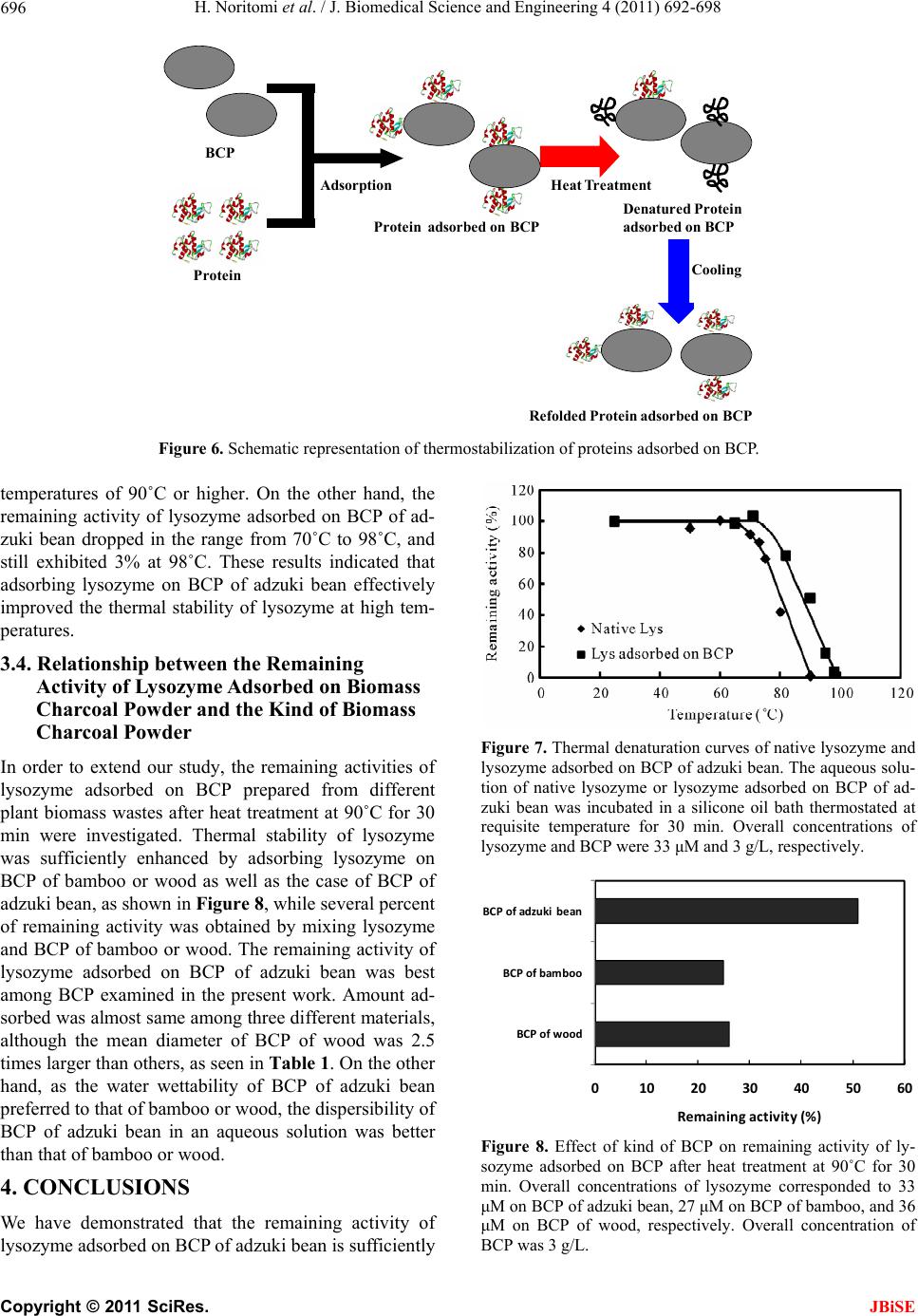 H. Noritomi et al. / J. Biomedical Science and Engineering 4 (2011) 692-698 Copyright © 2011 SciRes. 696 BCP Heat Treatment Protein Adsorption Cooling Ref old ed Protein a ds o rbed on BCP Protein adsorbed on BCPDen at ured Prot ein adsorbed on BCP Figure 6. Schematic representation of thermostabilization of proteins adsorbed on BCP. temperatures of 90˚C or higher. On the other hand, the remaining activity of lysozyme adsorbed on BCP of ad- zuki bean dropped in the range from 70˚C to 98˚C, and still exhibited 3% at 98˚C. These results indicated that adsorbing lysozyme on BCP of adzuki bean effectively improved the thermal stability of lysozyme at high tem- peratures. 3.4. Relationship between the Remaining Activity of Lysozyme Ads o rbed on Biomass Charcoal Powder and the Kind of Biomass Charcoal Powder Figure 7. Thermal denaturation curves of native lysozyme and lysozyme adsorbed on BCP of adzuki bean. The aqueous solu- tion of native lysozyme or lysozyme adsorbed on BCP of ad- zuki bean was incubated in a silicone oil bath thermostated at requisite temperature for 30 min. Overall concentrations of lysozyme and BCP were 33 μM and 3 g/L, respectively. In order to extend our study, the remaining activities of lysozyme adsorbed on BCP prepared from different plant biomass wastes after heat treatment at 90˚C for 30 min were investigated. Thermal stability of lysozyme was sufficiently enhanced by adsorbing lysozyme on BCP of bamboo or wood as well as the case of BCP of adzuki bean, as shown in Figure 8, while several percent of remaining activity was obtained by mixing lysozyme and BCP of bamboo or wood. The remaining activity of lysozyme adsorbed on BCP of adzuki bean was best among BCP examined in the present work. Amount ad- sorbed was almost same among three different materials, although the mean diameter of BCP of wood was 2.5 times larger than others, as seen in Table 1. On the other hand, as the water wettability of BCP of adzuki bean preferred to that of bamboo or wood, the dispersibility of BCP of adzuki bean in an aqueous solution was better than that of bamboo or wood. 0 10203040506 BCPofwood BCPofbamboo BC Pofad zu k ibe an Remain ingactivity(%) 0 Figure 8. Effect of kind of BCP on remaining activity of ly- sozyme adsorbed on BCP after heat treatment at 90˚C for 30 min. Overall concentrations of lysozyme corresponded to 33 μM on BCP of adzuki bean, 27 μM on BCP of bamboo, and 36 μM on BCP of wood, respectively. Overall concentration of BCP was 3 g/L. 4. CONCLUSIONS We have demonstrated that the remaining activity of lysozyme adsorbed on BCP of adzuki bean is sufficiently JBiSE 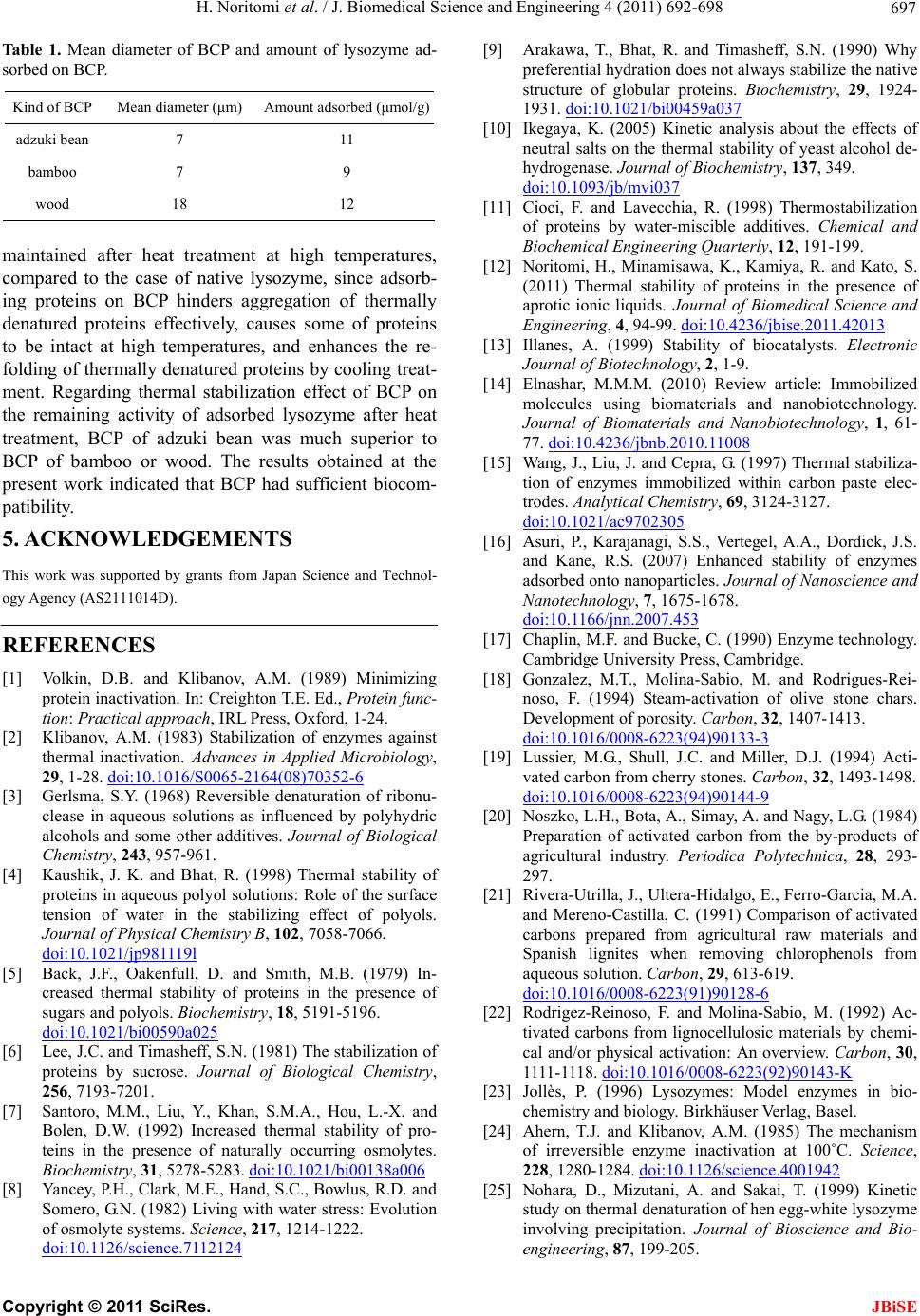 H. Noritomi et al. / J. Biomedical Science and Engineering 4 (2011) 692-698 697 Ta b le 1 . Mean diameter of BCP and amount of lysozyme ad- sorbed on BCP. Kind of BCP Mean diameter (μm) Amount adsorbed (μmol/g) adzuki bean 7 11 bamboo 7 9 wood 18 12 maintained after heat treatment at high temperatures, compared to the case of native lysozyme, since adsorb- ing proteins on BCP hinders aggregation of thermally denatured proteins effectively, causes some of proteins to be intact at high temperatures, and enhances the re- folding of thermally denatured proteins by cooling treat- ment. Regarding thermal stabilization effect of BCP on the remaining activity of adsorbed lysozyme after heat treatment, BCP of adzuki bean was much superior to BCP of bamboo or wood. The results obtained at the present work indicated that BCP had sufficient biocom- patibility. 5. ACKNOWLEDGEMENTS This work was supported by grants from Japan Science and Technol- ogy Agency (AS2111014D). REFERENCES [1] Volkin, D.B. and Klibanov, A.M. (1989) Minimizing protein inactivation. In: Creighton T.E. Ed., Protein func- tion: Practical approach, IRL Press, Oxford, 1-24. [2] Klibanov, A.M. (1983) Stabilization of enzymes against thermal inactivation. Advances in Applied Microbiology, 29, 1-28. doi:10.1016/S0065-2164(08)70352-6 [3] Gerlsma, S.Y. (1968) Reversible denaturation of ribonu- clease in aqueous solutions as influenced by polyhydric alcohols and some other additives. Journal of Biological Chemistry, 243, 957-961. [4] Kaushik, J. K. and Bhat, R. (1998) Thermal stability of proteins in aqueous polyol solutions: Role of the surface tension of water in the stabilizing effect of polyols. Journal of Physical Chemistry B, 102, 7058-7066. doi:10.1021/jp981119l [5] Back, J.F., Oakenfull, D. and Smith, M.B. (1979) In- creased thermal stability of proteins in the presence of sugars and polyols. Biochemistry, 18, 5191-5196. doi:10.1021/bi00590a025 [6] Lee, J.C. and Timasheff, S.N. (1981) The stabilization of proteins by sucrose. Journal of Biological Chemistry, 256, 7193-7201. [7] Santoro, M.M., Liu, Y., Khan, S.M.A., Hou, L.-X. and Bolen, D.W. (1992) Increased thermal stability of pro- teins in the presence of naturally occurring osmolytes. Biochemistry, 31, 5278-5283. doi:10.1021/bi00138a006 [8] Yancey, P.H., Clark, M.E., Hand, S.C., Bowlus, R.D. and Somero, G.N. (1982) Living with water stress: Evolution of osmolyte systems. Science, 217, 1214-1222. doi:10.1126/science.7112124 [9] Arakawa, T., Bhat, R. and Timasheff, S.N. (1990) Why preferential hydration does not always stabilize the native structure of globular proteins. Biochemistry, 29, 1924- 1931. doi:10.1021/bi00459a037 [10] Ikegaya, K. (2005) Kinetic analysis about the effects of neutral salts on the thermal stability of yeast alcohol de- hydrogenase. Journal of Biochemistry, 137, 349. doi:10.1093/jb/mvi037 [11] Cioci, F. and Lavecchia, R. (1998) Thermostabilization of proteins by water-miscible additives. Chemical and Biochemical Engineering Quarterly, 12, 191-199. [12] Noritomi, H., Minamisawa, K., Kamiya, R. and Kato, S. (2011) Thermal stability of proteins in the presence of aprotic ionic liquids. Journal of Biomedical Science and Engineering, 4, 94-99. doi:10.4236/jbise.2011.42013 [13] Illanes, A. (1999) Stability of biocatalysts. Electronic Journal of Biotechnology, 2, 1-9. [14] Elnashar, M.M.M. (2010) Review article: Immobilized molecules using biomaterials and nanobiotechnology. Journal of Biomaterials and Nanobiotechnology, 1, 61- 77. doi:10.4236/jbnb.2010.11008 [15] Wang, J., Liu, J. and Cepra, G. (1997) Thermal stabiliza- tion of enzymes immobilized within carbon paste elec- trodes. Analytical Chemistry, 69, 3124-3127. doi:10.1021/ac9702305 [16] Asuri, P., Karajanagi, S.S., Vertegel, A.A., Dordick, J.S. and Kane, R.S. (2007) Enhanced stability of enzymes adsorbed onto nanoparticles. Journal of Nanoscience and Nanotechnology, 7, 1675-1678. doi:10.1166/jnn.2007.453 [17] Chaplin, M.F. and Bucke, C. (1990) Enzyme technology. Cambridge University Press, Cambridge. [18] Gonzalez, M.T., Molina-Sabio, M. and Rodrigues-Rei- noso, F. (1994) Steam-activation of olive stone chars. Development of porosity. Carbon, 32, 1407-1413. doi:10.1016/0008-6223(94)90133-3 [19] Lussier, M.G., Shull, J.C. and Miller, D.J. (1994) Acti- vated carbon from cherry stones. Carbon, 32, 1493-1498. doi:10.1016/0008-6223(94)90144-9 [20] Noszko, L.H., Bota, A., Simay, A. and Nagy, L.G. (1984) Preparation of activated carbon from the by-products of agricultural industry. Periodica Polytechnica, 28, 293- 297. [21] Rivera-Utrilla, J., Ultera-Hidalgo, E., Ferro-Garcia, M.A. and Mereno-Castilla, C. (1991) Comparison of activated carbons prepared from agricultural raw materials and Spanish lignites when removing chlorophenols from aqueous solution. Carbon, 29, 613-619. doi:10.1016/0008-6223(91)90128-6 [22] Rodrigez-Reinoso, F. and Molina-Sabio, M. (1992) Ac- tivated carbons from lignocellulosic materials by chemi- cal and/or physical activation: An overview. Carbon, 30, 1111-1118. doi:10.1016/0008-6223(92)90143-K [23] Jollès, P. (1996) Lysozymes: Model enzymes in bio- chemistry and biology. Birkhäuser Verlag, Basel. [24] Ahern, T.J. and Klibanov, A.M. (1985) The mechanism of irreversible enzyme inactivation at 100˚C. Science, 228, 1280-1284. doi:10.1126/science.4001942 [25] Nohara, D., Mizutani, A. and Sakai, T. (1999) Kinetic study on thermal denaturation of hen egg-white lysozyme involving precipitation. Journal of Bioscience and Bio- engineering, 87, 199-205. C opyright © 2011 SciRes. JBiSE  H. Noritomi et al. / J. Biomedical Science and Engineering 4 (2011) 692-698 Copyright © 2011 SciRes. 698 JBiSE doi:10.1016/S1389-1723(99)89013-6 [26] Lumry, R. and Eyring, H. (1954) Conformation changes of proteins. Journal of Physical Chemistry, 58, 110-120. doi:10.1021/j150512a005 [27] Zale, S.E. and Klibanov, A.M. (1983) On the role of re- versible denaturation (unfolding) in the irreversible thermal inactivation of enzymes. Biotechnology and Bioengineering, 25, 2221-2230. doi:10.1002/bit.260250908 [28] Ibara-Molero, B. and Sanchez-Ruiz, J.M. (1997) Are there equilibrium intermediate states in the urea-induced unfolding of hen egg-white lysozyme? Biochemistry, 36, 9616-9624. doi:10.1021/bi9703305 [29] Griko, Y.V., Freire, E., Privalov, G., Dael, H.V. and Privalov, P.L. (1995) The unfolding thermodynamics of c-type lysozyme—A calorimetric study of the heat dena- turation of equine lysozyme. Journal of Molecular Biol- ogy, 252, 447-459. doi:10.1006/jmbi.1995.0510 [30] Privalov, P.L. and Khechinashvili, N.N. (1974) A ther- modynamic approach to the problem of stabilization of globular protein structure. Journal of Molecular Biology, 86, 665-684. doi:10.1016/0022-2836(74)90188-0 [31] Khechinashvili, N.N., Privalov, P.L. and Tiktopulo, E.I. (1973) Calorimetric investigation of lysozyme thermal denaturation. FEBS Letters, 30, 57-60. doi:10.1016/0014-5793(73)80618-0 [32] Anfinsen, C.B. (1973) Principles that govern the folding of protein chains. Science, 181, 223-230. doi:10.1126/science.181.4096.223 |