

Paper Menu >>
Journal Menu >>
 Materials Sciences and Applications, 2011, 2, 1627-1630 doi:10.4236/msa.2011.211216 Published Online November 2011 (http://www.SciRP.org/journal/msa) Copyright © 2011 SciRes. MSA 1627 Deformation-Induced Large Ductility of Super Saturated Solid Solution Fe-Cu Alloy Licai Fu*, Jun Yang, Q i nling Bi, Weim in Liu State Key Laboratory of Solid Lubrication, Lanzhou Institute of Chemical Physics, Chinese Academy of Sciences, Lanzhou, China. Email: *[email protected] Received September 25th, 2011; revised October 29th, 2011; accepted November 7th, 2011. ABSTRACT The mechanical properties of super saturated solid solution Fe60Cu40 alloy has been investigated using compression test. The results show that the grain precipitation and phase transformation occurs during compressive deformation result- ing in large work-hardening ability, high strength and large ductility. Our results demonstrate that this novel architec- ture offers a design pathway towards a new generation of strong materials with large ductility. Keywords: Fe-Cu Alloy, Super Solid Solution, Precipitation, Phase Transform, Ductility 1. Introduction Strength and ductility are of the most important me- chanical properties of structural materials. However, they are often difficult to obtain the high strong and large duc- tility simultaneously [1,2]. Generally, the low ductility of materials is attributed to the lack of work hardening caused by their inability to accumulate dislocations [3]. Therefore, the basic idea to improve the ductility of ma- terials is to regain the work hardening (dislocation ac- cumulation capability), which is often accompanied with sacrifice of strength. Classical methods for strengthening materials contain solid solution, dislocation, grain boun- dary and so on [4]. The solid solution strength metals are to alloy them with elements that are dissolved in the crystal lattice and form a solid solution. Such atoms elas- tically distort the crystal and can thus interact with the stress field of a dislocation and impede its movement, which results in high strength [5]. On the other hand, large numbers of reports indicated precipitate and phase transformation are also beneficial to improve the ductility during deformation of alloys. Kim showed that certain size of precipitate can improve the hardness and work hardening of the materials [6]. Their excellent mechani- cal properties result from the martensitic transformation of metastable retained austenite, induced by thermome- chanical loading [7,8]. Dendrite composite immiscible Fe60Cu40 alloy has been prepared successfully by combustion synthesis technique (CS) [9]. By controlling the applied pressure, the different super saturated solid solution Fe60Cu40 alloys have been obtained. Especially, there are not large composite seg- regation both in dendrite and matrix. In this paper, we examined the mechanical properties of this special alloy under compression test. The results show that the nano- scale precipitation and phase transformation occurs dur- ing compressive deformation resulting in large work- har- dening ability and high strength. Our results demonstrate that this novel architecture offers a design pathway to- wards both strong and ductility materials. 2. Experimental The Fe60Cu40 alloy has been prepared successfully by CS [9]. In this paper, the Fe60Cu40 alloys with different mi- crostructure have been produced by CS under different applied pressure with 8, 6 and 4 MPa of argon gas, which indicated as FC8, FC6 and FC4, respectively. Morpholo- gies and compositions of the Fe60Cu40 alloys were exam- ined using a JSM-5600LV scanning electron microscope (SEM) equipped with an energy dispersive X-ray spec- troscope (EDS, Kevex, USA). Cylindrical compressive specimens with length of 4.5 mm and a diameter of 2.8 mm were cut using an electro-discharging machine, and both ends of the compressive specimens were polished to mirror surfaces, and coated with graphite before tests to reduce the interfacial friction. Quai-static uniaxial com- pression test were performed at room temperature using a testing machine with a crosshead speed of 3.5 × 10⁻³ s–1. The before and after compression test samples were in- 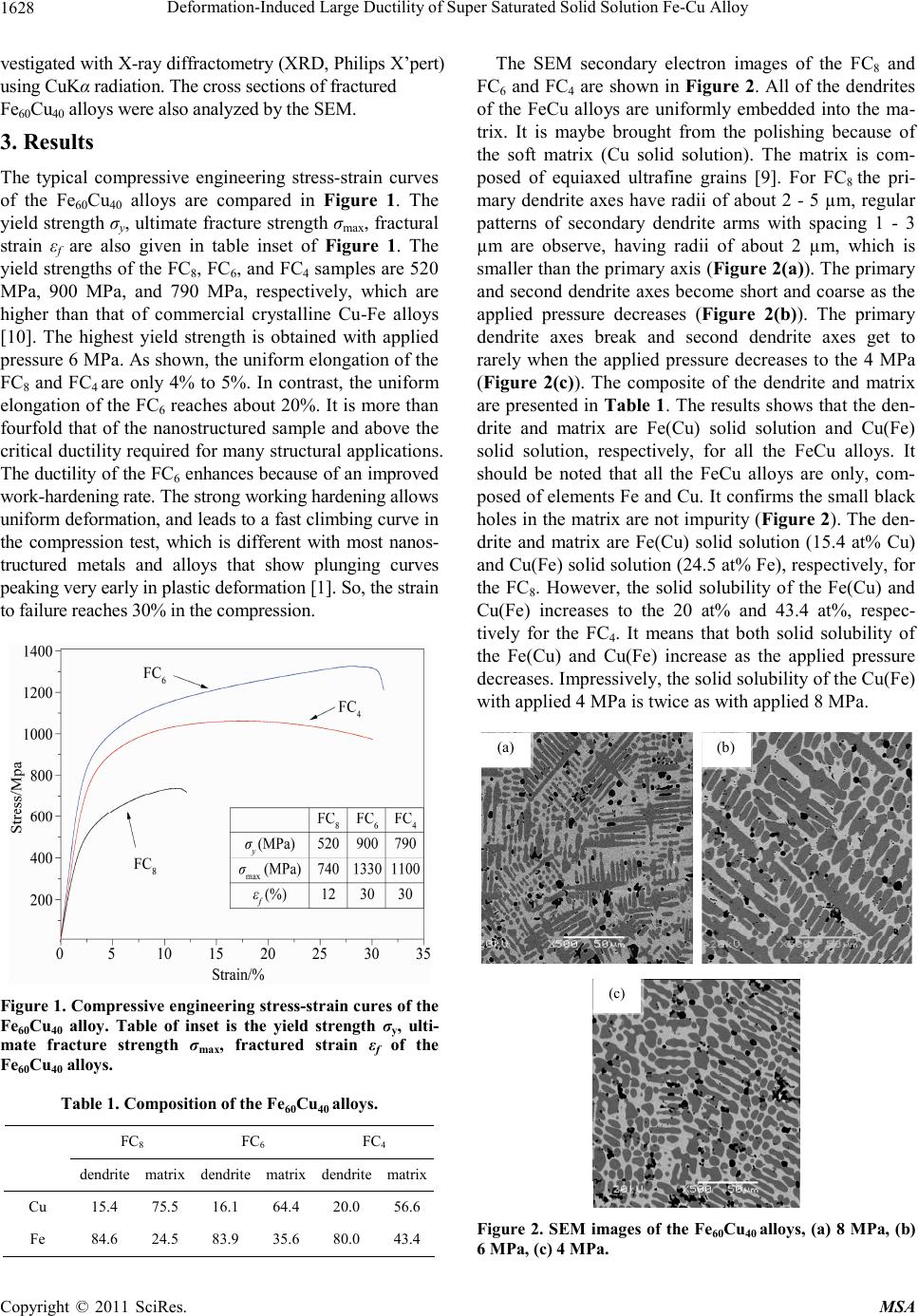 Deformation-Induced Large Ductility of Super Saturated Solid Solution Fe-Cu Alloy 1628 vestigated with X-ray diffractometry (XRD, Philips X’pert) using CuKα radiation. The cross sections of fractured Fe60Cu40 alloys were also analyzed by the SEM. 3. Results The typical compressive engineering stress-strain curves of the Fe60Cu40 alloys are compared in Figure 1. The yield strength σy, ultimate fracture strength σmax , fractural strain εf are also given in table inset of Figure 1. The yield strengths of the FC8, FC6, and FC4 samples are 520 MPa, 900 MPa, and 790 MPa, respectively, which are higher than that of commercial crystalline Cu-Fe alloys [10]. The highest yield strength is obtained with applied pressure 6 MPa. As shown, the uniform elongation of the FC8 and FC4 are only 4% to 5%. In contrast, the uniform elongation of the FC6 reaches about 20%. It is more than fourfold that of the nanostructured sample and above the critical ductility required for many structural applications. The ductility of the FC6 enhances because of an improved work-hardening rate. The strong working hardening allows uniform deformation, and leads to a fast climbing curve in the compression test, which is different with most nanos- tructured metals and alloys that show plunging curves peaking very early in plastic deformation [1]. So, the strain to failure reaches 30% in the compression. Figure 1. Compressive enginee ring stress-strain cures of the Fe60Cu40 alloy. Table of inset is the yield strength σy, ulti- mate fracture strength σmax, fractured strain εf of the Fe60Cu40 alloys. Table 1. Composition of the Fe60Cu40 alloys. FC8 FC6 FC4 dendrite matrix dendrite matrix dendritematrix Cu 15.4 75.5 16.1 64.4 20.0 56.6 Fe 84.6 24.5 83.9 35.6 80.0 43.4 The SEM secondary electron images of the FC8 and FC6 and FC4 are shown in Figure 2. All of the dendrites of the FeCu alloys are uniformly embedded into the ma- trix. It is maybe brought from the polishing because of the soft matrix (Cu solid solution). The matrix is com- posed of equiaxed ultrafine grains [9]. For FC8 the pri- mary dendrite axes have radii of about 2 - 5 µm, regular patterns of secondary dendrite arms with spacing 1 - 3 µm are observe, having radii of about 2 µm, which is smaller than the primary axis (Figure 2(a)). The primary and second dendrite axes become short and coarse as the applied pressure decreases (Figure 2(b)). The primary dendrite axes break and second dendrite axes get to rarely when the applied pressure decreases to the 4 MPa (Figure 2(c)). The composite of the dendrite and matrix are presented in Table 1 . The results shows that the den- drite and matrix are Fe(Cu) solid solution and Cu(Fe) solid solution, respectively, for all the FeCu alloys. It should be noted that all the FeCu alloys are only, com- posed of elements Fe and Cu. It confirms the small black holes in the matrix are not impurity (Figure 2). The den- drite and matrix are Fe(Cu) solid solution (15.4 at% Cu) and Cu(Fe) solid solution (24.5 at% Fe), respectively, for the FC8. However, the solid solubility of the Fe(Cu) and Cu(Fe) increases to the 20 at% and 43.4 at%, respec- tively for the FC4. It means that both solid solubility of the Fe(Cu) and Cu(Fe) increase as the applied pressure decreases. Impressively, the solid solubility of the Cu(Fe) with applied 4 MPa is twice as with applied 8 MPa. (a) (b) (c) Figure 2. SEM images of the Fe60Cu40 alloys, (a) 8 MPa, (b) 6 MPa, (c) 4 MPa. Copyright © 2011 SciRes. MSA  Deformation-Induced Large Ductility of Super Saturated Solid Solution Fe-Cu Alloy1629 Figure 3 shows the XRD pattern of Fe60Cu40 alloys before and after compressive deformation. All the FC8, FC6, and FC4 before and after compressive deformation contain the -Cu-rich and the α-Fe-rich phases. The dif- fraction peak γ-Fe-rich phase changes weak as the ap- plied pressure decreases, and the γ-Fe-rich phase has not been examined using XRD when the applied pressure decreases to 4 MPa. However, the γ-Fe structure occurs after FC4 deformation. Another impressively characteri- zation is that the diffraction peaks of the -Cu-rich struc- ture shift towards higher angles and γ-Fe-rich towards lower angle after Fe60Cu40 alloys deformation. It means that the solid solution of the -Cu-rich and γ-Fe-rich in Fe60Cu40 alloys decreases after the compressive deforma- tion. It is to be noted that FC6 has the highest ratio of -Cu-rich to γ-Fe-rich (defined as ratio of diffraction peaks). The fractography of the Fe60Cu40 alloys is shown in Figure 4. The intergranular fracture feature has been ob- served in the fractured surface of the FC6 (Figure 4(a)). The crack occurs along the dendrite axis because of the stress concentration in soft matrix in the compressive deformation. Some of the dendrite axis cracked when the stress concentration increases to the critical value, such as the zone of Ⅲ. The Figure 4(b), (c) and (d) are mag- nification of the Ⅰ, Ⅱ and Ⅲ of the Figure 4(a), re- spectively. Far from the fractured dendrite axis, large numbers of small grains precipitate from the dendrite and matrix (Figure 4(b)). Near the fractured dendrite axis (Ⅱ), more precipitations occur, and lots of dimples has been observed with grain size of ultrafine scale compar- ing with the precipitation. The visible melt traces (Figure 4(d)) are regarded as matrix (melt pointing is about 1000˚C) because the local temperature maybe is higher 1000˚C the local stress concentration as the sample fractures. The 40 50 60 70 80 90100 2Thet a 8 MPa 4 MPa Deformed before Deformed after -Fe(Cu) -Cu(Fe) -Fe(Cu) 6 MPa Figure 3. XRD patterns of the deformed before and after Fe60Cu40 alloys. Figure 4. Fractography of the Fe60Cu40 alloys (a), (b), (c), (d) FC6; (e) FC4; (f) FC8. dimples indicate good working har- den of the FC6. The super saturated solid solution of the FC4 with Cu(Fe) and Fe(Cu) is close to the FC6. Thus, the yield strength rea- ches 790 MPa, is near the yield strength of the FC6 (900 MPa). However, the local stress concentration of the FC4 is smaller than that of the FC6, because the dendrite axis of the FC4 is coarse and short compared with the FC6. So, the working harden is decreases even the negative value. For the FC8, owing to the smaller dendrite axis and sma- ller solid solution, the strength and ductility are smaller than that of the FC6. 4. Conclusions In this paper, the bulk immiscible Fe60Cu 40 alloy is suc- cessfully prepared by a combustion synthesis technique. The Fe60Cu40 alloy is composed of Fe-rich dendritic em- bedded in Cu-rich matrix uniformly. The content of the dendrite and matrix are 34.5% and 65.5%, respectively. The grain size of matrix is about 30 nm. Owing to the very high superheating (4700˚C) of combustion synthesis, the deeply undercooling is obtained, resulting there no large-scaled phase separation into Cu-rich and Fe-rich phases. Copyright © 2011 SciRes. MSA  Deformation-Induced Large Ductility of Super Saturated Solid Solution Fe-Cu Alloy Copyright © 2011 SciRes. MSA 1630 REFERENCES [1] M. A. Meyers, A. Mishra and D. J. Benson, “Mechanical Properties of Nanocrystalline Materials,” Progress in Ma- terials Science, Vol. 51, No. 4, 2006, pp. 427-556. doi:10.1016/j.pmatsci.2005.08.003 [2] C. C. Koch, I. A. Ovid’ko, S. Seal and S. Veprek, “Struc- tural Nanocrystalline Materials: Fundamentals and Appli- cations,” Cambridge University Press, Cambridge, 2007. doi:10.1017/CBO9780511618840 [3] L. Capolungo, D. E. Spearot, M. Cherkaoui, D. L. Mc- Dowell, J. Qu and K. I. Jacob, “Dislocation Nucleation from Bicrystal Interfaces and Grain Boundary Ledges: Re- lationship to Nanocrystalline Deformation,” Journal of the Mechanics and Physics of Solids, Vol. 55, No. 11, 2007, pp. 2300-2327. doi:10.1016/j.jmps.2007.04.001 [4] K. Lu, L. Lu and S. Suresh, “Strengthening Materials by Engineering Coherent Internal Boundaries at the Nano- scale,” Science, Vol. 324, No. 5925, 2009, pp. 349-352. [5] J. Rösler, H. Harders and M. Bäker, “Mechanical Behav- iour of Engineering Materials,” Springer-Verlag, Berlin 2007. [6] J. Kim, M. Lee, D. Kim and R. Wagoner, “Micromechan- ics-Based Strain Hardening Model in Consideration of Dislocation-Precipitate Interactions,” Metals and Materi- als International, Vol. 17, 2011, p. 291. do i:10.1007/s12540-011-0417-4 [7] Y. Ivanisenko, I. MacLaren, X. Sauvage, R. Z. Valiev and H. Fecht, “Shear-Induced α → γ Transformation in Nano- scale Fe-C Composite,” Acta Materialia, Vol. 54, No. 6, 2006, pp. 1659-1669. doi:10.1016/j.actamat.2005.11.034 [8] C. Yoo, Y. Park, Y. Jung and Y. Lee, “Effect of Grain Size on Transformation-Induced Plasticity in an Ultrafine-Grai- ned Metastable Austenitic Steel,” Scripta Materialia, Vol. 59, No. 1, 2008, pp. 71-74. doi:10.1016/j.scriptamat.2008.02.024 [9] L. Fu, J. Yang, Q. Bi and W. Liu, “Combustion Synthesis Immiscible Nanostructured Fe-Cu Alloy,” Journal of Al- loys and Compounds, Vol. 482, No. 1-2, 2009, pp. L22- L24. doi:10.1016/j.jallcom.2009.04.016 [10] H. Kakisawa, K. Minagawa and K. Halada, “Tensile Be- havior Change Depending on the Microstructure of a Fe-Cu Alloy Produced from Rapidly Solidified Powder,” Materials Science and Engineering: A, Vol. 340, No. 1-2, 2003, pp. 175-180. doi:10.1016/S0921-5093(02)00171-5 |