

Paper Menu >>
Journal Menu >>
 Materials Science s a nd Applications, 2011, 2, 1622-1626 doi:10.4236/msa.2011.211215 Published Online November 2011 (http://www.SciRP.org/journal/msa) Copyright © 2011 SciRes. MSA A Novel and Simple Route to Synthesis Nanocrystalline Titanium Carbide via the Reaction of Titanium Dioxide and Different Carbon Source Youjian Chen1, Yongyong Deng1, Hong Zhang1, Lihua Wang3, Jianhua Ma1,2* 1College of Chemistry and Materials Engineering, Wenzhou University, Wenzhou, China; 2Nanomaterials and Chemistry Key Labo- ratory, Advanced Materials Research Center of Wenzhou, Wenzhou University, Wenzhou, China; 3Shimadzu International Trading (Shanghai) Co., Ltd., Guangzhou, China. Email: *[email protected] Received September 10th, 2011; revised October 25th, 2011; accepted November 6th, 2011. ABSTRACT A novel and simple route for synthesizing nanocrystalline ceramic powders in molten salt was introduced in the paper. Titanium carbide (TiC) was prepared via the reaction of metallic magnesium powders with titanium dioxide (TiO2), carbon source and molten salt in an autoclave at 650˚C. Carbon source (oxalic acid and citric acid) in this paper was stable, low toxic and cheap. X-ray powder diffraction (XRD) patterns indicated that the products were cubic TiC. Scanning electron microscopy (SEM) images showed that the samples consisted of particles with an average size of 200 nm and 100 nm in diameter, respectively. Energy Dispersive Spectrometer (EDS) analysis of the samples suggested the products contained carbon and titanium elements. The product was also studied by the thermogravimetric analysis (TGA). It had good thermal stability and oxidation resistance below 350˚C in air. Keywords: Titanium Carbide, Chemical Synthesis, X-Ray Diffraction, Scanning Electron Microscopy 1. Introduction It is known that transition metal carbides have found extensive applications in many fields, such as cutting tools, wear-resistant parts and high-temperature structural ma- terials because of their outing properties, such as high hardness, high melting point, high thermal conductivity, high strength even at high temperatures, high wear and corrosion resistance, and a high degree of chemical sta- bility [1-3]. Recently, much attention has been paid to their catalytic properties because they exhibit activities similar to those of the noble metals [4]. Titanium carbide (TiC) is one of the most important compounds among transition metal carbides, due to its promising physical and chemical properties, such as a high melting temperature (3140˚C), a high boiling tem- perature (4820˚C), high Vickers hardness (28 - 35 GPa), high Young’s modulus (410 - 450 GPa), low density (4.93 g·cm–3), high flexure strength (240 - 400 N/mm2), good thermal conductivity (21 W/m2 × K), high resistance to corrosion and oxidation, high abrasion resistance, and high thermal shock resistance [5-8]. So it is widely used for cutting materials, abrasive, anti-wear and aerospace materials [9-11]. At the same time, it can also be used as a substitute for tungsten carbide in cermets because they have similar properties of high hardness and wear resis- tance, what’s more, nickel is used as binder for TiC is cheaper and less toxic than cobalt which WC requires as a binder [12]. Because of the promising properties and extensive application of TiC, it is meaningful to synthe- size nanocrystalline TiC in a simple route at low tempe- rature and with convenient manipulations. Traditionally, TiC powders are commercially synthe- sized via the reaction of titanium dioxide and carbon in the temperature range of 1700˚C - 2300˚C for 10 - 24 h [13], it is important to develop new technics to replace the old method which wastes time and energy. Recently, some new methods have been used to synthesize titanium carbide. Chandra et al. [14] synthesized nano-TiC pow- der using titanium gel precursor and carbon particles in the range of 1300˚C - 1580˚C for 2 h under argon cover. 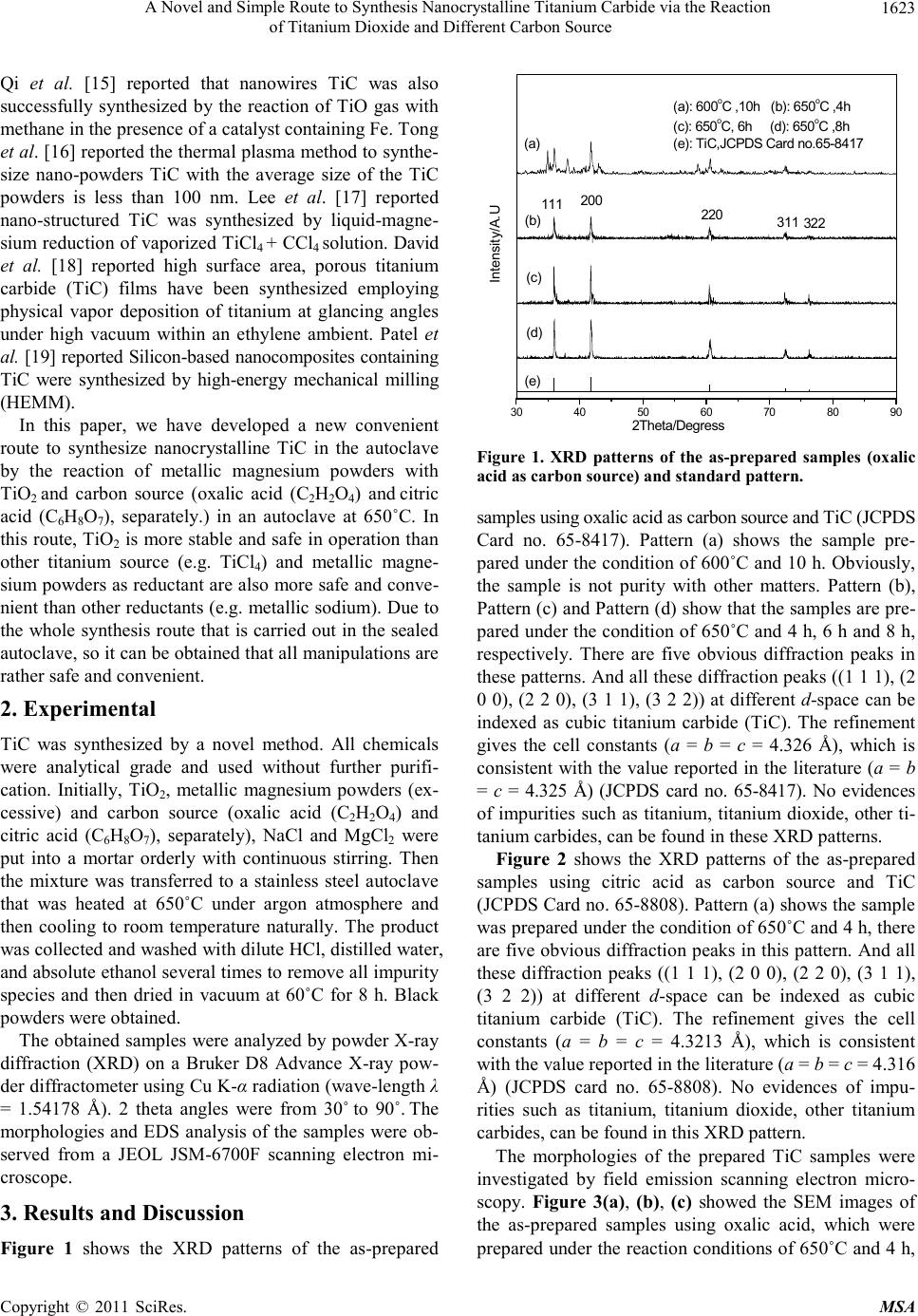 A Novel and Simple Route to Synthesis Nanocrystalline Titanium Carbide via the Reaction 1623 of Titanium Dioxide and Different Carbon Source Qi et al. [15] reported that nanowires TiC was also successfully synthesized by the reaction of TiO gas with methane in the presence of a catalyst containing Fe. Tong et al. [16] reported the thermal plasma method to synthe- size nano-powders TiC with the average size of the TiC powders is less than 100 nm. Lee et al. [17] reported nano-structured TiC was synthesized by liquid-magne- sium reduction of vaporized TiCl4 + CCl4 solution. David et al. [18] reported high surface area, porous titanium carbide (TiC) films have been synthesized employing physical vapor deposition of titanium at glancing angles under high vacuum within an ethylene ambient. Patel et al. [19] reported Silicon-based nanocomposites containing TiC were synthesized by high-energy mechanical milling (HEMM). In this paper, we have developed a new convenient route to synthesize nanocrystalline TiC in the autoclave by the reaction of metallic magnesium powders with TiO2 and carbon source (oxalic acid (C2H2O4) and citric acid (C6H8O7), separately.) in an autoclave at 650˚C. In this route, TiO2 is more stable and safe in operation than other titanium source (e.g. TiCl4) and metallic magne- sium powders as reductant are also more safe and conve- nient than other reductants (e.g. metallic sodium). Due to the whole synthesis route that is carried out in the sealed autoclave, so it can be obtained that all manipulations are rather safe and convenient. 2. Experimental TiC was synthesized by a novel method. All chemicals were analytical grade and used without further purifi- cation. Initially, TiO2, metallic magnesium powders (ex- cessive) and carbon source (oxalic acid (C2H2O4) and citric acid (C6H8O7), separately), NaCl and MgCl2 were put into a mortar orderly with continuous stirring. Then the mixture was transferred to a stainless steel autoclave that was heated at 650˚C under argon atmosphere and then cooling to room temperature naturally. The product was collected and washed with dilute HCl, distilled water, and absolute ethanol several times to remove all impurity species and then dried in vacuum at 60˚C for 8 h. Black powders were obtained. The obtained samples were analyzed by powder X-ray diffraction (XRD) on a Bruker D8 Advance X-ray pow- der diffractometer using Cu K-α radiation (wave-length λ = 1.54178 Å). 2 theta angles were from 30˚ to 90˚. The morphologies and EDS analysis of the samples were ob- served from a JEOL JSM-6700F scanning electron mi- croscope. 3. Results and Discussion Figure 1 shows the XRD patterns of the as-prepared 30 40 50 6070 80 90 2Theta/Degress (a) (b) (c) (d) (e) (a): 60 0oC ,10 h (b): 6 50oC ,4h (c): 6 50oC, 6h (d): 650oC ,8h (e): TiC,JCPDS Card no .65-8417 111 200 220 311 322 Intensity/A.U Figure 1. XRD patterns of the as-prepared samples (oxalic acid as carbon source) and standard pattern. samples using oxalic acid as carbon source and TiC (JCPDS Card no. 65-8417). Pattern (a) shows the sample pre- pared under the condition of 600˚C and 10 h. Obviously, the sample is not purity with other matters. Pattern (b), Pattern (c) and Pattern (d) show that the samples are pre- pared under the condition of 650˚C and 4 h, 6 h and 8 h, respectively. There are five obvious diffraction peaks in these patterns. And all these diffraction peaks ((1 1 1), (2 0 0), (2 2 0), (3 1 1), (3 2 2)) at different d-space can be indexed as cubic titanium carbide (TiC). The refinement gives the cell constants (a = b = c = 4.326 Å), which is consistent with the value reported in the literature (a = b = c = 4.325 Å) (JCPDS card no. 65-8417). No evidences of impurities such as titanium, titanium dioxide, other ti- tanium carbides, can be found in these XRD patterns. Figure 2 shows the XRD patterns of the as-prepared samples using citric acid as carbon source and TiC (JCPDS Card no. 65-8808). Pattern (a) shows the sample was prepared under the condition of 650˚C and 4 h, there are five obvious diffraction peaks in this pattern. And all these diffraction peaks ((1 1 1), (2 0 0), (2 2 0), (3 1 1), (3 2 2)) at different d-space can be indexed as cubic titanium carbide (TiC). The refinement gives the cell constants (a = b = c = 4.3213 Å), which is consistent with the value reported in the literature (a = b = c = 4.316 Å) (JCPDS card no. 65-8808). No evidences of impu- rities such as titanium, titanium dioxide, other titanium carbides, can be found in this XRD pattern. The morphologies of the prepared TiC samples were investigated by field emission scanning electron micro- scopy. Figure 3(a), (b), (c) showed the SEM images of the as-prepared samples using oxalic acid, which were prepared under the reaction conditions of 650˚C and 4 h, Copyright © 2011 SciRes. MSA 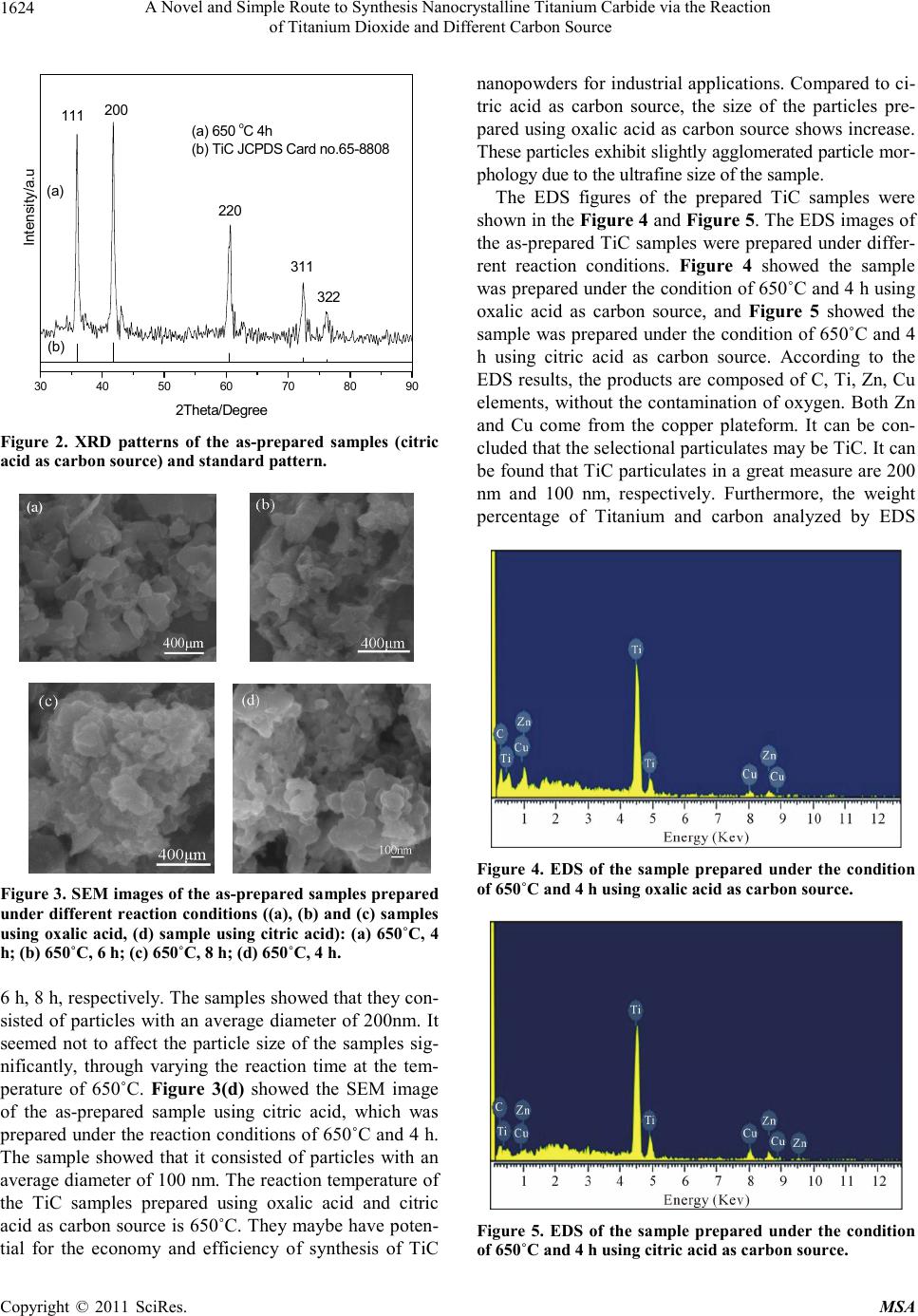 A Novel and Simple Route to Synthesis Nanocrystalline Titanium Carbide via the Reaction 1624 of Titanium Dioxide and Different Carbon Source 30 40 5060 70 80 90 2Theta/Degree (b) (a) 111 200 220 311 322 Intensity/a.u (a) 650 oC 4h (b) TiC JCP DS Card no. 65-880 8 Figure 2. XRD patterns of the as-prepared samples (citric acid as carbon sour ce) and standar d pattern. Figure 3. SEM images of the as-prepare d samples prepare d under different reaction conditions ((a), (b) and (c) samples using oxalic acid, (d) sample using citric acid): (a) 650˚C, 4 h; (b) 650˚C, 6 h; (c) 650˚C, 8 h; (d) 650˚C, 4 h. 6 h, 8 h, respectively. The samples showed that they con- sisted of particles with an average diameter of 200nm. It seemed not to affect the particle size of the samples sig- nificantly, through varying the reaction time at the tem- perature of 650˚C. Figure 3(d) showed the SEM image of the as-prepared sample using citric acid, which was prepared under the reaction conditions of 650˚C and 4 h. The sample showed that it consisted of particles with an average diameter of 100 nm. The reaction temperature of the TiC samples prepared using oxalic acid and citric acid as carbon source is 650˚C. They maybe have poten- tial for the economy and efficiency of synthesis of TiC nanopowders for industrial applications. Compared to ci- tric acid as carbon source, the size of the particles pre- pared using oxalic acid as carbon source shows increase. These particles exhibit slightly agglomerated particle mor- phology due to the ultrafine size of the sample. The EDS figures of the prepared TiC samples were shown in the Figure 4 and Figure 5. The EDS images of the as-prepared TiC samples were prepared under differ- rent reaction conditions. Figure 4 showed the sample was prepared under the condition of 650˚C and 4 h using oxalic acid as carbon source, and Figure 5 showed the sample was prepared under the condition of 650˚C and 4 h using citric acid as carbon source. According to the EDS results, the products are composed of C, Ti, Zn, Cu elements, without the contamination of oxygen. Both Zn and Cu come from the copper plateform. It can be con- cluded that the selectional particulates may be TiC. It can be found that TiC particulates in a great measure are 200 nm and 100 nm, respectively. Furthermore, the weight percentage of Titanium and carbon analyzed by EDS Figure 4. EDS of the sample prepared under the condition of 650˚C and 4 h using ox alic acid as carbo n sour ce. Figure 5. EDS of the sample prepared under the condition of 650˚C and 4 h using citric acid as car bon source. Copyright © 2011 SciRes. MSA 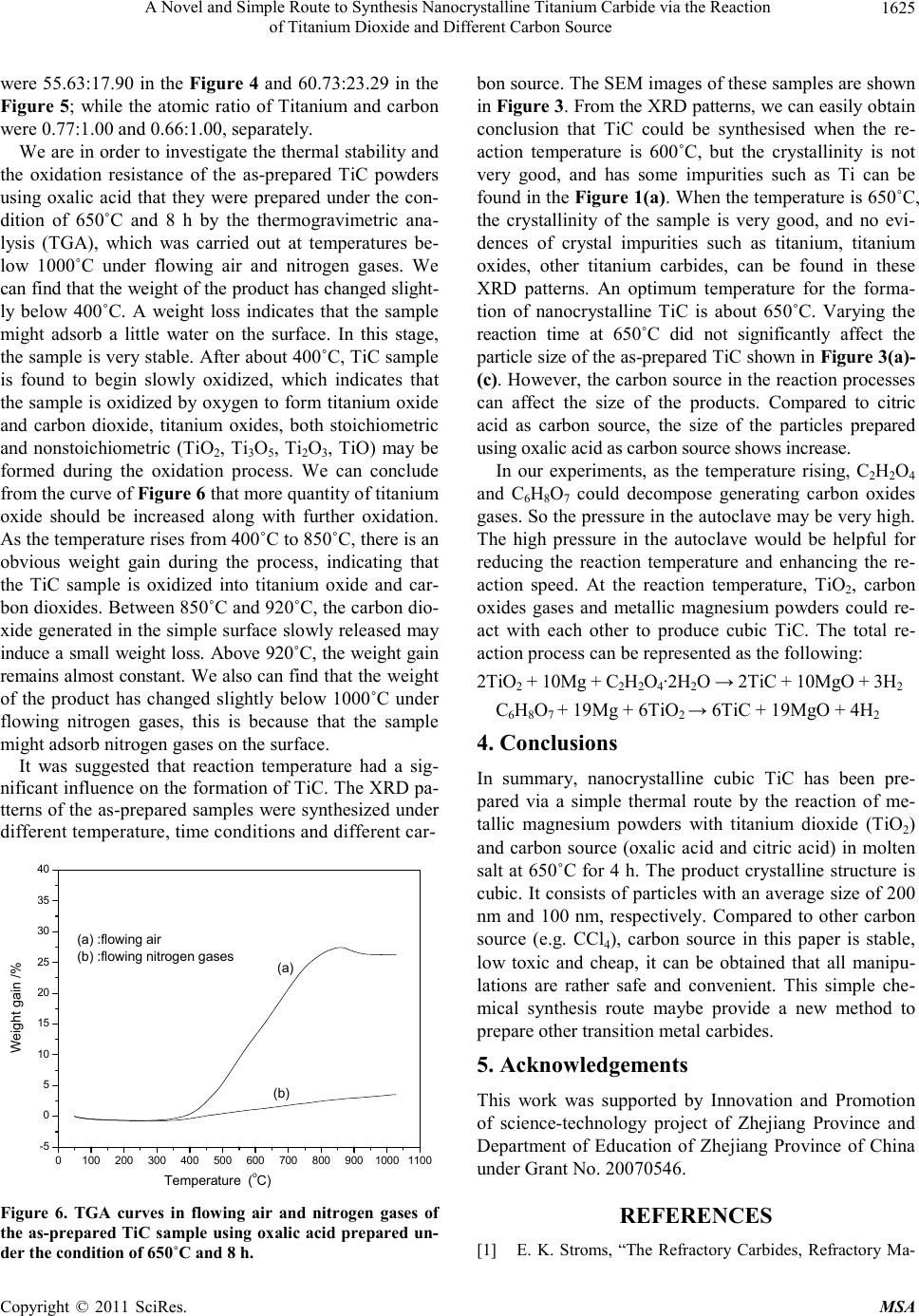 A Novel and Simple Route to Synthesis Nanocrystalline Titanium Carbide via the Reaction 1625 of Titanium Dioxide and Different Carbon Source were 55.63:17.90 in the Figure 4 and 60.73:23.29 in the Figure 5; while the atomic ratio of Titanium and carbon were 0.77:1.00 and 0.66:1.00, separately. We are in order to investigate the thermal stability and the oxidation resistance of the as-prepared TiC powders using oxalic acid that they were prepared under the con- dition of 650˚C and 8 h by the thermogravimetric ana- lysis (TGA), which was carried out at temperatures be- low 1000˚C under flowing air and nitrogen gases. We can find that the weight of the product has changed slight- ly below 400˚C. A weight loss indicates that the sample might adsorb a little water on the surface. In this stage, the sample is very stable. After about 400˚C, TiC sample is found to begin slowly oxidized, which indicates that the sample is oxidized by oxygen to form titanium oxide and carbon dioxide, titanium oxides, both stoichiometric and nonstoichiometric (TiO2, Ti3O5, Ti2O3, TiO) may be formed during the oxidation process. We can conclude from the curve of Figure 6 that more quantity of titanium oxide should be increased along with further oxidation. As the temperature rises from 400˚C to 850˚C, there is an obvious weight gain during the process, indicating that the TiC sample is oxidized into titanium oxide and car- bon dioxides. Between 850˚C and 920˚C, the carbon dio- xide generated in the simple surface slowly released may induce a small weight loss. Above 920˚C, the weight gain remains almost constant. We also can find that the weight of the product has changed slightly below 1000˚C under flowing nitrogen gases, this is because that the sample might adsorb nitrogen gases on the surface. It was suggested that reaction temperature had a sig- nificant influence on the formation of TiC. The XRD pa- tterns of the as-prepared samples were synthesized under different temperature, time conditions and different car- 0100 200 300 400 500 600700 800 90010001100 -5 0 5 10 15 20 25 30 35 40 Weight gain /% Temperature (oC) (a) (b) (a) :flowing air (b) :flowing nitrogen gases Figure 6. TGA curves in flowing air and nitrogen gases of the as-prepared TiC sample using oxalic acid prepared un- der the condition of 650˚C and 8 h. bon source. The SEM images of these samples are shown in Figure 3. From the XRD patterns, we can easily obtain conclusion that TiC could be synthesised when the re- action temperature is 600˚C, but the crystallinity is not very good, and has some impurities such as Ti can be found in the Figure 1(a). When the temperature is 650˚C, the crystallinity of the sample is very good, and no evi- dences of crystal impurities such as titanium, titanium oxides, other titanium carbides, can be found in these XRD patterns. An optimum temperature for the forma- tion of nanocrystalline TiC is about 650˚C. Varying the reaction time at 650˚C did not significantly affect the particle size of the as-prepared TiC shown in Figure 3(a)- (c). However, the carbon source in the reaction processes can affect the size of the products. Compared to citric acid as carbon source, the size of the particles prepared using oxalic acid as carbon source shows increase. In our experiments, as the temperature rising, C2H2O4 and C6H8O7 could decompose generating carbon oxides gases. So the pressure in the autoclave may be very high. The high pressure in the autoclave would be helpful for reducing the reaction temperature and enhancing the re- action speed. At the reaction temperature, TiO2, carbon oxides gases and metallic magnesium powders could re- act with each other to produce cubic TiC. The total re- action process can be represented as the following: 2TiO2 + 10Mg + C2H2O4·2H2O → 2TiC + 10MgO + 3H2 C6H8O7 + 19Mg + 6TiO2 → 6TiC + 19MgO + 4H2 4. Conclusions In summary, nanocrystalline cubic TiC has been pre- pared via a simple thermal route by the reaction of me- tallic magnesium powders with titanium dioxide (TiO2) and carbon source (oxalic acid and citric acid) in molten salt at 650˚C for 4 h. The product crystalline structure is cubic. It consists of particles with an average size of 200 nm and 100 nm, respectively. Compared to other carbon source (e.g. CCl4), carbon source in this paper is stable, low toxic and cheap, it can be obtained that all manipu- lations are rather safe and convenient. This simple che- mical synthesis route maybe provide a new method to prepare other transition metal carbides. 5. Acknowledgements This work was supported by Innovation and Promotion of science-technology project of Zhejiang Province and Department of Education of Zhejiang Province of China under Grant No. 20070546. REFERENCES [1] E. K. Stroms, “The Refractory Carbides, Refractory Ma- Copyright © 2011 SciRes. MSA  A Novel and Simple Route to Synthesis Nanocrystalline Titanium Carbide via the Reaction of Titanium Dioxide and Different Carbon Source Copyright © 2011 SciRes. MSA 1626 terials Series,” Academic Press, New York, 1967. [2] L. E. Toth, “Transition Metal Carbides and Nitrides,” Aca- demic Press, New York, 1971. [3] H. O. Pierson. “Handbook of Refractory Carbides and Ni- trides,” Noyes Publications, Park Ridge, 1996. [4] M. Nagai, T. Miyao and T. Tuboi, “Hydrodesulfurization of Dibenzothiophene on Alumina-Supported Molybdenum Nitride,” Catalysis Letters, Vol. 18, No. 1-2, 1993, pp. 9- 14. doi:10.1007/BF00769493 [5] J. J. Gangler, “Some Physical Properties of Eight Refrac- tory Oxides and Carbides,” Journal of the American Ce- ramic Society, Vol. 33, No. 12, 1950, pp. 367-374. doi:10.1111/j.1151-2916.1950.tb14155.x [6] Y. Shin, X. S. Li, C. Wang, J. R. Coleman and G. R. Exarhos, “Synthesis of Hierarchical Titanium Carbide from Titania-Coated Cellulose Paper,” Advanced Materials, Vol. 16, No. 14, 2004, pp. 1212-1215. doi:10.1002/adma.200306661 [7] G. Yasuo, F. Kensaku, K. Mikio, O. Yutaka, N. Masanobu and A. Kensuke, “Synthesis of Titanium Carbide from a Composite of TiO2, Nanoparticles/Methyl Cellulose by Carbothermal Reduction,” Material Research Bulletin, Vol. 36, No. 13-14, 2001, pp. 2263-2275. doi:10.1016/S0025-5408(01)00713-9 [8] P. Huber, D. Manova, S. Mandl and B. Rauschenbach, “Formation of TiN, TiC and TiCN by Metal Plasma Im- mersion Ion Implantation and Deposition,” Surface and Coatings Technology, Vol. 174-175, 2003, pp. 1243-1247. doi:10.1016/S0257-8972(03)00458-4 [9] S. C Tjong and Z. Y. Ma, “Microstructural and Mecha- nical Characteristics of in Situ Metal Matrix Composites,” Materials Science and Engineering: R: Reports, Vol. 29, No. 3-4, 2000, pp. 49-113. doi:10.1016/S0927-796X(00)00024-3 [10] N. Durlu, “Titanium Carbide Based Composites for High- temperature Applications,” Journal of the European Ce- ramic Society, Vol. 19, No. 13-14, 1999, pp. 2415-2419. doi:10.1016/S0955-2219(99)00101-6 [11] P. Ettmayer, H. Kolaska, W. Lengauer and K. Dreyer, “Ti(C,N)––Metallurgy and Properties,” International Jour- nal of Refractory Metals and Hard Materials, Vol. 13, No. 6, 1995, pp. 343-351. do i:10.1016/0263-4368(95)00027-G [12] R. Koc and J. S. Folmer, “Carbothermal Synthesis of Ti- tanium Carbide Using Ultrafine Titania Powders,” Jour- nal of Materials Science, Vol. 32, No. 12, 1997, pp. 3101- 3111. doi:10.1023/A:1018634214088 [13] N. A. Hassine, J. G. P. Binner and T. E. Cross, “Synthesis of Refractory Metal Carbide Powders via Microwave Carbothermal Reduction,” International Journal of Re- fractory Metals and Hard Materials, Vol. 13, No. 6, 1995, pp. 353-358. doi:10.1016/0263-4368(95)00035-H [14] C. Navin, S. Meenakshi, S. D. Kumar and S. S. Amrit- phale, “Synthesis of Nano-TiC Powder Using Titanium Gel Precursor and Carbon Particles,” Materials Letters, Vol. 63, No. 12, 2009, pp. 1051-1053. doi:10.1016/j.matlet.2009.02.004 [15] S. R. Qi, X. T. Huang, Z. W. Gan, X. X. Ding and Y. Cheng, “Synthesis of Titanium Carbide Nanowires,” Jour- nal of Crystal Growth, Vol. 219, No. 4, 2000, pp. 485-488. doi:10.1016/S0022-0248(00)00634-5 [16] L. Tong and G. R. Ramana, “Synthesis of Titanium Car- bide Nano-Powders by Thermal Plasma,” Scripta Mate- rialia, Vol. 52, No. 12, 2005, pp. 1253-1258. doi:10.1016/j.scriptamat.2005.02.033 [17] D. W. Lee and B. K. Kim, “Synthesis of Nano-Structured Titanium Carbide by Mg-Thermal Reduction,” Scripta Materialia, Vol. 48, No. 11, 2003, pp. 1513-1518. doi:10.1016/S1359-6462(03)00130-1 [18] D. W. Flaherty, N. T. Hahn, D. Ferrer, R. E. Todd, L. T. Paul and M. C. Buddie, “Growth and Characterization of High Surface Area Titanium Carbide,” The Journal of Phy- sical Chemistry C, Vol. 113, No. 29, 2009, pp. 12742- 12752. doi:10.1021/jp904236v [19] P. Patel, S. Kim II and P. N. Kumta, “Nanocomposites of Silicon/Titanium Carbide Synthesized Using High- Ener- gy Mechanical Milling for Use as Anodes in Lithium-Ion Batteries,” Materials Science and Engineering B, Vol. 116, No. 3, 2005, pp. 347-352. doi:10.1016/j.mseb.2004.05.046 |