

Paper Menu >>
Journal Menu >>
 Materials Science s a nd Applications, 2011, 2, 1675-1681 doi:10.4236/msa.2011.211223 Published Online November 2011 (http://www.SciRP.org/journal/msa) Copyright © 2011 SciRes. MSA 1675 Synthesis, Structural and Physical Properties of Cu1–xZnxFe2O4 Ferrites Shahida Akhter1*, Deba Prasad Paul1, Md. Abdul Hakim2, Dilip Kumar Saha2, Md. Al-Mamun2, Alhamra Parveen2 1Department of Physics, University of Chittagong, Chittagong, Bangladesh; 2Materials Science Division, Atomic Energy Centre, Dhaka, Bangladesh. Email: *[email protected] Received August 30th, 2011; revised October 13th, 2011; accepted October 22nd, 2011. ABSTRACT Zn substituted Cu-Zn ferrites with a composition Cu1–xZnxFe2O4 have been synthesized by standard double sintering ceramic method and characterized by X-ray diffraction. The single-phase cubic spinel structure of all the samples has been confirmed from X-ray diffraction analyses. The lattice constant is found to increase linearly with the zinc content obeying Vegard’s law. This increase in lattice parameter is explained in terms of the sizes of component ions. It is well known that density plays a key role in controlling the properties of polycrystalline ferrites. The X-ray and bulk densities of the Cu-Zn ferrite is significantly decreased whereas porosity increased with increasing Zn concentration, thereby giving an impression that zinc might be helping in the densification of the materials. SEM micrographs exhibit a de- crease in grain size with increasing Zn content. The real part of initial permeability, μ′ increase with increasing Zn contents upto x = 0.5 after that it decreases with higher Zn content. Keywords: Ferrites, XRD, Lattice Parameter, Density, Porosity, Permeability 1. Introduction Ferrites, i.e. ferrimagnetic cubic spinels, possess the com- bined properties of magnetic materials and insulators. Ferrites represent an important class of functional mag- netic materials, largely used in electronic industry and many other fields of interest, like high frequency devices, solid state physics, mobile communications of informa- tion technology [1-3]. By virtue of their magnetic and semiconducting properties the copper ferrite and its solid solutions with other ferrites are employed as magnetic materials foe multilayer chip inductors but also for transducers of high thermomagnetic sensitivity [4,5]. The copper ferrite has the structure of the mineral spinel cor- responding to the general chemical formula MeFe2O4 where Me is Cu or a diavalent ion of the transition ele- ments and Fe is the iron trivalent ion Fe3+. As long as the ions are distributed in this way over A (tetrahedral) and B (octrahedral) position the spinel is known as normal. When divalent ions are distributed on B position and trivalents ones on A position the spinel is known as in- verse. For instance zinc ferrite is normal and copper fer- rite completely inverse and these are extreme cases. In reality there is a random distribution of the ions over A and B sites and each composition is characterized by a degree of inversion, which very much depend on the preparation. Mixed ferrites have different degrees of in- version and CuZn ferrites proved to be very sensitive to thermal treatments having different cation distribution upon annealing and mainly upon cooling speed from high temperatures. The objective of this work is to syn- thesize the Zn substituted Cu-Zn ferrites and to investi- gate the effect of zinc ions which substitute iron in ferrite, on the structural and physical properties of Cu-Zn ferrite by studying XRD, SEM and frequency dependence per- meability. 2. Materials and Method Ferrite samples of the chemical formula Cu1–xZnxFe2O4 (x = 0.0, 0.1, 0.2, 0.3, 0.4, 0.5, 0.6, 0.7) were prepared by the double sintering ceramic technique. High purity re- agent powders of CuO, ZnO, and Fe2O3 were dried at 150˚C and were weighed precisely according to their molecular weight. Intimate mixing for the materials was carried out for 4 hours using agate mortar and then the materials in ethyl alcohol are poured into an agate jar with two types of stainless steel balls of different sizes. 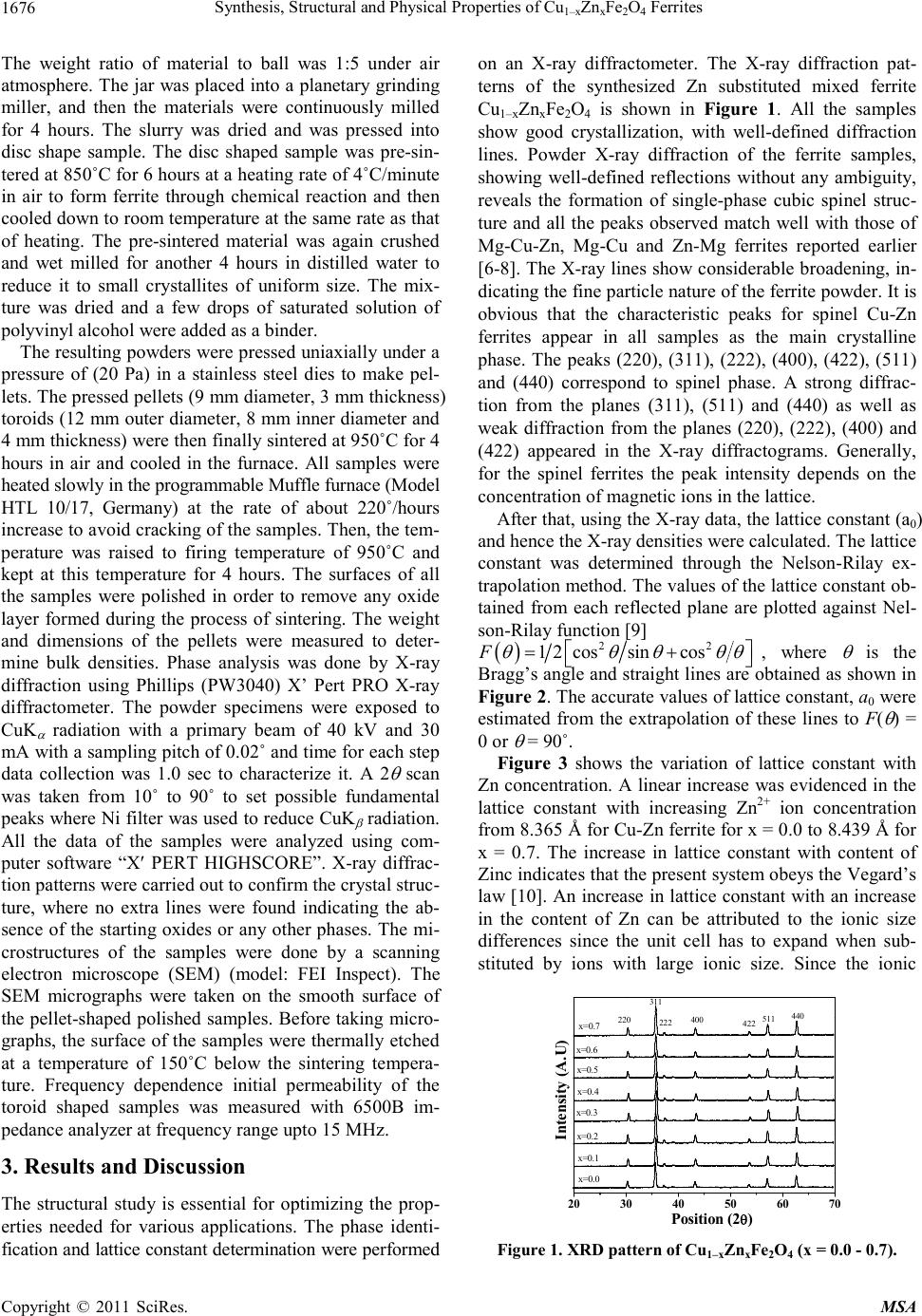 Synthesis, Structural and Physical Properties of CuZn Fe O Ferrites 1676 1–xx2 4 The weight ratio of material to ball was 1:5 under air atmosphere. The jar was placed into a planetary grinding miller, and then the materials were continuously milled for 4 hours. The slurry was dried and was pressed into disc shape sample. The disc shaped sample was pre-sin- tered at 850˚C for 6 hours at a heating rate of 4˚C/minute in air to form ferrite through chemical reaction and then cooled down to room temperature at the same rate as that of heating. The pre-sintered material was again crushed and wet milled for another 4 hours in distilled water to reduce it to small crystallites of uniform size. The mix- ture was dried and a few drops of saturated solution of polyvinyl alcohol were added as a binder. The resulting powders were pressed uniaxially under a pressure of (20 Pa) in a stainless steel dies to make pel- lets. The pressed pellets (9 mm diameter, 3 mm thickness) toroids (12 mm outer diameter, 8 mm inner diameter and 4 mm thickness) were then finally sintered at 950˚C for 4 hours in air and cooled in the furnace. All samples were heated slowly in the programmable Muffle furnace (Model HTL 10/17, Germany) at the rate of about 220˚/hours increase to avoid cracking of the samples. Then, the tem- perature was raised to firing temperature of 950˚C and kept at this temperature for 4 hours. The surfaces of all the samples were polished in order to remove any oxide layer formed during the process of sintering. The weight and dimensions of the pellets were measured to deter- mine bulk densities. Phase analysis was done by X-ray diffraction using Phillips (PW3040) X’ Pert PRO X-ray diffractometer. The powder specimens were exposed to CuK radiation with a primary beam of 40 kV and 30 mA with a sampling pitch of 0.02˚ and time for each step data collection was 1.0 sec to characterize it. A 2 scan was taken from 10˚ to 90˚ to set possible fundamental peaks where Ni filter was used to reduce CuK radiation. All the data of the samples were analyzed using com- puter software “X PERT HIGHSCORE”. X-ray diffrac- tion patterns were carried out to confirm the crystal struc- ture, where no extra lines were found indicating the ab- sence of the starting oxides or any other phases. The mi- crostructures of the samples were done by a scanning electron microscope (SEM) (model: FEI Inspect). The SEM micrographs were taken on the smooth surface of the pellet-shaped polished samples. Before taking micro- graphs, the surface of the samples were thermally etched at a temperature of 150˚C below the sintering tempera- ture. Frequency dependence initial permeability of the toroid shaped samples was measured with 6500B im- pedance analyzer at frequency range upto 15 MHz. 3. Results and Discussion The structural study is essential for optimizing the prop- erties needed for various applications. The phase identi- fication and lattice constant determination were performed on an X-ray diffractometer. The X-ray diffraction pat- terns of the synthesized Zn substituted mixed ferrite Cu1–xZnxFe2O4 is shown in Figure 1. All the samples show good crystallization, with well-defined diffraction lines. Powder X-ray diffraction of the ferrite samples, showing well-defined reflections without any ambiguity, reveals the formation of single-phase cubic spinel struc- ture and all the peaks observed match well with those of Mg-Cu-Zn, Mg-Cu and Zn-Mg ferrites reported earlier [6-8]. The X-ray lines show considerable broadening, in- dicating the fine particle nature of the ferrite powder. It is obvious that the characteristic peaks for spinel Cu-Zn ferrites appear in all samples as the main crystalline phase. The peaks (220), (311), (222), (400), (422), (511) and (440) correspond to spinel phase. A strong diffrac- tion from the planes (311), (511) and (440) as well as weak diffraction from the planes (220), (222), (400) and (422) appeared in the X-ray diffractograms. Generally, for the spinel ferrites the peak intensity depends on the concentration of magnetic ions in the lattice. After that, using the X-ray data, the lattice constant (a0) and hence the X-ray densities were calculated. The lattice constant was determined through the Nelson-Rilay ex- trapolation method. The values of the lattice constant ob- tained from each reflected plane are plotted against Nel- son-Rilay function [9] 22 12 cossincosF , where is the Bragg’s angle and straight lines are obtained as shown in Figure 2. The accurate values of lattice constant, a0 were estimated from the extrapolation of these lines to F( ) = 0 or = 90˚. Figure 3 shows the variation of lattice constant with Zn concentration. A linear increase was evidenced in the lattice constant with increasing Zn2+ ion concentration from 8.365 Å for Cu-Zn ferrite for x = 0.0 to 8.439 Å for x = 0.7. The increase in lattice constant with content of Zinc indicates that the present system obeys the Vegard’s law [10]. An increase in lattice constant with an increase in the content of Zn can be attributed to the ionic size differences since the unit cell has to expand when sub- stituted by ions with large ionic size. Since the ionic x=0.0 20 30 40 50 60 70 Position (2) Intensity (A.U) x=0.1 x=0.4 x=0.2 x=0.3 x=0.5 x=0.6 440 511 422 400 222 311 220 x=0.7 Figure 1. XRD pattern of Cu1–xZnxFe2O4 (x = 0.0 - 0.7). Copyright © 2011 SciRes. MSA 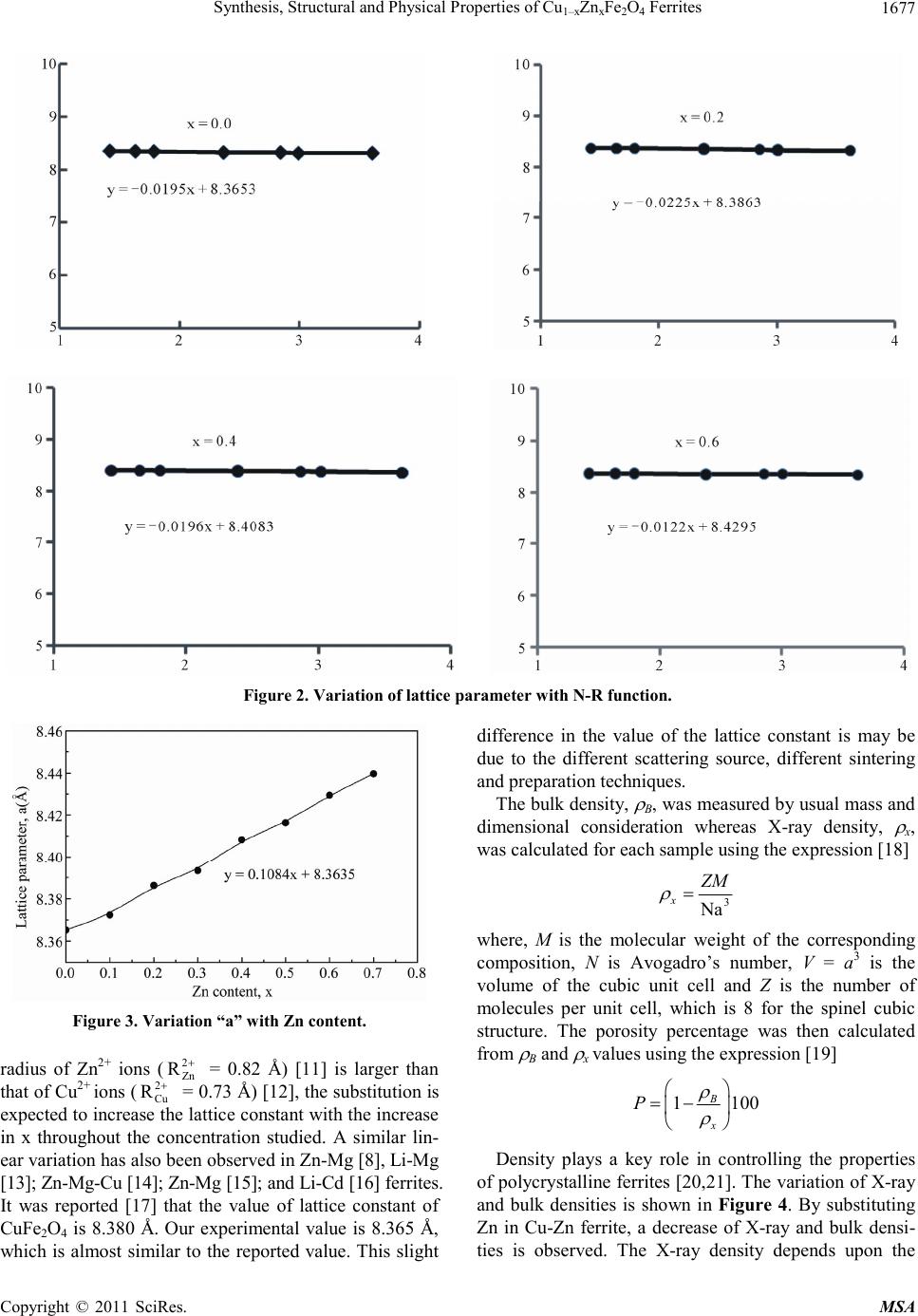 Synthesis, Structural and Physical Properties of Cu1–xZnxFe2O4 Ferrites Copyright © 2011 SciRes. MSA 1677 Figure 2. Variati on of lattice parameter with N-R function. Figure 3. Vari ati on “a” with Zn content. radius of Zn2+ ions ( = 0.82 Å) [11] is larger than that of Cu2+ ions ( = 0.73 Å) [12], the substitution is expected to increase the lattice constant with the increase in x throughout the concentration studied. A similar lin- ear variation has also been observed in Zn-Mg [8], Li-Mg [13]; Zn-Mg-Cu [14]; Zn-Mg [15]; and Li-Cd [16] ferrites. It was reported [17] that the value of lattice constant of CuFe2O4 is 8.380 Å. Our experimental value is 8.365 Å, which is almost similar to the reported value. This slight difference in the value of the lattice constant is may be due to the different scattering source, different sintering and preparation techniques. 2 Zn R Cu 2 R The bulk density, B, was measured by usual mass and dimensional consideration whereas X-ray density, x, was calculated for each sample using the expression [18] 3 N a x Z M where, M is the molecular weight of the corresponding composition, N is Avogadro’s number, V = a3 is the volume of the cubic unit cell and Z is the number of molecules per unit cell, which is 8 for the spinel cubic structure. The porosity percentage was then calculated from B and x values using the expression [19] 1 100 B x P Density plays a key role in controlling the properties of polycrystalline ferrites [20,21]. The variation of X-ray and bulk densities is shown in Figure 4. By substituting Zn in Cu-Zn ferrite, a decrease of X-ray and bulk densi- ties is observed. The X-ray density depends upon the  Synthesis, Structural and Physical Properties of CuZn Fe O Ferrites 1678 1–x x2 4 Figure 4. X-ray and bulk de nsities with Zn conte nt. lattice constants and molecular weight of the samples. As lattice constants increase linearly with the increase of Zn content, X-ray density decrease owing to the stoichiome- tery of the sample. Similar decrease pattern is observed by A. A. Pandit et al. in Mg-Mn ferrite [22]. It is also observed form Figure 4 that the X-ray densities are lar- ger in magnitude than corresponding to bulk densities. This may be due to the existence of pores which were formed and developed during the sample preparation or the sintering process [23]. The effect of Zn ion on bulk density and on the poros- ity is shown in Table 1 and Figure 5. By incorporating Zn into Cu-Zn ferrite, a significant decrease of the bulk density can be obtained. The highest density 5.124 g/cm3 whereas lowest porosity 5.61% is obtained for the com- position of x = 0.0 i.e for pure Cu-ferrite. The porosity value of all the samples is less than 12% that indicates the existence of very few pores in the samples. The po- rosity is found to increase from 5.61% for x = 0.0 to 10.18% for x = 0.7. Moreover this increase in porosity and decrease in bulk density is due to the increase in grain size, because the grains may be of irregular shape and as the sintering proceeds the grain growth takes place [24]. The intergrainular pores as developed during sin- tering must also be capable of moving with the grain boundaries as the growth occurs, requires that the pores move together and coalesce, and a different transport mechanism has been indicated. This consists of the trans- port of gaseous oxygen across the pores and the diffusion of cations around the pores; it is facilitated by high con- centration of cation vacancies i.e. excess of Fe2O4. Hence it is conclude that porosity increase with the addition of Zn content due to the creation of more cation vacancies with the reduction of oxygen vacancies [25]. Structural and magnetic properties sensitively depend on the microstructure of ferrites. Grain size of the micro- structures is the most important parameter affecting the magnetic properties of ferrites. Figure 6 shows the SEM Table 1. Lattice Constant, Bulk density, X-ray density and porosity of the system Cu1–xZnxFe2O4. Mn content (x) Lattice Constant, a0 (Å) Bulk Density, B (gm/cm3) X-ray Density, x (gm/cm3) Porosity (%) Grain size (μm) 0.0 8.36535.124 5.43 5.61 3.822 0.1 8.37245.067 5.42 6.49 3.577 0.2 8.38635.029 5.40 6.79 3.325 0.3 8.39344.974 5.39 7.65 2.902 0.4 8.40834.928 5.36 8.09 2.396 0.5 8.41644.868 5.35 9.02 2.047 0.6 8.42954.787 5.33 10.18 1.565 0.7 8.4396 4.716 5.31 11.26 1.277 Figure 5. Bulk density and Porosity with Zn content . photographs of Cu-Zn ferrites substitute with Zn content of 0.0, 0.2, 0.4 and 0.6 respectively. The average grain size was obtained by line intercept method using SEM. As shown in Figure 6, the microstructures revealed that the grain size was influenced by the Zn substitution. Fro m Table 1, it is observed that with the increase of Zn substitution, the grain size decreased. In general, the grain sizes of all samples are smaller than 4 μm, which is superior to reduce thickness of each layer in multilayer chip inductors leading to further miniaturization. The structural and magnetic properties of soft ferrites are influenced by the composition, additives and micro- structures of the materials. Among these factors, the mi- crostructures have great effect on structural and magnetic properties. It is generally known that the larger grain sizes, the higher the saturation magnetization and initial permeability. Figure 7 shows permeability increased with the increase of Zn content upto x = 0.5 and after that it decrease. However, the variation of initial permeability with Zn content was not consistent with the variation of microstructures, the bulk density and the above empirical Copyright © 2011 SciRes. MSA 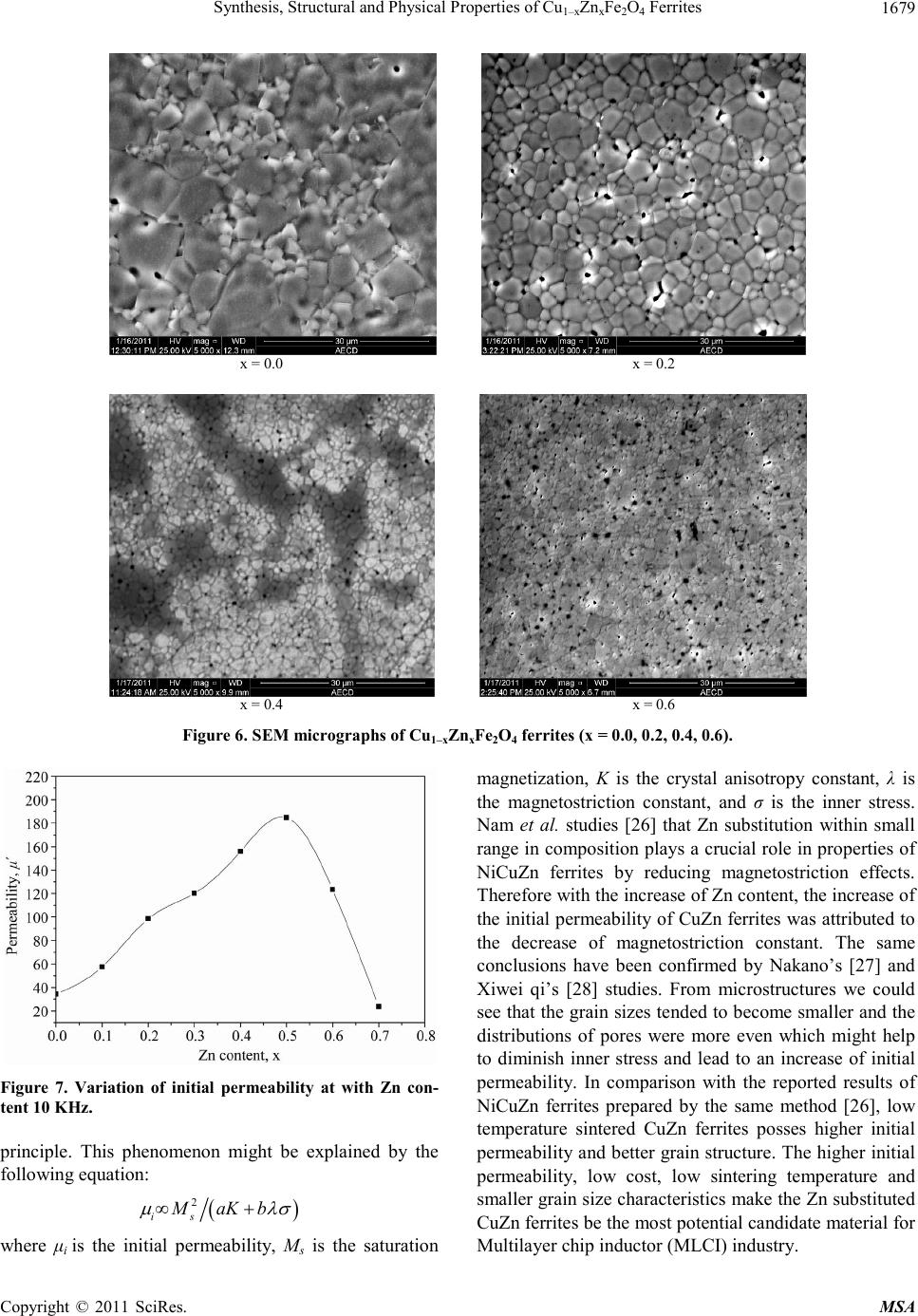 Synthesis, Structural and Physical Properties of Cu1–xZnxFe2O4 Ferrites Copyright © 2011 SciRes. MSA 1679 x = 0.0 x = 0.2 x = 0.4 x = 0.6 Figure 6. SEM micrographs of Cu1–xZnxFe2O4 ferrites (x = 0.0, 0.2, 0.4, 0.6). Figure 7. Variation of initial permeability at with Zn con- tent 10 KHz. principle. This phenomenon might be explained by the following equation: 2 is MaKb where μi is the initial permeability, Ms is the saturation magnetization, K is the crystal anisotropy constant, λ is the magnetostriction constant, and σ is the inner stress. Nam et al. studies [26] that Zn substitution within small range in composition plays a crucial role in properties of NiCuZn ferrites by reducing magnetostriction effects. Therefore with the increase of Zn content, the increase of the initial permeability of CuZn ferrites was attributed to the decrease of magnetostriction constant. The same conclusions have been confirmed by Nakano’s [27] and Xiwei qi’s [28] studies. From microstructures we could see that the grain sizes tended to become smaller and the distributions of pores were more even which might help to diminish inner stress and lead to an increase of initial permeability. In comparison with the reported results of NiCuZn ferrites prepared by the same method [26], low temperature sintered CuZn ferrites posses higher initial permeability and better grain structure. The higher initial permeability, low cost, low sintering temperature and smaller grain size characteristics make the Zn substituted CuZn ferrites be the most potential candidate material for Multilayer chip inductor (MLCI) industry. 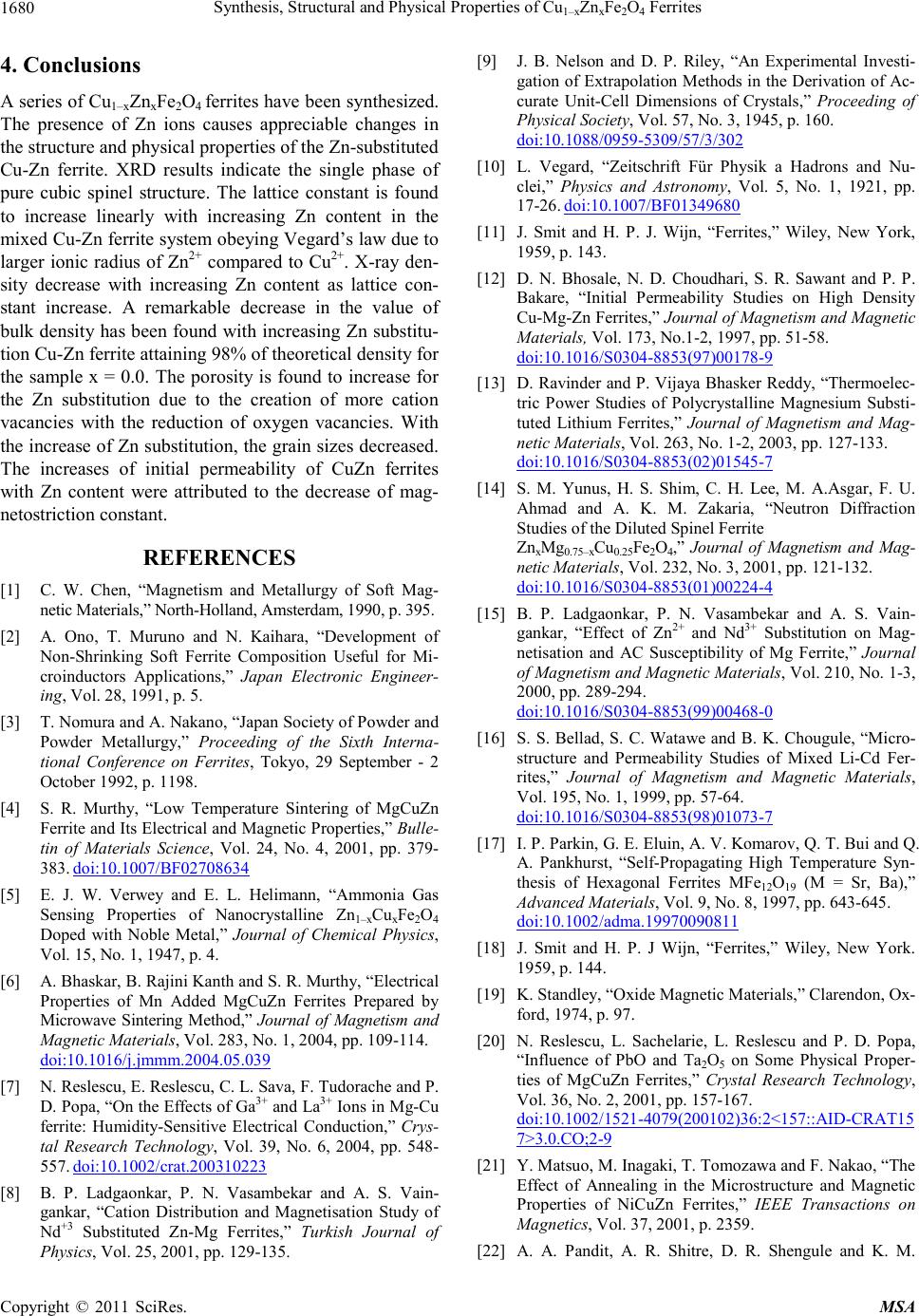 Synthesis, Structural and Physical Properties of CuZn Fe O Ferrites 1680 1–x x2 4 4. Conclusions A series of Cu1–xZnxFe2O4 ferrites have been synthesized. The presence of Zn ions causes appreciable changes in the structure and physical properties of the Zn-substituted Cu-Zn ferrite. XRD results indicate the single phase of pure cubic spinel structure. The lattice constant is found to increase linearly with increasing Zn content in the mixed Cu-Zn ferrite system obeying Vegard’s law due to larger ionic radius of Zn2+ compared to Cu2+. X-ray den- sity decrease with increasing Zn content as lattice con- stant increase. A remarkable decrease in the value of bulk density has been found with increasing Zn substitu- tion Cu-Zn ferrite attaining 98% of theoretical density for the sample x = 0.0. The porosity is found to increase for the Zn substitution due to the creation of more cation vacancies with the reduction of oxygen vacancies. With the increase of Zn substitution, the grain sizes decreased. The increases of initial permeability of CuZn ferrites with Zn content were attributed to the decrease of mag- netostriction constant. REFERENCES [1] C. W. Chen, “Magnetism and Metallurgy of Soft Mag- netic Materials,” North-Holland, Amsterdam, 1990, p. 395. [2] A. Ono, T. Muruno and N. Kaihara, “Development of Non-Shrinking Soft Ferrite Composition Useful for Mi- croinductors Applications,” Japan Electronic Engineer- ing, Vol. 28, 1991, p. 5. [3] T. Nomura and A. Nakano, “Japan Society of Powder and Powder Metallurgy,” Proceeding of the Sixth Interna- tional Conference on Ferrites, Tokyo, 29 September - 2 October 1992, p. 1198. [4] S. R. Murthy, “Low Temperature Sintering of MgCuZn Ferrite and Its Electrical and Magnetic Properties,” Bulle- tin of Materials Science, Vol. 24, No. 4, 2001, pp. 379- 383. doi:10.1007/BF02708634 [5] E. J. W. Verwey and E. L. Helimann, “Ammonia Gas Sensing Properties of Nanocrystalline Zn1–xCuxFe2O4 Doped with Noble Metal,” Journal of Chemical Physics, Vol. 15, No. 1, 1947, p. 4. [6] A. Bhaskar, B. Rajini Kanth and S. R. Murthy, “Electrical Properties of Mn Added MgCuZn Ferrites Prepared by Microwave Sintering Method,” Journal of Magnetism and Magnetic Materials, Vol. 283, No. 1, 2004, pp. 109-114. doi:10.1016/j.jmmm.2004.05.039 [7] N. Reslescu, E. Reslescu, C. L. Sava, F. Tudorache and P. D. Popa, “On the Effects of Ga3+ and La3+ Ions in Mg-Cu ferrite: Humidity-Sensitive Electrical Conduction,” Crys- tal Research Technology, Vol. 39, No. 6, 2004, pp. 548- 557. doi:10.1002/crat.200310223 [8] B. P. Ladgaonkar, P. N. Vasambekar and A. S. Vain- gankar, “Cation Distribution and Magnetisation Study of Nd+3 Substituted Zn-Mg Ferrites,” Turkish Journal of Physics, Vol. 25, 2001, pp. 129-135. [9] J. B. Nelson and D. P. Riley, “An Experimental Investi- gation of Extrapolation Methods in the Derivation of Ac- curate Unit-Cell Dimensions of Crystals,” Proceeding of Physical Society, Vol. 57, No. 3, 1945, p. 160. do i:1 0. 10 88 / 09 59 - 53 09 / 57 /3 / 30 2 [10] L. Vegard, “Zeitschrift Für Physik a Hadrons and Nu- clei,” Physics and Astronomy, Vol. 5, No. 1, 1921, pp. 17-26. doi :1 0. 10 07 / BF01349 68 0 [11] J. Smit and H. P. J. Wijn, “Ferrites,” Wiley, New York, 1959, p. 143. [12] D. N. Bhosale, N. D. Choudhari, S. R. Sawant and P. P. Bakare, “Initial Permeability Studies on High Density Cu-Mg-Zn Ferrites,” Journal of Magnetism and Magnetic Materials, Vol. 173, No.1-2, 1997, pp. 51-58. doi:10.1016/S0304-8853(97)00178-9 [13] D. Ravinder and P. Vijaya Bhasker Reddy, “Thermoelec- tric Power Studies of Polycrystalline Magnesium Substi- tuted Lithium Ferrites,” Journal of Magnetism and Mag- netic Materials, Vol. 263, No. 1-2, 2003, pp. 127-133. doi:10.1016/S0304-8853(02)01545-7 [14] S. M. Yunus, H. S. Shim, C. H. Lee, M. A.Asgar, F. U. Ahmad and A. K. M. Zakaria, “Neutron Diffraction Studies of the Diluted Spinel Ferrite ZnxMg0.75–xCu0.25Fe2O4,” Journal of Magnetism and Mag- netic Materials, Vol. 232, No. 3, 2001, pp. 121-132. doi:10.1016/S0304-8853(01)00224-4 [15] B. P. Ladgaonkar, P. N. Vasambekar and A. S. Vain- gankar, “Effect of Zn2+ and Nd3+ Substitution on Mag- netisation and AC Susceptibility of Mg Ferrite,” Journal of Magnetism and Magnetic Materials, Vol. 210, No. 1-3, 2000, pp. 289-294. doi:10.1016/S0304-8853(99)00468-0 [16] S. S. Bellad, S. C. Watawe and B. K. Chougule, “Micro- structure and Permeability Studies of Mixed Li-Cd Fer- rites,” Journal of Magnetism and Magnetic Materials, Vol. 195, No. 1, 1999, pp. 57-64. doi:10.1016/S0304-8853(98)01073-7 [17] I. P. Parkin, G. E. Eluin, A. V. Komarov, Q. T. Bui and Q. A. Pankhurst, “Self-Propagating High Temperature Syn- thesis of Hexagonal Ferrites MFe12O19 (M = Sr, Ba),” Advanced Materials, Vol. 9, No. 8, 1997, pp. 643-645. doi:10.1002/adma.19970090811 [18] J. Smit and H. P. J Wijn, “Ferrites,” Wiley, New York. 1959, p. 144. [19] K. Standley, “Oxide Magnetic Materials,” Clarendon, Ox- ford, 1974, p. 97. [20] N. Reslescu, L. Sachelarie, L. Reslescu and P. D. Popa, “Influence of PbO and Ta2O5 on Some Physical Proper- ties of MgCuZn Ferrites,” Crystal Research Technology, Vol. 36, No. 2, 2001, pp. 157-167. doi:10.1002/1521-4079(200102)36:2<157::AID-CRAT15 7>3.0.CO;2-9 [21] Y. Matsuo, M. Inagaki, T. Tomozawa and F. Nakao, “The Effect of Annealing in the Microstructure and Magnetic Properties of NiCuZn Ferrites,” IEEE Transactions on Magnetics, Vol. 37, 2001, p. 2359. [22] A. A. Pandit, A. R. Shitre, D. R. Shengule and K. M. Copyright © 2011 SciRes. MSA 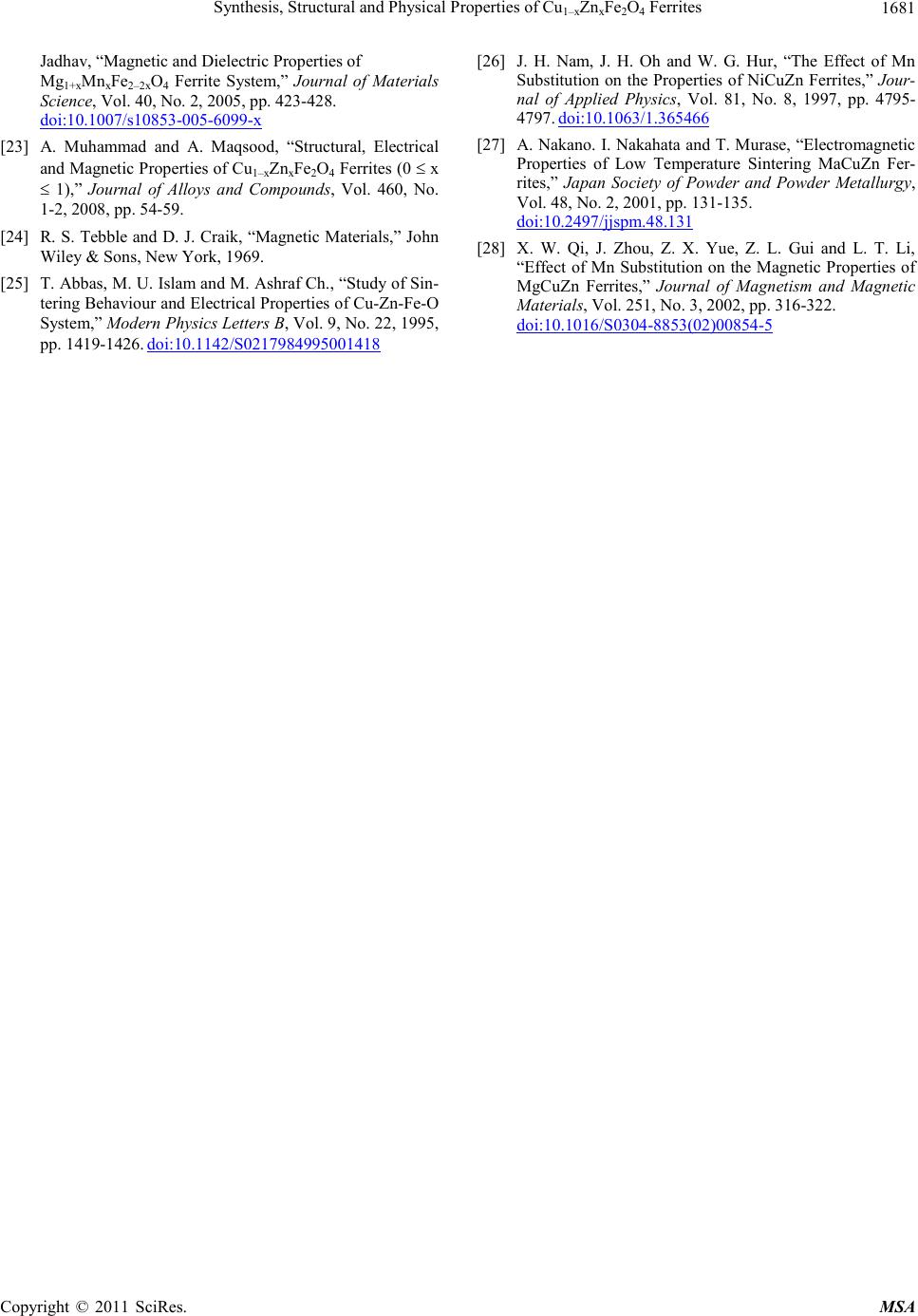 Synthesis, Structural and Physical Properties of Cu1–xZnxFe2O4 Ferrites Copyright © 2011 SciRes. MSA 1681 Jadhav, “Magnetic and Dielectric Properties of Mg1+xMnxFe2–2xO4 Ferrite System,” Journal of Materials Science, Vol. 40, No. 2, 2005, pp. 423-428. do i:1 0. 10 07 / s 10 85 3 -00 5 -60 99 - x [23] A. Muhammad and A. Maqsood, “Structural, Electrical and Magnetic Properties of Cu1–xZnxFe2O4 Ferrites (0 x 1),” Journal of Alloys and Compounds, Vol. 460, No. 1-2, 2008, pp. 54-59. [24] R. S. Tebble and D. J. Craik, “Magnetic Materials,” John Wiley & Sons, New York, 1969. [25] T. Abbas, M. U. Islam and M. Ashraf Ch., “Study of Sin- tering Behaviour and Electrical Properties of Cu-Zn-Fe-O System,” Modern Physics Letters B, Vol. 9, No. 22, 1995, pp. 1419-1426. doi:10.1142/S0217984995001418 [26] J. H. Nam, J. H. Oh and W. G. Hur, “The Effect of Mn Substitution on the Properties of NiCuZn Ferrites,” Jour- nal of Applied Physics, Vol. 81, No. 8, 1997, pp. 4795- 4797. do i:1 0. 10 63/1. 3 65 46 6 [27] A. Nakano. I. Nakahata and T. Murase, “Electromagnetic Properties of Low Temperature Sintering MaCuZn Fer- rites,” Japan Society of Powder and Powder Metallurgy, Vol. 48, No. 2, 2001, pp. 131-135. doi:10.2497/jjspm.48.131 [28] X. W. Qi, J. Zhou, Z. X. Yue, Z. L. Gui and L. T. Li, “Effect of Mn Substitution on the Magnetic Properties of MgCuZn Ferrites,” Journal of Magnetism and Magnetic Materia l s, Vol. 251, No. 3, 2002, pp. 316-322. doi:10.1016/S0304-8853(02)00854-5 |