

Paper Menu >>
Journal Menu >>
 Materials Science s a nd Applications, 2011, 2, 1661-1666 doi:10.4236/msa.2011.211221 Published Online November 2011 (http://www.SciRP.org/journal/msa) Copyright © 2011 SciRes. MSA 1661 Morphological Structure Characterization of PAH/NiTsPc Multilayer Nanostructured Films Josmary R. Silva1, Jac keli ne B. B rito1, Sonia T. Tanimoto2, Nara C. de Souza1* 1Grupo de Materiais Nanoestruturados, Universidade Federal de Mato Grosso, Barra do Garças, Brazil; 2Centro de Ciências Naturais e Humanas, Universidade Federal do ABC, Santo André, Brazil. Email: *[email protected] Received August 15th, 2011; revised September 30th, 2011; accepted October 11th, 2011. ABSTRACT Morphological structure and growth process of LbL nanostructured films from nickel tetrasulfonated phthalocyanine (NiTsPc) alternated with polyallylamine hydrochloride (PAH) were investigated. The experimental results of UV-visible adsorption kinetics (modeled by Johnson-Mehl-Avrami functions) and AFM images analyzes suggested that the surface morphology structure of films is formed by rod-shaped aggregates produced by a two-step growth process: nucleation and diffusion-limited growth. Keywords: Phthalocyanine, Layer-by-Layer Films, Growth Processes, Adsorption Kinetics 1. Introduction Phthalocyanines are interesting due to their properties and possible applications [1-3]. As this type of com- pound is hi ghly conjugated [4], it has interesting electric and photoelectric properties. Neutral phthalocyanines are insoluble in polar solvents; however, this can be changed by substituting the benzene rings with polar compounds. Several techniques have been used to produce phthalo- cyanine films, such as evaporation deposition [5-7], mo- lecular beam deposition [8], Langmuir-Blodgett [9-13], and self-assembly layer-by-layer (LbL) [14-18]. The lat- ter one is possible because the sulfonation of the ring of phthalocyanine resulting in tetrasulfonated phthalocya- nines, which are more soluble in polar solvents, such as water, and thus allows their application in the production of films by the LbL technique. The research on LbL films has been performed focu- sing on the effects from char ge density o f the molec ules in solution [16-20], drying procedure, solution ionic strength, solvent nature, and dipping time on the growth charac- teristics of the multilayers [17]. With regard to the struc- ture of the films, important findings were the interpene- tration of successive polyelectrolyte layers [21], and the preferential orientation of polymer chains perpendicu- larly to the interfaces [22]. In particular, the dc conduc- tion processes in LbL films from phthalocyanines was investigated in the early days due to its important role in technological applications, such as light emission diode. For instance, Promnimit et al. [19] investigated the cur- rent-voltage characteristics in the forward and reverse bias conditions demonstrated rectifying behaviors i n the onset of co nd ucti o n vol ta ge , which make s t he se fil ms a ttr ac ti ve for future electronic devices. The surface morphology of films is another interesting property to be investigated because the film/electrode interfaces are found in all devices and play an important role in their operation [20]. The surface morphology structure of LbL films is de- terminated by the processes responsible for the growth of the layers and is strongly dependent on the preparation conditions [21]. Although there are several studies on LbL films from NiTsPc [22-25], only a few reports on the surface mor- phology structure have been carried out [26-28]. In this work, we have prepared LbL films from NiTsPc alter- nated with PAH and investigated their surface morpholo- gy structure and the mechanisms o f the adsorptio n pr o c e ss associated to it. From adsorption kinetics experiments and AFM analyses, we have found that films are formed by rod-shaped aggregates promoted by nucleation and diffusion-limited growth. 2. Materials and Methods Nickel tetrasulfonated phthalocyanine (NiTsPc) and poly (allylamine hydrochloride) (PAH) were acquired from Al- drich and used as supplied. NiTsPc and PAH solutions were prepared as follows: 0.05 g of NiTsPc or PAH were 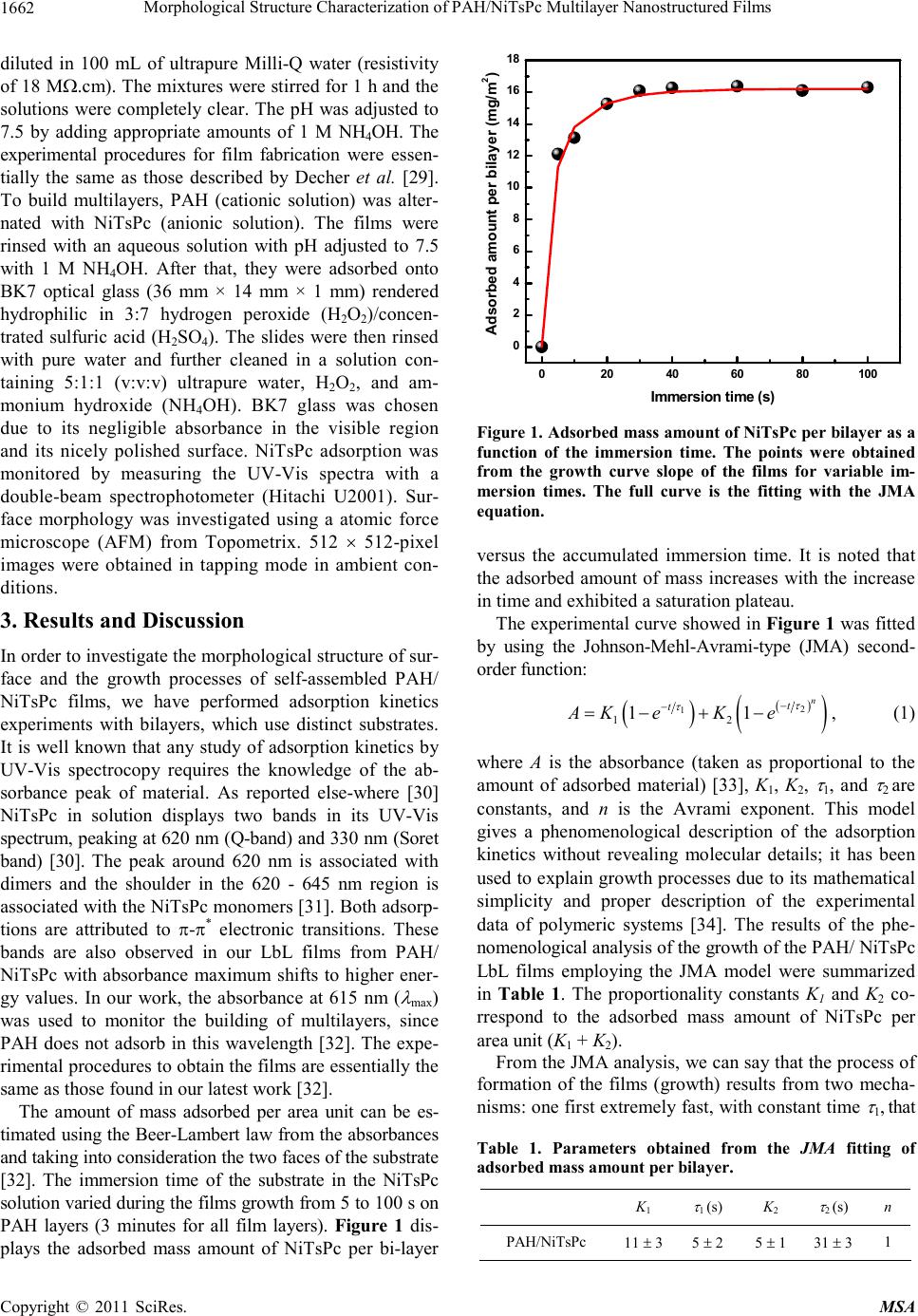 Morphological Structure Characterization of PAH/NiTsPc Multilayer Nanostructured Films 1662 diluted in 100 mL of ultrapure Milli-Q water (resistivity of 18 M.cm). The mixtures were stirred for 1 h and the solutions were completely clear. The pH was adjusted to 7.5 by adding appropriate amounts of 1 M NH4OH. The experimental procedures for film fabrication were essen- tially the same as those described by Decher et al. [29]. To build multilayers, PAH (cationic solution) was alter- nated with NiTsPc (anionic solution). The films were rinsed with an aqueous solution with pH adjusted to 7.5 with 1 M NH4OH. After that, they were adsorbed onto BK7 optical glass (36 mm × 14 mm × 1 mm) rendered hydrophilic in 3:7 hydrogen peroxide (H2O2)/concen- trated sulfuric acid (H2SO4). The slides were then rinsed with pure water and further cleaned in a solution con- taining 5:1:1 (v:v:v) ultrapure water, H2O2, and am- monium hydroxide (NH4OH). BK7 glass was chosen due to its negligible absorbance in the visible region and its nicely polished surface. NiTsPc adsorption was monitored by measuring the UV-Vis spectra with a double-beam spectrophotometer (Hitachi U2001). Sur- face morphology was investigated using a atomic force microscope (AFM) from Topometrix. 512 512-pixel images were obtained in tapping mode in ambient con- ditions. 3. Results and Discussion In order to investigate the morphological structure of sur- face and the growth processes of self-assembled PAH/ NiTsPc films, we have performed adsorption kinetics experiments with bilayers, which use distinct substrates. It is well kno wn that any study of adsorption kinetic s by UV-Vis spectrocopy requires the knowledge of the ab- sorbance peak of material. As reported else-where [30] NiTsPc in solution displays two bands in its UV-Vis spectrum, peaking at 620 nm (Q-band) and 330 nm (Soret band) [30]. The peak around 620 nm is associated with dimers and the shoulder in the 620 - 645 nm region is associated with the NiTsPc monomers [31]. Both adsorp- tions are attributed to -* electronic transitions. These bands are also observed in our LbL films from PAH/ NiTsPc with absorbance maximum shifts to higher ener- gy values. In our work, the absorbance at 615 nm ( max) was used to monitor the building of multilayers, since PAH does not adsorb in this wavelength [32]. The expe- rimental procedures to obtain the films are essentially the same as those found in our latest work [32]. The amount of mass adsorbed per area unit can be es- timated using the Beer-Lambert la w from the absorbances and taking into consideration the two faces of the substrate [32]. The immersion time of the substrate in the NiTsPc solution varied during the films growth from 5 to 100 s on PAH layers (3 minutes for all film layers). Figure 1 dis- plays the adsorbed mass amount of NiTsPc per bi-layer 0 20406080100 0 2 4 6 8 10 12 14 16 18 Adsorbed amount per bilayer (mg/m2) Immersion time (s) Figure 1. Adsorbed mass amount of NiTsPc per bilayer as a function of the immersion time. The points were obtained from the growth curve slope of the films for variable im- mersion times. The full curve is the fitting with the JMA equation. versus the accumulated immersion time. It is noted that the adsorbed amount of mass increases with the increase in time and exhibited a saturation plateau. The experimental curve showed in Figure 1 was fitte d by using the Johnson-Mehl-Avrami-type (JMA) second- order function: 2 1 12 11 n t t AK eKe , (1) where A is the absorbance (taken as proportional to the amount of adsorbed material) [33], K1, K2, 1, and 2 are constants, and n is the Avrami exponent. This model gives a phenomenological description of the adsorption kinetics without revealing molecular details; it has been used to explain gro wth processes due to its mathematical simplicity and proper description of the experimental data of polymeric systems [34]. The results of the phe- nome no log ica l a nal ysi s of t he gro wth o f t he P AH/ NiT sP c LbL films employing the JMA model were summarized in Table 1. The proportionality constants K1 and K2 co- rrespond to the adsorbed mass amount of NiTsPc per area unit (K1 + K2). From the JMA analysis, we can say that the process of formation of the films (growth) results from two mecha- nisms: one first extremely fast , with constant time 1, that Table 1. Parameters obtained from the JMA fitting of adsorbed mass amount pe r bilayer. K1 1 (s) K2 2 (s) n PAH/NiTsPc 11 35 2 5 1 31 31 Copyright © 2011 SciRes. MSA  Morphological Structure Characterization of PAH/NiTsPc Multilayer Nanostructured Films Copyright © 2011 SciRes. MSA 1663 may be associated with a nucleation, and a slow one with time constant 2, associated with a diffusion-controlled growth. A t wo-stage a d sorp tion proc ess was also pro posed by Raposo [34] and Tsukruk [35]. It is possible to use the Avrami parameter n to distinguish between growth on the interface or by diffusion. The parameter value of Avrami, n = 1, indicates needle-shaped or rod-shaped structures (1D adsorption) produced by diffusion controlled growth and without the formation of new nuclei during adsorp- tion [21,36,37]. Due to the sensibility of the parameter n, it is difficult to identify the process without additional information on the film growth [33], which can be obtained from AFM image analysis. To corroborate the adsorption kinetics results, morphological investigation of the 10-bilayer PAH/ NiTsPc films were carried out with layers of NiTsPc ad- sorbed for 3 min. Figure 2 shows the image of the sur- face of PAH/NiTsPc film (NiTsPc on top), which ex- hibits rod-shaped aggregates and a schematic model pro- posed to its structure. This finding is consistent with the previous adsorption kinetics results [38,39]. We can see the film forming units, which initially seem small “lying” rods that can be due to aggregation of adjacent NiTsPc rings in the films, which are driving by intermolecular for- ces [40,41]. Figure 3 (log-log) shows that the heights of aggre- gates increases when their diameters decreases. The data were taken at distinct cross sections of the images and the error bars included in the inset are average values of several scans. The inset shows three differents height profile. As noted, there is a preferential vertical growth, unlike from films prepared with the polydisperse POMA [21] and PANI [42], which show globular aggregates with no preferential growth direction. This kind of struc- ture had already been identified by Nishida et al. [43] for phthal ocyani ne fi lms o nto gol d surfac es b y STM dat a. In fact, our result corroborates the aggregate growth as co- lumns suggested by the previous results of adsorption kinetics and parameters of Avrami. The growth process of NiTsPc in LbL films starts with nuclei formed in the beginning of the adsorption. The adsorption process is the result of compromise between the energy factors, such as electrostatic forces, Van der Waals forces, hydrogen bonds, solvent quality, and en- tropic factors. The adsorption of polyelectrolytes on char- ged surface can be described by a rapid adsorption fo- llowed by a relatively long period in which the chains are being rearranged. In the first stage, the molecules adsorb on the surface while keeping its conformation in solution. When substrates are immersed in the solution of NiTsPc, immediately some molecules are adsorbed (according to the results of kinetics). The interaction of chains by hy- drogen bonds favors the formation of aggregates. These aggregates tend to carry their connection with the surface increasing the number of segments attached to the sub- strate, i.e. a rea r r an gemen t of m olecu les. 4. Conclusions Nickel tetrasulfonated phthalocyanine has been used to- gether with PAH to produce LbL films. The morpho- Figure 2. AFM image of a 10-bilayer PAH/NiTsPc film whose layers were adsorbed for 3 min using a NiTsPc solution. The scanning window s ize is 2 m × 2 m. The scheme show s the NiTsP c molecule which forms the aggregates.  Morphological Structure Characterization of PAH/NiTsPc Multilayer Nanostructured Films 1664 Figure 3. Dia meter vers us height of ag greg ates of t he PA H/Ni TsP c fil m. The inset s s how the full cu rve d raw n on t he i mage o f the surface of the film, which identifies the rod-shaped structures and the height profile of the films in three distinct cross-sections of the image (the arrow indicates a column correspo nding to a surface forming unit). logical structure of the films was investigated by using a combined method of the adsorption kinetics curves, mo- deled with JMA functions, and the behavior of diameter versus height of aggregates obtained from AFM images. This approach indicated that the aggregates are rod-sha- ped, which are produced by an adsorption process with two mechanisms: nucleation in the first sta ge ( 1 5 - 10 s) and diffusion-limited growth in another. Since NiTsPc is a semiconductor organic with applications in sensors, our results may be used as a starting point to future re- search on devices and bring out new insights on the na- nostructured films from thi s kind of mate rial. 5. Acknowledgements This work was supported by CNPq and Capes (Brazil). REFERENCES [1] C. C. Leznoff and A. B. P. Lever, “Phthalocyanines Pro- perties and Applications, Volume 1,” VCH Publishers, New York, 1993. [2] M. Pontie, C. Gobin, T. Pauporte, F. Bedioui and J. Devynck, “Electrochemical Nitric Oxide Microsensors: Sensitivity and Selectivity Characterization,” Analytica Chimica Acta, Vol. 411, No . 1-2, 2000, pp. 175- 185. doi:10.1016/S0003-2670(00)00741-8 [3] P. Peumans and S. R. Forrest, “Very-High-Efficiency Dou- ble-Heterostructure Copper Phthalocyanine/C60 Photo- volt aic Cel ls,” Applied Physics Lett ers, Vol. 79, No. 1, 2001, pp. 126-128. doi:10.1063/1.1384001 [4] S. Omiya, M. Tsutsui, E. F. Meyer Jr, I. Bernal and D. L. Cullen, “Synthesis and Structure of a New Class of Metallo- phthalocyanines: Carbonyl (P hthalocyaninato) (Pyridine or Tetrahydrofuran) Ruthenium(II) and Carbony (Phthalocy- aninato) (P yridine or Tetr ahydrofuran) Osmiu m (II),” Inor- ganic Chemis try , Vol. 19, No. 1 , 1 980, p p. 1 34- 1 42. doi:10.1021/ic50203a029 [5] M. Aoki, S. Masuda, Y. Einaga, et al., “Observation of Outermost Surface Layers of Phthalocyanine Ultra-Thin Films by Penning Ionization Electron Spectroscopy: Chlo- roaluminium Phthalocyanine on MoS2,” Molecular Crys- tals and Liquid Crystals Science and Technology Section A—Molecular Crystals and Liquid Crystals, Vol. 267, No. Copyright © 2011 SciRes. MSA  Morphological Structure Characterization of PAH/NiTsPc Multilayer Nanostructured Films1665 1, 1995, pp. 217-222. doi:10.1080/10587259508033997 [6] T. Pasinszki, M. Aoki, S. Masuda, et al., “Characte- rization of Ultrathin Films of Chloroaluminum Phtha- locy anine during L ay er-by- Layer Prepa ration o n G raphite: PIES and UPS Study,” Journal of Physical Chemistry, Vol. 99, No. 34, 1995, pp. 12858-12862. doi:10.1021/j100034a026 [7] L. K. Chau, C. Arbour, G. E. Collins, et al., “Phtha- locyanine Aggregates on Metal Dichalcogenide Surfaces: Dye Sensitization on Tin Disulfide Semiconductor Elec- trodes by Ordered and Disordered Chloroindium Phtha- locyanine Thin Films,” Journal of Physical Chemistry, Vol. 97, No. 11, 1993, pp. 2690-2698. doi:10.1021/j100113a034 [8] Y. Imanishi, S. Hattori, T. Amada, et al., “Fabrications and Optical Properties of Phthalocyanine Multi-Layered Films,” Molecular Crystals and Liquid Crystals Science and Technology Section A—Molecular Crystals and Liquid Crystals, Vol. 255, No. 1, 1994, pp. 35-44. doi:10.1080/10587259408029774 [9] M. C. Petty, “Langmuir-Blodgett Filmes: An Introduc- tion,” Cam br idg e Univ ers ity Pre ss, C ambridge, 1996. doi:10.1017/CBO9780511622519 [10] A. Ulman, “An Introduction to Ultrathin Organic Films: From Langmuir-Blodgett to Self-Assembly,” Academic Press, Waltham, 1991. [11] L. Gaffo, A. Dhanabalan, W. C. Moreira, et al., “Lang- muir Films of Ytterbium and Samarium Phthalocya- nines,” Sy nthe tic Metals, Vol. 102, N o. 1-3, 1 999, p. 1456. doi:10.1016/S0379-6779(98)00516-5 [12] H. W. Liu, Y. H. Liu, C. F. Zhu, et al., “Synthesis and Highly Ordered Thin Films of Optically Active 2’-Me- thoxy-1,1’-binaphthyl Substituted Phthalocyanines,” Syn- thetic Metals , Vol. 13 1, N o. 1- 3, 2002, pp. 135- 1 39. doi:10.1016/S0379-6779(02)00174-1 [13] L. H. Huo, W. Li, H. N. Cui, et al., “Molecular Orien- tation of Copper Phthalocyanine in Thin Films and their Gas-Sensing Properties,” Molecu lar Crysta l & Liqui d Cry- stals, Vol. 371, No. 1, 20 01, pp. 195-19 8. doi:10.1080/10587250108024720 [14] L. S. Li an d A. D. Q. Li, “P robing Surface Electronic Po- tentia ls a nd Pho to volt aic Ef f ec ts of Se lf -Assem ble d Multi - layers of Metal Phthalocyanine and Oligomeric Viologen on Cond uc tiv e Substr a te s ,” Journal of Physical Chemistry B, Vol. 105, No. 41, 2001, pp. 10022-10028. doi:10.1021/jp011556r [15] L. Xu, E. B. Wang, Z. Li, D. G. Kurth, et al., “Preparation and Nonlinear Optical Properties of Ultrathin Composite Films Containing both a Polyoxometalate Anion and a Binuclear Phthalocyanine,” New Journal of Chemistry, Vol. 26, No. 6, 200 2, p p. 78 2- 78 6. doi:10.1039/b110671f [16] L. S. Li, R. Wang, M. Fitzsimmons and D. Q. Li, “Surface Electronic Properties of Self-Assembled, Oppo- sitely Charged Macrocycle and Polymer Multilayers on Conductive Oxides,” Journal of Physical Chemistry B, Vol. 104, No. 47, 2000, pp. 11195-11201. doi:10.1021/jp001716j [17] L. S. Li, Q. X. Jia and A. D. Q. Li, “Effects of Organic Self-assembled Polymer and Metal Phthalocyanine Mul- tilayers on the Surface Photovoltaic Properties of Indium Tin Oxide and Titanium Oxide,” Chemistry of Materials, Vol. 14, No. 3, 2002, pp. 1159-1165. doi:10.1021/cm010711b [18] T. Ishida, W. Mizutani, H. Azehara, et al., “Molecular Ar- rangement and Electrical Conduction of Self-Assembled Monolay er s Ma de f rom Te rphe ny l T hiols ,” Sur fac e Sc ie nce , Vol. 514, No. 1-3, 2002, pp. 187- 193. doi:10.1016/S0039-6028(02)01627-8 [19] S. Promnimit, C. Cavelius, S. Mathur and J. Dutta, “Growth of Gold/Zinc Sulphide Multilayer Films Using Layer-by- Layer Assembly of Colloidal Nanoparticles,” Physical E, Vol. 41, No. 2, 2008, pp. 285-291. doi:10.1016/j.physe.2008.07.013 [20] J. R. Silva, N. C. de Souza, V. C. Fernandes, P. Homem- de-Mello and O. N. Oliveira Jr., “Langmuir-Blodgett Films of Diazobenzene Molecules,” Journal of Colloid and Interface Science, Vol. 327, No. 1, 2008, pp. 31-35. doi:10.1016/j.jcis.2008.08.004 [21] N. C. de Souza, J. R. Silva, R. Di Thommazo, M. Raposo, D. T. Balogh, J. A. Giacometti and O. N. Oliveira Jr., “In- fluence of Solution Treatment on the Adsorption and Morphology of Poly(o-methoxyaniline) Layer-by-Layer Films,” Journal of Physical Chemistry B, Vol. 108, No. 36, 2004 , pp. 3 5 99-13606. doi:10.1021/jp037873a [22] W. S. Alencar, F. N. Crespilho, M. V. A. Martins, V. Zucolotto, O. N. Oliveira Jr and W. C. Silva, “Synergistic Interaction between Gold Nanoparticles and Nickel Ph- thalocyanine in Layer-by-Layer (LbL) Films: Evidence of Constitutional Dynamic Chemistry (CDC),” Journal of Physical Chemistry, Vol. 11, No. 11, 2009, pp. 5 086-5091. [23] F. N. Crespilho, V. Zucolotto, J. R. Siqueira Jr., A. J. F. Carvalho, F. C. Nart and O. N. Oliveira Jr., “Using Elec- trochemical Data to Obtain Energy Diagrams for La- yer-by-Layer Films from Metallic Phthalocyanines,” In- ternational Journal Electrochemical Science, Vol. 1, 2006, pp. 151-15 9. [24] E. G. R. Fernandes, N. C. S. Vieira, A. A. A. de Queiroz, F. E. G. Guimarães and V. Zucolotto, “Immobilization of Poly (Propylene Imine) Dendrimer/Nickel Phtalocyanine as Nanostructured Multilayer Films to Be Used as Gate Membranes for SEGFET pH Sensors,” The Journal of Physical Chemistry C, Vol. 114, No. 14, 2010, pp. 6478- 6483. doi:10.1021/jp9106052 [25] A. C. Santos, V. Zucolotto, C. J. L. Constantino, H. N. Cunha, J. R. dos Santos Jr. and C. Eiras, “Electroactive LbL Films of Metallic Phthalocyanines and Poly (o-methox- yaniline) for Sensing,” Journal of Solid State Electro- chemistry, V ol. 11, No. 11, 2007, pp. 1505-1510. do i:10.1007/s10008-007-0338-9 [26] A. P. Gutierrez, S. Griveau, C. Richard, A. Pailleret, S. G. Granados and F. Bediouia, “Hybrid Materials from Carbon Nanotubes, Nickel Tetrasulfonated Phthalocyanine and Thin Polymer Layers for the Selective Electrochemical Acti- vation of Nitric Oxide in Solution,” Electroanalysis, Vol. 21, No. 21, 2009, pp. 2303-2310. doi:10.1002/elan.200904686 Copyright © 2011 SciRes. MSA  Morphological Structure Characterization of PAH/NiTsPc Multilayer Nanostructured Films Copyright © 2011 SciRes. MSA 1666 [27] J. R. Siqueira Jr., F. N. Crespilho, V. Zucolotto and O. N. Oliveira Jr., “Bifunctional Electroactive Nanostructured Membranes,” Electrochemistry Communications, Vol. 9, No. 11, 2007, pp. 2676-2680. doi:10.1016/j.elecom.2007.08.009 [28] I. Tapsoba, S. Bourhis, T. Feng and M. Pontie, “Sensitive and Selective Electrochemical Analysis of Methyl-para- thion (MPT) and 4-Nitrophenol (PNP) by a New Type p-NiTSPc/p-PPD Coated Carbon Fiber Microelectrode (CFME),” Electroanalysis, Vol. 21, No. 10, 2009, pp. 1167- 1176. doi:10.1002/elan.200804529 [29] G. Decher, J. D. Hong and J. Schmitt, “Buildup of Ultra- thin Multilayer Films by a Self-Assembly Process: III. Consecutively Alternating Adsorption of Anionic and Ca- tionic Polyelectrolytes on Charged Surfaces,” Thin Solid Films, Vol. 210-211, No. 2, 1992, pp. 831-835. doi:10.1016/0040-6090(92)90417-A [30] L. Guo, G. Ma, Y. Liu, J. Mi, S. Qian and I. Giu, “Optical and Non-Linear Optical Properties of Vanadium Oxide Phthalocyanine Films,” Applied Physics B, Vol. 74, No. 3, 2002, pp . 253-257. doi:10.1007/s003400200801 [31] A. T. Davidson, “The Ef fec t of the Meta l At om on the A b- sorption Spect ra of Phthalocya nine Film s ,” Journal of Che- mical Physics, Vol. 77, No. 1, 1982, pp. 168-172. doi:10.1063/1.443636 [32] J. R. Silva, N. C. de Souza and O. N. Oliveira Jr., “Adsor- ption Kinetics and Charge Inversion in Layer-by-Layer Films from Nickel Tetrasulfonated Phthalocyanine and Poly (Allylamine Hydrochloride),” Journal of Non-Crys- talline Solids, Vol. 356, No. 1, 2010, pp. 937-940. doi:10.1016/j.jnoncrysol.2009.12.021 [33] N. C. de Souza, J. R. Silva, C. A. Rodrigues, A. C. Hernandes, L. da F. Costa, J. A. Giacometti and O. N. Oliveira Jr., “Diff usion-Controlled G rowth of Aggregates in Layer-by-Layer Films of Poly(O-Methoxyaniline),” Syn- thetic Metals , Vol. 135-136, 2003, pp. 121-122. doi:10.1016/S0379-6779(02)00520-9 [34] M. Raposo and O. N. Oliveira Jr., “Adsorption Mecha- nisms in Layer-by-Layer Films,” Brazilian Journal of Physics, Vol. 28, No. 4, 1998, pp. 392-404. doi:10.1590/S0103-97331998000400014 [35] V. V. Tsukruk, V. N. Bliznynk, D. Visser, A. L. Camp- bell, T. J. Bunning and W. W. Adams, “Electrostatic De- position of Polyionic Monolayers on Charged Surfaces,” Macromolecules , Vol. 30, No. 21, 1997, pp. 6615-6625. doi:10.1021/ma961897g [36] J. N. Hay, “Application of the Modified Avrami Equa- tions to Polymer Crystallisation Kinetics,” British Poly- mer Journal, Vol. 3, No. 2, 1971, pp. 74-82. [37] J. W. Christian, “The Theory of Transformations in Me- tals and Alloys—An Advanced Textbook in Physical Metallurgy,” Pergamon Press, New York, 1981. [38] N. C. de Souza, V. Zucolotto, J. R. Silva , F. R. Santos, D. S. dos Santos Jr., D. T. Balogh, O. N. Oliveira Jr. and J. A. Giacometti, “Morphology Characterization of Layer-by- Layer Films from PAH/MA-co-DR13: The Role of Film Thickness,” Journal of Colloid and Interface Science, Vol. 285, No. 2, 2005, pp. 544-550. doi:10.1016/j.jcis.2004.11.058 [39] N. C. de Souza, J. C. Johner Flores and J. R. Silva, “Layer-by-Layer Films from Tartrazine Dye with Bovine Seru m Albumin,” Chemical Physics Letters, Vol. 484, No. 1-3, 2009, pp. 33-36. doi:10.1016/j.cplett.2009.10.065 [40] E. S. Dodsworth, A. B. P. Lever, P. Setmour and C. C. Leznoff, “Intramolecular Coupling in Metal-Free Binu- clear Phthalocyanines,” The Journal of Physical Che- mistry, Vol. 89, No. 26, 1985, pp. 5698-5705. doi:10.1021/j100272a025 [41] T. A. Oza, S. G. P atel, R. G. Patel, S. M. P rajapati and R. Vaidya, “Vibrational Spectra of Charge Transfer Com- plexe s of Lead Phthaloc y anine ,” Thin Solid Films, Vol. 47 , No. 1-2, 2005, pp. 153-161. doi:10.1016/j.tsf.2004.08.187 [42] S. A. Travain, N. C. de Souza, D. T. Balogh and J. A. Giacometti, “Study of the Growth Process of in Situ Po- lyaniline Deposited Films,” Journal of Colloid and Inter- face Science, Vol. 316, No. 2, 2007, pp. 292-297. doi:10.1016/j.jcis.2007.08.024 [43] K. R. A. Nishid a, B. Wiggins, K. W. Hipps an d U. Mazur, “Struct ural and Electronic Properties of Columnar Supra- molecular Assemblies Formed from Ionic Metal-Free Ph- thalocyanine on Au(111),” The Journal of Physical Che- mistry, Vol. 11 5, No. 33, 2011, pp. 16 305-1 6314. |