

Paper Menu >>
Journal Menu >>
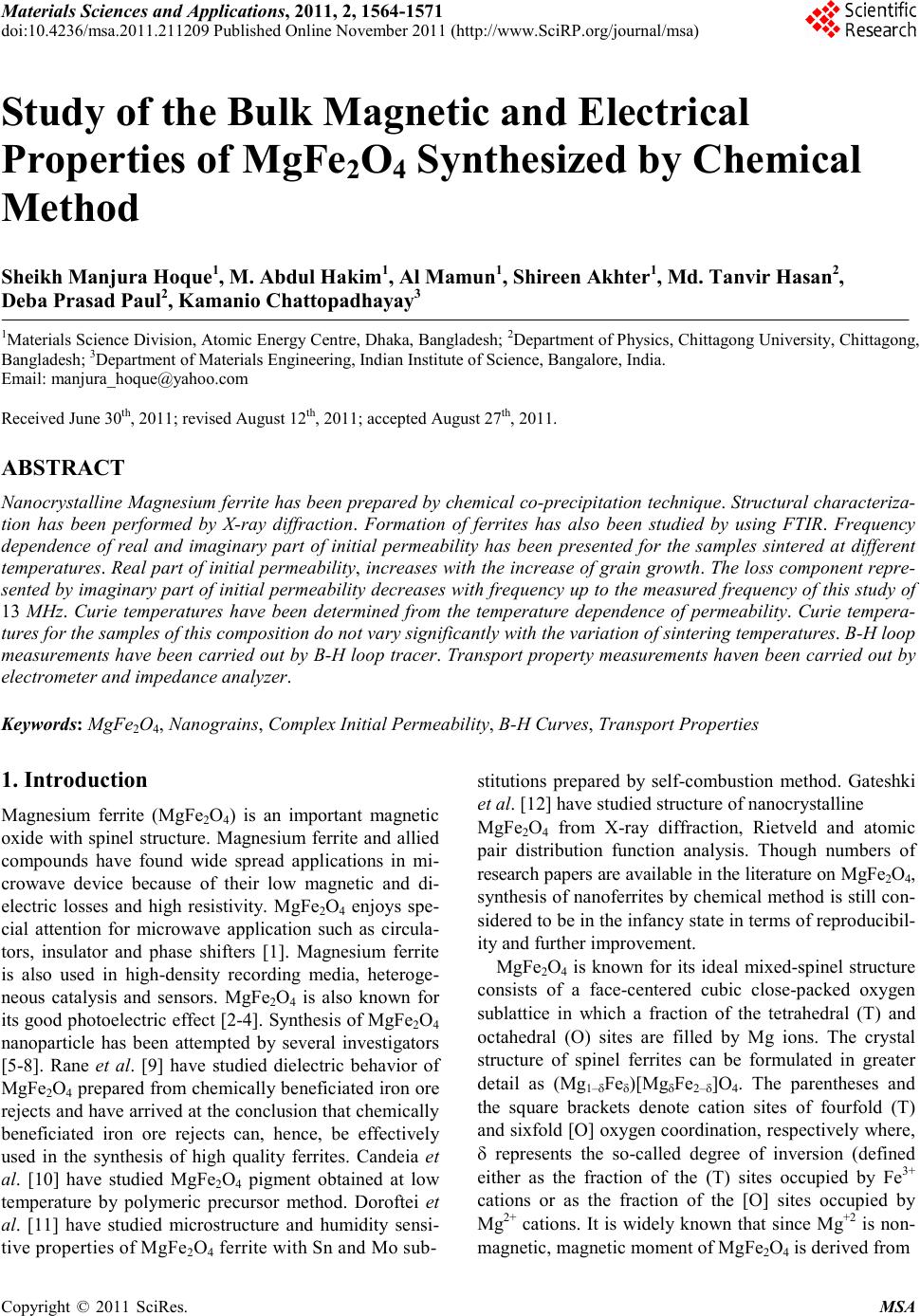 Materials Sciences and Applications, 2011, 2, 1564-1571 doi:10.4236/msa.2011.211209 Published Online November 2011 (http://www.SciRP.org/journal/msa) Copyright © 2011 SciRes. MSA Study of the Bulk Magnetic and Electrical Properties of MgFe2O4 Synthesized by Chemical Method Sheikh Manjura Hoque1, M. Abdul Hakim1, Al Mamun1, Shireen Akhter1, Md. Tanv i r H asan2, Deba Prasad Paul2, Kamanio Chattopadhayay3 1Materials Science Division, Atomic Energy Centre, Dhaka, Bangladesh; 2Department of Physics, Chittagong University, Chittagong, Bangladesh; 3Department of Materials Engineering, Indian Institute of Science, Bangalore, India. Email: [email protected] Received June 30th, 2011; revised August 12th, 2011; accepted August 27th, 2011. ABSTRACT Nanocrystalline Magnesium ferrite has been prepared by chemical co-precipitation technique. Structural characteriza- tion has been performed by X-ray diffraction. Formation of ferrites has also been studied by using FTIR. Frequency dependence of real and imaginary part of initial permeability has been presented for the samples sintered at different temperatures. Real part of initial permeability, increases with the increase of grain growth. The loss component repre- sented by imaginary part of initial permeability decreases with frequency up to the measured frequency of this study of 13 MHz. Curie temperatures have been determined from the temperature dependence of permeability. Curie tempera- tures for the samples of this composition do not vary significantly with the variation of sintering temperatures. B-H loop measurements have been carried out by B-H loop tracer. Transport property measurements haven been carried out by electrometer and impedance analyzer. Keywords: MgFe2O4, Nanograins, Complex Initial Permeability, B-H Curves, Transport Properties 1. Introduction Magnesium ferrite (MgFe2O4) is an important magnetic oxide with spinel structure. Magnesium ferrite and allied compounds have found wide spread applications in mi- crowave device because of their low magnetic and di- electric losses and high resistivity. MgFe2O4 enjoys spe- cial attention for microwave application such as circula- tors, insulator and phase shifters [1]. Magnesium ferrite is also used in high-density recording media, heteroge- neous catalysis and sensors. MgFe2O4 is also known for its good photoelectric effect [2-4]. Synthesis of MgFe2O4 nanoparticle has been attempted by several investigators [5-8]. Rane et al. [9] have studied dielectric behavior of MgFe2O4 prepared from chemically beneficiated iron ore rejects and have arrived at the conclusion that chemically beneficiated iron ore rejects can, hence, be effectively used in the synthesis of high quality ferrites. Candeia et al. [10] have studied MgFe2O4 pigment obtained at low temperature by polymeric precursor method. Doroftei et al. [11] have studied microstructure and humidity sensi- tive properties of MgFe2O4 ferrite with Sn and Mo sub- stitutions prepared by self-combustion method. Gateshki et al. [12] have studied structure of nanocrystalline MgFe2O4 from X-ray diffraction, Rietveld and atomic pair distribution function analysis. Though numbers of research papers are available in the literature on MgFe2O4, synthesis of nanoferrites by chemical method is still con- sidered to be in the infancy state in terms of reproducibil- ity and further improvement. MgFe2O4 is known for its ideal mixed-spinel structure consists of a face-centered cubic close-packed oxygen sublattice in which a fraction of the tetrahedral (T) and octahedral (O) sites are filled by Mg ions. The crystal structure of spinel ferrites can be formulated in greater detail as (Mg1–Fe)[MgFe2–]O4. The parentheses and the square brackets denote cation sites of fourfold (T) and sixfold [O] oxygen coordination, respectively where, represents the so-called degree of inversion (defined either as the fraction of the (T) sites occupied by Fe3+ cations or as the fraction of the [O] sites occupied by Mg2+ cations. It is widely known that since Mg+2 is non- magnetic, magnetic moment of MgFe2O4 is derived from 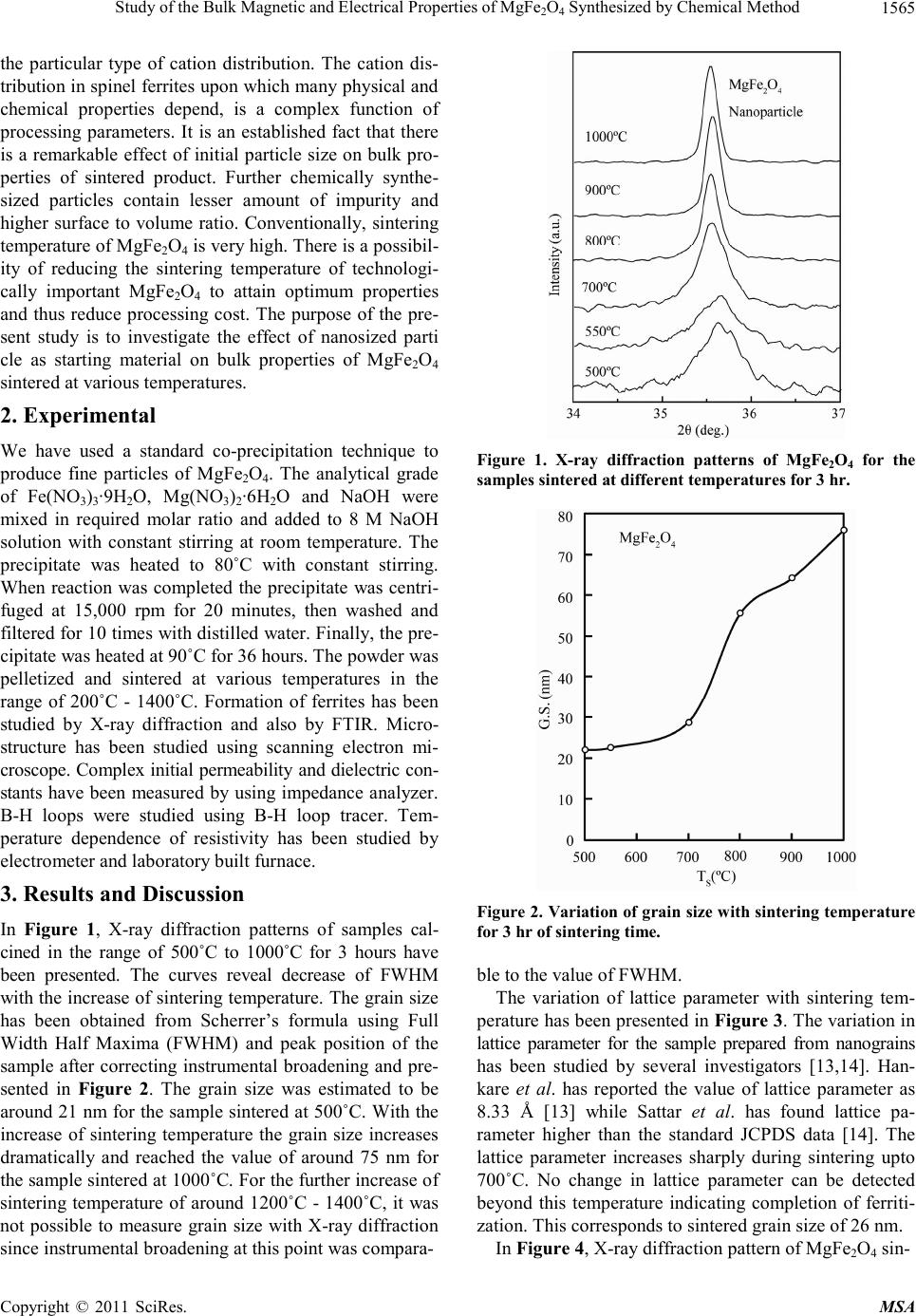 Study of the Bulk Magnetic and Electrical Properties of MgFeO Synthesized by Chemical Method1565 2 4 the particular type of cation distribution. The cation dis- tribution in spinel ferrites upon which many physical and chemical properties depend, is a complex function of processing parameters. It is an established fact that there is a remarkable effect of initial particle size on bulk pro- perties of sintered product. Further chemically synthe- sized particles contain lesser amount of impurity and higher surface to volume ratio. Conventionally, sintering temperature of MgFe2O4 is very high. There is a possibil- ity of reducing the sintering temperature of technologi- cally important MgFe2O4 to attain optimum properties and thus reduce processing cost. The purpose of the pre- sent study is to investigate the effect of nanosized parti cle as starting material on bulk properties of MgFe2O4 sintered at various temperatures. 2. Experimental We have used a standard co-precipitation technique to produce fine particles of MgFe2O4. The analytical grade of Fe(NO3)3·9H2O, Mg(NO3)2·6H2O and NaOH were mixed in required molar ratio and added to 8 M NaOH solution with constant stirring at room temperature. The precipitate was heated to 80˚C with constant stirring. When reaction was completed the precipitate was centri- fuged at 15,000 rpm for 20 minutes, then washed and filtered for 10 times with distilled water. Finally, the pre- cipitate was heated at 90˚C for 36 hours. The powder was pelletized and sintered at various temperatures in the range of 200˚C - 1400˚C. Formation of ferrites has been studied by X-ray diffraction and also by FTIR. Micro- structure has been studied using scanning electron mi- croscope. Complex initial permeability and dielectric con- stants have been measured by using impedance analyzer. B-H loops were studied using B-H loop tracer. Tem- perature dependence of resistivity has been studied by electrometer and laboratory built furnace. 3. Results and Discussion In Figure 1, X-ray diffraction patterns of samples cal- cined in the range of 500˚C to 1000˚C for 3 hours have been presented. The curves reveal decrease of FWHM with the increase of sintering temperature. The grain size has been obtained from Scherrer’s formula using Full Width Half Maxima (FWHM) and peak position of the sample after correcting instrumental broadening and pre- sented in Figure 2. The grain size was estimated to be around 21 nm for the sample sintered at 500˚C. With the increase of sintering temperature the grain size increases dramatically and reached the value of around 75 nm for the sample sintered at 1000˚C. For the further increase of sintering temperature of around 1200˚C - 1400˚C, it was not possible to measure grain size with X-ray diffraction since instrumental broadening at this point was compara- Figure 1. X-ray diffraction patterns of MgFe2O4 for the samples sinte red at different t emperature s for 3 hr. Figure 2. Variati on of grain size w ith sintering temperature for 3 hr of sinte r ing time. ble to the value of FWHM. The variation of lattice parameter with sintering tem- perature has been presented in Figure 3. The variation in lattice parameter for the sample prepared from nanograins has been studied by several investigators [13,14]. Han- kare et al. has reported the value of lattice parameter as 8.33 Å [13] while Sattar et al. has found lattice pa- rameter higher than the standard JCPDS data [14]. The lattice parameter increases sharply during sintering upto 700˚C. No change in lattice parameter can be detected beyond this temperature indicating completion of ferriti- zation. This corresponds to sintered grain size of 26 nm. In Figure 4, X-ray diffraction pattern of MgFe2O4 sin- Copyright © 2011 SciRes. MSA 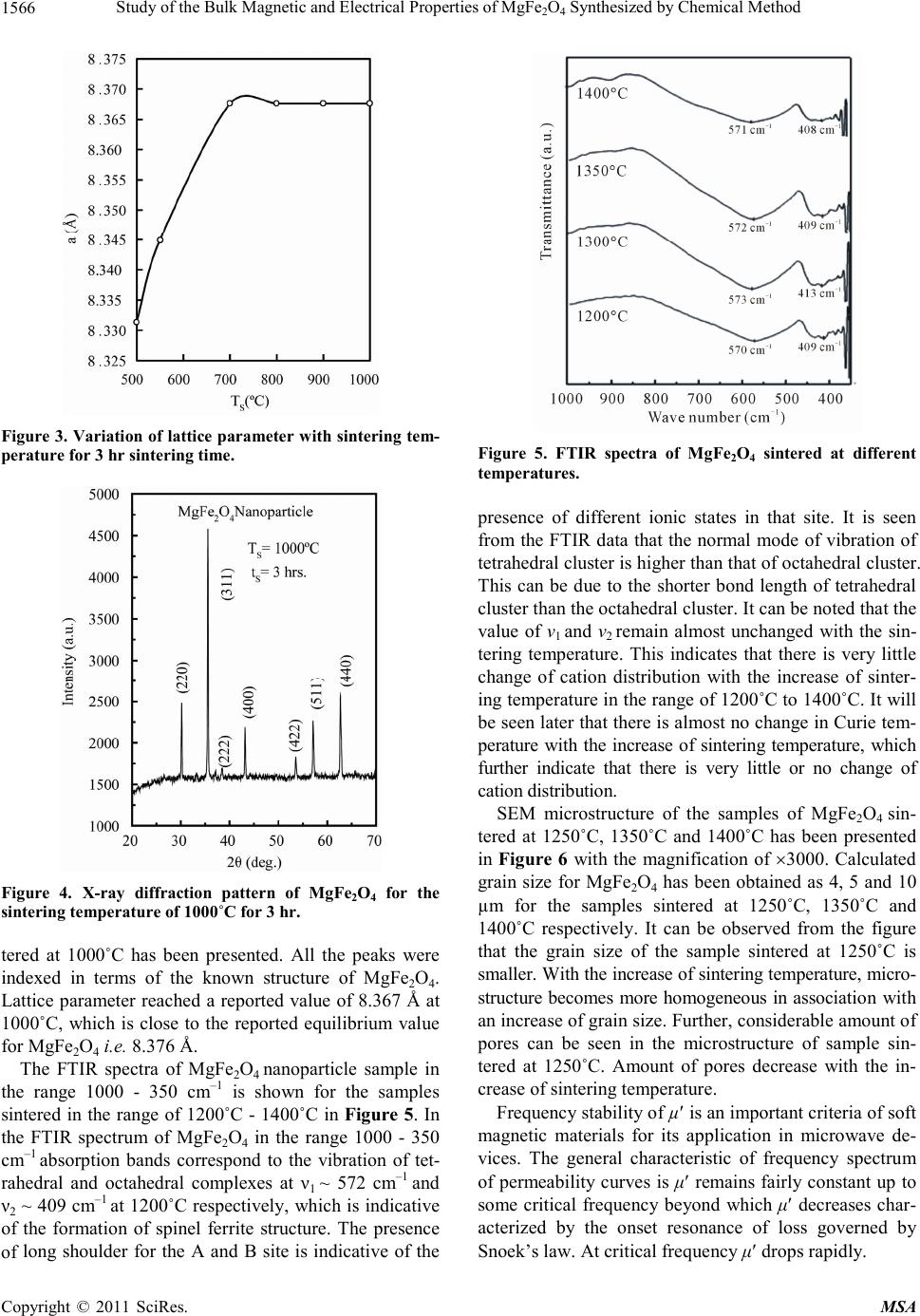 Study of the Bulk Magnetic and Electrical Properties of MgFeO Synthesized by Chemical Method 1566 2 4 Figure 3. Variati on of lattice para meter w ith sintering tem- pera ture for 3 hr s intering time . Figure 4. X-ray diffraction pattern of MgFe2O4 for the sintering temperature of 1000˚C for 3 hr. tered at 1000˚C has been presented. All the peaks were indexed in terms of the known structure of MgFe2O4. Lattice parameter reached a reported value of 8.367 Å at 1000˚C, which is close to the reported equilibrium value for MgFe2O4 i.e. 8.376 Å. The FTIR spectra of MgFe2O4 nanoparticle sample in the range 1000 - 350 cm–1 is shown for the samples sintered in the range of 1200˚C - 1400˚C in Figure 5. In the FTIR spectrum of MgFe2O4 in the range 1000 - 350 cm–1 absorption bands correspond to the vibration of tet- rahedral and octahedral complexes at ν1 ~ 572 cm–1 and ν2 ~ 409 cm–1 at 1200˚C respectively, which is indicative of the formation of spinel ferrite structure. The presence Figure 5. FTIR spectra of MgFe2O4 sintered at dferent resence of different ionic states in that site. It is seen ture of the samples of MgFe2O4 sin- te mportant criteria of soft m if temperatures. p from the FTIR data that the normal mode of vibration of tetrahedral cluster is higher than that of octahedral cluster. This can be due to the shorter bond length of tetrahedral cluster than the octahedral cluster. It can be noted that the value of ν1 and ν2 remain almost unchanged with the sin- tering temperature. This indicates that there is very little change of cation distribution with the increase of sinter- ing temperature in the range of 1200˚C to 1400˚C. It will be seen later that there is almost no change in Curie tem- perature with the increase of sintering temperature, which further indicate that there is very little or no change of cation distribution. SEM microstruc red at 1250˚C, 1350˚C and 1400˚C has been presented in Figure 6 with the magnification of 3000. Calculated grain size for MgFe2O4 has been obtained as 4, 5 and 10 µm for the samples sintered at 1250˚C, 1350˚C and 1400˚C respectively. It can be observed from the figure that the grain size of the sample sintered at 1250˚C is smaller. With the increase of sintering temperature, micro- structure becomes more homogeneous in association with an increase of grain size. Further, considerable amount of pores can be seen in the microstructure of sample sin- tered at 1250˚C. Amount of pores decrease with the in- crease of sintering temperature. Frequency stability of µ is an i agnetic materials for its application in microwave de- vices. The general characteristic of frequency spectrum of permeability curves is μ remains fairly constant up to some critical frequency beyond which μ decreases char- acterized by the onset resonance of loss governed by Snoek’s law. At critical frequency μ drops rapidly. of long shoulder for the A and B site is indicative of the Copyright © 2011 SciRes. MSA 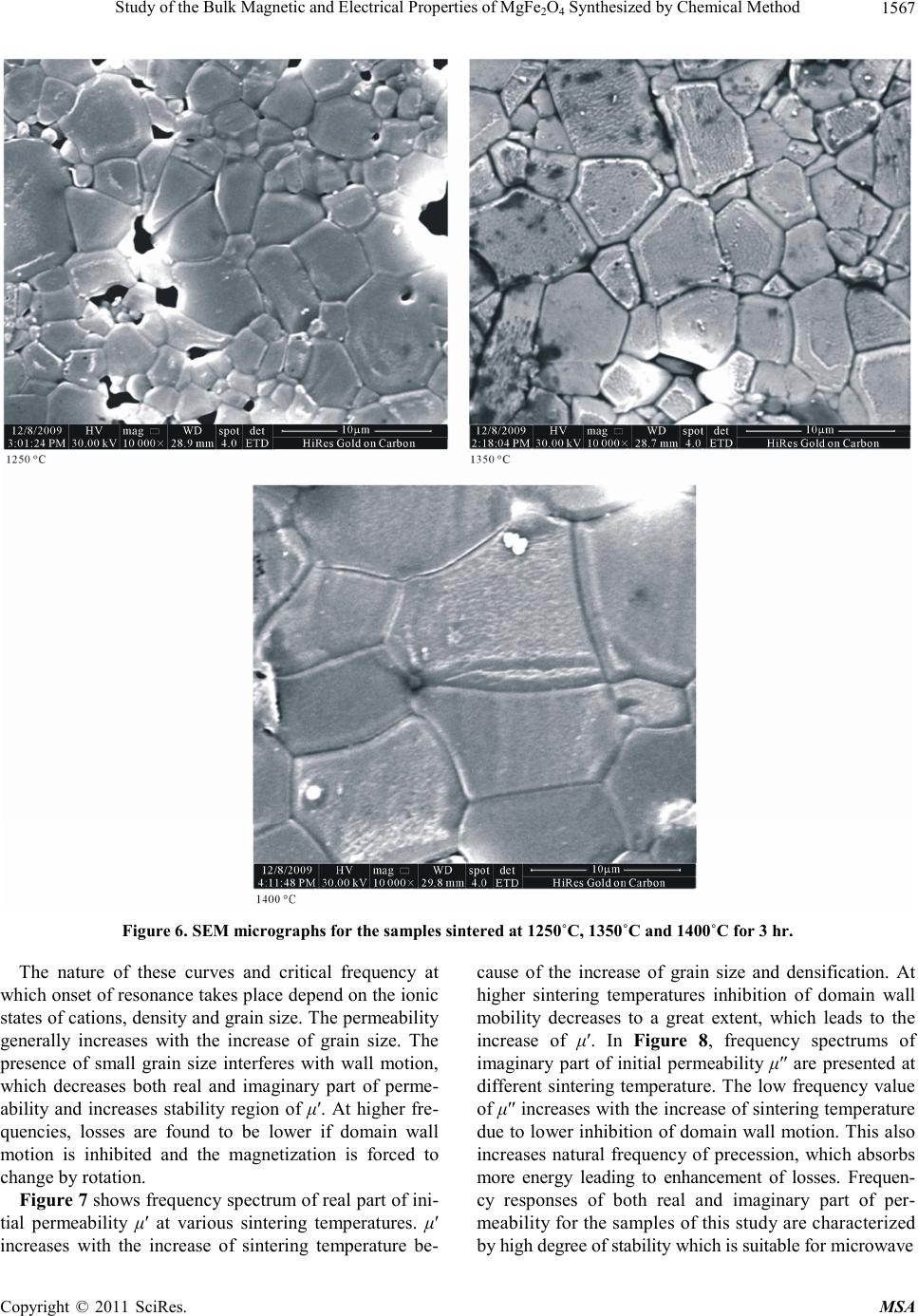 Study of the Bulk Magnetic and Electrical Properties of MgFe2O4 Synthesized by Chemical Method Copyright © 2011 SciRes. MSA 1567 Figure 6. SEM micrographs for the samples sintered at 1250˚C, 1350˚C and 1400˚C for 3 hr. The nature of these curves and critical frequency at w equency spectrum of real part of ini- tia cause of the increase of grain size and densification. At hich onset of resonance takes place depend on the ionic states of cations, density and grain size. The permeability generally increases with the increase of grain size. The presence of small grain size interferes with wall motion, which decreases both real and imaginary part of perme- ability and increases stability region of μ′. At higher fre- quencies, losses are found to be lower if domain wall motion is inhibited and the magnetization is forced to change by rotation. Figure 7 shows fr l permeability μ′ at various sintering temperatures. μ′ increases with the increase of sintering temperature be- higher sintering temperatures inhibition of domain wall mobility decreases to a great extent, which leads to the increase of μ′. In Figure 8, frequency spectrums of imaginary part of initial permeability μ″ are presented at different sintering temperature. The low frequency value of μ″ increases with the increase of sintering temperature due to lower inhibition of domain wall motion. This also increases natural frequency of precession, which absorbs more energy leading to enhancement of losses. Frequen- cy responses of both real and imaginary part of per- meability for the samples of this study are characterized by high degree of stability which is suitable for microwave 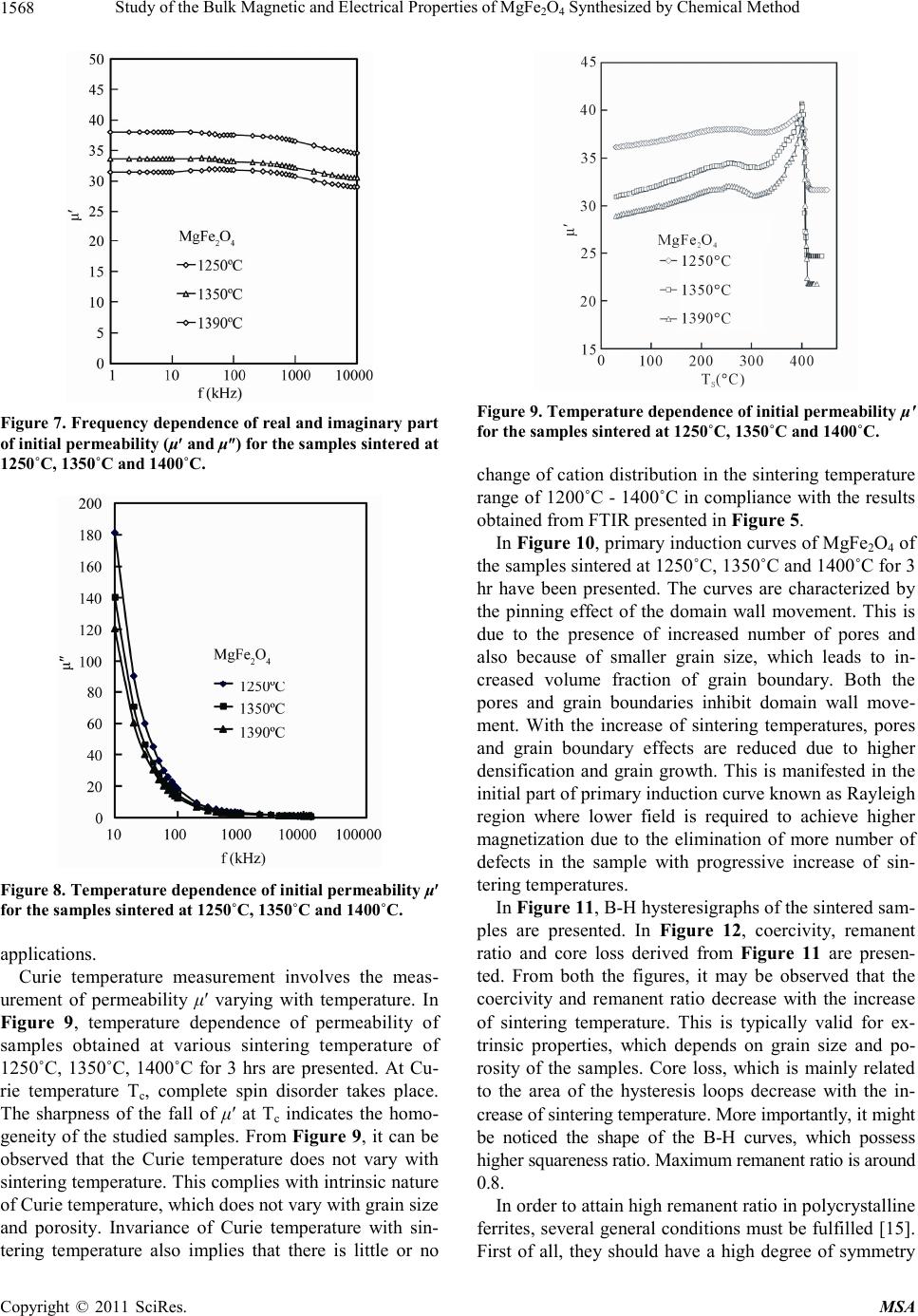 Study of the Bulk Magnetic and Electrical Properties of MgFeO Synthesized by Chemical Method 1568 2 4 Fig ure 7 . Fr equency de pend enc e of re al and i magi nary part of initial permeability (μ and μ) for the samples sitere d at n 1250˚C, 1350˚C and 1400˚C. Figure 8. Temperature dependence of initial permeability μ for the samples sintered at 1250˚C, 1350˚C and 1400 Curie temperature measurement involves the meas- rmeability μ′ varying with temperature. In Fi ˚C. applications. urement of pe gure 9, temperature dependence of permeability of samples obtained at various sintering temperature of 1250˚C, 1350˚C, 1400˚C for 3 hrs are presented. At Cu- rie temperature Tc, complete spin disorder takes place. The sharpness of the fall of μ′ at Tc indicates the homo- geneity of the studied samples. From Figure 9, it can be observed that the Curie temperature does not vary with sintering temperature. This complies with intrinsic nature of Curie temperature, which does not vary with grain size and porosity. Invariance of Curie temperature with sin- tering temperature also implies that there is little or no Figure 9. Temperature dependence of initial permeaility μ′ for the samples sintered at 1250˚C, 1350˚C and 1400 ure nge of 1200˚C - 1400˚C in compliance with the results 1400˚C for 3 hr n Figure 12, coercivity, remanent ra es, several general conditions must be fulfilled [15]. Fi b ˚C. change of cation distribution in the sintering temperat ra obtained from FTIR presented in Figure 5. In Figure 10, primary induction curves of MgFe2O4 of the samples sintered at 1250˚C, 1350˚C and have been presented. The curves are characterized by the pinning effect of the domain wall movement. This is due to the presence of increased number of pores and also because of smaller grain size, which leads to in- creased volume fraction of grain boundary. Both the pores and grain boundaries inhibit domain wall move- ment. With the increase of sintering temperatures, pores and grain boundary effects are reduced due to higher densification and grain growth. This is manifested in the initial part of primary induction curve known as Rayleigh region where lower field is required to achieve higher magnetization due to the elimination of more number of defects in the sample with progressive increase of sin- tering temperatures. In Figure 11, B-H hysteresigraphs of the sintered sam- ples are presented. I tio and core loss derived from Figure 11 are presen- ted. From both the figures, it may be observed that the coercivity and remanent ratio decrease with the increase of sintering temperature. This is typically valid for ex- trinsic properties, which depends on grain size and po- rosity of the samples. Core loss, which is mainly related to the area of the hysteresis loops decrease with the in- crease of sintering temperature. More importantly, it might be noticed the shape of the B-H curves, which possess higher squareness ratio. Maximum remanent ratio is around 0.8. In order to attain high remanent ratio in polycrystalline ferrit rst of all, they should have a high degree of symmetry Copyright © 2011 SciRes. MSA 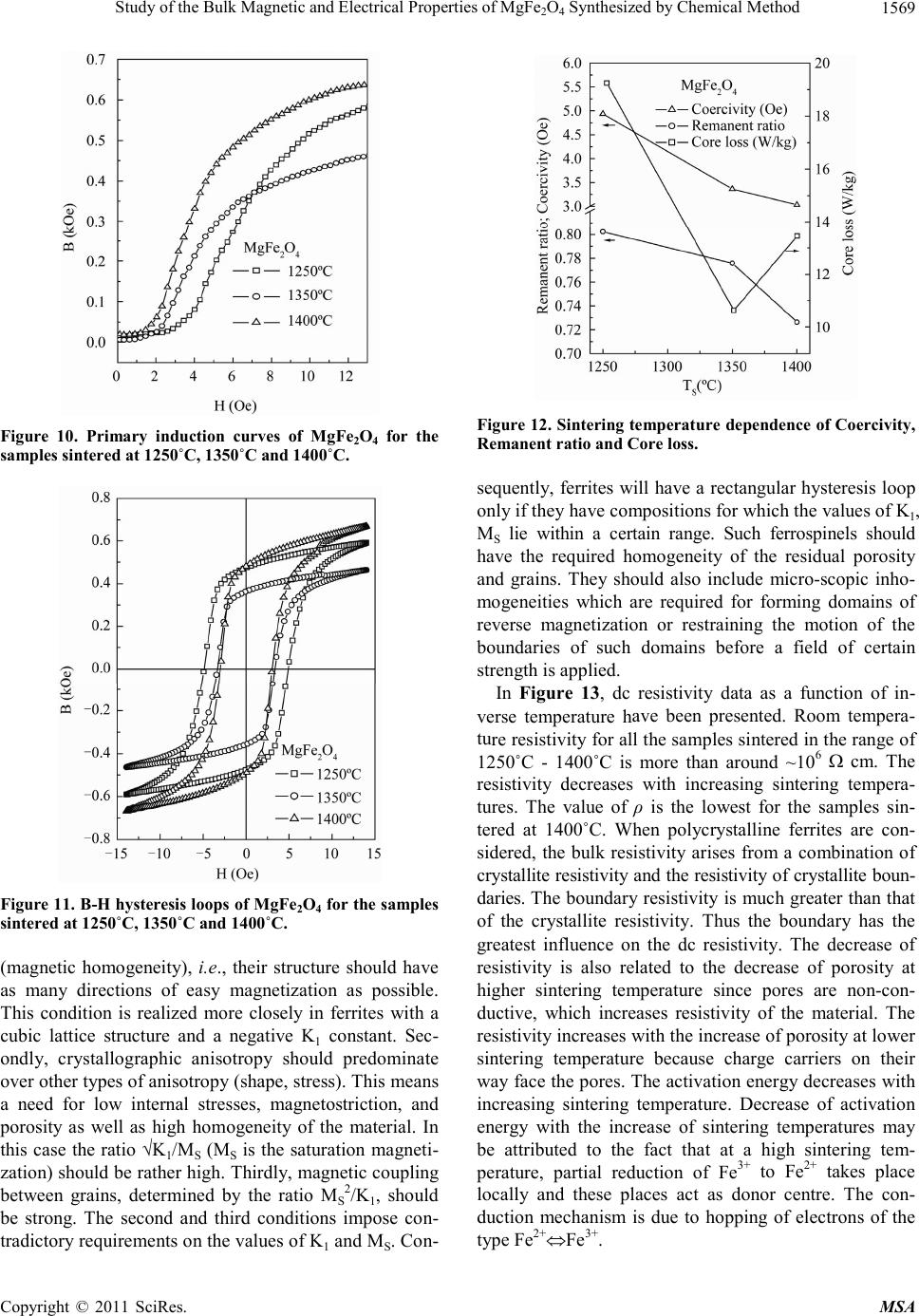 Study of the Bulk Magnetic and Electrical Properties of MgFeO Synthesized by Chemical Method1569 2 4 Figure 10. Primary induction curves of MgFe2O4 for the samples sintered at 1250˚C, 1350˚C and 1400˚C. Figure 11 . B-H hysteresis lo ops of M gFe2O4 for the samples sintered at 1250˚C, 1350˚C and 1400˚C. cture should have s many directions of easy magnetization as possible. (magnetic homogeneity), i.e., their stru a This condition is realized more closely in ferrites with a cubic lattice structure and a negative K1 constant. Sec- ondly, crystallographic anisotropy should predominate over other types of anisotropy (shape, stress). This means a need for low internal stresses, magnetostriction, and porosity as well as high homogeneity of the material. In this case the ratio K1/MS (MS is the saturation magneti- zation) should be rather high. Thirdly, magnetic coupling between grains, determined by the ratio MS2/K1, should be strong. The second and third conditions impose con- tradictory requirements on the values of K1 and MS. Con- Figure 12 . Sintering te mperature dependence of Co ercivity, Rema nent ratio and Core los s . gular hysteresis loop nly if they have compositions for which the values of K1, ave been presented. Room tempera- tu sequently, ferrites will have a rectan o MS lie within a certain range. Such ferrospinels should have the required homogeneity of the residual porosity and grains. They should also include micro-scopic inho- mogeneities which are required for forming domains of reverse magnetization or restraining the motion of the boundaries of such domains before a field of certain strength is applied. In Figure 13, dc resistivity data as a function of in- verse temperature h re resistivity for all the samples sintered in the range of 1250˚C - 1400˚C is more than around ~106 cm. The resistivity decreases with increasing sintering tempera- tures. The value of ρ is the lowest for the samples sin- tered at 1400˚C. When polycrystalline ferrites are con- sidered, the bulk resistivity arises from a combination of crystallite resistivity and the resistivity of crystallite boun- daries. The boundary resistivity is much greater than that of the crystallite resistivity. Thus the boundary has the greatest influence on the dc resistivity. The decrease of resistivity is also related to the decrease of porosity at higher sintering temperature since pores are non-con- ductive, which increases resistivity of the material. The resistivity increases with the increase of porosity at lower sintering temperature because charge carriers on their way face the pores. The activation energy decreases with increasing sintering temperature. Decrease of activation energy with the increase of sintering temperatures may be attributed to the fact that at a high sintering tem- perature, partial reduction of Fe3+ to Fe2+ takes place locally and these places act as donor centre. The con- duction mechanism is due to hopping of electrons of the type Fe2+Fe3+. Copyright © 2011 SciRes. MSA 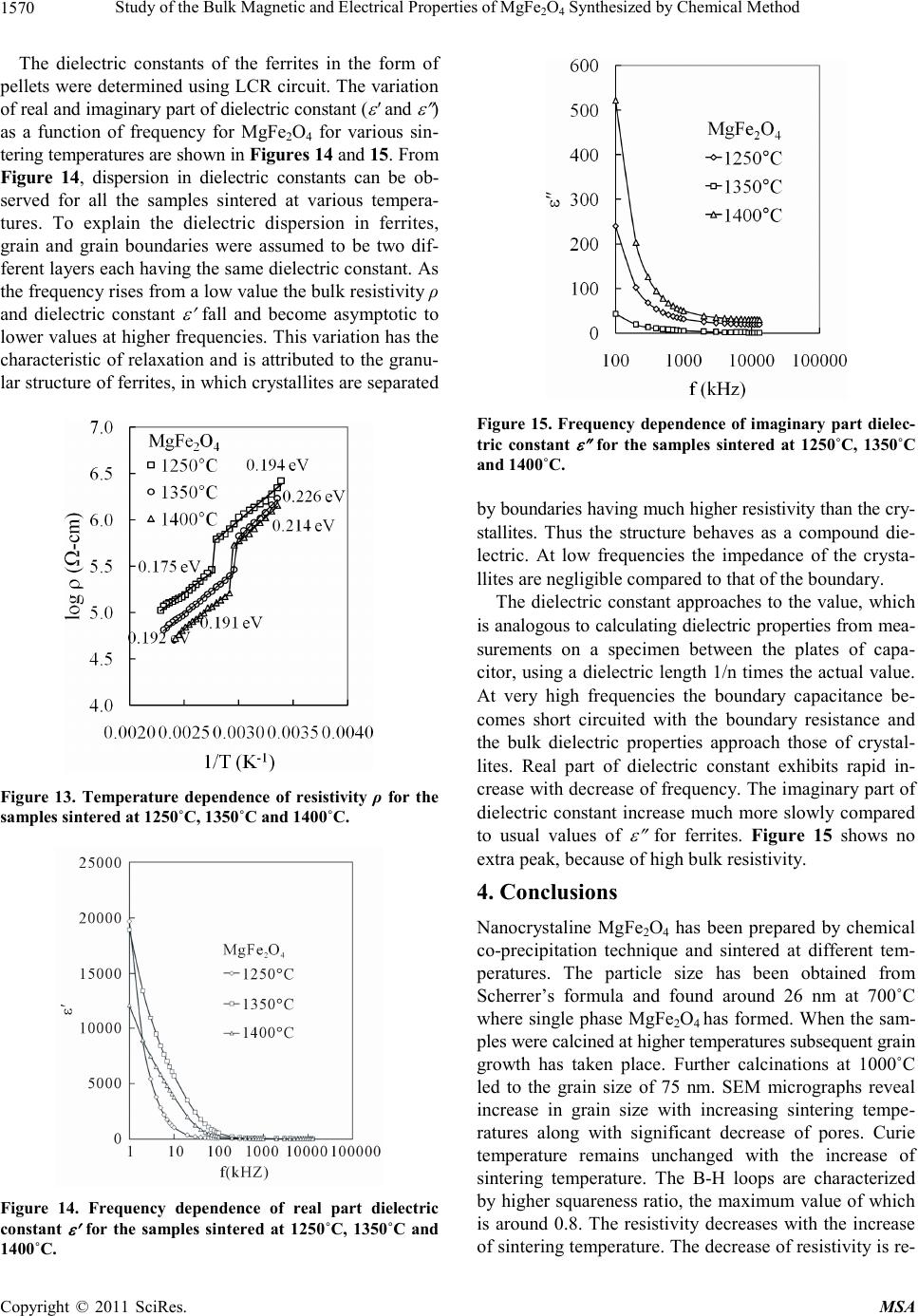 Study of the Bulk Magnetic and Electrical Properties of MgFeO Synthesized by Chemical Method 1570 2 4 mined using LCR circuit. The variation of The dielectric constants of the ferrites in the form of pellets were deter real and imaginary part of dielectric constant ( ' and ) as a function of frequency for MgFe2O4 for various sin- tering temperatures are shown in Figures 14 and 15. From Figure 14, dispersion in dielectric constants can be ob- served for all the samples sintered at various tempera- tures. To explain the dielectric dispersion in ferrites, grain and grain boundaries were assumed to be two dif- ferent layers each having the same dielectric constant. As the frequency rises from a low value the bulk resistivity ρ and dielectric constant fall and become asymptotic to lower values at higher frequencies. This variation has the characteristic of relaxation and is attributed to the granu- lar structure of ferrites, in which crystallites are separated Figure 13. Temperature dependence of resistivity ρ for the samples sintered at 1250˚C, 1350˚C and 1400˚C. Figure 15. Frequency dependence of imaginary part diele c- tric constant for the samples sintered at 1250˚C 50˚C and 1400˚C. s the structure behaves as a compound die- by chemical hnique and sintered at different tem- s , 13 by boundaries having much higher resistivity than the cry- tallites. Thus lectric. At low frequencies the impedance of the crysta- llites are negligible compared to that of the boundary. The dielectric constant approaches to the value, which is analogous to calculating dielectric properties from mea- surements on a specimen between the plates of capa- citor, using a dielectric length 1/n times the actual value. At very high frequencies the boundary capacitance be- comes short circuited with the boundary resistance and the bulk dielectric properties approach those of crystal- lites. Real part of dielectric constant exhibits rapid in- crease with decrease of frequency. The imaginary part of dielectric constant increase much more slowly compared to usual values of for ferrites. Figure 15 shows no extra peak, because of high bulk resistivity. 4. Conclusions Nanocrystaline MgFe2O4 has been prepared co-precipitation tec peratures. The particleize has been obtained from Scherrer’s formula and found around 26 nm at 700˚C where single phase MgFe2O4 has formed. When the sam- ples were calcined at higher temperatures subsequent grain growth has taken place. Further calcinations at 1000˚C led to the grain size of 75 nm. SEM micrographs reveal increase in grain size with increasing sintering tempe- ratures along with significant decrease of pores. Curie temperature remains unchanged with the increase of sintering temperature. The B-H loops are characterized by higher squareness ratio, the maximum value of which is around 0.8. The resistivity decreases with the increase of sintering temperature. The decrease of resistivity is re- Figure 14. Frequency dependence of real part dectric constant for the samples sintered at 1250˚C, 135C and 1400˚C. iel 0˚ Copyright © 2011 SciRes. MSA 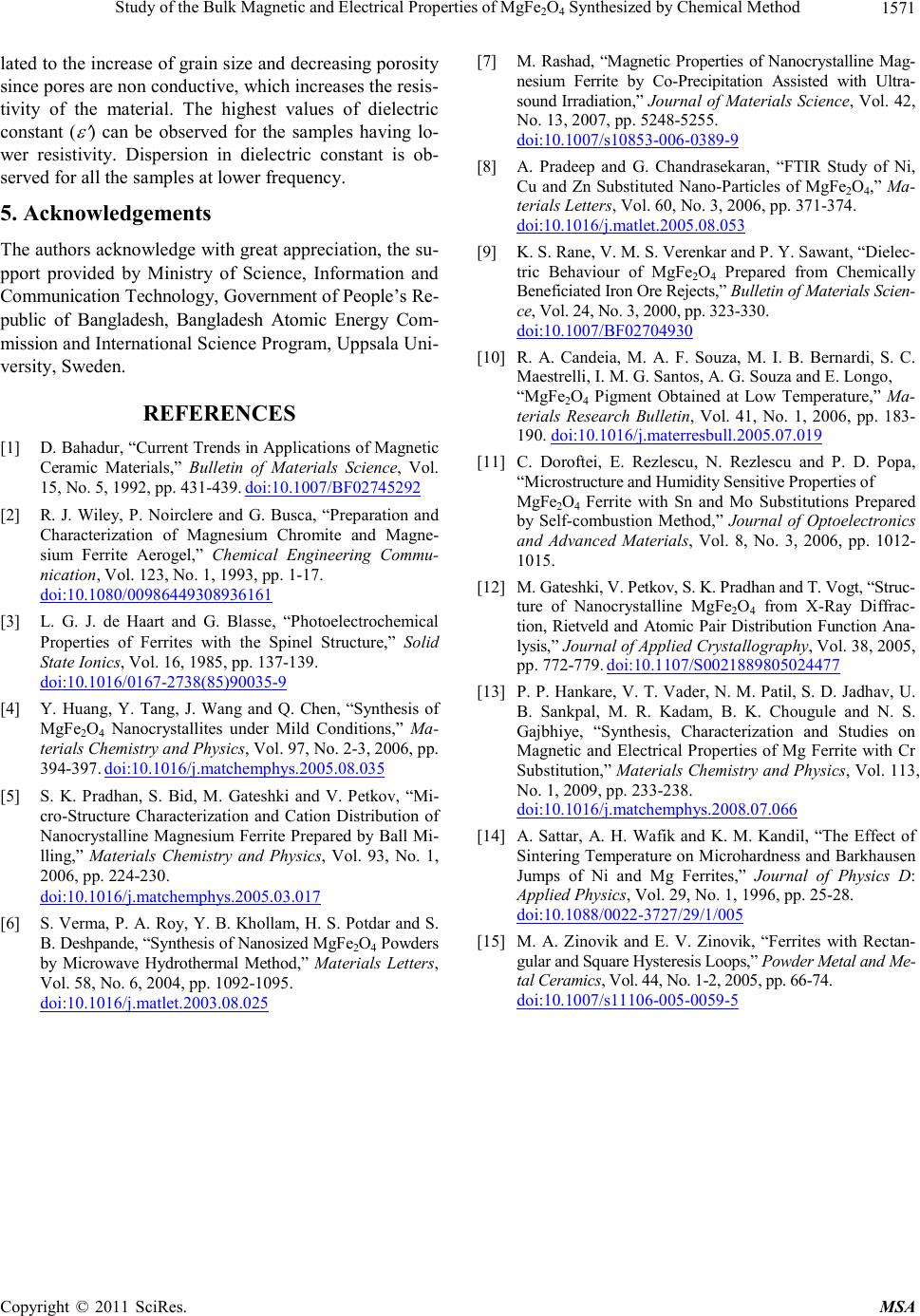 Study of the Bulk Magnetic and Electrical Properties of MgFe2O4 Synthesized by Chemical Method Copyright © 2011 SciRes. MSA 1571 on, the su- of Science, Informatio Government of People’s Re- Current Trends in Applications of Magnetic Ceramic Materials Science, Vol 15, No. 5, 19907/BF02745 lated to the increase of grain size and decreasing porosity since pores are non conductive, which increases the resis- tivity of the material. The highest values of dielectric constant ( ) can be observed for the samples having lo- wer resistivity. Dispersion in dielectric constant is ob- served for all the samples at lower frequency. 5. Acknowledgements The authors acknowledge with great appreciati pport provided by Ministry Communication Technology, n and public of Bangladesh, Bangladesh Atomic Energy Com- mission and International Science Program, Uppsala Uni- versity, Sweden. REFERENCES [1] D. Bahadur, “ . rials,” Bulletin of Mate 2, pp. 431-439. doi:10.10 292 [2] R. J. Wiley, P. Noirclere and G. Busca, “Preparation and Characterization of Magnesium Chromite and Magne- sium Ferrite Aerogel,” Chemical Engineering Commu- nication, Vol. 123, No. 1, 1993, pp. 1-17. doi:10.1080/00986449308936161 [3] L. G. J. de Haart and G. Blasse, “Photoelectrochemical Properties of Ferrites with the Spinel St State Ionics ructure,” Solid -139. , Vol. 16, 1985, pp. 137 doi:10.1016/0167-2738(85)90035-9 [4] Y. Huang, Y. Tang, J. Wang and Q. Chen, “Synthesis of MgFe2O4 Nanocrystallites under Mild Conditions,” Ma- terials Chemistry and Physics, Vol. 97, No. 2-3, 2006, pp. 394-397. doi:10.1016/j.matchemphys.2005.08.035 [5] S. K. Pradhan, S. Bid, M. Gateshki and V. Petkov, “Mi- cro-Structure Characterization and Cation Distribution of Nanocrystalline Magnesium Ferrite Prepared by Ball Mi- lling,” Materials Chemistry and Physics, Vol. 93, No. 1, 2006, pp. 224-230. doi:10.1016/j.matchemphys.2005.03.017 [6] S. Verma, P. A. Roy, Y. B. Khollam, H. S. Potdar and S. B. Deshpande, “Synthe by Microwave Hydrothermal Method,” M sis of Nanosized MgFe2O4 Powders aterials Le tters, Vol. 58, No. 6, 2004, pp. 1092-1095. doi:10.1016/j.matlet.2003.08.025 [7] M. Rashad, “Magnetic Properties of Nanocrystalline Mag- nesium Ferrite by Co-Precipitation Assisted with Ultra- sound Irradiation,” Journal of Materials Science, Vol. 42, No. 13, 2007, pp. 5248-5255. doi:10.1007/s10853-006-0389-9 [8] A. Pradeep and G. Chandrasekaran, “FTIR Study of Ni, Cu and Zn Substituted Nano-Particles of MgFe2O4,” Ma- terials Letters, Vol. 60, No. 3, 2006, pp. 371-374. doi:10.1016/j.matlet.2005.08.053 [9] K. S. Rane, V. M. S. Verenkar and P. Y. Sawant, “Dielec- tric Behaviour of MgFe2O4 Prepared from Chemically Beneficiated Iron Ore Rejects,” Bulletin of Materials Scien- ce, Vol. 24, No. 3, 2000, pp. 323-330. doi:10.1007/BF02704930 [10] R. A. Candeia, M. A. F. Souza, M. I. B. Bernardi, S. C. Maestrelli, I. M. G. Santos, A. G. Souza and E. Longo, “MgFe2O4 Pigment Obtained at Low Temperature,” Ma- terials Research Bulletin, Vol. 41, No. 1, 2006, pp. 183- 190. doi:10.1016/j.materresbull.2005.07.019 [11] C. Doroftei, E. Rezlescu, N. Rezlescu and P. D. Popa, hki, V. Petkov, S. K. Pradhan and T. Vogt, “Struc- “Microstructure and Humidity Sensitive Properties of MgFe2O4 Ferrite with Sn and Mo Substitutions Prepared by Self-combustion Method,” Journal of Optoelectronics and Advanced Materials, Vol. 8, No. 3, 2006, pp. 1012- 1015. [12] M. Gates ture of Nanocrystalline MgFe2O4 from X-Ray Diffrac- tion, Rietveld and Atomic Pair Distribution Function Ana- lysis,” Journal of Applied Crystallography, Vol. 38, 2005, pp. 772-779. doi:10.1107/S0021889805024477 [13] P. P. Hankare, V. T. Vader, N. M. Patil, S. D. Jadhav, U. B. Sankpal, M. R. Kadam, B. K. Chougule and N. S. Gajbhiye, “Synthesis, Characterization and Studies on Magnetic and Electrical Properties of Mg Ferrite with Cr Substitution,” Materials Chemistry and Physics, Vol. 113, No. 1, 2009, pp. 233-238. doi:10.1016/j.matchemphys.2008.07.066 [14] A. Sattar, A. H. Wafik and K. M. Kandil, “The Effect of Sintering Temperature on Microhardness and Barkhausen Jumps of Ni and Mg Ferrites,” Journal of Physics D: Applied Physics, Vol. 29, No. 1, 1996, pp. 25-28. doi:10.1088/0022-3727/29/1/005 [15] M. A. Zinovik and E. V. Zinovik, “Ferrites with Rectan- gular and Square Hysteresis Loops,” Powder Metal and Me- tal Ceramics, Vol. 44, No. 1-2, 2005, pp. 66-74. doi:10.1007/s11106-005-0059-5 |