

Paper Menu >>
Journal Menu >>
 Materials Science s a nd Applications, 2011, 2, 1572-1577 doi:10.4236/msa.2011.211210 Published Online November 2011 (http://www.SciRP.org/journal/msa) Copyright © 2011 SciRes. MSA Thermoelectric Power of Cu-Zn Ferrites Hussain Abd-Elkariem Dawoud Physics Department, Islamic University of Gaza, Gaza Strip, Palestine. Email: [email protected] Received May 24th, 2011; revised August 24th, 2011; accepted October 4th, 2011. ABSTRACT A series of Cu-Zn mixed ferrites with composition formula Cu1–xZnxFe2O4 is prepared by the double sintering ceramic technique. Thermoelectric power studies are performed over a temperature range of 300 to 800 k by a deferential method. The results showed a negative value for the Seebeck coefficient S for all samples, and all compositions exhib- ited an n-type semiconductors behavior in the measured range of temperature. The values of charge carrier concentra- tion n and the Fermi energy were determined. The values of n were found to decrease as temperature increased, while Fermi energy directed to more negative values when Zn content is increased. On the basis of these results a mechanism for the conduction in Cu-Zn ferrites is suggested and the properties of the mention compounds were determined. Keywords: Ferrites, Thermoelectric Power, Fermi Energy, Seebeck Coefficient 1. Introduction Spinel ferrites are commercially important materials be- cause of their excellent magnetic and electrical properties. Interesting physical and chemical properties of the mag- netically diluted ferrites arise from the ability of these compounds to distribute the cations amongst the avail- able tetrahedral A- and octahedral B-sites. Ferrites are able to fulfill a wide range of applications from micro wave to radio frequencies, are of great importance from both fundamental and applied research points of view [1,2]. Because Zinc is non-magnetic divalent ions that occupy essentially tetrahedral A sites, when substituted in ferrites [3]. Gonchar and Andreev [4] have reported that Ni-Cu-Zn ferrites with less content of Zn could ob- tain high Curie temperature, but the initial permeability of Ni-Cu-Zn ferrites reached. The substitution of Cu brings about a structural phase transition accompanied by the reduction in the crystal symmetry due to co-operative John-Teller effect [5,6], which ultimately results in some interesting electrical and magnetic properties. Various in- vestigations [7,8] studied the electrical and thermal po- wer of the spinel ferrites and have found that they have semi-conducting properties of n or p-type. In this article, the electric and thermoelectric power of Cu-Zn ferrites have been studied experimentally as a function of com- position and temperature in order to understand the con- duction mechanism in these samples. 2. Experimental Technique The polycrystalline Zinc-substituted Copper ferrites hav- ing compositional formula Cu1–xZnxFe2O4 where x step- ped 0 ≤ 0.2 ≥ 1, were prepared by the double sintering ceramic technique [9], from pure oxides powders Fe2O3, CuO and ZnO. Oxides were mixed in stoichiometric pro- portions and prefired at 750˚C for 5 h. The prefired powders were grounded and compressed at constant pre- ssure (3 × 10⁸ Pa) in the form of disk shape of 13 mm diameter. The samples were finally sintered at 1150˚C for 5 hours and then slowly cooled to room temperature with cooling rate of 2˚C/min. The electrical measurements were performed by two- probe method; silver past was applied on both sides of the samples to make good ohmic contact. Thermoelectric power studies were carried out as a function of composition and temperature by differential method [10]. The sample holder for measuring the See- beck coefficient consists of two non-magnetic copper elec- trodes between which the sample is fixed. An auxiliary heating coil is fixed to upper electrode for additional heating to maintain a temperature difference of about 15 degree between the two faces of the sample. A tempera- ture of both surfaces of the sample was measured by the same type of two thermocouples. The Seebeck coeffi- cient S was calculated using the relation SET where ∆E is the thermoelectric potential difference pro- 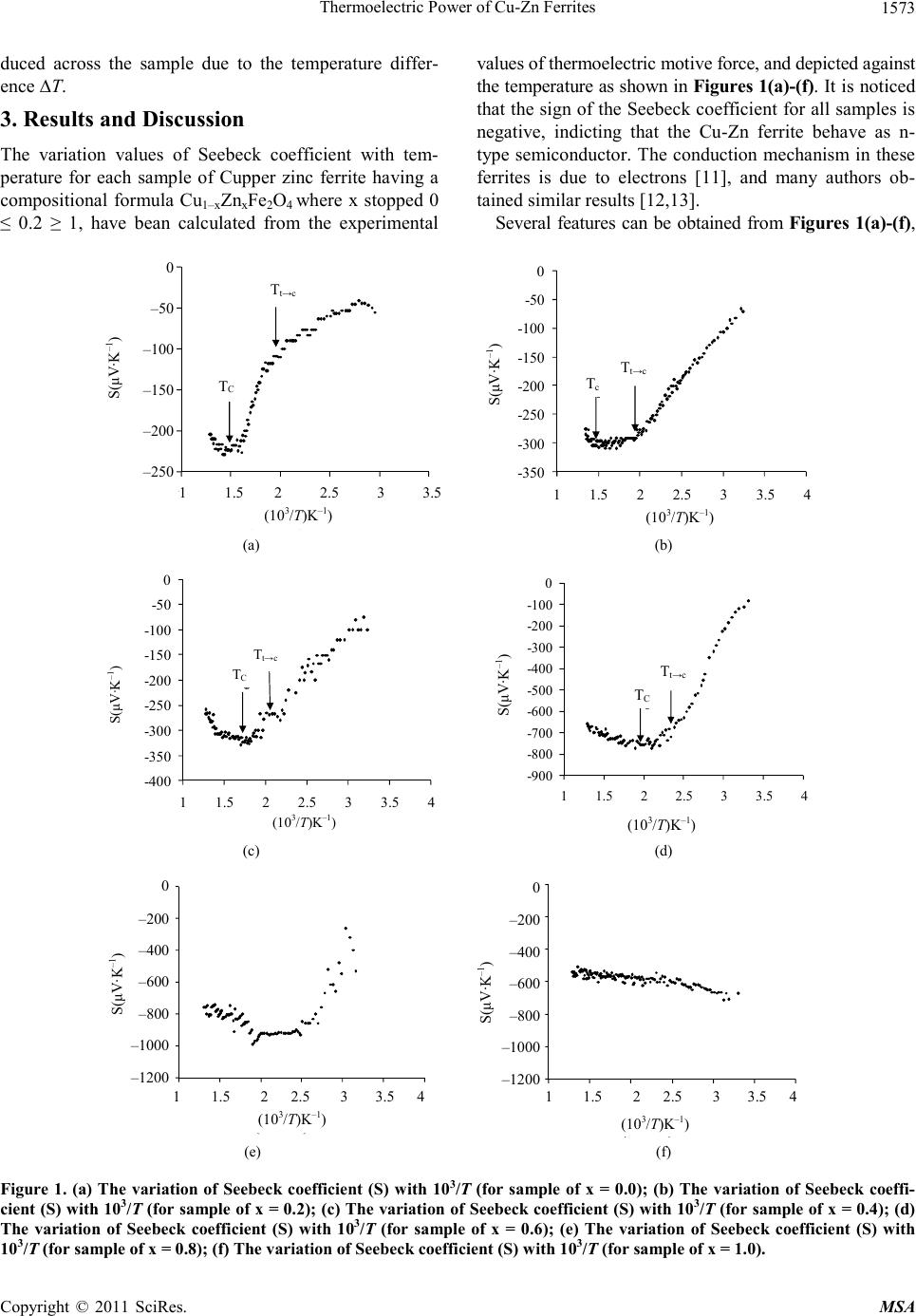 Thermoelectric Power of Cu-Zn Ferrites1573 duced across the sample due to the temperature differ- ence ∆T. 3. Results and Discussion The variation values of Seebeck coefficient with tem- perature for each sample of Cupper zinc ferrite having a compositional formula Cu1–xZnxFe2O4 where x stopped 0 ≤ 0.2 ≥ 1, have bean calculated from the experimental values of thermoelectric motive force, and depicted against the temperature as shown in Figures 1(a)-(f). It is noticed that the sign of the Seebeck coefficient for all samples is negative, indicting that the Cu-Zn ferrite behave as n- type semiconductor. The conduction mechanism in these ferrites is due to electrons [11], and many authors ob- tained similar results [12,13]. Several features can be obtained from Figures 1(a)-(f), -250 -200 -150 -100 -50 0 11.522.533.5 13 ) /10 ( K T S(μV·K – 1 ) (10 3 /T)K – 1 ) 1 1.5 2 2.5 3 3.5 0 –50 –100 –150 –200 –250 -350 -300 -250 -200 -150 -100 -5 0 0 11.522.533.54 13 ) / 10 ( K T S(μV·K – 1) (103/T)K – 1) Tc Tt→c T t→c T C (a) (b) -400 -350 -300 -250 -200 -150 -100 -5 0 0 11.522.533.54 13 ) / 10 ( K T S(μV·K –1 ) (10 3 /T)K – 1 ) T C T t→c -900 -800 -700 -600 -500 -400 -300 -200 -100 0 11.522.533.54 13 ) / 10 ( K T S(μV·K – 1 ) (10 3 /T)K – 1 ) T C T t→c (c) (d) -12 0 0 -10 0 0 -8 00 -6 00 -4 00 -2 00 0 11.522.533.54 13 )/10( KT S(μV·K – 1 ) (10 3 /T)K – 1 ) 1 1.5 2 2.5 3 3.5 4 0 –200 –400 –600 –800 –1000 –1200 -1200 -1000 -800 -600 -400 -200 0 11.522.533.54 13 ) / 10 ( K T S(μV·K – 1 ) (10 3 /T)K – 1 ) 1 1.5 2 2.5 3 3.5 4 0 –200 –400 –600 –800 –1000 –1200 (e) (f) Figure 1. (a) The variation of Seebeck coefficient (S) with 103/T (for sample of x = 0.0); (b) The variation of Seebeck coeffi- cient (S) with 103/T (for sample of x = 0.2); (c) The variation of Seebeck coefficient (S) with 103/T (for sample of x = 0.4); (d) The variation of Seebeck coefficient (S) with 103/T (for sample of x = 0.6); (e) The variation of Seebeck coefficient (S) with 03/T (for sample of x = 0.8); (f) The variation of Seebeck coefficient (S) with 103/T (for sample of x = 1.0). 1 Copyright © 2011 SciRes. MSA  Thermoelectric Power of Cu-Zn Ferrites 1574 compositions of x ≤ 0.6 have two change of slope in S against temperature, the first change at lower temperature can referred to structural change from tetragonal to cubic system. The transition from tetragonal to cubic Tt→c was found to decrease with increasing Zn content as shown in Figure 2. In other words the tetragonality is in agreement with the results of [14]. At higher temperature Seebeck coefficient S decrease in negativity with increasing temperature, up to a parti- cular temperature, hereafter referred to as Seebeck coef- ficient transition temperature Tc. However, by further in- crease of temperature, the values are found to decrease in negativity. The minimum values observed in Seebeck co- efficient may be attributed to a magnetic transition, where the ferromagnetic material becomes paramagnetic. On the other hand, in the case of samples of x = ≥ 0.8, the Seebeck coefficient is found to be increased slightly as the temperature increased unlike other samples, and there is no transition Tc was found. This is due to the fact that these samples having higher Zinc concentration with weak tetrahedral A-site and oc- tahedral B-site super exchange interaction. This behavior is obvious because both samples have higher concentra- tion of Zinc with paramagnetic structure at room tem- perature [14]. Similarly, they behave like normal solid with slightly increase in Seebeck coefficient values with temperature. However, the change of slope could not be observed in the case of the two samples i.e. of x = ≥ 0.8 since they are diamagnetic at room temperature [15]. Generally, the change of slope for samples of x ≤ 0.6 is attributed to change in conductivity mechanism. The conduction at lower temperature (below Curie tempera- ture) is due to hopping of electrons [12] between Fe3+ and Fe2+ ions, whereas at higher temperature (above Curie tem- perature) due to polaron hopping [15]. T t→c T S Following according to Wu et al. [16] the Seebeck co- efficient S is expressed in terms of Fe3+ and Fe2+ ions, considering the small polaron hopping conduction me- chanism as follows: 32 BB SlnFeFeke where [Fe3+]B and [Fe2+]B are the concentration of the Fe3+ and Fe2+ ions in the octahedral sites, respectively and β = 1. Dawoud et al. [17] reported that the increase of Zn substitution tends to increase the Fe2+ ions as de- mon-strated in above equation. In addition, the increase of Zn content is associated with a decrease in copper content. In turn the possibility of Cu+ formation and Cu2+↔Cu1+ hopping process and the number of holes involved will be reduced. As a result S becomes more negative with the increase of x (Zinc content). 4. Charge Carrier Concentration (n) In the case of low mobility semiconductor like ferrites having exceedingly levels , the value of N, the density of state can be taken as 1022 cm–3 [18]. n1expNV NSek The value of charge carriers concentration/unit volume have been calculated for all the samples by using the values of the Seebeck coefficient S, and the relation be- tween n and temperature is depicted in Figures 3(a)-(c) for samples of x = 0.0, 0.2 and 0.4 respectively. The val- ues of n for all samples are also listed in Table 1. The figures illustrated that, the values of n decreased with the increasing the temperature. 5. Fermi Energy (EF) The thermoelectric power data were utilized to determine the Fermi energy. The Fermi energy of Cu-Zn ferrite was calculated employing the following expression [10,19]. F EeSTAKT where K, e, S and T are Boltzmann constant, electronic charge, Seebeck coefficient and absolute temperature res- pectively. A is a dimensionless constant related to the kinetic energy of the charge carrier, and has values of 0 or 2. Two series of values of EF were obtained, over the temperature range from 300 K up to 800 K, for A = 0 and A = 2. Figure 4(a)-(c) represent the variation of Fermi energy with temperature. The extrapolation of the linear part of the two series of EF, for A = 0 and A = 2 inter- sects at T = 0. The corresponding value of EF, the point of intercep- tion at ordinate, gives the Fermi energy at zero tempera- Figure 2. The variation of Tt→c and TS with composition x. Copyright © 2011 SciRes. MSA  Thermoelectric Power of Cu-Zn Ferrites1575 0 1 2 3 4 5 6 7 8 9 10 11 0100 200 300 400500 600700 800900 n×10 21 T(K) (a) 0 1 2 3 4 5 6 7 8 9 0100200300 400500 600700 800900 n×10 21 T(K) (b) 0 1 2 3 4 5 6 7 8 9 0100200 300 400500 600 700 800 900 n×10 21 T(K) (c) Figure 3. (a) Temperature dependence of charge carrier n for sample of x = 0.0; (b) Temperature dependence of charge carrier n for sample of x = 0.2; (c) Temperature dependence of charge carrier n for sample of x = 0.4. ture EF (0); and Figures 4(a)-(c) indicates the variation of Fermi energy with temperature. Also Table 1 lists the values of Fermi energy obtained for each composition. It is noticed that EF (0) is positive for sample of x = 0 and sample of x = 0.2 then it decreases to the negative value i.e. at the left hand side of the gape, as zinc ion increased. Table 1. The values of Seebeck coefficient, Curie tempera- ture transition temperarure from tetragonal to cubic Tt→c and Fermi energy for Cu-Zn ferrites. x S at 374 K TS (K) Tt→c (K) Ef (ev) 0.0–53.8 688 540 2.4 × 10⁻²⁰ 0.2–158 630 512 1.6 × 10⁻²⁰ 0.4–166.7 569 482 0.4 × 10⁻²⁰ 0.6–515 509 439 –0.6 × 10⁻²⁰ 0.8–800 - - –0.8 × 10⁻²⁰ 1.0–636.7 - - –1.0 × 10⁻²⁰ (a) (b) (b) Figure 4. (a) Plot of Ef against temperature for sample of x = 0.0; (b) Plot of Ef against temperature for sample of x = 0.2; (c) Plot of Ef against temperature for sample of x = 1.0. Copyright © 2011 SciRes. MSA 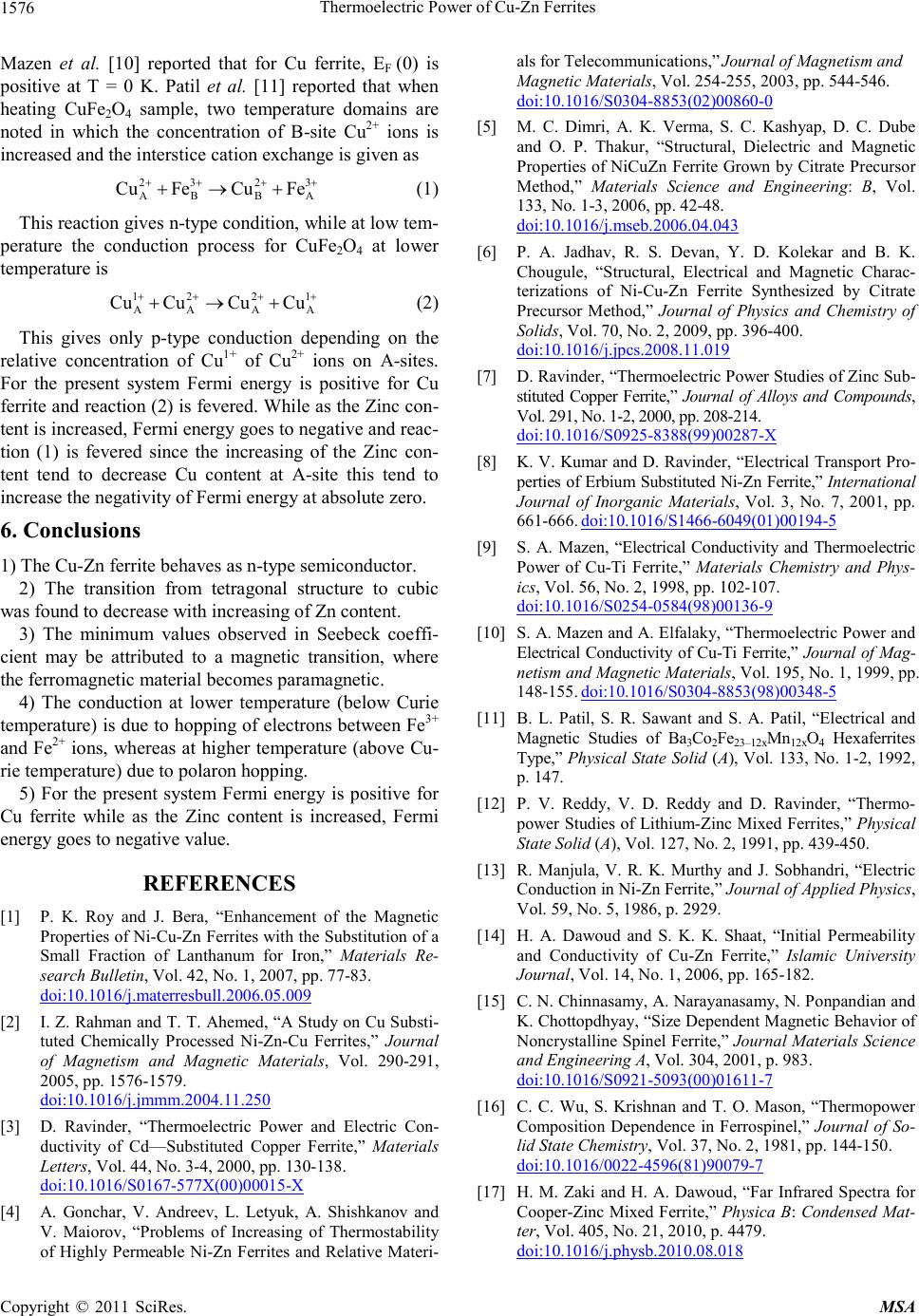 Thermoelectric Power of Cu-Zn Ferrites 1576 Mazen et al. [10] reported that for Cu ferrite, EF (0) is positive at T = 0 K. Patil et al. [11] reported that when heating CuFe2O4 sample, two temperature domains are noted in which the concentration of B-site Cu2+ ions is increased and the interstice cation exchange is given as 23 2 AB B Cu FeCu Fe 3 A 1 A (1) This reaction gives n-type condition, while at low tem- perature the conduction process for CuFe2O4 at lower temperature is 12 2 AA A Cu CuCuCu (2) This gives only p-type conduction depending on the relative concentration of Cu1+ of Cu2+ ions on A-sites. For the present system Fermi energy is positive for Cu ferrite and reaction (2) is fevered. While as the Zinc con- tent is increased, Fermi energy goes to negative and reac- tion (1) is fevered since the increasing of the Zinc con- tent tend to decrease Cu content at A-site this tend to increase the negativity of Fermi energy at absolute zero. 6. Conclusions 1) The Cu-Zn ferrite behaves as n-type semiconductor. 2) The transition from tetragonal structure to cubic was found to decrease with increasing of Zn content. 3) The minimum values observed in Seebeck coeffi- cient may be attributed to a magnetic transition, where the ferromagnetic material becomes paramagnetic. 4) The conduction at lower temperature (below Curie temperature) is due to hopping of electrons between Fe3+ and Fe2+ ions, whereas at higher temperature (above Cu- rie temperature) due to polaron hopping. 5) For the present system Fermi energy is positive for Cu ferrite while as the Zinc content is increased, Fermi energy goes to negative value. REFERENCES [1] P. K. Roy and J. Bera, “Enhancement of the Magnetic Properties of Ni-Cu-Zn Ferrites with the Substitution of a Small Fraction of Lanthanum for Iron,” Materials Re- search Bulletin, Vol. 42, No. 1, 2007, pp. 77-83. doi:10.1016/j.materresbull.2006.05.009 [2] I. Z. Rahman and T. T. Ahemed, “A Study on Cu Substi- tuted Chemically Processed Ni-Zn-Cu Ferrites,” Journal of Magnetism and Magnetic Materials, Vol. 290-291, 2005, pp. 1576-1579. doi:10.1016/j.jmmm.2004.11.250 [3] D. Ravinder, “Thermoelectric Power and Electric Con- ductivity of Cd—Substituted Copper Ferrite,” Materials Letters, Vol. 44, No. 3-4, 2000, pp. 130-138. doi:10.1016/S0167-577X(00)00015-X [4] A. Gonchar, V. Andreev, L. Letyuk, A. Shishkanov and V. Maiorov, “Problems of Increasing of Thermostability of Highly Permeable Ni-Zn Ferrites and Relative Materi- als for Telecommunications,” Journal of Magnetism and Magnetic Materials, Vol. 254-255, 2003, pp. 544-546. doi:10.1016/S0304-8853(02)00860-0 [5] M. C. Dimri, A. K. Verma, S. C. Kashyap, D. C. Dube and O. P. Thakur, “Structural, Dielectric and Magnetic Properties of NiCuZn Ferrite Grown by Citrate Precursor Method,” Materials Science and Engineering: B, Vol. 133, No. 1-3, 2006, pp. 42-48. doi:10.1016/j.mseb.2006.04.043 [6] P. A. Jadhav, R. S. Devan, Y. D. Kolekar and B. K. Chougule, “Structural, Electrical and Magnetic Charac- terizations of Ni-Cu-Zn Ferrite Synthesized by Citrate Precursor Method,” Journal of Physics and Chemistry of Solids, Vol. 70, No. 2, 2009, pp. 396-400. do i:10. 1016 /j .jp cs.20 08. 11.0 19 [7] D. Ravinder, “Thermoelectric Power Studies of Zinc Sub- stituted Copper Ferrite,” Journal of Alloys and Compounds, Vol. 291, No. 1-2, 2000, pp. 208-214. doi:10.1016/S0925-8388(99)00287-X [8] K. V. Kumar and D. Ravinder, “Electrical Transport Pro- perties of Erbium Substituted Ni-Zn Ferrite,” International Journal of Inorganic Materials, Vol. 3, No. 7, 2001, pp. 661-666. doi:10.1016/S1466-6049(01)00194-5 [9] S. A. Mazen, “Electrical Conductivity and Thermoelectric Power of Cu-Ti Ferrite,” Materials Chemistry and Phys- ics, Vol. 56, No. 2, 1998, pp. 102-107. doi:10.1016/S0254-0584(98)00136-9 [10] S. A. Mazen and A. Elfalaky, “Thermoelectric Power and Electrical Conductivity of Cu-Ti Ferrite,” Journal of Mag- netism and Magnetic Materials, Vol. 195, No. 1, 1999, pp. 148-155. doi:10.1016/S0304-8853(98)00348-5 [11] B. L. Patil, S. R. Sawant and S. A. Patil, “Electrical and Magnetic Studies of Ba3Co2Fe23–12xMn12xO4 Hexaferrites Type,” Physical State Solid (A), Vol. 133, No. 1-2, 1992, p. 147. [12] P. V. Reddy, V. D. Reddy and D. Ravinder, “Thermo- power Studies of Lithium-Zinc Mixed Ferrites,” Physical State Solid (A), Vol. 127, No. 2, 1991, pp. 439-450. [13] R. Manjula, V. R. K. Murthy and J. Sobhandri, “Electric Conduction in Ni-Zn Ferrite,” Journal of Applied Physics, Vol. 59, No. 5, 1986, p. 2929. [14] H. A. Dawoud and S. K. K. Shaat, “Initial Permeability and Conductivity of Cu-Zn Ferrite,” Islamic University Journal, Vol. 14, No. 1, 2006, pp. 165-182. [15] C. N. Chinnasamy, A. Narayanasamy, N. Ponpandian and K. Chottopdhyay, “Size Dependent Magnetic Behavior of Noncrystalline Spinel Ferrite,” Journal Materials Science and Engineering A, Vol. 304, 2001, p. 983. doi:10.1016/S0921-5093(00)01611-7 [16] C. C. Wu, S. Krishnan and T. O. Mason, “Thermopower Composition Dependence in Ferrospinel,” Journal of So- lid State Chemistry, Vol. 37, No. 2, 1981, pp. 144-150. do i:10. 1016 /00 22- 4596 (81 )9007 9-7 [17] H. M. Zaki and H. A. Dawoud, “Far Infrared Spectra for Cooper-Zinc Mixed Ferrite,” Physica B: Condensed Mat- ter, Vol. 405, No. 21, 2010, p. 4479. doi:10.1016/j.physb.2010.08.018 Copyright © 2011 SciRes. MSA  Thermoelectric Power of Cu-Zn Ferrites Copyright © 2011 SciRes. MSA 1577 [18] F. J. Morin, “Charge Carrier and Mobility of Cu-Ti Fer- rite,” Physical Review, Vol. 93, 1970, p. 433. [19] A. J. Bosman and C. Crevecoevr, “Electrical Conduction in Li-Doped CoO,” Journal of Physics and Chemistry of Solids, Vol. 30, No. 5, 1969, pp. 1151-1160. do i:10. 1016 /00 22- 3697 (69 )9037 2-2 |