

Paper Menu >>
Journal Menu >>
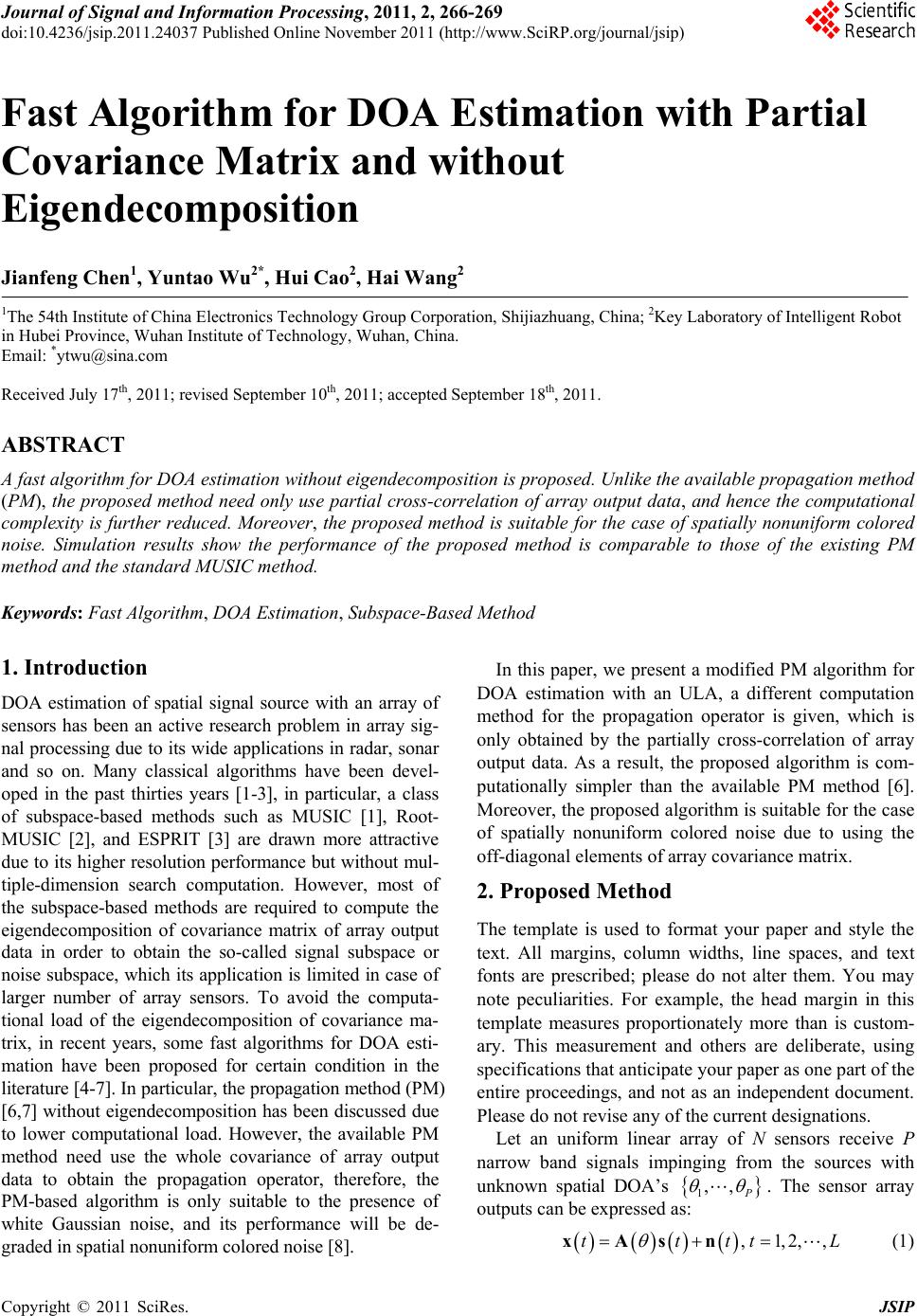 Journal of Signal and Information Processing, 2011, 2, 266-269 doi:10.4236/jsip.2011.24037 Published Online November 2011 (http://www.SciRP.org/journal/jsip) Copyright © 2011 SciRes. JSIP 1 Fast Algorithm for DOA Estimation with Partial Covariance Matrix and without Eigendecomposition Jianfeng Chen1, Yuntao Wu2*, Hui Cao2, Hai Wang2 1The 54th Institute of China Electronics Technology Group Corporation, Shijiazhuang, China; 2Key Laboratory of Intelligent Robot in Hubei Province, Wuhan Institute of Technology, Wuhan, China. Email: *[email protected] Received July 17th, 2011; revised September 10th, 2011; accepted September 18th, 2011. ABSTRACT A fast algorithm for DOA estim ation without eigend ecomposition is proposed. Unlike th e availab le propagation method (PM), the proposed method need only use partial cross-correlation of array output data, and hence the computational complexity is further reduced. Moreover, the proposed method is suitable for the case of spatially nonuniform colored noise. Simulation results show the performance of the proposed method is comparable to those of the existing PM method and the standa rd MUSIC method. Keywords: Fast Algorithm, DOA Estimation, Subspace-Based Method 1. Introduction DOA estimation of spatial signal source with an array of sensors has been an active research problem in array sig- nal processing due to its wide applications in radar, sonar and so on. Many classical algorithms have been devel- oped in the past thirties years [1-3], in particular, a class of subspace-based methods such as MUSIC [1], Root- MUSIC [2], and ESPRIT [3] are drawn more attractive due to its higher resolution performance but without mul- tiple-dimension search computation. However, most of the subspace-based methods are required to compute the eigendecomposition of covariance matrix of array output data in order to obtain the so-called signal subspace or noise subspace, which its application is limited in case of larger number of array sensors. To avoid the computa- tional load of the eigendecomposition of covariance ma- trix, in recent years, some fast algorithms for DOA esti- mation have been proposed for certain condition in the literature [4-7]. In particular, the propagation method (PM) [6,7] without eigendecomposition has been discussed due to lower computational load. However, the available PM method need use the whole covariance of array output data to obtain the propagation operator, therefore, the PM-based algorithm is only suitable to the presence of white Gaussian noise, and its performance will be de- graded in spatial nonuniform colored noise [8]. In this paper, we present a modified PM algorithm for DOA estimation with an ULA, a different computation method for the propagation operator is given, which is only obtained by the partially cross-correlation of array output data. As a result, the proposed algorithm is com- putationally simpler than the available PM method [6]. Moreover, the proposed algorithm is suitable for the case of spatially nonuniform colored noise due to using the off-diagonal elements of array covariance matrix. 2. Proposed Method The template is used to format your paper and style the text. All margins, column widths, line spaces, and text fonts are prescribed; please do not alter them. You may note peculiarities. For example, the head margin in this template measures proportionately more than is custom- ary. This measurement and others are deliberate, using specifications that anticipate your paper as one part of the entire proceedings, and not as an independent document. Please do not revise any of the current designations. Let an uniform linear array of N sensors receive P narrow band signals impinging from the sources with unknown spatial DOA’s 1,, P . The sensor array outputs can be expressed as: ,1,2,,tttt xAsn L (1) 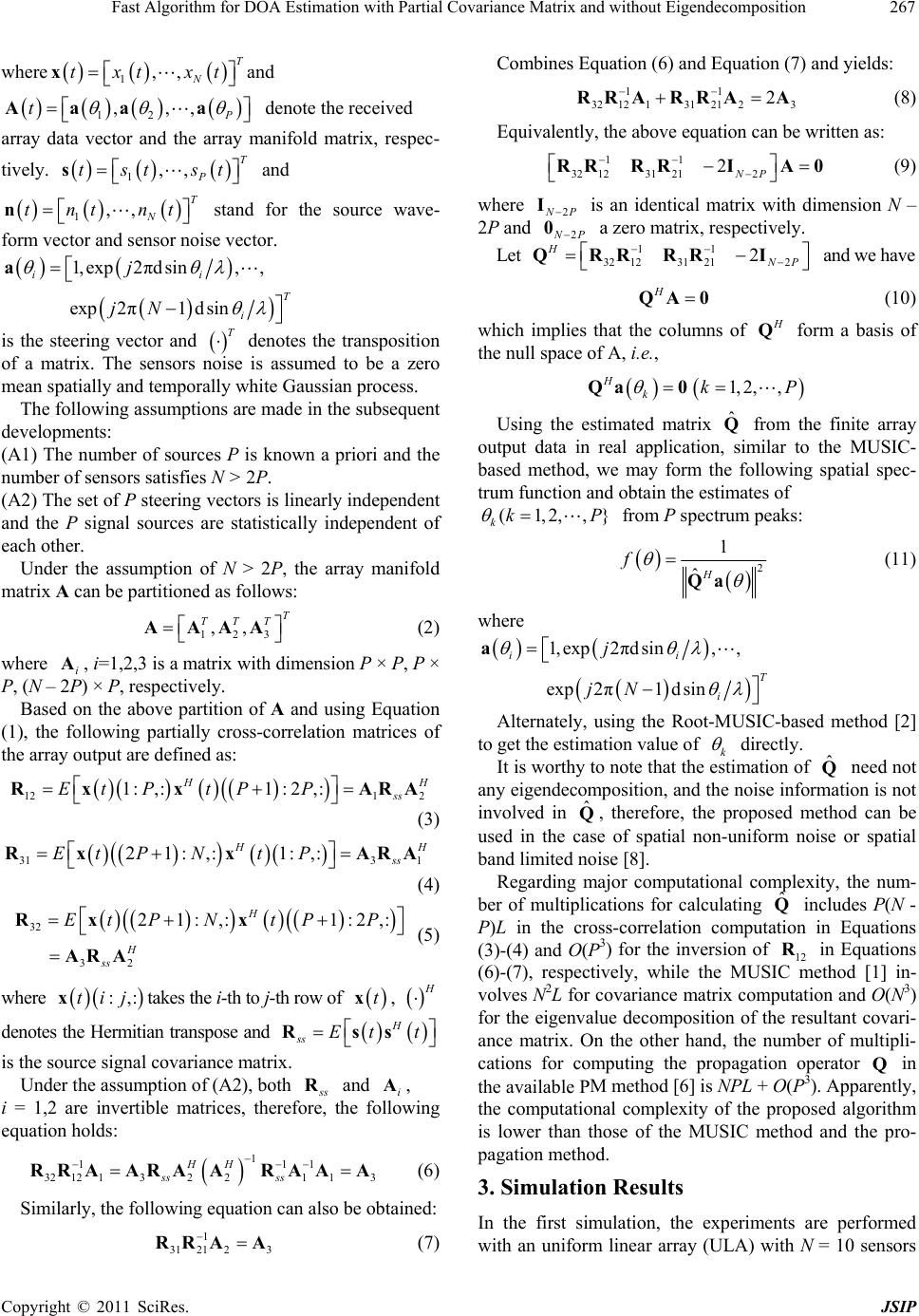 Fast Algorithm for DOA Estimation with Partial Covariance Matrix and without Eigendecomposition267 where and denote the received array data vector and the array manifold matrix, respec- tively. and stand for the source wave- form vector and sensor noise vector. 1,, T N txt xt x 12 ,,, P Aaa a 1,, T P tst st s 1,, T N tnt nt t n 1,exp2 πdsin, , exp2π1dsin ii T i j jN a is the steering vector and denotes the transposition of a matrix. The sensors noise is assumed to be a zero mean spatially and temporally white Gaussian process. T The following assumptions are made in the subsequent developments: (A1) The number of sources P is known a priori and the number of sensors satisfies N > 2P. (A2) The set of P steering vectors is linearly independent and the P signal sources are statistically independent of each other. Under the assumption of N > 2P, the array manifold matrix A can be partitioned as follows: 123 ,, T TTT AAAA (2) where i, i=1,2,3 is a matrix with dimension P × P, P × P, (N – 2P) × P, respectively. A Based on the above partition of A and using Equation (1), the following partially cross-correlation matrices of the array output are defined as: 121 2 1:,:1 :2,: H H ss Et PtPP Rx xAR A (3) 313 1 21:,:1:,: H H ss Et PNtP Rxx AR A (4) 32 32 21:,: 1:2,: H H ss Et PNtPP Rx x AR A (5) where takes the i-th to j-th row of :,:tijx tx, H denotes the Hermitian transpose and ts H ss Et Rs is the source signal covariance matrix. Under the assumption of (A2), both s s and i, i = 1,2 are invertible matrices, therefore, the following equation holds: R A 1 11 32121 32211 3 HH ss ss RRA ARAARAA A 1 (6) Similarly, the following equation can also be obtained: 1 31 21 23 RRAA (7) Combines Equation (6) and Equation (7) and yields: 11 3212 13121 23 2 RRA RRAA (8) Equivalently, the above equation can be written as: 11 32 1231 212 2NP RRRRIA0 (9) where 2 N P I 2 is an identical matrix with dimension N – 2P and N P 0 H a zero matrix, respectively. Let 11 32 1231 212 2NP QRRRRI and we have H QA 0 (10) which implies that the columns of H Q form a basis of the null space of A, i.e., 1, 2,, HkkP Qa 0 Using the estimated matrix from the finite array output data in real application, similar to the MUSIC- based method, we may form the following spatial spec- trum function and obtain the estimates of ˆ Q (1,2,, kk}P from P spectrum peaks: 2 1 ˆH f Qa (11) where 1,exp2πdsin, , exp2π1dsin ii T i j jN a Alternately, using the Root-MUSIC-based method [2] to get the estimation value of k directly. It is worthy to note that the estimation of need not any eigendecomposition, and the noise information is not involved in , therefore, the proposed method can be used in the case of spatial non-uniform noise or spatial band limited noise [8]. ˆ Q ˆ Q Regarding major computational complexity, the num- ber of multiplications for calculating includes P(N - P)L in the cross-correlation computation in Equations (3)-(4) and O(P3) for the inversion of 12 in Equations (6)-(7), respectively, while the MUSIC method [1] in- volves N2L for covariance matrix computation and O(N3) for the eigenvalue decomposition of the resultant covari- ance matrix. On the other hand, the number of multipli- cations for computing the propagation operator in the available PM method [6] is NPL + O(P3). Apparently, the computational complexity of the proposed algorithm is lower than those of the MUSIC method and the pro- pagation method. ˆ Q R Q 3. Simulation Results In the first simulation, the experiments are performed with an uniform linear array (ULA) with N = 10 sensors Copyright © 2011 SciRes. JSIP 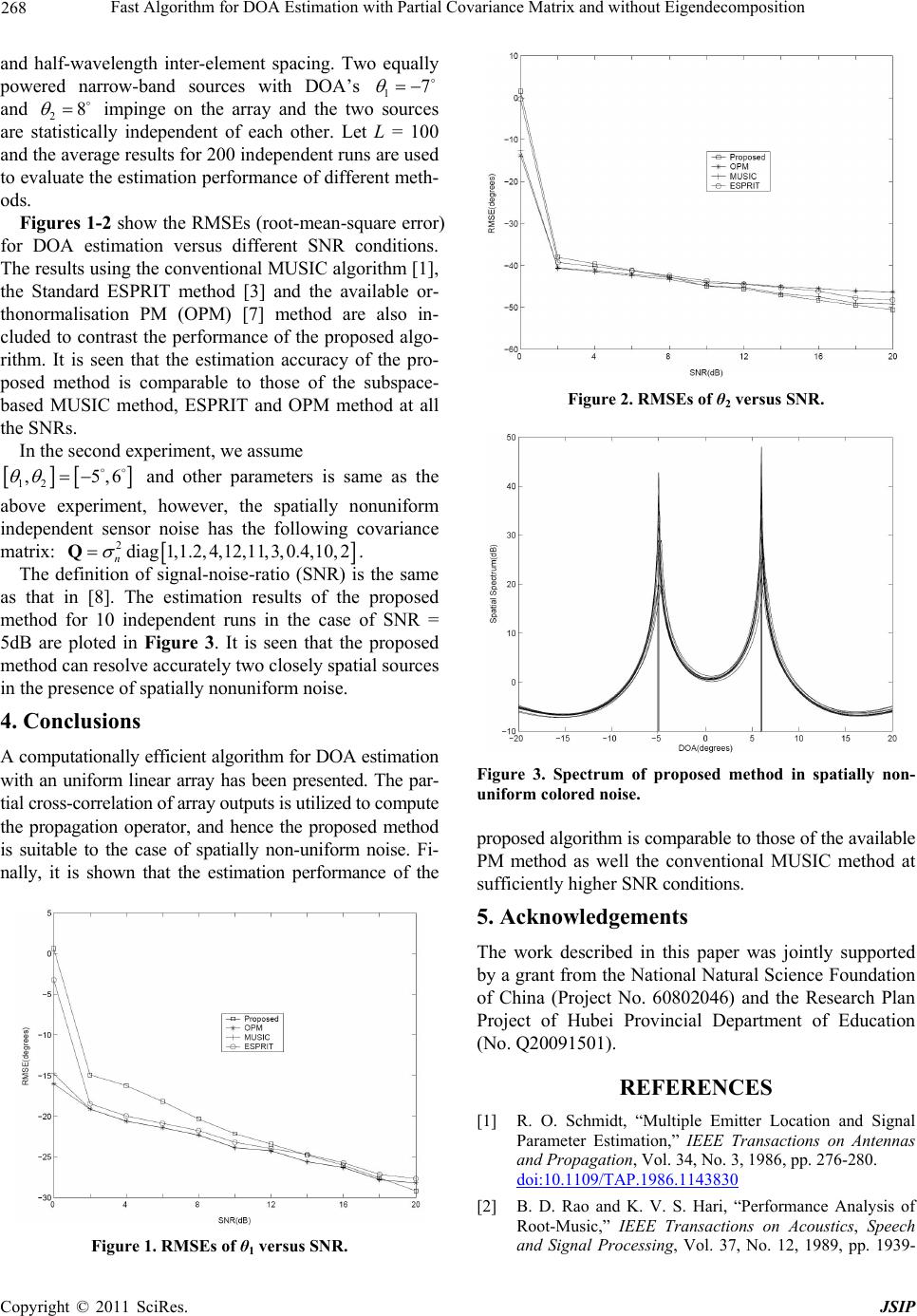 Fast Algorithm for DOA Estimation with Partial Covariance Matrix and without Eigendecomposition 268 and half-wavelength inter-element spacing. Two equally powered narrow-band sources with DOA’s 17 and 2 impinge on the array and the two sources are statistically independent of each other. Let L = 100 and the average results for 200 independent runs are used to evaluate the estimation performance of different meth- ods. 8 Figures 1-2 show the RMSEs (root-mean-square error) for DOA estimation versus different SNR conditions. The results using the conventional MUSIC algorithm [1], the Standard ESPRIT method [3] and the available or- thonormalisation PM (OPM) [7] method are also in- cluded to contrast the performance of the proposed algo- rithm. It is seen that the estimation accuracy of the pro- posed method is comparable to those of the subspace- based MUSIC method, ESPRIT and OPM method at all the SNRs. In the second experiment, we assume 12 ,5, 6 and other parameters is same as the above experiment, however, the spatially nonuniform independent sensor noise has the following covariance matrix: 2diag1,1.2, 4,12,11, 3, 0.4,10, 2 n Q. The definition of signal-noise-ratio (SNR) is the same as that in [8]. The estimation results of the proposed method for 10 independent runs in the case of SNR = 5dB are ploted in Figure 3. It is seen that the proposed method can resolve accurately two closely spatial sources in the presence of spatially nonuniform noise. 4. Conclusions A computationally efficient algorithm for DOA estimation with an uniform linear array has been presented. The par- tial cross-correlation of array outputs is utilized to compute the propagation operator, and hence the proposed method is suitable to the case of spatially non-uniform noise. Fi- nally, it is shown that the estimation performance of the Figure 1. RMSEs of θ1 versus SNR. Figure 2. RMSEs of θ2 versus SNR. Figure 3. Spectrum of proposed method in spatially non- uniform colored noise. proposed algorithm is comparable to those of the available PM method as well the conventional MUSIC method at sufficiently higher SNR conditions. 5. Acknowledgements The work described in this paper was jointly supported by a grant from the National Natural Science Foundation of China (Project No. 60802046) and the Research Plan Project of Hubei Provincial Department of Education (No. Q20091501). REFERENCES [1] R. O. Schmidt, “Multiple Emitter Location and Signal Parameter Estimation,” IEEE Transactions on Antennas and Propagation, Vol. 34, No. 3, 1986, pp. 276-280. doi:10.1109/TAP.1986.1143830 [2] B. D. Rao and K. V. S. Hari, “Performance Analysis of Root-Music,” IEEE Transactions on Acoustics, Speech and Signal Processing, Vol. 37, No. 12, 1989, pp. 1939- Copyright © 2011 SciRes. JSIP  Fast Algorithm for DOA Estimation with Partial Covariance Matrix and without Eigendecomposition Copyright © 2011 SciRes. JSIP 269 1949. doi:10.1109/29.45540 [3] R. Roy and T. Kailath, “ESPRIT-Estimation of Signal Parameters via Rotational Invariance Techniques,” IEEE Transactions on Acoustics, Speech and Signal Processing, Vol. 37, No. 17, 1989, pp. 984-995. doi:10.1109/29.32276 [4] J. Xin and A. Sano, “Computationally Efficient Subspace Based Method for Direction of Arrival Estimation with- out Eigendecomposition,” IEEE Transactions on Signal Processing, Vol. 52, No. 4, 2004, pp. 876-893. doi:10.1109/TSP.2004.823469 [5] J. F. Gu, P. Wei and H. M. Tai, “Fast Direction-of-Arrival Estimation with Known Waveforms and Linear Opera- tors,” IET Signal Processing, Vol. 2, No. 1, 2008, pp. 27- 36. doi:10.1049/iet-spr:20070066 [6] S. Marcos, A. Marsal and M. Benidir, “The Propagator Method for Source Bearing Estimation,” Signal Process- ing, Vol. 42, No. 2, 1995, pp. 121-138. doi:10.1016/0165-1684(94)00122-G [7] J. Munier and G. Y. Delisle, “Spatial Analysis Using New Properties of the Cross-Spectral Matrix,” IEEE Transac- tions on Signal Processing, Vol. 39, No. 3, 1991, pp. 746- 749. doi:10.1109/78.80863 [8] Y. T. Wu, C. H. Hou, G. S. Liao and Q. H. Guo, “Direc- tion of Arrival Estimation in the Presence of Unknown Nonuniform Noise Fields,” IEEE Journal of Oceanic En- gineering, Vol. 31, No. 2, 2006, pp. 504-510. doi:10.1109/JOE.2006.875270 |