

Paper Menu >>
Journal Menu >>
 Journal of Signal and Information Processing, 2011, 2, 270-273 doi:10.4236/jsip.2011.24038 Published Online November 2011 (http://www.SciRP.org/journal/jsip) Copyright © 2011 SciRes. JSIP 1 The Study of Multi-Expression Classification Algorithm Based on Adaboost and Mutual Independent Feature Liying Lang, Zuntao Hu Department of Electrical and Information, Hebei University of Engineering, Handan, China. Email: [email protected] Received June 20th, 2011; revised August 13th, 2011; accepted August 22nd, 2011. ABSTRACT In the paper conventional Adaboost algorithm is improved and local features of face such as eyes and mouth are sepa- rated as mutual independent elements for facial feature extraction and classification. The multi-expression classifica- tion algorithm which is based on Adaboost and mutual independent feature is proposed. In order to effectively and quickly train thresho ld values of weak classifiers of fea tures, Sample of training is carried out simple improvement. We obtain a good classification results through experiments. Keywords: Adaboost Multi-Expression Classification Algorithm, Local Feature, Feature Extraction, Sample Training 1. Introduction Due to increasingly wide application, Facial multi-ex- pression classification which is widely concerned by gov- ernments and research institutes is becoming a challeng- ing research topic in field of pattern recognition. Cur- rently there are many main methods used for facial ex- pression classification, such as Euclidean distance, Sup- port vector machine (SVM), Neural network(NN), Hid- den Markov(HMM), Adaboost and Linear discriminant analysis (LDA), etc. Adaboost algorithm which owns higher speed and higher detection rate has been success- fully applied in the field of face detection. Most of facial expression changes exist in eyes and mouth, so features of eyes and mouth are treated as mutual independent ele- ments [1]. The method can greatly reduce redundancy and improve the speed of training threshold values. However, if we want to use the algorithm to facial multi-ex pression classification, there is a main problem. When error recog- nition rate of weak classifiers of Adaboost is higher, overall recognition rate of the algorithm will reduce to zero exponentially, key problem is to train a weak classi- fier threshold value accurately and fast. So we improve training samples, and negative samples is proposed in this paper [2]. Threshold value of weak classifier is the most crucial part. Positive samp les contain on ly images of eyes or mouth, while negative samples are removed eyes and mouth. So the multi-expression classification algorithm which is based on Adaboost and mutual independent fea- ture is proposed. Experimental results prove that false recognition rate is almost close to zero. 2. Adaboost Multi-Expression Classification Algorithm Basic idea of Adaboost algorithm is to use a large num- ber of weak classifiers to add up together to form a very strong classification through a certain method. In the algorithm, each training sample is assigned a weight, and it demonstrates a probability of some weak classifiers which can be selected into training set. If a sample is accurately classified by the current weak classifier, its weight will be reduced. On the contrary, if a sample is not properly classified, the weight is to be raised accord- ingly. In this way, Adaboost algorithm can focus on more difficult samples [2,3]. A weak classifier j H x consists of the following three parts: rectangle feature value j f x, a classifica- tion threshold value j and a direction sign j p ( j p= 0,1). They are in line with the following relation ship [4]: ,, 1,2,3,4,5,6,7 0, jj jj j jpf xpj Hx else (1) We obtain the minimum threshold value min f i and the maximum threshold value max f i of eyes and mo- uth, making min max j f ifi . j H xis one of seven 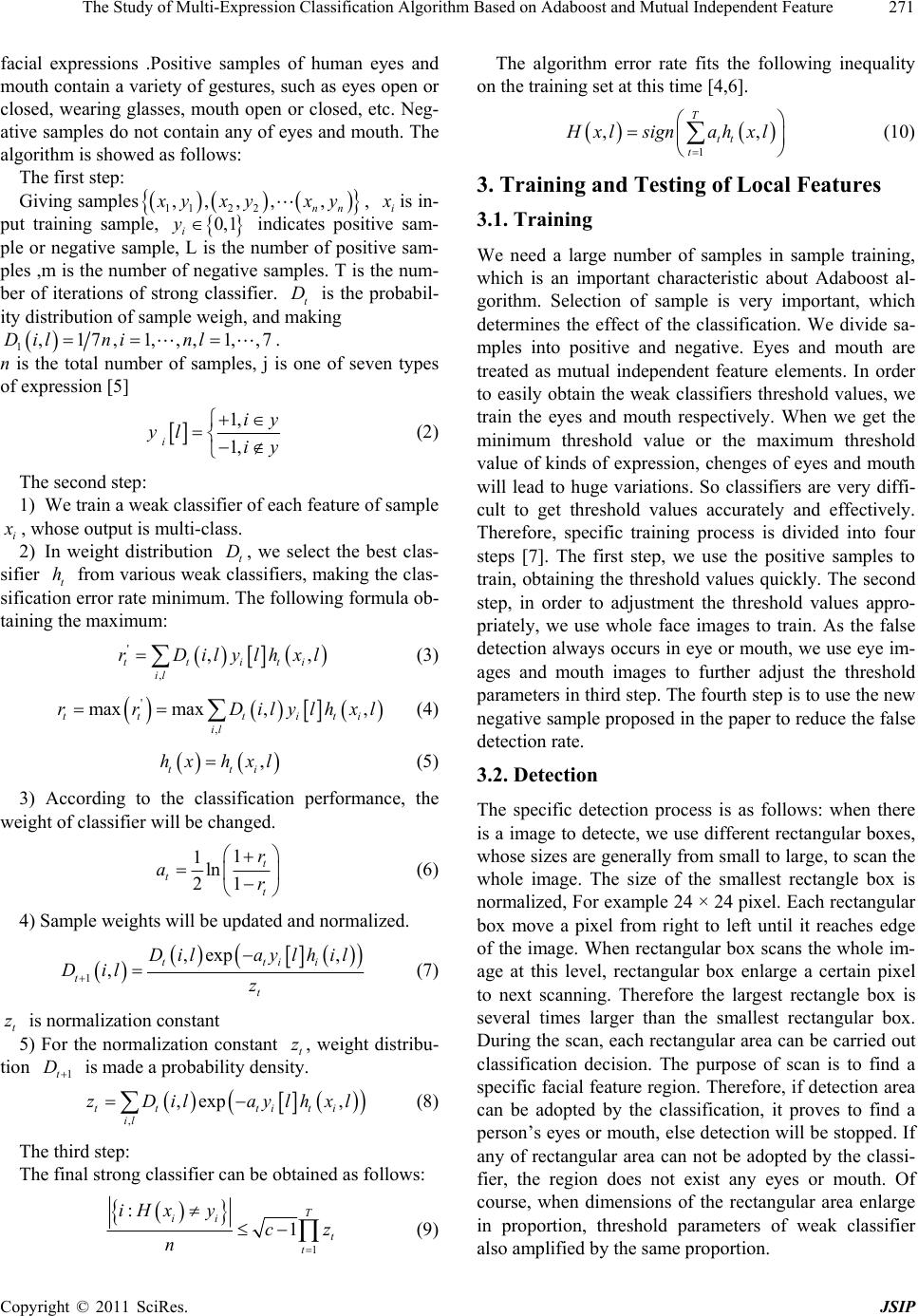 The Study of Multi-Expression Classification Algorithm Based on Adaboost and Mutual Independent Feature271 facial expressions .Positive samples of human eyes and mouth contain a variety of gestures, such as eyes open or closed, wearing glasses, mouth open or closed, etc. Neg- ative samples do not contain any of eyes and mouth. The algorithm is showed as follows: The first step: Giving samples 112 2 ,,,, , nn x yxy xy, i x is in- put training sample, indicates positive sam- ple or negative sample, L is the number of positive sam- ples ,m is the number of negative samples. T is the num- ber of iterations of strong classifier. t is the probabil- ity distribution of sample weigh, and making 0,1 i y D 1,17,1,,,1,, 7nlDil ni . n is the total number of samples, j is one of seven types of expression [5] 1, 1, i iy yl iy (2) The second step: 1) We train a weak classifier of each feature of sample i x , whose output is multi-class. 2) In weight distribution t D, we select the best clas- sifier t h from various weak classifiers, making the clas- sification error rate minimum. The following formula ob- taining the maximum: ' ,, ttiti il rDilylhx ,l (3) ' , max max,, tt tit il rr Dilylhx i l (4) , tti hx hxl (5) 3) According to the classification performance, the weight of classifier will be changed. 1 1ln 21 t tt r ar (6) 4) Sample weights will be updated and normalized. 1 ,exp , ,ttii tt Dil aylhil Dil z (7) t z is normalization constant 5) For the normalization constant t, weight distribu- tion is made a probability density. z 1t D ,,exp , tt titi il zDil aylhxl (8) The third step: The final strong classifier can be obtained as follows: 1 :1T ii t t iHx yc n The algorithm error rate fits the following inequality on the training set at this time [4,6]. z , (9) 1 , T tt t H xlsignahxl (10) 3. Training and Testing of Local Features 3.1. Training We need a large number of samples in sample training, which is an important characteristic about Adaboost al- gorithm. Selection of sample is very important, which determines the effect of the classification. We divide sa- mples into positive and negative. Eyes and mouth are treated as mutual independent feature elements. In order to easily obtain the weak classifiers threshold values, we train the eyes and mouth respectively. When we get the minimum threshold value or the maximum threshold value of kinds of expression, chenges of eyes and mouth will lead to huge variations. So classifiers are very diffi- cult to get threshold values accurately and effectively. Therefore, specific training process is divided into four steps [7]. The first step, we use the positive samples to train, obtaining the threshold values quickly. The second step, in order to adjustment the threshold values appro- priately, we use whole face images to train. As the false detection always occurs in eye or mouth, we use eye im- ages and mouth images to further adjust the threshold parameters in third step. The fourth step is to use the new negative sample proposed in the paper to reduce the false detection rate. 3.2. Detection The specific detection process is as follows: when there is a image to detecte, we use different rectangular boxes, whose sizes are generally from small to large, to scan the whole image. The size of the smallest rectangle box is normalized, For example 24 × 24 pixel. Each rectangular box move a pixel from right to left until it reaches edge of the image. When rectangular box scans the whole im- age at this level, rectangular box enlarge a certain pixel to next scanning. Therefore the largest rectangle box is several times larger than the smallest rectangular box. During the scan, each rectangular area can be carried out classification decision. The purpose of scan is to find a specific facial feature region. Therefore, if detection area can be adopted by the classification, it proves to find a person’s eyes or mouth, else detection will be stopp ed. If any of rectangular area can not be adopted by the classi- fier, the region does not exist any eyes or mouth. Of course, when dimensions of the rectangular area enlarge in proportion, threshold parameters of weak classifier also amplified by the same proportion. Copyright © 2011 SciRes. JSIP 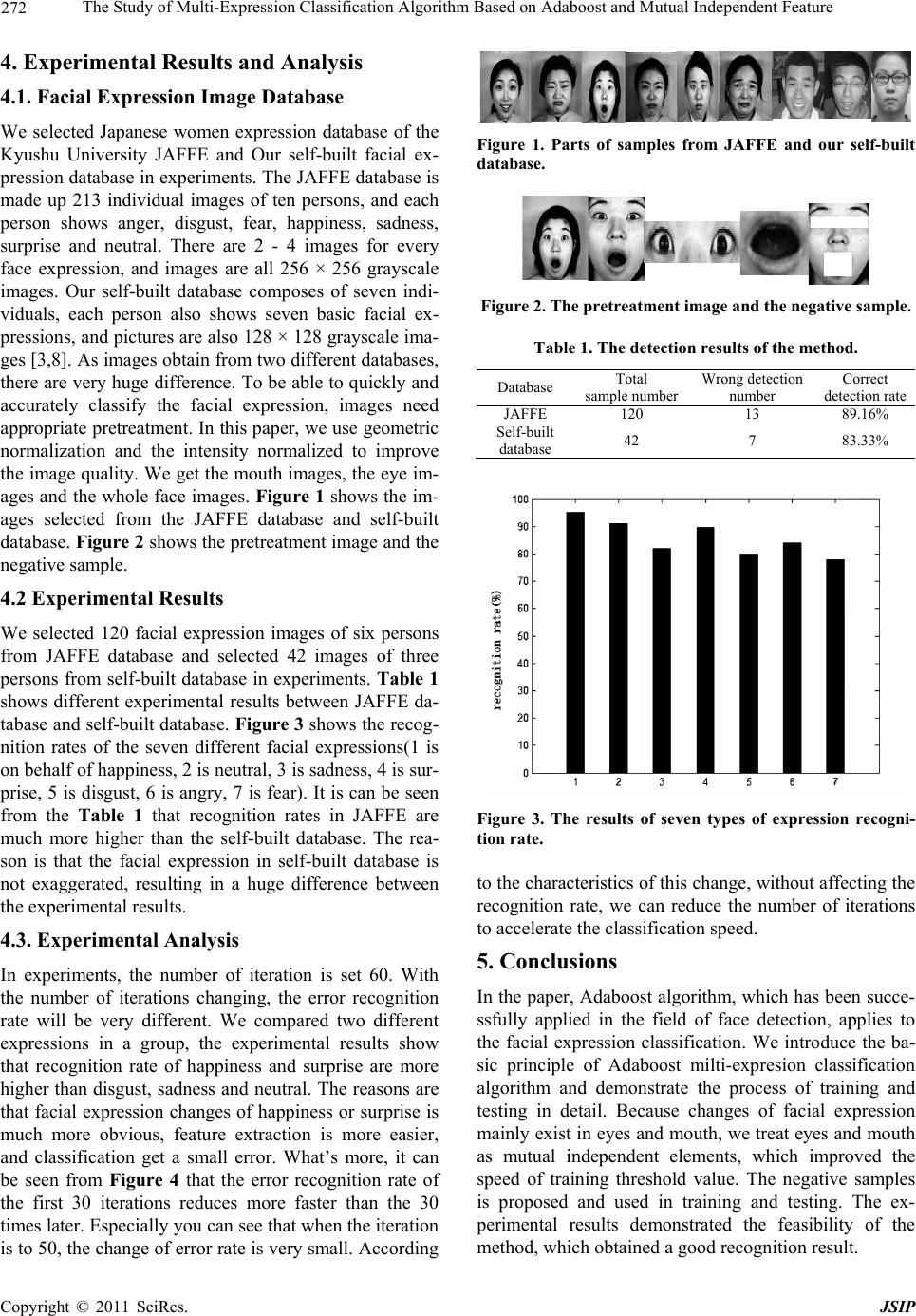 The Study of Multi-Expression Classification Algorithm Based on Adaboost and Mutual Independent Feature 272 4. Experimental Results and Analysis 4.1. Facial Expression Image Database We selected Japanese women expression database of the Kyushu University JAFFE and Our self-built facial ex- pression database in experiments. The JAFFE database is made up 213 individual images of ten persons, and each person shows anger, disgust, fear, happiness, sadness, surprise and neutral. There are 2 - 4 images for every face expression, and images are all 256 × 256 grayscale images. Our self-built database composes of seven indi- viduals, each person also shows seven basic facial ex- pressions, and pictures are also 128 × 128 grayscale ima- ges [3,8]. As images obtain from two different databases, there are very huge difference. To be able to quickly and accurately classify the facial expression, images need appropriate pretreatment. In this paper, we use geometric normalization and the intensity normalized to improve the image quality. We get the mouth images, the eye im- ages and the whole face images. Figure 1 shows the im- ages selected from the JAFFE database and self-built database. Figure 2 shows the pretreatment image and the negative sample. 4.2 Experimental Results We selected 120 facial expression images of six persons from JAFFE database and selected 42 images of three persons from self-built database in experiments. Table 1 shows different experimental results between JAFFE da- tabase and self-built datab ase. Figure 3 shows the recog- nition rates of the seven different facial expressions(1 is on behalf of happiness, 2 is neutral, 3 is sadness, 4 is sur- prise, 5 is disgust, 6 is angry, 7 is fear). It is can be seen from the Table 1 that recognition rates in JAFFE are much more higher than the self-built database. The rea- son is that the facial expression in self-built database is not exaggerated, resulting in a huge difference between the experimental results. 4.3. Experimental Analysis In experiments, the number of iteration is set 60. With the number of iterations changing, the error recognition rate will be very different. We compared two different expressions in a group, the experimental results show that recognition rate of happiness and surprise are more higher than disgust, sadness and neutral. The reasons are that facial expression changes of happiness or surprise is much more obvious, feature extraction is more easier, and classification get a small error. What’s more, it can be seen from Figure 4 that the error recognition rate of the first 30 iterations reduces more faster than the 30 times later. Especially you can see that when the iteration is to 50, the change of error rate is very small. According Figure 1. Parts of samples from JAFFE and our self-built database. Figure 2. The pretreatment image and the negative sample. Table 1. The detection results of the method. Database Total sample numberWrong detection number Correct detection rate JAFFE 120 13 89.16% Self-built database 42 7 83.33% Figure 3. The results of seven types of expression recogni- tion rate. to the characteristics of this ch ange, without affecting the recognition rate, we can reduce the number of iterations to accelerate the classification speed. 5. Conclusions In the paper, Adaboost algor ithm, which has been succe- ssfully applied in the field of face detection, applies to the facial expression classification. We introduce the ba- sic principle of Adaboost milti-expresion classification algorithm and demonstrate the process of training and testing in detail. Because changes of facial expression mainly exist in eyes and mouth, we treat eyes and mouth as mutual independent elements, which improved the speed of training threshold value. The negative samples is proposed and used in training and testing. The ex- perimental results demonstrated the feasibility of the method, which obtained a good recognition result. Copyright © 2011 SciRes. JSIP 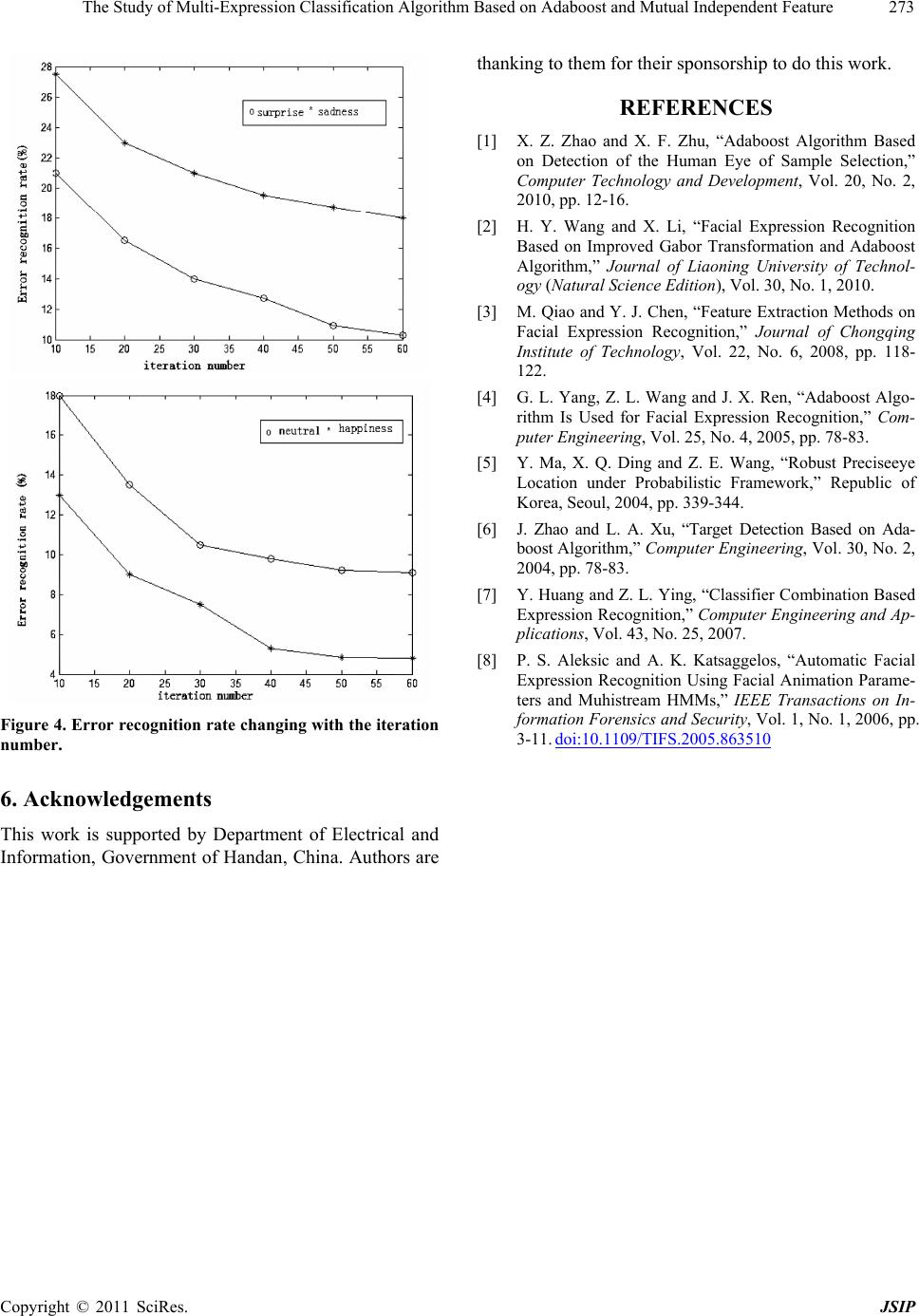 The Study of Multi-Expression Classification Algorithm Based on Adaboost and Mutual Independent Feature Copyright © 2011 SciRes. JSIP 273 Figure 4. Error recognition rate changing with the iteration number. 6. Acknowledgements This work is supported by Department of Electrical and Information, Government of Handan, China. Authors are thanking to them for their sponsorship to do this work. REFERENCES [1] X. Z. Zhao and X. F. Zhu, “Adaboost Algorithm Based on Detection of the Human Eye of Sample Selection,” Computer Technology and Development, Vol. 20, No. 2, 2010, pp. 12-16. [2] H. Y. Wang and X. Li, “Facial Expression Recognition Based on Improved Gabor Transformation and Adaboost Algorithm,” Journal of Liaoning University of Technol- ogy (Natural Science Ed it i o n ), Vol. 30, No. 1, 2010. [3] M. Qiao and Y. J. Chen, “Feature Extraction Methods on Facial Expression Recognition,” Journal of Chongqing Institute of Technology, Vol. 22, No. 6, 2008, pp. 118- 122. [4] G. L. Yang, Z. L. Wang and J. X. Ren, “Adaboost Algo- rithm Is Used for Facial Expression Recognition,” Com- puter Engineering, Vol. 25, No. 4, 2005, pp. 78-83. [5] Y. Ma, X. Q. Ding and Z. E. Wang, “Robust Preciseeye Location under Probabilistic Framework,” Republic of Korea, Seoul, 2004, pp. 339-344. [6] J. Zhao and L. A. Xu, “Target Detection Based on Ada- boost Al g or i t h m , ” Computer Engineering, Vol. 30, No. 2, 2004, pp. 78-83. [7] Y. Huang and Z. L. Ying, “Classifier Combination Based Expression Recognition,” Computer Engineering and Ap- plications, Vol. 43, No. 25, 2007. [8] P. S. Aleksic and A. K. Katsaggelos, “Automatic Facial Expression Recognition Using Facial Animation Parame- ters and Muhistream HMMs,” IEEE Transactions on In- formation Forensics and Security, Vol. 1, No. 1, 2006, pp. 3-11. doi:10.1109/TIFS.2005.863510 |