

Paper Menu >>
Journal Menu >>
 Journal of Signal and Information Processing, 2011, 2, 253-256 doi:10.4236/jsip.2011.24035 Published Online November 2011 (http://www.SciRP.org/journal/jsip) Copyright © 2011 SciRes. JSIP 1 New Formulas for Irregular Sampling of Two-Bands Signals Bernard Lacaze Telecommunications for Space and Aeronautics, Toulouse, France. Email: [email protected] Received March 15th, 2011; revised June 20th, 2011; accepted June 30th, 2011. ABSTRACT Many sampling formulas are available for processes in baseband ,aa at the Nyquist rate πa. However signals of telecommunications have power spectra which occupate two bands or more. We know that PNS (periodic non-uniform sampling) allow an errorless reconstruction at rate smaller than the Nyquist one. For instance PNS2 can be used in the two-bands case at the Landau rate ,ab ba , πab We prove a set of formulas which are available in cases more general than the PNS2. They take into account two sampling sequences which can be periodic or not and with same mean rate or not. Keywords: Stationary Process e s , Irregular Sampling, Two-Bands Processes 1. Introduction Communications signals are often transmitted in frequ- ency channels which are in the form where the width is small with respect to . For instance we have for the whole FM band (87.5 MHz, 108 MHz). Of course, the occupied frequency in- terval by a single station is smaller which leads to rela- tive occupency very weak. When modelling by stationary processes, negative frequencies are taken into account. Real processes are transmitted in frequency bands in the form . We know that such processes can be reconstructed by sampling at the Landau rate ,ba a 2 abab ,ab /0.a ,ba 2πab , which is weaker than the Nyquist rate 2πa [1]. PNS2 (Periodic Nonuniform Sampling of order 2) is the most known example [2,3]. In the case of baseband signals where power spectra are strictly in , any sampling plan regular enough can be asso- ciated with errorless formulas provided that the sampling rate is larger than ,aa 2πa [4-6]. They are close to La- grange interpolation formulas, replacing far samples by well-chosen sequences. However this kind of scheme cannot be used when power spectra are not in baseband. This paper addresses the problem of errorless sampling of stationary processes Z = ,Zt t with spectral support inside two symmetric sets of the real line. For instance and without loss of generality, let this support be (1), where l and >0 . This means that [7,8] E=e iZ ZtZ ts d (2) where E .. stands for the mathematical expectation (or ensemble mean) and the superscript for the complex conjugate. Z s is the spectral density of the process Z. We assume that =0 Z s in some neighboorhood of the bounds of 0 to be sure that Z is oversampled with respect to the Landau's theorem in all studied cases. Knowing that is arbitrary the minimal sampling rate for errorless reconstruction is 2 because 0=4π [1]. Samplings like PNSn (periodic nonuniform sam- pling of order n) may be solutions of the problem [9], [10]. For example we have the formula [2,3] sin 2πsin 2π =sin 2π ab Utltb Utlat Zt la b (3) sin π =π xn txn Ut Znx txn provided that 2la b . We are in the case of a PNS2 where the sampling sequences are and ab . =21π,21π21π,2 1πll ll (1) 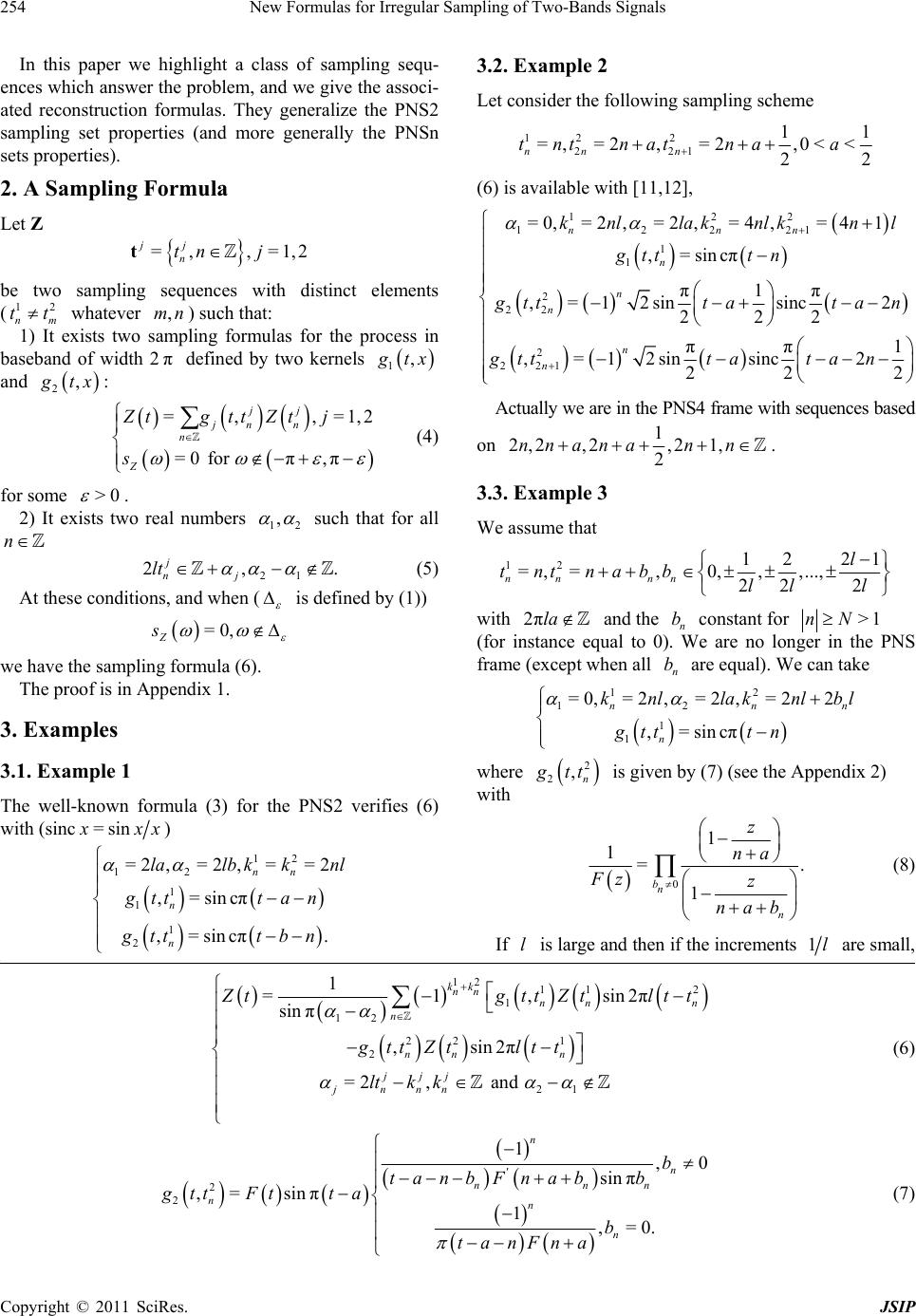 New Formulas for Irregular Sampling of Two-Bands Signals 254 In this paper we highlight a class of sampling sequ- ences which answer the problem, and we give the associ- ated reconstruction formulas. They generalize the PNS2 sampling set properties (and more generally the PNSn sets properties). 2. A Sampling Formula Let Z =, ,=1,2 jj n tn jt be two sampling sequences with distinct elements ( whatever ) such that: 12 nm tt,mn 1) It exists two sampling formulas for the process in baseband of width 2 defined by two kernels π 1, g tx and 2, g tx: =, ,=1 =0 forπ,π jj jn n n Z Ztg ttZtj s ,2 (4) for some >0 . 2) It exists two real numbers 12 , such that for all n 21 2, j nj lt . (5) At these conditions, and when ( is defined by (1)) =0, Z s we have the sampling formula (6). The proof is in Appendix 1. 3. Examples 3.1. Example 1 The well-known formula (3) for the PNS2 verifies (6) with (sinc= x sin x x) 12 12 1 1 1 2 =2 ,=2 ,==2 ,=sincπ ,=sincπ. nn n n lalb kknl gtt tan gtt tbn 3.2. Example 2 Let consider the following sampling scheme 12 2 221 11 =,=2,=2,0< < 22 nn n tntnatnaa (6) is available with [11,12], 122 12221 1 1 2 22 2 221 =0, =2,=2,=4,=41 ,=sincπ π1π ,=12sinsinc 2 222 ππ 1 ,=12sin sinc2 22 nnn n n n n n knllaknlknl gtt tn 2 g ttt at an gtttata n Actually we are in the PNS4 frame with sequences based on 1 2,2,2,2 1, 2 nnanan n . 3.3. Example 3 We assume that 12 12 21 = ,=,0,,,..., 22 2 nn nnl tntnabb ll l with 2πla and the n constant for b>1nN (for instance equal to 0). We are no longer in the PNS frame (except when all are equal). We can take n b 12 12 1 1 =0,=2,=2 ,=22 ,=sincπ nn n knl laknlb gtt tn n l where 2 2,n g tt is given by (7) (see the Appendix 2) with 0 1 1=. 1 bn n z na Fz z nab (8) If is large and then if the increments l1l are small, . 12 11 2 1 12 22 1 2 21 1 =1,sin2π sin π ,sin2π =2,and kk nn nn n n nn n jjj jnnn Z tgttZt gttZt ltt ltkk ltt (6) 2 2 1,0 sin π ,= sinπ 1,=0. n n ' nnn nn n b tanbFnab b gtt Ftta b tanFna (7) Copyright © 2011 SciRes. JSIP 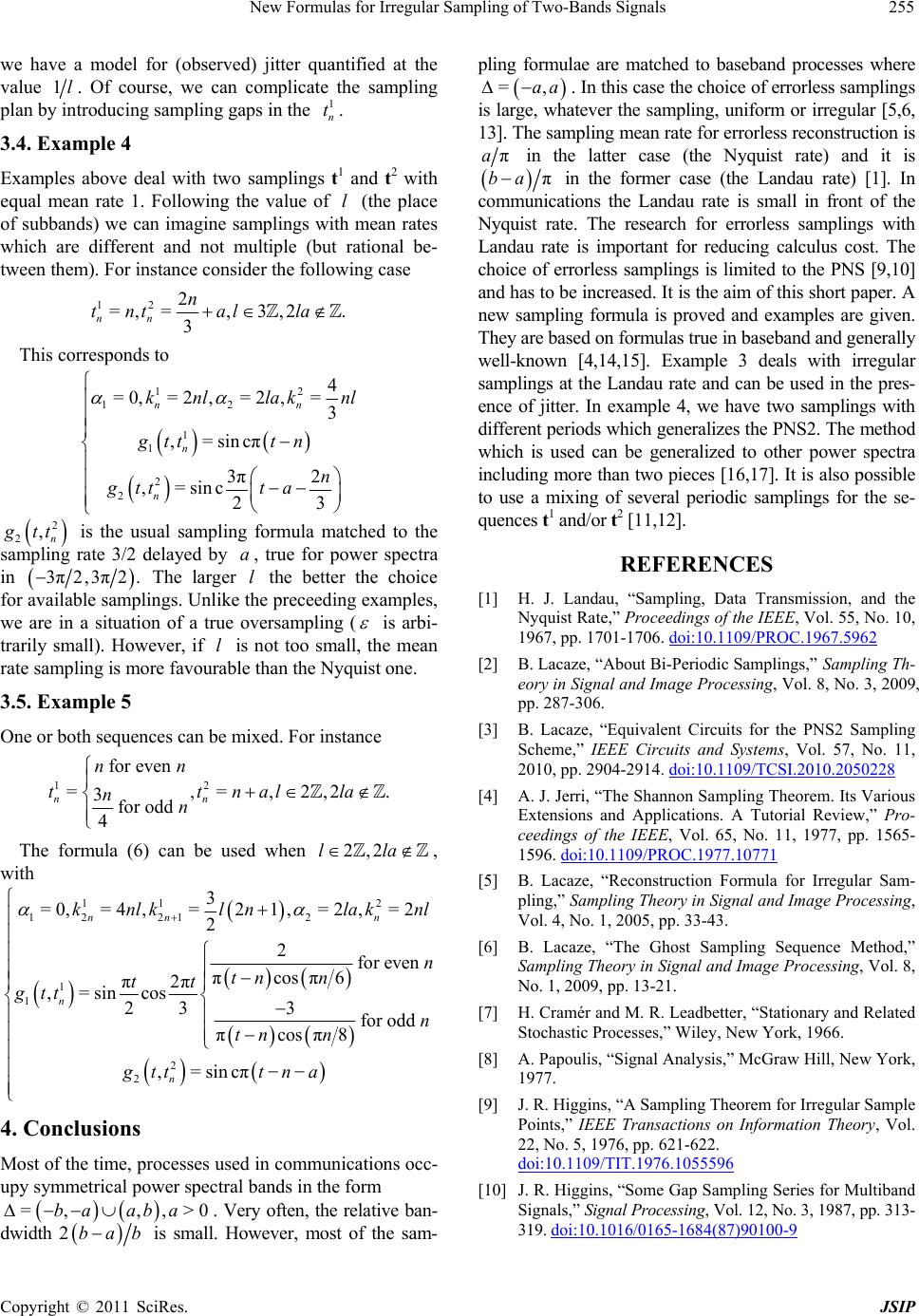 New Formulas for Irregular Sampling of Two-Bands Signals255 we have a model for (observed) jitter quantified at the value 1l. Of course, we can complicate the sampling plan by introducing sampling gaps in the . 1 n t 3.4. Example 4 Examples above deal with two samplings t1 and t2 with equal mean rate 1. Following the value of (the place of subbands) we can imagine samplings with mean rates which are different and not multiple (but rational be- tween them). For instance consider the following case l 12 2 =, =,3,2. 3 nn n tntalla This corresponds to 12 12 1 1 2 2 4 =0,=2,=2 ,=3 ,=sincπ 3π2 ,=sinc 23 nn n n knllakn gtt tn n gtt ta l 2 2,n g tt is the usual sampling formula matched to the sampling rate 3/2 delayed by , true for power spectra in a 3π2,3π2. The larger the better the choice for available samplings. Unlike the preceeding examples, we are in a situation of a true oversampling ( l is arbi- trarily small). However, if is not too small, the mean rate sampling is more favourable than the Nyquist one. l 3.5. Example 5 One or both sequences can be mixed. For instance 12 for even =,=,2,2 3for odd 4 nn nn ttnal nn .la The formula (6) can be used when , with 2,2lla 11 2 12 212 1 1 2 2 3 =0,=4,=21,=2,=2 2 2for even πcosπ6 π2π ,=sincos 3 23 for odd πcos π8 ,=sincπ nn n n n knlk lnlakn n tn n tt gtt n tn n gtt tna l 0 4. Conclusions Most of the time, processes used in communications occ- py symmetrical power spectral bands in the form u =, ,,>ba aba . Very often, the relative ban- dwidth 2bab is small. However, most of the sam- pling formulae are matched to baseband processes where =,aa . In this case the choice of errorless samplings is large, whatever the sampling, uniform or irregular [5,6, 13]. The sampling mean rate for errorless reconstruction is πa in the latter case (the Nyquist rate) and it is πba in the former case (the Landau rate) [1]. In communications the Landau rate is small in front of the Nyquist rate. The research for errorless samplings with Landau rate is important for reducing calculus cost. The choice of errorless samplings is limited to the PNS [9,10] and has to be increased. It is the aim of this short paper. A new sampling formula is proved and examples are given. They are based on formulas true in baseband and generally well-known [4,14,15]. Example 3 deals with irregular samplings at the Landau rate and can be used in the pres- ence of jitter. In example 4, we have two samplings with different periods which generalizes the PNS2. The method which is used can be generalized to other power spectra including more than two pieces [16,17]. It is also possible to use a mixing of several periodic samplings for the se- quences t1 and/or t2 [11,12]. REFERENCES [1] H. J. Landau, “Sampling, Data Transmission, and the Nyquist Rate,” Proceedings of the IEEE, Vol. 55, No. 10, 1967, pp. 1701-1706. doi:10.1109/PROC.1967.5962 [2] B. Lacaze, “About Bi-Periodic Samplings,” Sampling Th- eory in Signal and Image Processing, Vol. 8, No. 3, 2009, pp. 287-306. [3] B. Lacaze, “Equivalent Circuits for the PNS2 Sampling Scheme,” IEEE Circuits and Systems, Vol. 57, No. 11, 2010, pp. 2904-2914. doi:10.1109/TCSI.2010.2050228 [4] A. J. Jerri, “The Shannon Sampling Theorem. Its Various Extensions and Applications. A Tutorial Review,” Pro- ceedings of the IEEE, Vol. 65, No. 11, 1977, pp. 1565- 1596. doi:10.1109/PROC.1977.10771 [5] B. Lacaze, “Reconstruction Formula for Irregular Sam- pling,” Sampling Theory in Signal and Image Processing, Vol. 4, No. 1, 2005, pp. 33-43. [6] B. Lacaze, “The Ghost Sampling Sequence Method,” Sampling Theory in Signal and Image Processing, Vol. 8, No. 1, 2009, pp. 13-21. [7] H. Cramér and M. R. Leadbetter, “Stationary and Related Stochastic Processes,” Wiley, New York, 1966. [8] A. Papoulis, “Signal Analysis,” McGraw Hill, New York, 1977. [9] J. R. Higgins, “A Sampling Theorem for Irregular Sample Points,” IEEE Transactions on Information Theory, Vol. 22, No. 5, 1976, pp. 621-622. doi:10.1109/TIT.1976.1055596 [10] J. R. Higgins, “Some Gap Sampling Series for Multiband Signals,” Signal Processing, Vol. 12, No. 3, 1987, pp. 313- 319. doi:10.1016/0165-1684(87)90100-9 Copyright © 2011 SciRes. JSIP 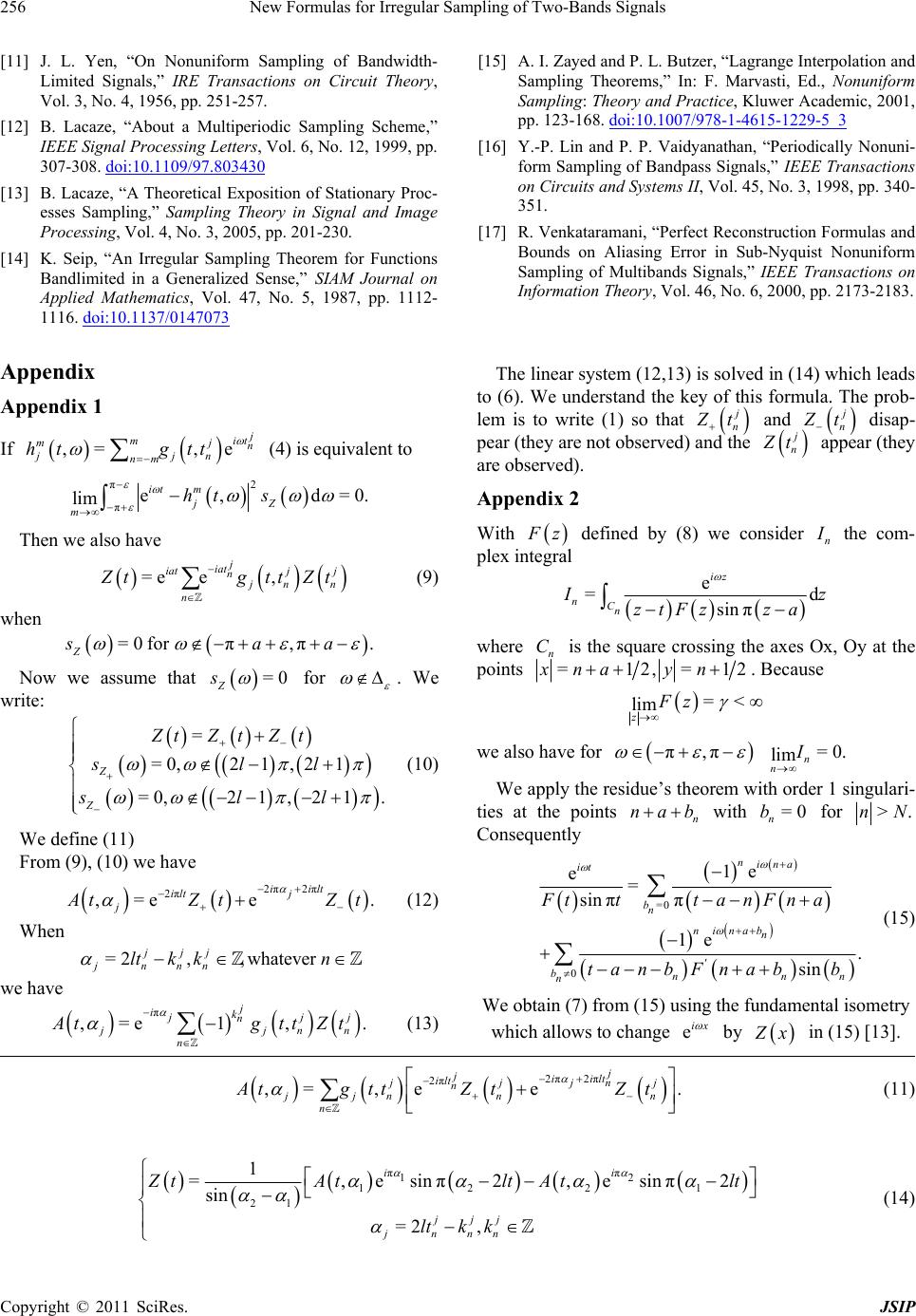 New Formulas for Irregular Sampling of Two-Bands Signals 256 [11] J. L. Yen, “On Nonuniform Sampling of Bandwidth- Limited Signals,” IRE Transactions on Circuit Theory, Vol. 3, No. 4, 1956, pp. 251-257. [12] B. Lacaze, “About a Multiperiodic Sampling Scheme,” IEEE Signal Processing Letters, Vol. 6, No. 12, 1999, pp. 307-308. doi:10.1109/97.803430 [13] B. Lacaze, “A Theoretical Exposition of Stationary Proc- esses Sampling,” Sampling Theory in Signal and Image Processing, Vol. 4, No. 3, 2005, pp. 201-230. [14] K. Seip, “An Irregular Sampling Theorem for Functions Bandlimited in a Generalized Sense,” SIAM Journal on Applied Mathematics, Vol. 47, No. 5, 1987, pp. 1112- 1116. doi:10.1137/0147073 [15] A. I. Zayed and P. L. Butzer, “Lagrange Interpolation and Sampling Theorems,” In: F. Marvasti, Ed., Nonuniform Sampling: Theory and Practice, Kluwer Academic, 2001, pp. 123-168. doi:10.1007/978-1-4615-1229-5_3 [16] Y.-P. Lin and P. P. Vaidyanathan, “Periodically Nonuni- form Sampling of Bandpass Signals,” IEEE Transactions on Circuits and Systems II, Vol. 45, No. 3, 1998, pp. 340- 351. [17] R. Venkataramani, “Perfect Reconstruction Formulas and Bounds on Aliasing Error in Sub-Nyquist Nonuniform Sampling of Multibands Signals,” IEEE Transactions on Information Theory, Vol. 46, No. 6, 2000, pp. 2173-2183. Appendix Appendix 1 If ,= ,e j mit mn jj nm ht gtt j n (4) is equivalent to 2 π πe, d lim it m jZ mht s =0. Then we also have =e e, j iat iatj j n j nn n Z tgtt Zt a (9) when =0for π,π. Z sa Now we assume that =0 Z s for . We write: = =0,21, 21 =0,21, 21. Z Z ZtZ tZ t sll sl l . (10) We define (11) From (9), (10) we have 2π2π 2π ,=e e iilt ilt j j A tZtZ t (12) When =2,,whatever jjj jnnn ltkkn we have π ,=e1 , j ik. j j jn jj nnn A tgt tZt (13) The linear system (12,13) is solved in (14) which leads to (6). We understand the key of this formula. The prob- lem is to write (1) so that j n j n Z t and Z t disap- pear (they are not observed) and the j Z n t appear (they are observed). Appendix 2 With F z defined by (8) we consider n I the com- plex integral e =d sin π iz nCn I z ztFz za where is the square crossing the axes Ox, Oy at the points n C =12,=1xna yn 2. Because =< lim zFz we also have for π,π =0. lim n nI We apply the residue’s theorem with order 1 singulari- ties at the points n nab with for =0 n b>.nN Consequently =0 0 1e e= sin ππ 1e . sin nina it bn ninab n ' bnn n Fttta nFn a tanbFnab b n (15) We obtain (7) from (15) using the fundamental isometry which allows to change eix by Z x in (15) [13]. 2π2π 2π ,= ,ee j jiilt ilt jj jn n jjn nn n Atg ttZ tZt . j (11) ππ 12 122 1 21 1 =,esinπ2,esinπ2 sin =2 , ii jjj jnnn Z tAt ltAt ltk k lt (14) Copyright © 2011 SciRes. JSIP |