

Paper Menu >>
Journal Menu >>
 Journal of Signal and Information Processing, 2011, 2, 257-265 doi:10.4236/jsip.2011.24036 Published Online November 2011 (http://www.SciRP.org/journal/jsip) Copyright © 2011 SciRes. JSIP 1 On Development of Fuzzy Controller: The Case of Gaussian and Triangular Membership Functions Vincent O. S. Olunloyo, Abayomi M. Ajofoyinbo, Oye Ibidapo-Obe Department of Systems Engineering, Faculty of Engineering Complex, University of Lagos, Lagos, Nigeria. Email: [email protected]om, [email protected], [email protected] Received September 30th, 2011; revised October 31st, 2011; accepted November 16th, 2011. ABSTRACT In recent years, the use of Fuzzy set theory has been popularised for handling overlap domains in control engineering but this has mostly been within the context of triangular membership functions. In actual practice however, such do- mains are hardly triangular and in fact for most engineering applications the membership functions are usually Gaus- sian and sometimes cosine. In an earlier paper, we derived explicit Fourier series expressions for systematic and dy- namic compu tation of g rade of me mbership in the overlap a nd non-o verlap region s of triangu lar Fu zzy sets. In ano ther paper, we extended the methodology to cover cases of cosine, exponential and Gaussian Fuzzy sets by presenting ex- plicit Fourier series representation for encoding fuzziness in the overlap and non-overlap domains of Fuzzy sets. This current paper presents the development of a “Fuzzy Controller” device, which incorporates the formal mathematical representation for computing grade of membership of Gaussian and triangular Fuzzy sets. It is shown that triangular approximation of Gaussian membersh ip function in Fuzzy control can lead to wrong lingu istic classification which may have adverse effects on operational and control decisions. The development of the Fuzzy controller demonstrates that the proposed technique can indeed be incorporated in engineering systems for dynamic and systematic computation of grade of membership in th e overlap and non-overlap regio ns of Fuzzy sets; and thus provides a basis for th e design of embedded Fuzzy controller for mission critical applications. Keywords: Fuzzy Controller, Triangular, Gaussian, Fou r ier Series Representation, Membership Functions 1. Introduction The key elements in human thinking are not numbers, but labels of Fuzzy sets, viz: classes of objects in which the transition from membership to non-membership is gradual rather than abrupt (Zadeh [1]). Fuzzy logic has found applications for control and analysis purposes, as for example recorded in the work of Bellman and Zadeh [2], Berenji and Khedar [3]. Ruan and Fantoni [4] also reported industrial applications of Fuzzy logic. Olunloyo and Ajofoyinbo [5] applied hybrid Fuzzy-stochastic methodology for maintenance optimization. Araujo, Sandri and Macau [6], Marinke and Araujo [7], and Moura, Rodrigues and Araujo [8] presented some other industrial applications of Fuzzy systems/logic most of which are related to thermal-vacuum processes, usually encountered in particular, in the qualification of space devices. Savkovic [9] studied Fuzzy logic theory and applied it to the process control system. Ji and Wang [10] developed an adaptive Neural Fuzzy Controller for active vibration suppression in flexible structures. Researchers generally treat the overlap region as intersection or union of two or more Fuzzy sets and have invoked the Min and Max operators, respectively, as needed. Olunloyo, Ajo- foyinbo and Badiru [11] proposed an algorithm for the treatment of overlap of adjoining Fuzzy sets based on partitioned grids. In view of the importance of this Fuzzy overlap region, especially where there is need to monitor and ensure smooth transition between the adjoining Fuzzy sets in relation to the design of mission critical applications, Olunloyo and Ajofoyinbo [12] proposed an alternative approach for computing membership function based on the Fourier series representation of the envelope of the Fuzzy patch. In the literature, for example, as in the work of King and Mamdani [13], and Zimmermann [14], most control applications use triangular and trape- zoidal profiles for membership functions. However, such triangular or trapezoidal assumptions, in most applica- tions are generally poor approximations of the prevailing Gaussian membership function that governs most engi- neering processes. The Gaussian membership function applies in engineering problem domain, especially for  On Development of Fuzzy Controller: The Case of Gaussian and Triangular Membership Functions 258 engineering measurements; as it gives actual representa- tion at every point. According to Ross [15], membership function essen- tially embodies all fuzziness in a particular Fuzzy set, and its description is the essence of a Fuzzy property or operation. Watanabe [16] asserted that the statistical tec- hniques for determining membership functions fall into two broad categories viz: use of frequencies and direct estimation. The two methods were analysed by Turksen [17] when he reviewed the various methods and their methodology for implementation. The determination of membership function can also be categorized as either being manual or automatic. The automatic generation of membership function emphasises the use of modern soft computing techniques (in particular Genetic Algorithm and Neural Networks). Meredith, Karr and Krishnakumar [18] applied Genetic Algorithm (GA) to the fine tuning of membership functions in a Fuzzy logic controller for a helicopter. Karr [19] applied GA to the design of Fuzzy logic controller for the Cart Pole problem. Lee and Ta- kagi [20] also tackled the Cart problem. In their case, they took a holistic approach by using GA to design the whole system (determination of the optimal number of rules as well as the membership functions). Moreover, Ross [21] reported on six methods for developing mem- bership functions namely: intuition, inference, rank or- dering, neural networks, genetic algorithm and inductive reasoning. The manual and automatic techniques for de- termining membership functions of Fuzzy sets are non- systematic and suffer from certain deficiencies. On the one hand, most of the existing automatic techniques are heuristic in nature; which implies that different values can be obtained for same input values presented at dif- ferent times. On the other hand, the manual techniques suffer from the deficiency that they rely on subjective interpretation of words and the peculiarities of the en- gaged human expert. By analyzing the nature of the overlap patches defined by the intersection and union of a typical grade of mem- bership function for a linguistic variable, it is shown that the resultant signal does fall into the class of functions for which a Fourier series representation can be written. The problem then is to construct such a series and com- pute the corresponding coefficients. Furthermore, in or- der to align the results with the properties of membership functions, some element of normalization and standardi- zation is introduced. To be more specific, starting with triangular Fuzzy sets, Olunloyo, Ajofoyinbo and Badiru [22] formulated explicit Fourier series representation for computing the grade of membership in the overlap and non-overlap regions. Ajofoyinbo [23] derived explicit Fourier series expressions for encoding fuzziness in the overlap and non-overlap domains of membership func- tions of different Fuzzy sets. This methodology was ex- tended by obtaining explicit Fourier series expressions for computing the union and intersection of the Gaussian, cosine and exponential Fuzzy sets. In [24], Olunloyo, Ajofoyinbo and Ibidapo-Obe presented an implementa- tion of embedded “Fuzzy Controller” via simulation. In the current work, the development of Fuzzy controller based on Fourier series representation for computing grade of membership of Gaussian and triangular Fuzzy sets are presented. This paper also investigates the per- formance of Fuzzy controller based on Gaussian and triangular membership functions, in classifying data val- ues in the universe of discourse. The remainder of this paper is organized as follows: Problem formulation is presented in Chapter 2. This is followed by Systems de- sign and implementation in Chapter 3. Discussion of sample results is presented in Chapter 4. Chapter 5 con- cludes the paper. 2. Problem Formulation Fundamental conditions for Fourier series representation are: 1) Function must be periodic, 2) Function must have finite number of discontinuities, and 3) Function must be bounded. We note that the universe of discourse in a Fuzzy plane consists of one or more data points. Each of the data points in a given universe of discourse has some form of data distribution around it in the form of some distribution profile, whether Gaussian, exponential, tri- angular or any other. Since all data points in the universe of discourse would have same form of data distribution around every data point, we could therefore derive an explicit Fourier series expression for the envelope of the Fuzzy patch since we can be assured of the repetition of the assumed distribution pattern around each data point. Moreover, in as much as the distribution around the data points has same shape, then appropriate normalisation can be introduced to transform the union and intersection of such Fuzzy sets into functions that are amenable to Fourier series representation. Although various func- tional profiles of membership functions could be used, the triangular and trapezoidal have in the past served as approximations of the others in the first instance. In fact, the trapezoidal form can, further, be approximated by the triangular form since the end-points of the ‘tolerance’ interval in a trapezoidal distribution have the same grade of membership and could therefore be assigned a point value that represents the peak of the triangular profile. In Sections 2.1 and 2.2 below, we present Fourier series representation for computing union and intersection of Gaussian and triangular Fuzzy sets respectively. Copyright © 2011 SciRes. JSIP  On Development of Fuzzy Controller: The Case of Gaussian and Triangular Membership Functions Copyright © 2011 SciRes. JSIP 259 2.1. Fourier Series Representation for Gaussian Membership Function 0 1 cos sin 2 n kk k a f xakwx bkwx (1) The membership function of union of Gaussian Fuzzy sets is computed as follows: w here 22 22 12π4π14π16π π2π 22 2618 2618 0 3 0 1ede 28π xx xx ad x x (2) Recall from Abramowitz and Stegun [25]: 2 221π ed*e** 2 bac atbt cab f tterfa tConst aa (3) Thus, 0 3 2π2π 166 0.5*2π0.5 * π 28π0.5 0.5 4π4π 66 0.5*2π0.5 * 2π0.5*π 0.5 0.5 aerf erf erf erf (4) From Equation (4), we define 1 I and 2 I as: 1 2π2π 66 0.5 2π*0.5*π 0.5 0.5 Ierf erf (5) and 2 4π4π 6 0.5 2π*0.5*2π0.5 * π 0.5 0.5 Ierf erf 6 (6) We compute coefficients and as follows: k ak band 2 2 2 2 12π4π π2 2618 3 0 1416 2π2 2618 π 1ecos 2π ecosd xx k xx ak kx x dxx (7) 2 2 2 2 12π4π π2 2618 3 0 14π16π 2π2 2618 π 1esin 2π esind xx k xx bk kx x d xx (10) 2 12 3 111cos1 1 2π kk kII bkk k (11) By recalling 1 I and 2 I from Equations (5) and (6) respectively, we can re-write Equation (7) as follows: 1 3 2 1sin πsin 0 2π sin2πsin π kI ak k Ikk k (8) Similarly, we obtain the expression for computing membership function in the overlap region of Gaussian Fuzzy sets (i.e., intersection of the Gaussian Fuzzy sets) as follows: 0 1 cos sin 2 n kk k a f xakwxbkwx (12) 0 k a (9)  On Development of Fuzzy Controller: The Case of Gaussian and Triangular Membership Functions 260 where 22 4π 14π16π12π4π π22 3 26182618 0 2ππ 3 11 1 ede 22π2π2 xx xx ad x x (13) By invoking Equation (3), we can express Equation (13) as: 0 4π4π 2π 66 0.5*2π0.5 * 2π0.5 *3 0.5 0.5 1 22π2π2π 4π66 0.5* 2π0.5 *30.5 0.5 erf erf a erf erf (14) From Equation (14), we define 1 J and 2 J as: 1 4π4π 2π 6 0.5*2π0.5 * 2π0.5 *3 0.5 0.5 Jerf erf 6 (15) and 2 2π2π 4π6 0.5*2π0.5 *30.50.5 Jerf erf 6 (16) Coefficients and are then computed as follows: k ak b 22 22 4π 14π16π12π4π π22 3 26182618 2ππ 3 11 1 ecosdecos π2π2π xx xx k akxx dkxx (17) Upon substituting 1 J and 2 J from Equations (15) and (16) respectively, we can re-write Equation (17) as: 21 14π2π sin sin π33 kkk aJ J k (18) and 12 12π4π coscos πcos πcos π33 kk bJ kJk k k (19) 2.2. Fourier Series Representation for Triangular Membership Function The Fourier series representation for computing the grade of membership of the intersection of triangular Fuzzy sets (i.e. triangular pulses) is given by: 0 1 cos sin 2 n kk k a f xakxb kx (20) where 01 24 a (21) For the case k odd, 1 2 22 1 41 1sin 4 k N k fx kx k (22) and for the case k even 2 22 1 14 11cos 4π Nk k f xk k x (23) Similarly, the Fourier series representation for the un- ion of triangular Fuzzy sets (i.e. polygonal waveform) is given by: Copyright © 2011 SciRes. JSIP  On Development of Fuzzy Controller: The Case of Gaussian and Triangular Membership Functions261 1 cos sin 2 okk k a Gxakxbkx (24) where 0 1 224 a0 (25) for the case k odd, 00 22 1 4 1cos 24 π N k Gx kx k (26) while, for the case k even, 02 00 1 184148cos 24 Nk k Gx kx (27) We note that 0 is the point of overlap of the two ad- joining triangular Fuzzy sets. Thus, 0 represents the maximum grade of membership of the intersection of the triangular Fuzzy sets. In compliance with the require- ments of the membership function of Fuzzy set, in respect of the intersection, we normalize f x as follows: 0 1 fx fx (28) where . i.e. maximum grade of membership for the intersection of triangular Fuzzy sets. 0max INTERSECTION fx 3. Systems Design and Implementation We briefly describe the development of a “Fuzzy con- troller” to measure temperature and pressure, and pro- duce some output that can represent input to other sub-s ystems or systems. Itemised below are some of the de- tails of systems design and the implementation of the Fuzzy Controllers. The electrical circuit is presented in Figure 1, while the corresponding photo-image of the device is presented in Figure 2. The circuit in Figure 1 consists of the following major hardware components: a) Microchip 40-Pin Enhanced Flash PIC16F877A Microcontrollers b) LM35D precision integrated-circuit temperature sensor c) MPX4115A piezoresistive pressure sensor, and d) LCM-S01602DSF/C Liquid Crystal Display (HD 44780-compliant LCD) There are only four units of the PIC16F877A Micro- controllers deployed in the circuit. Each Microcontroller is configured with XT 4MHz Crystal. Moreover, the cir- cuit incorporates the LCM-S01602DSF/C Liquid Crystal Display (LCD) output unit capable of displaying 2 × 16 characters. The four (4) Microcontrollers are grouped into two functional sections namely: a) Section 1: Temperature This section consists of two (2) Microcontrollers. Mi- crocontroller #1 executes the Program code for tempera- ture input from the LM35D Sensor; it also conditions and convert signals to digital form, and computes grade of membership of the Gaussian Fuzzy sets. Similarly, Mi- crocontroller #2 executes the corresponding program code for temperature input from the LM35D Sensor, digitises the signals, and computes membership grades of the triangular Fuzzy sets. D7 D6 D5 D4 D3 D2 D1 D0 E RW RS RS RW E5V D0 D1 D2 D3 D4 D5 D6 D7 TPM RS RW E5V D0 D1 D2 D3 D4 D5 D6 D7 TPM RS RW E5V D0 D1 D2 D3 D4 D5 D6 D7 TPM D7 D6 D5 D4 D3 D2 D1 D0 RS RW E TPM 5V TPM 5V PSN PSN IC1 PSN PSN IC3 IC4IC2 PSN IC1 IC2 IC3 IC4 LED RA0/AN0 2 RA1/AN1 3 RA2/AN2/VREF- 4 RA4/T0CKI 6 RA5/AN4/SS 7 RE0/AN5/RD 8 RE1/AN6/WR 9 RE2/AN7/CS 10 OSC1/CLKIN 13 OSC2/CLKOUT 14 RC1/T1OSI/CCP2 16 RC2/CCP1 17 RC3/SCK/SCL 18 RD0/PSP0 19 RD1/PSP1 20 RB7/PGD 40 RB6/PGC 39 RB5 38 RB4 37 RB3/PGM 36 RB2 35 RB1 34 RB0/INT 33 RD7/PSP7 30 RD6/PSP6 29 RD5/PSP5 28 RD4/PSP4 27 RD3/PSP3 22 RD2/PSP2 21 RC7/RX/DT 26 RC6/TX/CK 25 RC5/SDO 24 RC4/SDI/SDA 23 RA3/AN3/VREF+ 5 RC0/T1OSO/T1CKI 15 MCLR/Vpp/THV 1 MCU #1 (GAUSSIAN MF) PIC1 6 F8 77A R9 20k 15.4 3 4 5 621 SENSOR MPX 5 100D D7 14 D6 13 D5 12 D4 11 D3 10 D2 9D1 8D0 7 E 6RW 5RS 4 VSS 1 VDD 2 VEE 3 LCD LCMS01602DSF/C RA0/ AN0 2 RA1/ AN1 3 RA2/AN2/VREF- 4 RA4/ T0CKI 6 RA5/ AN4/SS 7 RE0/ AN5/RD 8 RE1/ AN6/WR 9 RE2/ AN7/CS 10 OSC1 /C L K IN 13 OSC2 /C L K OUT 14 RC1/T1OSI/CCP2 16 RC2/CCP117 RC3/SCK/SCL18 RD0/PSP019 RD1/PSP120 RB7/PGD40 RB6/PGC39 RB5 38 RB4 37 RB3/PGM 36 RB2 35 RB1 34 RB0/INT 33 RD7/PSP730 RD6/PSP629 RD5/PSP528 RD4/PSP427 RD3/PSP322 RD2/PSP221 RC7/RX/DT26 RC6/TX/CK25 RC5/SDO 24 RC4/SDI/SDA 23 RA3/AN3/VREF+ 5 RC0/T1OSO/T1CKI 15 MCLR/Vpp/THV 1 MCU #4 (TRI ANGULAR MF) PIC16F877A RA0/AN0 2 RA1/AN1 3 RA2/AN2/VREF- 4 RA4/T0CKI 6 RA5/AN4/SS 7 RE0/AN5/RD 8 RE1/AN6/WR 9 RE2/AN7/CS 10 OSC1/CLKIN 13 OSC2/CLKOUT 14 RC1/T1OSI/CCP2 16 RC2/CCP1 17 RC3/SCK/SCL18 RD0/PSP019 RD1/PSP120 RB7/PGD 40 RB6/PGC 39 RB5 38 RB4 37 RB3/PGM 36 RB2 35 RB1 34 RB0/INT 33 RD7/PSP730 RD6/PSP629 RD5/PSP528 RD4/PSP427 RD3/PSP322 RD2/PSP221 RC7/RX/DT 26 RC6/TX/CK 25 RC5/SDO 24 RC4/SDI/SDA 23 RA3/AN3/VREF+ 5 RC0/T1OSO/T1CKI 15 MCLR/Vpp/THV 1 MCU #3 (GAUSSIAN MF) PIC16F877A RA0/AN0 2 RA1/AN1 3 RA2/AN2/VREF- 4 RA4/T0CKI 6 RA5/AN4/SS 7 RE0/AN5/RD 8 RE1/AN6/WR 9 RE2/AN7/CS 10 OSC1/CLKIN 13 OSC2/CLKOUT 14 RC1/T1OSI/CCP2 16 RC2/CCP117 RC3/SCK/SCL18 RD0/PSP0 19 RD1/PSP1 20 RB7/PGD 40 RB6/PGC 39 RB5 38 RB4 37 RB3/PGM 36 RB2 35 RB1 34 RB0/INT 33 RD7/PSP7 30 RD6/PSP6 29 RD5/PSP5 28 RD4/PSP4 27 RD3/PSP3 22 RD2/PSP2 21 RC7/RX/DT 26 RC6/TX/CK 25 RC5/SDO 24 RC4/SDI/SDA 23 RA3/AN3/VREF+ 5 RC0/T1OSO/T1CKI 15 MCLR/Vpp/THV 1 MCU #2 (TRIANGULAR MF) PIC1 6 F8 77A GND 3+VS 1 VOUT 2 U6 (SENSOR) LM35 RV2 2.2k D2 LED-RED R3 220 Volts +88.8 Volts +88.8 IC SEL TEMP/ PR E S 1 2 3 U1:A 4081 5 6 4 U1:B 4081 8 9 10 U1:C 4081 12 13 11 U1:D 4081 3 2 U2:A 4049 5 4 U2:B 4049 7 6 U2:C 4049 C1 33p C2 33p C3 33p C4 33p C5 33p C6 33p C7 33p C8 33p Figure 1. Electrical circuit of the fuzzy controller. Copyright © 2011 SciRes. JSIP 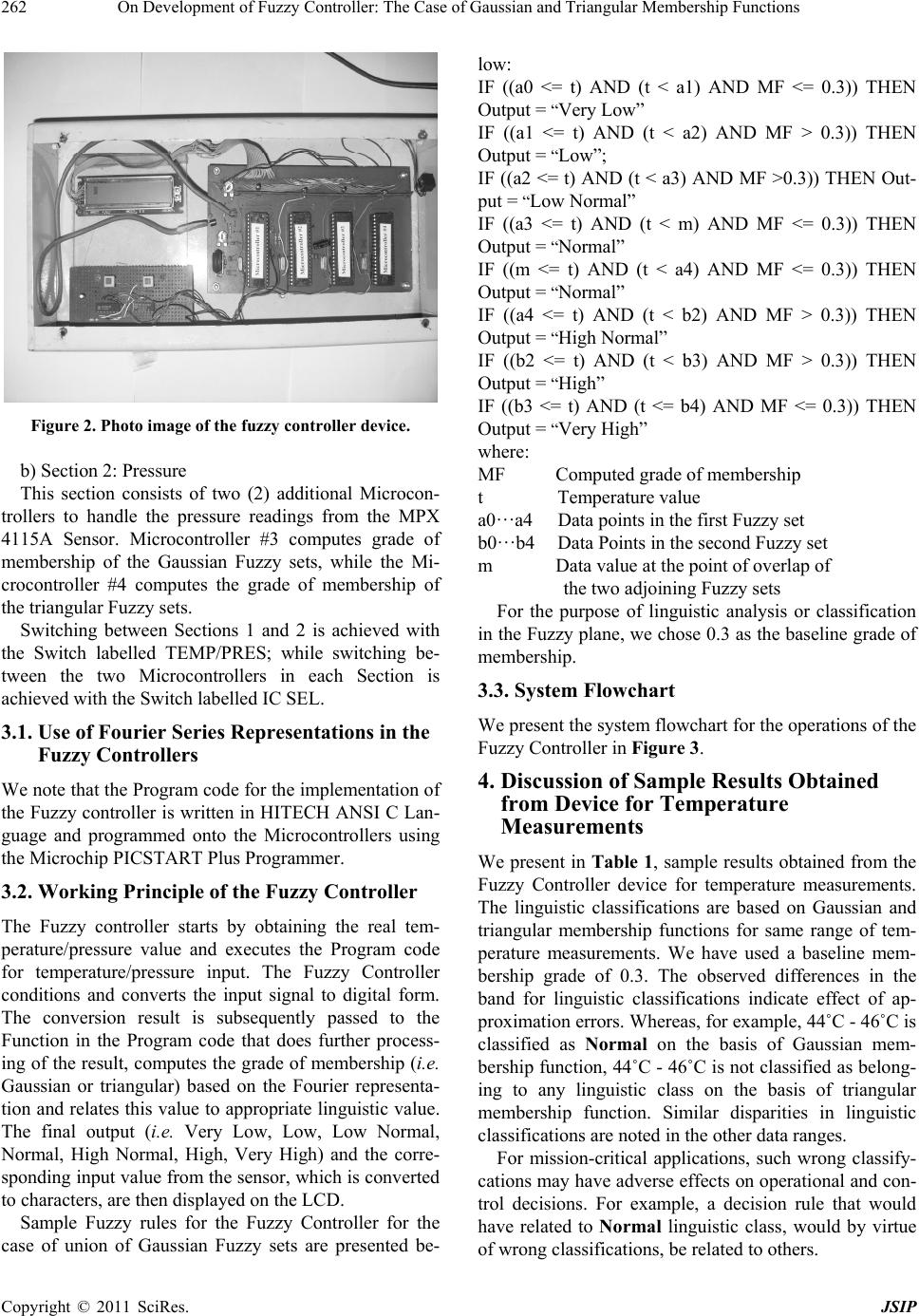 On Development of Fuzzy Controller: The Case of Gaussian and Triangular Membership Functions 262 Figure 2. Photo image of the fuzzy controller device. b) Section 2: Pressure This section consists of two (2) additional Microcon- trollers to handle the pressure readings from the MPX 4115A Sensor. Microcontroller #3 computes grade of membership of the Gaussian Fuzzy sets, while the Mi- crocontroller #4 computes the grade of membership of the triangular Fuzzy sets. Switching between Sections 1 and 2 is achieved with the Switch labelled TEMP/PRES; while switching be- tween the two Microcontrollers in each Section is achieved with the Switch labelled IC SEL. 3.1. Use of Fourier Series Representations in the Fuzzy Controllers We note that the Program code for the implementation of the Fuzzy controller is written in HITECH ANSI C Lan- guage and programmed onto the Microcontrollers using the Microchip PICSTART Plus Programmer. 3.2. Working Principle of the Fuzzy Controller The Fuzzy controller starts by obtaining the real tem- perature/pressure value and executes the Program code for temperature/pressure input. The Fuzzy Controller conditions and converts the input signal to digital form. The conversion result is subsequently passed to the Function in the Program code that does further process- ing of the result, computes the grade of membership (i.e. Gaussian or triangular) based on the Fourier representa- tion and relates this value to appropriate linguistic value. The final output (i.e. Very Low, Low, Low Normal, Normal, High Normal, High, Very High) and the corre- sponding input value from the sensor, which is converted to characters, are then displayed on the LCD. Sample Fuzzy rules for the Fuzzy Controller for the case of union of Gaussian Fuzzy sets are presented be- low: IF ((a0 <= t) AND (t < a1) AND MF <= 0.3)) THEN Output = “Very Low” IF ((a1 <= t) AND (t < a2) AND MF > 0.3)) THEN Output = “Low”; IF ((a2 <= t) AND (t < a3) AND MF >0.3)) THEN Out- put = “Low Normal” IF ((a3 <= t) AND (t < m) AND MF <= 0.3)) THEN Output = “Normal” IF ((m <= t) AND (t < a4) AND MF <= 0.3)) THEN Output = “Normal” IF ((a4 <= t) AND (t < b2) AND MF > 0.3)) THEN Output = “High Normal” IF ((b2 <= t) AND (t < b3) AND MF > 0.3)) THEN Output = “High” IF ((b3 <= t) AND (t <= b4) AND MF <= 0.3)) THEN Output = “Very High” where: MF Computed grade of membership t Temperature value a0…a4 Data points in the first Fuzzy set b0…b4 Data Points in the second Fuzzy set m Data value at the point of overlap of the two adjoining Fuzzy sets For the purpose of linguistic analysis or classification in the Fuzzy plane, we chose 0.3 as the baseline grade of membership. 3.3. System Flowchart We present the system flowchart for the operations of the Fuzzy Controller in Figure 3. 4. Discussion of Sample Results Obtained from Device for Temperature Measurements We present in Table 1, sample results obtained from the Fuzzy Controller device for temperature measurements. The linguistic classifications are based on Gaussian and triangular membership functions for same range of tem- perature measurements. We have used a baseline mem- bership grade of 0.3. The observed differences in the band for linguistic classifications indicate effect of ap- proximation errors. Whereas, for example, 44˚C - 46˚C is classified as Normal on the basis of Gaussian mem- bership function, 44˚C - 46˚C is not classified as belong- ing to any linguistic class on the basis of triangular membership function. Similar disparities in linguistic classifications are noted in the other data ranges. For mission-critical applications, such wrong classify- cations may have adverse effects on operational and con- trol decisions. For example, a decision rule that would have related to Normal linguistic class, would by virtue of wrong classifications, be related to others. Copyright © 2011 SciRes. JSIP 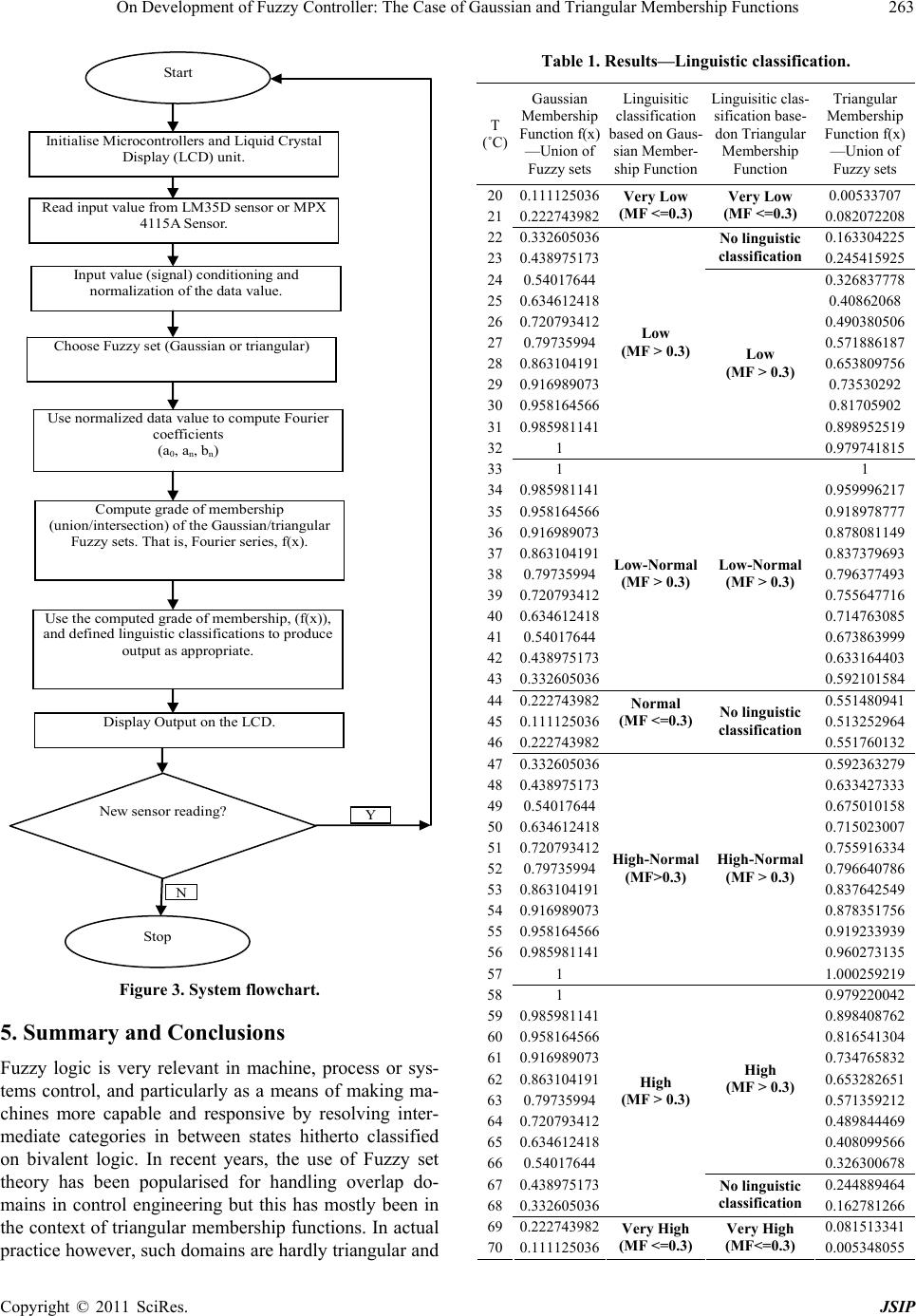 On Development of Fuzzy Controller: The Case of Gaussian and Triangular Membership Functions263 Initialise Microcontrollers and Liquid Crystal Display (LCD) unit. Read input value from LM35D sensor or MPX 4115A Sensor. Input value (signal) conditioning and normalization of the data value. Use normalized data value to compute Fourier coefficients (a 0 , a n , b n ) Compute grade of membership (union/intersection) of the Gaussian/triangular Fuzzy sets. That is, Fourier series, f(x). Use the computed grade of membership, (f(x)), and defined linguistic classifications to produce output as appropriate. Display Output on the LCD. New sensor reading? Stop Start Choose Fuzzy set (Gaussian or triangular) Y N Figure 3. System flowchart. 5. Summary and Conclusions Fuzzy logic is very relevant in machine, process or sys- tems control, and particularly as a means of making ma- chines more capable and responsive by resolving inter- mediate categories in between states hitherto classified on bivalent logic. In recent years, the use of Fuzzy set theory has been popularised for handling overlap do- mains in control engineering but this has mostly been in the context of triangular membership functions. In actual practice however, such domains are hardly triangular and Table 1. Results—Linguistic classification. T (˚C) Gaussian Membership Function f(x) —Union of Fuzzy sets Linguisitic classification based on Gaus- sian Member- ship Function Linguisitic clas- sification base- don Triangular Membership Function Triangular Membership Function f(x) —Union of Fuzzy sets 20 0.1111250360.00533707 21 0.222743982 Very Low (MF <=0.3) Very Low (MF <=0.3) 0.082072208 22 0.3326050360.163304225 23 0.438975173 No linguistic classification 0.245415925 24 0.540176440.326837778 25 0.6346124180.40862068 26 0.7207934120.490380506 27 0.797359940.571886187 28 0.8631041910.653809756 29 0.9169890730.73530292 30 0.9581645660.81705902 31 0.9859811410.898952519 321 Low (MF > 0.3)Low (MF > 0.3) 0.979741815 331 1 34 0.9859811410.959996217 35 0.9581645660.918978777 36 0.9169890730.878081149 37 0.8631041910.837379693 38 0.797359940.796377493 39 0.7207934120.755647716 40 0.6346124180.714763085 41 0.540176440.673863999 42 0.4389751730.633164403 43 0.332605036 Low-Normal (MF > 0.3)Low-Normal (MF > 0.3) 0.592101584 44 0.2227439820.551480941 45 0.1111250360.513252964 46 0.222743982 Normal (MF <=0.3) No linguistic classification 0.551760132 47 0.3326050360.592363279 48 0.4389751730.633427333 49 0.540176440.675010158 50 0.6346124180.715023007 51 0.7207934120.755916334 52 0.797359940.796640786 53 0.8631041910.837642549 54 0.9169890730.878351756 55 0.9581645660.919233939 56 0.9859811410.960273135 571 High-Normal (MF>0.3) High-Normal (MF > 0.3) 1.000259219 581 0.979220042 59 0.9859811410.898408762 60 0.9581645660.816541304 61 0.9169890730.734765832 62 0.8631041910.653282651 63 0.797359940.571359212 64 0.7207934120.489844469 65 0.6346124180.408099566 66 0.54017644 High (MF > 0.3) 0.326300678 67 0.4389751730.244889464 68 0.332605036 High (MF > 0.3) No linguistic classification 0.162781266 69 0.2227439820.081513341 70 0.111125036 Very High (MF <=0.3) Very High (MF<=0.3) 0.005348055 Copyright © 2011 SciRes. JSIP 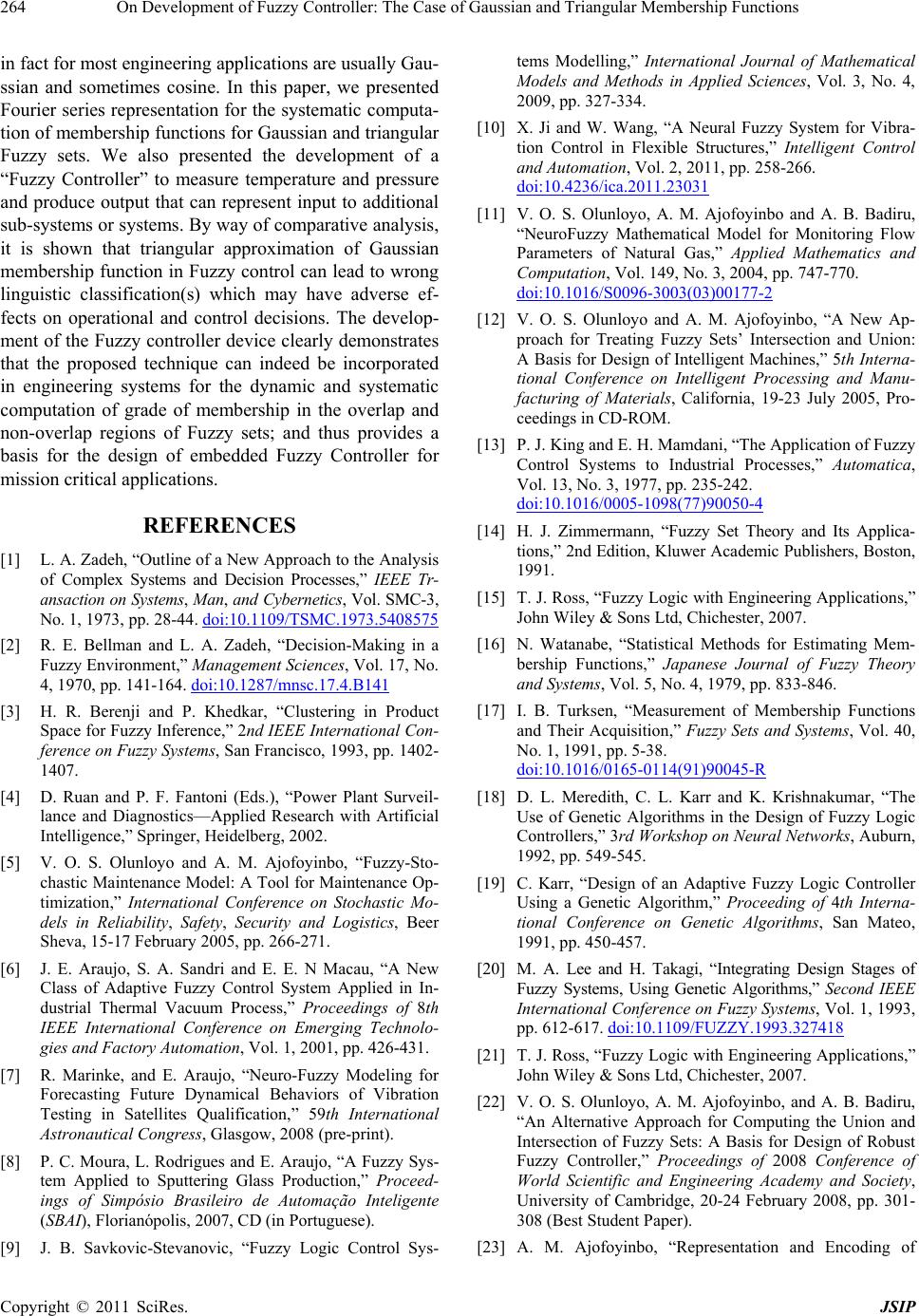 On Development of Fuzzy Controller: The Case of Gaussian and Triangular Membership Functions 264 in fact for most engineering applications are usually Gau- ssian and sometimes cosine. In this paper, we presented Fourier series representation for the systematic computa- tion of membership functions for Gaussian and triangular Fuzzy sets. We also presented the development of a “Fuzzy Controller” to measure temperature and pressure and produce output that can represent input to additional sub-systems or systems. By way of comparative analysis, it is shown that triangular approximation of Gaussian membership function in Fuzzy control can lead to wrong linguistic classification(s) which may have adverse ef- fects on operational and control decisions. The develop- ment of the Fuzzy controller device clearly demonstrates that the proposed technique can indeed be incorporated in engineering systems for the dynamic and systematic computation of grade of membership in the overlap and non-overlap regions of Fuzzy sets; and thus provides a basis for the design of embedded Fuzzy Controller for mission critical applications. REFERENCES [1] L. A. Zadeh, “Outline of a New Approach to the Analysis of Complex Systems and Decision Processes,” IEEE Tr- ansaction on Systems, Man, and Cybernetics, Vol. SMC-3, No. 1, 1973, pp. 28-44. doi:10.1109/TSMC.1973.5408575 [2] R. E. Bellman and L. A. Zadeh, “Decision-Making in a Fuzzy Environment,” Management Sciences, Vol. 17, No. 4, 1970, pp. 141-164. doi:10.1287/mnsc.17.4.B141 [3] H. R. Berenji and P. Khedkar, “Clustering in Product Space for Fuzzy Inference,” 2nd IEEE International Con- ference on Fuzzy Systems, San Francisco, 1993, pp. 1402- 1407. [4] D. Ruan and P. F. Fantoni (Eds.), “Power Plant Surveil- lance and Diagnostics—Applied Research with Artificial Intelligence,” Springer, Heidelberg, 2002. [5] V. O. S. Olunloyo and A. M. Ajofoyinbo, “Fuzzy-Sto- chastic Maintenance Model: A Tool for Maintenance Op- timization,” International Conference on Stochastic Mo- dels in Reliability, Safety, Security and Logistics, Beer Sheva, 15-17 February 2005, pp. 266-271. [6] J. E. Araujo, S. A. Sandri and E. E. N Macau, “A New Class of Adaptive Fuzzy Control System Applied in In- dustrial Thermal Vacuum Process,” Proceedings of 8th IEEE International Conference on Emerging Technolo- gies and Factory Automation, Vol. 1, 2001, pp. 426-431. [7] R. Marinke, and E. Araujo, “Neuro-Fuzzy Modeling for Forecasting Future Dynamical Behaviors of Vibration Testing in Satellites Qualification,” 59th International Astronautical Congress, Glasgow, 2008 (pre-print). [8] P. C. Moura, L. Rodrigues and E. Araujo, “A Fuzzy Sys- tem Applied to Sputtering Glass Production,” Proceed- ings of Simpósio Brasileiro de Automação Inteligente (SBAI), Florianópolis, 2007, CD (in Portuguese). [9] J. B. Savkovic-Stevanovic, “Fuzzy Logic Control Sys- tems Modelling,” International Journal of Mathematical Models and Methods in Applied Sciences, Vol. 3, No. 4, 2009, pp. 327-334. [10] X. Ji and W. Wang, “A Neural Fuzzy System for Vibra- tion Control in Flexible Structures,” Intelligent Control and Automation, Vol. 2, 2011, pp. 258-266. doi:10.4236/ica.2011.23031 [11] V. O. S. Olunloyo, A. M. Ajofoyinbo and A. B. Badiru, “NeuroFuzzy Mathematical Model for Monitoring Flow Parameters of Natural Gas,” Applied Mathematics and Computation, Vol. 149, No. 3, 2004, pp. 747-770. doi:10.1016/S0096-3003(03)00177-2 [12] V. O. S. Olunloyo and A. M. Ajofoyinbo, “A New Ap- proach for Treating Fuzzy Sets’ Intersection and Union: A Basis for Design of Intelligent Machines,” 5th Interna- tional Conference on Intelligent Processing and Manu- facturing of Materials, California, 19-23 July 2005, Pro- ceedings in CD-ROM. [13] P. J. King and E. H. Mamdani, “The Application of Fuzzy Control Systems to Industrial Processes,” Automatica, Vol. 13, No. 3, 1977, pp. 235-242. doi:10.1016/0005-1098(77)90050-4 [14] H. J. Zimmermann, “Fuzzy Set Theory and Its Applica- tions,” 2nd Edition, Kluwer Academic Publishers, Boston, 1991. [15] T. J. Ross, “Fuzzy Logic with Engineering Applications,” John Wiley & Sons Ltd, Chichester, 2007. [16] N. Watanabe, “Statistical Methods for Estimating Mem- bership Functions,” Japanese Journal of Fuzzy Theory and Systems, Vol. 5, No. 4, 1979, pp. 833-846. [17] I. B. Turksen, “Measurement of Membership Functions and Their Acquisition,” Fuzzy Sets and Systems, Vol. 40, No. 1, 1991, pp. 5-38. doi:10.1016/0165-0114(91)90045-R [18] D. L. Meredith, C. L. Karr and K. Krishnakumar, “The Use of Genetic Algorithms in the Design of Fuzzy Logic Controllers,” 3rd Workshop on Neural Networks, Auburn, 1992, pp. 549-545. [19] C. Karr, “Design of an Adaptive Fuzzy Logic Controller Using a Genetic Algorithm,” Proceeding of 4th Interna- tional Conference on Genetic Algorithms, San Mateo, 1991, pp. 450-457. [20] M. A. Lee and H. Takagi, “Integrating Design Stages of Fuzzy Systems, Using Genetic Algorithms,” Second IEEE International Conference on Fuzzy Systems, Vol. 1, 1993, pp. 612-617. doi:10.1109/FUZZY.1993.327418 [21] T. J. Ross, “Fuzzy Logic with Engineering Applications,” John Wiley & Sons Ltd, Chichester, 2007. [22] V. O. S. Olunloyo, A. M. Ajofoyinbo, and A. B. Badiru, “An Alternative Approach for Computing the Union and Intersection of Fuzzy Sets: A Basis for Design of Robust Fuzzy Controller,” Proceedings of 2008 Conference of World Scientific and Engineering Academy and Society, University of Cambridge, 20-24 February 2008, pp. 301- 308 (Best Student Paper). [23] A. M. Ajofoyinbo, “Representation and Encoding of Copyright © 2011 SciRes. JSIP  On Development of Fuzzy Controller: The Case of Gaussian and Triangular Membership Functions Copyright © 2011 SciRes. JSIP 265 Fuzziness in Engineering Systems: The Case of Fuzzy Controllers,” Ph. D. Thesis, University of Lagos, Nigeria, 2008, unpublished. [24] V. O. S. Olunloyo, A. M. Ajofoyinbo and O. Ibidapo-Obe, “Design and Implementation of Embedded Fuzzy Con- trollers Based on Fourier Computation of Membership Functions,” Proceedings of the 8th World Scientific and Engineering Academy and Society International Confer- ence on Electronics, Hardware, Wireless and Optical Co- mmunications, University of Cambridge, 21-23 February 2009, pp. 133-142 (Best Paper of the Conference). [25] I. Abramowitz and I. A. Stegun, “Handbook of Mathe- matical Functions,” Dover Publications Inc., New York, 1964. |