

Paper Menu >>
Journal Menu >>
 Open Journal of Organ Transplant Surgery, 2011, 1, 14-18 doi:10.4236/ojots.2011.12003 Published Online November 2011 (http://www.SciRP.org/journal/ojots) Copyright © 2011 SciRes. OJOTS Combined Heart-Kidney Transplantation: A Single Center Experience Giuliana Bacchi1, Luciano Potena2, Giovanni Mosconi1, Candida C. Quarta2, Lucia Stalteri1, Gaia Magnani2, Giorgio Feliciangeli1, Francesco Grigioni2, Angelo Branzi2, Sergio Stefoni1 1Department of Internal Medicine, Aging and Renal Disease, University of Bologna, Bologna, Italy 2Cardiovas cular De p a r tment, heart transplant program, University of Bologna, Bologna, Italy E-mail: [email protected] Received August 26, 2011; revised October 1, 2011; accepted October 12, 2011 Abstract Introduction: We report our experience with seven cases of combined heart-kidney transplantation (HKT). Patients and methods: Between January 2003 and December 2009, seven subjects underwent combined HKT, receiving both organs from a single donor. Their age ranged from 30 years to 59 years, six were male. Five patients were dialysis dependent before transplantation and two were in chronic renal failure (serum crea- tinine levels > 2.6 mg/dL). The heart was transplanted first in all cases. Results: Heart function rapidly re-covered in five of the patients, while two needed temporary inotropic and mechanical support. Diuresis started immediately in four patients. At discharge, all patients had well-functioning grafts (left ventricular ejection fraction 60% ± 6%; serum creatinine 1.4 ± 0.3 mg/dL). After an average follow-up period of 45 ± 24 months no deaths have occurred. Heart allografts are functioning normally in six patients and none of the patients currently require dialysis treatment. The main adverse event noted during follow-up was hyperten- sion in five patients. Four patients were cardiac allograft rejection free and five patients were kidney rejec- tion free. Conclusion: Our results are in line with the data which has been previously reported in the litera- ture and suggest that HKT is a viable therapeutic choice in the treatment of advanced cardiac and renal fail- ure in carefully selected patients. Keywords: Heart Transplantation, Kidney Transplantation, Dual-Organ Transplantation, Heart Failure, Kidney Failur e 1. Introduction Since the first report of a combined heart and kidney transplant (HKT) from a single donor in 1978 [1], and following the subsequent successful HKT in terms of long term survival in 1986 [2], this therapeutic solution has been performed numerous times and with growing frequency with more than 722 such procedures reported to the United Network for Organ Sharing (UNOS) be- tween January 1, 1988 and May 31, 2011. Herein, we report our experience with 7 patients who underwent combined HKT. 2. Methods Between January 2003 and December 2009, 533 kidney transplantations and 243 heart transplantations were per- formed at the S. Orsola Uni versity Hospital. Among these, seven subjects underwent combined heart and kidney transplantations (HKT), receiving both organs from sin- gle donors selected acco rding to ABO blood group com- patibility and a negative lymphocytotoxic cross-match, but without regard to HLA-antigen matching due to the time constraints of cardiac surgery. One other patient, in addition to a heart and kidney, received a liver and so was not considered in this report. A retrospective review of the medical records of these 7 HKT recipients was conducted. The surgical technique did not differ from the one used in the isolated transplantation of these organs. In six cases, the heart transplant was performed and then the renal allograft was positioned immediately af- terwards. In one case (no. 3), the kidney was implanted ten hours after the heart wh en the hemodynamic situation of the patient had sta bil i zed. Patients were followed up by both transplantation teams, 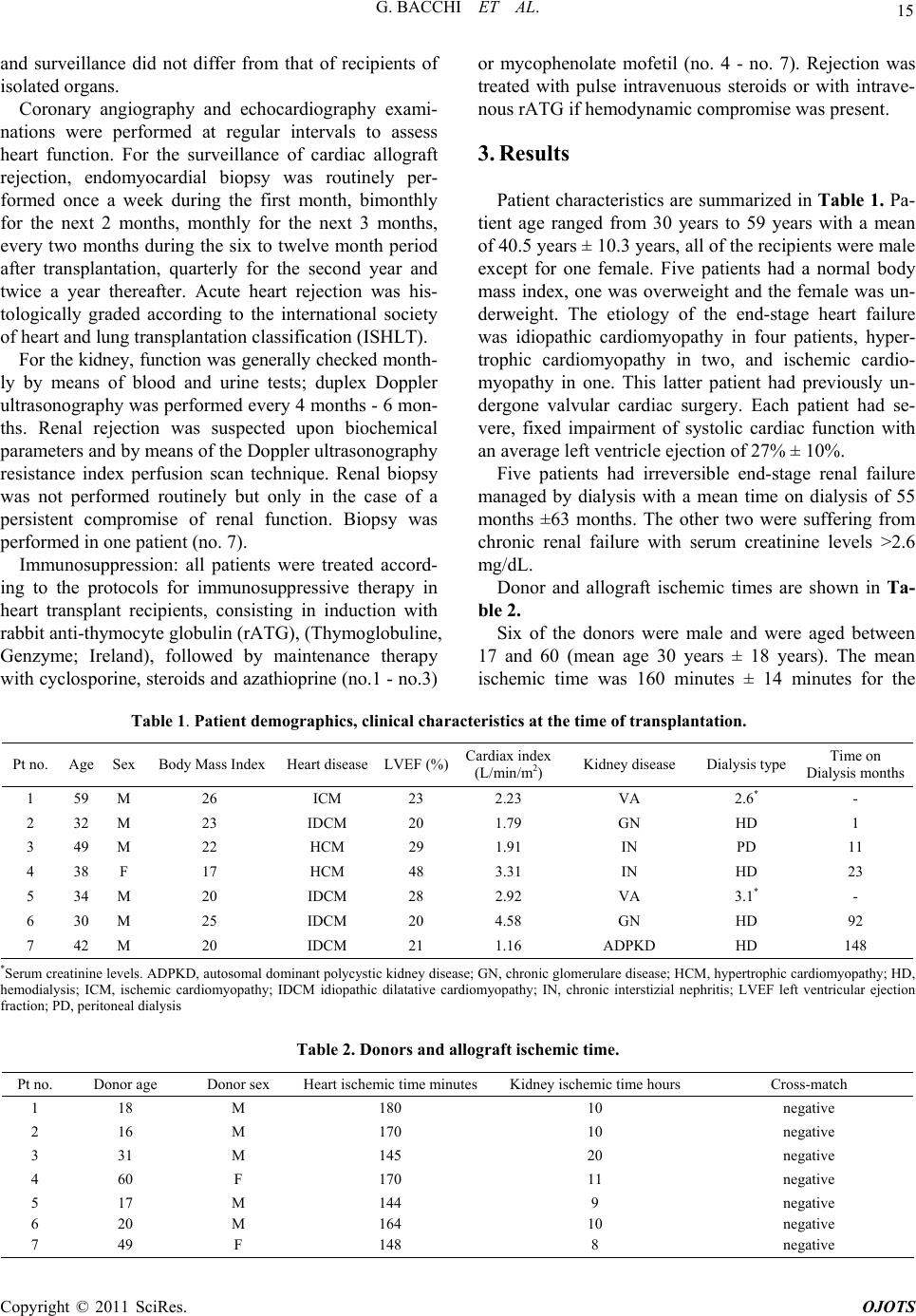 15 G. BACCHI ET AL. and surveillance did not differ from that of recipients of isolated organs. Coronary angiography and echocardiography exami- nations were performed at regular intervals to assess heart function. For the surveillance of cardiac allograft rejection, endomyocardial biopsy was routinely per- formed once a week during the first month, bimonthly for the next 2 months, monthly for the next 3 months, every two months during the six to twelve month period after transplantation, quarterly for the second year and twice a year thereafter. Acute heart rejection was his- tologically graded according to the international society of heart and lung transplantation classification (ISHLT). For the kidney, function was generally checked month - ly by means of blood and urine tests; duplex Doppler ultrasonography was performed every 4 months - 6 mon- ths. Renal rejection was suspected upon biochemical parameters and by means of the Doppler ultrasonogr aphy resistance index perfusion scan technique. Renal biopsy was not performed routinely but only in the case of a persistent compromise of renal function. Biopsy was performe d in one pat i e nt (no. 7). Immunosuppression: all patients were treated accord- ing to the protocols for immunosuppressive therapy in heart transplant recipients, consisting in induction with rabbit anti-thymocyte globulin (rATG), (Thy moglobu lin e, Genzyme; Ireland), followed by maintenance therapy with cyclosporine, steroids and azathioprine (no.1 - no.3) or mycophenolate mofetil (no. 4 - no. 7). Rejection was treated with pulse intravenuous steroids or with intrave- nous rATG if hemodynamic compromise was present. 3. Results Patient characteristics are summarized in Table 1. Pa- tient age ranged from 30 years to 59 years with a mean of 40.5 years ± 10.3 years, all of the recipients were male except for one female. Five patients had a normal body mass index, one was overweight and the female was un- derweight. The etiology of the end-stage heart failure was idiopathic cardiomyopathy in four patients, hyper- trophic cardiomyopathy in two, and ischemic cardio- myopathy in one. This latter patient had previously un- dergone valvular cardiac surgery. Each patient had se- vere, fixed impairment of systolic cardiac function with an average left ventricle ejection of 27% ± 10%. Five patients had irreversible end-stage renal failure managed by dialysis with a mean time on dialysis of 55 months ±63 months. The other two were suffering from chronic renal failure with serum creatinine levels >2.6 mg/dL. Donor and allograft ischemic times are shown in Ta- ble 2. Six of the donors were male and were aged between 17 and 60 (mean age 30 years ± 18 years). The mean ischemic time was 160 minutes ± 14 minutes for the Table 1. Patient demographics, clinical characteristics at the time of transplantation. Pt no. Age Sex Body Mass Index Heart diseaseLVEF (%)Cardiax index (L/min/m2) Kidney disease Dialysis type Time on Dialysis months 1 59 M 26 ICM 23 2.23 VA 2.6* - 2 32 M 23 IDCM 20 1.79 GN HD 1 3 49 M 22 HCM 29 1.91 IN PD 11 4 38 F 17 HCM 48 3.31 IN HD 23 5 34 M 20 IDCM 28 2.92 VA 3.1* - 6 30 M 25 IDCM 20 4.58 GN HD 92 7 42 M 20 IDCM 21 1.16 ADPKD HD 148 *Serum creatinine levels. ADPKD, autosomal dominant polycystic kidney disease; GN, chronic glomerulare disease; HCM, hypertrophic cardiomyopathy; HD, hemodialysis; ICM, ischemic cardiomyopathy; IDCM idiopathic dilatative cardiomyopathy; IN, chronic interstizial nephritis; LVEF left ventricular ejection fraction; PD, peritoneal dialysis Table 2. Donors and allograft ischemic time. Pt no. Donor age Donor sex Heart ischemic time minut e sKidney ischemic time hours Cross-mat c h 1 18 M 180 10 negative 2 16 M 170 10 negative 3 31 M 145 20 negative 4 60 F 170 11 negative 5 17 M 144 9 negative 6 20 M 164 10 negative 7 49 F 148 8 negative Copyright © 2011 SciRes. OJOTS 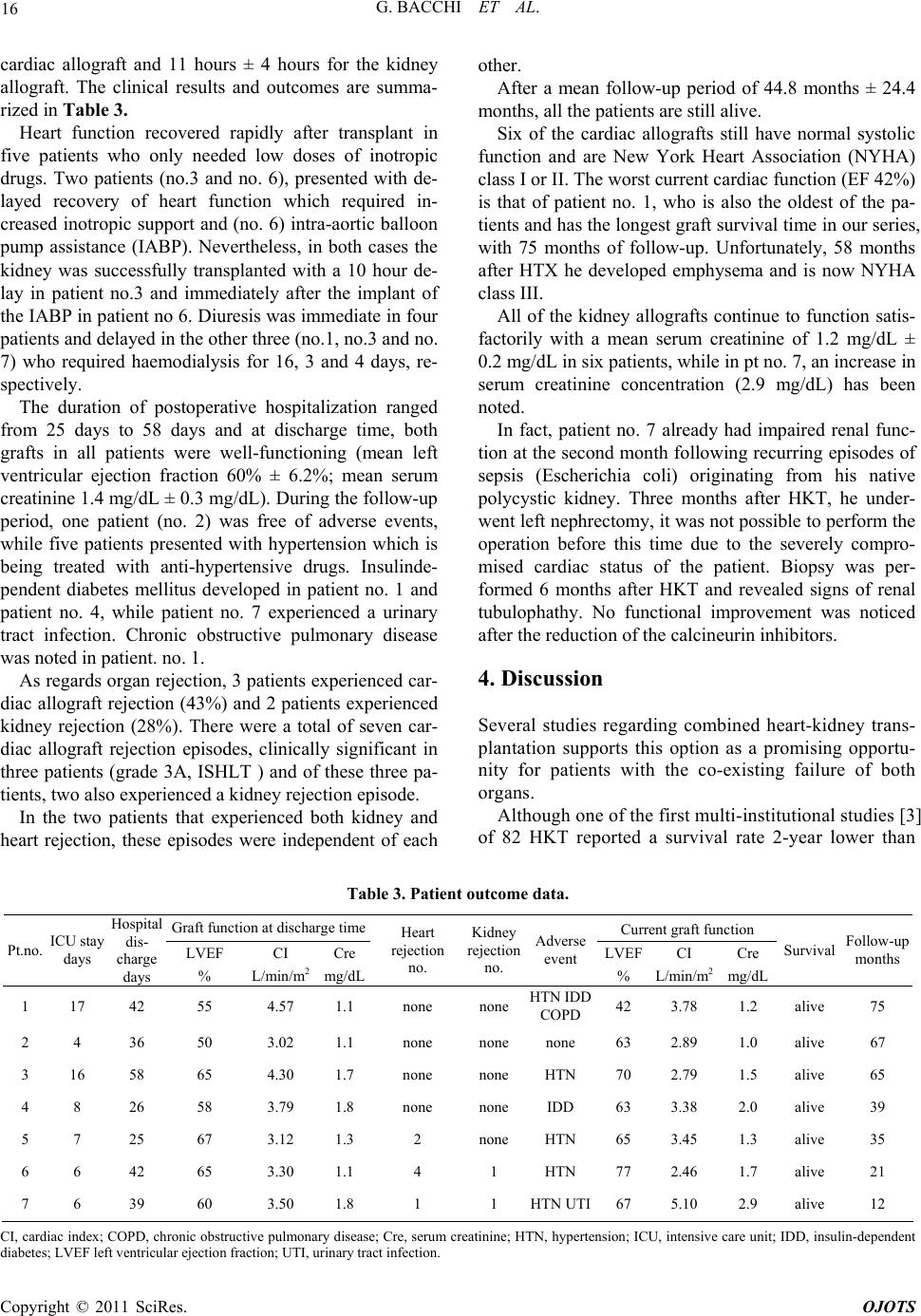 G. BACCHI ET AL. 16 cardiac allograft and 11 hours ± 4 hours for the kidney allograft. The clinical results and outcomes are summa- rized in Table 3. Heart function recovered rapidly after transplant in five patients who only needed low doses of inotropic drugs. Two patients (no.3 and no. 6), presented with de- layed recovery of heart function which required in- creased inotropic support and (no. 6) intra-aortic balloon pump assistance (IABP). Nevertheless, in both cases the kidney was successfully transplanted with a 10 hour de- lay in patient no.3 and immediately after the implant of the IABP in patient no 6. Diuresis was immediate in four patients and delayed in the other three (no.1, no.3 and no. 7) who required haemodialysis for 16, 3 and 4 days, re- spectively. The duration of postoperative hospitalization ranged from 25 days to 58 days and at discharge time, both grafts in all patients were well-functioning (mean left ventricular ejection fraction 60% ± 6.2%; mean serum creatinine 1.4 mg/dL ± 0.3 mg/dL). During the follow-up period, one patient (no. 2) was free of adverse events, while five patients presented with hypertension which is being treated with anti-hypertensive drugs. Insulinde- pendent diabetes mellitus developed in patient no. 1 and patient no. 4, while patient no. 7 experienced a urinary tract infection. Chronic obstructive pulmonary disease was noted in patient. no. 1. As regards organ rejection, 3 patients experienced car- diac allograft rejection (43%) and 2 patients experienced kidney rejection (28%). There were a total of seven car- diac allograft rejection episodes, clinically significant in three patients (grade 3A, ISHLT ) and of these three pa- tients, two also experienced a kidney rejection episode. In the two patients that experienced both kidney and heart rejection, these episodes were independent of each other. After a mean follow-up period of 44.8 months ± 24.4 months, all the patients are still alive. Six of the cardiac allografts still have normal systolic function and are New York Heart Association (NYHA) class I or II. The worst current cardiac function (EF 42%) is that of patient no. 1, who is also the oldest of the pa- tients and has the longest graft surv ival time in our series, with 75 months of follow-up. Unfortunately, 58 months after HTX he developed emphysema and is now NYHA class III. All of the kidney allografts continue to function satis- factorily with a mean serum creatinine of 1.2 mg/dL ± 0.2 mg/dL in six patients, while in pt no. 7, an increase in serum creatinine concentration (2.9 mg/dL) has been noted. In fact, patient no. 7 already had impaired renal func- tion at the second month following r ecurring episodes of sepsis (Escherichia coli) originating from his native polycystic kidney. Three months after HKT, he under- went left nephrectomy, it was not possible to perform the operation before this time due to the severely compro- mised cardiac status of the patient. Biopsy was per- formed 6 months after HKT and revealed signs of renal tubulophathy. No functional improvement was noticed after the reduction of the calcine urin inhibitors. 4. Discussion Several studies regarding combined heart-kidney trans- plantation supports this option as a promising opportu- nity for patients with the co-existing failure of both organs. Although one of the first multi-institutional studies [3] of 82 HKT reported a survival rate 2-year lower than Table 3. Patient outcome data. Graft function at discharge timeCurrent graf t function Pt.no. ICU stay days Hospital dis- charge days LVEF % CI L/min/m2 Cre mg/dL Heart rejection no. Kidney rejection no. Adverse event LVEF % CI L/min/m2 Cre mg/dL Survival Follow-up months 1 17 42 55 4.57 1.1 none noneHTN IDD COPD 42 3.78 1.2 alive 75 2 4 36 50 3.02 1.1 none nonenone 63 2.89 1.0 alive 67 3 16 58 65 4.30 1.7 none noneHTN 70 2.79 1.5 alive 65 4 8 26 58 3.79 1.8 none none IDD 63 3.38 2.0 alive 39 5 7 25 67 3.12 1.3 2 noneHTN 65 3.45 1.3 alive 35 6 6 42 65 3.30 1.1 4 1 HTN 77 2.46 1.7 alive 21 7 6 39 60 3.50 1.8 1 1 HTN UTI67 5.10 2.9 alive 12 CI, cardiac i ndex; COPD, chronic obs tructive pul monary disease; Cr e, serum creati nine; HTN, h ypertension; ICU, intensiv e care unit; IDD, insulin-dependent diabetes; LVEF left ventricular ejection fraction; UTI, urinary tract infection. Copyright © 2011 SciRes. OJOTS  17 G. BACCHI ET AL. that of isolated heart transplant recipients, according to the UNOS database, this difference was not statistically significant; several more recent studies from single centres with a low number of cases have yielded en- couraging results, both in terms of long-term graft function and patient survival [4-7]. Moreover, in a recent analysis Russo et al [8], refer- ring also to the UNOS database, found that low risk patients with an estimated filtration rate of less than 33 mL/min gained a survival benefit from HKT over heart transplantation alone. In our experience with 7 patients who have under- gone HKT with single donor allografts all patient are alive at a mean follow-up of 45 months ± 24 months (range, 75 months - 12 months) which supports the sat- isfactory results of this procedure. Some advantages can be noted in using the same do- nor and a single operative session for both organs. Firstly the recipients have a single exposure to alloan- tigen avoiding further antigenic stimulation. Secondly, they have a single induction immunosuppressive treat- ment and, thirdly, when the surgical procedure is car- ried out in the same surgical session they avoid a sub- sequent anaesthesia and also the cold renal storage is reduced. Some authors [6,9] have stated a preference for a staged approach involving a later second operative procedure. However, in the experience of kidney trans- plantation, prolonged cold ischemic time (CIT) is a well-known risk factor for delayed graft function [10] which is itself associated to lower graft function and graft survival rate in the long term [11]. In our experience, except for one staged procedure which was necessary due to instable hemodynamic conditions, all kidneys were immediately implanted after the closure of the chest allowing for a CIT of no longer than 10 hours. Of note, many studies describe a low rate of rejection in HKT [3,6,9] which is in accordance with another recent analysis from UNOS clinical data [12] that showed that both kidney and heart allograft rejections are reduced when compared with each respective al- lograft alone (17% vs 24%, p < 0.001 and 26% vs 52%, p < 0.001; respectively). More generally they found that the heart liver and kidney allografts are themselves protected from rejection and that they protect the other organ when transplanted from the same donor. It ap- pears that any organ transplant combination may induce tolerance or reduce host immunor esponsiveness, but the mechanisms of this immune event in human patients are not clearly understood even if various hypotheses have been suggested [3,13,14]. In our study population, four out of seven patients had no acute rejection episode of either organ and no simultaneous rejection was noted. Despite the limited data we have, this supports the fact that simultaneous rejection is rare in HKT [15] thus suggesting that sur- veillance of both organs is advisable and could be car- ried out separately for each transplanted organ. Despite the good clinical HKT results, the use for two organs for one patient of such a scarcity of donors may represent an ethical dilemma. We believe that this issue can be at least partially settled with an optimal candidate selection that is guided by the indications for heart transplantation, viewing the combined kidney transplant as a possibility to remove a contraindication to heart transplant alone. Of note, as opposed to end-stage kidney disease that can be artificially treated with long-term dialysis, no mechanical device is cur- rently represent a valuable option as a substitute for heart transplantation for resolving end stage heart fail- ure. Thus, heart transplantation may be the only life- saving option in patients with end stage heart failure that additionally suffer from end-stage kidney disease. On the other hand, we do not believe that HKT should be an option permitting kidney transplant in patients with end-stage kidney disease and severe but non- symptomatic heart disease, because heart transplant is not proven to improve survival in these patients as compared with optimal medical treatment for heart failure [16]. Our current policy is to consider HKT in patients with an indication for heart transplant, a low comorbidity profile, and a creatinine clearance of less than 30 mL/min due to parenchyma kidney disease [17], (i.e. excluding patients with renal insufficiency secon- dary to lo w-c ard iac ou tpu t alon e). In conclusion, our results support the previously re- ported data about HKT, suggesting that this procedure has become a valuable option for selected patients needing a heart transplant with concurrent severe renal failure. Donor scarcity underlines the need for a careful and stringent selection of candidate patients in order to optimize the best outcome for both organs. 5. References [1] J. Norman, D. Cooley, B., Kahan, et al., “Total Support of the Circulation of a Patient with Post-Cardiotomy Stone-Heart Syndrome by a Partial Artificial Heart (ALVAD) for 5 Days Followed by Heart and Kidney Transplantation,” Lancet, Vol. 1, No. 8074 , 1978, pp. 1125-1127. doi:10.1016/S0140-6736(78)90301-X [2] S. Livesey, K. Rolles, R. Calne, J. Wallwork and T. A. H. English, “Successful Simultaneous Heart and Kidney Transplantation Using the Same Donor,” Clinical Trans- plantation, Vol. 2, 1988, pp. 1-4. [3] J. Narula, L. E. Bennett, T. DiSalvo, J. D. Hosenpud, M. J. Semigran and G. W. Dec, “Outcomes in Recipients of Copyright © 2011 SciRes. OJOTS  G. BACCHI ET AL. 18 Combined Heart-Kidney Transplantation: Multiorgan, Same-Donor Transplant Study of the International Soci- ety of Heart and Lung Transplantation/United Network for Organ Sharing Scientific Registry,” Transplantation, Vol. 63, No. 6, 1997, pp. 861-867. doi:10.1097/00007890-199703270-00012 [4] G. D. Trachiotis, J. D. Vega, T. S. Johnston, et al., “Ten- Year Follow-up in Patients with Combined Heart and Kkidney Transplantation,” Journal of Thoracic and Car- diovascular Surgery, Vol. 126, No. 6, 2003, pp. 2065- 2071. doi:10.1016/j.jtcvs.2003.07.009 [5] S. S. Wang, N. K. Chou, N. H. Chi, et. al., “Simultaneous Heart and Kidney Transplantation for Combined Cardiac and Renal Failure,” Transplantation Proceedings, Vol. 38, No. 7, 2006, pp. 2135-2137. doi:10.1016/j.transproceed.2006.06.002 [6] J. L. Hermsen, D. S. Nath, A. M. del Rio, J. B. Eickstaedt, C. Wigfield, J. D. Lindsey and N. M. Edwards, “Com- bined Heart-Kidney Transplantation: The University of Wisconsin Experience,” Journal of Heart and Lung Transplantation, Vol. 26, No. 11, 2007; pp. 1119-1126. doi:10.1016/j.healun.2007.08.011 [7] G. Bruschi, L. Botta, T. Colombo, et al., “Combined Heart and Kidney Transplantation: Long-Term Analysis of Renal Function and Major Adverse Events at 20 Years,” Transplantation Procee dings, Vol. 42, No. 4, 2010, pp. 1283-1285. doi:10.1016/j.transproceed.2010.03.064 [8] M. J. Russo, A. Rana, J. M. Chen, et al., “Pretransplanta - tion Patient Characteristics and Survival Following Com- bined Heart and Kidney Transplantation,” Archives of Surgery, Vol. 144, No. 3, 2009, pp. 241-246. doi:10.1001/archsurg.2008.559 [9] C. Blanche, A. Kamlot, D. A. Blanche, B. Kearney, A. V. Wong, L. S. Czer and A. Trento, “Combined Heart-Kid- ney Transplantation with Single-Donor Allografts,” Jour- nal of Thoracic and Cardiovascular Surgery, Vol. 122, No. 3, 2001, pp. 495-500. doi:10.1067/mtc.2001.115700 [10] W. D. Irish, D. A. McCollum, R. J. Tesi, et al., “Nomo- gram for Predicting the Likelihood of Delayed Graft Function in Adult Cadaveric Renal Transplant Recipi- ents,” Journal of the American Society of Nephrology, Vol. 14, No. 11, 2003, pp. 2967-2974. doi:10.1097/01.ASN.0000093254.31868.85 [11] S. G. Yarlagadda, S. G. Coca, R. N. Formica Jr, E. D. Poggio and C. R. Parikh, “Association between Delayed Graft Function and Allograft and Patient Survival: A Systematic Review and Meta-Analysis,” Nephrology Di- alysis Transplantation, Vol. 24, No. 3, 2009, pp. 1039- 1047. doi:10.1093/ndt/gfn667 [12] A. Rana, S. Robles, M. J. Russo, et al., “The Combined Organ Effect: Protection against Rejection?” Annals of Surgery, Vol. 248, No. 5, 2008, pp. 871-879. doi:10.1097/SLA.0b013e31817fc2b8 [13] T. E. Starzl, A. J. Demetris, N. Murase, et al., “Chimer- ism after Organ Transplantation,” Current Opinion in Nephrology and Hypertension, Vol. 6, No. 3, 1997, pp. 292-298. doi:10.1097/00041552-199705000-00015 [14] N. Perico and G. Remuzzi, “Acquired Transplant Toler- ance,” International Journal of Clinical and Laboratory Research, Vol. 27, No. 3, 1997, pp. 165-177. doi:10.1007/BF02912453 [15] J. A. Castillo-Lugo and K. R. Brinker, “An Overview of Combined Heart and Kidney Transplantation,” Current Opinion in Cardiolog, Vol. 14, No. 2, 1999, pp. 121-125. doi:10.1097/00001573-199903000-00008 [16] N. R. Banner, C. A. Rogers and R. S. Bonser, United Kingdom Cardiothoracic Transplant Audit Steering Group, “Effect of Heart Transplantation on Survival in Ambulatory and Decompensated Heart Dailure,” Trans- plantation, Vol. 86, No. 11, 2008, pp. 1515-1522. doi:10.1097/TP.0b013e31818b3328 [17] G. Mosconi, L. Panicali, E. Persici, et al., “Native Kidney Function after Renal Transplantation Combined with Other Solid Organs in Preemptive Patients,” Transplan- tation Proceedings , Vol. 42, No. 4, 2010, pp. 1017-1020. doi:10.1016/j.transproceed.2010.03.125 Copyright © 2011 SciRes. OJOTS |