

Paper Menu >>
Journal Menu >>
 Vol.1, No.3, 73-76 (2011) http://dx.doi.org/10.4236/oje.2011.13010 Open Journal of Ecology C opyright © 2011 SciRes. OPEN ACCESS Preliminary molecular variability among haplotypes of Saudi Arabian house sparrow Passer domesticus Sayed A. M. Amer1,2*, Metwally M. Montaser1,3, Mohammed Shobrak1 1Faculty of Science, Taif University, Taif, Kingdom of Saudi Arabia; *Corresponding Author: [email protected] 2Department of Zoology, Faculty of Science, Cairo University, Giza, Egypt; 3Department of Zoology, Faculty of Science, Al-Azhar Uni ver sity, Cairo, Egypt. Received 22 September 2011; revised 20 October 2011; accepted 30 October 2011. ABSTRACT Genetic variability of Passer domesticus from different localities of Saudi Arabia was investi- gated. Six hundred and fifty nine nucleotides were sequenced from the mitochondrial cyto- chrome b gene. There was a slight difference among the studied haplotypes and most substi- tutions were synonymous. In some haplotypes at the west of Arabian Peninsula (mountainous habitat), two transitions only were non-synony- mous. The data were used to construct the rela- tionship of the Arabian house sparrow to its con specific taxa from Europe and America. Neigh- bor-joining (NJ), maximum-parsimony (MP) and maximum-likelihood (ML) analytical methods were used. The three methods showed cluster- ing of the Arabian haplotypes in one group and their sister relationship with the haplotypes fr- om Netherlands and America. A spanish haplo- type came basal to both groups. Collecting more samples and more DNA data could be of necessary to clearly address the genetic vari- ability of this rapidly propagated species in Ara- bia. Keyw ords: Saudi Arabia; House Sparrow; Mitochondrial DNA; Genetic Variability 1. INTRODUCTION The house sparrow, Passer domesticus is distributed in Europe, Nor t h Af ri ca and p a rts of Asia such as Middle East, Indian subcontinent and a narrowing band from northern Asia toward the Pacific coast. Its large-scale spread includes North and South America, South Africa, Australia and New Zealand [1-3]. The genetic diversity among the avian fauna is found to be low, probab ly due largely to the greater mobility of birds, resulting in higher levels of gene flow [4]. There have been several studies of the genetics of house spar- rows on species and population level [5-11]. Moreover, the relationships among their congeneric species and to other finches (Passeridae and New World sparrows) have been tackled molecularly, for the first time, by Allende et al. [12]. Recently, the genetic relationships among pas- serines and other related families were studied using mitochondrial and nuclear genome’s data [13]. Dor and Lotem [14] have studied the parentage of the house sparrows on a molecular basis. Quantifying and characterizing avian genetic variabil- ity should be a priority in conservation to evaluate the effect of recent drastic population changes, to preserve present-day diversity and, eventually, to provide guide- lines for future conservation plans [15]. Despite its close proximity to man, relatively little is known about the connectivity between house sparrow populations. Do the various sites that has been occupied by the species form a continuous population, or are we dealing with a more meta population type of population structure? These Conservation information should take into account kn- owledge on genetic population structure. Therefore the aim of the present study was to collect samples of the house sparrow from around the Kingdom of Saudi Ara- bia in order to sequence an orthologous gene from each of these samples. Such data could aid to understand the relatedness of these haplotypes and to get an overall pic- ture of the genetic variability of this passerine bird pro- viding guidelines for its conservation. 2. MATERIALS AND METHODS We collected 17 samples of P. domesticus from the wild of 6 localities from Saudi Arabia (Arar, Qassim, Tabuk, Al-Madina, Taif and Jazan). See Figure 1 that explains the exact localities. Blood and tissue samples have been numbered and labeled immediately in the lab and preserved in –80˚C for further molecular studies. 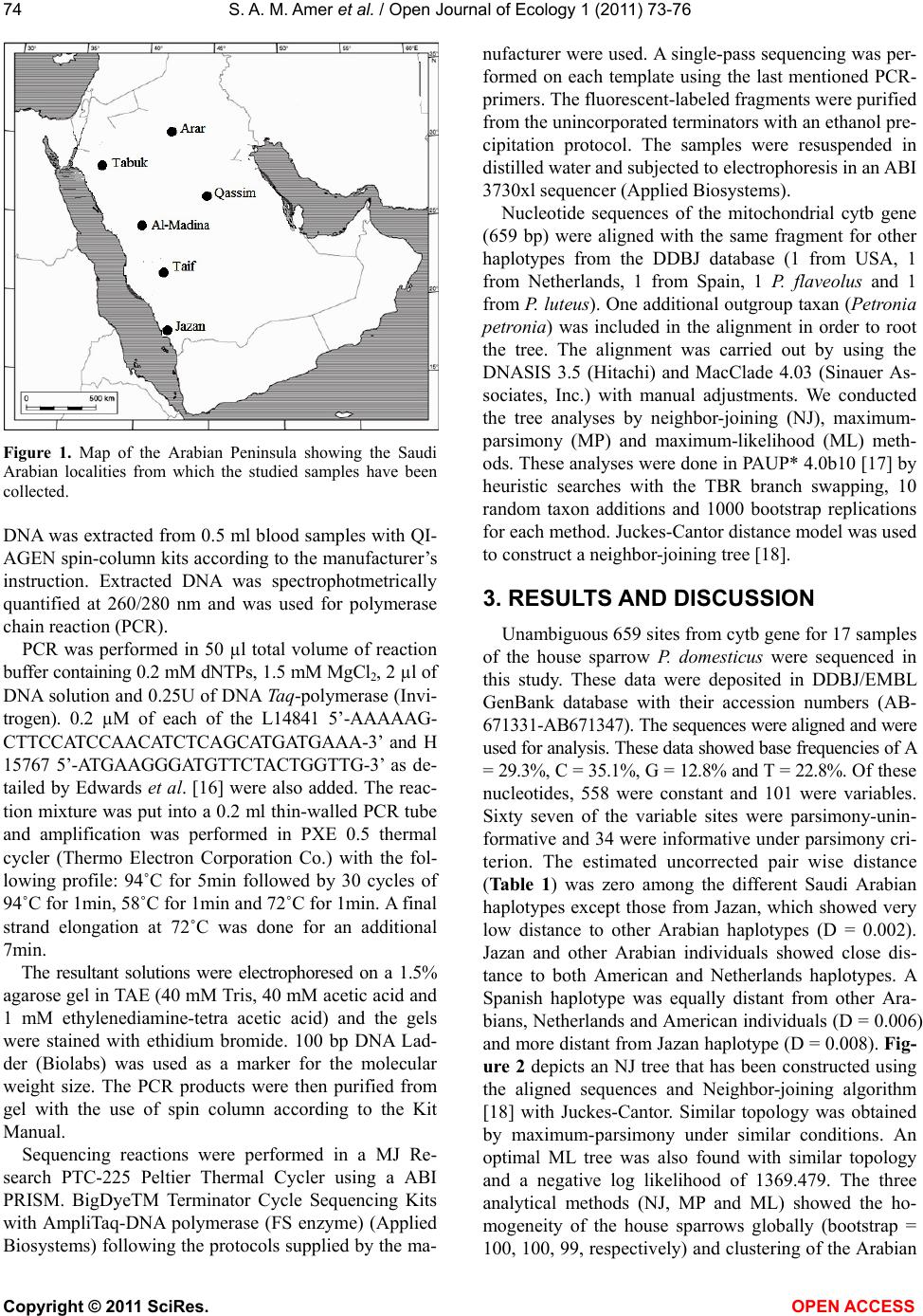 S. A. M. Amer et al. / Open Journal of Ecology 1 (2011) 73-7 6 Copyright © 2011 SciRes. OPEN ACCESS 74 Figure 1. Map of the Arabian Peninsula showing the Saudi Arabian localities from which the studied samples have been collected. DNA was extracted from 0.5 ml blood samples with QI- AGEN spin-column kits according to the manufacturer ’s instruction. Extracted DNA was spectrophotmetrically quantified at 260/280 nm and was used for polymerase chain reaction (PCR). PCR was performed in 50 µl total volume of reaction buffer containing 0.2 mM dNTPs, 1.5 mM MgCl2, 2 µl of DNA solution and 0.25U of DNA Taq-polymerase (Invi- trogen). 0.2 µM of each of the L14841 5’-AAAAAG- CTTCCATCCAACATCTCAGCATGATGAAA-3’ and H 15767 5’-ATGAAGGGATGTTCTACTGGTTG-3’ as de- tailed by Edwards et al. [16] were also added. The reac- tion mixture was put into a 0.2 ml thin-walled PCR tube and amplification was performed in PXE 0.5 thermal cycler (Thermo Electron Corporation Co.) with the fol- lowing profile: 94˚C for 5min followed by 30 cycles of 94˚C for 1min, 58˚C for 1min and 72˚C for 1min. A final strand elongation at 72˚C was done for an additional 7min. The resultant solutions were electrophoresed on a 1.5% agarose gel in TAE (40 mM Tris, 40 mM acetic acid and 1 mM ethylenediamine-tetra acetic acid) and the gels were stained with ethidium bromide. 100 bp DNA Lad- der (Biolabs) was used as a marker for the molecular weight size. The PCR products were then purified from gel with the use of spin column according to the Kit Manual. Sequencing reactions were performed in a MJ Re- search PTC-225 Peltier Thermal Cycler using a ABI PRISM. BigDyeTM Terminator Cycle Sequencing Kits with AmpliTaq-DNA polymerase (FS enzyme) (Applied Biosystems) following the protocols supplied by the ma- nufacturer were used. A single-pass sequencing was per- formed on each template using the last mentioned PCR- primers. The fluorescent-labeled fragments were purified from the unincorporated terminators with an ethanol pre- cipitation protocol. The samples were resuspended in distilled water and subjected to electrophoresis in an ABI 3730xl sequencer (Applied Biosystems). Nucleotide sequences of the mitochondrial cytb gene (659 bp) were aligned with the same fragment for other haplotypes from the DDBJ database (1 from USA, 1 from Netherlands, 1 from Spain, 1 P. flaveolus and 1 from P. luteu s). One additional outgrou p taxan (Petronia petron ia) was included in the alignment in order to root the tree. The alignment was carried out by using the DNASIS 3.5 (Hitachi) and MacClade 4.03 (Sinauer As- sociates, Inc.) with manual adjustments. We conducted the tree analyses by neighbor-joining (NJ), maximum- parsimony (MP) and maximum-likelihood (ML) meth- ods. These analyses were done in PAUP* 4.0b10 [17] by heuristic searches with the TBR branch swapping, 10 random taxon additions and 1000 bootstrap replications for each method. Juckes-Cantor distance model was used to construct a neighbor-joining tree [18]. 3. RESULTS AND DIS CUSSION Unambiguous 659 sites from cytb gene for 17 samples of the house sparrow P. domesticus were sequenced in this study. These data were deposited in DDBJ/EMBL GenBank database with their accession numbers (AB- 671331-AB671347). The sequences were aligned and wer e used for an al ysis. Thes e da ta show ed b ase fr equ encies of A = 29.3%, C = 35.1%, G = 12.8% and T = 22.8%. O f th e s e nucleotides, 558 were constant and 101 were variables. Sixty seven of the variable sites were parsimony-unin- formative and 34 were informative under parsimony cri- terion. The estimated uncorrected pair wise distance (Table 1) was zero among the different Saudi Arabian haplotypes except those from Jazan, which showed very low distance to other Arabian haplotypes (D = 0.002). Jazan and other Arabian individuals showed close dis- tance to both American and Netherlands haplotypes. A Spanish haplotype was equally distant from other Ara- bians, Netherlands and American individuals (D = 0.006) and more distant from Jazan haplotype (D = 0.008). Fig- ure 2 depicts an NJ tree that has been constructed using the aligned sequences and Neighbor-joining algorithm [18] with Juckes-Cantor. Similar topology was obtained by maximum-parsimony under similar conditions. An optimal ML tree was also found with similar topology and a negative log likelihood of 1369.479. The three analytical methods (NJ, MP and ML) showed the ho- mogeneity of the house sparrows globally (bootstrap = 100, 100, 99, respectively) and clustering of the Arabian  S. A. M. Amer et al. / Open Journal of Ecology 1 (2011) 73-7 6 Copyright © 2011 SciRes. OPEN ACCESS 7575 Ta bl e 1. Uncorrected pair wise distances determined between haplotypes from different localities. “Others” refer to all Saudi Arabian haplotypes except those from Jazan since they showed zero distance when they compared. Other localities Jazan USA Netherlands Other localities - Jazan 0.002 - USA 0.003 0.005 - Netherlands 0.003 0.005 0.000 - Spain 0.006 0.008 0.006 0.006 Jazan Taif Qassim Tabuk Al-Madina USA [AY030117] Netherlands [AY495393] Spain [AF230906] P. flaveolus [L77904] P. luteus [AY495394] Petronia petronia [AF230914] 0.005 substitutions/site Arar 96, 92 100, 100, 99 88, 77, 64 63, 72, 63 69, 72, 73House s p arro w Saudi Arabia Figure 2. Neighbor-joining tree constructed from 659 bp of cytb gene among the different studied haplotypes. The boot- strap values are showed at nodes for neighbor-joining, maxi- mum-parsimony and maximum-likelihood methods, respec- tively, when they are more than 50%. house sparrow (from different localities) in one group with the American and Netherlands sparrows (bootstrap - ping = 69, 72 and 73, respectively). The Spain sample came basal to both groups. This relationship was trust- able because of the reasonably strong statistical support. One cannot discriminate any intra-population variation for this bird in Saudi Arabia. Nucleotide substitutions are generally considered in terms of transitions and transversions. The sequenced fr- agment of cytb gene showed 24 substitutions among the different haplotypes of which two were transversions. Among these polymorphic changes, 22 were in the third position, and 2 were in the first and second po sitions an d therefore, 2 of these su bstitutions were non-synonymous and the 22 were synonymous. One of the non synony- mous changes was found in only one haplotype from Al- Madina and involved a substitution of phenylalanine with Sereine at T191 ➝ C191. The position of this ami- no acid in the frame of cytb gene is at 64. The second substitution was found in different haplotypes inhabiting Qassim, Tabuk, Jazan and Taif and showed a transition for the amino acid number 116 from valine to isoleucine at A346 ➝ G346 (Figure 3). It is notable that the non Figure 3. The aligned translated amino acids of the sequenced fragment of cytb gene for different haplotypes. The underlined letters are those amino acids with polymorphism. Note that this alignment is for the portion exhibited polymorphism (from 59 to 116). synonymous mutations were found in the samples inhab- iting the localities at the vicinity of west Saudi Arabia, which is characterized by mountainous habitat. These habitats are acquired abundance of vegetations and cha- racterized by different climate (temperature, rainfall and humidity). Further study is necessary in which more statistical packages for more samples and data should be used to relate these chang es to ecology. Due to their ability to fly, birds can move over large geographical scales, and their populations are therefore often spatially more homogeneous than in some other taxonomic groups [4,19,20] . The genetic variabili ty wit hin house sparrow populations in Saudi Arabia were in the same category as previously estimated for other areas in the world [9,11,21]. Genetic variability within its popu- lations was very limited probably due to the connection between them [1]. We found a weak differenttiation am- ong some of the population s, mainly in tho se at the west- ern edge of the Kingdom, but other areas showed no significant popu lation difference (Table 1). A ccordingly, we could not differentiate any type of clusters of indi- viduals within the collected data. Exten siv e homogeneity of populations was most likely due to populations are better connected. We, therefore, concluded that Saudi Arabian house sparrow need s collection of more samples and DNA data and manipulates these data by up to data statistical programs to address its genetic diversity. 4. ACKNOWLEDGEMENTS This work has been done under the financial support of Taif Univer-  S. A. M. Amer et al. / Open Journal of Ecology 1 (2011) 73-7 6 Copyright © 2011 SciRes. 76 sity of Kingdom of Saudi Arabia (Project number 1/432/1066). OPEN ACCESS REFERENCES [1] Kekkonen, J., Seppa, P., Hanski, I.K., Jensen, H., Vai- sanen, R.A. and Brommer, J.E. (2011) Low genetic dif- ferentiation in a sedentary bird: House sparrow popula- tion genetics in a contiguous landscape. Heredity, 106, 183-190. doi:10.1038/hdy.2010.32 [2] Summers-Smith, J.D. (1988) The Sparrows: A study of the genus passer. T and AD Poyser, Staffordshire. [3] Anderson, T.R. (2006) The ubiquitous house sparrow: From genes to populations. Oxford University Press, Ox- ford. doi:10.1093/acprof:oso/9780195304114.001.0001 [4] Barrowclough, G.F. (1983) Biochemical studies of micro- evolut ionary proc esses. In: Bru sh, A.H. a nd Clar k. J.G.A. Eds., Perspectives in ornithology, University of Cam- bridge Press, Cambridge, 223-261. [5] Fleischer, C. (1983) A comparison of theoretical and ele- ctrophoretic assessment of genetic structure in popula- tions of the house sparrow (Passer domesticus). Evolu- tion, 37, 1001-1009. doi:10.2307/2408414 [6] Parkin, D.T. and Cole, S.R. (1985) Genetic differentia- tion and rates of evolution in some populations of the house sparrow (Passer domesticus) in Australia and New Zealand. Heredity, 53, 15-23. doi:10.1038/hdy.1985.4 [7] Bjordal, H., Cole, S.R. and Parkin, D.T. (1986) Genetic differentiation among some populations of the house sparrow Passer domesticus from south-western Norway. Heriditas, 105, 107-114. d oi :1 0.1111 /j .1 601 -5223.1986.tb00648.x [8] Wetton, J.H., Parkin, T. and Carter, R.E. (1992) The use of genetic markers for parentage analysis in Passer do- mesticus (house sparrows). Heredity, 69, 243-254. doi:10.1038/hdy.1992.122 [9] Neumann, K. and Wetton, J.H. (1996) Highly polymor- phic microsatellites in the house sparrow Passer domes- ticus. Molecular Ecology, 5, 307-309. d oi :1 0.1111 /j .1 365 -294X.1996.tb00319.x [10] Griffith, S.C., Stewart, I.R.K., Dawson, D.A., Owens, I.P.F. and Burke, T. (1999) Contrasting levels of extra-pair pa- ternity in mainland and island populations of the house sparrow (Passer domesticus): Is there an “island effect”? Biological Journal of the Linnaean Society, 68, 303-316. doi:10.1006/bijl.1999.0343 [11] Griffith, S.C., Dawson, D.A., Jensen, H., Ockendon, N., Greig, C., Neumann, K. and Burke, T. (2007) Fourteen polymorphic microsatellite loci characterized in the house sparrow Passer domesticus (Passeridae, Aves). Molecu- lar Ecology, 7, 333-336. [12] Allende, L.M., Ruboi, I., Guillén, J., Ruiz-del-Valle, V., Guillen, J., Martinez-Laso, J. and Lowy, E. (2001) The old world sparrows (Genus Passer): Phylogeography and their relative abundance of nuclear mtDNA pseudogenes. Journal of Molecular Evolution, 53, 144-154. [13] Va n der Meij, M.A.A., de Bakker, M.A.G. and Bout, R.G. (2005) Phylogenetic relationships of finches and allies based on nuclear and mitochondrial DNA. Molecular Phylogenetics and Evolution, 34, 97-105. doi:10.1016/j.ympev.2004.09.006 [14] Dor, R. and Lotem, A. (2009) Heritability of nestling begging intensity in the house sparrow (Passer domesti- cus). Evolution, 63, 738-748. d oi :1 0.1111 /j .1 558 -5646.2008.00598.x [15] Negro, J.J. and Torres, M.J. (1999) Genetic variability and differentiation of two bearded vulture Gypaetus bar- batus populations and implications for reintroduction pro- jects. Biological Conservation, 87, 249-254. doi:10.1016/S0006-3207(98)00056-1 [16] Edwards, S.V. , Arctander, P. and Wilson, A.C. (1991) Mi- tochondrial resolution of a deep branch in the genealogi- cal tree for perching birds. Proceedings: Biological Sci- ences, 243, 99-107. doi:10.1098/rspb.1991.0017 [17] Swofford, D.L. (2002) PAUP*. Phylogenetic analysis us- ing parsimony (*and Other Methods). 4th Edition, Sun- der-land, Sinauer. [18] Saitou, N. and Nei, M. (1987) The neighbor-joining me- thod: A new method for reconstructing phylogenetic trees. Molecular Biology and Evolution, 4, 406-425. [19] Evans, P.G.H. (1987) Electrophoretic variability of gene products. In: Cooke, F. and Buckley, P.A. Eds., Av ian ge - netics: A population and ecological approach, Academic Press, London, 105-162. [20] Ward, R.D., Skibinski, D.O.F. and Woodwark, M. (1992) Protein heterozygosity, protein structure, and taxonomic differentiation. Evolutionary Biology, 26, 73-159. doi:10.1007/978-1-4615-3336-8_3 [21] Garnier, S., Durand, P., Arnathau, C., Risterucci, A.M., Es- parza-Salas, R., Cellier-Holzem, E. and Sorci, G. (2009) New polymorphic microsatellite loci in the house spar- row, Passer dome sticus. Molecular Ecology Resources, 9, 1063-1065. d oi :10 .1111 /j. 1755-0998.2009.02552.x |