

Paper Menu >>
Journal Menu >>
 Vol.1, No.3, 63-64 (2011) http://dx.doi.org/10.4236/oje.2011.13008 Open Journ al of Ecology C opyright © 2011 SciRes. OPEN ACCESS The effect of water-level fluctuations on swamp forest colonization by seedlings of Tabebuia cassinoides DC. (Bignoniaceae) Pablo José Francisco Pena Rodrigues*, Mariana de Andrade Iguatemy Instituto de Pesquisas, Jardim Botânico do Rio de Janeiro, Rio de Janeiro, Brazil; *Cor responding Aut hor: [email protected] Received 14 September 2011; revised 14 October 2011; accepted 27 October 2011. ABSTRACT Establishment of Tabebuia cassinoides seed- lings is related to water-level fluctuations in southeastern Brazil swamp forests. Nine years of annual monitoring of 48 individuals establish- ed during a drought in November 1997, when the sw amp was unflooded, suggested that their establishment depends on this unpredictable event. This conclusion is further sustained by the wide variability of the seedling cohort size structure, and the fascicular root conformation that holds the shoots erect. Keywords: Tropical Rain Forest; Wetland; Seedling Establishment; Safe Site; Root Morphology Germination and seedling establishment in wetlands are poorly understood [1], and in most cases involve adaptations to survive oxygen deprivation [2,3]. There- fore, flooding is the main cause of low frequency of ger- mination [4]. Seed buoyancy and long-term dormancy are often listed as important traits that allow seed s to sur- vive and/or reach safe sites [5,6] that are crucial for their development. Even understory forest plants can serve as safe sites. For instance, the Brazilian swamp forest tree Tabebuia cassinoides DC. (Bignoniaceae) germinates inside the tanks of the understory bromeliad Nidularium procerum Lindm [7]. However, not all swamps in southeastern Brazil have understory bromeliads, and young T. cassi- noides seedlings are flood-intolerant. Therefore, althou- gh asexual reproduction has been reported as an impor- tant characteristic of this species [7], other seed-estab- lishment strategies must operate, to account for the high abundance of this species in most Brazilian swamps [8], even if we consider that only a small fraction of the seeds produced will survive to maturity [9]. In November 1997, a severe drough t occurred dur ing the rainy season in a swamp forest of the Parque Estadual da Serra do Mar, Núcleo Picinguaba (23˚21'S, 44˚51'W), São Paulo state, southeastern Brazil. This swamp did not have a dense bromeliad understory. Therefore, it provided a good location to test the hypothesis that in these types of swamp forest, seedling establishment of this species occurs in years when the water table recedes. On this occasion, 48 newly germinated seedlings of an unflood- ed cohort of T. cassinoides were chosen at random and tagged. At the unflooded site we also observed the estab- lishment of many terrestrial herbs. From November 1997 to December 2006 the seedlings were monitored annual- ly for mortality, and beginning in 2000 they were meas- ured for height and basal diameter. From 1998 to 2006 the site was continuou sly flood ed (ca. 40 cm d epth) . Bet- ween 1998 and 2002, mean annual mortality was only 6.06 percent (±1.59). Simultaneously, herb density de- clined drastically (pers. ob s.). Finally, dur ing 2002-2003, 28 percent of the cohort died and a total of 26 individu- als remained alive (Table 1). Although this deciduous tree flowered and set seeds every year (between August and November), no new seedlings became established at this site. This could be due to intolerance of the seeds or seedlings to permanent flooding, or to transport of seeds to other sites by water. Therefore, low water levels may favor species germina- tion, as shown in Chinese wetlands [10]. Height and basal diameter of cohort members showed wide variation from November 2000 to December 2006 (Table 1), and diameter was always closely correlated to height (r2 > 0.89; Ta b l e 1 ). The cohort density stability indicated no density-dependent or size-dependent morta- lity patterns. The fascicular root morphology of the saplings seems to hold the shoots erect, which might be important for fixation or for maintenance of a larger flood-free surface area of the shoots, as is important for internal aeration [11]. Therefore, the onset of root fixation in unflooded soil conditions, allowing substrate trapping, may be cru- 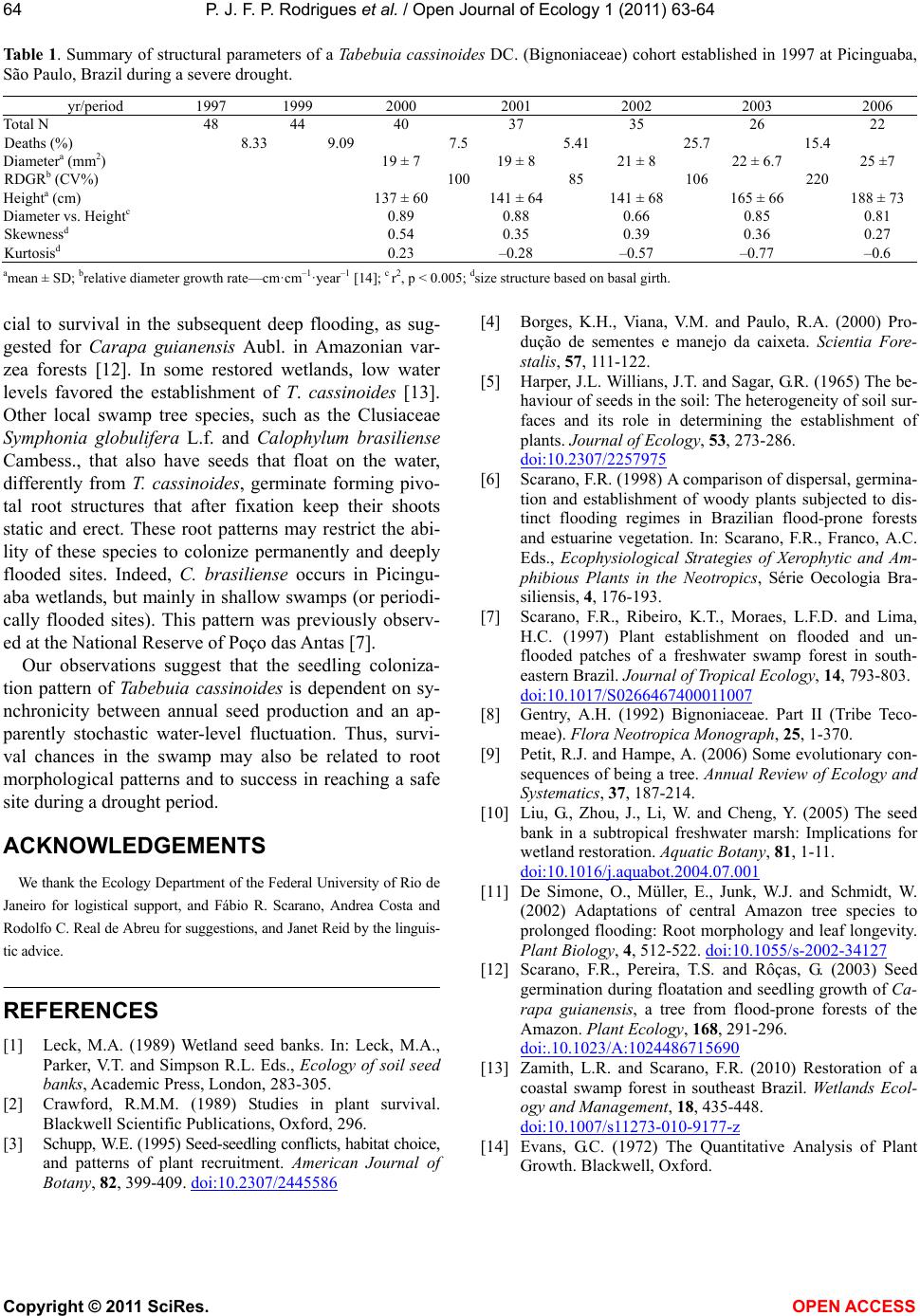 P. J. F. P. Rodrigues et al. / Open Journal of Ecology 1 (2011) 63-64 Copyright © 2011 SciRes. OPEN ACCESS 64 Tab le 1. Summary of structural parameters of a Tabebuia cassinoides DC. (Bignoniaceae) cohort established in 1997 at Picinguaba, São Paulo, Brazil during a severe drought. yr/period 1997 1999 2000 2001 2002 2003 2006 Total N 48 44 40 37 35 26 22 Deaths (%) 8.33 9.09 7.5 5.41 25.7 15.4 Diametera (mm2) 19 ± 7 19 ± 8 21 ± 8 22 ± 6.7 25 ±7 RDGRb (CV%) 100 85 106 220 Heighta (cm) 137 ± 60 141 ± 64 141 ± 68 165 ± 66 188 ± 73 Diameter vs. Heightc 0.89 0.88 0.66 0.85 0.81 Skewnessd 0.54 0.35 0.39 0.36 0.27 Kurtosisd 0.23 –0.28 –0.57 –0.77 –0.6 amean ± SD; brelative diameter growth rate—cm·cm–1·year–1 [14]; c r2, p < 0.005; dsize str u cture based on basal girth. cial to survival in the subsequent deep flooding, as sug- gested for Carapa guianensis Aubl. in Amazonian var- zea forests [12]. In some restored wetlands, low water levels favored the establishment of T. cassinoides [13]. Other local swamp tree species, such as the Clusiaceae Symphonia globulifera L.f. and Calophylum brasiliense Cambess., that also have seeds that float on the water, differently from T. cassinoides, germinate forming pivo- tal root structures that after fixation keep their shoots static and erect. These root patterns may restrict the abi- lity of these species to colonize permanently and deeply flooded sites. Indeed, C. brasiliense occurs in Picingu- aba wetlands, but mainly in shallow swamps (or periodi- cally flooded sites). This pattern was previously observ- ed at the National Reserve of Poç o das Antas [7]. Our observations suggest that the seedling coloniza- tion pattern of Tabebuia cassinoides is dependent on sy- nchronicity between annual seed production and an ap- parently stochastic water-level fluctuation. Thus, survi- val chances in the swamp may also be related to root morphological patterns and to success in reaching a safe site during a drought period . ACKNOWLEDGEMENTS We thank th e Ecology Department of the Federal Univ ersity of Rio de Janeiro for logistical support, and Fábio R. Scarano, Andrea Costa and Rodolfo C. Real de Abreu for sugg estions, and Janet R eid by the linguis - tic advice. REFERENCES [1] Leck, M.A. (1989) Wetland seed banks. In: Leck, M.A., Parker, V.T. and Simpson R.L. Eds., Ecology of soil seed banks, Academic Press, London, 283-305. [2] Crawford, R.M.M. (1989) Studies in plant survival. Blackwell Scientific Publications, Oxford, 296. [3] Schupp, W.E. (1995) See d-seedling conf licts, habita t choice, and patterns of plant recruitment. American Journal of Botany, 82, 399-409. doi:10.2307/2445586 [4] Borges, K.H., Viana, V.M. and Paulo, R.A. (2000) Pro- dução de sementes e manejo da caixeta. Scientia Fore- stalis, 57, 111-122. [5] Harper, J.L. Willians, J.T. and Sagar, G.R. (1965) The be- haviour of seeds in the soil: The heterogeneity of soil sur- faces and its role in determining the establishment of plants. Journal of Ecology, 53, 273-286. doi:10.2307/2257975 [6] Scarano, F.R. (1998) A comparison of dispersal, germina- tion and establishment of woody plants subjected to dis- tinct flooding regimes in Brazilian flood-prone forests and estuarine vegetation. In: Scarano, F.R., Franco, A.C. Eds., Ecophysiological Strategies of Xerophytic and Am- phibious Plants in the Neotropics, Série Oecologia Bra- siliensis, 4, 176-193. [7] Scarano, F.R., Ribeiro, K.T., Moraes, L.F.D. and Lima, H.C. (1997) Plant establishment on flooded and un- flooded patches of a freshwater swamp forest in south- eastern Brazil. Journal of Tropical Ecology, 14, 793-803. doi:10.1017/S0266467400011007 [8] Gentry, A.H. (1992) Bignoniaceae. Part II (Tribe Teco- meae). Flora Neotropica Monograph, 25, 1-370. [9] Petit, R.J. and Hampe, A. (2006) Some evolutionary con- sequences of being a tree. Annual Review of Ecology and Systematics, 37, 187-214. [10] Liu, G., Zhou, J., Li, W. and Cheng, Y. (2005) The seed bank in a subtropical freshwater marsh: Implications for wetland restoration. Aquatic Botany, 81, 1-11. doi:10.1016/j.aquabot.2004.07.001 [11] De Simone, O., Müller, E., Junk, W.J. and Schmidt, W. (2002) Adaptations of central Amazon tree species to prolonged flooding: Root morphology and leaf longevity. Plant Biology, 4, 512-522. doi:10.1055/s-2002-34127 [12] Scarano, F.R., Pereira, T.S. and Rôças, G. (2003) Seed germination during floatation and seedling growth of Ca- rapa guianensis, a tree from flood-prone forests of the Amazon. Plant Ecology, 168, 291-296. doi:.10.1023/A:1024486715690 [13] Zamith, L.R. and Scarano, F.R. (2010) Restoration of a coastal swamp forest in southeast Brazil. Wetlands Ecol- ogy and Management, 18, 435-448. doi:10.1007/s11273-010-9177-z [14] Evans, G.C. (1972) The Quantitative Analysis of Plant Growth. Blackwell, Oxford. |