

Paper Menu >>
Journal Menu >>
 Vol.1, No.3, 65-72 (2011) http://dx.doi.org/10.4236/oje.2011.13009 Open Journal of Ecology C opyright © 2011 SciRes. OPEN ACCESS Depth profile exploration of enzyme activity and culturable microbial community from the oxygen-starved soil of Sundarban mangrove forest, India Subhajit Das1, Tarun kumar Sarkar2, Minati De3, Dipnarayan Ganguly1, Tusher kanti Maiti4, Abhishek Mukherjee1, Tapan kumar Jana1, Tarun Kumar De1* 1Department of Marine Science, Calcutta University, Calcutta, India; *Corresponding Author: [email protected]; [email protected] 2Department of Community Medicine, North Bengal Medical College, Darjeeling, India; 3Maniktala Siksha Bhavan, Calcutta, India; 4Microbiology Laboratory, Department of Botany, Burdwan University, Burdwan, India. Received 23 August 2011; revised 26 September 2011; accepted 16 October 2011. ABSTRACT Populations of culturable microbes and active- ties of dehydrogenase & β-D glucosidase were found maximum in surface soil and decreased with increase in depth in Sundarban mangrove environment. The maximum (13.529 × 10⁶ C.F.U g–1 dry weight of soil) and minimum (11.547 × 10⁶ C.F.U g–1 dry weight of soil) total microbial po- pulations in surface soil were recorded during post-monsoon and monsoon respectively. At 60 cm depth, the minimum (6.396 × 10⁶ C.F.U g–1 dry weight of soil) and maximum (8.003 × 10⁶ C.F.U g–1 dry weight of soil) numbers of total microbial po pulatio ns were observ ed du ring mon - soon and post-monsoon respectively. A decrea- sing trend of total microbial load, enzyme activi- ties and nutrient status with organic carbon were found w ith increase in depth throughout the year. Present study revealed the relationship among depth integrated variations of physico-chemical components (viz. soil temperature, pH, moisture, organic-C, Nitrate-Nitrogen, and available-P) and microbial populations as well as activity of de- hydrogenase and -D glucosidase enzy mes. Keyw ords: Sundarban; Mangrove Sediment; Enzyme Activities; Depth; Microbial Populations 1. INTRODUCTION The distribution of microbial activities in estuarine systems is clearly complex and variable. Much research remains to be done in order to define the distributions of microbial activities and the major factors involved in controlling these distributions in estuaries. Mangroves are highly productive marine ecosystem where bacteria actively participate in bio-mineralization and biotrans- formation of minerals. [1]. Leaves and wood provided by mangrove plants to the sediment are degraded prima- rily by large variety of microbes and their active partici- pation in the heterotrophic food chain [2-4]. Major pro- ducts of general recycling of organic matter are detritus which is rich in enzymes and proteins and contains large microbial populations [5]. Bacteria are the major par- ticipants in the Carbon, Sulphur, Nitrogen and Phosphor- rous cycles in mangrove forest [6,7]. Bacterial activities are responsible for most of the carbon recycling in man- grove sediment under both in oxic and anoxic condition. Sulfate reduction, methane production, and denitrifica- tion are the important processes for the terminal electron removal during decomposition of organic matter in an- oxic environment. It has been studied that N2 fixation by heterotrophic bacteria are generally regulated by specific environmental factors like O2, combined N2 and the availability of carbon source for energy requirement [8]. Aerobic, autotrophic nitrifiers (nitrifying bacteria) oxi- dize NH3 to 2 NO and 3, with molecular oxygen as electron acceptor. Nitrite and nitrate are reduced to gaseous di-nitrogen by heterotrophic denitrifying bacte- ria which use NOx instead of oxygen as electron accep- tor [9,10]. These estimations of enzyme activities and CO2 emission provide an index of microbial dynamics. These estimations also provide an insight into the rates of organic matter breakdown and mineralization. Sea- sonal variation in soil enzyme activity is biologically important because they, along with the changes in the NO 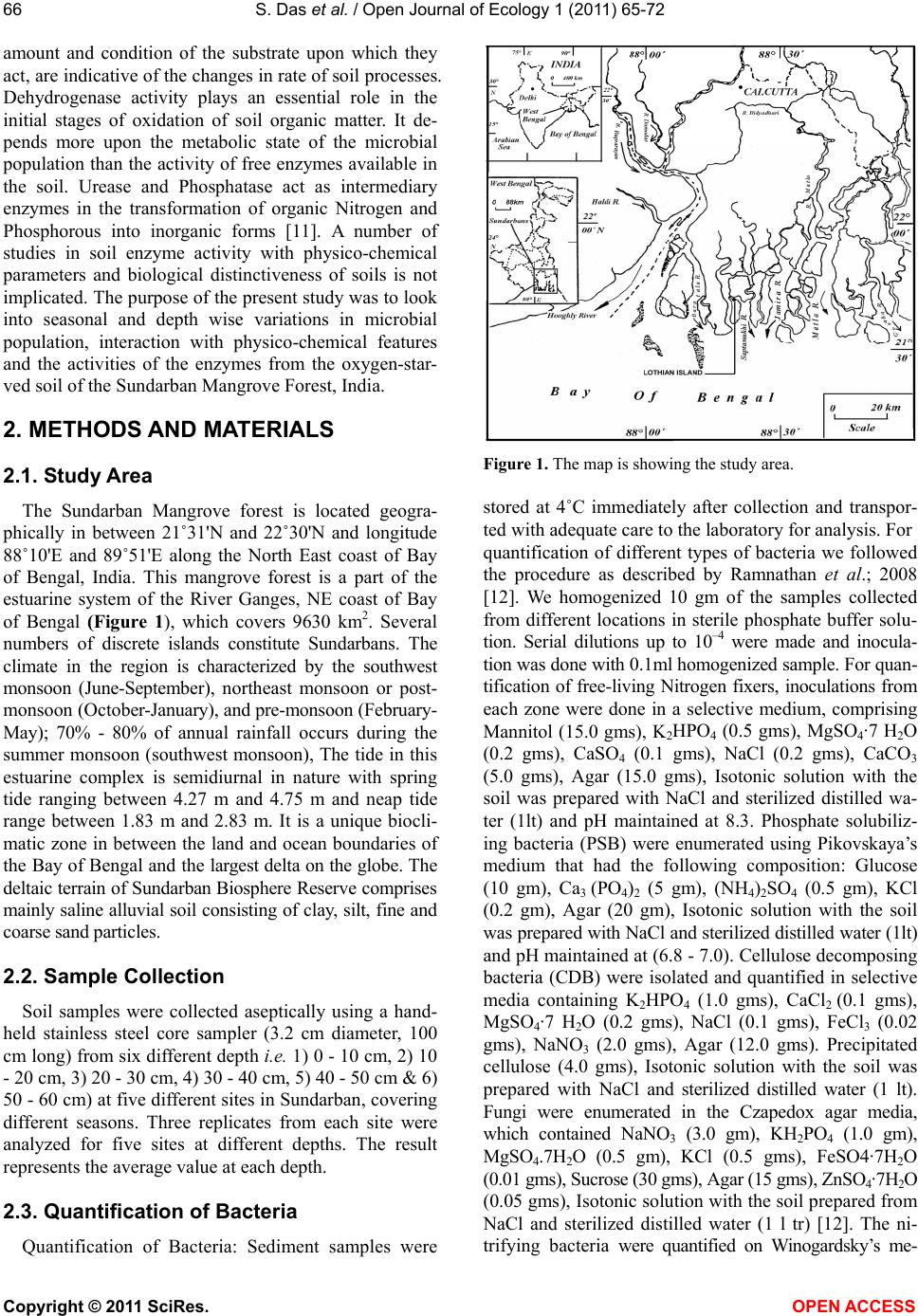 S. Das et al. / Open Journal of Ecology 1 (2011) 65-72 Copyright © 2011 SciRes. OPEN ACCESS 66 amount and condition of the substrate upon which they act, are indicative of the changes in rate of soil processes. Dehydrogenase activity plays an essential role in the initial stages of oxidation of soil organic matter. It de- pends more upon the metabolic state of the microbial population than the activity of free enzymes available in the soil. Urease and Phosphatase act as intermediary enzymes in the transformation of organic Nitrogen and Phosphorous into inorganic forms [11]. A number of studies in soil enzyme activity with physico-chemical parameters and biological distinctiveness of soils is not implicated. The purpose of the present study was to look into seasonal and depth wise variations in microbial population, interaction with physico-chemical features and the activities of the enzymes from the oxygen-star- ved soil of the Sundarban Mangrove Forest, India. 2. METHODS AND MATERIALS 2.1. Study Area The Sundarban Mangrove forest is located geogra- phically in between 21˚31'N and 22˚30'N and longitude 88˚10'E and 89˚51'E along the North East coast of Bay of Bengal, India. This mangrove forest is a part of the estuarine system of the River Ganges, NE coast of Bay of Bengal (Figure 1), which covers 9630 km2. Several numbers of discrete islands constitute Sundarbans. The climate in the region is characterized by the southwest monsoon (June-September), northeast monsoon or post- monsoon (October-January), and pre-monsoon (February- May); 70% - 80% of annual rainfall occurs during the summer monsoon (southwest monsoon), The tide in this estuarine complex is semidiurnal in nature with spring tide ranging between 4.27 m and 4.75 m and neap tide range between 1.83 m and 2.83 m. It is a unique biocli- matic zone in between the land and ocean boundaries of the Bay of Bengal and the largest delta on the globe. The deltaic terrain of Sundarban Biosphere Reserve comprises mainly saline alluvial soil consisting of clay, silt, fine and coarse sand particles. 2.2. Sample Collection Soil samples were collected aseptically using a hand- held stainless steel core sampler (3.2 cm diameter, 100 cm long) from six different depth i.e. 1) 0 - 10 cm, 2) 10 - 20 cm, 3) 20 - 30 cm, 4) 30 - 40 cm, 5) 40 - 50 cm & 6) 50 - 60 cm) at five different sites in Sundarban, covering different seasons. Three replicates from each site were analyzed for five sites at different depths. The result represents the average value at each depth. 2.3. Quantification of Bacteria Quantification of Bacteria: Sediment samples were Figure 1. The map is showing the study area. stored at 4˚C immediately after collection and transpor- ted with adequate care to the laboratory for analysis. For quantification of different types of bacteria we followed the procedure as described by Ramnathan et al.; 2008 [12]. We homogenized 10 gm of the samples collected from different locations in sterile phosphate buffer solu- tion. Serial dilutions up to 10–4 were made and inocula- tion was done with 0.1ml homogenized sample. For quan- tification of free-living Nitrogen fixers, inoculations from each zone were done in a selective medium, comprising Mannitol (15.0 gms), K2HPO4 (0.5 gms), MgSO4·7 H2O (0.2 gms), CaSO4 (0.1 gms), NaCl (0.2 gms), CaCO3 (5.0 gms), Agar (15.0 gms), Isotonic solution with the soil was prepared with NaCl and sterilized distilled wa- ter (1lt) and pH maintained at 8.3. Phosphate solubiliz- ing bacteria (PSB) were enumerated using Pikovskaya’s medium that had the following composition: Glucose (10 gm), Ca3 (PO4)2 (5 gm), (NH4)2SO4 (0.5 gm), KCl (0.2 gm), Agar (20 gm), Isotonic solution with the soil was prepared with NaCl and sterilized distilled water (1lt) and pH maintained at (6.8 - 7.0). Cellulose decomposing bacteria (CDB) were isolated and quantified in selective media containing K2HPO4 (1.0 gms), CaCl2 (0.1 gms), MgSO4·7 H2O (0.2 gms), NaCl (0.1 gms), FeCl3 (0.02 gms), NaNO3 (2.0 gms), Agar (12.0 gms). Precipitated cellulose (4.0 gms), Isotonic solution with the soil was prepared with NaCl and sterilized distilled water (1 lt). Fungi were enumerated in the Czapedox agar media, which contained NaNO3 (3.0 gm), KH2PO4 (1.0 gm), MgSO4.7H2O (0.5 gm), KCl (0.5 gms), FeSO4·7H2O (0.01 gms), Sucrose (30 gms), Agar (15 gms), ZnSO4·7H2O (0.05 gms), Isotonic solution with the soil prepared from NaCl and sterilized distilled water (1 l tr) [12]. The ni- trifying bacteria were quantified on Winogardsky’s me-  S. Das et al. / Open Journal of Ecology 1 (2011) 65-72 Copyright © 2011 SciRes. 6767 electrode was checked before using the quinhydrone in pH 4 and 7 buffers (mV reading for quinhydrone is 218 and 40.8, respectively, at 25˚C). The potential of a calo- mel reference electrode (+244 mV) was added to each value to calculate Eh value for the sediment samples [20]. dium (g/l: K2HPO4 1, NaCl 2, MgSO4·7H2O 0.5, FeSO4·7H2O trace, CaCl2·2H2O 0.02, pH 8.5) containing 1.0 g/l either (NH4)2SO4 and the colonies were visualized (pinkish hue) by flooding the plates with sulphanillic acid reagent (sulphanillic acid 8 g/l acetic acid (5 M) and ά-na- phthayl amine 5 g/l acetic acid (5 M); 1:1, v/v) [13]. Sulfate reducing bacteria (SRB) were cultured under anaerobic condition for quantification in Starkey’s me- dium containing K2HPO4, 0.5 gm; NH4Cl, 1 gm; Na2SO4, 1 gm; CaCl2·2H2O, 0.1 gm; MgSO4·7H2O, 2 gm; Sodium Lactate (70% Solution), 5 gm; FeSO4·(NH4)2SO4·6H2O, 0.5 gm; Isotonic solution with the soil prepared from NaCl and sterilized distilled water (1 L) and pH main- tained at (7.0 - 7.5) [14]. 2.5. Measurement of Enzyme Activity Dehydrogenase activity assay: Moist 1 gm soil sample from each depth was mixed with 1.5 ml TRIS buffer and 2ml 0.5% aqueous solution of iodonitrotetrazolium chlo- ride (substrate). After 2 hr of incubation, the samples were extracted by using 10 ml solution N,N-dimethyl- formamide/ethanol in a 1:1 ratio. Produced iodonitro te- trazolium formazan (INTF) were measured immediately spectrophotometrically at 464 nm [21]. Determination of β-D-Glucosidase activity: 1 gm of the collected soil samples from different depth region were mixed with acetate buffer. After 10min, p-nitrophenyl-β-Dglucopyranoside (substrate) was added in required amount and incubated at 37˚C temperature for 1 hour. Ethanol (95%) was ad- ded in required amount to terminate the reaction. Relea- sed para nitro phenol (PNP) was determined spectropho- tometrically at 400 nm [22]. 2.4. Sediment Quality Measurement Concentrations of Sulphate-Sulphur, Nitrate-Nitrogen, Nitrite-Nitrogen, Phosphate-Phosphorous, and Silicate- Silica in the soil sediment sample were measured foll- owing standard procedure [15,16]. The pH value was mea- sured in a 1:5 (w/w) soil water suspension using an elec- tric digital pH meter [17] and salinity of a soil saturation extract (ECe) was determined by measuring the elec- trical conductance of soil water saturation extract with the help of a conductivity meter [18]. Soil organic car- bon was measured by standard methods [19]. Soil redox potentials (Eh) at each sampling site were measured with brightened platinum electrodes which were allowed to equilibrate in situ for 1 hr prior to measurement. Each 3. RESULT AND DISCUSSION Ta bl e 1 depicts the seasonal variations of total micro- bial populations, organic carbon content and physico-che- Table 1. Seasonal variations of physico-chemical parameters and microbial population (CFU × 106·g–1 dry sediment) at different depth in Sundarban mangrove environment. Season Depth (cm) Eh (mV) pH Temp (˚C)Salinity (PSU)Org.C2 4 SO 3 4 PO 3 NO 2 NO CFU × 106 0 –98 7.94 17.83 16.97 1.031.830.3150.175 0.049 12.237 10 –102 8.39 17.83 17.01 0.971.640.3050.179 0.048 11.604 20 –108 8.27 17.82 17.08 0.921.420.3150.166 0.045 10.62 30 –112 8.23 17.82 17.23 0.821.380.3400.221 0.044 9.279 40 –128 8.25 17.82 17.35 0.781.290.3210.245 0.048 8.560 50 –136 8.21 17.80 17.84 0.751.210.2850.226 0.032 8.941 Pre-mon-soon 60 –143 8.19 17.82 17.87 0.701.070.2390.214 0.050 7.763 0 –102 8.22 24.68 14.99 0.871.040.3200.204 0.047 11.547 10 –112 8.12 24.71 15.05 0.821.000.2620.183 0.045 10.326 20 –135 8.19 24.67 15.05 0.800.890.2800.173 0.044 10.103 30 –148 8.18 24.69 15.17 0.830.910.2300.159 0.047 8.921 40 –165 8.14 24.59 15.22 0.700.820.2500.159 0.058 7.767 50 –173 8.16 23.82 15.28 0.670.940.2100.163 0.048 7.413 Mon-soon 60 –175 8.12 23.73 15.41 0.590.870.1900.162 0.048 6.396 0 –121 8.42 12.94 15.35 1.371.310.6750.205 0.024 13.529 10 –128 8.37 12.95 15.36 1.261.200.6120.197 0.014 12.183 20 –131 8.34 12.94 15.46 1.251.130.5660.171 0.013 10.958 30 –135 8.32 12.93 15.53 1.071.140.5110.176 0.021 10.743 40 –145 8.24 12.90 15.55 0.971.060.4410.151 0.021 9.576 50 –167 8.24 12.92 15.67 0.921.060.4430.136 0.019 9.008 Post-mon-soon 60 –187 8.19 13.12 15.69 0.930.940.3440.130 0.018 8.003 OPEN ACCESS  S. Das et al. / Open Journal of Ecology 1 (2011) 65-72 Copyright © 2011 SciRes. OPEN ACCESS 68 mical parameters at various depths in Sundarban mangro- ve sediment. Temperature and Eh values of soil samples showed a decreasing trend from surface to a depth of 60 cm. A reverse profile was observed in case of pH and salinity. During monsoon, the salinity was found to be 14.99 psu in surface soil and it was 15.41 psu at 60 cm below surface. Less soil salinity in monsoon with respect to pre-monsoon and post-monsoon may be due to high degree of dilution by river (freshwater) run off during monsoon period [23]. Eh value showed a decreasing trend from surface soil (–98 mV) to the 60 cm depth (–143 mV) which represented more anoxicity of bottom soil than that of surface during pre-monsoon (Ta b l e 1 ). Soil redox potential value (Eh) from surface to a region of 60 cm of depth in three distinct seasons suggested that the soil of deep forest region of Sundarban Mangrove is relatively anoxic or it can be referred to as oxygen-im- poverished or oxygen-starved soil. Total number of microbial populations in surface soil was found to be 12.237 × 10⁶, 11.547 × 10⁶ and 13.529 × 10⁶ (C.F.U g–1 dry wt. of sediment) compared to 7.763 × 10⁶, 6.396 × 10⁶ & 8.003 × 10⁶ (C.F.U g–1 dry wt. of se- diment) at the 60 cm depth during pre-monsoon, mon- soon and post-monsoon respectively (Table 1). Depth profile exploration with respect to microbial population showed an inverse relationship between the total bacterial population and depth (cm) (Figure 2) [The regression equation is, Total bacterial population = 2.94187 + 7.55525 Organic C (%); F = 42.86; P = 0.000; n = 21] whereas a direct relationship is reflected from the study between the total bacterial population and organic C% throughout the year (Figure 3). [The regres- sion equation is To tal bacterial populatio n = 12.2396 – 0.0818286 Depth (cm); F = 91.74; P = 0.000; n = 21]. During three seasons, the decrease in total microbial population with increasing depth might be due to dep- letion of organic carbon with increase in depth since previous studies have revealed that organic carbon is most significant for controlling microbial population Figure 2. Relationship between Total CFUs (×106) and depth (cm). Figure 3. Relationship between Total CFUs (×106) and organic carbon. [24]. Decrease in Nitrate-Nitrogen concentration with in- crease in depth (Table 1) could be explained by the decrease in population of nitrifying bacteria with in- crease in depth as earlier study has showed active par- ticipation of nitrifying bacteria in bio-mineralization [25]. The concentration of phosphate-phosphorous was found to be 0.675 and 0.344 μg·g–1 dry wt. of sediment in sur- face and at a depth of 60 cm respectively, during post- mon-soon. The concentration of Phosphate-Phospho- rous, Sulfate-Sulfur, organic Carbon and organic matter were found to show a decreasing trend with increase in depth. Dehydrogenase activity plays an essential role in the initial stages of oxidation of soil organic matter [11]. Dehydrogenase activity was found to diminish from surface with increase in depth (Figure 4) and the regres- sion equation is Dehydrogenase = 373.563 – 1.57281 Depth (cm); [F = 2.80548, P = 0.110, n = 21]. During pre-monsoon, the depth profile study with re- spect to enzyme activity evoked an informative scenario. Dehydrogenase and β-D glucosidase activity were found to show a decreasing trend with increase in depth (Fig- ure 5(a)). Dehydrogenase activity was found to show de- creasing trend with increasing depth. Same profile was found for β-D glucosidase activity (Figure 5(b)). Niemi Figure 4. Relationship between enzyme (dehydrogenase) ac- tivity and depth (cm).  S. Das et al. / Open Journal of Ecology 1 (2011) 65-72 Copyright © 2011 SciRes. OPEN ACCESS 6969 R.M. et al. in 2005 [26] showed similar trend of enzyme activity with increase in depth. During post monsoon urease activity did not show significant gradation with increasing depth from surface to 60 cm of depth. Both dehydrogenase and β-D glucosidase activity were found Pre mo nsoon 225 230 235 240 245 250 255 260 0 102030405060 Dep th (cm) G lucosid as e Activit y 300 310 320 330 340 350 360 370 380 390 D ehydr ogenase Activit y glucosidase activity dehydrogenase activity (a) Monsoon 210 220 230 240 250 260 270 280 290 300 0 102030405060 De p th (cm) G lu cos id as e Act ivit y 300 320 340 360 380 400 420 440 460 480 500 Dehydrogenase Activit y glucosidase activity dehydrogenase activity (b) Po st mon soon 200 205 210 215 220 225 230 235 240 245 250 0 102030405060 Dep th (cm) G lucosid a se Act ivit y 150 170 190 210 230 250 270 Deh ydrogen as e Act ivit y glucosidase activity dehydrogenas e activity (c) Figure 5. Depth profile of soil enzyme activity during pre- monsoon, (a) monsoon and (b) post monsoon(c). to show decreasing pattern with increase in depth up to 20 cm of depth (Figure 5(c)). Culture methods used in this study to assess the sea- sonal influences on the microbial community of the Sun- darban mangrove forest ecosystem detected six different types of microbes (Cellulose Decomposing Bacteria, Sulfate Reducing Bacteria, Phosphate Solubilizing Bac- teria, Nitrogen Fixing Bacteria, Fungi, and Nitrifying Bacteria). Apart from these six different types (Proteo- bacteria, Flexibacteria, Actinobacteria, Chloflexi, Planto- mycetes, and Gammatimonadates) were detected. Ghosh et al. 2010 [27] detected two more types (Acidobacteria, Firmicutes), using culture independent method in the Sundarban mangrove sediment. Plate culture method is able to count only a fraction of total microbial load acce- ssible in soil; however they provide a valid and reliable measure of heterotrophic microbial biomass and acti- vities present in the soil and generally the variations in number of colony forming units correspond to the varia- tions in the total microbial community [28-30]. From the season wise study of relative abundance of microbial population of different category, an expounding outcome was revealed. During pre-monsoon the most dominating group was cellulose decomposing bacteria (40%). Least dominance was showed by free living nitrogen fixing bacteria (5%). Phosphate solubilizing bacteria (8%), Sul- fate reducing bacteria (9%) and nitrifying bacteria (15%), however, showed considerable relative abundance (Fig- ure 6(a)). During monsoon, the most dominating group was cellulose decomposing bacteria (49%) prior to fungi (21%). Least supremacy was exhibited by free living nitrogen fixing bacteria (4%). Phosphate solubilizing ba- cteria (10%), Sulfate reducing bacteria (4%) and nitrify- ing bacteria (12%) showed considerable relative abun- dance (Figure 6(b)). Climatic condition and occurrence of plenty of orga- nic carbon in the soil throughout the year might be re- sponsible for maximum abundance of cellulose decom- posing bacteria [31]. The post monsoon season also fol- lowed the same pattern with the most dominating group of microbe being cellulose decomposing bacteria (47%) prior to fungi (21%). Free living Nitrogen fixing bacteria was of least dominance (5%). Phosphate solubilizing bacteria (10%), Sulfate redu- cing bacteria (5%) and nitrifying bacteria (12%) follow- ing the pattern reflected earlier showed quite consider- able relative abundance (Figure 6(c)). Increase in population of sulfate reducing bacteria with increase in depth might be due to increase in anox- icity with increase in depth [32]. Twelve parameters viz. Total C.F.U, pH, Eh (mV) , Temp (˚C), Salinity (psu), 3 NO , 2 NO , Organic C%, , , glucosidase activity and dehydrogenase activity were included in the PCA (principal component analysis). 3 4 PO2 4 SO  S. Das et al. / Open Journal of Ecology 1 (2011) 65-72 Copyright © 2011 SciRes. OPEN ACCESS 70 Premonsoon 15% 8% 5% 40% 23% 9% Nitrifying Bacteria Phosphate Solubilizing Ba ct eria Free Living Nitrogen Fixing Ba ct eria Cellulose Decomposing Ba ct eria Fungi Sulfate Reducing Bacteria (a) Monsoon 12% 10% 4% 49% 21% 4% Nitrifying Bacteria Phosphate Solubilizing Bacteria Free Living Nitrogen Fixing Bacteria Cellulose Decomposing Bacteria Fungi Sulfate Reducing Bacteria (b) Post monsoon 12% 10% 5% 47% 21% 5% Nitrifying Bacteria Phosphate Solubilizing Ba c t er ia Free Living Nitrogen Fixing Ba c t er ia Cellulose Decomposing Ba c t er ia Fungi Sulfate Reducing Bacteria (c) Figure 6. Relative abundance of different groups of culturable microbes in the sediment during (a) pre-monsoon; (b) monsoon; and (c) post-monsoon. The principal component analysis (Table 2) showed that only three factors were responsible for explaining the variability of physico-chemical parameters and enzy- me activities. All these three factors comprise about 87% of the variability. In fact, factor 1 & 2 contributed to about 72% of the variability including the components. Temp., Eh, 3, 2, NO NO2 4 SO , β-D glucosidase, dehy- drogenase show negative correlation with total bacterial populations and, , Org.C %. Factor 3 largely arises due to salinity and glucosidal activity which are posi- 3 4 PO Tab le 2 . Principal Component Analysis (Eigenanalysis of the Correlation Matrix): Total C.F.U, pH, Temp (˚C), Eh (mV), Salinity (psu), 3 NO (µg·g–1 dry wt of soil), 2 (µg·g–1 dry wt of soil), Organic C%, NO 3 4 PO (µg·g–1 dry wt of soil), 2 4 SO (mg·g–1 dry wt of soil ), β-D Glucosidase activity (µg PNP produced hr–1·g–1 dry wt of soil) & dehydrogenase activity [nmol INTF (g dry wt of soil )–1 2 h–1]. Eigen value5.04443.55811.7686 0.8810 0.38000.1591 Proportion 0.4200.2970.147 0.073 0.0320.013 Cumulative0.4200.717 0.864 0.938 0.969 0.983 Variable PC1 PC2PC3 PC4 PC5PC6 Total CFU 0.265–0.367–0.268 0.172 0.0200.006 pH 0.314–0.049–0.045 –0.571 0.724–0.113 Eh (mV) 0.061–0.508–0.032 0.076 0.067–0.258 Temp –0.407–0.060–0.261 –0.106 0.0940.162 Salinity –0.023–0.1990.682 0.008 0.058–0.298 3 NO –0.015–0.3430.274 –0.629 –0.469 0.277 2 NO –0.390–0.1750.072 0.025 0.315 0.626 Org.C 0.401–0.140–0.204 0.124 –0.0360.235 3 4 PO 0.423–0.042–0.148 –0.116 –0.1870.315 2 4 SO 0.142–0.3780.312 0.443 0.1890.257 β-D Glucosidase–0.171–0.412–0.323 –0.069 –0.213–0.323 Dehydrogenase–0.347–0.282–0.213 –0.033 0.146–0.109 tively correlated with total bacterial populations. 4. CONCLUSIONS From the present study an efficient conclusion can be drawn as a result of our research on depth profile ex- ploration of enzyme activity with microbial community from the oxygen-starved soil of Sundarban Mangrove forest, India. Organic carbon from the leaves, wood from forest and other organic dead or waste products from other living organisms are easily degraded by cellulose decomposing bacteria in the mangrove sediment because they are the most dominating group of microbes prior to fungi. Other groups of microbes have also exhibited sig- nificant population count which helps in bio-mineralize- tion. Microbial activity throughout the year with respect to dehydrogenase activity and β-D glucosidase activity were found to be efficient enough to carry out active bio-mineralization through biogeochemical cycles. Verti- cal decrease in nutrient concentration along with soil enzyme activity suggested that increasing depth caused unfavorable condition for microorganisms to carry out bio-mineralization processes. 5. ACKNOWLEDGEMENTS The financial assistance from DOEn, Govt. of West Bengal and U. G. C., New Delhi are gratefully acknowledged. The authors are also grateful to the Forest Department, Govt. of West Bengal for assisting  S. Das et al. / Open Journal of Ecology 1 (2011) 65-72 Copyright © 2011 SciRes. OPEN ACCESS 7171 the research team in collecting data and providing all infrastructural facilities to reach the remote island. REFERENCES [1] Gonzalez-Acosta, B., Bashan, Y., Hernandez-Saavedra, N.Y., Ascenaio, F. and Cruz-Aguero, G. (2006) Seasonal seawater temperature as the major determinant for popu- lations of culturable bacteria in the sediments of an intact mangrove in an arid region. FEMS Microbiology Ecology, 55, 311-321. doi:10.1111/j.1574-6941.2005.00019.x [2] Alongi, D.M., Boto, K.G. and Tirendi, F. (1989) Effect of exported mangrove litter on bacterial productivity and dis- solved organic carbon fluxes in adjacent tropical near- shore sediments. Marine Ecology Progress Series, 56, 133- 144. doi:10.3354/meps056133 [3] Alongi, D.M., Christofferson, P. and Tirendi, F. (1993) The influence of forest type on microbial-nutrient rela- tionship in tropical mangrove sediment. Journal of Ex- perimental Marine Biology and Ecology, 171, 201-223. doi:10.1016/0022-0981(93)90004-8 [4] Alongi, D.M. (1994) The role of bacteria in nutrient re- cycling in tropical mangrove and other coastal benthic ecosystems. Hydrobiologia, 285, 19-32. doi:10.1007/BF00005650 [5] Holguin, G., Bashan, Y. and Vazavez, P. (2001) The role of sediment microorganism in the productivity, conserva- tion and rehabilitation of mangrove ecosystem: An Over- view. Biology of Fertile Soils, 33, 265-278. doi:10.1007/s003740000319 [6] Vazquez, P., Holguin, G., Puente, M.E., Lopez-Cortes, A. and Bashan, Y. (2000) Phosphate-solubilizing microor- ganisms associated with the rhizosphere of mangroves in a semiarid coastal lagoon. Biology and Fertility of Soils, 30, 460-468. doi:10.1007/s003740050024 [7] Rojas, A., Holguin, G., Glick, B.R. and Bashan, Y. (2001) Synergism between Phyllobacterium sp. (N2-fixer) and Bacillus licheniformis (P-solubilizer), both from a semi- arid mangrove rhizosphere. FEMS Microbiology Ecology, 35, 181-187. doi:10.1111/j.1574-6941.2001.tb00802.x [8] Teri, C.B. and Mary, K.F. (2005) Linking microbial com- munity composition and soil processes in a California annual grassland and mixed conifer forest. Biogeochem- istry, 73, 395-415. doi:10.1111/j.1574-6941.2001.tb00802.x [9] Riley, R.H., Peter, M. and Vitousek, P.M. (1995) Nutrient dynamics and nitrogen trace gas flux during ecosystem development in montane rain forest. Ecology, 76, 292- 304. doi:10.2307/1940650 [10] Wlodarczyk, T., (2000) N2O emission and absorption against a background of CO2 in Eutric Cambisol under different oxidation-reduction conditions. Acta Agrophysi- ca, 28, 39-43. [11] Pascual, J.A., Hernandez, T., Garcia, C. and Ayuso, M. (1998) Enzymatic activities in an arid soil amended with urban organic wastes: Laboratory experiment. Bioresour- ce Technology, 64, 131-138. doi:10.1016/S0960-8524(97)00171-5 [12] Ramanathan, A.L., Singh, G., Majumder, J., Samal, A.C., Chowhan, R., Rayan, R.K., Roykumar, K. and Santra, S.C. (2008) A study of microbial diversity and its inter- action with nutrients in the sediments of Sundarban man- groves. Indian Journal of Marine Science, 37, 159-165. [13] Das, J. and Dangar, T.K. (2008) Microbial population dynamics, especially stress tolerant Bacillus thuringiensis, in partially anaerobic rice field soils during postharvest period of the Himalayan, island, brackish water and co- astal habitats of India. World Journal of Microbiology and Biotechnology, 24, 1403-1410. [14] Sahrani, F.K., Ibrahim, Z., Yahya, A. and Aziz, M. (2008) Isolation and Identification of Marine Sulfate Reducing Bacteria Desulfovibrio sp and Citrobacter freundii from Pasir Gudang, Malaysia. Sains Malyasiana, 37, 365-371. [15] Grasshoff, K., Ehrhardt, M. and Kremling, K. (1983) Standard method for sea water analysis. 2nd Edition, Wiley-VCH, Weinheim. [16] Mussa, S.A.B., Elferjani, H.S., Haroun, F.A. and Abdel- nabi, F.F. (2009) Determination of available nitrate, pho- sphate and sulfate in soil samples. International Journal of PharmTech Research, 1, pp 598-604. [17] Tiwari, S.C., Tiwari, B.K. and Mishra, R.R (1989) Mi- crobial community, enzyme activity and CO2 evolution in Pineapple Orchard soil. Tropical Ecology, 30, 265-273. [18] Richards, L.A. (Ed.) (1968) Diagnosis and improvement of Saline and Alkali soils. Oxford and IBH Publishing Co., New Delhi, 160. [19] Walkley, A. and Black, I.A. (1934) An examination of Degtjareff method for determining soil organic matter, and a proposed modification of the chromic acid titration method. Soil Science, 37, 29-38. doi:10.1097/00010694-193401000-00003 [20] Mckee, K.L., Mendelssohn, I.A. and Hester, M.W. (1988) Reexamination of pore water Sulfhde concentrations and Redox Potentials near the aerial roots of Rhizophora Man- gle and Avicennia Germinans. American Journal of Bot- any, 75, 1352-1359. doi:10.2307/2444458 [21] Mersi, W. and Schinner, F. (1991) An improved and ac- curate method for determiningthe dehydrogenase activity of soils with iodonitrotetrazolium chloride. Biology and Fertility of Soils, 11, 216-220. doi:10.1007/BF00335770 [22] Knight, T.R. and Dick, R.P. (2004) Differentiating micro- bial and stabilized b-glucosidase activity relative to soil quality. Soil Biology & Biochemistry, 36, 2089-2096. doi:10.1016/j.soilbio.2004.06.007 [23] Wahid, S.M., Babel, M.S. and Bhuiyan, A.R. (2007) Hy- drologic monitoring and analysis in the Sundarbans mangrove ecosystem, Bangladesh. Journal of Hydrology, 332, 381-395. doi:10.1016/j.jhydrol.2006.07.016 [24] Kirchman, D.L and Rich, J.H. (1997) Regulation of Ba- cterial Growth Rates by Dissolved Organic Carbon and Temperature in the Equatorial Pacific Ocean. Microbial Ecology, 33, 11-20. [25] Ward, B.B. (1996) Nitrification and denitrification: Pro- bing the nitrogen cycle in aquatic environments. Micro- bial Ecology, 32, 247-261. doi:10.1007/BF00183061 [26] Niemi, R.M., Vepsäläinen, M., Wallenius, K., Simpanen, S., Alakukku, L. and Pietola, L. (2005) Temporal and soil depth-related variation in soil enzyme activities and in root growth of red clover (Trifolium pratense) and timo- thy (Phleum pratense) in the field. Applied Soil Ecology, 30, 113-125. doi:10.1016/j.apsoil.2005.02.003 [27] Ghosh, A., Dey, N., Bera, A., Tiwari, A., Sathyniranjan, K.B., Chakrabarti, K. and Chattopadhyay, D. (2010) Cul- ture independent molecular analysis of bacterial commu-  S. Das et al. / Open Journal of Ecology 1 (2011) 65-72 Copyright © 2011 SciRes. OPEN ACCESS 72 nities in the mangrove sediment of Sunderban, India. Sa- line Systems, 6, 1-11. doi:10.1186/1746-1448-6-1 [28] Tiwari, S.C., Tiwari, B.K. and Mishra, R.R. (1986) Tem- poral and depth-wise variations in CO2 evolution and mi- crobial population in pineapple plantation soil. Journal of Soil Biology and Ecology, 6, 67-76. [29] Tiwari, S.C., Tiwari, B.K. and Mishra, R.R. (1987) The influence of moisture regimes on the population of activ- ity of soil microorganisms. Plant and Soil, 101, 133-136. doi:10.1007/BF02371041 [30] Tiwari, S.C., Tiwari, B.K. and Mishra, R.R. (1987) Tem- poral and depth-wise variations in dehydrogenase and urease activities and bacterial population in pineapple plantation soils. Proceedings of Indian National science Academy Part B, 53, 173-176. [31] Ashokkumar, S., Rajaram, G., Manivasagan, P., Ramesh, S., Sampathkumar, P. and Mayavu, P. (2010) Studies on hydrographical parameters, nutrients and microbial popu- lations of mullipallam creek in muthupettai mangroves (southeast coast of India). Research Journal of Microbi- ology, 6, 71-86. [32] Hakansson, T., Suer, P., Mattiasson, B. and Allard, B. (2008) Sulphate reducing bacteria to precipitate mercury after electrokinetic soil remediation. International Jour- nal of Environmental Science and Technology, 5, 267- 274. |