

Paper Menu >>
Journal Menu >>
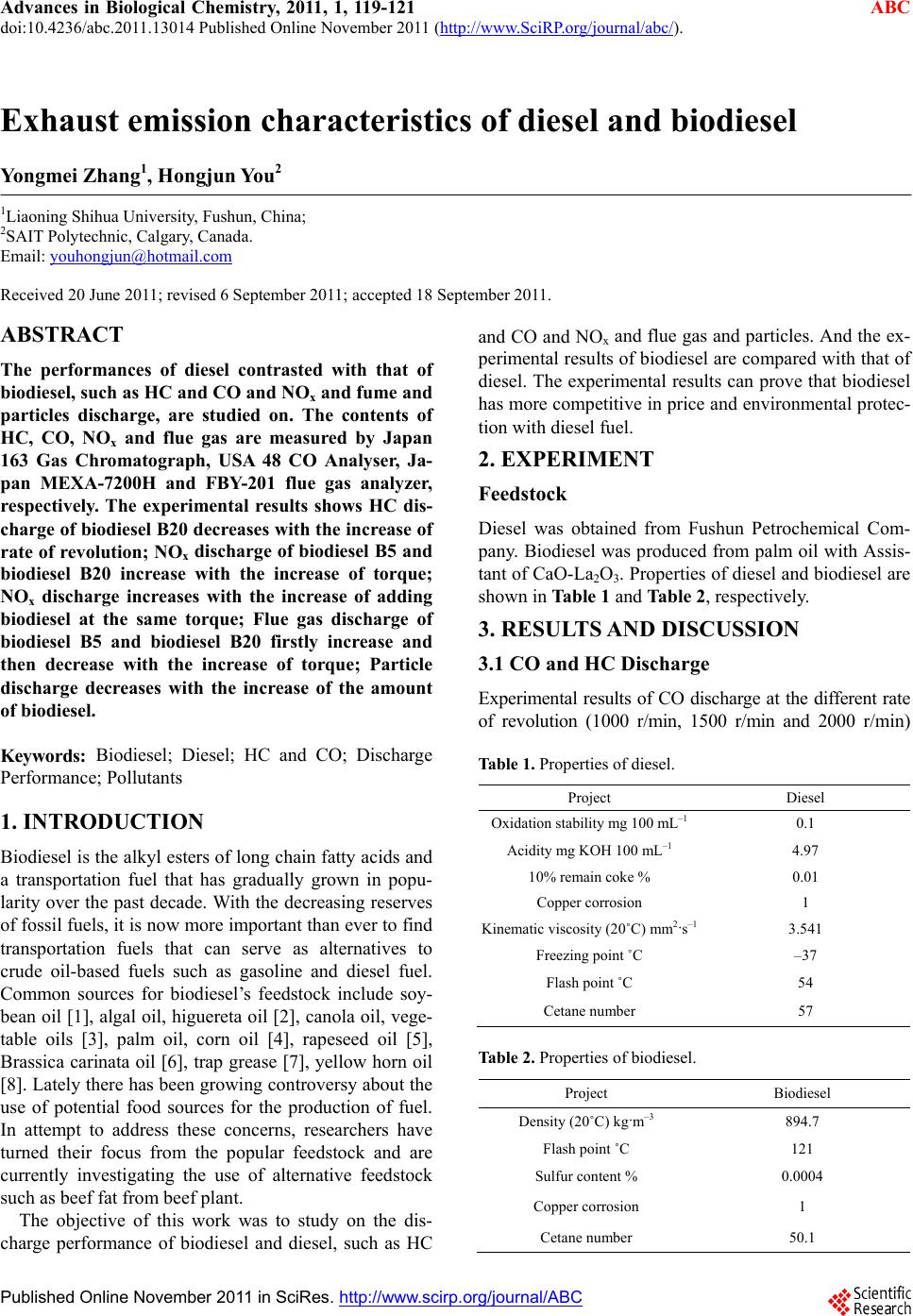 Advances in Biological Chemistry, 2011, 1, 119-121 doi:10.4236/abc.2011.13014 Published Online November 2011 (http://www.SciRP.org/journal/abc/ ABC ). Published Online November 2011 in SciRes. http://www.scirp.org/journal/ABC Exhaust emission characteristics of diesel and biodiesel Yongmei Zhang1, Hongjun You2 1Liaoning Shihua University, Fushun, China; 2SAIT Polytechnic, Calgary, Canada. Email: [email protected] Received 20 June 2011; revised 6 September 2011; accepted 18 September 2011. ABSTRACT The performances of diesel contrasted with that of biodiesel, such as HC and CO and NOx and fume and particles discharge, are studied on. The contents of HC, CO, NOx and flue gas are measured by Japan 163 Gas Chromatograph, USA 48 CO Analyser, Ja- pan MEXA-7200H and FBY-201 flue gas analyzer, respectively. The experimental results shows HC dis- charge of biodiesel B20 decreases with the increase of rate of revolution; NOx discharge of biodiesel B5 and biodiesel B20 increase with the increase of torque; NOx discharge increases with the increase of adding biodiesel at the same torque; Flue gas discharge of biodiesel B5 and biodiesel B20 firstly increase and then decrease with the increase of torque; Particle discharge decreases with the increase of the amount of biodiesel. Keywords: Biodiesel; Diesel; HC and CO; Discharge Performance; Pollutants 1. INTRODUCTION Biodiesel is the alkyl esters of long chain fatty acids and a transportation fuel that has gradually grown in popu- larity over the past decade. With the decreasing reserves of fossil fuels, it is now more important than ever to find transportation fuels that can serve as alternatives to crude oil-based fuels such as gasoline and diesel fuel. Common sources for biodiesel’s feedstock include soy- bean oil [1], algal oil, higuereta oil [2], canola oil, vege- table oils [3], palm oil, corn oil [4], rapeseed oil [5], Brassica carinata oil [6], trap grease [7], yellow horn oil [8]. Lately there has been growing controversy about the use of potential food sources for the production of fuel. In attempt to address these concerns, researchers have turned their focus from the popular feedstock and are currently investigating the use of alternative feedstock such as beef fat from beef plant. The objective of this work was to study on the dis- charge performance of biodiesel and diesel, such as HC and CO and NOx and flue gas and particles. And the ex- perimental results of biodiesel are compared with that of diesel. The experimental results can prove that biodiesel has more competitive in price and environmental protec- tion with diesel fuel. 2. EXPERIMENT Feedstock Diesel was obtained from Fushun Petrochemical Com- pany. Biodiesel was produced from palm oil with Assis- tant of CaO-La2O3. Properties of diesel and biodiesel are shown in Table 1 and Table 2, respectively. 3. RESULTS AND DISCUSSION 3.1 CO and HC Discharge Experimental results of CO discharge at the different rate of revolution (1000 r/min, 1500 r/min and 2000 r/min) Table 1. Properties of diesel. Project Diesel Oxidation stability mg 100 mL–1 0.1 Acidity mg KOH 100 mL–1 4.97 10% remain coke % 0.01 Copper corrosion 1 Kinematic viscosity (20˚C) mm2·s–1 3.541 Freezing point ˚C –37 Flash point ˚C 54 Cetane number 57 Table 2. Properties of biodiesel. Project Biodiesel Density (20˚C) kg·m–3 894.7 Flash point ˚C 121 Sulfur content % 0.0004 Copper corrosion 1 Cetane number 50.1 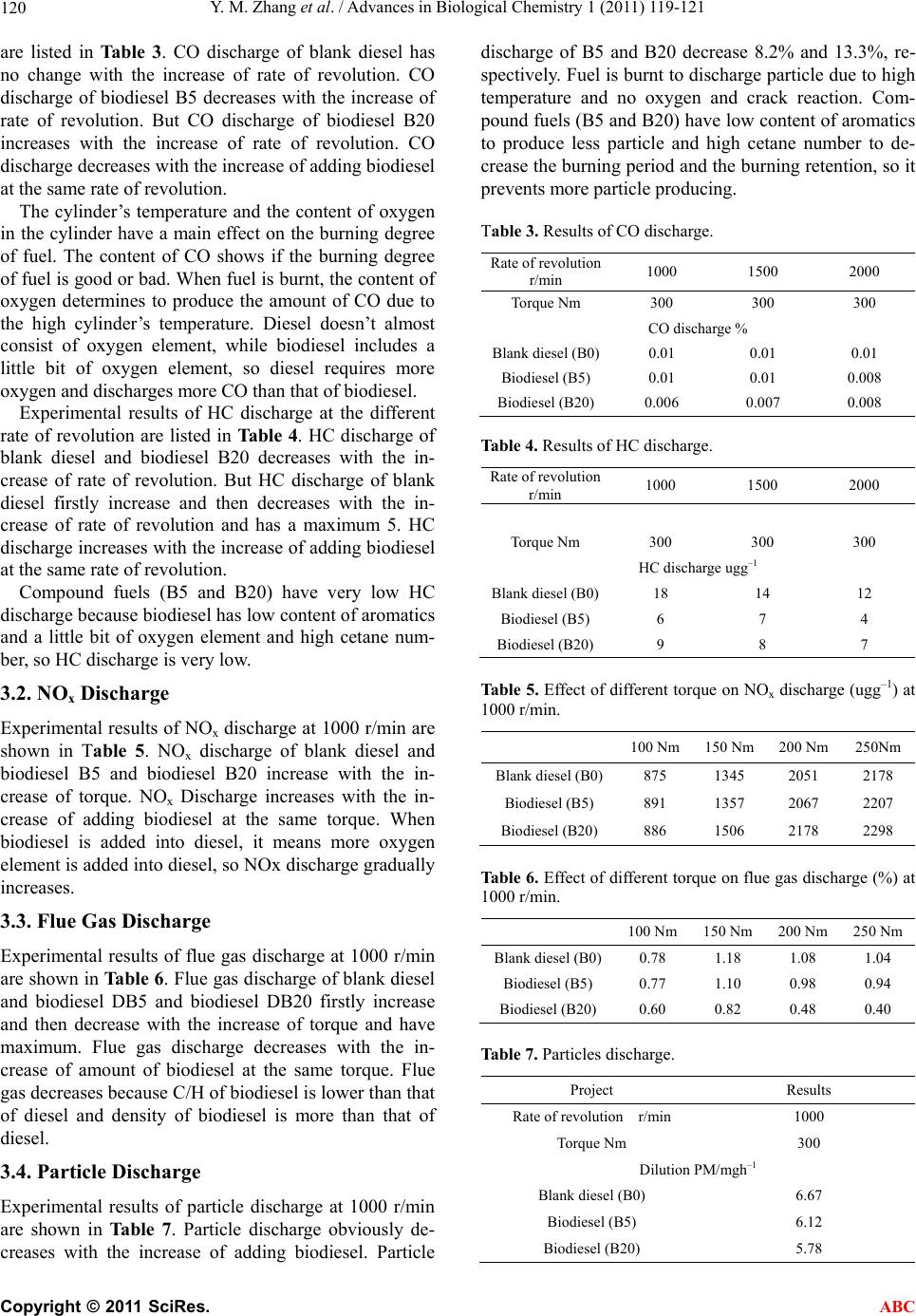 Y. M. Zhang et al. / Advances in Biological Chemistry 1 (2011) 119-121 120 are listed in Ta bl e 3 . CO discharge of blank diesel has no change with the increase of rate of revolution. CO discharge of biodiesel B5 decreases with the increase of rate of revolution. But CO discharge of biodiesel B20 increases with the increase of rate of revolution. CO discharge decreases with the increase of adding biodiesel at the same rate of revolution. The cylinder’s temperature and the content of oxygen in the cylinder have a main effect on the burning degree of fuel. The content of CO shows if the burning degree of fuel is good or bad. When fuel is burnt, the content of oxygen determines to produce the amount of CO due to the high cylinder’s temperature. Diesel doesn’t almost consist of oxygen element, while biodiesel includes a little bit of oxygen element, so diesel requires more oxygen and discharges more CO than that of biodiesel. Experimental results of HC discharge at the different rate of revolution are listed in Tab le 4 . HC discharge of blank diesel and biodiesel B20 decreases with the in- crease of rate of revolution. But HC discharge of blank diesel firstly increase and then decreases with the in- crease of rate of revolution and has a maximum 5. HC discharge increases with the increase of adding biodiesel at the same rate of revolution. Compound fuels (B5 and B20) have very low HC discharge because biodiesel has low content of aromatics and a little bit of oxygen element and high cetane num- ber, so HC discharge is very low. 3.2. NOx Discharge Experimental results of NOx discharge at 1000 r/min are shown in Table 5. NOx discharge of blank diesel and biodiesel B5 and biodiesel B20 increase with the in- crease of torque. NOx Discharge increases with the in- crease of adding biodiesel at the same torque. When biodiesel is added into diesel, it means more oxygen element is added into diesel, so NOx discharge gradually increases. 3.3. Flue Gas Discharge Experimental results of flue gas discharge at 1000 r/min are shown in Table 6. Flue gas discharge of blank diesel and biodiesel DB5 and biodiesel DB20 firstly increase and then decrease with the increase of torque and have maximum. Flue gas discharge decreases with the in- crease of amount of biodiesel at the same torque. Flue gas decreases because C/H of biodiesel is lower than that of diesel and density of biodiesel is more than that of diesel. 3.4. Particle Discharge Experimental results of particle discharge at 1000 r/min are shown in Table 7 . Particle discharge obviously de- creases with the increase of adding biodiesel. Particle discharge of B5 and B20 decrease 8.2% and 13.3%, re- spectively. Fuel is burnt to discharge particle due to high temperature and no oxygen and crack reaction. Com- pound fuels (B5 and B20) have low content of aromatics to produce less particle and high cetane number to de- crease the burning period and the burning retention, so it prevents more particle producing. Table 3. Results of CO discharge. Rate of revolution r/min 1000 1500 2000 Torque Nm 300 300 300 CO discharge % Blank diesel (B0)0.01 0.01 0.01 Biodiesel (B5) 0.01 0.01 0.008 Biodiesel (B20) 0.006 0.007 0.008 Table 4. Results of HC discharge. Rate of revolution r/min 1000 1500 2000 Torque Nm 300 300 300 HC discharge ugg–1 Blank diesel (B0)18 14 12 Biodiesel (B5) 6 7 4 Biodiesel (B20) 9 8 7 Table 5. Effect of different torque on NOx discharge (ugg–1) at 1000 r/min. 100 Nm150 Nm 200 Nm250Nm Blank diesel (B0)875 1345 2051 2178 Biodiesel (B5) 891 1357 2067 2207 Biodiesel (B20) 886 1506 2178 2298 Table 6. Effect of different torque on flue gas discharge (%) at 1000 r/min. 100 Nm150 Nm 200 Nm250 Nm Blank diesel (B0)0.78 1.18 1.08 1.04 Biodiesel (B5) 0.77 1.10 0.98 0.94 Biodiesel (B20) 0.60 0.82 0.48 0.40 Table 7. Particles discharge. Project Results Rate of revolution r/min 1000 Torque Nm 300 Dilution PM/mgh–1 Blank diesel (B0) 6.67 Biodiesel (B5) 6.12 Biodiesel (B20) 5.78 C opyright © 2011 SciRes. ABC 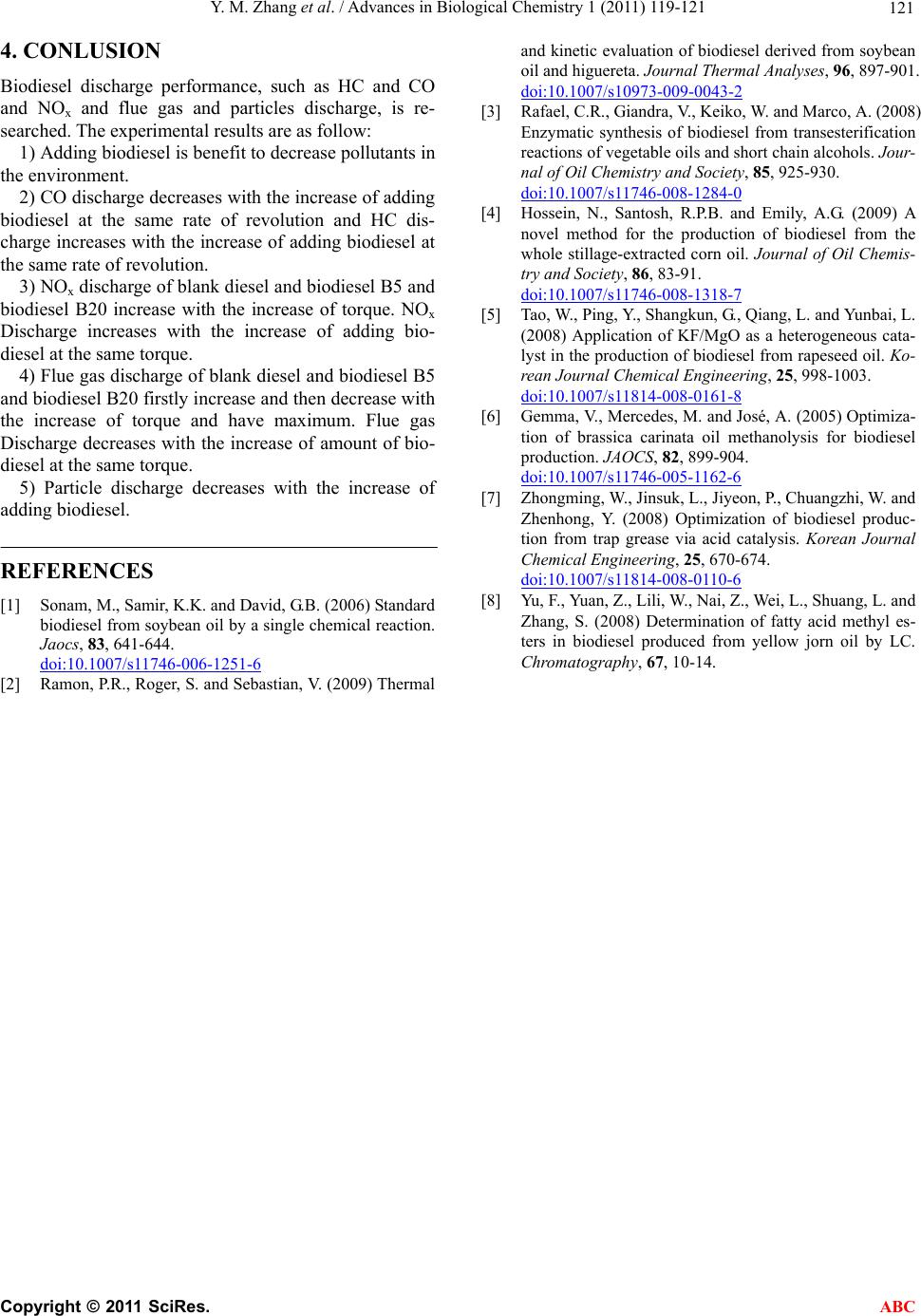 Y. M. Zhang et al. / Advances in Biological Chemistry 1 (2011) 119-121 Copyright © 2011 SciRes. 121 4. CONLUSION Biodiesel discharge performance, such as HC and CO and NOx and flue gas and particles discharge, is re- searched. The experimental results are as follow: ABC 1) Adding biodiesel is benefit to decrease pollutants in the environment. 2) CO discharge decreases with the increase of adding biodiesel at the same rate of revolution and HC dis- charge increases with the increase of adding biodiesel at the same rate of revolution. 3) NOx discharge of blank diesel and biodiesel B5 and biodiesel B20 increase with the increase of torque. NOx Discharge increases with the increase of adding bio- diesel at the same torque. 4) Flue gas discharge of blank diesel and biodiesel B5 and biodiesel B20 firstly increase and then decrease with the increase of torque and have maximum. Flue gas Discharge decreases with the increase of amount of bio- diesel at the same torque. 5) Particle discharge decreases with the increase of adding biodiesel. REFERENCES [1] Sonam, M., Samir, K.K. and David, G.B. (2006) Standard biodiesel from soybean oil by a single chemical reaction. Jaocs, 83, 641-644. doi:10.1007/s11746-006-1251-6 [2] Ramon, P.R., Roger, S. and Sebastian, V. (2009) Thermal and kinetic evaluation of biodiesel derived from soybean oil and higuereta. Journal Thermal Analyses, 96, 897-901. doi:10.1007/s10973-009-0043-2 [3] Rafael, C.R., Giandra, V., Keiko, W. and Marco, A. (2008) Enzymatic synthesis of biodiesel from transesterification reactions of vegetable oils and short chain alcohols. Jour- nal of Oil Chemistry and Society, 85, 925-930. doi:10.1007/s11746-008-1284-0 [4] Hossein, N., Santosh, R.P.B. and Emily, A.G. (2009) A novel method for the production of biodiesel from the whole stillage-extracted corn oil. Journal of Oil Chemis- try and Society, 86, 83-91. doi:10.1007/s11746-008-1318-7 [5] Tao, W., Ping, Y., Shangkun, G., Qiang, L. and Yunbai, L. (2008) Application of KF/MgO as a heterogeneous cata- lyst in the production of biodiesel from rapeseed oil. Ko- rean Journal Chemical Engineering, 25, 998-1003. doi:10.1007/s11814-008-0161-8 [6] Gemma, V., Mercedes, M. and José, A. (2005) Optimiza- tion of brassica carinata oil methanolysis for biodiesel production. JAOCS, 82, 899-904. doi:10.1007/s11746-005-1162-6 [7] Zhongming, W., Jinsuk, L., Jiyeon, P., Chuangzhi, W. and Zhenhong, Y. (2008) Optimization of biodiesel produc- tion from trap grease via acid catalysis. Korean Journal Chemical Engineering, 25, 670-674. doi:10.1007/s11814-008-0110-6 [8] Yu, F., Yuan, Z., Lili, W., Nai, Z., Wei, L., Shuang, L. and Zhang, S. (2008) Determination of fatty acid methyl es- ters in biodiesel produced from yellow jorn oil by LC. Chromatography, 67, 10-14. |