

Paper Menu >>
Journal Menu >>
 Advances in Biological Chemistry, 2011, 1, 103-108 doi:10.4236/abc.2011.13012 Published Online November 2011 (http://www.SciRP.org/journal/abc/ ABC ). Published Online November 2011 in SciR es. http://www.scirp.org/journal/ABC Compatibility of Biomphalaria glabrata and B. alexandrina snails to infection with an egyptian strain of Schistosoma mansoni through two cycles in the experimental final host Momeana Bayoumi Mahmoud Environmental Research e s and Medical Malacology Department, Theodor Bilharz Research Institute, Giza, Egypt. Email: [email protected] Received 24 September 2011; revised 29 October 2011; accepted 8 November 2011. ABSTRACT The infection rate and cercarial production from B. glabrata, in comparison with B. alexandrina snails, post their exposure to S. mansoni miracidia of an E- gyptian strain after two cycles in albino-mice was studies.The results indicated that infection rate of B. glabrata with the Egyptian strain of S. mansoni was less than that of B. alexandrina snails On the other hand infected B. glabrata exhibited a longer life span and a higher number of shedding cercariae, It was also, noticed that in the first cycle mice infected with S. mansoni cercariae shed from infected B. alexandrina snails, the mean number of worms recovered from infected mice was approximately twice that in mice infected with cercariae shed from infected B. glabrata snails The same observation was recorded from the mean number of ova/g liver tissue from infected mice. In the second cycle the same observation was re- corded as first cycle suppression in the infection rate of B. glabrata than that B. alexandrina. Also, longer prepatent period and life span Also, mice infection as the number of worms per infected mouse by cercariae shed from B. alexandrina snails was approximately 2.5 times that of mice infected by cercariae shed from B. glabrata being 29.3 and 12.5 worms/mouse.The results also indicated that the egg laying capacity of B. glabrata was higher than that B. alexandrina, It is concluded from this work that infectivity of S. man- soni cercariae shed from B. glabrata snails after two cycles of mice infection and used to infect the experi- mental final host was less than that of cercariae shed from infected B. alexandrina snails. This may declare a low compatibility o f B. glabrata snails with the Egy- ptian strain of S. mansoni in comparison with B. al- exandrina snails. However, this conclusion needs more passages of mice infection with cercariae to have pre- cise data and conclusions. Keywords: Biomphalaria alexandrina; B. Glabrata; Schistosom a m ansoni; Compatibility 1. INTRODUCTION Schistosomiasis is one of the major health problems in many developing countries [1]. The prevalence of this parasite in human population depends on the number of infected snails in an area. The specificity of parasite-host interactions has received great attention by parasitolo- gists and evolutionary biologists [2]. It was known till 1996 that B. alexandrina is the only planorbid species acting as the intermediate host of Schistosoma mansoni in Egypt. This snail was widely distributed now along the Nile Delta and valley. Re- cently, B. glabrata the intermediate host of S. mansoni in the New world, has been reported from natural freshwa- ter habitats in Egypt [3]. The authors collected the snail population from many water courses of irrigation and drainage systems in Qalyoubia and Kafr El-Sheikh Go- vernorates. In trematode-snail interactions, which are generally regarded as highly specific [4], compatibility patterns of species or strains of parasites and hosts have been used for phylogenetic studies as well as for investigations of parasite-host convolu tion on a local scale [5], Especially in medically relevant blood flukes. Snail compatib ility is also a topic of practical importance for epidemiological surveys and development of biological control methods. This is the reason why most work on snail compatibility and the snail’s internal defense system against trematode infections was performed with S. mansoni [6]. Host snails of the genus Bomphalaria respond with humoral and cellular mechanisms to S. mansoni sporocysts [7]. It was recently demonstrated by selection experiments under laboratory conditions with different snail lines that, in the system S. mansoni, B. glabrata, compatibility char- acteristics seem to be inherited with resistance being dominant over susceptib ility [4,8].  M. B. Mahmoud / Advances in Biological Chemistry 1 (2011) 103-108 104 In fact, we found that an Egyptian (laboratory) strain of S. mansoni discriminated between its host snail B. alexandrina and other species and strains, already during approach and after contac [9,10]. The present study aims to study the compatibility of B. glabrata snails to infection with an Egyptian strain of S. mansoni which is very important from the epidemiol- ogical point of view and draws the attention to the pos- sible role of this snail (B. glabrata) may play in schisto- somiasis in Egypt. 2. MATERIALS AND METHODS 2.1. Snails The snails used in the present study, Biomphalaria alex- andrina and B. glabrata, were obtained from the Schisto- some Biological Supply Centre (SBSC), Theodor Bilharz Research Institute (TBRI). B. glabrata snails were col- lected from some foci in the irrigation canals at Qalyoubia Governorate [3], transferred to laboratory examined for natural trematode infection, negative and healthy ones were maintained under laboratory conditions [1 1]. 2.2. Snails Infection S. mansoni miracidia of the Egyptian strain were obtained from SBSC. B. alexandrina and B. glabrata snails used for infection were almost the same size (4 mm - 5 mm) and individually exposed to miracidia (10 miracidia/snail) for 24 hrs after miracidial exposure, snails were main- tained in dechlorinated water at 24˚C ± 1˚C then from 20 days post exposure, samples from surviving snails were microscopically examined for sporocysts. The other sur- viving snails were examined to cercarial shedding after 30 days post miracidial exposure by exposing each snail in 2 ml water for 3 hrs to 100 watt filament lamp, 40 cm far at 26˚C ± 1˚C. Positive snails were isolated, marked and re-exposed for cercarial shedding twice weekly. The cer- cariae emerged from each positive snail were counted and recorded. The prepatent period, infection rate, periodic cercarial production and life span of infected snails were determined for each species. 2.3. Fecund ity of B. alex andrina and B. glabr at a For each snail species three replicates were used each of 10 snails (5 mm - 8 mm)/L the aquaria were provided with thin plastic sheets for egg deposition. The snails were fed blue-green algae (Nostoc muscorum) and dried lettuce leaves. The egg clutches were weekly collected and eggs were counted and recorded. 2.4. Animals Infections Laboratory bred albino mice in this study were obtained from SBSC cercariae shed from infected B. alexandrina snails were used to infect a group of 6 mice and those shed from B. glabrata were used to infect another 6 mice group. The infection was done by the tail immersion method (100 cercariae/mouse [11] and 4 mice non-in- fected act as a control. 2.5. Parasitological Investigations Worm load and distribution were studied in infected mice by perfusion (hepatic and intestinal) method and the number of eggs was counted per g tissue [12]. The S. mansoni eggs from mice infected with cercariae shed from B. alexandrina snails were hatched to miracidia that used to infect clean groups of B. alexandrina and B.glabrata snails. The same re-exposure of snail to mi- racidia was followed by miracidia hatched from S. man- soni eggs obtained from mice infected with cercariae shed from B. glabrata snails. This technique of re-ex- posure of snail to miracidia was repeated after another passage of mice infection with cercariae shed from the first passage of infect i on. 2.6. Student’s t-Test Student’s t-Test and chi-square test [13] were used in comparing the means and rates of experimental group statistically. 3. RESULTS AND DISCUSSION 3.1. First Cycle Laboratory produced snails B. alexandrina and B. gla- brata were exposed to S. mansoni miracidia individually (10 miracidia/snail). The result indicated that after 20 days from exposure to miracidia the survival rate of B. glabrata significantly higher (96%) than B. alexandrina (76%). Crushing ten snails from each species to examine for sporocyst revealed that positive snails of B. alexan- drina was 8 snails, however only one snail positive of B. glabrata. The present results showed that there are significant differences between B. alexandrina and B. glabrata in- fected with S. mansoni from Egypt, in the tested pa- rameters (survival rate, infection rate, prepatent period, cercarial production, duration of shedding and life span of infected snails). From Ta ble 1 the results indicated that after 34 days from miracidial exposure the survival rate of B. glabrata was higher about 70% compared to 46% of B. alexan- drina with significant difference (p < 0.001). These re- sults agree with [7,14], they found that a reduction in th e survival rate of infected B. alexandrina compared to in- fected B. glabrata snails through the prepatent period. The present results showed that B. glabrata was less susceptible to in fection with Egyptian strain of S mansoni than B. alexandrina being 8.6% and 78.3% respectivel y. The infection rate was significantly much higher of C opyright © 2011 SciRes. ABC 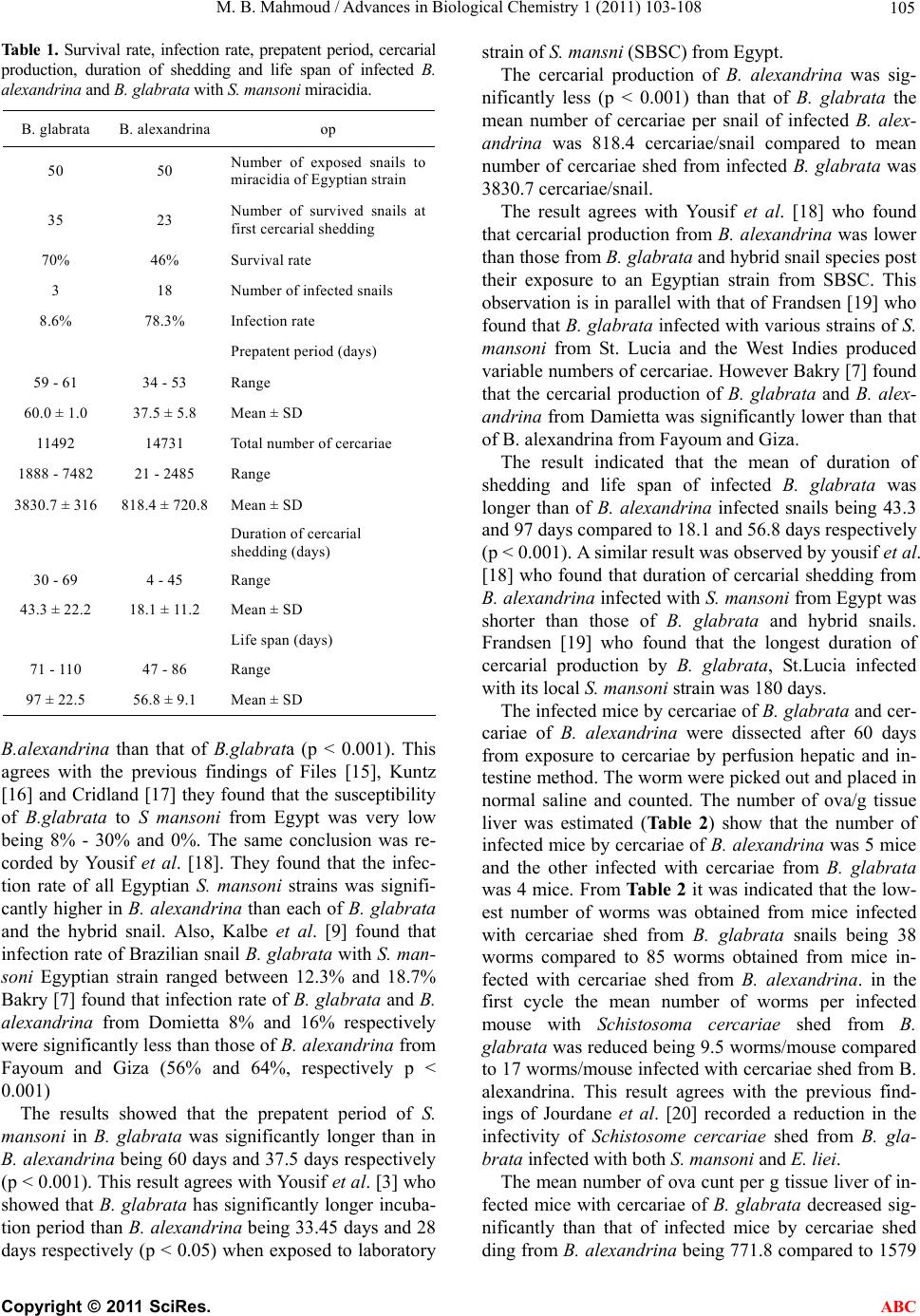 M. B. Mahmoud / Advances in Biological Chemistry 1 (2011) 103-108 Copyright © 2011 SciRes. 105 ABC Ta ble 1. Survival rate, infection rate, prepatent period, cercarial production, duration of shedding and life span of infected B. alexandrina and B. glabrata with S. manson i miracidia. op B. alexandrina B. glabrata Number of exposed snails to miracidia of Egyptian strain 50 50 Number of survived snails at first cercarial shedding 23 35 Survival rate 46% 70% Number of infected snails 18 3 Infection rate 78.3% 8.6% Prepatent period (days) Range 34 - 53 59 - 61 Mean ± SD 37.5 ± 5.8 60.0 ± 1.0 Total number of cercariae 14731 11492 Range 21 - 2485 1888 - 7482 Mean ± SD 818.4 ± 720.8 3830.7 ± 316 Duration of cercarial shedding (days) Range 4 - 45 30 - 69 Mean ± SD 18.1 ± 11.2 43.3 ± 22.2 Life span (days) Range 47 - 86 71 - 110 Mean ± SD 56.8 ± 9.1 97 ± 22.5 B.alexandrina than that of B.glabrata (p < 0.001). This agrees with the previous findings of Files [15], Kuntz [16] and Cridland [17] they found that the susceptibility of B.glabrata to S mansoni from Egypt was very low being 8% - 30% and 0%. The same conclusion was re- corded by Yousif et al. [18]. They found that the infec- tion rate of all Egyptian S. mansoni strains was signifi- cantly higher in B. alexandrina than each of B. glabrata and the hybrid snail. Also, Kalbe et al. [9] found that infection rate of Brazilian sn ail B. glabrata with S. man- soni Egyptian strain ranged between 12.3% and 18.7% Bakry [7] found that infection rate of B. glabrata and B. alexandrina from Domietta 8% and 16% respectively were significantly less than tho se of B. alexandrina from Fayoum and Giza (56% and 64%, respectively p < 0.001) The results showed that the prepatent period of S. mansoni in B. glabrata was significantly longer than in B. alexandrina being 60 days and 37.5 days r espectively (p < 0.001). This resu lt agrees with Yousif et al. [3] who showed that B. glabrata has significantly longer incuba- tion period than B. alexandrina being 33.45 days and 28 days respectively (p < 0.05) when exposed to laboratory strain of S. mansni (SBSC) from Egypt. The cercarial production of B. alexandrina was sig- nificantly less (p < 0.001) than that of B. glabrata the mean number of cercariae per snail of infected B. alex- andrina was 818.4 cercariae/snail compared to mean number of cercariae shed from infected B. glabrata was 3830.7 cercariae/snail. The result agrees with Yousif et al. [18] who found that cercarial production from B. alexandrina was lower than those from B. glabrata and hybrid snail species post their exposure to an Egyptian strain from SBSC. This observation is in p arallel with that of Frandsen [19] who found that B. glabrata infected with various strains of S. mansoni from St. Lucia and the West Indies produced variable numbers of cercariae. However Bakry [7] found that the cercarial production of B. glabrata and B. alex- andrina from Damietta was significantly lower than th at of B. alexandrina from Fayoum and Giza. The result indicated that the mean of duration of shedding and life span of infected B. glabrata was longer than of B. alexandrina infected snails being 43.3 and 97 days compared to 18.1 and 56.8 days respectiv ely (p < 0.001). A similar result was observed by yousif et al. [18] who found that duration of cercarial shedding from B. alexandrina infected with S. mansoni from Egypt was shorter than those of B. glabrata and hybrid snails. Frandsen [19] who found that the longest duration of cercarial production by B. glabrata, St.Lucia infected with its local S. mansoni strain was 180 days. The infected mice by cercariae of B. glabrata and cer- cariae of B. alexandrina were dissected after 60 days from exposure to cercariae by perfusion hepatic and in- testine method. The worm were picked out and placed in normal saline and counted. The number of ova/g tissue liver was estimated (Ta ble 2) show that the number of infected mice by cercariae of B. alexandrina was 5 mice and the other infected with cercariae from B. glabrata was 4 mice. From Tabl e 2 it was indicated that the low- est number of worms was obtained from mice infected with cercariae shed from B. glabrata snails being 38 worms compared to 85 worms obtained from mice in- fected with cercariae shed from B. alexandrina. in the first cycle the mean number of worms per infected mouse with Schistosoma cercariae shed from B. glabrata was reduced being 9.5 worms/mouse compared to 17 worms/mouse infected with cercariae shed from B. alexandrina. This result agrees with the previous find- ings of Jourdane et al. [20] recorded a reduction in the infectivity of Schistosome cercariae shed from B. gla- brata infecte d wit h both S. manso ni and E. liei. The mean number of ova cunt per g tissue liver of in- fected mice with cercariae of B. glabrata decreased sig- nificantly than that of infected mice by cercariae shed ding from B. alexandrina being 771.8 compared to 1579 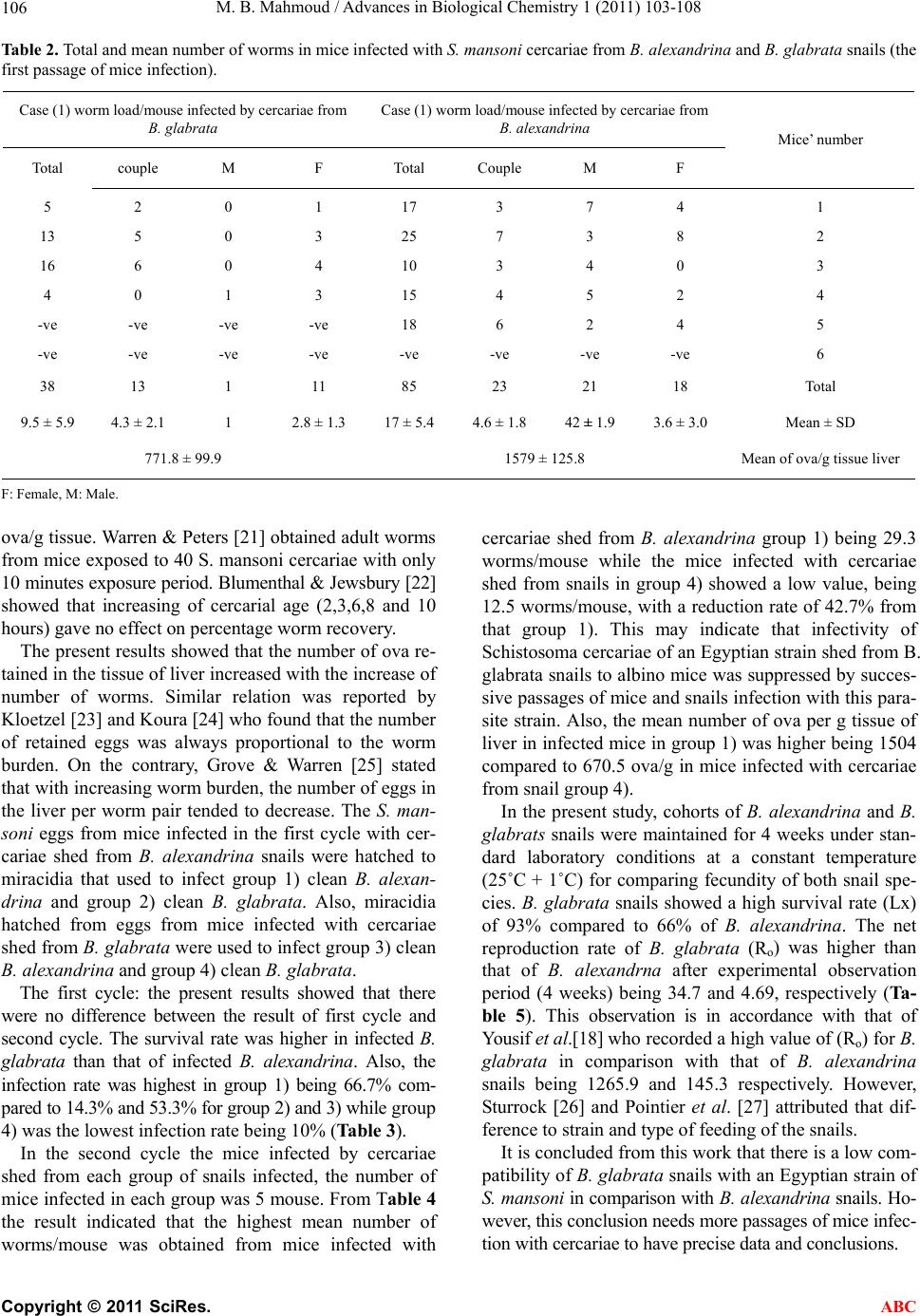 M. B. Mahmoud / Advances in Biological Chemistry 1 (2011) 103-108 106 Table 2. Total and mean number of worms in mice infected with S. mansoni cercariae from B. alexandrina and B. glabrata snails (the first passage of mice infection). Case (1) worm load/mouse infected by cercariae from B. alexandrina Case (1) worm load/mouse infected by cercariae from B. glabrata Mice’ number F M Couple Total F M couple Total 1 2 3 4 5 6 4 8 0 2 4 -ve 7 3 4 5 2 -ve 3 7 3 4 6 -ve 17 25 10 15 18 -ve 1 3 4 3 -ve -ve 0 0 0 1 -ve -ve 2 5 6 0 -ve -ve 5 13 16 4 -ve -ve Total 18 21 23 85 11 1 13 38 Mean ± SD 3.6 ± 3.0 42 ± 1.9 4.6 ± 1.8 17 ± 5.4 2.8 ± 1.3 1 4.3 ± 2.1 9.5 ± 5.9 Mean of ova/g tissue live r 1579 ± 125.8 771.8 ± 99.9 F: Female, M: Male. ova/g tissue. Warren & Peters [21] obtained adult worms from mice exposed to 40 S. mansoni cercariae with only 10 minutes exposure period. Blumenthal & Jewsbury [22] showed that increasing of cercarial age (2,3,6,8 and 10 hours) gave no effect on percentage worm recovery. The present results showed that the number of ova re- tained in the tissue of liver increased with the in crease of number of worms. Similar relation was reported by Kloetzel [23] an d Koura [24 ] who found that th e number of retained eggs was always proportional to the worm burden. On the contrary, Grove & Warren [25] stated that with increasing worm burden, the number of eggs in the liver per worm pair tended to decrease. The S. man- soni eggs from mice infected in the first cycle with cer- cariae shed from B. alexandrina snails were hatched to miracidia that used to infect group 1) clean B. alexan- drina and group 2) clean B. glabrata. Also, miracidia hatched from eggs from mice infected with cercariae shed from B. glabrata were used to infect group 3) clean B. alexandri na and group 4) clean B. glabrata. The first cycle: the present results showed that there were no difference between the result of first cycle and second cycle. The survival rate was higher in infected B. glabrata than that of infected B. alexandrina. Also, the infection rate was highest in group 1) being 66.7% com- pared to 14.3% and 53.3% for group 2) and 3) while gr ou p 4) was the lowest infection rate being 10% (Table 3). In the second cycle the mice infected by cercariae shed from each group of snails infected, the number of mice infected in each group was 5 mouse. From Table 4 the result indicated that the highest mean number of worms/mouse was obtained from mice infected with cercariae shed from B. alexandrina group 1) being 29.3 worms/mouse while the mice infected with cercariae shed from snails in group 4) showed a low value, being 12.5 worms/mouse, with a reduction rate of 42.7% from that group 1). This may indicate that infectivity of Schistosoma cercariae of an Egyptian strain shed from B. glabrata snails to albino mice was suppressed by succes- sive passages of mice and snails infection with this para- site strain. Also, the mean number of ova per g tissue of liver in infected mice in group 1) was higher being 1504 compared to 670.5 ova/g in mice infected with cercariae from snail group 4). In the present study, cohorts of B. alexandrina and B. glabrats snails were maintained for 4 weeks under stan- dard laboratory conditions at a constant temperature (25˚C + 1˚C) for comparing fecundity of both snail spe- cies. B. glabrata snails showed a high survival rate (Lx) of 93% compared to 66% of B. alexandrina. The net reproduction rate of B. glabrata (Ro) was higher than that of B. alexandrna after experimental observation period (4 weeks) being 34.7 and 4.69, respectively (Ta- ble 5). This observation is in accordance with that of Yousif et al.[18] who recorded a high value of (Ro) for B. glabrata in comparison with that of B. alexandrina snails being 1265.9 and 145.3 respectively. However, Sturrock [26] and Pointier et al. [27] attributed that dif- ference to strain and type of feeding of the snails. It is concluded from this work th at there is a low com- patibility of B. glabrata snails with an Eg yptian strain of S. mansoni in comparison with B. alexandrina snails. Ho- wever, this conclusion needs more passages of mice infec- tion with cercariae to have precise data and conclusions. C opyright © 2011 SciRes. ABC 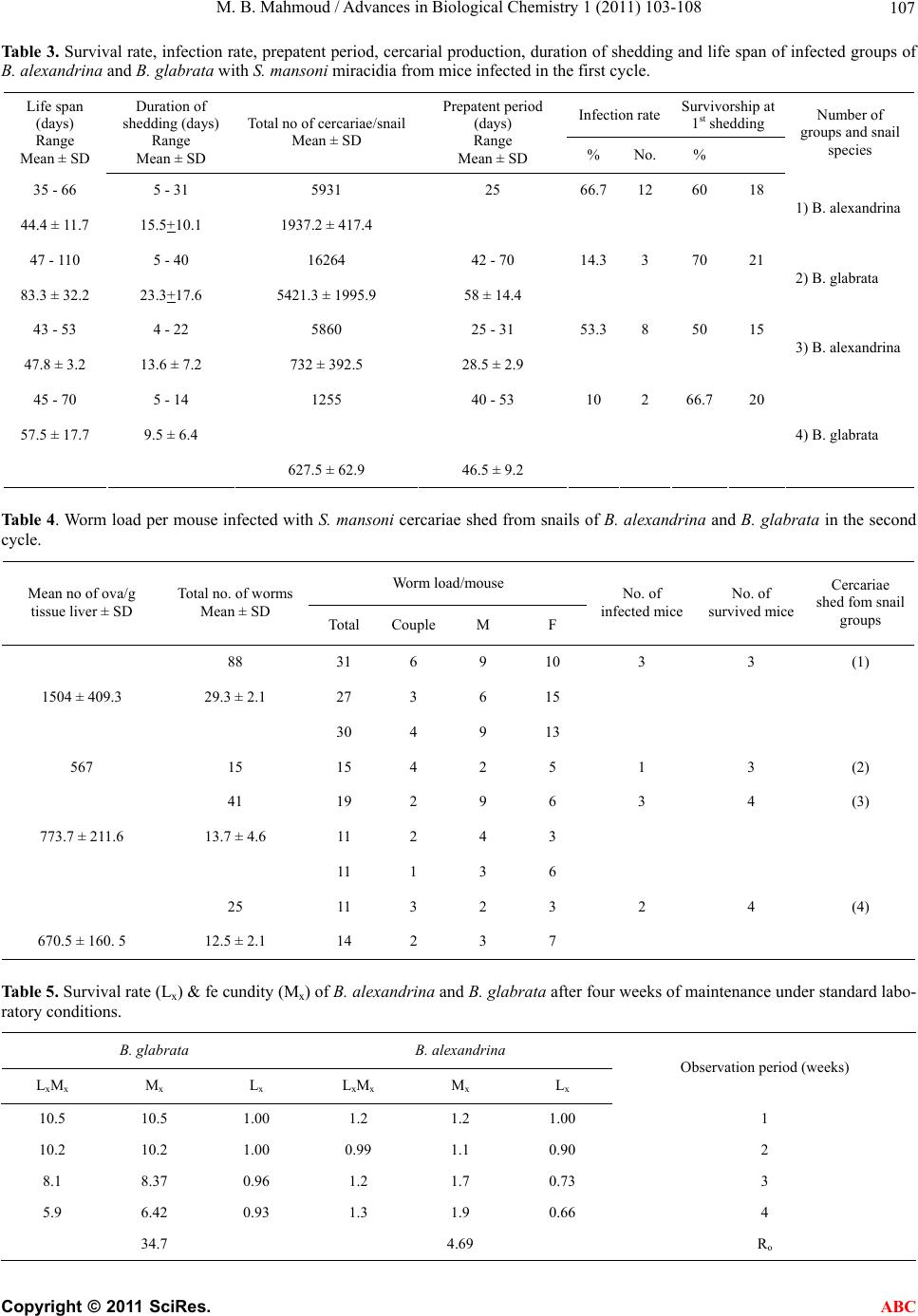 M. B. Mahmoud / Advances in Biological Chemistry 1 (2011) 103-108 107 Table 3. Survival rate, infection rate, prepatent period, cercarial production, duration of shedding and life span of infected groups of B. alexandrina and B. glabrata with S. mansoni miracidia from mice infected in the first cycle. Survivorship at 1st shedding Infection rateNumber of groups and snail species % No.% Prepatent period (days) Range Mean ± SD Total no of cercariae/snail Mean ± SD Duration of shedding (days) Range Mean ± SD Life span (days) Range Mean ± SD 18 60 12 66.725 5931 5 - 31 35 - 66 1) B. alexandrina 1937.2 ± 417.4 15.5+10.1 44.4 ± 11.7 21 70 3 14.342 - 70 16264 5 - 40 47 - 110 2) B. glabrata 58 ± 14.4 5421.3 ± 1995.9 23.3+17.6 83.3 ± 32.2 15 50 8 53.325 - 31 5860 4 - 22 43 - 53 3) B. alexandrina 28.5 ± 2.9 732 ± 392.5 13.6 ± 7.2 47.8 ± 3.2 20 66.7 2 10 40 - 53 1255 5 - 14 45 - 70 9.5 ± 6 .4 57.5 ± 17.7 4) B. glabrata 46.5 ± 9.2 627.5 ± 62.9 Tabl e 4. Worm load per mouse infected with S. mansoni cercariae shed from snails of B. alexandrina and B. glabrata in the second cycle. Worm load/mouse Cercariae shed fom snail groups No. of survived mice No. of infected mice F M CoupleTotal Total no. of worms Mean ± SD Mean no of ova/g tissue liver ± SD (1) 3 3 10 9 6 31 88 15 6 3 27 29.3 ± 2.1 1504 ± 409.3 13 9 4 30 (2) 3 1 5 2 4 15 15 567 (3) 4 3 6 9 2 19 41 3 4 2 11 13.7 ± 4.6 773.7 ± 211.6 6 3 1 11 (4) 4 2 3 2 3 11 25 7 3 2 14 12.5 ± 2.1 670.5 ± 160. 5 Table 5. Survival rate (Lx) & fe cundity (Mx) of B. alexandrina and B. glabrata after four weeks of maintenance under standard labo- ratory conditions. B. alexandrina B. glabrata Observation period (weeks) Lx Mx LxMx Lx Mx LxMx 1 1.00 1.2 1.2 1.00 10.5 10.5 2 0.90 1.1 0.99 1.00 10.2 10.2 3 0.73 1.7 1.2 0.96 8.37 8.1 4 0.66 1.9 1.3 0.93 6.42 5.9 Ro 4.69 34.7 C opyright © 2011 SciRes. ABC 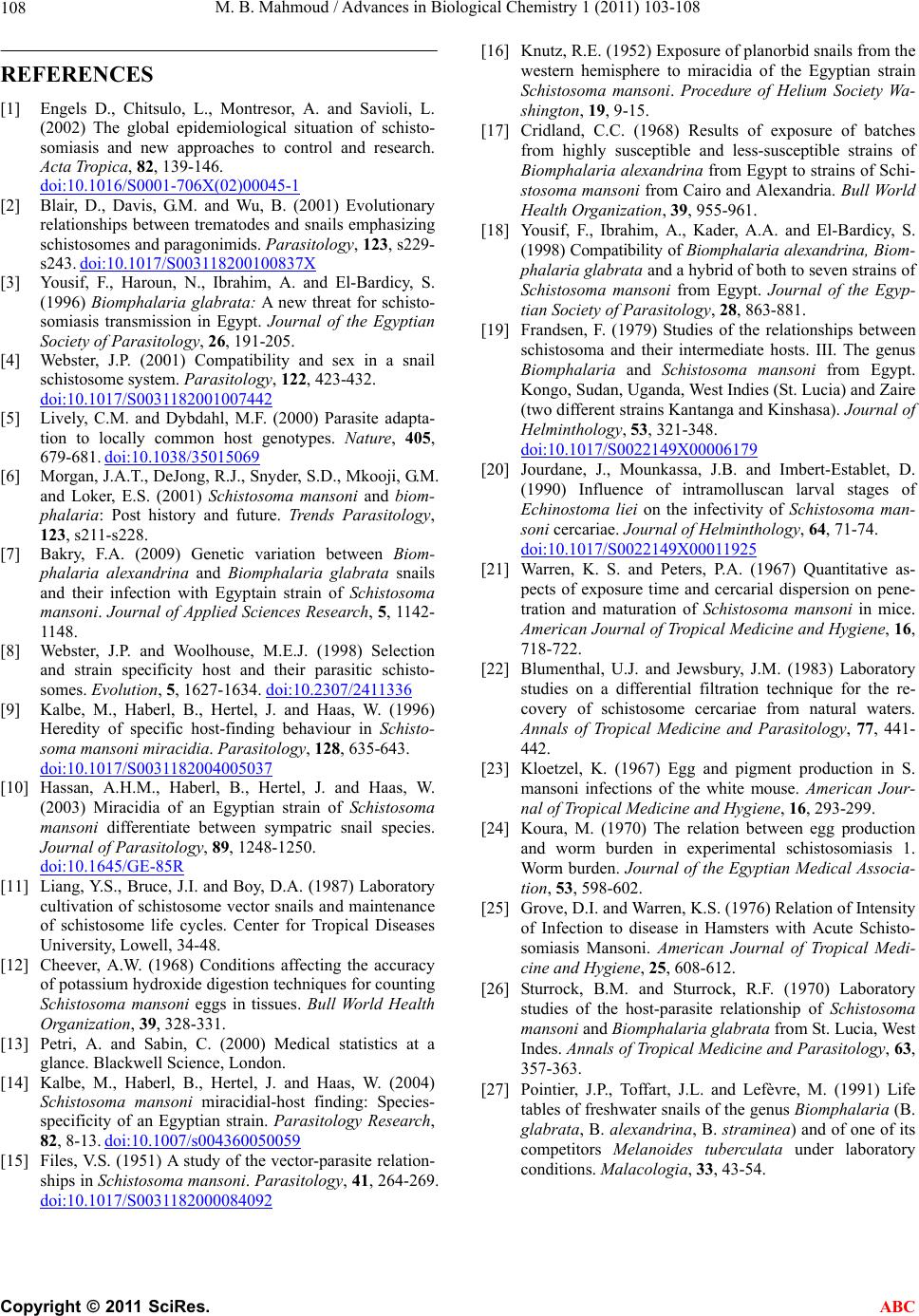 M. B. Mahmoud / Advances in Biological Chemistry 1 (2011) 103-108 108 REFERENCES [1] Engels D., Chitsulo, L., Montresor, A. and Savioli, L. (2002) The global epidemiological situation of schisto- somiasis and new approaches to control and research. Acta Tropica, 82, 139-146. doi:10.1016/S0001-706X(02)00045-1 [2] Blair, D., Davis, G.M. and Wu, B. (2001) Evolutionary relationships between trematodes and snails emphasizing schistosomes and paragonimids. Parasitology, 123, s229- s243. doi:10.1017/S003118200100837X [3] Yousif, F., Haroun, N., Ibrahim, A. and El-Bardicy, S. (1996) Biomphalaria glabrata: A new threat for schisto- somiasis transmission in Egypt. Journal of the Egyptian Society of Parasitology, 26, 191-205. [4] Webster, J.P. (2001) Compatibility and sex in a snail schistosome system. Parasitology, 122, 423-432. doi:10.1017/S0031182001007442 [5] Lively, C.M. and Dybdahl, M.F. (2000) Parasite adapta- tion to locally common host genotypes. Nature, 405, 679-681. doi:10.1038/35015069 [6] Morgan, J.A.T., DeJong, R.J., Snyder, S.D., Mkooji, G.M. and Loker, E.S. (2001) Schistosoma mansoni and biom- phalaria: Post history and future. Trends Parasitology, 123, s211-s228. [7] Bakry, F.A. (2009) Genetic variation between Biom- phalaria alexandrina and Biomphalaria glabrata snails and their infection with Egyptain strain of Schistosoma mansoni. Journal of Applied Sciences Research, 5, 1142- 1148. [8] Webster, J.P. and Woolhouse, M.E.J. (1998) Selection and strain specificity host and their parasitic schisto- somes. Evolution, 5, 1627-1634. doi:10.2307/2411336 [9] Kalbe, M., Haberl, B., Hertel, J. and Haas, W. (1996) Heredity of specific host-finding behaviour in Schisto- soma mansoni miracidia. Parasitology, 128, 635-643. doi:10.1017/S0031182004005037 [10] Hassan, A.H.M., Haberl, B., Hertel, J. and Haas, W. (2003) Miracidia of an Egyptian strain of Schistosoma mansoni differentiate between sympatric snail species. Journal of Parasitology, 89, 1248-1250. doi:10.1645/GE-85R [11] Liang, Y.S., Bruce, J.I. and Boy, D.A. (1987) Laboratory cultivation of schistosome vector snails and maintenance of schistosome life cycles. Center for Tropical Diseases University, Lowell, 34-48. [12] Cheever, A.W. (1968) Conditions affecting the accuracy of potassium hydroxide digestion techniques for counting Schistosoma mansoni eggs in tissues. Bull World Health Organization, 39, 328-331. [13] Petri, A. and Sabin, C. (2000) Medical statistics at a glance. Blackwel l Science, London. [14] Kalbe, M., Haberl, B., Hertel, J. and Haas, W. (2004) Schistosoma mansoni miracidial-host finding: Species- specificity of an Egyptian strain. Parasitology Research, 82, 8-13. doi:10.1007/s004360050059 [15] Files, V.S. (1951) A study of the vector-parasite relation- ships in Schistosoma mansoni. Parasitology, 41, 264-269. doi:10.1017/S0031182000084092 [16] Knutz, R.E. (1952) Exposure of planorbid snails from the western hemisphere to miracidia of the Egyptian strain Schistosoma mansoni. Procedure of Helium Society Wa- shington, 19, 9-15. [17] Cridland, C.C. (1968) Results of exposure of batches from highly susceptible and less-susceptible strains of Biomphalaria alexandrina from Egypt to strains of Schi- stosoma mansoni from Cairo and Alexandria. Bull World Health Organization, 39, 955-961. [18] Yousif, F., Ibrahim, A., Kader, A.A. and El-Bardicy, S. (1998) Compatibility of Biomphalaria alexandrin a, Biom - phalaria glabrata and a hybr id of bot h to se ven st ra i ns of Schistosoma mansoni from Egypt. Journal of the Egyp- tian Society of Parasitology, 28, 863-881. [19] Frandsen, F. (1979) Studies of the relationships between schistosoma and their intermediate hosts. III. The genus Biomphalaria and Schistosoma mansoni from Egypt. Kongo, Sudan, Uganda, West Indies (St. Lucia) and Zaire (two different strains Kantanga and Kinshasa). Journal of Helminthology, 53, 321-348. doi:10.1017/S0022149X00006179 [20] Jourdane, J., Mounkassa, J.B. and Imbert-Establet, D. (1990) Influence of intramolluscan larval stages of Echinostoma liei on the infectivity of Schistosoma man- soni cercariae. Journal of Helminthology, 64, 71-74. doi:10.1017/S0022149X00011925 [21] Warren, K. S. and Peters, P.A. (1967) Quantitative as- pects of exposure time and cercarial dispersion on pene- tration and maturation of Schistosoma mansoni in mice. American Journal of Tropical Medicine and Hygiene, 16, 718-722. [22] Blumenthal, U.J. and Jewsbury, J.M. (1983) Laboratory studies on a differential filtration technique for the re- covery of schistosome cercariae from natural waters. Annals of Tropical Medicine and Parasitology, 77, 441- 442. [23] Kloetzel, K. (1967) Egg and pigment production in S. mansoni infections of the white mouse. American Jour- nal of Tropical Medicine and Hygiene, 16, 293-299. [24] Koura, M. (1970) The relation between egg production and worm burden in experimental schistosomiasis 1. Worm burden. Journal of the Egyptian Medical Associa- tion, 53, 598-602. [25] Grove, D.I. and Warren, K.S. (1976) Relation of Intensity of Infection to disease in Hamsters with Acute Schisto- somiasis Mansoni. American Journal of Tropical Medi- cine and Hygiene, 25, 608-612. [26] Sturrock, B.M. and Sturrock, R.F. (1970) Laboratory studies of the host-parasite relationship of Schistosoma mansoni and Biomphalaria glabrata from St. Lucia, West Indes. Annals of Tropical Medicine and Parasitology, 63, 357-363. [27] Pointier, J.P., Toffart, J.L. and Lefèvre, M. (1991) Life tables of freshwater snails of the genus Biomphalaria (B. glabrata, B. alexandrina, B. straminea) and of one of its competitors Melanoides tuberculata under laboratory conditions. Malacologia, 33, 43-54. C opyright © 2011 SciRes. ABC |