

Paper Menu >>
Journal Menu >>
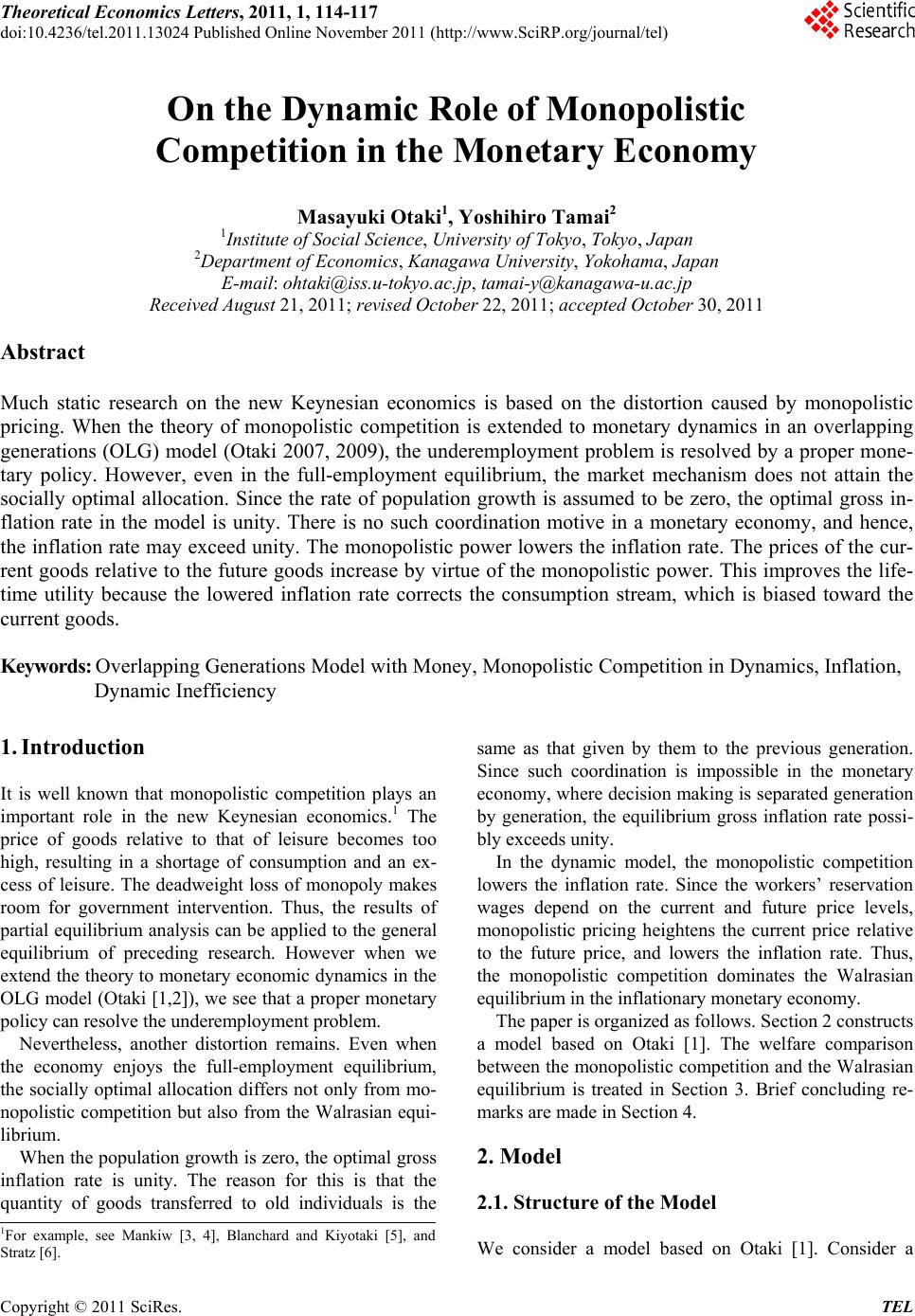 Theoretical Economics Letters, 2011, 1, 114-117 doi:10.4236/tel.2011.13024 Published Online November 2011 (http://www.SciRP.org/journal/tel) Copyright © 2011 SciRes. TEL On the Dynamic Role of Monopolistic Competition in the Monetary Economy Masayuki Otaki1, Yoshihiro Tamai2 1Institute of Social Scienc e, University of Tokyo, Tokyo, Japan 2Department of Economics , Kanagawa University, Yokohama, Japan E-mail: [email protected], [email protected] Received August 21, 2011; revised October 22, 2011; accepted October 30, 2011 Abstract Much static research on the new Keynesian economics is based on the distortion caused by monopolistic pricing. When the theory of monopolistic competition is extended to monetary dynamics in an overlapping generations (OLG) model (Otaki 2007, 2009), the underemployment problem is resolved by a proper mone- tary policy. However, even in the full-employment equilibrium, the market mechanism does not attain the socially optimal allocation. Since the rate of population growth is assumed to be zero, the optimal gross in- flation rate in the model is unity. There is no such coordination motive in a monetary economy, and hence, the inflation rate may exceed unity. The monopolistic power lowers the inflation rate. The prices of the cur- rent goods relative to the future goods increase by virtue of the monopolistic power. This improves the life- time utility because the lowered inflation rate corrects the consumption stream, which is biased toward the current goods. Keywords: Overlapping Generations Model with Money, Monopolistic Competition in Dynamics, Inflation, Dynamic Inefficiency 1. Introduction It is well known that monopolistic competition plays an important role in the new Keynesian economics.1 The price of goods relative to that of leisure becomes too high, resulting in a shortage of consumption and an ex- cess of leisure. The deadweight loss of monopoly makes room for government intervention. Thus, the results of partial equilibriu m analysis can be applied to the general equilibrium of preceding research. However when we extend the theory to monetary economic dynamics in the OLG model (Otaki [1,2]), we see that a proper monetary policy can resolve the underemploymen t problem. Nevertheless, another distortion remains. Even when the economy enjoys the full-employment equilibrium, the socially optimal allocation differs not only from mo- nopolistic competition but also from the Walrasian equi- librium. When the population growth is zero, the optimal gross inflation rate is unity. The reason for this is that the quantity of goods transferred to old individuals is the same as that given by them to the previous generation. Since such coordination is impossible in the monetary economy, where decision making is separated generation by generation, the equilibrium gross inflation rate possi- bly exceeds unity. In the dynamic model, the monopolistic competition lowers the inflation rate. Since the workers’ reservation wages depend on the current and future price levels, monopolistic pricing heightens the current price relative to the future price, and lowers the inflation rate. Thus, the monopolistic competition dominates the Walrasian equilibrium in the inflationary monetary economy. The paper is organized as follows. Section 2 constructs a model based on Otaki [1]. The welfare comparison between the monopolistic competitio n and the Walrasian equilibrium is treated in Section 3. Brief concluding re- marks are made in Section 4. 2. Model 2.1. Structure of the Model 1For example, see Mankiw [3, 4], Blanchard and Kiyotaki [5], and Stratz [6]. We consider a model based on Otaki [1]. Consider a 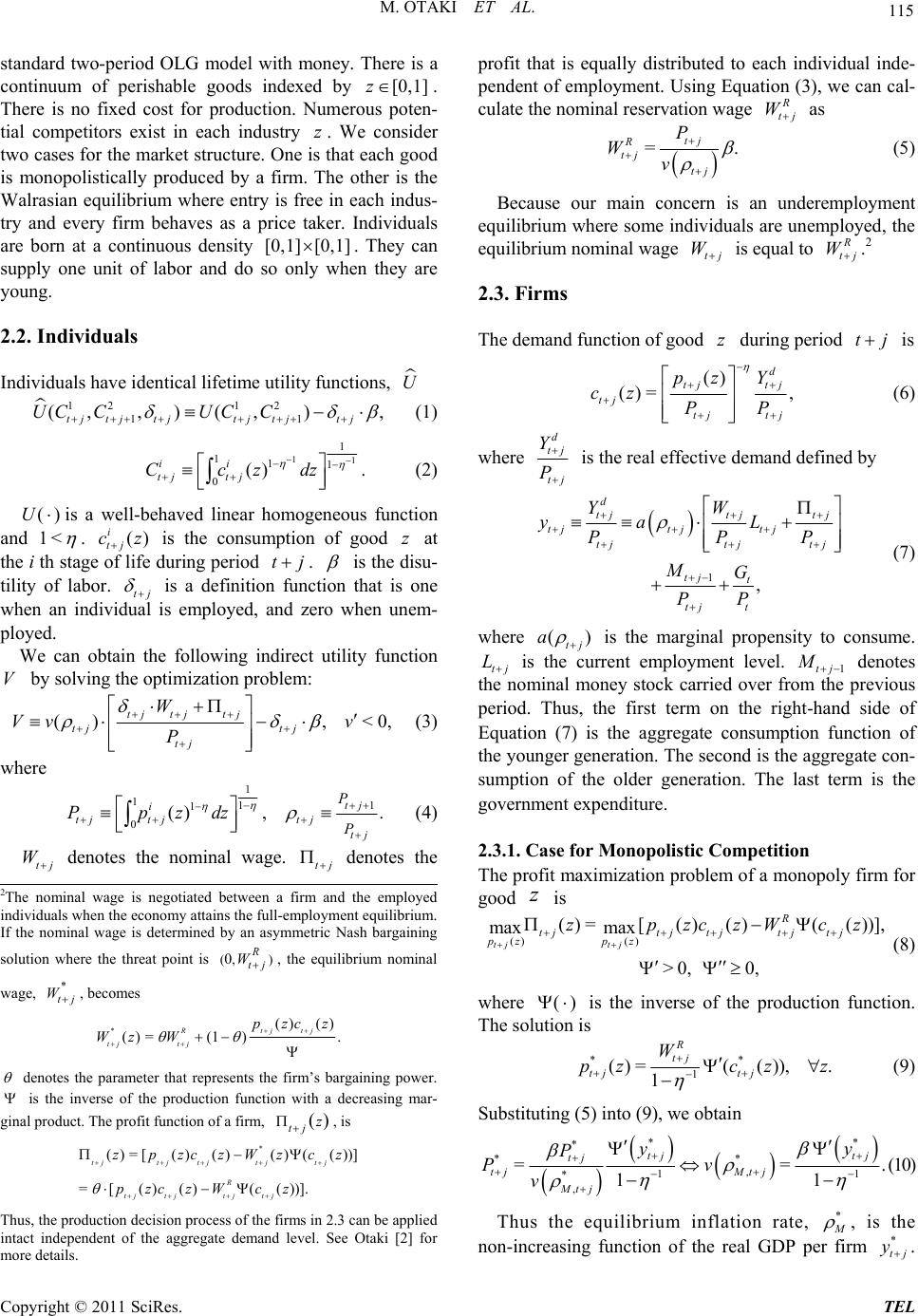 115 M. OTAKI ET AL. standard two-period OLG model with money. There is a continuum of perishable goods indexed by [0,1]z . There is no fixed cost for production. Numerous poten- tial competitors exist in each industry . We consider two cases for the market structure. One is that each good is monopolistically produced by a firm. The other is the Walrasian equilibrium where entry is free in each indus- try and every firm behaves as a price taker. Individuals are born at a continuous density . They can supply one unit of labor and do so only when they are young. z [0[0,1] ,1] 2.2. Individuals Individuals have identical lifetime utility functions, U 12 12 11 (, ,)(, ) tj tjtjtj tjtj UC CUC C, (1) 11 1 111 0() . ii tj tj Cczdz (2) ( )U 1<is a well-behaved linear homogeneous function and . is the consumption of good at the i th stage of life during period . () i tj cz z tj is the disu- tility of labor. tj is a definition function that is one when an individual is employed, and zero when unem- ployed. We can obtain the following indirect utility function by solving the optimization problem: V (), <0 tj tjtj tj tj tj W Vv v P , (3) where 1 11 1 1 0 (),. tj i tjtjtj tj P P Ppzdz (4) tj W denotes the nominal wage. denotes the profit that is equally distributed to each individual inde- pendent of employment. Using Equation (3), we can cal- culate the nominal reservation wage tj R tj W as =. tj R tj tj P Wv (5) Because our main concern is an underemployment equilibrium where some ind ividuals are unemployed, the equilibrium nominal wage is equal to tj W R tj W .2 2.3. Firms The demand function of good during period t zj is () ()= , d tj tj Y PP tj tj tj pz cz (6) where d tj tj Y P is the real effective demand defined by 1 , tj L d tjtj tj tj tj tjtj tj tj t tj t YW ya PPP MG PP ) (7) where ( tj a is the marginal propensity to consume. tj L is the current employment level. 1tj denotes the nominal money stock carried over from the previous period. Thus, the first term on the right-hand side of Equation (7) is the aggregate consumption function of the younger generation. The second is the aggregate con- sumption of the older generation. The last term is the government expenditure. M 2.3.1. Case for Mon opolistic Competition The profit maximization problem of a monopoly firm for good is z 2The nominal wage is negotiated between a firm and the employed individuals when the economy attains the full-employment equilibrium. If the nominal wage is determined by an asymmetric Nash bargaining solution where the threat point is , the equilibrium nominal wage, , becomes (, )0R tj W * tj W *() () ()=(1 ). tj tj R tj tj p zc z Wz W denotes the parameter that represents the firm’s bargaining power. is the inverse of the production function with a decreasing mar- ginal product. The profit function of a firm, , is () tjz * ()=[()()() (())] =[( )()(( ))]. tjtj tjtjtj R tjtjtj tj zpzczWzcz pzczW cz Thus, the production decision process of the firms in 2.3 can be applied intact independent of the aggregate demand level. See Otaki [2]fo r more details. () () ()=[()()( ())], max max > 0, 0, tj tj R tjtjtjtjtj pz pz zpzczWcz (8) where ( ) is the inverse of the production function. The solution is ** 1 ()=( ()),. 1 R tj tj tj W pzcz z (9) Substituting (5) into (9), we obtain ** * ** , 11 *, == 11 tj tj tj tj Mtj Mt j yy P Pv v . (10) Thus the equilibrium inflation rate, * M , is the non-increasing function of the real GDP per firm * tj y . Copyright © 2011 SciRes. TEL 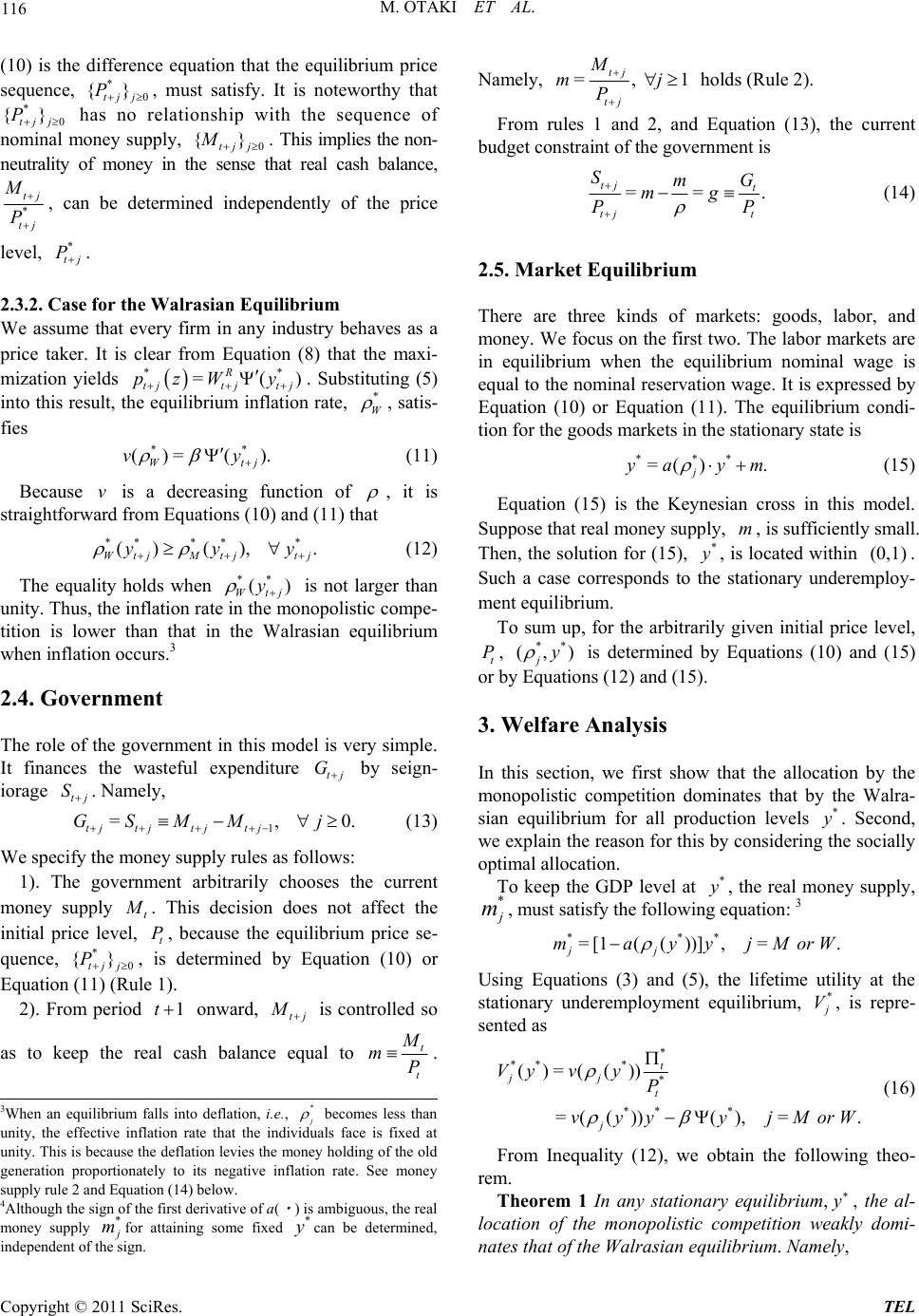 M. OTAKI ET AL. 116 (10) is the difference equation that the equilibrium price sequence, , must satisfy. It is noteworthy that has no relationship with the sequence of nominal money supply, 0. This implies the non- neutrality of money in the sense that real cash balance, *0 {} tjj P *0 {} tjj P {} tjj M * tj tj M P , can be determined independently of the price level, . * t Pj tj 2.3.2. Case for the Walrasian Equilibrium We assume that every firm in any industry behaves as a price taker. It is clear from Equation (8) that the maxi- mization yields . Substituting (5) into this result, the equilibrium inflation rate, ( tj pz y * = R tj W * ) * W , satis- fies * = ( W * . tj y() )v (11) Because is a decreasing function of v , it is straightforward from Equations (10) and (11) that ** () Wt j tj tj GS t ** (), Mtj yy ** ( Wt y 1 = tj tj MM * j tj .y ) 0. (12) The equality holds when is not larger than unity. Thus, the inflation rate in the monopolistic compe- tition is lower than that in the Walrasian equilibrium when inflation occurs.3 j 2.4. Government The role of the government in this model is very simple. It finances the wasteful expenditure by seign- iorage . Namely, tj G t S , j (13) We specify the money supply rules as follows: 1). The government arbitrarily chooses the current money supply M . This decision does not affect the initial price level, , because the equilibrium price se- quence, , is determined by Equation (10) or Equation (11) (Rul e 1). t P *0 {} tjj P t 2). From period onward, is controlled so as to keep the real cash balance equal to 1tj M t t M mP . Namely, =, tj tj M m P 1j holds (Rule 2). From rules 1 and 2, and Equation (13), the current budget constraint of the government is == tj t tj t SG m mg P . P (14) 2.5. Market Equilibrium There are three kinds of markets: goods, labor, and money. We focus on the first two. The labor markets are in equilibrium when the equilibrium nominal wage is equal to the nominal reservation wage. It is expressed by Equation (10) or Equation (11). The equilibrium condi- tion for the goods markets in the stationary state is *** =( ). j ya ym (15) Equation (15) is the Keynesian cross in this model. Suppose that real money supply, , is sufficiently small. Then, the solution for (15), m * y , is located within . Such a case corresponds to the stationary underemploy- ment equilibrium. (0,1) To sum up, for the arbitrarily given initial price level, , is determined by Equations (10) and (15) or by Equations (12) and (15). t P** (,) jy 3. Welfare Analysis In this section, we first show that the allocation by the monopolistic competition dominates that by the Walra- sian equilibrium for all production levels * y . Second, we explain the reason for th is by considering th e socially optimal allocation. To keep the GDP level at * y , the real money supply, * j m, must satisfy the following equation: 3 *** =[1(())= . jj ma yjMor ] ,y W Using Equations (3) and (5), the lifetime utility at the stationary underemployment equilibrium, * j V, is repre- sented as * **** ** * ()=(()) =(())(),= . t jj t j VyvyP vyyy jMorW (16) 3When an equilibrium falls into deflation, i.e., * j becomes less than unity, the effective inflation rate that the individuals face is fixed at unity. This is because the deflation levies the money holding of the old generation proportionately to its negative inflation rate. See money supply rule 2 and Equation (14) below. 4Although the sign of the first derivative of a( ・ ) is ambiguous, the real money supply From Inequality (12), we obtain the following theo- rem. Theorem 1 In any stationary equilibrium, y , the al- location of the monopolistic competition weakly domi- nates that of the Walras ian equilibrium. Namely, * j mfor attaining some fixed * y can be determined, independent of the sign. Copyright © 2011 SciRes. TEL 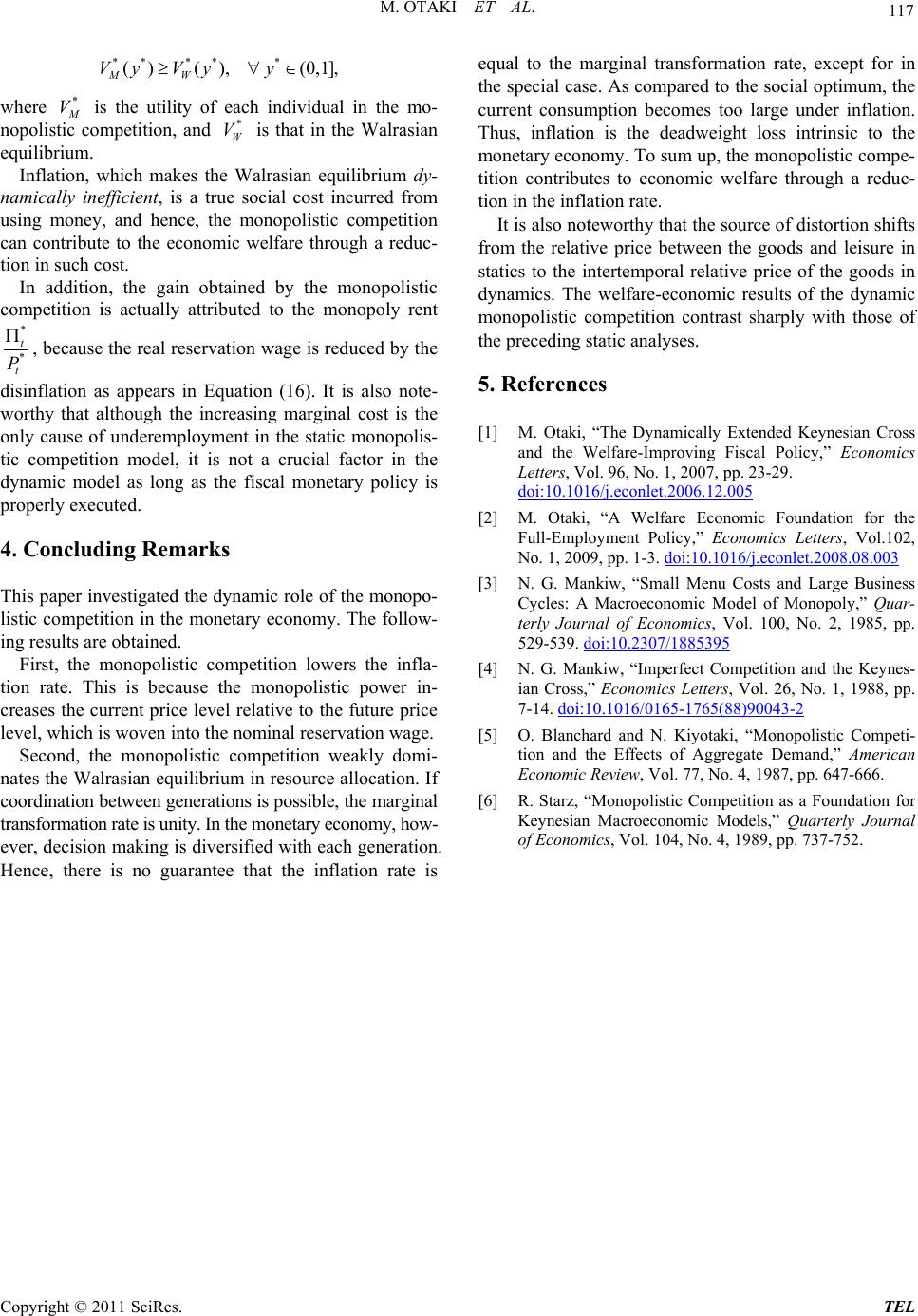 M. OTAKI ET AL. Copyright © 2011 SciRes. TEL 117 ** *** ()(), (0,1], MW Vy Vyy where * M V is the utility of each individual in the mo- nopolistic competition, and is that in the Walrasian equilibrium. * W V Inflation, which makes the Walrasian equilibrium dy- namically inefficient, is a true social cost incurred from using money, and hence, the monopolistic competition can contribute to the economic welfare through a reduc- tion in such cost. In addition, the gain obtained by the monopolistic competition is actually attributed to the monopoly rent * * t t P , because the real reservation wage is reduced by the disinflation as appears in Equation (16). It is also note- worthy that although the increasing marginal cost is the only cause of underemployment in the static monopolis- tic competition model, it is not a crucial factor in the dynamic model as long as the fiscal monetary policy is properly executed. 4. Concluding Remarks This paper investigated the dynamic role of the monop o- listic competition in the monetary economy. The follow- ing results are obtained. First, the monopolistic competition lowers the infla- tion rate. This is because the monopolistic power in- creases the current price level relative to the future price level, which is woven into the nominal reserv ation wage. Second, the monopolistic competition weakly domi- nates the Walrasian equilibrium in resource allocation. If coordination between generations is possible, the marginal transformation rate is unity. In the monetary economy, how- ever, decision making is diversified with each generation. Hence, there is no guarantee that the inflation rate is equal to the marginal transformation rate, except for in the special case. As compared to the social optimum, the current consumption becomes too large under inflation. Thus, inflation is the deadweight loss intrinsic to the mon eta r y e co no my. To su m u p, th e mo no po lis ti c c omp e - tition contributes to economic welfare through a reduc- tion in the inflation rate. It is also noteworthy that the sou rce of distortion sh ifts from the relative price between the goods and leisure in statics to the intertemporal relative price of the goods in dynamics. The welfare-economic results of the dynamic monopolistic competition contrast sharply with those of the preceding static analyses. 5. References [1] M. Otaki, “The Dynamically Extended Keynesian Cross and the Welfare-Improving Fiscal Policy,” Economics Letters, Vol. 96, No. 1, 2007, pp. 23-29. doi:10.1016/j.econlet.2006.12.005 [2] M. Otaki, “A Welfare Economic Foundation for the Full-Employment Policy,” Economics Letters, Vol.102, No. 1, 2009, pp. 1-3. doi:10.1016/j.econlet.2008.08.003 [3] N. G. Mankiw, “Small Menu Costs and Large Business Cycles: A Macroeconomic Model of Monopoly,” Quar- terly Journal of Economics, Vol. 100, No. 2, 1985, pp. 529-539. doi:10.2307/1885395 [4] N. G. Mankiw, “Imperfect Competition and the Keynes- ian Cross,” Economics Letters, Vol. 26, No. 1, 1988, pp. 7-14. doi:10.1016/0165-1765(88)90043-2 [5] O. Blanchard and N. Kiyotaki, “Monopolistic Competi- tion and the Effects of Aggregate Demand,” American Economic Review, Vol. 77, No. 4, 1987, pp. 647-666. [6] R. Starz, “Monopolistic Competition as a Foundation for Keynesian Macroeconomic Models,” Quarterly Journal of Economics, Vol. 104, No. 4, 1989, pp. 737-752. |