

Paper Menu >>
Journal Menu >>
 Psychology 777 2011. Vol.2, No.8, 777-780 Copyright © 2011 SciRes. doi:10.4236/psych.2011.28119 Walking in a Natural Winter Setting to Relieve Attention Fatigue: A Pilot Study Scott Perkins1, H. Russell Searight2, Susan Ratwik2 1Western Kentucky University, Bowling Green, Kentucky, USA; 2Lake Superior State University, Sault Sainte Marie, Michigan, USA. Email: [email protected] Received May 20th, 2011; revised July 27th, 2011; accepted September 15th, 2011. Previous research has suggested that exposure to outdoor surroundings is associated with improved attention and concentration among children with attention deficit hyperactivity disorder (AD/HD). This effect has been attrib- uted to the impact of exposure to “green space” in restoring fatigued attention. Because of concerns about side effects and misuse of stimulant medication, there has been considerable interest in green space exposure as a possible alternative or complementary therapy for ADHD. In the current study, adults completed a 20-minute walk in three types of outdoor settings: a wooded trail, a residential neighborhood, and a parking lot. Participants completed subtests from the Wechsler Memory Scale assessing attention, concentration, and short-term memory as well as the Profile of Mood States, a self-report measure for assessing current emotional status. Based upon previous green space research, it was anticipated that participants in the wooded trail condition would perform better on the cognitive tasks. However, there was no difference between the three conditions in participants’ pre- and post-walk cognitive functioning. When data from the three groups were pooled, there was a significant benefit associated with the 20-minute walk for short-term memory as well in reducing tension, depression, anger, and fatigue. The results do suggest that relatively brief outdoor physical activity may be a useful complementary intervention for persons with conditions adversely affecting short-term memory. Keywords: Attention, Green Space, Complementary and Alternative Therapy Walking in a Natural Winter Setting to Relieve Attention Fatigue Attention Deficit Hyperactivity Disorder (AD/HD), a psy- chiatric condition characterized by significant impairment in attention, concentration, short-term memory as well as disin- hibition and restlessness, affects approximately 5% - 7% of children (Haugaard, 2008). While ranges vary, somewhere between 30% - 60% of these children will continue to exhibit cognitive symptoms in adulthood (Searight, Burke, & Rottnek, 2000). The evidence-based treatment of choice for AD/HD is stimulant medication with possible side effects of hypertension, insomnia, anorexia, and irritability. Because of these adverse effects as well as findings indicating that up to 30% of patients with AD/HD fail to respond to medications such as methyl- phenidate (Searight, Gafford, & Evans, 2009), there has been considerable interest in alternative therapies. ADHD symptoms are generally pervasive―occurring across settings and through the life course. However, persons with this clinical condition do exhibit variability in attention and concen- tration. The factors associated with symptom variability include familiar versus novel environmental stimuli as well as the presence of distractions. Recently, several studies have sug- gested that exposure to outdoor activities may, at least tempo- rarily, improve attention and concentration (Faber, Taylor & Kuo, 2009). This novel approach is based upon Attention Res- toration Theory (ART) which posits that there are two types of attention―voluntary and involuntary (Faber Taylor et al., 2001; Faber Taylor & Kuo, 2009; Tennessen & Cimprich, 1995). Green Space is said to alleviate fatigued voluntary attention by drawing from involuntary attention (Faber Taylor & Kuo, 2009; Tennessen & Cimprich, 1995). Until very recently, research on ART has been somewhat limited and not clinically applied. A limited number of previous studies have shown positive effects of exposure to Green Space in both clinical and non- clinical samples of adults and children (Faber Taylor & Kuo, 2009; Tennessen & Cimprich, 1995). Therefore, the hypothe- sized benefits of green space are not unique to persons with clinically significant deficits but should improve attention and concentration in all individuals. Among children diagnosed with AD/HD, green space expo- sure in warmer climates and seasons has been associated with improved attention (Kuo & Faber Taylor, 2004; Faber Taylor & Kuo, 2009). While some of the evidence for green space’s benefits is cross-sectional such as the survey finding that par- ents of AD/HD children report improved symptoms after ac- tivities conducted in natural “greener” outdoor settings com- pared with indoor settings (Faber Taylor, Koop & Sullivan, 2001; Kuo & Faber Taylor, 2004), a recent study directly ex- amined cognitive functioning. Kuo and Faber Taylor (2009) conducted a within-subjects crossover study comparing the cognitive effects of 20-minute walks in three outdoor settings: downtown, a residential neighborhood, and a park. Based upon the significantly higher score on the Digits Backwards task for the park exposure compared with the other two settings, the green space effect was supported (Kuo & Faber Taylor, 2009). Of interest, the children rated the park exposure more positively than the other two settings. With the growing recognition that AD/HD is a life long con- dition (Searight, Burke, & Rottnek, 2000), a logical extension of research on children and green space is to examine this effect in adults. As noted earlier, given the established efficacy of stimulant medication for treating attentional symptoms in both children and adults, research on alternative strategies has been limited. Additionally, it has only been in the past decade that the chronicity of AD/HD from childhood into adulthood has  S. PERKINS ET AL. 778 been widely accepted. Despite the persistence of AD/HD symptoms into adulthood, there have been few studies of the cognitive effects of green space on older individuals. From the perspective of attention restoration theory, differing environ- ments have varying impact on attentional resources. Settings requiring a higher level of focus and directed attention result in decrements in attentional functioning over time. Green space is believed to be “gently absorbing” and restores involuntary at- tention through its ability to “rest and rejuvenate” (Taylor & Kuo, 2009; p. 403) cognitive functioning. In addition, since green vegetation is climate- and season-dependent in many regions, it would be of interest to examine the cognitive impact of outdoor exposure in winter in a geographic region with four distinct seasons. To date, there has been no research examining whether this effect applies to colder climates or seasons (win- ter/early spring). While there is some support for the green space-attention restoration hypothesis, the mechanism involved is not clear. Of note, Faber Taylor and Kuo (2009) found that participants re- ported a more positive affective experience in the park com- pared with the other two settings. It is possible that the cogni- tive benefits may accrue from exercise and its impact on neural activity or through the psychological benefits of exercise in fostering a sense of well-being. The current study is an attempt to partially replicate and ex- tend Taylor and Kuo’s (2009) finding that a 20 min. walk in a park-like setting (green space) was associated with greater lev- els of improved attention and concentration compared with a walk of the same duration in a downtown or neighborhood setting. In the current study, adults will participate in an outdoor ac- tivity (a walk) in three different locations: a wooded trail, a parking lot, and a mixed residential business neighborhood for a 20 min. interval. Participants will be randomly assigned to only one of these conditions and their attention, concentration, and short-term memory as well as their emotional state will be assessed immediately before and after the activity. As an addi- tional measure, the Wechsler Memory Scale was administered. It has been noted that this test requires more active processing of information than the digit span task and more closely ap- proximates the type of deficits that adults with attentional problems report in their daily lives (Quilan & Brown, 2003). Specifically, it was hypothesized that adults walking in a wooded, partially snow-covered setting would demonstrate greater improvement on the Digit Span and Logical Memory tasks relative to those walking in a paved parking lot or resi- dential/business neighborhood. In addition, since it has been established that aerobic activity has some emotionally benefi- cial effects, we administered the Profile of Mood States (POMS) to all three groups immediately before and after the walk Methods Participants Potential participants were recruited primarily from upper- level undergraduate psychology classes. However, the majority of participants were not psychology majors. A total of 26 par- ticipants, seven male and 19 female university students with an approximate age range of 19 to 24 years, were randomly as- signed to one of the three outdoor conditions: Woods-9; Neigh- borhood-8; Parking Lot-9. Because of scheduling issues, the participants completed the walk in groups of two to four indi- viduals. Participants were instructed not to converse with one another during the guided walk led by the first investigator. Measures Wechsler Memory Scale—Revised: Immediately before and after the walk, all participants were administered the following: three tasks from the Wechsler Memory Scale-Revised (Wechs- ler, 1987) digit span forwards (DSF), digit span backwards (DSB), and logical memory (LM). The digit span tests are sen- sitive to attention and concentration and are frequently used in diagnostic evaluations for AD/HD (Hale, Hoeppner, & Fiorello, 2002). The digit span tasks require the participant to repeat a progressively longer string of numbers immediately after verbal presentation by the examiner with directions to say the numbers in reverse order for the digits backwards task. The number se- quences were taken from the Wechsler Memory Scale-Revised Manual (Wechsler, 1987) for the pretests of the digits forward and backwards. The post-test sequences were generated with a random number table but followed the same presentation for- mat. The Logical Memory (LM) task is used to assess short- term memory. The LM task consists of listening to a short story immediately followed by the instruction to verbally recall the story. A total score is computed based upon the total segments correctly recalled. Two comparable, yet different, stories were administered as pre- and post-tests, respectively. Inter-scorer reliabilities .90 and above have been reported for immediate recall of both forms (Lezak, 1995). The Profile of Mood States: The Profile of Mood States (POMS; McNair, Lorr, & Droppleman, 2005) is one of the most commonly employed affective state measures in exercise and sports psychology. The POMS was developed to assess affective states and short-term changes in emotion. Items are rated on a five point scale and grouped into six dimensions: Tension-Anxiety (T), Depression-Dejection (D), Anger-Hostil- ity (A), Vigor-Activity (V), Fatigue-Inertia (F), and Confusion- Bewilderment (C). The POMs is administered with participants being asked to rate their emotional state with respect to a spe- cific time frame typically ranging from the past week to imme- diate present (McNair, Lorr, & Droppleman, 2005). Internal consistency reliabilities range from .65 to .74 (Hansen, Stevens, & Coast, 2001). Factor analytic studies have yielded six dimen- sions with content generally consistent with the subscale names noted above (Nyenhuis, Yamamoto, Luchetta, Terrien & Par- mentier, 1991). Procedure Participants were randomly assigned to one of the three treatment groups by way of a random number table. Based on availability, participants completed the protocol on a weekday beginning as early as 1:00 p.m. and ending as late as 7:00 p.m. Participants were tested individually. Prior to the walk, the participants completed the POMS, background information questionnaire, and the consent document. In addition, the first author administered the digit span forwards, digit span back- wards and logical memory tests. Immediately after testing, the participants were taken on a guided 20-minute walk in groups of two to four persons, at a moderate pace and generally level terrain, for each treatment group. Participants were instructed not to converse with one another during the guided walk led by the first investigator. The completion of the post-walk POMS and cognitive tasks followed the same order as the pre-testing. Results Review of the data set resulted in the removal of one Neigh- 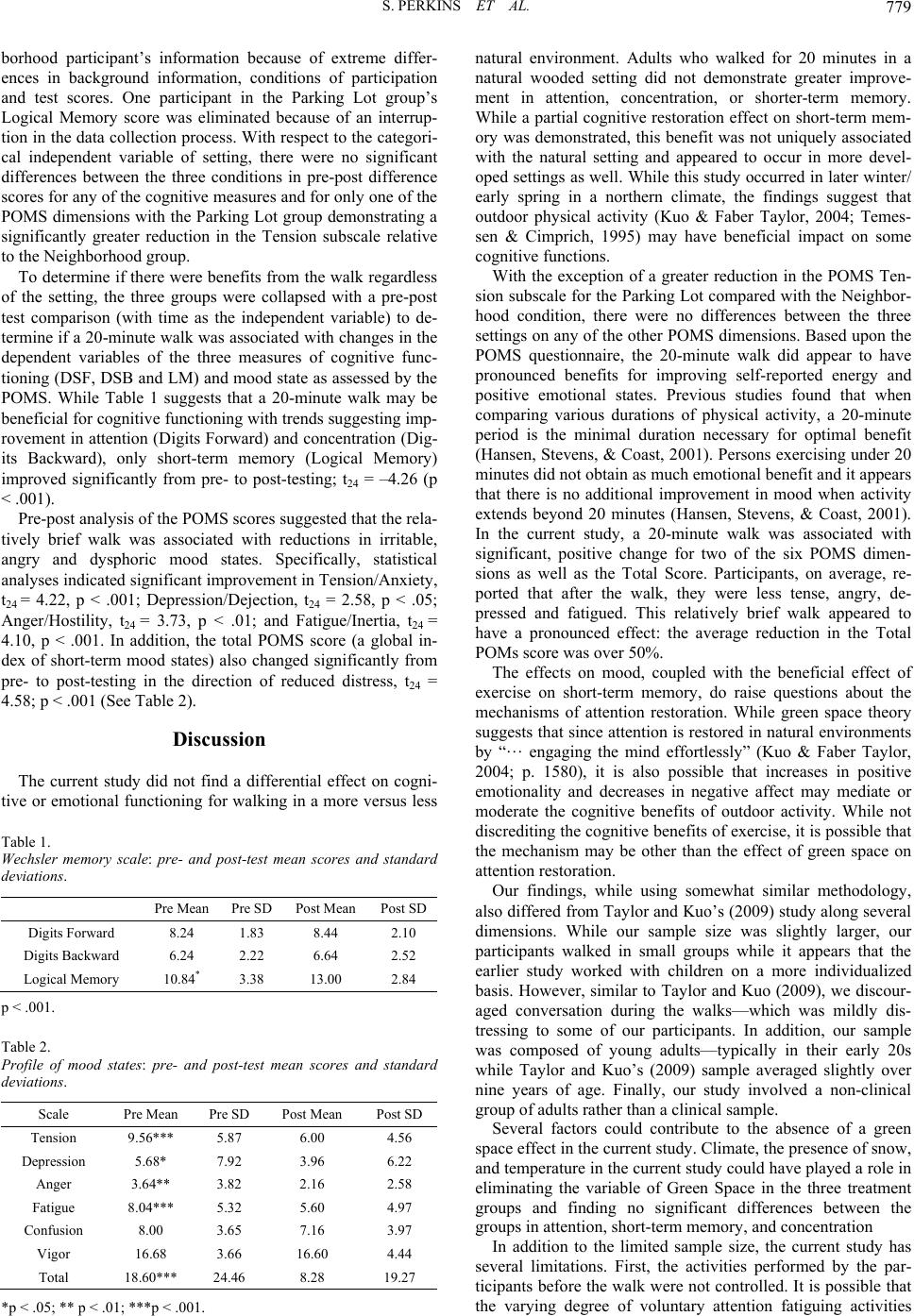 S. PERKINS ET AL. 779 borhood participant’s information because of extreme differ- ences in background information, conditions of participation and test scores. One participant in the Parking Lot group’s Logical Memory score was eliminated because of an interrup- tion in the data collection process. With respect to the categori- cal independent variable of setting, there were no significant differences between the three conditions in pre-post difference scores for any of the cognitive measures and for only one of the POMS dimensions with the Parking Lot group demonstrating a significantly greater reduction in the Tension subscale relative to the Neighborhood group. To determine if there were benefits from the walk regardless of the setting, the three groups were collapsed with a pre-post test comparison (with time as the independent variable) to de- termine if a 20-minute walk was associated with changes in the dependent variables of the three measures of cognitive func- tioning (DSF, DSB and LM) and mood state as assessed by the POMS. While Table 1 suggests that a 20-minute walk may be beneficial for cognitive functioning with trends suggesting imp- rovement in attention (Digits Forward) and concentration (Dig- its Backward), only short-term memory (Logical Memory) improved significantly from pre- to post-testing; t24 = –4.26 (p < .001). Pre-post analysis of the POMS scores suggested that the rela- tively brief walk was associated with reductions in irritable, angry and dysphoric mood states. Specifically, statistical analyses indicated significant improvement in Tension/Anxiety, t24 = 4.22, p < .001; Depression/Dejection, t24 = 2.58, p < .05; Anger/Hostility, t24 = 3.73, p < .01; and Fatigue/Inertia, t24 = 4.10, p < .001. In addition, the total POMS score (a global in- dex of short-term mood states) also changed significantly from pre- to post-testing in the direction of reduced distress, t24 = 4.58; p < .001 (See Table 2). Discussion The current study did not find a differential effect on cogni- tive or emotional functioning for walking in a more versus less Table 1. Wechsler memory scale: pre- and post-test mean scores and standard deviations. Pre Mean Pre SD Post Mean Post SD Digits Forward 8.24 1.83 8.44 2.10 Digits Backward 6.24 2.22 6.64 2.52 Logical Memory 10.84* 3.38 13.00 2.84 p < .001. Table 2. Profile of mood states: pre- and post-test mean scores and standard deviations. Scale Pre Mean Pre SD Post Mean Post SD Tension 9.56*** 5.87 6.00 4.56 Depression 5.68* 7.92 3.96 6.22 Anger 3.64** 3.82 2.16 2.58 Fatigue 8.04*** 5.32 5.60 4.97 Confusion 8.00 3.65 7.16 3.97 Vigor 16.68 3.66 16.60 4.44 Total 18.60*** 24.46 8.28 19.27 *p < .05; ** p < .01; ***p < .001. natural environment. Adults who walked for 20 minutes in a natural wooded setting did not demonstrate greater improve- ment in attention, concentration, or shorter-term memory. While a partial cognitive restoration effect on short-term mem- ory was demonstrated, this benefit was not uniquely associated with the natural setting and appeared to occur in more devel- oped settings as well. While this study occurred in later winter/ early spring in a northern climate, the findings suggest that outdoor physical activity (Kuo & Faber Taylor, 2004; Temes- sen & Cimprich, 1995) may have beneficial impact on some cognitive functions. With the exception of a greater reduction in the POMS Ten- sion subscale for the Parking Lot compared with the Neighbor- hood condition, there were no differences between the three settings on any of the other POMS dimensions. Based upon the POMS questionnaire, the 20-minute walk did appear to have pronounced benefits for improving self-reported energy and positive emotional states. Previous studies found that when comparing various durations of physical activity, a 20-minute period is the minimal duration necessary for optimal benefit (Hansen, Stevens, & Coast, 2001). Persons exercising under 20 minutes did not obtain as much emotional benefit and it appears that there is no additional improvement in mood when activity extends beyond 20 minutes (Hansen, Stevens, & Coast, 2001). In the current study, a 20-minute walk was associated with significant, positive change for two of the six POMS dimen- sions as well as the Total Score. Participants, on average, re- ported that after the walk, they were less tense, angry, de- pressed and fatigued. This relatively brief walk appeared to have a pronounced effect: the average reduction in the Total POMs score was over 50%. The effects on mood, coupled with the beneficial effect of exercise on short-term memory, do raise questions about the mechanisms of attention restoration. While green space theory suggests that since attention is restored in natural environments by “… engaging the mind effortlessly” (Kuo & Faber Taylor, 2004; p. 1580), it is also possible that increases in positive emotionality and decreases in negative affect may mediate or moderate the cognitive benefits of outdoor activity. While not discrediting the cognitive benefits of exercise, it is possible that the mechanism may be other than the effect of green space on attention restoration. Our findings, while using somewhat similar methodology, also differed from Taylor and Kuo’s (2009) study along several dimensions. While our sample size was slightly larger, our participants walked in small groups while it appears that the earlier study worked with children on a more individualized basis. However, similar to Taylor and Kuo (2009), we discour- aged conversation during the walks—which was mildly dis- tressing to some of our participants. In addition, our sample was composed of young adults—typically in their early 20s while Taylor and Kuo’s (2009) sample averaged slightly over nine years of age. Finally, our study involved a non-clinical group of adults rather than a clinical sample. Several factors could contribute to the absence of a green space effect in the current study. Climate, the presence of snow, and temperature in the current study could have played a role in eliminating the variable of Green Space in the three treatment groups and finding no significant differences between the groups in attention, short-term memory, and concentration In addition to the limited sample size, the current study has several limitations. First, the activities performed by the par- ticipants before the walk were not controlled. It is possible that the varying degree of voluntary attention fatiguing activities  S. PERKINS ET AL. 780 within an hour before the experiment could have impacted the results. Again, Taylor and Kuo (2009) had all of their young participants complete puzzles immediately prior to the walk. If outdoor activity does have an attention restorative effect, the impact of the walk on the measures of attention and concentra- tion may have been more pronounced if all of our participants had performed a voluntary attention fatiguing task immediately beforehand. Another possible limitation is that while our par- ticipants were tested individually, they walked, with the first author, in groups of two to four persons. Immediately before beginning the walk, the first author did instruct the groups to keep conversation to a minimum. Anecdotally, as noted above, many of the participants indicated that they found that inhibit- ing talking during the walk required effort. This inhibitory ac- tivity could have offset the cognitive benefits of the walk, itself. Finally, the number of participants in each group could have been too small to demonstrate an effect by group for the bene- fits of outdoor activity on attention and concentration. There are a number of unanswered questions about the ef- fects of Green Space on outdoor exercise on attention. For ex- ample, the duration of the beneficial effects of physical activity on cognitive functioning is unknown. In addition, while the duration of physical activity for improving mood has been es- tablished, the optimal length of time for physical activity to improve cognitive functioning has yet to be determined. Vary- ing treatment times or intensities of outdoor activities should be tested to find the type and length of treatment that will maxi- mize benefits. Finally, the role of transient mood states, the impact of various exercise settings, and participant age should also be examined further. References Faber Taylor, A., Kuo, F. E., & Sullivan, W. C. (2001). Coping with ADD: The surprising connection to green play settings. Environment and Behavior, 33, 54-77. doi:10.1177/00139160121972864 Faber Taylor, A., & Kuo, F. E. (2009). Children with attention deficits concentrate better after walk in the park. Journal of Attention Disor- ders, 12, 402-409. doi:10.1177/1087054708323000 Hale, J. B., Hoeppner, J. B., & Fiorello, C. A. (2002). Analyzing digit span components for assessment of attention processes. Journal of Psychoeducational Assessment, 20, 128-143. doi:10.1177/073428290202000202 Hansen, C. J., Stevens, L.C., & Coast, J. R. (2001). Exercise duration and mood state: How much is enough to feel better? Health Psy- chology, 20, 267-275. doi:10.1037/0278-6133.20.4.267 Haugaard, J. J. (2008). Child ps yc ho pathology. Boston: McGraw-Hill. Kuo, F. E., & Faber Taylor, A. (2004). A potential natural treatment for attention-deficit/hyperactivity disorder: Evidence from a national study. American Journal of Public Health, 94, 1580-1586. doi:10.2105/AJPH.94.9.1580 Lezak, M. D. (1995). Neuropsychological assessment (3rd ed.). New York: Oxford. McNair, D. M., Lorr, M., & Droppleman, L. F. (2005). POMS. Profile of mood states manual. New York: MHS. Nyenhuis, D. L., Yamamoto, C., Luchetta, T., Terrien, A., & Parmen- tier, A. (1999). Adult and geriatric normative data and validation of the profile of mood states. Journal of Clinical Psychology, 55, 79-86. doi:10.1002/(SICI)1097-4679(199901)55:1<79::AID-JCLP8>3.0.CO ;2-7 Searight, H. R., Burke, J. M., & Rottnek, F. (2000). Adult ADHD: Evaluation and treatment in family medicine. American Family Phy- sician, 62, 2077-2086. Searight, H. R., Gafford, J., & Evans, S. (2009). Attention deficit hy- peractivity disorder (AD/HD). In M. Mengel and P. Schwiebert (Eds.), Family Medicine: Ambulatory Care and Prevention (pp. 612-628). New York: Mc-Graw-Hill. Tennessen, C. M., & Cimprich, B. (1995). Views to nature: Effects on attention. Journal of Environmental Psychology, 15, 77-85. doi:10.1016/0272-4944(95)90016-0 Wechsler, D. (1987). Wechsler memory scale-revised manual. San Antonio: The Psychological Corporation. |