

Paper Menu >>
Journal Menu >>
 Journal of Environmental Protection, 2011, 2, 1257-1263 doi:10.4236/jep.2011.29145 Published Online November 2011 (http://www.scirp.org/journal/jep) Copyright © 2011 SciRes. JEP Key Vulnerabilities and Limitations in the Management of Hazardous Waste and Its Disposal: A Checklist Assessment Tool Rob White, Diane Heckenberg School of Sociology and Social Work, University of Tasmania, Hobart, Australia. Email: [email protected] Received September 9th, 2011; revised October 6th, 2011; accepted November 5th, 2011. ABSTRACT From an environmental protection perspective, the crucial issues pertaining to the policing of hazardous waste relate to both the vulnerabilities and limitations of current practices, and the potential issues that demand attention in the here and now, to alleviate future calamity. This paper describes the process involved in developing a vulnerabilities and limitations checklist th at provides a relatively simple yet multi-pronged approach to assessing present and future envi- ronmental harms and crimes with in the hazardous waste sector . Although it was not the intention of the authors to de- velop a gener ic checklist, this tool may prove useful to other industry sectors. Keywords: Hazardous W a st e , Vulnerabilities Checklist, Environmental Crime 1. Introduction From a criminal justice perspective, environmental pro- tection is intimately linked to issues pertaining to crime, criminality and the potential to do harm. The waste ma- nagement area presents numerous opportunities for crime [1]. This is acknowledged by the illegitimate interna- tional trade and transportation of hazardous wastes [2], the role of organized criminal syndicates in waste mana- gement [3], and the illegal dumping of waste by legiti- mate corporations [4,5]. The very nature of the industry—getting rid of some- times dangerous substances at a competitive price – clearly opens up the prospect of wrongdoing [5]. What is meant by hazardous waste, and the links be- tween disposal of hazardous waste and specifically cri- minal activity, warrants closer scrutiny. Certainly from a criminological perspective, there is little knowledge of the scale of the problem in Australia, the types of crimi- nality involved, or the precise nature of disposal (e.g., illegal dumping, combining illegal with legal waste, il- legal export). Aside from an investigation by the Austra- lian Crime Commission (unpublished) and a recently released report by the Australian Institute of Criminology [6] few police investigators or academic researchers have examined the policing of hazardous waste disposal in the Australian context. Findings by Bricknell [6] are consistent with the in- ternational literature that indicates that there is a rela- tionship between hazardous waste disposal and orga- nized crime. Waste disposal management has been infiltrated over- seas by organized criminals and the business of dumping waste in Australia is not immune to similar penetration. The available evidence for an association with organized crime is presently anecdotal and specifics are lacking. However, the structure of the system, the ease in which waste can be transferred and the apparent formation of alliances between operators already working on the frin- ges of legal activity, makes it one of the likelier candi- dates for organized criminal activity (AIC Roundtable participant’s personal communications 2009, cited in [6]. In 2001, the Independent Commission Against Cor- ruption (ICAC) [7] conducted a strategic assessment of the New South Wales waste sector to identify the associ- ated corruption risks. The assessment identified a num- ber of issues and corruption-related risks that needed to be addressed, for the following reasons: there is a history, internationally, of unscrupulous operators, behaviour has included threats and intimi- dation. Locally, there have been a number of cases of corrupt conduct in the industry [7]. many different organisations are involved in the in-  Key Vulnerabilities and Limitations in the Management of Hazardous Waste and Its Disposal: 1258 A Checklist Assessment Tool dustry ranging from small one-person operations to transnational companies [7]. the industry as a whole lacks a cohesive structure and tends to be ad hoc in focus and management [7]. The assessment also found that ‘the waste sector ex- hibits a number of what ICAC termed “higher risk func- tions” including: Government’s role in the waste sector beyond estab- lishing the statutory framework involves public offi- cials regulating the industry by monitoring compli- ance with planning and environmental protection leg- islation (corruption risk: regulatory activity) [7]. Local councils are involved in supplying an essential service, waste collection, where demand can only be met by entering large and long-term collection con- tracts (corruption risk: allocation of scarce resource) [7]. State and local government are involved in multi- million dollar contracts with the private sector to ma- nage the collection, transportation and processing of waste (corruption risk: contracting) [7]. Significant amounts of business on waste transfer and waste disposal facilities are conducted for cash (cor- ruption risk: cash handling) [7]. Over the past few years, the ICAC has worked on many cases of corruption or potential corruption in vari- ous aspects of the waste sector. The allegations they have received often refer to favouritism when tendering or contracting for waste management services. Other com- mon allegations include: misuse or theft of public resources, failure to make or keep proper records, fraudulently altering records (such as the tare weight for trucks entering and leaving tip sites), and bribery and collusion between interested parties [7]. 2. Our Study Comments by participants in our study of the hazardous waste sector in Australia acknowledge the sector’s vulne- rability and demonstrate awareness of the largely anec- dotal evidence of organised crime in the sector, as well as the characteristics of perpetrators generally associated with the industry When you put it all together the industry is open to ex- ploitation—if you want to do it you can, if you do get caught you are going to get away with it (Participant, Na- tional Study) The rumour-mill suggests there is organized crime (Participant, National Study) There are organized individuals rather than organized crime—that is organized in their behavior—exploiting the industry (Participant, National Study) The United Kingdom Serious Organised Crime Agen- cy (SOCA) [8] describes the types of perpetrators and diverse relationships that characterise organised crime and organised criminal activities. Organised crime is defined as “those involved, nor- mally working with others, in continuing serious cri- minal activities for substantial profit, whether based in the UK or elsewhere”. Organised criminals that work together for the duration of a particular criminal ac- tivity or activities are what we call an organised cri- me group [8]. Organised crime group structures vary. Successful organised crime groups often consist of a durable core of key individuals. Around them, there’s a clus- ter of subordinates, specialists, and other more tran- sient members, plus an extended network of dispos- able associates [8]. Many groups are in practice loose networks of crimi- nals that come together for the duration of a criminal activity, acting in different roles depending on their skills and expertise. Collaboration is reinforced by shared experiences (such as prison), or recommenda- tion from trusted individuals. Others are bonded by family or ethnic ties—some “crime families” are pre- cisely that [8]. Organised criminals make use of specialists who pro- vide a service, sometimes to a range of crime gangs. Services include transport, money laundering, debt enforcement, or the provision of false documentation (identity crime underpins a wide variety of organised criminal activities) [8]. In addition, secondary, but no less serious crimes oc- cur in conjunction with organized crime and waste dis- posal, such as the falsification of documentation and the clandestine processing of profits. This is illustrated in the following observation: Money laundering is also rife among European crimi- nal organisations involved in waste disposal and wildlife trafficking. The nature of these crimes implies a level of organised criminal contribution and, in some instances, there is. Hayman and Brack’s (2002:7) analysis, however, suggests that the majority of environmental crime is per- petrated by “loosely organised networks of individuals with some specialist knowledge”. These networks can still be intricately woven, particularly the chain(s) of connec- tion between the middle-men or suppliers [6]. As an initial example of why all of this is important Vander Beken and Balcaen [9] illustrate in Table 1 the key opportunities for crime in the waste cycle. Drawing on this type of background information and informed more specifically by the European literature on waste management, we began building a picture of the C opyright © 2011 SciRes. JEP  Key Vulnerabilities and Limitations in the Management of Hazardous Waste and Its Disposal: 1259 A Checklist Assessment Tool Table 1. Risks in the Waste Cycle. Illegal storage In cases where an empty hangar is found filled with tyres or some other waste product with no trace of the owner of the hangar, the work of a crime group is suspected Transboundary shipment/trafficking in toxic waste Waste cycle is vulnerable to trafficking at 3 different stages: 1) Initial transfer—from producer to firm specialising in waste management 2) Transit phase—transport and storage activities can be run illegally, inspection of storage sites may be sporadic 3) Destination stage—treatment, recycling and final disposal—illicit practices mean the waste ends up elsewhere Illegal dumping of domestic, municipal and industrial wastes Criminal groups take payment for disposal of the waste but dump it illegally Illegal dumping of hazardous waste Illegal dumping of hazardous waste is an activity in which the involvement of crime groups can be identified Source: Vander Beken and Balcaen (2006, pp. 304-305) [9]. overall vulnerability of the sector. This was achieved by gradually layering on top of the available overseas infor- mation, relevant observations from reports at State and Local level within Australia. We then added preliminary information from our present study (2011), gathered dur- ing informal discussions with participants from the states of Queensland, Tasmania, Victoria and Canberra. Four Perspectives Four geographical perspectives were considered in de- veloping the vulnerabilities and limitations checklist tool for the management of hazardous waste. Presented below, these four perspectives are based upon the following sources of information and insight. 1) International/Regional Informed by the European literature on the vulnerabi- lity and regulation of the hazardous waste sector [1,9,10]. 2) State Informed by two key reports—the 2010 Victorian Auditor-General’s report on a State Regulator [11] and the Ombudsman Victoria’s 2010 report on a municipal landfill [12]. 3) Local Informed by the 2002 Independent Commission Against Corruption report [7] report on a Municipal operator/ regulator. 4) National Informed by findings from preliminary discussions with a representative of the Australian Crime Commission and 17 participants from Canberra, Brisbane, Melbourne and Hobart involved in regulating hazardous waste disposal in Australia at international, national and state levels. The information gathered above, together with litera- ture and reports on organized crime and waste-specific crimes, informs the list of limitations and vulnerabilities presented in this paper. Our idea was to develop a tool to assess overall environmental regulatory performance specifically in relation to the management of hazardous waste and its disposal, although the list may be useful for other assessment purposes pertaining to environmental protection as well. The development process began with exploring defi- nitions of organized crime, the nature of organized cri- minal groups, key motivations for organized criminals to infiltrate companies, the characteristics of organizations that are vulnerable to infiltration [6,8,13-21], the modus operandi of crime and criminals in other domains such as the black market in tiger products in China [13]; issues surrounding the global movement of electronic waste [22] and issues related to corruption [7,23]. Drawing from the European literature on the vulner- ability of the hazardous waste sector to organized crime as well as the risks inherent in the waste cycle [1,9,10] we formulated a preliminary list of ten key vulnerabili- ties. A 2007 study [5], for instance, notes various vulne- rabilities, such as “the conflict between economic and environmental interests which creates incentive for ille- gal profit maximization”; “a corporate culture that con- siders protection of the environment to be less important than profits” [5] “the considerable savings to be made by illegal disposal” [5]; unfair competition and declining prices which act as deterrents to new [legitimate] market entrants, as well as a market that becomes unattractive to new entrepreneurs because of its bad reputation [5]. This literature provided the first ten vulnerabilities. 1) Economics versus ecology; 2) Nature and value of waste; 3) Legislative ambiguity; 4) Complex regulatory environment; 5) Regulatory capture; 6) Waste classification; 7) Compliance rather than enforcement; 8) Systems and processes; 9) Risks in the waste cycle; 10) Prosecution, sentencing and greening of the judi- ciary; The focus then turned to Australia and a 2010 Victo- rian Auditor General’s Report [11] on a State Environ- mental Protection Agency, and the 2010 Ombudsman Victoria’s Report [12] on a state municipal landfill, which added two further vulnerabilities: 11) Information management; 12) Governance; A review of the 2002 Independent Commission Against Corruption Report [7] concerning corruption risks at lo- Copyright © 2011 SciRes. JEP  Key Vulnerabilities and Limitations in the Management of Hazardous Waste and Its Disposal: 1260 A Checklist Assessment Tool cal municipal level, in particular the “corruption risks in a nutshell” (which includes attributes such as: attitude to- wards waste, nature of the waste sector, value of waste, complex regulatory environment, conflicting roles of government, risk and regulatory functions, waste classi- fication, new technology and new markets, grants admi- nistration, tendering for waste services, contract admini- stration and audit, dealing with poor contractor perform- ance, public sector values and business ethics, threats to regulators, detecting illegally dumped waste, cash hand- ling at facilities and bypassing weighbridge procedures) reaffirmed the above 12 vulnerabilities and contributed a further two: 13) Conflicts of interest; 14) Monitoring contractor performance; Finally, the thematic coding of preliminary findings from informal discussions with the participants in our study—against the 14 indicators above—added a further four vulnerabilities. 15) Investigatory capacity and expertise; 16) Resources; 17) Collaboration; 18) Politicization. At this point it became clear that several of the indi- cators could more accurately be described as limitations (drawbacks) rather than vulnerabilities (exposure). From there it was a matter of systematically examining and refining the definitions for each indicator. These 18 vu- lnerabilities and limitations are defined in Table 2. In turn, the 18 indicators can be utilized as an organiza- tional diagnostic tool—namely a checklist—for rapid assessment of vulnerabilities and limitations in a parti- cular jurisdiction, as illustrated in Table 3. 3. Looking to the Future The checklist tool presented above can be used to evalu- ate existing regulatory practices. It would also be of va- lue at some stage to further develop the ideas implicit within this assessment tool into an integrated theoretical model. Similarly, the tool could be coupled with horizon scanning for the purposes of forward planning [26]. For example, the use and need for horizon scanning as an intellectual exercise and planning tool is related to the idea that ‘many threats and opportunities are presently poorly recognized’ [24]. Accordingly a more systematic approach to identification nd solution of issues is re- quired, rather than reliance upon ad hoc or reactive approaches. For example, “the need for horizon scanning of environmental issues is illustrated by the recent failure to foresee both the widespread adoption of the range of bio-fuels currently in use, and the environmental conse- quences of bio-fuels production” [25]. Horizon scanning can provide insight into risks (potential problems) and harms (actual problems). Coupled with concepts such as paradoxical harm (refers to apparently contradictory yet consciously chosen forms of harm), and the mobility of harm (transference), horizon scanning provides a mecha- nism to discern where emerging threats (and positive opportunities) may arise and potential strategies for mi- tigating or adapting to these [26]. One emerging issue on a global scale is industrial Table 2. Key Vulnerabilities & Limitations. Economics versus ecology Conflict between economic and environmental interests creates incentives for illegal profit maximization Characteristics of waste Crime risks vary according to the type of product Legislative definitions New definitions of waste that open up opportunities for crime Complex Regulatory Environment Conditions under which regulation takes place Regulatory Capture Regulators compromised by those they regulate Waste Classification Ambiguity as to which wastes are hazardous Compliance rather than enforcement Administrative controls focused on licensing and site inspections, rather than enforcement Simplification of procedures Procedural changes, including simplification and streamlining that create opportunities for illegal activities Risks inherent in the Waste Cycle Vulnerability to illegality and illegal dumping Prosecution & Sentencing Environmental crime is not “real crime” Information Management All the systems and processes for the creation, distribution, use, storage and retrieval of information Governance Effective and efficient management practices and general processes of ethical governance Conflicts of Interest Pressures on organizational unit to perform multiple roles and attempt to service various constituencies at the same time Monitoring Contractor Performance Ongoing monitoring and assessment of performance over time and relative to regulatory frameworks Investigatory Capacity and Expertise Considerable variation in pre-service and in-service training, and in use of coercive and investigatory powers Resources Inadequate funding and personnel to meet current regulatory challenges Collaboration Nature of partnerships and partnership practices both in terms of horizontal (across diverse agencies and occupational spheres) and vertical (top-bottom interaction) collaboration Politicization Influence of powerful sectional interests on regulatory processes and outcome C opyright © 2011 SciRes. JEP 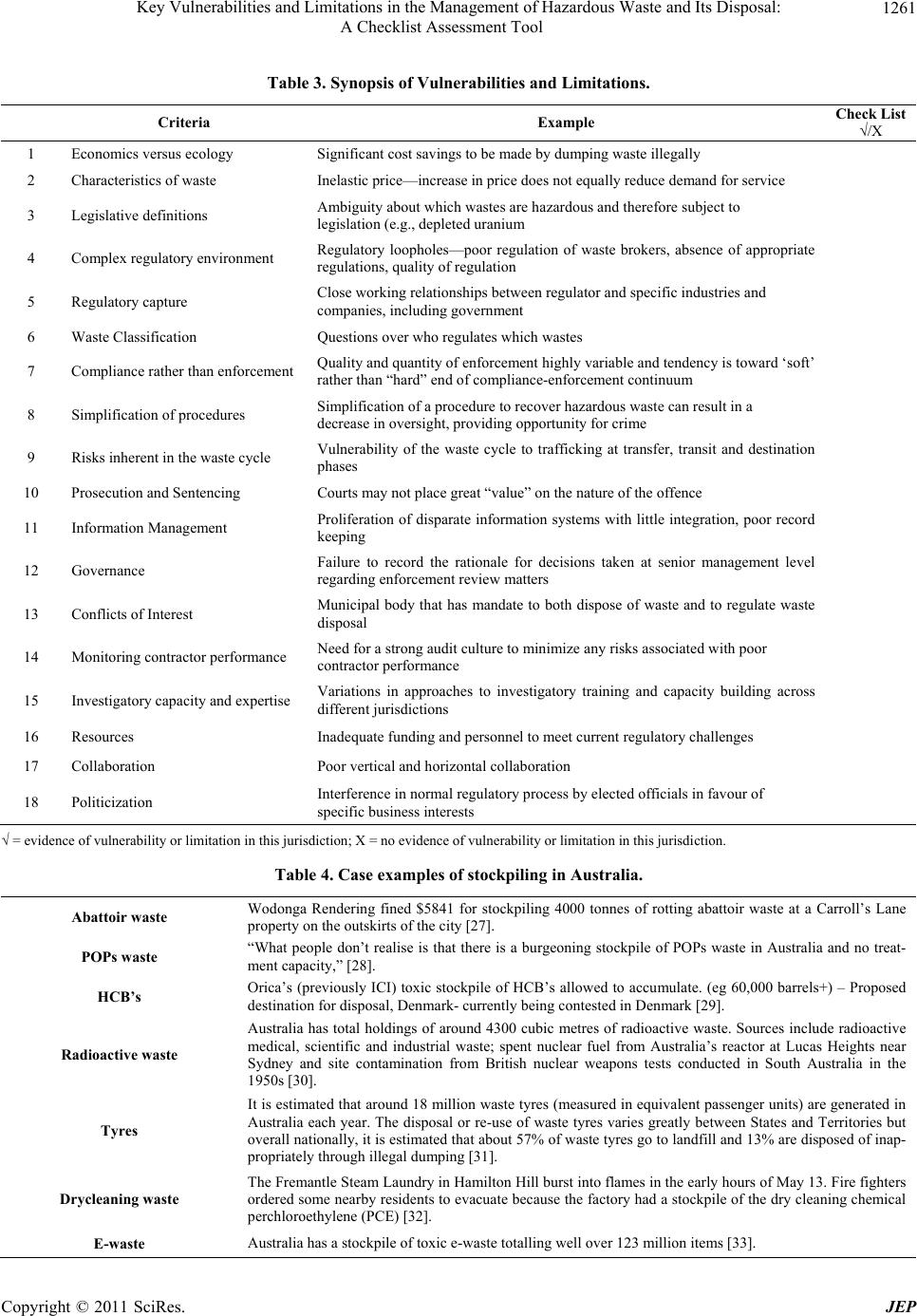 Key Vulnerabilities and Limitations in the Management of Hazardous Waste and Its Disposal: A Checklist Assessment Tool Copyright © 2011 SciRes. JEP 1261 Table 3. Synopsis of Vulnerabilities and Limitations. Criteria Example Check List √/X 1 Economics versus ecology Significant cost savings to be made by dumping waste illegally 2 Characteristics of waste Inelastic price—increase in price does not equally reduce demand for service 3 Legislative definitions Ambiguity about which wastes are hazardous and therefore subject to legislation (e.g., depleted uranium 4 Complex regulatory environment Regulatory loopholes—poor regulation of waste brokers, absence of appropriate regulations, quality of regulation 5 Regulatory capture Close working relationships between regulator and specific industries and companies, including government 6 Waste Classification Questions over who regulates which wastes 7 Compliance rather than enforcement Quality and quantity of enforcement highly variable and tendency is toward ‘soft’ rather than “hard” end of compliance-enforcement continuum 8 Simplification of procedures Simplification of a procedure to recover hazardous waste can result in a decrease in oversight, providing opportunity for crime 9 Risks inherent in the waste cycle Vulnerability of the waste cycle to trafficking at transfer, transit and destination phases 10 Prosecution and Sentencing Courts may not place great “value” on the nature of the offence 11 Information Management Proliferation of disparate information systems with little integration, poor record keeping 12 Governance Failure to record the rationale for decisions taken at senior management level regarding enforcement review matters 13 Conflicts of Interest Municipal body that has mandate to both dispose of waste and to regulate waste disposal 14 Monitoring contractor performance Need for a strong audit culture to minimize any risks associated with poor contractor performance 15 Investigatory capacity and expertise Variations in approaches to investigatory training and capacity building across different jurisdictions 16 Resources Inadequate funding and personnel to meet current regulatory challenges 17 Collaboration Poor vertical and horizontal collaboration 18 Politicization Interference in normal regulatory process by elected officials in favour of specific business interests √ = evidence of vulnerability or limitation in this jurisdiction; X = no evidence of vulnerability or limitation in this jurisdiction. Table 4. Case examples of stockpiling in Australia. Abattoir waste Wodonga Rendering fined $5841 for stockpiling 4000 tonnes of rotting abattoir waste at a Carroll’s Lane property on the outskirts of the city [27]. POPs waste “What people don’t realise is that there is a burgeoning stockpile of POPs waste in Australia and no treat- ment capacity,” [28]. HCB’s Orica’s (previously ICI) toxic stockpile of HCB’s allowed to accumulate. (eg 60,000 barrels+) – Proposed destination for disposal, Denmark- currently being contested in Denmark [29]. Radioactive waste Australia has total holdings of around 4300 cubic metres of radioactive waste. Sources include radioactive medical, scientific and industrial waste; spent nuclear fuel from Australia’s reactor at Lucas Heights near Sydney and site contamination from British nuclear weapons tests conducted in South Australia in the 1950s [30]. Tyres It is estimated that around 18 million waste tyres (measured in equivalent passenger units) are generated in Australia each year. The disposal or re-use of waste tyres varies greatly between States and Territories but overall nationally, it is estimated that about 57% of waste tyres go to landfill and 13% are disposed of inap- propriately through illegal dumping [31]. Drycleaning waste The Fremantle Steam Laundry in Hamilton Hill burst into flames in the early hours of May 13. Fire fighters ordered some nearby residents to evacuate because the factory had a stockpile of the dry cleaning chemical perchloroethylene (PCE) [32]. E-waste Australia has a stockpile of toxic e-waste totalling well over 123 million items [33]. 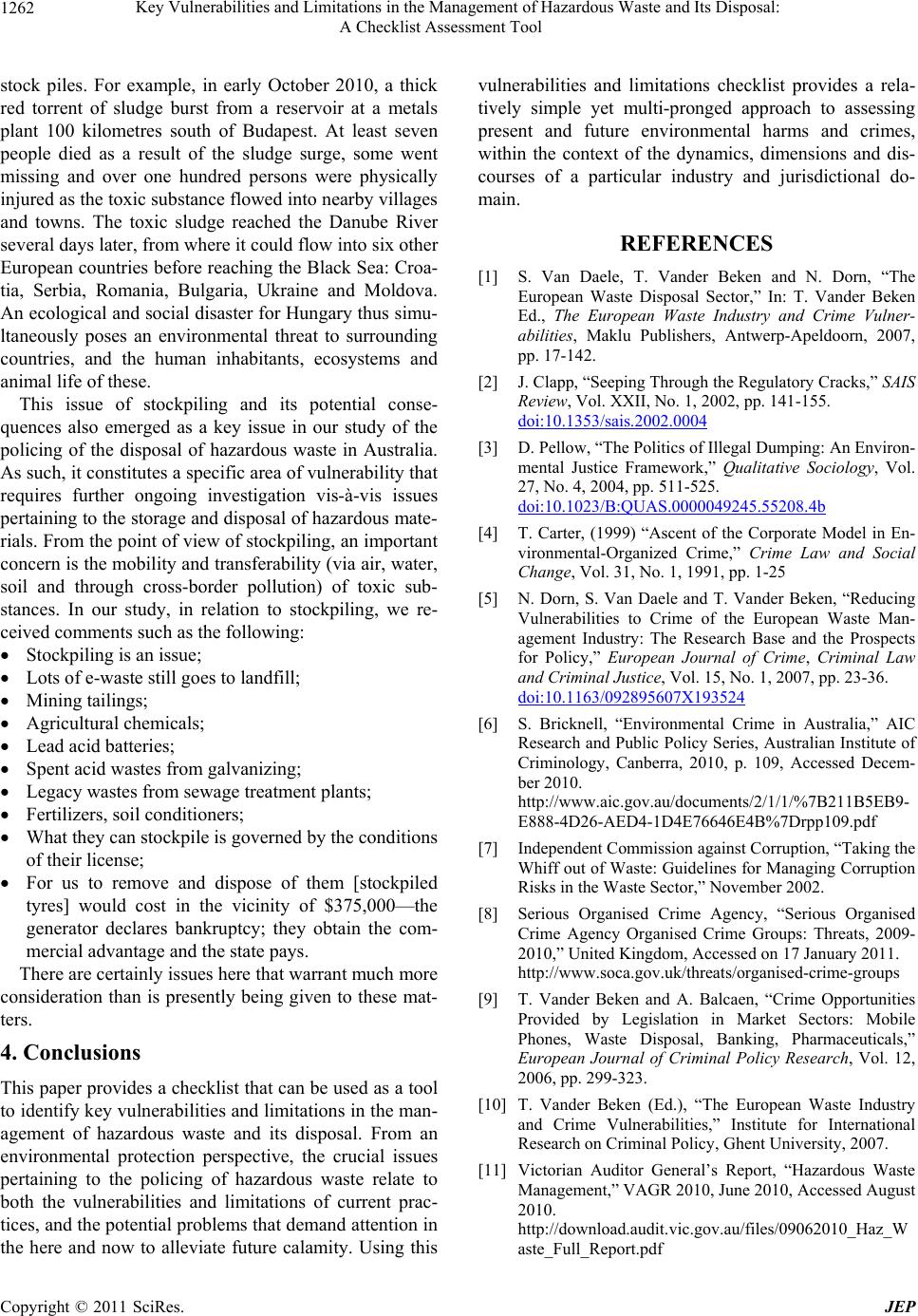 Key Vulnerabilities and Limitations in the Management of Hazardous Waste and Its Disposal: 1262 A Checklist Assessment Tool stock piles. For example, in early October 2010, a thick red torrent of sludge burst from a reservoir at a metals plant 100 kilometres south of Budapest. At least seven people died as a result of the sludge surge, some went missing and over one hundred persons were physically injured as the toxic substance flowed into nearby villages and towns. The toxic sludge reached the Danube River several days later, from where it could flow into six other European countries before reaching the Black Sea: Croa- tia, Serbia, Romania, Bulgaria, Ukraine and Moldova. An ecological and social disaster for Hungary thus simu- ltaneously poses an environmental threat to surrounding countries, and the human inhabitants, ecosystems and animal life of these. This issue of stockpiling and its potential conse- quences also emerged as a key issue in our study of the policing of the disposal of hazardous waste in Australia. As such, it constitutes a specific area of vulnerability that requires further ongoing investigation vis-à-vis issues pertaining to the storage and disposal of hazardous mate- rials. From the point of view of stockpiling, an important concern is the mobility and transferability (via air, water, soil and through cross-border pollution) of toxic sub- stances. In our study, in relation to stockpiling, we re- ceived comments such as the following: Stockpiling is an issue; Lots of e-waste still goes to landfill; Mining tailings; Agricultural chemicals; Lead acid batteries; Spent acid wastes from galvanizing; Legacy wastes from sewage treatment plants; Fertilizers, soil conditioners; What they can stockpile is governed by the conditions of their license; For us to remove and dispose of them [stockpiled tyres] would cost in the vicinity of $375,000—the generator declares bankruptcy; they obtain the com- mercial advantage and the state pays. There are certainly issues here that warrant much more consideration than is presently being given to these mat- ters. 4. Conclusions This paper provides a checklist that can be used as a tool to identify key vulnerabilities and limitations in the man- agement of hazardous waste and its disposal. From an environmental protection perspective, the crucial issues pertaining to the policing of hazardous waste relate to both the vulnerabilities and limitations of current prac- tices, and the potential problems that demand attention in the here and now to alleviate future calamity. Using this vulnerabilities and limitations checklist provides a rela- tively simple yet multi-pronged approach to assessing present and future environmental harms and crimes, within the context of the dynamics, dimensions and dis- courses of a particular industry and jurisdictional do- main. REFERENCES [1] S. Van Daele, T. Vander Beken and N. Dorn, “The European Waste Disposal Sector,” In: T. Vander Beken Ed., The European Waste Industry and Crime Vulner- abilities, Maklu Publishers, Antwerp-Apeldoorn, 2007, pp. 17-142. [2] J. Clapp, “Seeping Through the Regulatory Cracks,” SAIS Review, Vol. XXII, No. 1, 2002, pp. 141-155. doi:10.1353/sais.2002.0004 [3] D. Pellow, “The Politics of Illegal Dumping: An Environ- mental Justice Framework,” Qualitative Sociology, Vol. 27, No. 4, 2004, pp. 511-525. doi:10.1023/B:QUAS.0000049245.55208.4b [4] T. Carter, (1999) “Ascent of the Corporate Model in En- vironmental-Organized Crime,” Crime Law and Social Change, Vol. 31, No. 1, 1991, pp. 1-25 [5] N. Dorn, S. Van Daele and T. Vander Beken, “Reducing Vulnerabilities to Crime of the European Waste Man- agement Industry: The Research Base and the Prospects for Policy,” European Journal of Crime, Criminal Law and Criminal Justice, Vol. 15, No. 1, 2007, pp. 23-36. doi:10.1163/092895607X193524 [6] S. Bricknell, “Environmental Crime in Australia,” AIC Research and Public Policy Series, Australian Institute of Criminology, Canberra, 2010, p. 109, Accessed Decem- ber 2010. http://www.aic.gov.au/documents/2/1/1/%7B211B5EB9- E888-4D26-AED4-1D4E76646E4B%7Drpp109.pdf [7] Independent Commission against Corruption, “Taking the Whiff out of Waste: Guidelines for Managing Corruption Risks in the Waste Sector,” November 2002. [8] Serious Organised Crime Agency, “Serious Organised Crime Agency Organised Crime Groups: Threats, 2009- 2010,” United Kingdom, Accessed on 17 January 2011. http://www.soca.gov.uk/threats/organised-crime-groups [9] T. Vander Beken and A. Balcaen, “Crime Opportunities Provided by Legislation in Market Sectors: Mobile Phones, Waste Disposal, Banking, Pharmaceuticals,” European Journal of Criminal Policy Research, Vol. 12, 2006, pp. 299-323. [10] T. Vander Beken (Ed.), “The European Waste Industry and Crime Vulnerabilities,” Institute for International Research on Criminal Policy, Ghent University, 2007. [11] Victorian Auditor General’s Report, “Hazardous Waste Management,” VAGR 2010, June 2010, Accessed August 2010. http://download.audit.vic.gov.au/files/09062010_Haz_W aste_Full_Report.pdf C opyright © 2011 SciRes. JEP  Key Vulnerabilities and Limitations in the Management of Hazardous Waste and Its Disposal: 1263 A Checklist Assessment Tool [12] Ombudsman Victoria, “Brookland Greens Estate—Inve- stigation into Methane Gas Leaks,” October 2009, Victo- rian Government Printer, Accessed August 2010. http://www.ombudsman.vic.gov.au/resources/documents/ Brookland_Greens_Estate1.pdf [13] J. Gosling, “A Response to the Global Crime Article, The Black Market in China for Tiger Products’ (Brendan Moyle), Addressing Enforcement Related Assertions,” 2009, Accessed March 2010. http://www.eia-international.org/files/news571-1.pdf [14] F. G. Shanty and P. P. Mishra (Eds.), “Organized Crime: From Trafficking to Terrorism,” An International Ency- clopedia, California, ABC-CLIO Inc., Vol. 1, 2008. [15] C. Hartfield, “Paradigms, Pathologies, and Practicalities – Policing Organized Crime in England and Wales,” Polic- ing, Vol. 2, No. 1, 2008, pp. 65-73. [16] J.O. Finckenauer, “Problems of Definition: What Is Or- ganized Crime?” Trends in Organized Crime, Vol. 8, No. 3, 2005, pp. 63-83. doi:10.1007/s12117-005-1038-4 [17] V. Ruggiero, “Organized Crime: Between the Informal and the Formal Economy,” Global Consortium on Secu- rity Transformation, Working Paper Series, No. 4, July 2010. [18] S. Ciotti, “The Dangerous and Toxic Waste Management and the Organized Crime: From Exploitation to Interna- tional Health Emergency,” Presentation, St. John Interna- tional University, Umea, Sweden, 25-26 November 2008 [19] A. Szasz, “Corporations, Organized Crime, and the Dis- posal of Hazardous Waste: An Examination of the Mak- ing of a Criminogenic Regulatory Structure,” Criminolo- gy, Vol. 24, 1986, pp. 1-27. doi:10.1111/j.1745-9125.1986.tb00374.x [20] L. Greyl, S. Vegni, M. Natalicchio, S. Cure and J. Ferretti, “The Waste Crisis in Campania, Italy,” A Case Study, Prepared for the Ecological Economic for and by NGOs (CEECEC), May 2010, Accessed September 2011. http://www.CEECEC.Net/case-studies/waste-crisis-in-Ca mpania-italy/ [21] M. Massari and P. Monzini, “Dirty Businesses in Italy: A Case-Study of Illegal Trafficking in Hazardous Waste,” Global Crime, Vol. 6, No. 3-4, 2004, pp. 285-304. doi:10.1080/17440570500273416 [22] C. Gibbs, E. F. McGarrell and M. Axelrod, “Transna- tional White-Collar Crime and Risk: Lessons from the Global Trade in Electronic Waste,” Criminology & Pub- lic Policy, Vol. 9, No. 3, 2010, pp. 543-560. doi:10.1111/j.1745-9133.2010.00649.x [23] R. Tillman, “Making the Rules and Breaking the Rules: The Political Origins of Corporate Corruption in the New Economy,” Crime Law Soc Change, Vol. 51, 2009, pp. 73-86. doi:10.1007/s10611-008-9150-4 [24] W. J. Sutherland and H. J. Woodroof, “The Need for Environmental Horizon Scanning,” Trends in Ecology & Evolution, Vol. 24, No. 10, 2009, pp. 523-527. doi:10.1016/j.tree.2009.04.008 [25] W. J. Sutherland, M. Clout, I. M. Cŏté, P. Daszak, M. H. Depledge, L. Fellman, E. Fleishman, R. Garthwaite, D. W. Gibbons, J. De Lurio, A. J. Impey, F. Lickorish, D. Lindenmayer, J. Madgwick, C. Margerison, T. Maynard, L. S. Peck, J. Pretty, S. Prior, K. H. Redford, J. P. W. Scharlemann, M. Spalding and R. Watkinson, “A Hori- zon Scan of Global Conservation Issues for 2010,” Trends in Ecology and Evolution, Vol. 25, No. 1, 2010, pp. 1-7. doi:10.1016/j.tree.2009.10.003 [26] R. White and D. Heckenberg, “Environmental Horizon Scanning and Criminological Theory and Practice,” Euro- pean Journal on Criminal Policy and Research, Pub- lished on line 12 February 2011, Accessed on 21 March, 2011. http://www.springerlink.com/content/k846m4n7p183422 7/fulltext.pdf [27] D. Thomas, “$5840 Fine for Stinking Wodonga Stock- pile,” The Border Mail, 22 July 2010, Accessed October 2010. http://www.bordermail.com.au/news/local/news/general/5 840-fine-for-stinking-wodonga-stockpile/1892358.aspx [28] A. Salleh, “Clock Ticking on Growing Toxic Waste Pile,” ABC Science, 30 June 2010, Accessed October 2010. http://www.abc.net.au/science/articles/2010/06/30/29402 70.htm [29] S. Parnell, “Toxic Waste Stockpile Spurs Push to Export It to Europe,” The Australian, 19 February 2009. [30] Environmental Defenders Office WA Inc, “Waste Man- agement in Western Australia: Current Law and Practice and Recommendations for Reform,” Environmental De- fenders Office WA Inc, August 2007, Accessed October 2010. http://www.edowa.org.au/submissions/EDOwastemanage mentreport.pdf [31] Environmental Protection Authority SA, “EPA Guideline: Waste Tyres,” EPA 2010, South Australia, Updated Sep- tember 2010. [32] S. Wainwright, “Toxic Fire Exposes Working Class Community,” Green Left Weekly, 15 May 2010. Ac- cessed October 2010. http://www.greenleft.org.au/taxonomy/term/1205> [33] J. Angel, “Submission to Standing Committee on The Environment, Communications and the Arts on Man- agement of Australia’s Waste Streams and the Drink Container Recycling Bill 2008,” Total Environment Cen- tre Inc, May 2008, Accessed October 2010. http://www.aph.gov.au/senate/committee/eca_ctte/aust_w aste_streams/submissions/sub067.pdf Copyright © 2011 SciRes. JEP |