

Paper Menu >>
Journal Menu >>
 Theoretical Economics Letters, 2011, 1, 95-98 doi:10.4236/tel.2011.13020 Published Online November 2011 (http://www.SciRP.org/journal/tel) Copyright © 2011 SciRes. TEL Multiple Equilibria between Fertility Rates and Pension Levels Based on the Target Level of Government Debt Hideki Nakamura1, Masaya Yasuoka2 1Faculty of Economics, Osaka City Un iversity, Osaka, Japan 2Faculty of Economics and Business Administration, the University of Kitakyushu, Kitakyushu, Japan E-mail: [email protected], [email protected] Received August 1, 2011; revised August 26, 2011; accepted September 2, 20 11 Abstract We show that when the government has a target debt level, multiple equilibria exist in the relationship be- tween fertility rates and pension levels. One is associated with a high fertility rate and a high pension level. The other is associated with a low fertility rate and a low pension level. If the government fails to provide adequate security for individuals during their retirement years, it would result in a failure of coordination between the government and individuals. Keywords: Fertility, Pensions, Target Level of Government Debt, Multiple Equilibria 1. Introduction The fertility rate in Japan has been decreasing, while the ratio of elderly people to the total population has been increasing. In addition, the Japanese government has attempted to reduce the number of issued government bonds by implementing the Reform of Fiscal Structure Law in 1997, because the government debt in Japan had increased significantly during the 1990s. This led to con- siderable controversy over the sustainability of the pay-as- you-go (PAYG) social security scheme in an aging society with fewer children and a large public debt1. Should the government reduce the pension level in order not to increase the government debt as the pen- sionable proportion of the population rises? This paper assesses the possible relationship between the level of pension and the fertility rate when the government has a target for restricting the level of government debt. Pen- sion levels affect lifetime income, which in turn affect the fertility rate. We show that given income taxes or consumption taxes, there exist multiple equilibria between pension levels and fertility rates. If the government chooses to set pensions at a low level, th e fertility rate of those dependent on such pensions decreases during their child-rearing years. A low pension level means that indi- viduals cannot count on a reasonable income during their retirement years. Thus, they would seek to have fewer children during their younger years so as to reduce their household living expenses. The government then cannot increase the pension level becau se of the low level of tax revenue. On the other hand, if the government chooses to fix pensions at a higher level, this would tend to increase the fertility rate, as the prospect of larger pensions en- ables individuals to consider having more children. The government, in due course, obtains more tax revenue, because a higher fertility rate eventually expands the size of the taxpaying labor force relative to the pensionable group. Thus, the government should provide adequate security for individuals during their retirement years not to cause a failure of coordination between the govern- ment and individuals2. We must emphasize the following points. Assuming a balanced government budget, Zhang [1], Groezen, Leers, and Meijdam [2], Groezen and Meijdam [3], and Hi- razawa and Yakita [4] examined the effects of the PAYG social security scheme on fertility and welfare. As in their models, our model also considers endogenous fer- tility, in that children are assumed to be consumption goods. By introduc ing a target level of government debt, Futagami, Iwaisako, and Ohdoi [5] showed that multiple equilibria exist in the relationship between productive government spending and economic growth. Considering 1Member countries of the European Union must maintain a ratio o f government debt to GDP less than 60% in line with the Maastricht Treaty. In addition, a decline in the fertility rate and growing public debt are also evident in South Korea and Germany. 2In Japan and some European developed countries, including Italy, Germany, France, and Sweden, the correlation between the fertility rate and the ratio of pension benefit to labor income is high.  H. NAKAMURA ET AL. 96 1t a situation in which population aging causes a heavy burden of social security payments, Ono [6] showed that the effects of pension reform and population aging on capital accumulation are different between potential two equilibria. This paper shows that multiple equilibria exist in the relationship between the pension level and the fer- tility rate because the existence of a target level for gov- ernment debt yields a complementary relationship be- tween the government and individuals through the pen- sion system. 2. Model We consider a small , open, overlapping-generations model. Individuals live in three periods. In the first period, the cost of child rearing is p aid for by parents. In the second period, during which individuals are working, they de- cide how much to consume, how much to save, and how many children to have. They have to pay income taxes during this time3. In the third period, they receive the interest payments and a pension and consume their in- comes. The government collects income taxes and issues bonds used for providing pensions while maintaining a target level of government debt. Firms are assumed to be perfectly competitive. The interest rate which is exoge- nously given is assumed to be constant. The wage rate also remains constant. 2.1 Individuals The utility maximization problem for an individual born in period t-1 is expressed as: 121 12 ,, max lnln1ln tt ttt nc cnc c , (1) 21 1 .. 1 t tt cp st cznw r r , (2) where 0 , 0 , and 1 c. t is the number of children born in period t, 1t and 21t are the consumption levels in periods t and t+1, respectively, nc is the income tax rate, is the pension level, is the cost of child rearing, is the gross interest rate, and is the wage rate. p rz wThe first-order conditions of the utility maximization problem yield: 11 1 tp cc w r 21211 tp ccr w r , (4) 1. tp nn w zr , (3) (5) The relationships between consumption in periods t and t+1 and the fertility rate in period t are linear be- cause of the log -linear function of utility. Th e number of children is proportionate to their parents’ lifetime in- come. 2.2. The Government The government finances the pension system by two methods: levying income taxes and issuing bonds. Its budget constraint can be written as: 11 , ttt t BrBNpNw where t is the government debt in period t, and is the population born in period t-1. Bt N GDP per capita is constant in our model. Thus, we consider the debt-per-capita dynamics4. These dynamics are represented as: 12, tt rpw bb nnn (6) where ttt bBN , which is public debt per capita, and 11tttt NNNN n . The government is assumed to have a target level of debt per capita, which is represented by b>0. By con- trolling the income tax rate and the pension level, the government tries to satisfy b which is represented as: 2. rpw bb nnn (7) When the government follows (6), a negative primary balance implies that r/n<1 must hold for convergence. 3. Multiple Equilibria Figure 1 shows the relationship between the fertility rate and the pension level represented by (5) and (7). Given b and , (5) implies a linear relationship. A rise in the pension level causes an increase in the fertility rate, be- cause it increases the level of lifetime income. Since higher pensions provide individuals with added security after their retirement, it allows them to have more chil- dren. On the other hand, (7) represents a nonlinear rela- tionship between the fertility rate and the pension level. When the fertility rate is low, the government can pay only low pensions. It is difficult to maintain the target level of government debt because of the low level of tax revenue. A higher pension level becomes possible with a 3It is widely argued in Japan that consumption taxes should be in- creased because of growing public debt. Assuming consumption taxes obtains the same results. 4If we assumed technological progress exogenously, we would con- sider the dynamics of ratio of public debt to national income. How- ever, our res ults would remain intact. Copyright © 2011 SciRes. TEL 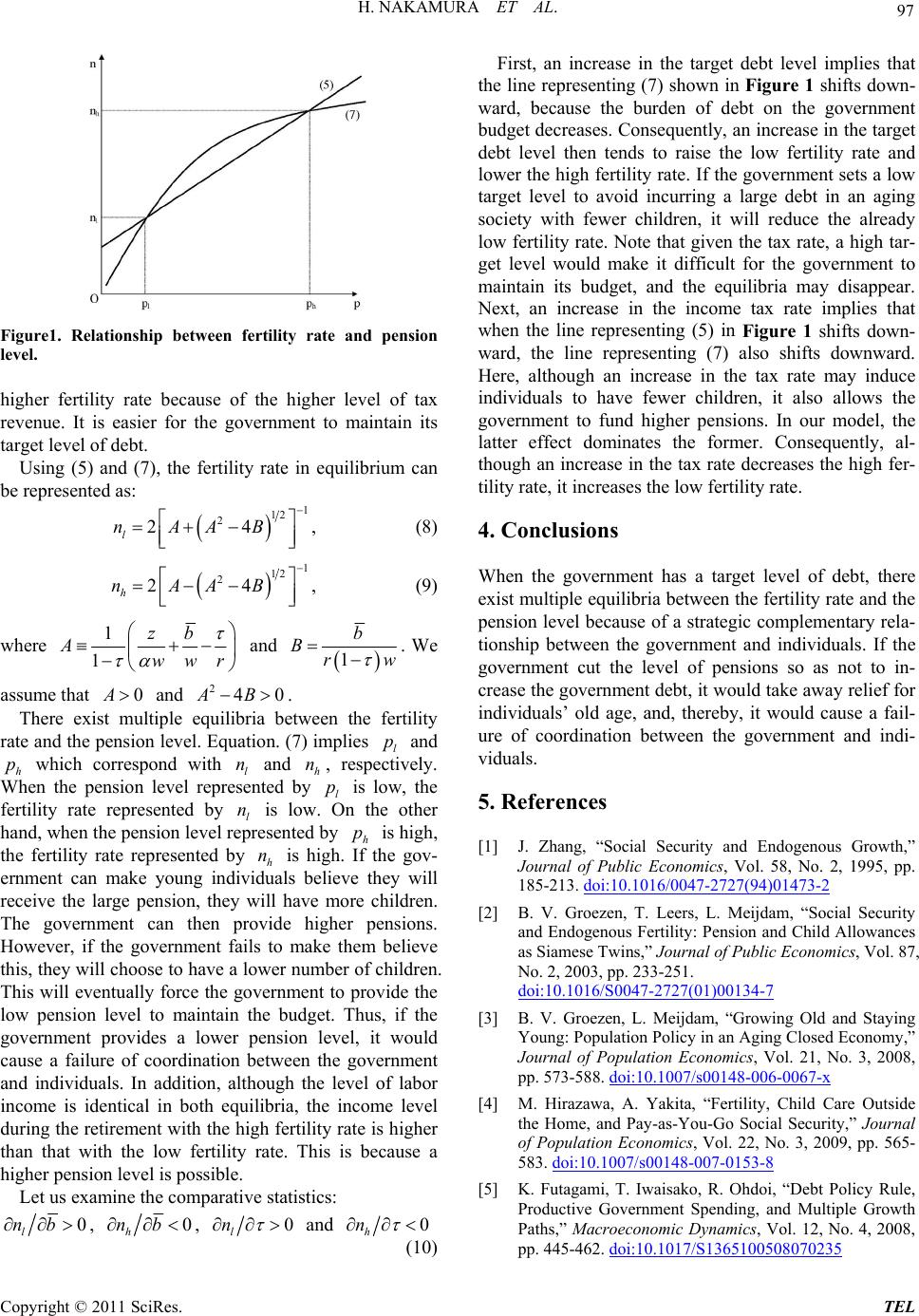 97 H. NAKAMURA ET AL. Figure1. Relationship between fertility rate and pension level. higher fertility rate because of the higher level of tax revenue. It is easier for the government to maintain its target level of debt. Using (5) and (7), the fertility rate in equilibrium can be represented as: 1 12 2 24 l nAAB , (8) 1 12 2 24 h nAAB , (9) where 1 1 zb Awwr and 1 b Brw . We assume that and . 0A240AB There exist multiple equilibria between the fertility rate and the pension level. Equatio n. (7) implies l and h which correspond with l and h, respectively. When the pension level represented by l is low, the fertility rate represented by l is low. On the other hand, when the pension level represented by h is high, the fertility rate represented by h is high. If the gov- ernment can make young individuals believe they will receive the large pension, they will have more children. The government can then provide higher pensions. However, if the government fails to make them believe this, they will choose to have a lower number of children. This will eventually force the government to provide the low pension level to maintain the budget. Thus, if the government provides a lower pension level, it would cause a failure of coordination between the government and individuals. In addition, although the level of labor income is identical in both equilibria, the income level during the retirement with the h igh fertility rate is higher than that with the low fertility rate. This is because a higher pension level is possible. p p n n np p n Let us examine the comparative statistics: 0 l nb , 0 h nb , 0 l n and 0 h n (10) First, an increase in the target debt level implies that the line representing (7) shown in Figure 1 shifts down- ward, because the burden of debt on the government budget decreases. Consequently, an increase in the target debt level then tends to raise the low fertility rate and lower the high fertility rate. If the government sets a low target level to avoid incurring a large debt in an aging society with fewer children, it will reduce the already low fertility rate. Note that given the tax rate, a high tar- get level would make it difficult for the government to maintain its budget, and the equilibria may disappear. Next, an increase in the income tax rate implies that when the line representing (5) in Figure 1 shifts down- ward, the line representing (7) also shifts downward. Here, although an increase in the tax rate may induce individuals to have fewer children, it also allows the government to fund higher pensions. In our model, the latter effect dominates the former. Consequently, al- though an increase in the tax rate decreases the high fer- tility rate, it increases the low fertility rate. 4. Conclusions When the government has a target level of debt, there exist multiple equilibria between the fertility rate and the pension level because of a strategic complementary rela- tionship between the government and individuals. If the government cut the level of pensions so as not to in- crease the government debt, it would take away relief for individuals’ old age, and, thereby, it would cause a fail- ure of coordination between the government and indi- viduals. 5. References [1] J. Zhang, “Social Security and Endogenous Growth,” Journal of Public Economics, Vol. 58, No. 2, 1995, pp. 185-213. doi:10.1016/0047-2727(94)01473-2 [2] B. V. Groezen, T. Leers, L. Meijdam, “Social Security and Endogenous Fertility: Pension and Child Allowances as Siamese Twins,” Journal of Public Economics, Vol. 87, No. 2, 2003, pp. 233-251. doi:10.1016/S0047-2727(01)00134-7 [3] B. V. Groezen, L. Meijdam, “Growing Old and Staying Young: Population Policy in an Aging Closed Economy,” Journal of Population Economics, Vol. 21, No. 3, 2008, pp. 573-588. doi:10.1007/s00148-006-0067-x [4] M. Hirazawa, A. Yakita, “Fertility, Child Care Outside the Home, and Pay-as-You-Go Social Security,” Journal of Population Economics, Vol. 22, No. 3, 2009, pp. 565- 583. doi:10.1007/s00148-007-0153-8 [5] K. Futagami, T. Iwaisako, R. Ohdoi, “Debt Policy Rule, Productive Government Spending, and Multiple Growth Paths,” Macroeconomic Dynamics, Vol. 12, No. 4, 2008, pp. 445-462. doi:10.1017/S1365100508070235 Copyright © 2011 SciRes. TEL  H. NAKAMURA ET AL. Copyright © 2011 SciRes. TEL 98 [6] T. Ono, “Social Security Policy with Public Debt in an Aging Economy,” Journal of Population Economics, Vol. 16, No. 2, 2003, pp. 363-387. |