

Paper Menu >>
Journal Menu >>
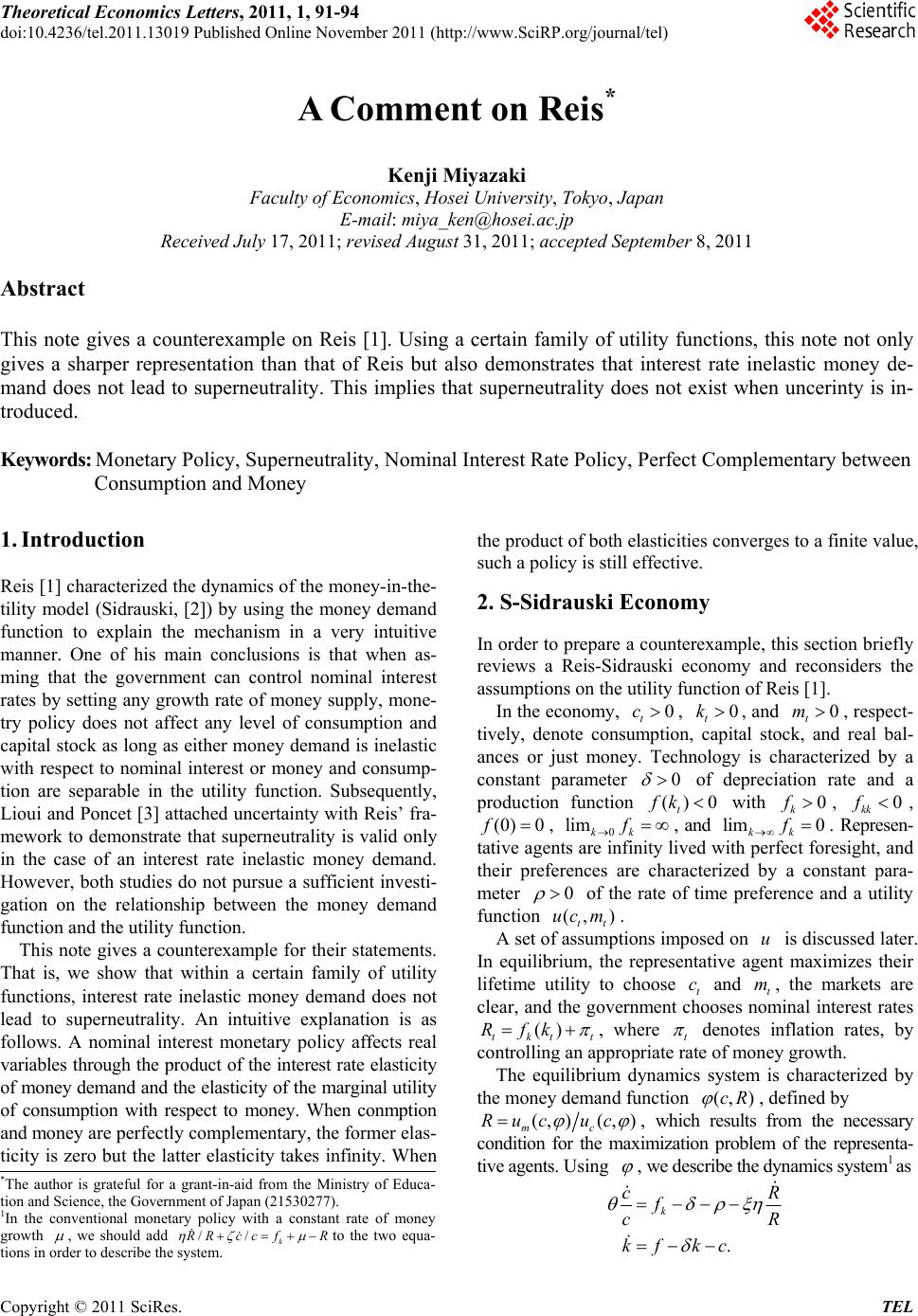 Theoretical Economics Letters, 2011, 1, 91-94 doi:10.4236/tel.2011.13019 Published Online November 2011 (http://www.SciRP.org/journal/tel) Copyright © 2011 SciRes. TEL A Comment on Reis* Kenji Miyazaki Faculty of Economics, Hosei University, Tokyo, Japan E-mail: [email protected] Received July 17, 201 1; revised August 31, 2011; accepted September 8, 20 1 1 Abstract This note gives a counterexample on Reis [1]. Using a certain family of utility functions, this note not only gives a sharper representation than that of Reis but also demonstrates that interest rate inelastic money de- mand does not lead to superneutrality. This implies that superneutrality does not exist when uncerinty is in- troduced. Keywords: Monetary Policy, Superneutrality, Nominal Interest Rate Policy, Perfect Complementary between Consumption and Money 1. Introduction Reis [1] characterized the dynamics of the money-in-the- tility model (Sidrauski, [2]) by using the money demand function to explain the mechanism in a very intuitive manner. One of his main conclusions is that when as- ming that the government can control nominal interest rates by setting any growth rate of money supply, mone- try policy does not affect any level of consumption and capital stock as long as either money demand is inelastic with respect to nominal interest or money and consump- tion are separable in the utility function. Subsequently, Lioui and Poncet [3 ] attached uncertainty with Reis’ fra- mework to demonstrate that superneutrality is valid only in the case of an interest rate inelastic money demand. However, both studies do not pursue a sufficient investi- gation on the relationship between the money demand function and the utility fu nction. This note gives a counterexample for their statements. That is, we show that within a certain family of utility functions, interest rate inelastic money demand does not lead to superneutrality. An intuitive explanation is as follows. A nominal interest monetary policy affects real variables through the product of the interest rate elasticity of money demand and the elasticity of the marginal utility of consumption with respect to money. When conmption and money are perfectly complementary, the former elas- ticity is zero but the latter elasticity takes infinity. When the product of both elasticitie s converges to a finite valu e, such a policy is still effective. 2. S-Sidrauski Economy In order to prepare a counterexample, this section briefly reviews a Reis-Sidrauski economy and reconsiders the assumptions on the utility fun c tion of Reis [1]. In the economy, , , and , respect- tively, denote consumption, capital stock, and real bal- ances or just money. Technology is characterized by a constant parameter 0 t c 0 0 t k0 t m ()fk of depreciation rate and a production function t with , 00 k f0 kk f , (0) 0f , 0 limkk f , and . Represen- tative agents are infin ity lived with perfect foresight, and their preferences are characterized by a constant para- meter lim 0 kk f 0 of the rate of time preference and a utility function () tt uc m . A set of assumptions imposed on is discussed later. In equilibrium, the representative agent maximizes their lifetime utility to choose t and t, the markets are clear, and the government chooses nominal interest rates t u c m () tkt Rfk , where t denotes inflation rates, by controlling an appropriate rate of money growth. The equilibrium dynamics system is characterized by the money demand function (cR) , defined by ()( mc Ruc uc) , which results from the necessary condition for the maximization problem of the representa- tive agents. Using , we descri be the dy namics system 1 as *The author is grateful for a grant-in-aid from the Ministry of Educa- tion and Science, the Government of Japan (21530277). 1In the conventional monetary policy with a constant rate of money growth , we should add // k R Rccf R to the two equa- tions in order to describe the system. k cR f cR kf kc 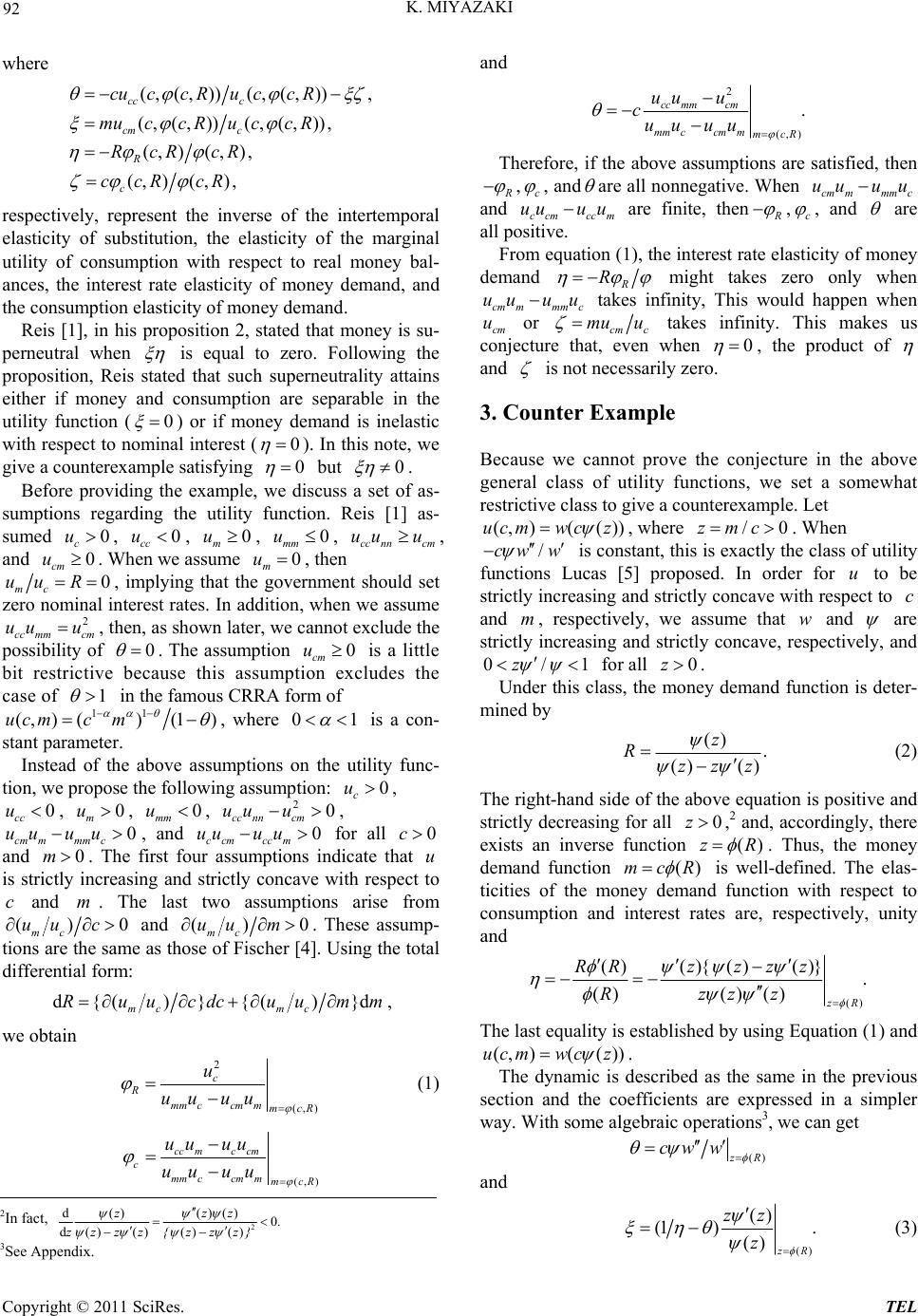 K. MIYAZAKI 92 where (( ))(( )), (())(()), ()(), ()(), cc c cm c R c cuccRuccR mucc Rucc R RcR cR ccR cR respectively, represent the inverse of the intertemporal elasticity of substitution, the elasticity of the marginal utility of consumption with respect to real money bal- ances, the interest rate elasticity of money demand, and the consumption elasticity of money demand. Reis [1], in his proposition 2, stated that money is su- perneutral when 0 is equal to zero. Following the proposition, Reis stated that such superneutrality attains either if money and consumption are separable in the utility function ( ) or if money demand is inelastic with respect to nominal interest (0 0). In this no te, we give a counterexample satisfyin g but 0 . Before providing the example, we discuss a set of as- sumptions regarding the utility function. Reis [1] as- sumed , , , , , and . When we assume , then 0 c u 0 cm 0 cc u0 m uu0 mm u 0 mcc nncm uu u u0R 2 u mc , implying that the government should set zero nominal interest rates. In addition, when we assume cc mmcm , then, as shown later, we cannot exclude the possibility of uu uu 0 . The assumption cm is a little bit restrictive because this assumption excludes the case of 0u 1 in the famous CRRA form of 11 ()m(c)m ( 1)uc , where 01 is a con- stant parameter. Instead of the above assumptions on the utility func- tion, we propose the following assumption: , , , , , cm , and 0 c u 0 cc u m uu 0 m u0 mm c u u0 mm u 20 cc nncm uu u 0 ccm ccm u uuu for all and . The first four assumptions indicate that is strictly increasing and strictly concave with respect to and . The last two assumptions arise from 0cu0 m m c ()uu c0 mc and () 0 mc uu m. These assump- tions are the same as those of Fischer [4]. Using the total differential form: d{()}{()}d mc mc Ruucdcuum m, we obtain 2 () c Rmmccmm mcR u uu uu (1) () cc mc cm c mmccmm mcR uu uu uu uu and 2 () cc mmcm mmccmm mcR uu u cuu uu Therefore, if the above assumptions are satisfied, then R ,c , and are all nonnegative. When cm mmm c uuu u and ccmcc um uuu are finite, then R ,c , and are all positive. From equation (1), the interest rate elasticity of money demand R R might takes zero only when cm mmm c uuu u takes infinity, This would happen when cm or ucm c mu u takes infinity. This makes us conjecture that, even when 0 , the product of and is not necessari ly zero. 3. Counter Example Because we cannot prove the conjecture in the above general class of utility functions, we set a somewhat restrictive class to give a counterexample. Let ()(()ucmwcz) cw w, where . When 0zmc m is constant, this is exactly the class of utility functions Lucas [5] proposed. In order for u to be strictly increasing and strictly concave with respect to and , respectively, we assume that and c w are strictly increasing and strictly concave, respectively, and 01z for all . 0z Under this class, the money demand function is deter- mined by () () () z Rzzz (2) The right-hand side of the abov e equation is pos itive and strictly decreasing for all ,2 and, accordingly, there exists an inverse function 0z z ()R ()R. Thus, the money demand function mc is well-defined. The elas- ticities of the money demand function with respect to consumption and interest rates are, respectively, unity and () ()(){ ()()} ( )()() z R RRzzzz Rzzz ) The last equality is established by using Equatio n (1 ) and ()(()ucmwcz . The dynamic is described as the same in the previous section and the coefficients are expressed in a simpler way. With some algebraic operations3, we can get () z R cww and () () (1) () z R zz z (3) 2In fact, 2 d() ()() 0 d()()() () zzz zzzz{zzz} 3See Appendix. Copyright © 2011 SciRes. TEL 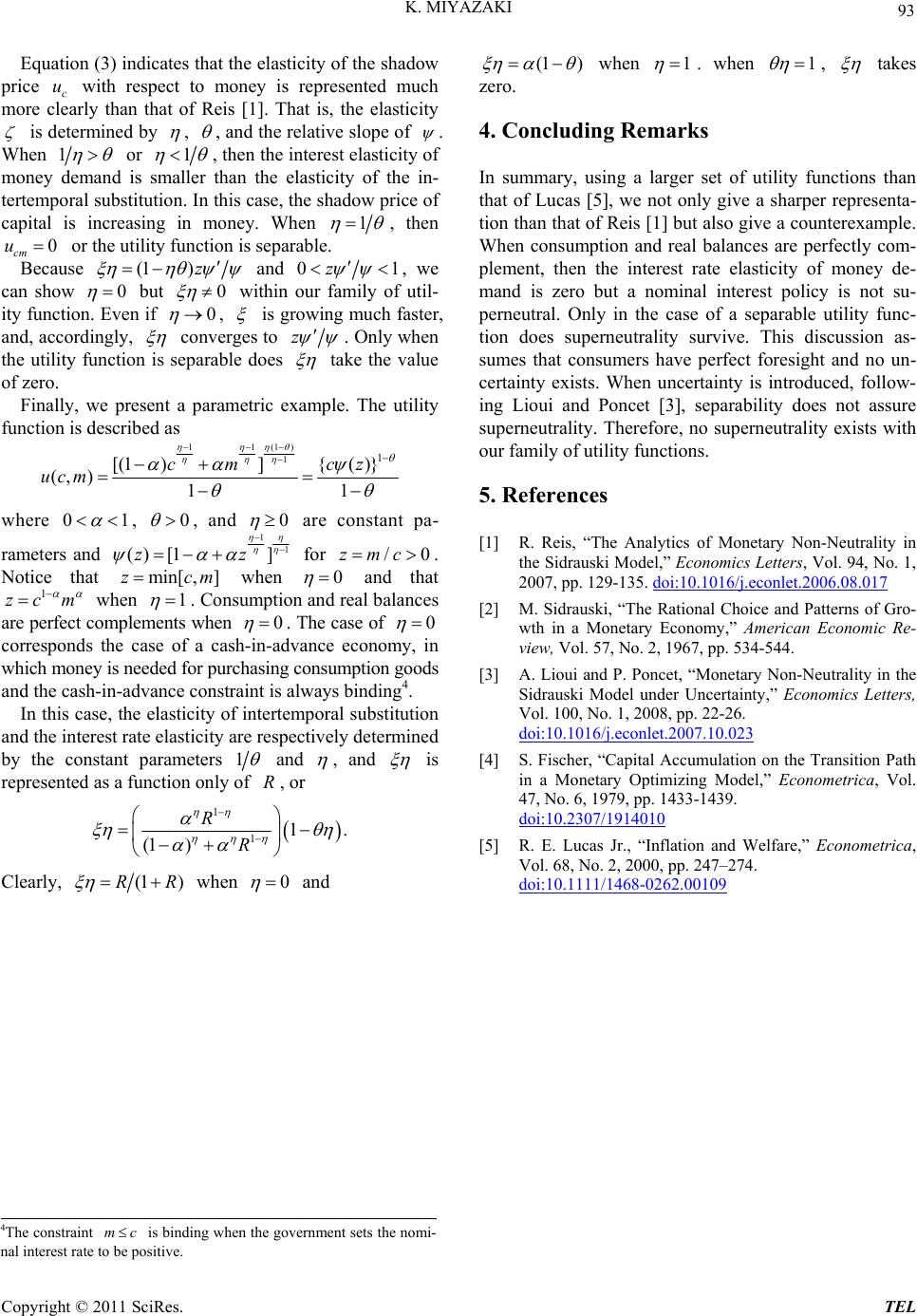 K. MIYAZAKI Copyright © 2011 SciRes. TEL 93 Equation (3) indicates that the elasticity of the shadow price c with respect to money is represented much more clearly than that of Reis [1]. That is, the elasticity u is determined by , , and the relative slope of . When 1 or 1 , then the interest elasticity of money demand is smaller than the elasticity of the in- tertemporal substitutio n. In this case, the shadow price of capital is increasing in money. When 1 , then or the utility function is separable. 0 cm u Because (1 )z and 01z , we can show 0 but 0 0 within our family of util- ity function. Even if , is growing much faster, and, accordingly, converges to z . Only when the utility function is separable does take the value of zero. Finally, we present a parametric example. The utility function is described as (1 ) 11 11 [(1)]{( )} () 1 cm cz ucm 1 where 01 , 0 , and 0 are constant pa- rameters and 11 () [1]zz m for . Notice that when 0zmc 0min[ ]zc and that 1 zcm when 1 . Consumption and real balances are perfect complements when 0 . The case of 0 corresponds the case of a cash-in-advance economy, in which money is needed for purchasi ng consumption goods and the cash-in-advance constraint is always binding4. In this case, the elasticity of intertemporal substitution and the interest rate elasticity are respectively determined by the constant parameters 1 and , and is represented as a function only of , or R 1 11 (1 ) R R Clearly, (1 )RR when 0 and (1 ) when 1 . when 1 , takes zero. 4. Concluding Remarks In summary, using a larger set of utility functions than that of Lucas [5], we not only give a sharper representa- tion than that of Reis [1] but also give a counterexample. When consumption and real balances are perfectly com- plement, then the interest rate elasticity of money de- mand is zero but a nominal interest policy is not su- perneutral. Only in the case of a separable utility func- tion does superneutrality survive. This discussion as- sumes that consumers have perfect foresight and no un- certainty exists. When uncertainty is introduced, follow- ing Lioui and Poncet [3], separability does not assure superneutrality. Therefore, no superneutrality exists with our family of utility functions. 5. References [1] R. Reis, “The Analytics of Monetary Non-Neutrality in the Sidrauski Model,” Economics Letters, Vol. 94, No. 1, 2007, pp. 129-135. doi:10.1016/j.econlet.2006.08.017 [2] M. Sidrauski, “The Rational Choice and Patterns of Gro- wth in a Monetary Economy,” American Economic Re- view, Vol. 57, No. 2, 1967, pp. 534-544. [3] A. Lioui and P. Poncet, “Monetary Non-Neutrality in the Sidrauski Model under Uncertainty,” Economics Letters, Vol. 100, No. 1, 2008, pp. 22-26. doi:10.1016/j.econlet.2007.10.023 [4] S. Fischer, “Capital Accumulation on the Transition Path in a Monetary Optimizing Model,” Econometrica, Vol. 47, No. 6, 1979, pp. 1433-1439. doi:10.2307/1914010 [5] R. E. Lucas Jr., “Inflation and Welfare,” Econometrica, Vol. 68, No. 2, 2000, pp. 247–274. doi:10.1111/1468-0262.00109 4The constraint is binding when the government sets the nomi-mc nal interest rate to be p ositive. 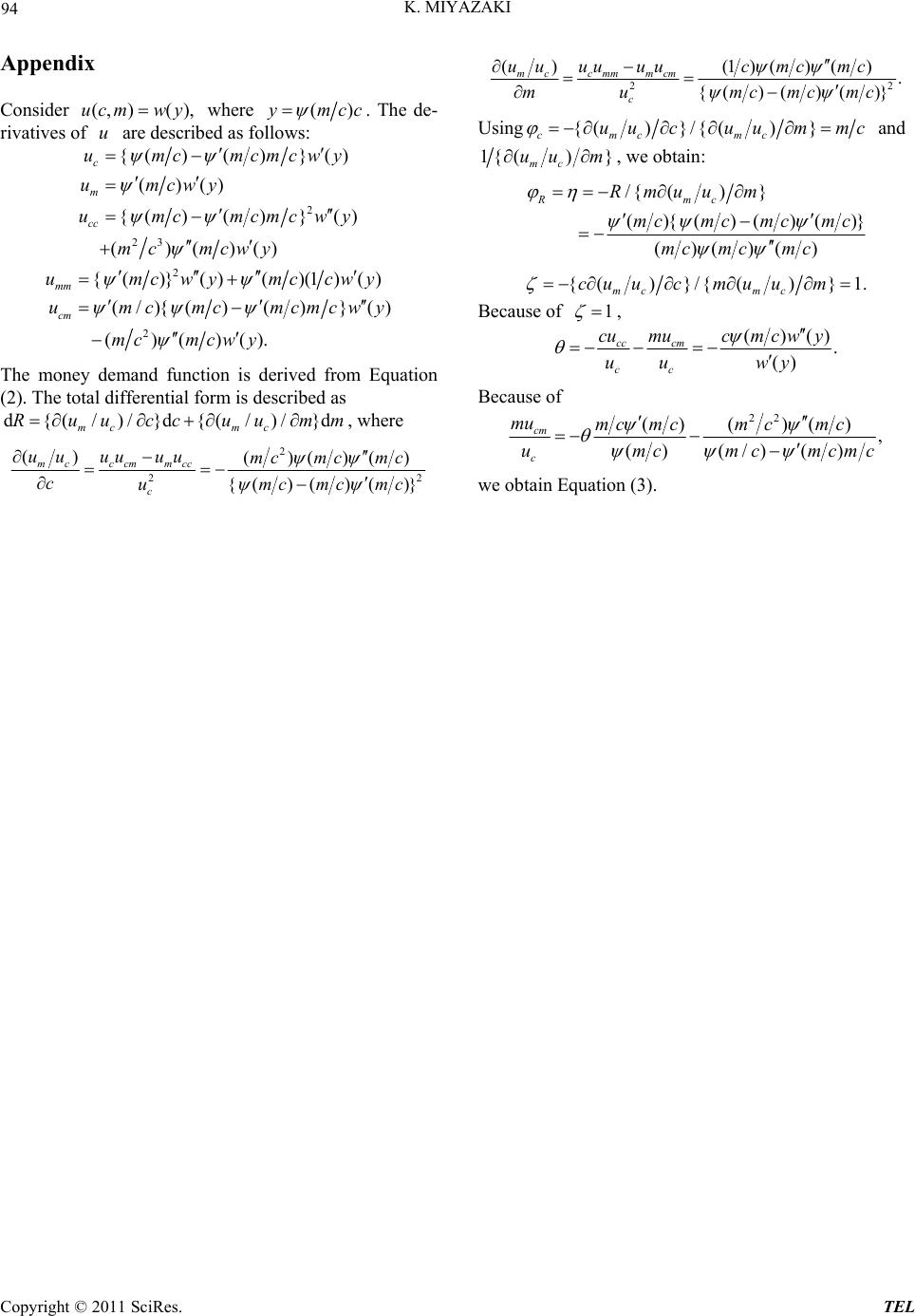 K. MIYAZAKI 94 Appendix Consider where ()()ucm wy()ymcc . The de- rivatives of are described as follows: u 2 23 {( )( )}() ()() {()()} () ()()() c m cc umcmcmcwy umcwy umcmcmcw mc mcwy y 2 2 {( )}()( )(1)() (){()()}( ()()() mm cm umcwymccw umcmcmcmcw mcmcw y ) y y m The money demand function is derived from Equation (2). The total differential form is described as , where d{( )}d{( )}d mcmc Ruuccuum 2 22 () ()()() {( )( )( )} mcccmmcc c uuuu uumcmc mc cumcmc 22 () (1 ) ()() {( )( )()} mccmm mcm c uu uu uucmcmc mumcmcm c Using {( )}{( )} cmcmc uu cuu mmc and 1{ ()} mc uu m , we obtain: {() } (){()()() ()()() Rmc Rmuu m mcmcmcmc mc mcmc } {( )}{( )}1 mc mc cuucmuum Because of 1 , ()() () cc cm cc cu mucmcwy uu wy Because of mc 22 () ()() ()() () cm c mu mcmcm cmc umcmcmc mc w e obtain Equa t i on (3 ). Copyright © 2011 SciRes. TEL |