

Paper Menu >>
Journal Menu >>
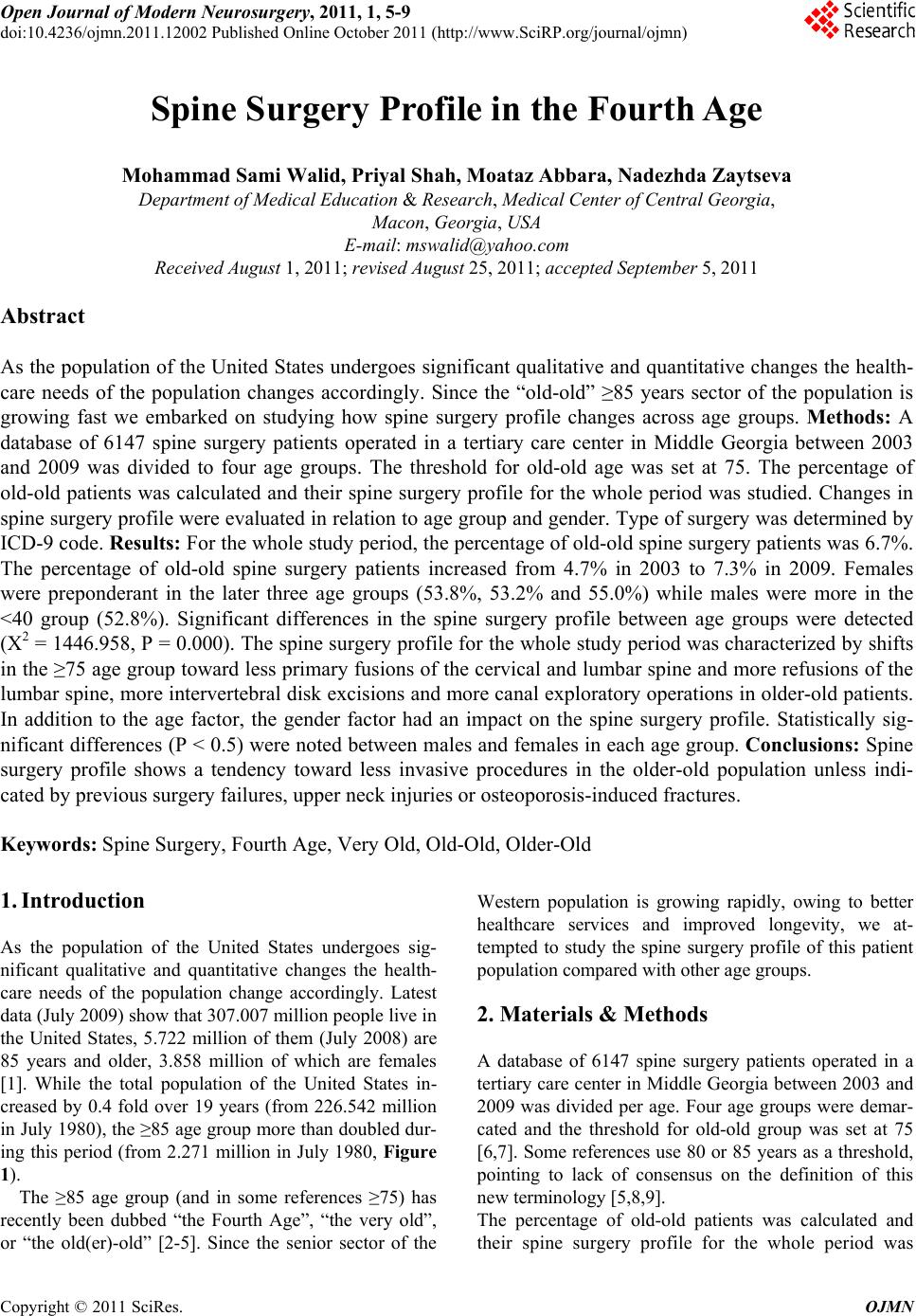 Open Journal of Mo dern Neurosurgery, 2011, 1, 5-9 doi:10.4236/ojmn.2011.12002 Published Online October 2011 (http://www.SciRP.org/journal/ojmn) Copyright © 2011 SciRes. OJMN Spine Surgery Profile in the Fourth Age Mohammad Sami Walid, Priyal Shah, Moataz Abbara, Nadezhda Zaytseva Department of Medic al Education & Research, Medical Center of Central Georgia, Macon, Georgia, USA E-mail: [email protected] Received August 1, 2011; revised August 25, 2011; accepted September 5, 2011 Abstract As the population of the United States undergoes significant qualitative and quantitative changes the health- care needs of the population changes accordingly. Since the “old-old” ≥85 years sector of the population is growing fast we embarked on studying how spine surgery profile changes across age groups. Methods: A database of 6147 spine surgery patients operated in a tertiary care center in Middle Georgia between 2003 and 2009 was divided to four age groups. The threshold for old-old age was set at 75. The percentage of old-old patients was calculated and their spine surgery profile for the whole period was studied. Changes in spine surgery profile were evaluated in relation to age group and gender. Type of surgery was determined by ICD-9 code. Results: For the whole study period, the percentage of old-old spine surgery patients was 6.7%. The percentage of old-old spine surgery patients increased from 4.7% in 2003 to 7.3% in 2009. Females were preponderant in the later three age groups (53.8%, 53.2% and 55.0%) while males were more in the <40 group (52.8%). Significant differences in the spine surgery profile between age groups were detected (Χ2 = 1446.958, P = 0.000). The spine surgery profile for the whole study period was characterized by shifts in the ≥75 age group toward less primary fusions of the cervical and lumbar spine and more refusions of the lumbar spine, more intervertebral disk excisions and more canal exploratory operations in older-old patients. In addition to the age factor, the gender factor had an impact on the spine surgery profile. Statistically sig- nificant differences (P < 0.5) were noted between males and females in each age group. Conclusions: Spine surgery profile shows a tendency toward less invasive procedures in the older-old population unless indi- cated by previous surgery failures, upper neck injuries or osteoporosis-induced fractures. Keywords: Spine Surgery, Fourth Age, Very Old, Old-Old, Older-Old 1. Introduction As the population of the United States undergoes sig- nificant qualitative and quantitative changes the health- care needs of the population change accordingly. Latest data (July 2009) show that 307.007 million people live in the United States, 5.722 million of them (July 2008) are 85 years and older, 3.858 million of which are females [1]. While the total population of the United States in- creased by 0.4 fold over 19 years (from 226.542 million in July 1980), the ≥85 age group more than doubled dur- ing this period (from 2.271 million in July 1980, Figure 1). The ≥85 age group (and in some references ≥75) has recently been dubbed “the Fourth Age”, “the very old”, or “the old(er)-old” [2-5]. Since the senior sector of the Western population is growing rapidly, owing to better healthcare services and improved longevity, we at- tempted to study the spine surgery profile of this patient population compared with other age groups. 2. Materials & Methods A database of 6147 spine surgery patients operated in a tertiary care center in Middle Georgia between 2003 and 2009 was divided per age. Four age groups were demar- cated and the threshold for old-old group was set at 75 [6,7]. Some references use 80 or 85 years as a threshold, pointing to lack of consensus on the definition of this new terminology [5,8,9]. The percentage of old-old patients was calculated and their spine surgery profile for the whole period was 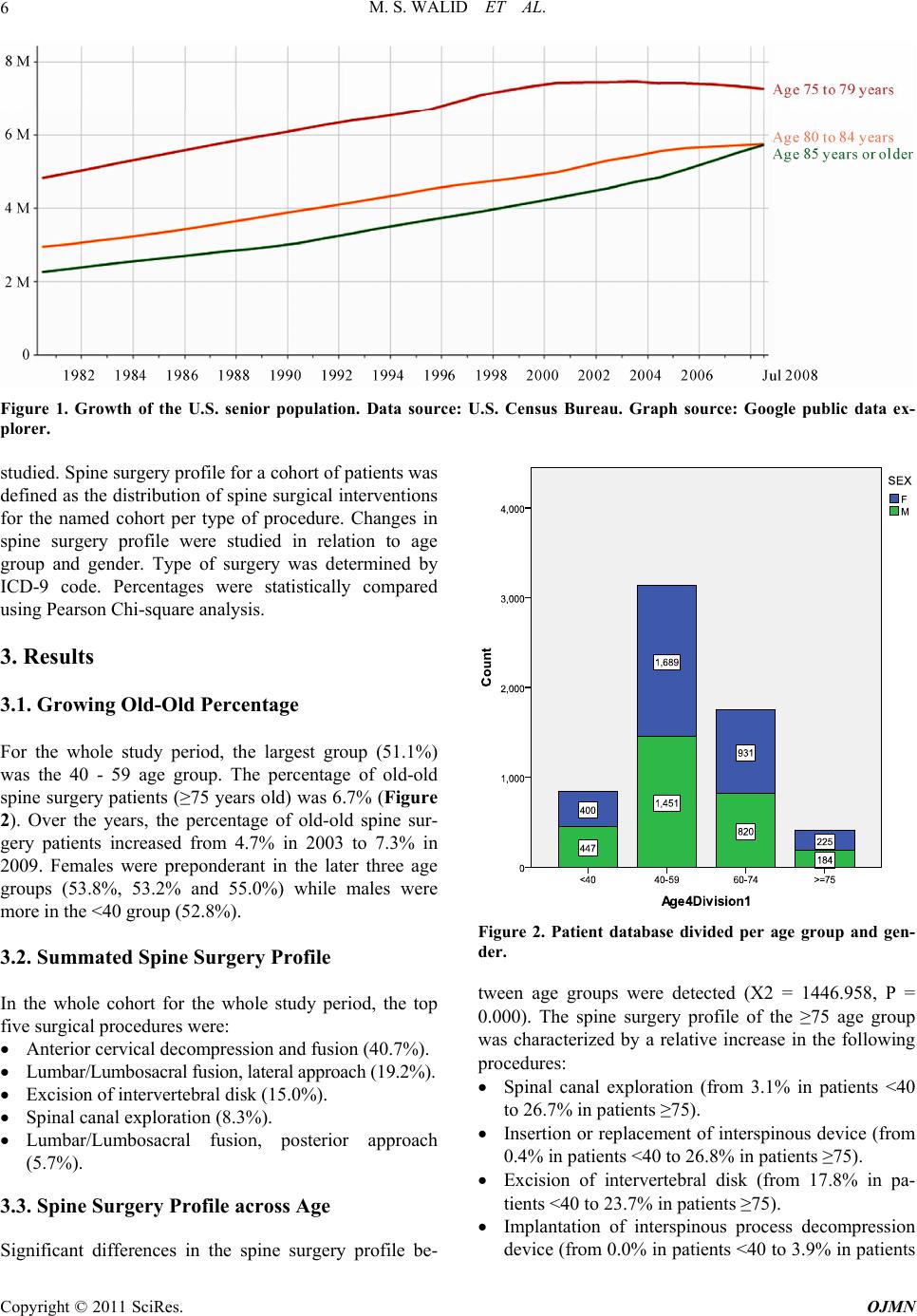 M. S. WALID ET AL. 6 Figure 1. Growth of the U.S. senior population. Data source: U.S. Census Bureau. Graph source: Google public data ex- plorer. studied. Spine surgery profile for a cohort of patients was defined as the distribution of spine surgical interventions for the named cohort per type of procedure. Changes in spine surgery profile were studied in relation to age group and gender. Type of surgery was determined by ICD-9 code. Percentages were statistically compared using Pearson Chi-square analysis. 3. Results 3.1. Growing Old-Old Percentage For the whole study period, the largest group (51.1%) was the 40 - 59 age group. The percentage of old-old spine surgery patients (≥75 years old) was 6.7% (Figure 2). Over the years, the percentage of old-old spine sur- gery patients increased from 4.7% in 2003 to 7.3% in 2009. Females were preponderant in the later three age groups (53.8%, 53.2% and 55.0%) while males were more in the <40 group (52.8%). 3.2. Summated Spine Surgery Profile In the whole cohort for the whole study period, the top five surgical procedures were: Anterior cervical decompression and fusion (40.7%). Lumbar/Lumbosacral fusion, lateral approach (19.2%). Excision of intervertebral disk (15.0%). Spinal canal exploration (8.3%). Lumbar/Lumbosacral fusion, posterior approach (5.7%). 3.3. Spine Surgery Profile across Age Significant differences in the spine surgery profile be- Figure 2. Patient database divided per age group and gen- der. tween age groups were detected (Χ2 = 1446.958, P = 0.000). The spine surgery profile of the ≥75 age group was characterized by a relative increase in the following procedures: Spinal canal exploration (from 3.1% in patients <40 to 26.7% in patients ≥75). Insertion or replacement of interspinous device (from 0.4% in patients <40 to 26.8% in patients ≥75). Excision of intervertebral disk (from 17.8% in pa- tients <40 to 23.7% in patients ≥75). Implantation of interspinous process decompression device (from 0.0% in patients <40 to 3.9% in patients Copyright © 2011 SciRes. OJMN 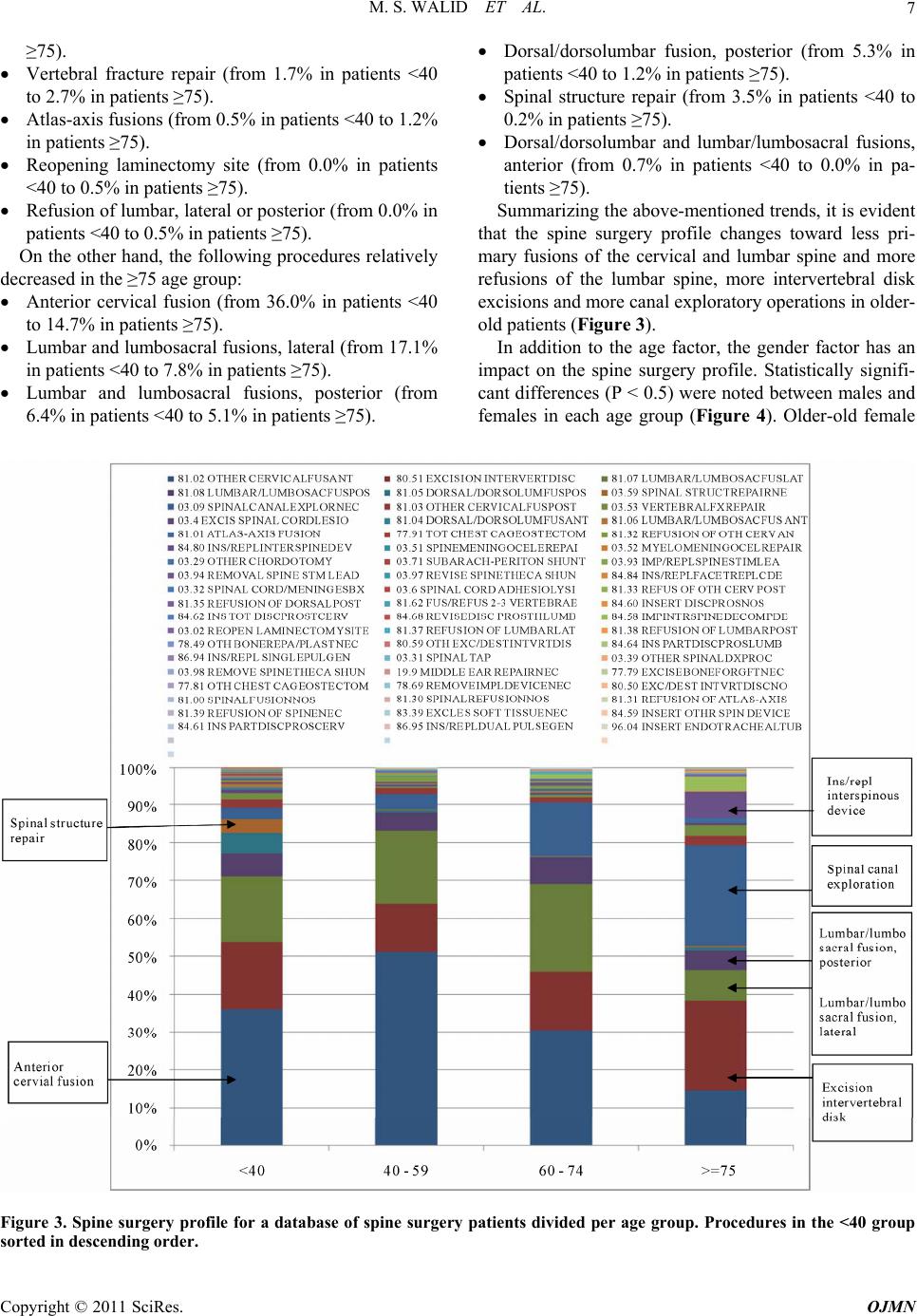 M. S. WALID ET AL.7 ≥75). Vertebral fracture repair (from 1.7% in patients <40 to 2.7% in patients ≥75). Atlas-axis fusions (from 0.5% in patients <40 to 1.2% in patients ≥75). Reopening laminectomy site (from 0.0% in patients <40 to 0.5% in patients ≥75). Refusion of lumbar, lateral or posterior (from 0.0% in patients <40 to 0.5% in patients ≥75). On the other hand, the following procedures relatively decreased in the ≥75 age group: Anterior cervical fusion (from 36.0% in patients <40 to 14.7% in patients ≥75). Lumbar and lumbosacral fusions, lateral (from 17.1% in patients <40 to 7.8% in patients ≥75). Lumbar and lumbosacral fusions, posterior (from 6.4% in patients <40 to 5.1% in patients ≥75). Dorsal/dorsolumbar fusion, posterior (from 5.3% in patients <40 to 1.2% in patients ≥75). Spinal structure repair (from 3.5% in patients <40 to 0.2% in patients ≥75). Dorsal/dorsolumbar and lumbar/lumbosacral fusions, anterior (from 0.7% in patients <40 to 0.0% in pa- tients ≥75). Summarizing the above-mentioned trends, it is evident that the spine surgery profile changes toward less pri- mary fusions of the cervical and lumbar spine and more refusions of the lumbar spine, more intervertebral disk excisions and more canal exploratory operations in older- old patients (Figure 3). In addition to the age factor, the gender factor has an impact on the spine surgery profile. Statistically signifi- cant differences (P < 0.5) were noted between males and females in each age group (Figure 4). Older-old female Figure 3. Spine surgery profile for a database of spine surgery patients divided per age group. Procedures in the <40 group sorted in descending order. Copyright © 2011 SciRes. OJMN 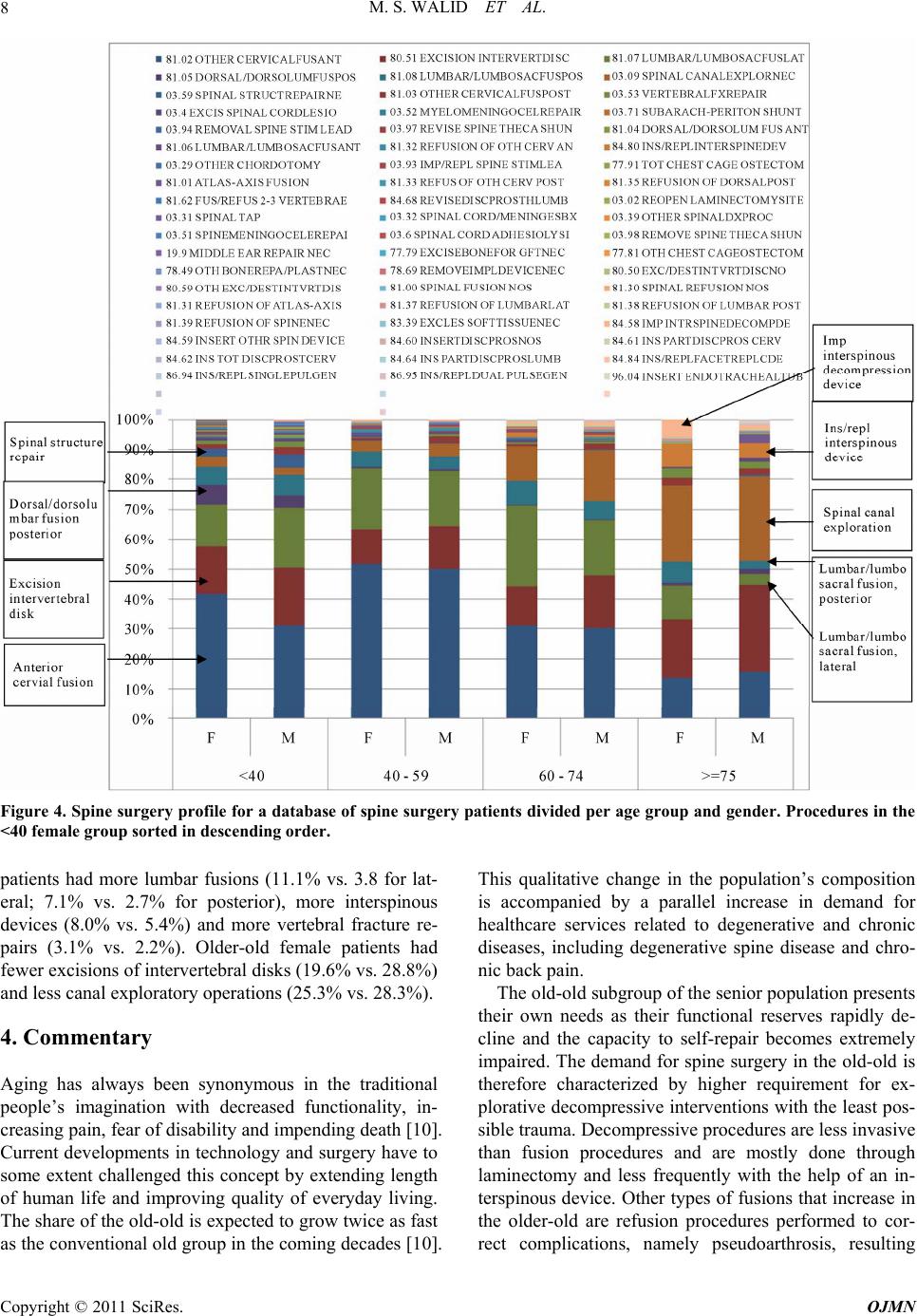 M. S. WALID ET AL. 8 Figure 4. Spine surgery profile for a database of spine surgery patients divided per age group and gender. Procedures in the <40 female group sorted in desce nding or de r. patients had more lumbar fusions (11.1% vs. 3.8 for lat- eral; 7.1% vs. 2.7% for posterior), more interspinous devices (8.0% vs. 5.4%) and more vertebral fracture re- pairs (3.1% vs. 2.2%). Older-old female patients had fewer excisions of intervertebral disks (19.6% vs. 28.8%) and less canal exploratory operations (25.3% vs. 28.3%). 4. Commentary Aging has always been synonymous in the traditional people’s imagination with decreased functionality, in- creasing pain, fear of disability and impending death [10]. Current developments in technology and surgery have to some extent challenged this concept by extending length of human life and improving quality of everyday living. The share of the old-old is expected to grow twice as fast as the conventional old group in the coming decades [10]. This qualitative change in the population’s composition is accompanied by a parallel increase in demand for healthcare services related to degenerative and chronic diseases, including degenerative spine disease and chro- nic back pain. The old-old subgroup of the senior population presents their own needs as their functional reserves rapidly de- cline and the capacity to self-repair becomes extremely impaired. The demand for spine surgery in the old-old is therefore characterized by higher requirement for ex- plorative decompressive interventions with the least pos- sible trauma. Decompressive procedures are less invasive than fusion procedures and are mostly done through laminectomy and less frequently with the help of an in- terspinous device. Other types of fusions that increase in the older-old are refusion procedures performed to cor- rect complications, namely pseudoarthrosis, resulting Copyright © 2011 SciRes. OJMN  M. S. WALID ET AL.9 from previous fusion attempts. Atlas-axis fusions also increase in older-old patients due to a comparatively elevated risk of upper cervical spine injuries in elderly patients [11]. Female old-old patients unsurprisingly present with higher frequency of vertebral fracture acci- dents and therefore require more such repairs due to higher prevalence of osteoporosis [7]. The relatively higher occurrence of dorsal/dorsolumbar fusions and spine structure repair operations in the <40 age group could be related to more frequent traumatic and congeni- tal etiology in younger age. The preponderance of fe- males patients in the later three age groups and males in the younger group reflects the fact that younger males are subject to suffer more professional spine injuries while females have better longevity and the longer they live the higher the risk of osteoporosis. In summary, the spine surgery profile of our patients shows a tendency toward less invasive procedures in the older-old population unless indicated by previous sur- gery failures, upper neck injuries or osteoporosis-induced fractures. 5. References [1] Population in the U.S. Google Public Data Explorer. [2] P. B. Baltes and J. Smith, “New Frontiers in the Future of Aging: From Successful Aging of the Young Old to the Dilemmas of the Fourth Age,” Gerontology, Vol. 49, No. 2, 2003, pp. 123-135. doi:10.1159/000067946 [3] R. Rozzini, I. Sleiman, S. Maggi, M. Noale and M. Tra- bucchi, “Gender Differences and Health Status in Old and Very Old Patients,” Journal of the American Medical Directors Association, Vol. 10, No. 8, 2009, pp. 554-558. doi:10.1016/j.jamda.2009.04.005 [4] J. Cohen-Mansfield, D. Shmotkin, N. Eyal, Y. Reichental and H. Hazan, “A Comparison of Three Types of Auto- biographical Memories in Old-Old Age: First Memories, Pivotal Memories and Traumatic Memories,” Gerontol- ogy, Vol. 56, No. 6, 2010, pp. 564-573. doi:10.1159/000295113 [5] D. Paulson, M. E. Bowen and P. A. Lichtenberg, “Suc- cessful Aging and Longevity in Older Old Women: The Role of Depression and Cognition,” Journal of Aging Research, 2011. [6] D. McGinnis and E. M. Zelinski, “Understanding Unfa- miliar Words in Young, Young-Old, and Old-Old Adults: Inferential Processing and the Abstraction-Deficit Hy- pothesis,” Psychol Aging, Vol. 18, No. 3, 2003, pp. 497-509. doi:10.1037/0882-7974.18.3.497 [7] C. A. Inderjeeth, A. C. Foo, M. M. Lai and P. Glen- denning, “Efficacy and Safety of Pharmacological Agents in Managing Osteoporosis in the Old-Old: Review of the Evidence,” Bone, Vol. 44, No. 5, 2009, pp. 744-751. doi:10.1016/j.bone.2008.12.003 [8] K. Zinke, M. Zeintl, A. Eschen, C. Herzog and M. Kliegel, “Potentials and Limits of Plasticity Induced by Working Memory Training in Old-Old Age,” Gerontol- ogy, 2011. [9] B. Draper and L. F. Low, “Psychiatric Services for the Old-Old,” International Psychogeriatric Association, Vol. 22, No. 4, 2010, pp. 582-588. [10] F. Landi, A. Russo, R. Liperoti, P. Danese, E. Maiorana, M. Pahor, R. Bernabei and G. Onder, “Daily Pain and Functional Decline Among Old-Old Adults Living in the Community: Results from the ilSIRENTE Study,” Jour- nal of Pain Symptom Manage, Vol. 38, No. 3, 2009, pp. 350-357. doi:10.1016/j.jpainsymman.2008.10.005 [11] M. S. Walid and N. V. Zaytseva, “Upper Cervical Spine Injuries in Elderly Patients,” Australian Family Physician, Vol. 38, No. 1-2, 2009, pp. 43-45. Copyright © 2011 SciRes. OJMN |