

Paper Menu >>
Journal Menu >>
 American Journal of Plant Sciences, 2011, 2, 535-538 doi:10.4236/ajps.2011.24063 Published Online October 2011 (http://www.SciRP.org/journal/ajps) Copyright © 2011 SciRes. AJPS 535 The Post-Transcriptional mRNA Editing Analysis of cox3 Mitochondrial Gene in Fern Asplenium nidus Reveals Important Features Sebastian Panarese, Guglielmo Rainaldi Department of Biochemistry and Molecular Biology, University of BARI “Aldo Moro”, Bari, Italy. Email: [email protected] Received July 18th, 2011; revised August 20th, 2011; accepted September 5th, 2011. ABSTRACT In the mitochondria and chloroplasts of flowering plants (angiosperms), transcripts of protein-coding genes are altered after synthesis so that their final primary nucleotide sequence differs from that of the corresponding DNA sequence. This posttranscriptional mRNA editing consists almost exclusively of C-to-U substitutions (direct) and less frequently of U-to-C substitution (reverse). Editing occurs predominantly within coding regions, mostly at isolated C residues, and usually at first or second positions of codons, thereby almost always changing the amino acid fro m that specified by the unedited codon. Editing may also create initiation and termination codons. The effect of C-to-U RNA editing in plants is to make proteins encoded by plant organelles more similar in sequence to their non plant homologs, then specific C-to- U editing events are essential for the production of functional plant mitochondrial proteins. Our attention has been devoted to the study of the mRNA editing in cox3 mitochondrial gene of fern Asplenium nidus. This study reveals the extreme importance of both C-to -U and U-to-C substitutions for protein expression . Keywords: mt DNA, Plant, Monilophytes, Aspleniu m ni d us 1. Introduction Mitochondrial genomes of land plants have been fully sequenced and characterized in several species belonging to the Briophytes (Marchantia polymorpha [1] and Phy- scomitrella patens [2]) and Spermatophytes (Arabidopsis thaliana [3], Beta vulga ris [4], Oryza sativa [5], Brassica napus [6], Zea mays [7], Nicotiana tabacum [8] and Triticum aestivum [9]). The comparison of organization, structure and expres- sion between Spermatophyte mitochondrial genomes reveals several homogeneous features which can be sum- marized as follows: i) the presence of repeated sequences, ii) a heterogeneous structure, iii) the presence of DNA segments of extra mitochondrial origin (mainly chloro- plastic) carrying in some cases active genes (usually for tRNAs) [10-12], iv) the editing of transcription products of structural genes, v) an incomplete set of tRNA genes. To gain more knowledge on the mitochondrial bio- genesis of Monilophytes, in particular respect to editing process, we chose plants of a filicales family, the fern Asplenium nidus, available at the Botanical Garden of the University of Bari. In our previous investigations [13] we verified high level of editing process in filicales with to respect Sper- matophytes plants. In our system, the editing analysis of cox3 mitochondrial gene confirms this hypothesis. 2. Materials and Methods 2.1. Sources of Mitochondrial DNA Two alternative procedures for the isolation of organelles have been developed depending on the tissue used as starting material: roots or leaves. In the former the soil contained in the thick network of roots was removed by hand and washed in distilled water. This step was fol- lowed by drying the roots on filter paper and weighing and wrapping them with a double layer of sterile gauze. After washing several times with sterile water, the roots were suspended in sterile buffer (Mannitol 0,4 M, Mops 25 mM, EGTA 1 mM, PVP 1% pH 7,8) and homogeni- zed in a blender with five hits every five seconds at me- dium speed. Fractionation, lysis of organelles and DNA extraction were as reported by Hanson [14]. The isolation of organelles and DNA from green 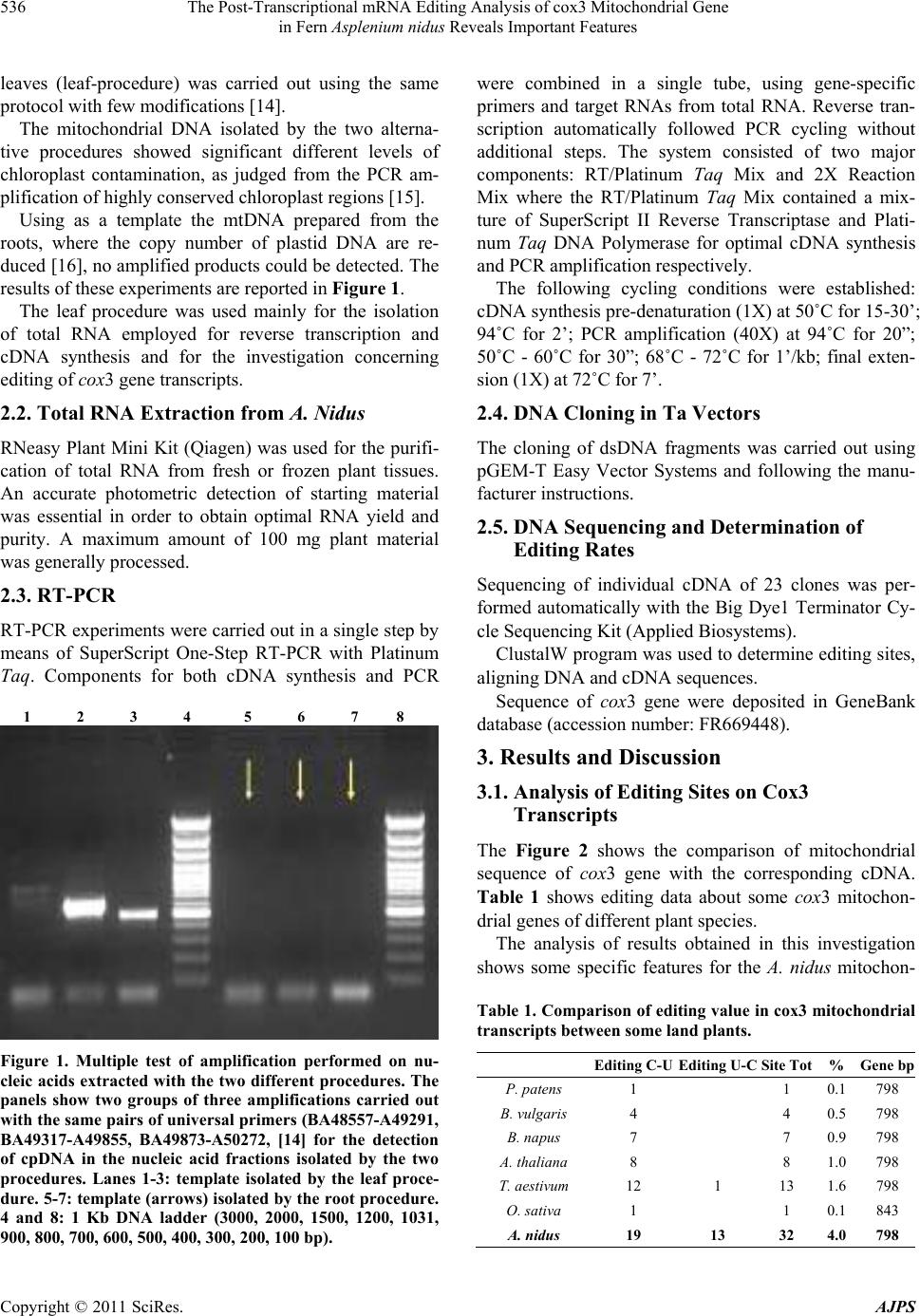 The Post-Transcriptional mRNA Editing Analysis of cox3 Mitochondrial Gene 536 in Fern Asplenium nidus Reveals Important Features leaves (leaf-procedure) was carried out using the same protocol with few modifications [14]. The mitochondrial DNA isolated by the two alterna- tive procedures showed significant different levels of chloroplast contamination, as judged from the PCR am- plification of highly conserved chloroplast regions [15]. Using as a template the mtDNA prepared from the roots, where the copy number of plastid DNA are re- duced [16], no amplified products could be detected. The results of these experiments are reported in Figure 1. The leaf procedure was used mainly for the isolation of total RNA employed for reverse transcription and cDNA synthesis and for the investigation concerning editing of co x 3 gene transcripts. 2.2. Total RNA Extraction from A. Nidus RNeasy Plant Mini Kit (Qiagen) was used for the purifi- cation of total RNA from fresh or frozen plant tissues. An accurate photometric detection of starting material was essential in order to obtain optimal RNA yield and purity. A maximum amount of 100 mg plant material was generally processed. 2.3. RT-PCR RT-PCR experiments were carried out in a single step by means of SuperScript One-Step RT-PCR with Platinum Taq. Components for both cDNA synthesis and PCR 1 2 3 4 5 6 7 8 Figure 1. Multiple test of amplification performed on nu- cleic acids extracted with the two different procedures. The panels show two groups of three amplifications carried out with the same pairs of universal primers (BA48557-A49291, BA49317-A49855, BA49873-A50272, [14] for the detection of cpDNA in the nucleic acid fractions isolated by the two procedures. Lanes 1-3: template isolated by the leaf proce- dure. 5-7: template (arrows) isolated by the root procedure. 4 and 8: 1 Kb DNA ladder (3000, 2000, 1500, 1200, 1031, 900, 800, 700, 600, 500, 400, 300, 200, 100 bp). were combined in a single tube, using gene-specific primers and target RNAs from total RNA. Reverse tran- scription automatically followed PCR cycling without additional steps. The system consisted of two major components: RT/Platinum Taq Mix and 2X Reaction Mix where the RT/Platinum Taq Mix contained a mix- ture of SuperScript II Reverse Transcriptase and Plati- num Taq DNA Polymerase for optimal cDNA synthesis and PCR amplification respectively. The following cycling conditions were established: cDNA synthesis pre-denaturation (1X) at 50˚C for 15-30’; 94˚C for 2’; PCR amplification (40X) at 94˚C for 20”; 50˚C - 60˚C for 30”; 68˚C - 72˚C for 1’/kb; final exten- sion (1X) at 72˚C for 7’. 2.4. DNA Cloning in Ta Vectors The cloning of dsDNA fragments was carried out using pGEM-T Easy Vector Systems and following the manu- facturer instructions. 2.5. DNA Sequencing and Determination of Editing Rates Sequencing of individual cDNA of 23 clones was per- formed automatically with the Big Dye1 Terminator Cy- cle Sequencing Kit (Applied Biosyste ms). ClustalW program was used to determine editing sites, aligning DNA and cDNA sequences. Sequence of cox3 gene were deposited in GeneBank database (accession number: FR669448). 3. Results and Discussion 3.1. Analysis of Editing Sites on Cox3 Transcripts The Figure 2 shows the comparison of mitochondrial sequence of cox3 gene with the corresponding cDNA. Table 1 shows editing data about some cox3 mitochon- drial genes of diffe rent plant species. The analysis of results obtained in this investigation shows some specific features for the A. nidus mitochon- Table 1. Comparison of editing value in cox3 mitochondrial transcripts betw een some land plants. Editing C-UEditing U-C Site Tot % Gene bp P. patens 1 1 0.1798 B. vulgaris 4 4 0.5798 B. napus 7 7 0.9798 A. thaliana 8 8 1.0798 T. aestivum 12 1 13 1.6798 O. sativa 1 1 0.1843 A. nidus 19 13 32 4.0798 Copyright © 2011 SciRes. AJPS 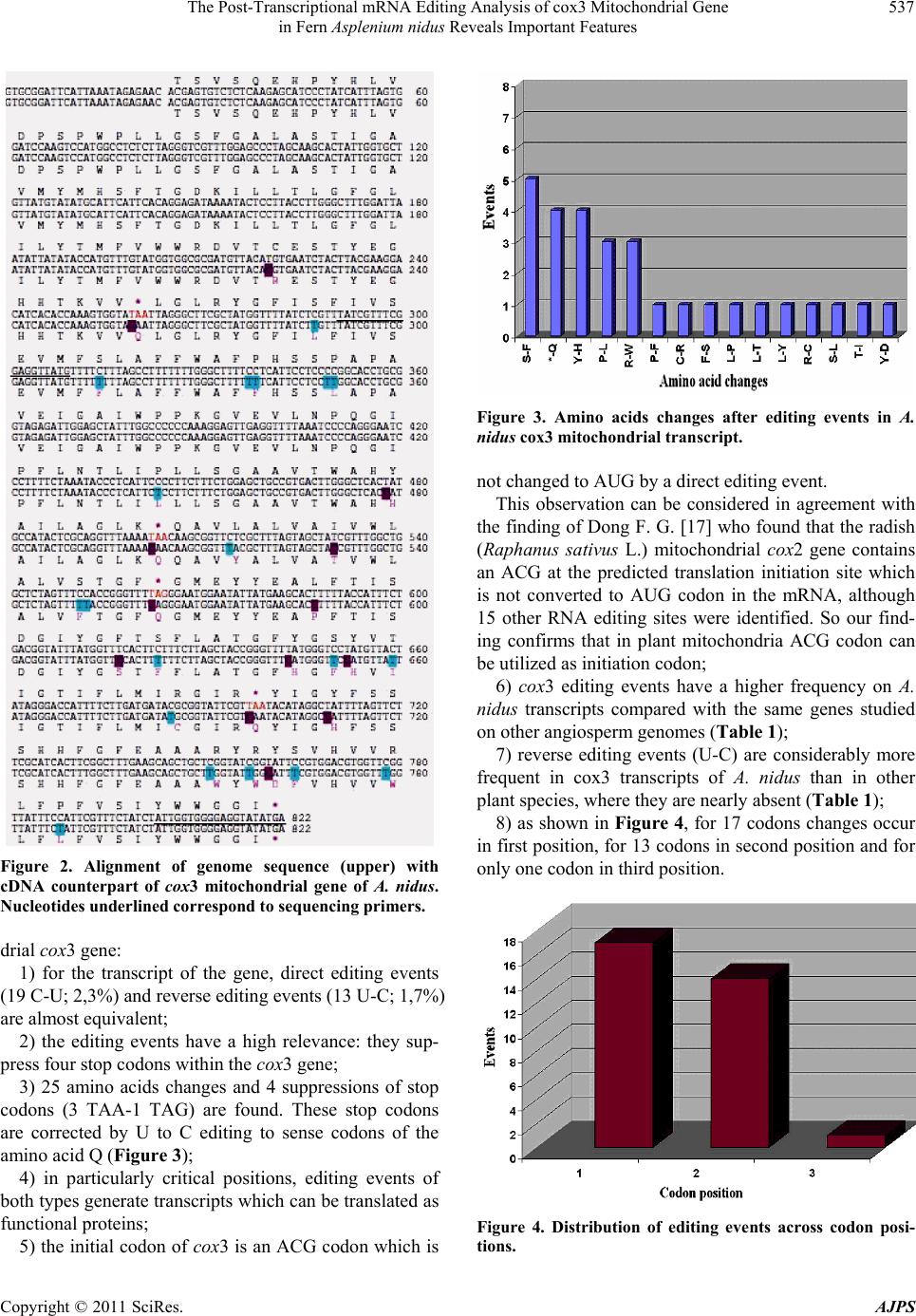 The Post-Transcriptional mRNA Editing Analysis of cox3 Mitochondrial Gene 537 in Fern Asplenium nidus Reveals Important Features Figure 2. Alignment of genome sequence (upper) with cDNA counterpart of cox3 mitochondrial gene of A. nidus. Nucleotides underlined correspond to sequencing primers. drial cox 3 gene: 1) for the transcript of the gene, direct editing events (19 C-U; 2,3%) and reverse editing events (13 U-C; 1,7%) are almost equivalent; 2) the editing events have a high relevance: they sup- press four stop codons within the cox3 gene; 3) 25 amino acids changes and 4 suppressions of stop codons (3 TAA-1 TAG) are found. These stop codons are corrected by U to C editing to sense codons of the amino acid Q (Figure 3); 4) in particularly critical positions, editing events of both types generate transcripts which can be translated as functional proteins; 5) the initial codon of cox3 is an ACG codon wh ich is Figure 3. Amino acids changes after editing events in A. nidus cox3 mitochondrial transcript. not changed to AUG by a direct editing event. This observation can be considered in agreement with the finding of Dong F. G. [17] who found that the radish (Raphanus sativus L.) mitochondrial cox2 gene contains an ACG at the predicted translation initiation site which is not converted to AUG codon in the mRNA, although 15 other RNA editing sites were identified. So our find- ing confirms that in plant mitochondria ACG codon can be utilized as initiation codon; 6) cox3 editing events have a higher frequency on A. nidus transcripts compared with the same genes studied on other angiosperm genomes (Table 1); 7) reverse editing events (U-C) are considerably more frequent in cox3 transcripts of A. nidus than in other plant species, where they are nearly absent (Table 1); 8) as shown in Figure 4, for 17 codons changes occur in first position, for 13 codons in second positio n and for only one codon in third position. Figure 4. Distribution of editing events across codon posi- tions. Copyright © 2011 SciRes. AJPS  The Post-Transcriptional mRNA Editing Analysis of cox3 Mitochondrial Gene in Fern Asplenium nidus Reveals Important Features Copyright © 2011 SciRes. AJPS 538 REFERENCES [1] K. Oda, K. Yamato, E. Ohta, H. Fukuzawa, T. Kohchi, S. Nakayama, K. Ishizaki, M. Fujisawa and K. Yamato, “Gene Organization Deduced from the Complete Se- quence of Liverwort Marchantia polymorpha Mitochon- drial DNA. A Primitive Form of Plant Mitochondrial Genome,” Journal of Molecular Biology, Vol. 223, No. 1, 1992, pp. 1-7. doi:10.1016/0022-2836(92)90708-R [2] K. Terasawa, M. Odahara, Y. Kabeya, T. Kikugawa, T. Sekine, M. Fujiwara and N. Sato, “The Mitochondrial Genome of the Moss Physcomitrella patens Sheds New Light on Mitochondrial Evolution in Land Plants,” Mo- lecular Biology and Evolution, Vol. 24, No. 3, 2006, pp. 699-709. doi:10.1093/molbev/msl198 [3] M. Unseld, J. R. Marien feld, P. Brandt and A. Brennicke, “The Mitochondrial Genome of Arabidopsis thaliana Contains 57 Genes in 366,924 Nucleotides,” Nature Ge- netics, Vol. 15, 1997, pp. 57-61. doi:10.1038/ng0197-57 [4] T. Kubo, S. Nishizawa, A. Sugawara, N. Itchoda, A. Es- tiati an d T. Mikami, “The Complete Nucl eotide Seque nce of the Mitochondrial Genome of Sugar Beet (Beta vul- garis L.) Reveals a Novel Gene for tRNA(Cys) (GCA),” Nucleic Acids Research, Vol. 28, No. 13, 2000, pp. 2571-2576. doi:10.1093/nar/28.13.2571 [5] Y. Notsu, S. Masood, T. Nishikawa, N. Kubo, G. Akiduki, M. Nakazono, A. Hirai and K. Kadowaki, “The Complete Sequence of the Rice (Oryza sativa L.) Mitochondrial Ge- nome: Frequent DNA Sequence Acquisition and Loss dur- ing the Evolution of Flowering Plants,” Molecular Genetics and Genomics, Vol. 268, No. 4, 2002, pp. 434-445. doi:10.1007/s00438-002-0767-1 [6] H. Handa, “The Complete Nucleotide Seque nce and RNA Editing Content of the Mitochondrial Genome of Rape- seed (Brassica napus L.): Comparative Analysis of the Mitochondrial Genomes of Rapeseed and Arabidopsis thaliana,” Nucleic Acids Rese arch, Vol. 31, No. 20, 2003, pp. 5907-5916. doi:10.1093/nar/gkg795 [7] S. W. Clifton, P. Minx, C. M. Fauron, M. Gibson, J. O. Allen, H. Sun, M. Thompson, W. B. Barbazuk, S. Kanuganti, C. Tayloe, L. Meyer, R. K. Wilson and K. J. Newton, “Sequence and Comparative Analysis of the Maize NB Mitochondrial Genome,” Plant Physiology, Vol. 136, 2004, pp. 3486-3503. doi:10.1104/pp.104.044602 [8] Y. Sugiyama, Y. Watase, M. Nagase, N. Makita, S. Yagura, A. Hirai and M. Sugiura, “The Complete Nucle o- tide Sequence and Multipartite Organization of the To- bacco Mitochondrial Genome: Comparative Analysis of Mitochondrial Genomes in Higher Plants, Molecular Ge- netics and Genomics, Vol. 272, No. 6, 2005, pp. 603-615. doi:10.1007/s00438-004-1075-8 [9] Y. Ogihara, Y. Yamazaki, K. Murai, A. Kanno, T. Terachi, T. Shiina, N. Miyashita, S. Nasuda, C. Nakamura, N. Mori, S. Takumi, M. Murata, S. Futo and K. Tsunewaki, “Structural Dynamics of Cereal Mitochon- drial Genomes as Revealed by Complete Nucleotide Se- quencing of the Wheat Mitochondrial Genome,” Nucleic Acids Research, Vol. 33, No. 19, 2005, pp. 6235-6250. doi:10.1093/nar/gki925 [10] A. Kanno, M. Nakazono, A. Hirai and T. Kameya, “A Chloroplast Derived trnH Gene Is Expressed in the Mito- chondrial Genome of Gramineous Plants,” Plant Molecu- lar Biology, Vol. 34, No. 2, 1997, pp. 353-356. doi:10.1023/A:1005828728036 [11] J. Fey and L. Marechal-Drouard, “Expression of the Two Chloroplast-Like tRNA (Asn) Genes in Potato Mitochon- dria: Mapping of Transcription Initiation Sites Present in the trnN1-tr nYnad2 Cluster and Upstream of trnN2,” Current Genetics, Vol. 36, No. 1-2, 1999, pp. 49-54. doi:10.1007/s002940050471 [12] F. Damiano, L. R. Ceci, L. Siculella and R. Gallerani, “Transcription of Two Sunflower (Helianthus annuus L.) Mitochondrial tRNA Genes Having Different Genetic Origins,” Gene, Vol. 286, No. 1, 2002, pp. 25-32. doi:10.1016/S0378-1119(01)00801-0 [13] S. Panarese, G. Rainaldi, C. De Benedetto and R. Galler- ani, “Sequencing of a Segment of a Monilophyte Species Mitochondrial Genome Reveals Features Highly Similar to those of Seed Plant mtDNAs,” The Open Plant Science Journal, Vol. 2, 2008, pp. 15-20. doi:10.2174/1874294700802010015 [14] M. R. Hanson, M. L. Boeshore, P. McClean, M. O’Con- nell and H. Nivison, “The Isolation of Mitochondria and Mitochondrial DNA, Methods in Enzymology, Vol. 118, 1986, pp. 437-447. doi:10.1016/0076-6879(86)18091-8 [15] P. Taberlet, L. Gielly, G. Pautou and J. Bouvet, “Univer- sal Primers for Amplification of the Non-Coding Regions of Chloroplast DNA,” Plant Molecular Biology, Vol. 17, No. 5, 1991, pp. 1105-1109. doi:10.1007/BF00037152 [16] K. Isono, Y. Niwa, K. Satoh and H. Kobayashi, “Evi- dence for Transcriptional Regulation of Plastid Photo- synthesis Genes in Arabidopsis thaliana Roots,” Plant Physiology, Vol. 114, No. 2, 1997, pp. 623-630. doi:10.1104/pp.114.2.623 [17] F. G. Dong, K. G. Wilson and C. A. Makaroff, “The Radish (Raphanus sativus L.) Mitochondrial cox2 Gene Contains an ACG at the Predicted Translation Initiation Site,” Current Genetics, Vol. 34, No. 2, 1998, pp. 79-87. doi:10.1007/s002940050369 |