

Paper Menu >>
Journal Menu >>
 Psychology 2011. Vol.2, No.7, 681-686 Copyright © 2011 SciRes. DOI:10.4236/psych.2011.27104 Family Functioning and Adolescents’ Psychological Well-Being in Families with a TBI Parent Dan Florin Stanescu1, Georg Romer2 1Department of Communication and Public Relations, National School of Political Studies and Public Administration, Bucharest, Romania; 2Universität Sklinikum Hambrug-Eppendorf, Hamburg, Germany. Email: [email protected] Received July 7th, 2011; revised August 12th, 2011; accepted September 21st, 2011. This study aimed at examining the interrelation between family functioning and children’s mental health in families with a brain injured parent. The first goal of this study was to investigate the predictive power of fam- ily functioning for children’s psychological well-being. Second, differential sub-dimensions of family function- ing were examined in respect of their predictive power for children’s psychological adaptation. Third, coping strategies on the family system level were differentiated in terms of their predictive power both for family func- tioning and for children’s psychosocial adjustment. 58 families were included in the current study. The follow- ing instruments were used: Youth Self Report, Family Crisis Oriented Personal Scales, and Family Assessment Device. Family dysfunction as a whole positively correlates with psychological symptoms of adolescents; four sub-dimensions of family functioning predicted children’s problems, namely affective responsiveness, affective involvement, roles, and communication. This research is all the more informative as the studies on the subject are nearly inexistent, and since it focuses on a category of utmost value—children. Keywords: Mental Health, Somatically Ill Parents, Acute TBI, Protective Factors, Children Introduction It has long been known that somatic illness in a parent is a risk factor for subsequent psychiatric disorders in children (Rutter, 1966). Although many professionals recognize the potential psycho-traumatic effect of parental illnesses for children (Lezak, 1986; Lewandowski, 1992), some of the best information comes from those working on a daily basis with these kinds of cases, i.e. those being directly involved in care process (De- Boskey & Morin, n.d.; Johnson, 2000). Due to their clinical experience, one can now have a broad image about the changes forced onto families and their members by parental illnesses. Thus, on the one hand, Armistead, Klein & Forehand (1997) suggested parental depression, withdrawal, inter-parental con- flict, and parental divorce as factors mediating children’s mal- adjustment by disrupting the parenting function. Other authors (Compas, Worsham, Epping-Jordan et al., 1994; Compas, Worsham, Ey et al., 1996) found that subjective perceptions of a parental illness predicted internalizing problems or distress in the child better than did objective severity of the parental dis- ease, and also that adolescent girls whose mothers had cancer reported more symptoms of anxiety or depression than girls whose fathers were ill, or boys with an ill parent of either gen- der. On the other hand, it can be generally assumed that the qual- ity of the parent-child relationship and other intra-familial at- tachments are important links in the mechanisms that explain how exposure to parental illness and severe stress in families may or may not lead to psychological problems in children (Romer et al., 2002). Since any parent-child dyad is embedded into, and interrelated with, all other dyadic, triadic and polyadic relationships within the family system, the construct of family relational functioning (Epstein, Bishop, & Levine, 1978) ap- pears to be a central issue for explaining adaptive as well as maladaptive patterns in families. If a family develops adaptive coping strategies, these may serve as a model for the individual child’s psychological adaptation. This model’s stated assump- tion is that the primary function of the family unit is to pro- vide a setting for the development and maintenance of family members on the biological, social, and psychological levels (Epstein, Bishop, and Baldwin 1984, 1978). Hence, family is- sues are grouped into three areas—the basic task area, the de- velopmental task area, and the hazardous task area. The McMasters Model of Family Functioning conceives of the basic task area (providing food, money, transportation, and shelter) as the most fundamental of the three areas. The devel- opmental task area includes family issues related to the stages of the family developmental sequence. At the individual level, these issues include crises in infancy, childhood, or adolescence; at the family level, these could be issues such as the beginning of marriage or the first pregnancy. The hazardous tasks area encompasses the ways in which families handle crises resulting from e.g. accidents, illness, or loss of income or of job. It sug- gests that families who are unable to handle these task areas are most likely to develop clinically sig nif ica nt prob lem s. Starting from these assumptions, high family relational func- tioning may be considered a protective factor for children ex- posed to acute severe physical illness in a parent, and low fam- ily relational functioning is likely to predict children’s malad- justment respectively. However, there are few empirical data supporting this assumption (Romer et al., 2002). Therefore, knowledge is needed about family characteristics that predict their children’s higher or lower risk for psychological mal- adaptation to parental illness. This study aimed at examining the interrelation between fam- ily functioning, family coping strategies and children’s mental health in families with a severe acute brain injured parent. Fam- ily coping strategies represent a combination of the meaning families attribute to events and how they utilize resources as 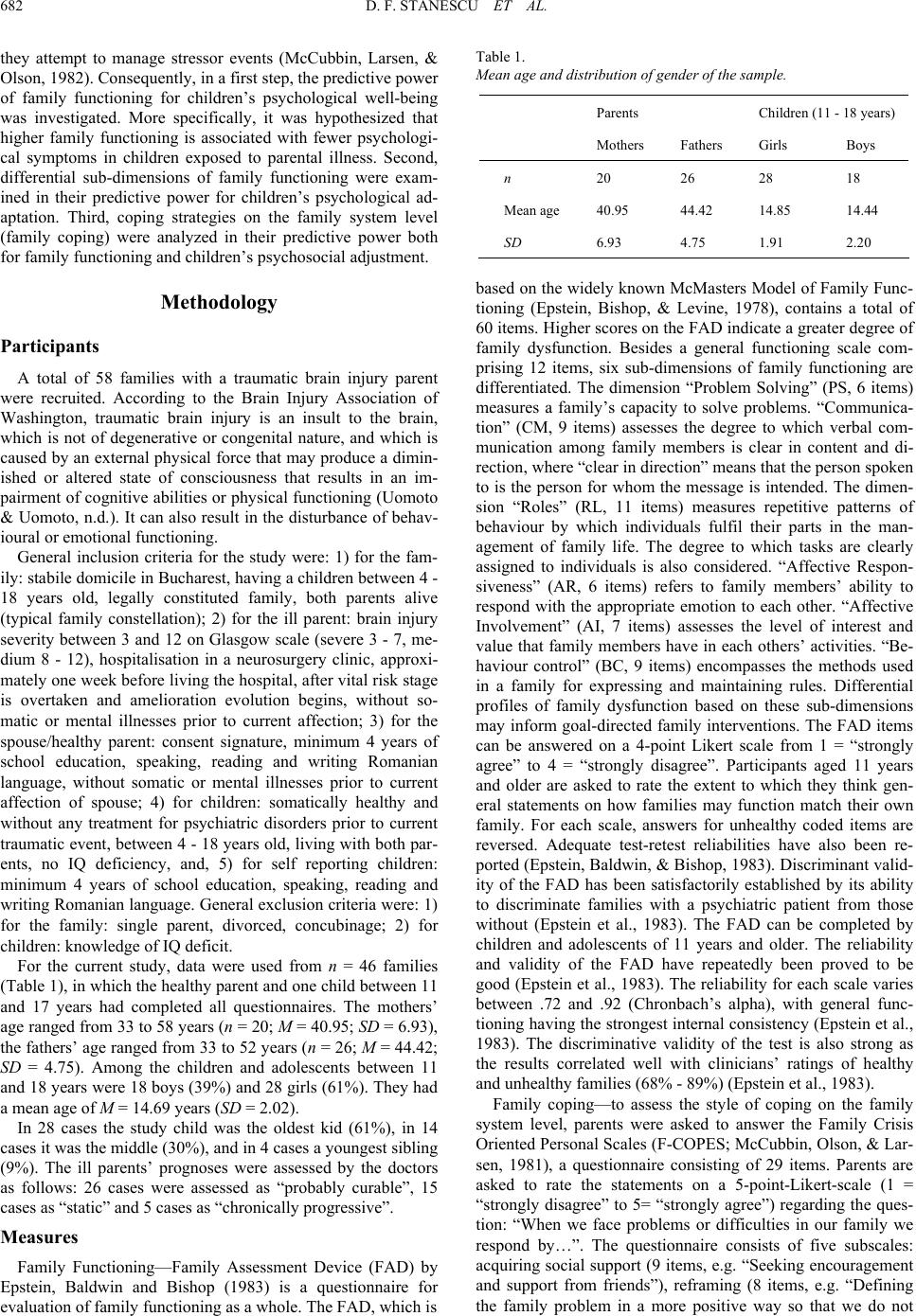 D. F. STANESCU ET AL. 682 they attempt to manage stressor events (McCubbin, Larsen, & Olson, 1982). Consequently, in a first step, the predictive power of family functioning for children’s psychological well-being was investigated. More specifically, it was hypothesized that higher family functioning is associated with fewer psychologi- cal symptoms in children exposed to parental illness. Second, differential sub-dimensions of family functioning were exam- ined in their predictive power for children’s psychological ad- aptation. Third, coping strategies on the family system level (family coping) were analyzed in their predictive power both for family functioning and children’s psychosocial adjustment. Methodology Participants A total of 58 families with a traumatic brain injury parent were recruited. According to the Brain Injury Association of Washington, traumatic brain injury is an insult to the brain, which is not of degenerative or congenital nature, and which is caused by an external physical force that may produce a dimin- ished or altered state of consciousness that results in an im- pairment of cognitive abilities or physical functioning (Uomoto & Uomoto, n.d.). It can also result in the disturbance of behav- ioural or emotional functioning. General inclusion criteria for the study were: 1) for the fam- ily: stabile domicile in Bucharest, having a children between 4 - 18 years old, legally constituted family, both parents alive (typical family constellation); 2) for the ill parent: brain injury severity between 3 and 12 on Glasgow scale (severe 3 - 7, me- dium 8 - 12), hospitalisation in a neurosurgery clinic, approxi- mately one week before living the hospital, after vital risk stage is overtaken and amelioration evolution begins, without so- matic or mental illnesses prior to current affection; 3) for the spouse/healthy parent: consent signature, minimum 4 years of school education, speaking, reading and writing Romanian language, without somatic or mental illnesses prior to current affection of spouse; 4) for children: somatically healthy and without any treatment for psychiatric disorders prior to current traumatic event, between 4 - 18 years old, living with both par- ents, no IQ deficiency, and, 5) for self reporting children: minimum 4 years of school education, speaking, reading and writing Romanian language. General exclusion criteria were: 1) for the family: single parent, divorced, concubinage; 2) for children: knowledge of IQ deficit. For the current study, data were used from n = 46 families (Table 1), in which the healthy parent and one child between 11 and 17 years had completed all questionnaires. The mothers’ age ranged from 33 to 58 years (n = 20; M = 40.95; SD = 6.93), the fathers’ age ranged from 33 to 52 years (n = 26; M = 44.42; SD = 4.75). Among the children and adolescents between 11 and 18 years were 18 boys (39%) and 28 girls (61%). They had a mean age of M = 14.69 years (SD = 2.02). In 28 cases the study child was the oldest kid (61%), in 14 cases it was the middle (30%), and in 4 cases a youngest sibling (9%). The ill parents’ prognoses were assessed by the doctors as follows: 26 cases were assessed as “probably curable”, 15 cases as “static” and 5 cases as “chronically progressive”. Measures Family Functioning—Family Assessment Device (FAD) by Epstein, Baldwin and Bishop (1983) is a questionnaire for evaluation of family functioning as a whole. The FAD, which is Table 1. Mean age and distribution of gender of the sample. Parents Children (11 - 18 years) MothersFathers Girls Boys n 20 26 28 18 Mean age40.95 44.42 14.85 14.44 SD 6.93 4.75 1.91 2.20 based on the widely known McMasters Model of Family Func- tioning (Epstein, Bishop, & Levine, 1978), contains a total of 60 items. Higher scores on the FAD indicate a greater degree of family dysfunction. Besides a general functioning scale com- prising 12 items, six sub-dimensions of family functioning are differentiated. The dimension “Problem Solving” (PS, 6 items) measures a family’s capacity to solve problems. “Communica- tion” (CM, 9 items) assesses the degree to which verbal com- munication among family members is clear in content and di- rection, where “clear in direction” means that the person spoken to is the person for whom the message is intended. The dimen- sion “Roles” (RL, 11 items) measures repetitive patterns of behaviour by which individuals fulfil their parts in the man- agement of family life. The degree to which tasks are clearly assigned to individuals is also considered. “Affective Respon- siveness” (AR, 6 items) refers to family members’ ability to respond with the appropriate emotion to each other. “Affective Involvement” (AI, 7 items) assesses the level of interest and value that family members have in each others’ activities. “Be- haviour control” (BC, 9 items) encompasses the methods used in a family for expressing and maintaining rules. Differential profiles of family dysfunction based on these sub-dimensions may inform goal-directed family interventions. The FAD items can be answered on a 4-point Likert scale from 1 = “strongly agree” to 4 = “strongly disagree”. Participants aged 11 years and older are asked to rate the extent to which they think gen- eral statements on how families may function match their own family. For each scale, answers for unhealthy coded items are reversed. Adequate test-retest reliabilities have also been re- ported (Epstein, Baldwin, & Bishop, 1983). Discriminant valid- ity of the FAD has been satisfactorily established by its ability to discriminate families with a psychiatric patient from those without (Epstein et al., 1983). The FAD can be completed by children and adolescents of 11 years and older. The reliability and validity of the FAD have repeatedly been proved to be good (Epstein et al., 1983). The reliability for each scale varies between .72 and .92 (Chronbach’s alpha), with general func- tioning having the strongest internal consistency (Epstein et al., 1983). The discriminative validity of the test is also strong as the results correlated well with clinicians’ ratings of healthy and unhealthy families (68% - 89%) (Epstein et al., 1983). Family coping—to assess the style of coping on the family system level, parents were asked to answer the Family Crisis Oriented Personal Scales (F-COPES; McCubbin, Olson, & Lar- sen, 1981), a questionnaire consisting of 29 items. Parents are asked to rate the statements on a 5-point-Likert-scale (1 = “strongly disagree” to 5= “strongly agree”) regarding the ques- tion: “When we face problems or difficulties in our family we respond by…”. The questionnaire consists of five subscales: acquiring social support (9 items, e.g. “Seeking encouragement and support from friends”), reframing (8 items, e.g. “Defining the family problem in a more positive way so that we do not 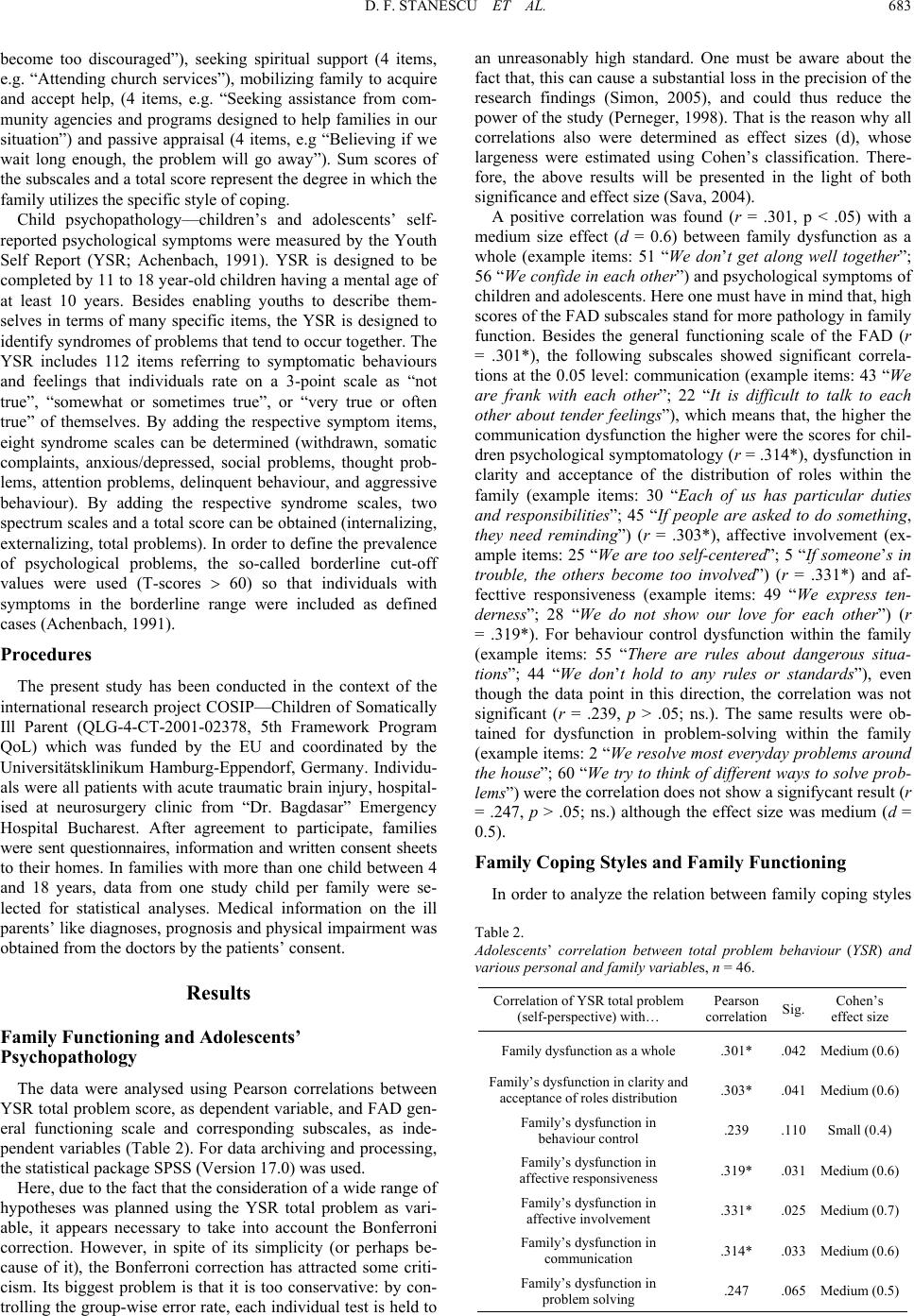 D. F. STANESCU ET AL. 683 become too discouraged”), seeking spiritual support (4 items, e.g. “Attending church services”), mobilizing family to acquire and accept help, (4 items, e.g. “Seeking assistance from com- munity agencies and programs designed to help families in our situation”) and passive appraisal (4 items, e.g “Believing if we wait long enough, the problem will go away”). Sum scores of the subscales and a total score represent the degree in which the family utilizes the specific style of coping. Child psychopathology—children’s and adolescents’ self- reported psychological symptoms were measured by the Youth Self Report (YSR; Achenbach, 1991). YSR is designed to be completed by 11 to 18 year-old children having a mental age of at least 10 years. Besides enabling youths to describe them- selves in terms of many specific items, the YSR is designed to identify syndromes of problems that tend to occur together. The YSR includes 112 items referring to symptomatic behaviours and feelings that individuals rate on a 3-point scale as “not true”, “somewhat or sometimes true”, or “very true or often true” of themselves. By adding the respective symptom items, eight syndrome scales can be determined (withdrawn, somatic complaints, anxious/depressed, social problems, thought prob- lems, attention problems, delinquent behaviour, and aggressive behaviour). By adding the respective syndrome scales, two spectrum scales and a total score can be obtained (internalizing, externalizing, total problems). In order to define the prevalence of psychological problems, the so-called borderline cut-off values were used (T-scores 60) so that individuals with symptoms in the borderline range were included as defined cases (Achenbach, 1991). Procedures The present study has been conducted in the context of the international research project COSIP—Children of Somatically Ill Parent (QLG-4-CT-2001-02378, 5th Framework Program QoL) which was funded by the EU and coordinated by the Universitätsklinikum Hamburg-Eppendorf, Germany. Individu- als were all patients with acute traumatic brain injury, hospital- ised at neurosurgery clinic from “Dr. Bagdasar” Emergency Hospital Bucharest. After agreement to participate, families were sent questionnaires, information and written consent sheets to their homes. In families with more than one child between 4 and 18 years, data from one study child per family were se- lected for statistical analyses. Medical information on the ill parents’ like diagnoses, prognosis and physical impairment was obtained from the doctors by the patients’ consent. Results Family Functioning and A dolescents’ Psychopathology The data were analysed using Pearson correlations between YSR total problem score, as dependent variable, and FAD gen- eral functioning scale and corresponding subscales, as inde- pendent variables (Table 2). For data archiving and processing, the statistical package SPSS (Version 17. 0) was used. Here, due to the fact that the consideration of a wide range of hypotheses was planned using the YSR total problem as vari- able, it appears necessary to take into account the Bonferroni correction. However, in spite of its simplicity (or perhaps be- cause of it), the Bonferroni correction has attracted some criti- cism. Its biggest problem is that it is too conservative: by con- trolling the group-wise error rate, each individual test is held to an unreasonably high standard. One must be aware about the fact that, this can cause a substantial loss in the precision of the research findings (Simon, 2005), and could thus reduce the power of the study (Perneger, 1998). That is the reason why all correlations also were determined as effect sizes (d), whose largeness were estimated using Cohen’s classification. There- fore, the above results will be presented in the light of both significance and effect size (Sava, 2004). A positive correlation was found (r = .301, p < .05) with a medium size effect (d = 0.6) between family dysfunction as a whole (example items: 51 “We don’t get along well together”; 56 “We confide in each other”) and psychological symptoms of children and adolescents. Here one must have in mind that, high scores of the FAD subscales stand for more pathology in family function. Besides the general functioning scale of the FAD (r = .301*), the following subscales showed significant correla- tions at the 0.05 level: communication (example items: 43 “We are frank with each other”; 22 “It is difficult to talk to each other about tender feelings”), which means that, the higher the communication dysfunction the higher were the scores for chil- dren psychological symptomatology (r = .314*), dysfunction in clarity and acceptance of the distribution of roles within the family (example items: 30 “Each of us has particular duties and responsibilities”; 45 “If people are asked to do something, they need reminding”) (r = .303*), affective involvement (ex- ample items: 25 “We are too self-centered”; 5 “If someone’s in trouble, the others become too involved”) (r = .331*) and af- fecttive responsiveness (example items: 49 “We express ten- derness”; 28 “We do not show our love for each other”) (r = .319*). For behaviour control dysfunction within the family (example items: 55 “There are rules about dangerous situa- tions”; 44 “We don’t hold to any rules or standards”), even though the data point in this direction, the correlation was not significant (r = .239, p > .05; ns.). The same results were ob- tained for dysfunction in problem-solving within the family (example items: 2 “We resolve most everyday problems around the house”; 60 “We try to think of different ways to solve prob- lems”) were the correlation does not show a signifycant result (r = .247, p > .05; ns.) although the effect size was medium (d = 0.5). Family Coping Styles and Family Functioning In order to analyze the relation between family coping styles Table 2. Adolescents’ correlation between total problem behaviour (YSR) and various personal and family va ri a bl es, n = 46. Correlation of YSR total problem (self-perspective) with… Pearson correlation Sig. Cohen’s effect size Family dysfunction as a whole .301* .042 Medium (0.6) Family’s dysfunction in clarity and acceptanc e of roles distribution .303* .041 Medium (0.6) Family’s dy s function in behaviour cont rol .239 .110 Small (0.4) Family’s dy s function in affective responsive n ess .319* .031 Medium (0.6) Family’s dy s function in affective involvem e n t .331* .025 Medium (0.7) Family’s dy s function in communication .314* .033 Medium (0.6) Family’s dy s function in problem solving .247 .065 Medium (0.5)  D. F. STANESCU ET AL. 684 and family functioning, each subscale of the F-COPES was correlated with the FAD and its subscales respectively (Table 3). Two significant negative correlations were found between the subscale “reframing” of the F-COPES and the “problem solving” (r = –.329*), respectively “affective involvement” (r = –.349*) scales of the FAD in the sense that frequent use of reframing strategies was associated with low family dysfunc- tion regarding problem solving and affective involvement (namely over-involvement). A significant positive correlation was found in the same way for the coping strategies “passive appraisal” and “affective responsiveness” (r = .374*), which means that frequent use of passive appraisal strategies was associated with high level of family dysfunction regarding af- fective responsiveness. Discussion The main purpose of this study was to examine the interrela- tions between differential family functioning, family coping and adolescents’ mental health in a sample of 46 adolescents having a parent affected by a severe central nervous system injury. Differential family relational functioning was measured by the Family Assessment Device (FAD, Epstein et al. 1983). Preferred coping strategies in families were detected using the F-COPES. Children’s psychological functioning was measured based on self reporting of adolescents. For measuring the prevalence of problems in children and adolescents, the Youth Self Report (YSR) was administered as a widely used screening instrument for individual psychopathology in teenagers. Regarding the family functioning, the quality of intra-famil- ial relationships is an important missing link in the mechanisms involved that explains how exposure to stress in families may or may not lead to psychological problems in children (Romer et al., 2002). If a family develops adaptive coping strategies, these serve as a model for the individual child’s psychological adaptation. Based on these assumptions, high family function- ing was considered protective for children exposed to parental physical illness, whereas family dysfunction may be likely to predict children’s maladjustment respectively. The new situa- tion can be considered as one of family crisis which leads to major disorganizations of routines and to a huge increase of emotional tensions between the healthy family membe rs. Thus, the child’s psychosocial development is assumed to be affected by the secondary effects of a parent’s illness on family life, such as fears for the future, financial burdens, role changes, physical strains of caring, or marital distress, as well as on the parent-child relationship in particular, such as changes in pa- rental personality traits, parents’ self-esteem, emotional avail- ability, parenting competencies, as well as separations due to hospitalisation or anticipated loss (Lewandowski, 1992; Romer et al., 2002). The re sults show tha t discrepant levels of fa mily functi oning predicted children’s psychological symptoms. This is supported by the positive correlation between family dysfunction as a whole and adolescents psychological symptoms. Furthermore, the finding that, besides the general functioning subscale, dys- function in four other sub-dimensions of family functioning predicted children’s problems, namely affective responsiveness, affective involvement, communication and roles, deserves more in-depth interpretation. Affective responsiveness refers to fam- ily members’ open sharing of feelings, whereas affective in- volvement reflects interest and value family members attach to each others’ activities; communication, involving honesty, dif- ficulty and level of communication between family members; and roles, which refers to clarity and acceptance of roles distri- bution, to particular duties and responsibilities. The present findings suggest that teenage children’s healthy adaptation to illness-related family stress is facilitated if parents and children are able to express and share feelings openly while maintaining appropriate boundaries between individual family members that help to prevent over-involvement with each other, if they are able to communicate openly to each other and to share and also accept specific new roles and responsibilities. Furthermore, open communication about illness-related concerns and related feelings should be facilitated in order to prevent a conspiracy of silence. These findings may well inform focused intervention concepts in medical family therapy. These findings are supported by similar results from previ- ous studies. Thus, Rost (1992) in his review on empirical stud- ies on children of somatically ill parents summarized some protective factors, such as open communication between par- ents and children about the illness as well as flexible boundaries between the family system and the social environment. Fol- lowing the same idea, Power (1985), found that well-adjusted families were those in which family members took care of their own needs and were involved in activities outside the family. Furthermore, communication about the disease was open and information to/about all family members was appropriate. In the poorly adjusted families, the disease was perceived as an Table 3. Intercorrelations of F AD scal e s a n d F-COPES scales, Adolescents, n = 46. F-COPES FAD Seeking social support Reframing Seeking spiritual suppo rtMobilizing family to acquire and accept help Passive appraisal Problem sol ving –.096 –.329* –.212 –.045 .106 Communication .122 –.185 –.171 .105 .202 Roles .191 –.200 –.188 .203 .184 Affective responsiveness .142 .096 –.210 .013 .374* Affective involvement .085 –.349* –.174 .102 .084 Behaviour c ontrol .009 .278 –.169 –.050 .246 General func tioning .090 –.093 –.157 .085 .213 *Correlation is significant at the .05 level (2-tailed).  D. F. STANESCU ET AL. 685 ongoing source of distress. Lack of communication, informa- tion and understanding was prominent in these families. Corre- lation analyses revealed that only two of the FAD subscales did not correlate with children and adolescents psychological symptoms, namely behaviour control and problem solving. Here, one can assume that by the very nature of the traumatic event and its consequences for family life, all families will have to make use of their resources and skills in problem solving and behaviour control to a maximum degree. Therefore, these two areas of family function are highly activated in terms of pri- mary coping requ i r e ments. Differential family coping strategies could not discriminate families in which adolescents reported symptoms from those families with asymptomatic offspring. It has to be noted here again, that F-COPES data were not available from the adoles- cents’ perspective. Therefore a bias based on a shift of report- ing perspectives in the data correlated with each other cannot be excluded. Data suggest that there is no significant path from families’ coping strategies to children’s psychological outcome. However, in both parents’ perspective, common use of reframe- ing as a coping strategy predicted to an impressive degree high family function. In fathers’ reporting respectively, seeking so- cial and/or spiritual support was associated with higher rela- tional functioning in families. To sum up, these findings are well applicable to inform fo- cused concepts for systemic interventions in families with an ill parent, that are not only geared to utilize the family system as a supporting resource for the ill parent, but also aim at preventing mental health problems in children of ill parents. Fostering family rela t ional functioni ng in crisis can be assumed to equally serve both goals. Our findings suggest that supporting a family in finding appropriate ways of reframing the stressful situation may be especia lly effective in stre ngthening family funct ioning in crisis. From the child’s perspective, reframing connotations that are appealing to adult family members may not be equally helpful, unless they are adequately explained on the child’s cognitive level. If patients or their relatives report these as their main coping patterns, this may reflect helplessness rather than an effective way of self-regulation and stabilization, and thus may be carefully questioned by health professionals. Further- more, our data suggest that adolescents with an ill parent are especially vulnerable for internalizing problems, if families have a low ability to share feelings and are having weak intra- familial boundaries with an increased danger of intrusion, over-involvement or enmeshment (Minuchin, 1998). If one acknowledges that in families facing the existential threat of serious parental illness the attachment system is highly acti- vated and therefore cohesive forces are stimulated together with all resources and competencies involved in mutual support and problem solving, which are already evoked to the greatest pos- sible degree, it becomes plausible that these families have a specific vulnerability to dysfunctional affective involvement, if there are not enough intra-familial boundaries to counterbal- ance the strong cohesive forces. Therefore, systemic interven- tions, besides encouraging open expression and sharing of feel- ings between parents and children, should at the same time focus on strengthening clear boundaries between individuals, so that children will be able to feel empathy for their ill parents’ harm and distress without getting contaminated by these in their intra-psychic world. Despite a number of strengths of this study, it is not without its limitations. These limitations do not affect its main findings, but bear on how they are interpreted. Taking into consideration that this study investigated a novel area in child mental health (in Romania this was actually the first study on children of somatica lly ill parents), one could admit that a mere exploratory approach would suffice. For this study, an important emphasis on hypothesis testing, which for some research questions was supplemented by an exploratory analysis. Also, because the sample size was relatively limited, it was decided to use both effect sizes and statistical significance in hypothesis testing. The inclusion criteria established in the project, which ex- clude the families with problems prior to current illness, or single parent families, divorced, not legally constituted, could exclude exactly the kind of family which, perhaps, are in more need of psychological support for their children than the fami- lies included in the rese arc h. The use of data from the other European partners involved in the project, although highly desirable, was unfortunately im- possible, primarily due to the fact that the Romanian subproject was focused on a different type of disease, acute central nerv- ous system injuries, while our partners were focused on chronic illnesses like cancer or multiple-sclerosis. Yet, some of the findings (e.g. affective responsiveness and affective involve- ment FAD subscales roles in children and adolescents psycho- logical symptomatology) are mirrored both in German and UK data (Edwards et al., 2006; Romer et al., 2006), in spite of dif- ferences in parental illnesses, which is evidence for the fact that, the life threat or absence of the ill parent, his suffering, depress- sion and burden on the healthy parent and the need of reorgan- izing the roles in family are effects encountered across different designs and samples. References Achenbach, T. M. (1991). Manual for the youth self-report and 1991 profile. Burlington, VT: Department of Psychiatry, University of Vermont. Armistead, L., Klein, K., & Forehand, R. (1997). Disclosure of parental HIV infection to children in the families of men with haemophilia: Rates, outcomes, and the role of the family environment. Journal of Family Psychology, 11, 49-61. doi:10.1037/0893-3200.11.1.49 Compas, B. E., Worsham, N. L., Epping-Jordan, J. E., Grant, K. E., Mireault, G., Howell, D. C., & Malcarne, V. L. (1994). When mom or dad has cancer: Markers of psychological distress in cancer pa- tients, spouses and children. Health Psychology, 13, 507-515. doi:10.1037/0278-6133.13.6.507 Compas, B. E., Worsham, N. L., Ey, S., & Howell, D. C. (1996). When mom or dad has cancer: II. Coping, cognitive appraisals and psycho- logical distress in children of cancer patients. Health Psychology, 15, 167-175. doi:10.1037/0278-6133.15.3.167 DeBoskey, S. D., & Morin, K. (n.d.). Head injury: a guide for families. Florida: Brain Injury Association of Florida. URL (laet checked 14 April 2005) from http://www.bianh.org Edwards, L., Wa tson, M., St. James-Roberts, I., Ashley, S., Tilney, C., Brougham, B., & Romer, G. (2006). Adolescents coping with a par- ent’s breast cancer. Manuscript submitted fo r publication. Epstein, N., Baldwin, L. & Bishop, D. (1983). The McMaster family assessment device. Journal of Marital and Family Therapy, 9, 171-180. Epstein, N., Bishop, D., & Levine S. (1978). The McMaster model of family functioning. Journal of Marriage and Family Counselling, 4, 19-31. doi:10.1111/j.1752-0606.1983.tb01497.x Epstein, N., Bishop, D., & Baldwin, L. (1984). McMaster model of family functioning. In D. H. Olson, & P. M. Miller (Eds.), Family studies review year-book (Vol. 2). New Delhi: Sage Publications. doi:10.1111/j.1752-0606.1978.tb00537.x Johnson, G. (2000). Traumatic brain injury survival guide. Traverse City, MI. URL (last checked 26 July 2004) http://www.tbiguide.com Lewandowski, L. A. (1992). Needs of children during the critical ill- ness of a parent or sibling. Critical Care Nursing Clinics of North America, 4, 573-585.  D. F. STANESCU ET AL. 686 Lezak, M. D. (1986). Psychological implications of traumatic brain damage for the patient’s family. Rehabilitation Psychology, 31, 241-250. doi:10.1037/h0091551 McCubbin, H. I., Olson, D., & Larsen, A. (1981). Family crisis ori- ented personal evaluation scale. In H. I. McCubbin, A. I. Thompson, & M. A. McCubbin (Eds.), Family assessment: Resiliency, coping and adaptation—Inventories for research and practice (pp. 455-507). Madison: University of Wisconsin System. McCubbin, H. I., Larsen, A., & Olson, D. H. (1982). Family crisis oriented personal evaluation scales. In D. H. Olson, H. I. McCubbin, H. Barnes, A. Larsen, M. Muxen, & M. Wilson (Eds.), Family in- ventories (pp. 143-159). St. Paul: University of Minnesota Press. Minuchin, S. (1998). Familles en therapie. Paris: Editions Eres. Perneger, T. (1998). What’s wrong with Bonferroni adjustments. Brit- ish Medical Journal, 316, 1236-1238. Power, P. W. (1985). Family coping behaviours in chronic illness: A rehabilitation perspective. Rehabilitat ion Literature, 46, 78- 83. Romer, G., Barkmann, C., Schulte-Markwort, M., Thomalla, G., & Riedesser, P. (2002). Children of somatically ill parents: A meth- odological review. Clinical Child Psychology and Psychiatry, 7, 17-38. doi:10.1177/1359104502007001003 Romer, G., Saha, R., Haagen, M., Schmitt, F., & Baldus, C. (2006). Differential family functioning, family coping and teenage children’s psychological adjustment when a parent is physically ill—A multi-perspective study. Manuscript submi tted for publication. Rost, R. (1992). Psychosoziale Probleme von Kindern Körperlich Kranken Eltern. Ein Literaturüberblick. Unpublished Mediziniche Dissertation. Rutter, M. (1966). Children of sick parents. An environmental and psychiatric study. Lo n do n : O xford University Pre s s. Sava, F. (2004). Analiza datelor in cercetarea psihologica: Metode statistice complementare. Cluj-Napoca: Editura ASCR. Simon, S. (2005). Steve’s attempt to teach statistics. URL (laet checked 9 February 2006) from http://www.cmh.edu |