

Paper Menu >>
Journal Menu >>
 Psychology 2011. Vol.2, No.7, 665-668 Copyright © 2011 SciRes. DOI:10.4236/psych.2011.27101 The Analysis of Attachment Styles through Interpersonal Circumplex Description Wen Xue, Shouying Zhao School of Educational, Guizhou Normal University, Guiyang, China. Email: [email protected] Received May 18th, 2011; revised July 23rd, 2011; accepted September 9th, 2011. The study explored how the dyads with different attachment styles behave towards Leary’s circumplex in coop- erative and competitive tasks. 100 strangers as a sample were surveyed through two experiments on computer, by using RBQ (Riverside Behav ioral Q-sort) to examine thei r interpersonal traits through rated by experimente rs. Relation Questionnaire (RQ) and ECR were also used to measure their attachment styles. There are three con- clusions based on the results of this study that: 1) Individuals of different attachment styles in interpersonal in- teraction had shown different trend of interpersonal styles; 2) Individuals of different attachment styles take up different area in interpersonal circumplex, which proves that it is continuous not discrete of interpersonal at- tachment style; 3) the dyads in different sex of different attachment types showed different satisfaction in these two tasks. Keywords: Interpersonal Circumplex, Attachment Style, Interpersonal Relationship, Dyads Introduction It was mentioned in Bowlby and Ainsworth’s attachment theory that patterns of childhood attachment have examined in the context of adult’s experience of emotion, especially in their relationships. This extension is consistent with Bowlby’s asser- tion that the attachment mechanism is an impact “from the cra- dle to the grave”. Act ual ly , the continuity of infant’s attachment style has further effect on individual’s manifestation towards their relationships or association (such as marriage, romantic relation, the companionship). Therefore, most attachment re- searches have been done by the domestic and international researchers, combined with various composition of character about cognition, personality or trait. So further exploring will be continued for the correlation of this individually emotional link and individual mental state shape, interpersonal behavior, and social cognition and support, happiness, etc. With the gradually in-depth social science researches on adult interpersonal attachment, studies for attachment methods and means of measurement have become more diversified. In China, the main measurement of interpersonal attachment is in two ways. In the first way, individual’s attachment style was measured to determine the differences between individuals with different attachment styles; and the Ladder is the determination of the one’s score on attachment dimensi ons. Individuals’ scores on different dimension will be used to determine the extent of their attachment avoidance and anxiety and so on. Question- naires are highly applied in researches concerning both the degree in dimension structure and attachment styles. Which is used the most is the type of Adult Attachment Styles Question- naire. Early questionnaire survey towards adult attachment was fo- cused on the discrete types (Hazan & Shaver, 1987), which was developed by Ainsworth’s three infant attachment types. Since then, a large number of adult attachment scales were emerging, greatly promoting the research progress in this field. According to Bowlby’s theory, the individual was referred to the self- model and other-model, because individual’s attachment style depends on their own positive or negative assessment about themselves and their supporters (especially parents). So the adult attachment styles based on the integration of these two models, can be divided in four-categorical scheme, such as secure, ambivalent, fearful and dismissing. Therefore, the sub- sequent establishment of attachment scale towards two dimen- sions—self-model and other-model, became the core content discussed by the researchers. The individual with secure at- tachment of cherish both the positive self-evaluation and other-evaluation, and they want others to response their own emotional needs; compared with that, ambivalent attachment style owes negative self-model, whereas of positive other-model; The individuals of dismissing attachment style possess positive self-model, but they believe that others are not worth trusting; The fearful attachment’s self-model and the other-model were both negative. Based on this theoretical analysis, Bartholomew and Horowitz developed a self-report scale—Relationship Ques- tionnaire. Since then, based on the RQ, Brennan developed a standard adult intimate relationships Attachment Scale—Closed Relation Experience scale (ECR), a scale of 36 questions, in which, at- tachment anxiety and attachment avoidance as its the two di- mensions composition. Currently, Attachment investigation would be confirmed by of the combination of these two item polls or they may use the ECR to determine the subjects’ style while the RQ as the crit er i on for test. Question However, recent research suggests that rather than a three-or four-categorical, a dimensional, more comprehensive model may better represent adult attachment (Crowell, Fraley, & Shaver 1999). Hazan and Shaver (1987) found that “Secure attachment tend to describe their parents friendly and warm, whereas Anxiety-Ambivalent attachment of the individuals described their families aggressive, and avoidant person tend to report their par ents cold and rejectin g”. Therefore, it is no doubt the measurement method based on interpersonal relationship 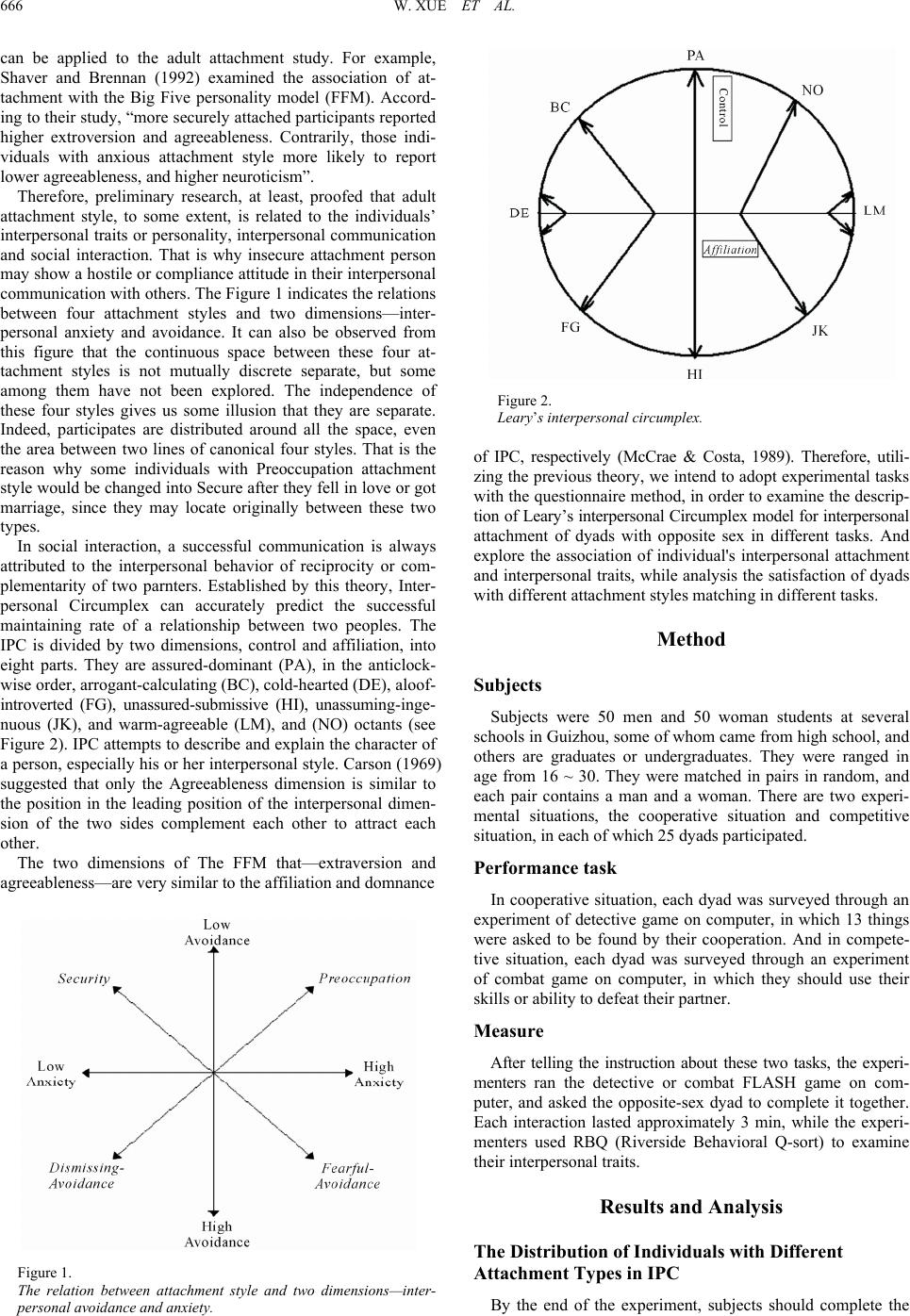 W. XUE ET AL. 666 can be applied to the adult attachment study. For example, Shaver and Brennan (1992) examined the association of at- tachment with the Big Five personality model (FFM). Accord- ing to their study, “more securely attached participants reported higher extroversion and agreeableness. Contrarily, those indi- viduals with anxious attachment style more likely to report lower agreeableness, and higher neuroticism”. Therefore, preliminary research, at least, proofed that adult attachment style, to some extent, is related to the individuals’ interpersonal traits or personality, interpersonal communication and social interaction. That is why insecure attachment person may show a hostile or compliance attitude in their interpersonal communication with others. The Figure 1 indicates the relations between four attachment styles and two dimensions—inter- personal anxiety and avoidance. It can also be observed from this figure that the continuous space between these four at- tachment styles is not mutually discrete separate, but some among them have not been explored. The independence of these four styles gives us some illusion that they are separate. Indeed, participates are distributed around all the space, even the area between two lines of canonical four styles. That is the reason why some individuals with Preoccupation attachment style would be changed into Secure after they fell in love or got marriage, since they may locate originally between these two types. In social interaction, a successful communication is always attributed to the interpersonal behavior of reciprocity or com- plementarity of two parnters. Established by this theory, Inter- personal Circumplex can accurately predict the successful maintaining rate of a relationship between two peoples. The IPC is divided by two dimensions, control and affiliation, into eight parts. They are assured-dominant (PA), in the anticlock- wise order, arrogant-calculating (BC), cold-hearted (DE), aloof- introverted (FG), unassured-submissive (HI), unassuming-inge- nuous (JK), and warm-agreeable (LM), and (NO) octants (see Figure 2). IPC attempts to describe and explain the character of a person, especially his or her interpersonal style. Carson (1969) suggested that only the Agreeableness dimension is similar to the position in the leading position of the interpersonal dimen- sion of the two sides complement each other to attract each other. The two dimensions of The FFM that—extraversion and agreeableness—are very similar to the affiliation and domnance Figure 1. The relation between attachment style and two dimensions—inter- personal avoidance and anxiety. Figure 2. Leary’s interpersonal circumplex. of IPC, respectively (McCrae & Costa, 1989). Therefore, utili- zing the previous theory, we intend to adopt experimental tasks with the questionnaire method, in order to examine the descrip- tion of Leary’s interpersonal Circumplex model for interpersonal attachment of dyads with opposite sex in different tasks. And explore the association of individual's interpersonal attachment and interpersonal traits, while analysis the satisfaction of dyads with different attachment styles matching in different tasks. Method Subjects Subjects were 50 men and 50 woman students at several schools in Guizhou, some of whom came from high school, and others are graduates or undergraduates. They were ranged in age from 16 ~ 30. They were matched in pairs in random, and each pair contains a man and a woman. There are two experi- mental situations, the cooperative situation and competitive situation, in each of which 25 dyads participated. Performance task In cooperative situation, each dyad was surveyed through an experiment of detective game on computer, in which 13 things were asked to be found by their cooperation. And in compete- tive situation, each dyad was surveyed through an experiment of combat game on computer, in which they should use their skills or ability to defeat their partner. Measure After telling the instruction about these two tasks, the experi- menters ran the detective or combat FLASH game on com- puter, and asked the opposite-sex dyad to complete it together. Each interaction lasted approximately 3 min, while the experi- menters used RBQ (Riverside Behavioral Q-sort) to examine their interpersonal traits. Results and Analysis The Distribution of Individuals with Different Attachment Types in IPC By the end of the experiment, subjects should complete the  W. XUE ET AL. 667 self-report scale RQ and ECR also, in order to determine their attachment styles. There are 43 people of secure attachment, 15 of fearful attachment, whereas 22 subjects of ambivalent at- tachment, and 20 with dismissing style. Then the subjects’ at- tachment type was tested with their highest scores in the eight subscales of RBQ through correlation analysis. Every subscale would represent a trait in the circumplex, the pie charts are shown as follow (see Figure 3). Through the Figure 3, subjects with secure attachment tested in two tasks mainly reflects a highly-frequency performance in PA, JK LM, and NO. Among other three insecure attachment styles, it is easy to find that the interpersonal performance of ambivalent-attachment individual is similar to the secure one, but the proportion of each trait is distinguished with it. Fearful attachment were tested mainly in interpersonal style of BC, DE, and FG, which is the most distinguished on compared with the secure style ; while the subjects of dismissing attachment got high scores in FG and JK. In order to exclude the possibility that extreme data would be generated by the highest scores, and to further explore the rela- tionship between variables about the 4 types of attachment and the 8 interpersonal traits in IPC octant, we tested the data of 100 individual of these two tasks through Pearson two-tailed test (Table 1). It can be well informed in Table 1 that subjects with secure attachment style (A) was more obvious in the performance of BC, PA, NO, LM in interpersonal interaction, which shows significantly positive correlation in PA, but shows a signify- cantly negative correlation with the HI. This matches the hy- pothesis that highly positive self-model is the main character of secure individuals. When it comes to fearful attachment style (B), the situation may become just opposite, which shows posi- tive relation towards the traits of BC, DE, FG, HI and a lower scores on the affiliation dimension of the circumplex, while a higher score in complaisance, because individuals under this style take a part in negative self-model and other-model. Sub- jects with ambivalent attachment take a positive correlation with BC and DE two traits. Although it may indicate a conflict- tion against the highest-score pie chart that DE takes no evi- Figure 3. The highest score’s distribution of RBQ in different attachment style individuals. (Pies: 1-secure; 2-fearful; 3-ambivalent; 4-dismissingTrait: from 1-PA to 8-NO). Table 1. The correlation coefficent of eight interpersonal traits and attachment styles in two tasks. PA BC DE FG HI JK LM NO A 0.27** 0.23* –0.07 –0.18 –0.27** 0.09 0.140.17 B –0.13 –0.13 0.013 0.31** 0.03 0.01 –0.06 –0.09 C –0.13 –0.04 0.089 0.03 –0.01 0.03 0.07–0.10 D 0.01 0.025 –0.22* –0.04 –0.01 0.09 0.020.01 dence above this attachment style, it can be explained that this characteristics is due to this type of attachment and subjects’ average score on this trait are not low, but this is not their high- est score characteristics. What should be a surprise is that the dismissing attachment shows similarity with the secure on. Since individuals with this type although evaluate others nega- tive or not worth trusting, a positive self-model was formalized in their inner mechanisms of attachment experience in early stage. So they may also get a not low score on control dimen- sion, however, they may cherish less ability of an agreeable nature, which can be indicated on the decreased correlation coefficient compared with the secure attachment, because their other-model are negative. To a contrary, Figure 4 provides a clear distribution of dif- ferent attachment styles’ location in the circumplex. And each style is depicted as a consecutive manner in the circumplex, which proofs the continuum of attachment style shown in hori- zontal and vertical dimensions. Among them, three types of attachment are in continuous interpersonal performance, with- out being interrupted, whereas ambivalent attachment person take a break in the circular model. In this interpersonal process, individuals belonged to ambivalent attachment style, tended to be divided into two forms, one of which relatively came closer to fearful attachment, and the other form performed relatively as the secure one, which also well confirmed the assumption that it is the continuity rather than separation should be the nature of attachment styles. But whether it is close to the fearful attachment, or secure attachment, it showed high compliance more than the dominance on the control dimension. In our daily life it often seems as manifestation as lacking of confidence when put it in social relation. This should be attributed to the negative self-evaluation model of ambivalent attachment. The Satisfaction of Dyads with Different Attachment Styles in Cooperation Task Calculating through variance analysis, the statistic signify- cance (Sig) = 0.018 < 0.05 (Table 2), indicated that, between dyads with the different attachment-style matching, at least one group showed significant difference towards other groups. As shown in the satisfaction mean picture (Figure 5), both partners in the dyads were secure attachment showed the most coopera- tion satisfaction in this interaction, followed which is the dyads Figure 4. The description of four attachment styles in IPC (1-secure; 2-fearful; 3-ambivalent; 4-dismissing).  W. XUE ET AL. 668 with only one secure attachment individual, and dyads with both are insecure attachment took the lowest score compared with the other two group. The Satisfaction of Dyads with Different Attachment Styles in Competition Task Similar to the cooperative task, the statistic significance (Sig) in competitive task is 0.018 < 0.05 (see Table 3), which also indicated at least one group showed significant difference to- wards other groups. We can be well informed through the linear figure (Figure 6), that dyads of secure attachment showed sig- nificantly higher satisfaction than dyads with insecure satisfac- tion. But compared to cooperative tasks, the scores between the two groups with insecure attachment style, the difference is not distinguished. In cooperation task, to some kind of degree, in- crease peoples’ satisfaction when it comes to exact social asso- ciation. Figure 6. The average score of competitive satisfaction degree towards dyads in different attachment styles. (1-dyads of secure; 2-dyads with only one insecure partner; 3-dyads of unsecure). Conclusion Three conclusions based on the results of this experimental Table 2. Variance analysis for cooperative satisfaction degree towards dyads in different attachment styles. ANOVA Sum of squares DfMean of square s F Sig. Between groups 10.183 2473.895 3.2560.018 In group 23.257 22145.524 Sum 33.440 24 study can be showed that: 1) Individuals of different attach- ment styles in interpersonal interaction had shown different trend of interpersonal styles; 2) Individuals of different at- tachment styles take up different area in interpersonal circum- plex, which proves that it is continuous not discrete of inter- personal attachment style; 3) the dyads in different sex of dif- ferent attachment types showed different satisfaction in these two tasks. In cooperative task, dyads of secure attachment style took the highest satisfaction, and of insecure attachment style with the lowest one, while in competitive task, it is not distin- guished between dyads of insecure attachment style and dyads with only one insecure partner. References Gallo, L. C. et al. (2003). An interpersonal analysis of adult attachment style: Circumplex descriptions, recalled developmental experiences, self-representations and interpersonal functioning in adulthood. Journal of Personalit y, 71, 141-182. doi:10.1111/1467-6494.7102003 Li, T. G. (2005). Attachment and memory for emotional events. Jour- nal of Peking University, 41 , 965-974. Ansell, E. B., Kurtz, J. E., & Markey, P. M. (2008). Gender differences in interpersonal complementarity within roommate dyads. Personality and Social Psychology Bulletin, 34, 502-512. doi:10.1177/0146167207312312 Gurtman, M. B., & Pincus, A. L. (2000). Interpersonal adjective scales: Confirmation of circumplex structure from multiple perspectives. Personality and Social Psychology Bulletin, 26, 374- 384. doi:10.1177/0146167200265009 Markey, P. M., Funder, D. C., & Ozer, D. J. (2003). Complementarity Figure 5. Average score of cooperative satisfaction degree towards dyads in different attachment styles. of interpersonal behaviors in dyadic interactions. Journal of Person- ality and Social Psychology, 29, 1082-1090. Mayseless, O., & Scharf, M. (2007). Adolescents’ attachment repre- sentations and their capacity for intimacy in close relationships. Journal of research on adolescence, 17, 23-50. Table 3. Variance analysis for competitive satisfaction degree towards dyads in different attachment styles. ANOVA Sum of squares DfMean of square s F Sig. Between groups 11.248 2473.895 4.6670.020 In group 26.512 22145.524 Sum 37.760 24 Sadler, P., & Woody, E. (2003). Is who you are who you’re talking to? Interpersonal style and complementarity in mixed-sex interactions. Journal of Personality a nd Social Psychology, 84, 80-96. doi:10.1016/j.jecp.2004.02.002 Sullivan, H. S. (1953). The interpersonal theory of psychiatry. New York: Norton. Zimmermann, P. (2004). Attachment representations and characteristics of friendship relations during adolescence. Journal of Experimental Child Psychology, 88, 83-101. doi:10.1016/j.jecp.2004.02.002 |