

Paper Menu >>
Journal Menu >>
 Advances in Chemical Engi neering and Science , 2011, 1, 245-251 doi:10.4236/aces.2011.14035 Published Online October 2011 (http://www.SciRP.org/journal/aces) Copyright © 2011 SciRes. ACES Pretreatment of Wa stewater Streams from Petroleum/Petrochemical Industries Using Coagulation Hossam Altaher*, Emad ElQada, Waid Omar Chemical Engi neeri n g Techn ol o gy Dep art m e nt, Yanbu Industrial College, Saudi Arabia E-mail: *[email protected] (or [email protected]) Received June 27, 2011; revised July 19, 2011; accepted August 12, 2011 Abstract Coagulation-flocculation processes using different types of conventional coagulants, namely, ferric chloride (FeCl3), aluminum sulfate (AL2(SO4)3·18H2O), lime and ferrous sulfate (FeSO4) were investigated using the Jar-test technique. A further aim is to determine the optimum conditions for the treatment of industrial wastewater effluents i.e. coagulant dosage, mixing rate, temperature and pH control. Under optimal condi- tion of process parameters, coagulation/flocculation process was able to lower the turbidity well below the permissible level (1.8 NTU). The results indicate that ferric chloride had superior efficiency compared with other coagulants with efficient dose of 800 mg/l. The optimal initial pH of the effluents that enhanced the turbidity removal was 8.6. The temperature showed no significant effect on the turbidity removal. Keywords: Ferric Chloride, Coagulation, Wastewater, Petrochemicals, Pretreatment 1. Introduction This template, Yanbu Industrial City, at the Red Sea Coast of Saudi Arabia, is considered as one of the major industrial cities in the Kingdom of Saudi Arabia. The city accommodates several large refining and petro- chemical plants as well as a broad range of other manu- facturing and support enterprises [1]. This inexorable growth in the scale of the petrochemical industries and oil refinery was largely responsible for the remarkable ecological problems at Yanbu Industrial City . This forces the Saudi government to issue strict legis- lation concerning the quality of industrial wastewater effluents and the industries are not allowed to discharge any treated or untreated effluent in open channels and even after treatment, the reclaimed water must have to comply with direct discharge standards before discharge to the sea [2]. So the entire industrial sectors send their wastewater effluents to a local wastewater treatment plant to treat their waste effluents to an increasingly high standard. Actually, the treatment system consisting of physical, chemical, and biological units is not enough in its current state to reach the permissible levels of dis- charge especially for turbidity. However, the focus of this paper is the enhancement of coagulation process in an attempt to comply with turbidity standards for obvi- ous health issues. Coagulation, adsorption on activated carbon, precipi- tation, evaporation, ion-exchange, oxidation, and bio- degradation and membrane filtration are known as an industrial pollution prevention technology and used for the decontamination of contaminated water and waste- water [3]. According to Renault et al. [3], complete treatment will clearly require several steps and it is o ften appropriate to combine several methods of purification before maximal efficiency is obtained. Coagulation/flocculation is a widely-used process in the primary purification of water and in industrial wastewater treatment [3-5]. This method has a prefer- ence in the primary purification processes mainly due to the ease of operation, high efficiency, cost effective Also, it uses less energy than alternative treatment [5-7]. Coagulants, both inorganic and organic such as alu- minum sulfate (alum), ferrous sulfate, ferric chloride and ferric chloro-sulfate are widely used as coagulants in water and wastewater treatment for removing a broad range of impurities from effluent, including organic mat- ter, turbidity, color, microorganism, colloidal particles and dissolved organic substances [4,5,8-10] Wang et al [11] demonstrated that many factors can influence the efficiency of coagulation-flocculation pro- cess such as the type and dosage of coagulant/ floccu- lant, pH, mixing speed and time, temperature and reten- tion time. An appropriate combination of these factors is  246 H. ALTAHER ET AL. desirable to obtain a high efficiency of treatment. Dosta et al [9] and Franceschi et al [12] illustrated the role of the pH in determining the electrical charge of organic and inorganic colloids and considered it as a major factor in the hydrolysis of aluminum salts. The process usually consists of the rapid dispersal of a coagulant into the wastewater containing solid particles followed by an intense agitation commonly defined as rapid mixing [13]. The coagulant aggregates the particles into small flocs that slowly settle by charge neutraliza- tion in negatively charged colloids by cationic hydrolysis products and incorporation of impurities in an amor- phous hydroxide precipitate (sweep flocculation), there- by facilitating their removal in subsequent sedimentation, floatation and filtration stages [5,6]. Zheng et al. [10] reported that the basic prerequisites for an effect- tive coagulant are the charge neutralization capacity and the bridge-aggregation ability. The aim of this systematic study was to optimize the coagulation-flocculation process and investigate the ef- fect of wastewater initial pH, affects the type of coagu- lant and coagulant dosage, Temperature and mixing con- ditions in order to enhance the efficiency of the coagula- tion—flocculation process especially focusing on the optimal turbidity removal. 2. Materials and Methods 2.1. Wastewater Samples Wastewater was obtained from the wastewater treatment facility in Yanbu Industrial City. This wastewater is a mixture of industrial wastewater from all the industrial facilities in Yanbu Industrial City. However, most of these industrial facilities are petrochemical companies and refineries. The wastewater was collected from the influent collection well and sent directly to our lab. Wastewater was stored at 4˚C and was equilibrated to room temperature before use. The main characteristics of the wastewater are presented in Table 1. 2.2. Preparation of Coagulants Ferric chloride (FeCl3) was obtained from Loba Chemie (India), Aluminum sulfate (Al2(SO4)3·18H2O) was ob- tained from Panreac Quimica SA (Spain), Ferrous sulfate (FeSO4) was obtained from TechnoPharmChem (india). The solutions were prepared by dissolving 10g of each substance in distilled water and the solution volumes were increased to 1 liter. Each 1 ml of these stock solu- tions was equivalent to 20 mg/l when added to 500 ml of wastewater to be tested. Table 1. Main characteristics of wastewater. BOD51 mg/lit TSS2 mg/lit TDS3 mg/lit TS4 mg/lit Total hardness mg/lit as CaCO3 57.5 22172323 4545 190 1After 1/10 dilution; 2TSS: Total suspended solids; 3TDS: Total dissolved solids; 4TS: total solids. 2.3. Comparison of Different Coagulants Coagulation and flocculation tests were performed in a standard jar test apparatus (SOLTEQ flocculation test unit, Mode TR 10) consisting of six paddles and equipped with 6 beakers of 1 liter volume. Each beaker was filled with 500 ml of wastewater sample. The per- formance of the coagulants was compared by adding 50 ml of each one to 500 ml of wastewater without adjust- ing pHs of the samples. The samples were agitated at a flash mixing speed of 300 rpm for 3 minutes followed by slow mixing speed of 50 rpm for 15 minutes. At the end of the stirring period the flocs were allowed to settle down for 20 minutes. The samples were taken by im- mersing a pipette 2 cm below the surface of the water. Turbidity, total dissolved solids, and pH were measured using Hach 2100 AN turbidimeter, SevenEasy conduc- tivity meter from Metler Toledo, and pH501 EuTech Instrument, respectively. All the equipment were cali- brated before use. 2.4. Effect of pH To measure the effect of initial pH 7, 1-liter beakers were filled with 500 ml of the wastewater. The pH of each of sample was adjusted at different value using 1 N of sul- furic acid or sodium hydroxide solutions. The pHs tested covered the range from 3 up to 11.5. To each beaker 50 ml of FeCl3 were added. The mixture were rapidly mixed at 300 rpm for 3 minutes, slow mixed for 15 minutes at 50 rpm and allowed to settle for 20 minutes. Samples to be analyzed were taken from the supernatant 2 cm below the level of the liquid. 2.5. Effect of Coagulant Dose The optimum dose of the selected coagulant was deter- mined by placing different volumes of coagulant (5, 10, 20, 30, 40, 50, 70 ml) in conical flasks. The volume was adjusted to 70 ml in each flask by adding distilled water (65, 60, 50. 40, 30, 20, 0 ml, respectively). This proce- dure was applied to keep the total volume of the treated samples at the same value. The rapid stirring speed was 300 rpm for 3 minutes and the slow stirring speed was 50 rpm for 15 minutes, followed by 20 minutes of settling. The effect of coagulant dose on pH of solution was Copyright © 2011 SciRes. ACES  H. ALTAHER ET AL. 247 measure by adding different doses of coagulant to 500 ml aliquot of the wastewater, stirring for 2 minutes and then measuring the pH of the different solutions. The effects of rapid and slow mixing speed were studied similarly. The rapid mixing speed was varied from 100 to 350 rpm keeping the slow mixing at a constant value of 50 rpm. The slow mixing effect was studied by varying the speed from 45 rpm to 100 rpm keeping the rapid mixing at a value of 30 0 rpm. 2.6. 30-Minutes Settling Tests This experiment as usual with a jar test protocol. Two beakers were filled with 500 ml aliquot of wastewater. 40 ml of FeCl3 were added to each beaker. The mixtures were rapidly stirred at 300 rpm for 3 minutes, followed by slow stirring at 50 rpm for 15 minutes. The two sam- ples were placed in 1-liter cylinder and allowed to settle down without disturbance. The volume of the sludge in the cylinder was observed with time. All the above men- tioned tests were performed at room temperature. 2.7. Effect of Temperature The effect of temperature was tested by adjusting the temperatures of three wastewater samples (500ml each) at three different temperatures (13˚C, 22˚C and 43˚C). To each sampl e 40 ml of FeCl3 were added. The mixture were stirred rapidly for 3 minutes at 300 rpm, slow- stirred at 50 rpm for 15 minutes, and allowed to settle for 20 minutes. The final temperature was measured to take into account the effect of any change that may have oc- curred. 3. Results and Discussion 3.1. Comparison of Different Coagulants The objective of this experiment was to determine the best coagulan t that can be used to reduce tu rbidity to the permissible level for such wastewater. It is well known that the behavior of coagulant may change from waste- water to another according to many factors including alkalinity, pH, and different constituents of wastewater [11, 12]. Figure 1 depicts the removal efficiencies for different coagulants. It was found that ferric chloride had superior efficiency in removing turbidity compared with other coagulants at the sp ecified conditions. Final turbidity of 1.8 NTU is well below the permissi- ble level set by governmental agencies in Yanbu Indus- trial City (15 NTU) for such parameter. Ferrous sulfate at these conditions increased the turbidity of the sample, while lime has negligible effect on turbidity removal. Figure 1. Effect of different coagulants on turbidity removal. Alum was found to have comparable removal efficiency to FeCl3, but the later was chosen to avoid the hazardous effect of alum . 3.2. Effect of pH on Treatment Process The pH value is a very important factor in the coagula- tion process. The optimum value of pH depends essen- tially on the properties of the water treated, type of the coagulant used and its concentration. Abdulaziz et al. [14] attributed the effect of pH on coagulation process as a balance of two competitive forces; (1) forces between H+ and metal hydrolysis products for interaction with or- ganic ligands that may be present in water, and (2) forces between hydroxide ions and organic anions for interact- tion with metal hydrolysis products. The effect of pH can be explained by the study of the reactions involved with the coagulants as depicted below [15]: 332 32 2FeCl3Ca(HCO )2Fe(OH) ()3CaCl6CO 2 2 32 3 2FeCl3Ca(OH)2Fe(OH) ()3CaCl It is clear that the increase of the concentration of al- kalinity will shift the reaction to the right direction (product side), i.e. enhancing the coagulation/ floccula- tion process. It can be depicted from Figure 2 that the optimum initial pH for turbidity removal is 7 and 8.6 giving removal efficiencies of 95.9% and 95.2%, re- spectively. The later pH was selected for further tests for two reasons. First, it was the initial pH of the raw wastewater. So, no need for adding chemicals to adjust the pH. Second, as illustrated by Figure 3, the coagulan t dose will lead to a decrease in pH of the solution until it reaches an acidic value, which is not required during coagulation. By the addition of iron chloride (FeCl36H2O) as coagulant, the suspended negatively charged solid particles are destabilized. The removal of solids in water by settling or filtration of the solid particles must be incorporated as flocks and Copyright © 2011 SciRes. ACES  248 H. ALTAHER ET AL. Figure 2. Effect of initial pH on turbidity removal. Figure 3. Effect of coagulant dose on solution pH. these flocks are formed after dosing of the coagulant. The addition of FeCl36H2O, as coagulant, to water will result in formation of Fe(OH)3 which dissociates to form different positively charged ions and negatively charged ions which are produced due to the following hydrolysis reactions [16]: 3 3 Fe(OH)Fe3OH 32 23 Fe2HOFe(OH)H O 3 3 232 Fe(OH)H OFe(OH)H O 34 22 2Fe4H OFe(OH)2H O 34 Fe(OH) OHFe(OH) As the above reactions indicate, in addition to iron hy- droxide, the following hydrolyses products of Fe3+ are also formed: Fe(OH)2+, Fe(OH)2+, Fe(OH)–4. The con- centration of each ion depends on the pH, dose concen- tration and equilibrium constant for each reaction which is temperature dependant. The calculated dependence of the concentration of each hydrolysis product over wide pH range and different dose concentrations is depicted in Figure 4. The results obtained indicated that the best turbidity removal was achieved at dose concentration of 800 mg/l and pH range between 7 and 8.6 as indicated in Figures Figure 4. Effect of initial pH on turbidity removal. 2 and 5, respectively. By referring to Figure 4, these operating conditions are located in the above dark rec- tangle. In this region, large amounts of precipitated Fe(OH)3 are formed with the absence of positively charged particles. This is evidence that at these optimum conditions a precipitation coagulation, or sweep coagula- tion, is the dominant mechanism where colloids are in- corporated into neutral (iron) hydroxide flocs. The measurements presented in Figure 2 showed that the pH value of water decreases by increasing the dose concentration of FeCl36H2O. As a result of the dosing of iron chloride, OH- ions are removed and the pH will decrease. The magnitude of the pH drop depends on the buffering capacity of the water. The higher the buffering capacity, the smaller the pH drop is. When the pH drop is too large, pH will be in- creased by dosing a base, such as caustic soda. It is worthy to notice that, by examining Figure 4, the pH value influences the solid particles stabilization in two counter currently directions. At low dosage concen- tration, increasing the pH leads to an increase in the negatively charged ions (stabilization effect) and a de- crease in the concentration of the positively charged ions (destabilization effect). The achieved maximum turbidity removal at high dose concentration over the optimum pH range between 7 and 9 can be explained through the en- hancement of precipitation of Fe(OH)3. This forces the sweep coagulation process. This process cannot occur in strongly basic medium or strongly acidic medium. The observed drop in turbidity removal in strongly ba- sic medium is due to the increased concentration of the negatively charged ions which contributes negatively in the coagulation process by its stabilization effects. 3.3. Effect of Coagulant Dose As illustrated by Figure 5, the highest efficiency of tur- bidity removal to such wastewater was achieved using 800 mg/l of ferric chloride. This dose resulted in turbid- ity removal efficiency of 97.5% equivalent to a final tur- bidity of 2.2 NTU. This high dose can be decreased to half its value (400 mg/l) to produce turbidity removal Copyright © 2011 SciRes. ACES 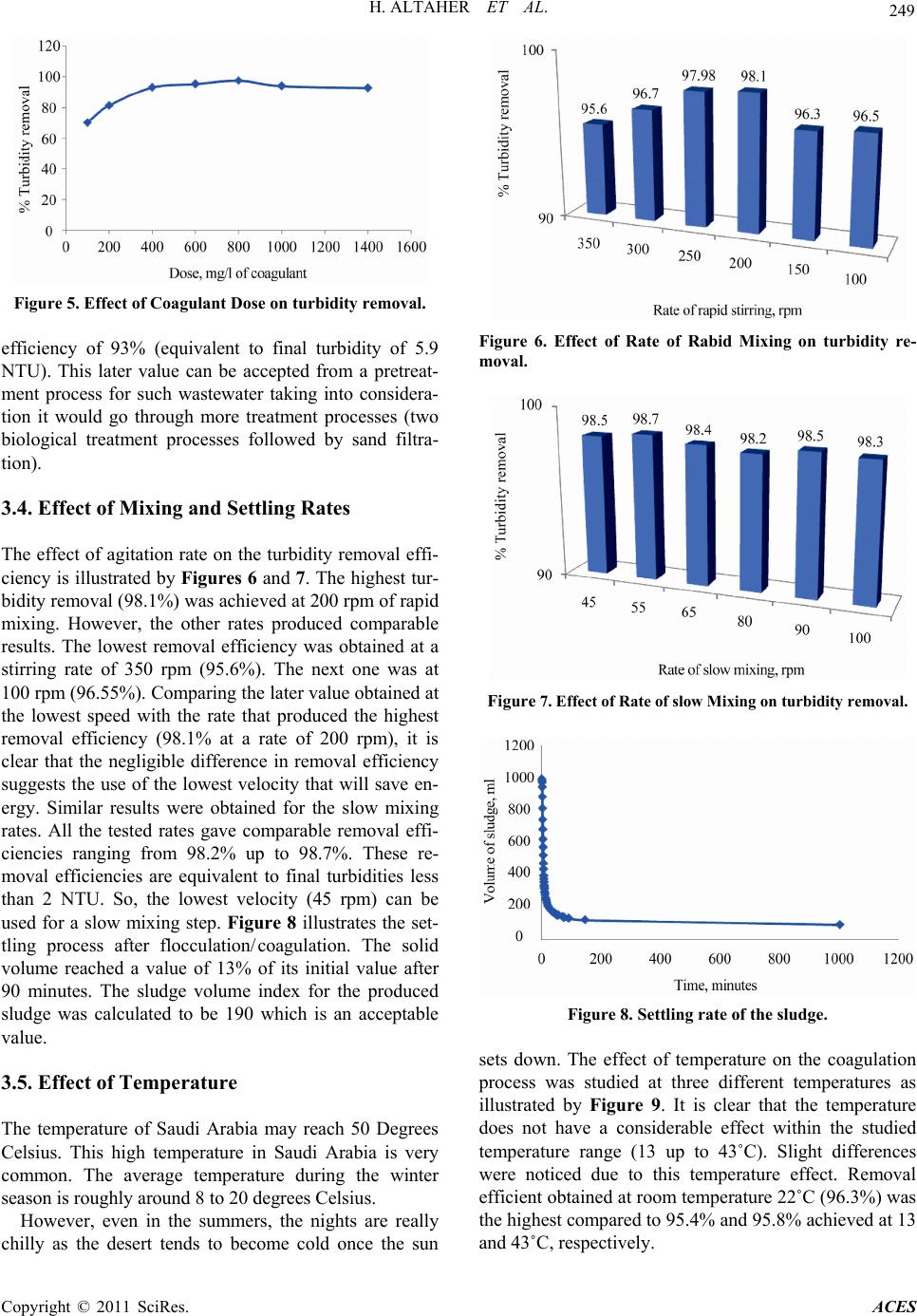 H. ALTAHER ET AL. 249 Figure 5. Effect of Coagulant Dose on turbidity removal. efficiency of 93% (equivalent to final turbidity of 5.9 NTU). This later value can be accepted from a pretreat- ment process for such wastewater taking into considera- tion it would go through more treatment processes (two biological treatment processes followed by sand filtra- tion). 3.4. Effect of Mixing and Settling Rates The effect of agitation rate on the turbidity removal effi- ciency is illustrated by Figures 6 and 7. The highest tur- bidity removal (98.1%) was achieved at 200 rpm of rapid mixing. However, the other rates produced comparable results. The lowest removal efficiency was obtained at a stirring rate of 350 rpm (95.6%). The next one was at 100 rpm (96.55%). Comparing the later value obtained at the lowest speed with the rate that produced the highest removal efficiency (98.1% at a rate of 200 rpm), it is clear that the negligible difference in removal efficiency suggests the use of the lowest velocity that will save en- ergy. Similar results were obtained for the slow mixing rates. All the tested rates gave comparable removal effi- ciencies ranging from 98.2% up to 98.7%. These re- moval efficiencies are equivalent to final turbidities less than 2 NTU. So, the lowest velocity (45 rpm) can be used for a slow mixing step. Figure 8 illustrates the set- tling process after flocculation/ coagulation. The solid volume reached a value of 13% of its initial value after 90 minutes. The sludge volume index for the produced sludge was calculated to be 190 which is an acceptable value. 3.5. Effect of Temperature The temperature of Saudi Arabia may reach 50 Degrees Celsius. This high temperature in Saudi Arabia is very common. The average temperature during the winter season is roughly around 8 to 20 degrees Celsius. However, even in the summers, the nights are really chilly as the desert tends to become cold once the sun Figure 6. Effect of Rate of Rabid Mixing on turbidity re- moval. Figure 7. Effect of Rate of slow Mixing on turbidity removal. Figure 8. Settling rate of the sludge. sets down. The effect of temperature on the coagulation process was studied at three different temperatures as illustrated by Figure 9. It is clear that the temperature does not have a considerable effect within the studied temperature range (13 up to 43˚C). Slight differences were noticed due to this temperature effect. Removal efficient obtained at room temperature 22˚C (96.3%) was the highest compared to 95.4% and 95.8% achieved at 13 and 43˚C, respectively. Copyright © 2011 SciRes. ACES 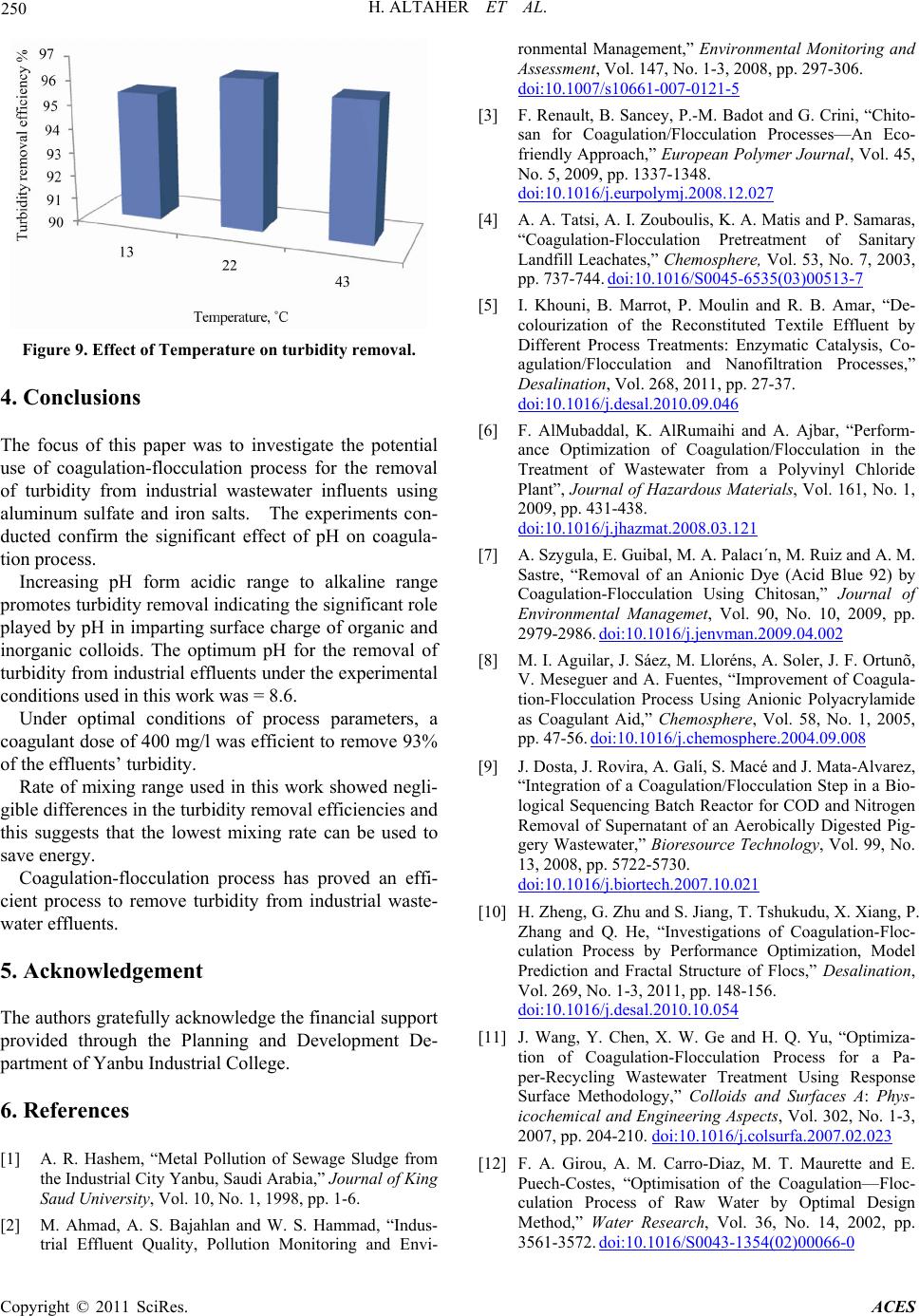 250 H. ALTAHER ET AL. Figure 9. Effect of Temperature on turbidity removal. 4. Conclusions The focus of this paper was to investigate the potential use of coagulation-flocculation process for the removal of turbidity from industrial wastewater influents using aluminum sulfate and iron salts. The experiments con- ducted confirm the significant effect of pH on coagula- tion process. Increasing pH form acidic range to alkaline range promotes turbidity removal indicating the significant role played by pH in imparting surface charge of organic and inorganic colloids. The optimum pH for the removal of turbidity from industrial effluents under the experimental conditions used in this work was = 8.6. Under optimal conditions of process parameters, a coagulant dose of 400 mg/l was efficient to remove 93% of the effluents’ turbidity. Rate of mixing range used in this work showed negli- gible differences in the turbidity removal efficiencies and this suggests that the lowest mixing rate can be used to save energy. Coagulation-flocculation process has proved an effi- cient process to remove turbidity from industrial waste- water effluents. 5. Acknowledgement The authors gratefully acknowledge the financial support provided through the Planning and Development De- partment of Yanbu I ndustrial College. 6. References [1] A. R. Hashem, “Metal Pollution of Sewage Sludge from the Industrial City Yanbu, Saudi Arabia,” Journal of King Saud University, Vol. 10, No. 1, 1998, pp. 1-6. [2] M. Ahmad, A. S. Bajahlan and W. S. Hammad, “Indus- trial Effluent Quality, Pollution Monitoring and Envi- ronmental Management,” Environmental Monitoring and Assessment, Vol. 147, No. 1-3, 2008, pp. 297-306. doi:10.1007/s10661-007-0121-5 [3] F. Renault, B. Sancey, P.-M. Badot and G. Crini, “Chito- san for Coagulation/Flocculation Processes—An Eco- friendly Approach,” European Polymer Journal, Vol. 45, No. 5, 2009, pp. 1337-1348. doi:10.1016/j.eurpolymj.2008.12.027 [4] A. A. Tatsi, A. I. Zouboulis, K. A. Matis and P. Samaras, “Coagulation-Flocculation Pretreatment of Sanitary Landfill Leachates,” Chemosphere, Vol. 53, No. 7, 2003, pp. 737-744. doi:10.1016/S0045-6535(03)00513-7 [5] I. Khouni, B. Marrot, P. Moulin and R. B. Amar, “De- colourization of the Reconstituted Textile Effluent by Different Process Treatments: Enzymatic Catalysis, Co- agulation/Flocculation and Nanofiltration Processes,” Desalination, Vol. 268, 2011, pp. 27-37. doi:10.1016/j.desal.2010.09.046 [6] F. AlMubaddal, K. AlRumaihi and A. Ajbar, “Perform- ance Optimization of Coagulation/Flocculation in the Treatment of Wastewater from a Polyvinyl Chloride Plant”, Journal of Hazardous Materials, Vol. 161, No. 1, 2009, pp. 431-438. doi:10.1016/j.jhazmat.2008.03.121 [7] A. Szygula, E. Guibal, M. A. Palacı´n, M. Ruiz and A. M. Sastre, “Removal of an Anionic Dye (Acid Blue 92) by Coagulation-Flocculation Using Chitosan,” Journal of Environmental Managemet, Vol. 90, No. 10, 2009, pp. 2979-2986. doi:10.1016/j.jenvman.2009.04.002 [8] M. I. Aguilar, J. Sáez, M. Lloréns, A. Soler, J. F. Ortunõ, V. Meseguer and A. Fuentes, “Improvement of Coagula- tion-Flocculation Process Using Anionic Polyacrylamide as Coagulant Aid,” Chemosphere, Vol. 58, No. 1, 2005, pp. 47-56. doi:10.1016/j.chemosphere.2004.09.008 [9] J. Dosta, J. Rovira, A. Galí, S. Macé and J. Mata-Alvarez, “Integration of a Coagulation/Flocculation Step in a Bio- logical Sequencing Batch Reactor for COD and Nitrogen Removal of Supernatant of an Aerobically Digested Pig- gery Wastewater,” Bioresource Technology, Vol. 99, No. 13, 2008, pp. 5722-5730. doi:10.1016/j.biortech.2007.10.021 [10] H. Zheng, G. Zhu and S. Jiang, T. Tshukudu, X. Xiang, P. Zhang and Q. He, “Investigations of Coagulation- Floc- culation Process by Performance Optimization, Model Prediction and Fractal Structure of Flocs,” Desalination, Vol. 269, No. 1-3, 2011, pp. 148-156. doi:10.1016/j.desal.2010.10.054 [11] J. Wang, Y. Chen, X. W. Ge and H. Q. Yu, “Optimiza- tion of Coagulation-Flocculation Process for a Pa- per-Recycling Wastewater Treatment Using Response Surface Methodology,” Colloids and Surfaces A: Phys- icochemical and Engineering Aspects, Vol. 302, No. 1-3, 2007, pp. 204-210. doi:10.1016/j.colsurfa.2007.02.023 [12] F. A. Girou, A. M. Carro-Diaz, M. T. Maurette and E. Puech-Costes, “Optimisation of the Coagulation— Floc- culation Process of Raw Water by Optimal Design Method,” Water Research, Vol. 36, No. 14, 2002, pp. 3561-3572. doi:10.1016/S0043-1354(02)00066-0 Copyright © 2011 SciRes. ACES 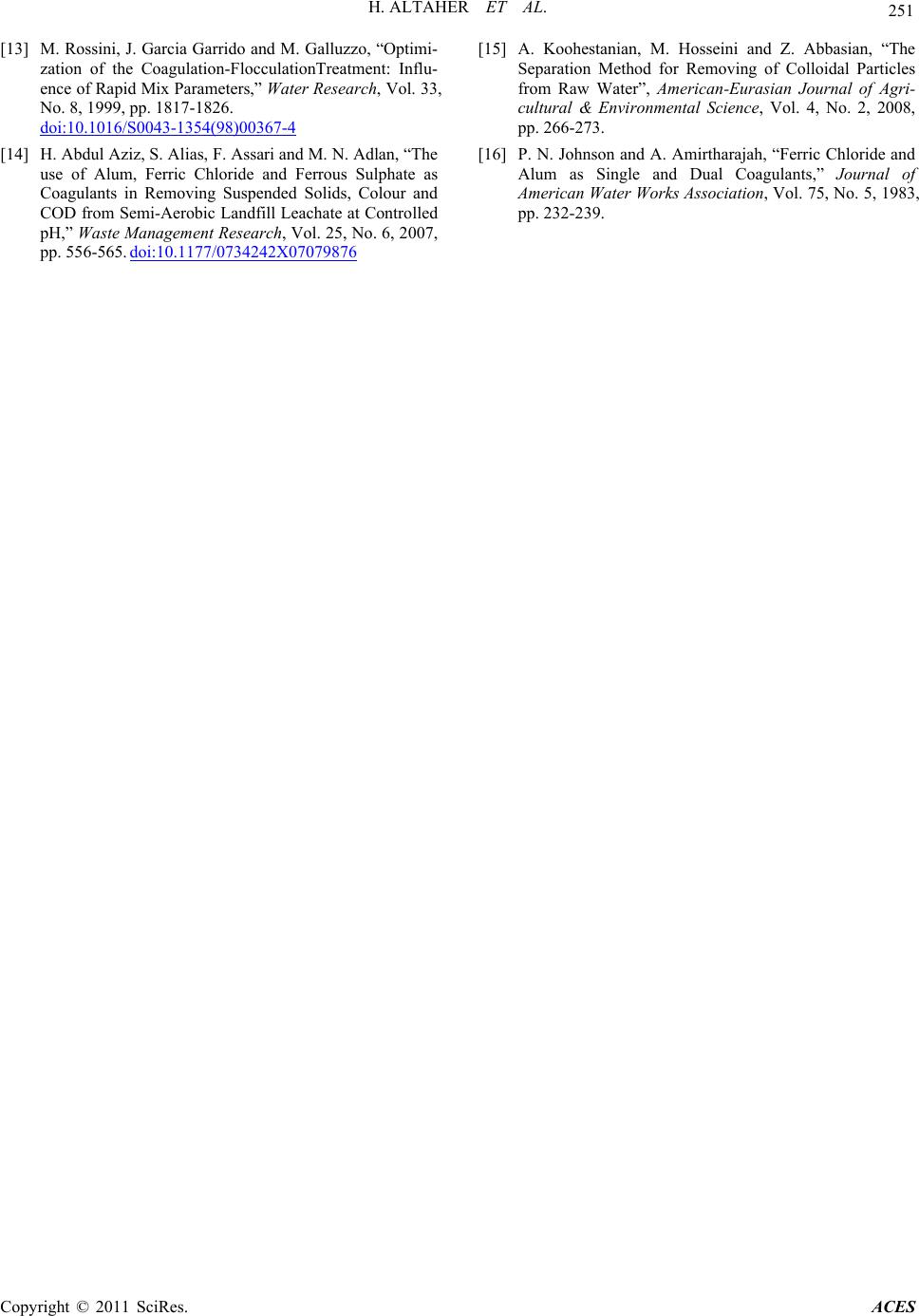 H. ALTAHER ET AL. Copyright © 2011 SciRes. ACES 251 [13] M. Rossini, J. Garcia Garrido and M. Galluzzo, “Optimi- zation of the Coagulation-FlocculationTreatment: Influ- ence of Rapid Mix Parameters,” Water Research, Vol. 33, No. 8, 1999, pp. 1817-1826. doi:10.1016/S0043-1354(98)00367-4 [14] H. Abdul Aziz, S. Alias, F. Assari and M. N. Adlan, “The use of Alum, Ferric Chloride and Ferrous Sulphate as Coagulants in Removing Suspended Solids, Colour and COD from Semi-Aerobic Landfill Leachate at Controlled pH,” Waste Management Research, Vol. 25, No. 6, 2007, pp. 556-565. doi:10.1177/0734242X07079876 [15] A. Koohestanian, M. Hosseini and Z. Abbasian, “The Separation Method for Removing of Colloidal Particles from Raw Water”, American-Eurasian Journal of Agri- cultural & Environmental Science, Vol. 4, No. 2, 2008, pp. 266-273. [16] P. N. Johnson and A. Amirtharajah, “Ferric Chloride and Alum as Single and Dual Coagulants,” Journal of American Water Works Association, Vol. 75, No. 5, 1983, pp. 232-239. |