

Paper Menu >>
Journal Menu >>
 Pharmacology & Pharmacy, 2011, 2, 338-340 doi:10.4236/pp.2011.24043 Published Online October 2011 (http://www.SciRP.org/journal/pp) Copyright © 2011 SciRes. PP Frequent Episodic Vertigo Is an Unexpected Side Effect of Flutamide Jiann-Jy Chen1,2, Dem-Lion Chen3* 1Department of Medical Imaging, Taipei Medical University & Shuang Ho Hospital, New Taipei, Chinese Taipei; 2Department of Otorhinolaryngology, Tao-Yuan Hospital, Department of Health, Executive Yuan, Taoyuan, Chinese Taipei; 3G-Home Otorhi- nolaryngologic Clinic, Kaohsiung, Chinese Taipei. Email: *[email protected] Received April 28th, 2011; revised May 28th, 2011; accepted July 29th, 2011. ABSTRACT An 82-year-old male suffered from prostatic cancer five years ago. Since then, he has taken flutamide and was bothered with episodic vertigo (EV) every morning. In order to treat prostatic cancer, flutamide was not discontinued, but con- servative treatment and life-style change were recommended. Finally, EV actually subsided. Herein, we report the rare case, in which EV was an unexpected side effect of flutamide. Herein we review his whole history, physical examination, vestibular function test, electronystagmogram, caloric test, awake encephalogram, blood examinations, color-coded duplex ultrasonogram and magnetic resonance imaging/angiogram to suggest a mechanism of flutamide responsible for EV. Keywords: Flutamide, Episodic Vertigo, Prostatic Cancer 1. Introduction Flutamide (4’-nitro-3’-trifluoromethylisobutyranilide) could antagonize the nuclear androgen receptors of prostatic cancer, and inhibits intake of androgen; so, it has been widely applied to treat prostatic cancer. The main ad- verse reactions are reported diarrhea, nausea, vomiting, gastrointestinal distress, gynecomastia, muscular cramps and cardiovascular complications [1,2], and never epi- sodic vertigo in the literature, but we encountered a case of frequent episodic vertigo after taking flutamide. Here- in we report it because of rare curiosity and suggest a m- chanism responsible for the side effect. 2. Case Report A right-handed 82-year-old male has height 166 cm, weight 55 kg, and body mass index 20.0 kg/m2. He did not suffer head trauma, hypertension, diabetes mellitus, heart disease, migraine or psychosis; neither did he have any hobby of cigarette smoking, alcohol drinking, areca chewing, or coffee consumption. However, he has regu- larly taken doxazosin (Doxaben) or terazosin (Hytrin) to treat benign prostatic hyperplasia for 12 years. Five years ago, he unfortunately got stage II prostatic adenocarci- noma and began taking anti-androgen flutamide (Fugerel) every day. Since then, he has bothered with episodic ver- tigo every early morning. Changing position exacerbated symptom, and only bed rest would relieve symptom in half an hour. There was no headache, blurred vision, ataxia, syncope, tinnitus, hearing block or other neurolo- gic signs. Three years ago, he first visited our emergency due to sever episodic vertigo with nausea and vomiting. Blood pressure (heart rate) was 122/78 mmHg (59/min). One hour after he was treated conservatively, symptoms sub- sided, and blood pressure (heart rate) was 142/89 mmHg (86/min). Then, Doxazosin or Terazosin was discontin- ued, but episodic vertigo still recurred every early morn- ing. Last July, he visited our emergency again. Blood pressure (heart rate) was 128/79 mmHg (47/min). When symptoms subsided, blood pressure (heart rate) rose to 138/89 mmHg (72/min). Computed tomography of brain was unremarkable. In the following three days, he was assigned to the author for a battery of studies. Physical examination and vestibular function test were normal, except that squat to stand test or hyperventilation test provoked the same vertigo. Electronystagmogram, caloric test, awake encephalogram and blood examina- tions were unremarkable. Color-coded duplex ultrasono- gram (EnVisor, Philips, USA) revealed mild atheroscle- rosis over bilateral common carotid arteries, and total 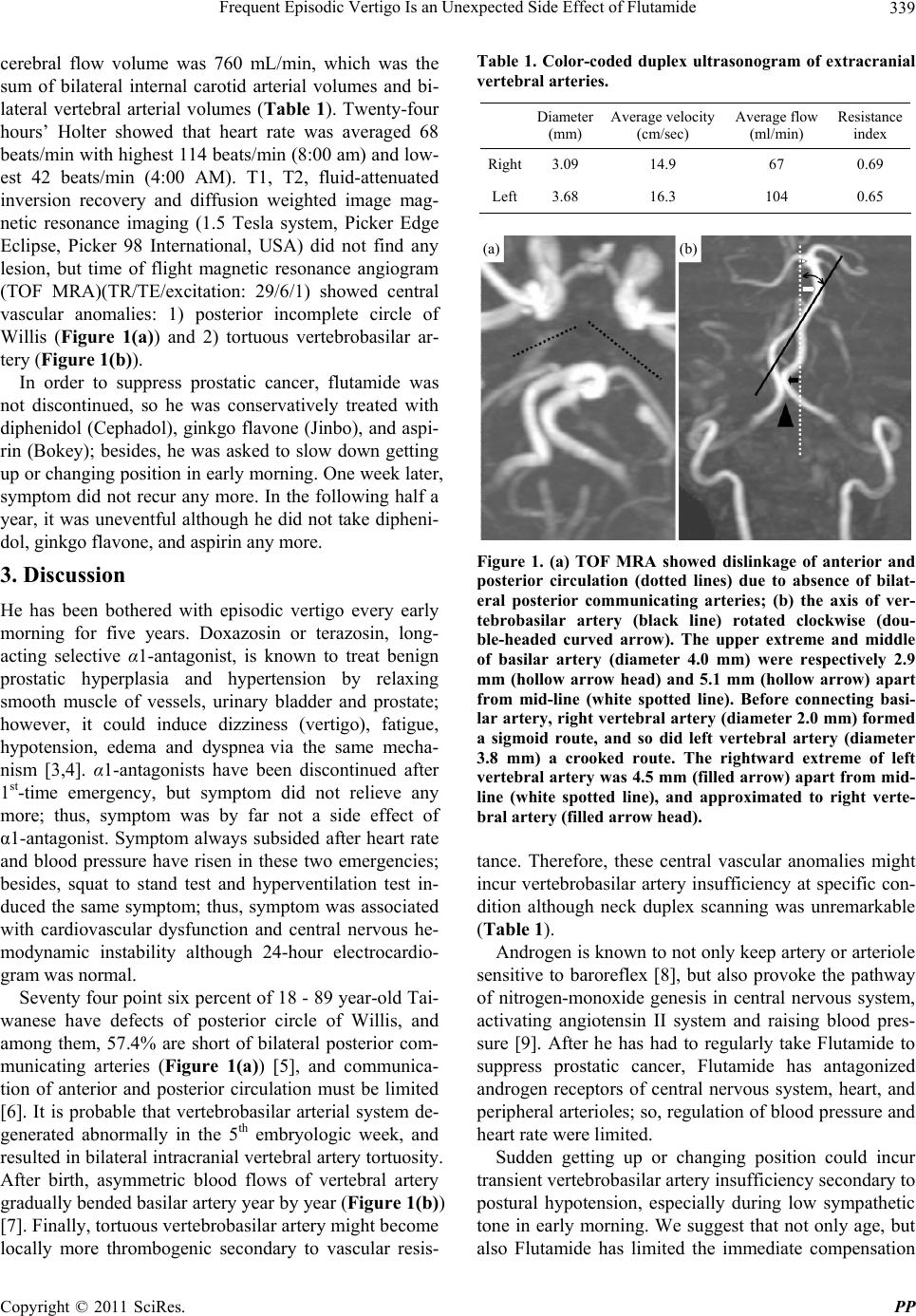 Frequent Episodic Vertigo Is an Unexpected Side Effect of Flutamide339 cerebral flow volume was 760 mL/min, which was the sum of bilateral internal carotid arterial volumes and bi- lateral vertebral arterial volumes (Table 1). Twenty-four hours’ Holter showed that heart rate was averaged 68 beats/min with highest 114 beats/min (8:00 am) and low- est 42 beats/min (4:00 AM). T1, T2, fluid-attenuated inversion recovery and diffusion weighted image mag- netic resonance imaging (1.5 Tesla system, Picker Edge Eclipse, Picker 98 International, USA) did not find any lesion, but time of flight magnetic resonance angiogram (TOF MRA)(TR/TE/excitation: 29/6/1) showed central vascular anomalies: 1) posterior incomplete circle of Willis (Figure 1(a)) and 2) tortuous vertebrobasilar ar- tery (Figure 1(b)). In order to suppress prostatic cancer, flutamide was not discontinued, so he was conservatively treated with diphenidol (Cephadol), ginkgo flavone (Jinbo), and aspi- rin (Bokey); besides, he was asked to slow down getting up or changing position in early morning. One week later, symptom did not recur any more. In the following half a year, it was uneventful although he did not take dipheni- dol, ginkgo flavone, and aspirin any more. 3. Discussion He has been bothered with episodic vertigo every early morning for five years. Doxazosin or terazosin, long- acting selective α1-antagonist, is known to treat benign prostatic hyperplasia and hypertension by relaxing smooth muscle of vessels, urinary bladder and prostate; however, it could induce dizziness (vertigo), fatigue, hypotension, edema and dyspnea via the same mecha- nism [3,4]. α1-antagonists have been discontinued after 1st-time emergency, but symptom did not relieve any more; thus, symptom was by far not a side effect of α1-antagonist. Symptom always subsided after heart rate and blood pressure have risen in these two emergencies; besides, squat to stand test and hyperventilation test in- duced the same symptom; thus, symptom was associated with cardiovascular dysfunction and central nervous he- modynamic instability although 24-hour electrocardio- gram was normal. Seventy four point six percent of 18 - 89 year-old Tai- wanese have defects of posterior circle of Willis, and among them, 57.4% are short of bilateral posterior com- municating arteries (Figure 1(a)) [5], and communica- tion of anterior and posterior circulation must be limited [6]. It is probable that vertebrobasilar arterial system de- generated abnormally in the 5th embryologic week, and resulted in bilateral intracranial vertebral artery tortuosity. After birth, asymmetric blood flows of vertebral artery gradually bended basilar artery year by year (Figure 1(b)) [7]. Finally, tortuous vertebrobasilar artery might become locally more thrombogenic secondary to vascular resis- Table 1. Color-coded duplex ultrasonogram of extracranial vertebral arteries. Diameter (mm) Average velocity (cm/sec) Average flow (ml/min) Resistance index Right3.09 14.9 67 0.69 Left3.68 16.3 104 0.65 (a) (b) Figure 1. (a) TOF MRA showed dislinkage of anterior and posterior circulation (dotted lines) due to absence of bilat- eral posterior communicating arteries; (b) the axis of ver- tebrobasilar artery (black line) rotated clockwise (dou- ble-headed curved arrow). The upper extreme and middle of basilar artery (diameter 4.0 mm) were respectively 2.9 mm (hollow arrow head) and 5.1 mm (hollow arrow) apart from mid-line (white spotted line). Before connecting basi- lar artery, right vertebral artery (diameter 2.0 mm) formed a sigmoid route, and so did left vertebral artery (diameter 3.8 mm) a crooked route. The rightward extreme of left vertebral artery was 4.5 mm (filled arrow) apart from mid- line (white spotted line), and approximated to right verte- bral artery (filled arrow head). tance. Therefore, these central vascular anomalies might incur vertebrobasilar artery insufficiency at specific con- dition although neck duplex scanning was unremarkable (Table 1). Androgen is known to not only keep artery or arteriole sensitive to baroreflex [8], but also provoke the pathway of nitrogen-monoxide genesis in central nervous system, activating angiotensin II system and raising blood pres- sure [9]. After he has had to regularly take Flutamide to suppress prostatic cancer, Flutamide has antagonized androgen receptors of central nervous system, heart, and peripheral arterioles; so, regulation of blood pressure and heart rate were limited. Sudden getting up or changing position could incur transient vertebrobasilar artery insufficiency secondary to postural hypotension, especially during low sympathetic tone in early morning. We suggest that not only age, but also Flutamide has limited the immediate compensation Copyright © 2011 SciRes. PP  Frequent Episodic Vertigo Is an Unexpected Side Effect of Flutamide Copyright © 2011 SciRes. PP 340 of heart rate and blood pressure for transient vertebro- basilar artery insufficiency; fortunately, simply episodic vertigo resulted, but not ischemia stroke. However, it was beyond neck duplex scanning to identify transient verte- brobasilar insufficiency; besides, it was beyond electro- nystagmogram and caloric test to identify transient ves- tibulopathy. In order to suppress prostatic cancer, Flutamide was not discontinued, and conservative treatment and life-style change were recommended as below. Diphenidol has been tried to relieve vertigo. Ginkgo flavone and aspirin have also been tried to decrease the vascular resistance of vertebrobasilar artery. In order to spare his heart enough time to compensate for postural hypotension, he was asked to slow down getting up or changing position. As a result, episodic vertigo did not recur in one week despite daily flutamide. In the following over half a year, it was uneventful although he has not taken diphenidol, ginkgo flavone and aspirin any more. Herein, we report the case, in which EV was an unexpected side effect of flutamide. REFERENCES [1] D. G. McLeod, “Antiandrogenic Drugs,” Cancer, Vol. 71, No. 3, 1993, pp. 1046-1049. doi:10.1002/1097-0142(19930201)71:3+<1046::AID-CN CR2820711424>3.0.CO;2-M [2] E. J. Dole and M. T. Holdsworth, “Flutamide: An Antian- drogen for the Treatment of Prostate Cancer,” The Annals of Pharmacotherapy, Vol. 31, No. 1, 1997, pp. 65-75. [3] H. Lepor, “Alpha Blockers for the Treatment of Benign Prostatic Hyperplasia,” Reviews in Urology, Vol. 9, No. 4, 2007, pp. 181-190. [4] R. Kirby and A. Jardin, “Doxazosin in the Treatment of Benign Prostatic Hyperplasia. A Review of the Safety Profile in Older Patients,” Prostate Cancer and Prostatic Diseases, Vol. 1, No. 2, 1997, pp. 84-89. doi:10.1038/sj.pcan.4500211 [5] H. W. Chen, P. S. Yen, C. C. Lee, C. C. Chen, P. Y. Chang, S. K. Lee, W. H. Lee, C. M. Ling and A. S. B. Chou, “Magnetic Resonance Angiographic Evaluation of Circle of Willis in General Population: A Morphologic Study in 507 Cases,” Chinese Journal of Radiology, Vol. 29, No. 5, 2004, pp. 223-229. [6] D. F. Schomer, M. P. Marks, G. K. Steinberg, I. M. Johnstone, D. B. Boothroyd, M. R. Ross, N. J. Pelc and D. R. Enzmann, “The Anatomy of the Posterior Communi- cating Artery as a Risk Factor for Ischemic Cerebral In- farction,” The New England Journal of Medicine, Vol. 330, No. 22, 1994, pp. 1565-1570. doi:10.1056/NEJM199406023302204 [7] J. M. Hong, C. S. Chung, O. Y. Bang, I. S. Joo and K. Huh, “Vertebral Artery Dominance Contributes to Basilar Artery Curvature and Peri-Vertebrobasilar Junctional In- farcts,” Journal of Neurology, Neurosurgery & Psychia- try, Vol. 80, No. 10, 2009, pp. 1087-1092. doi:10.1136/jnnp.2008.169805 [8] G. R. Ward and A. A. Abdel-Rahman, “Orchiectomy or Androgen Receptor Blockade Attenuates Baroreflex-Me- diated Bradycardia in Conscious Rats,” BMC Pharma- cology, Vol. 6, 2006, p. 2. doi:10.1186/1471-2210-6-2 [9] B. Xue, A. K. Johnson and M. Hay, “Sex Differences in Angiotensin II-Induced Hypertension,” Brazilian Journal of Medical and Biological Research, Vol. 40, No. 5, 2007, pp. 727-734. doi:10.1590/S0100-879X2006005000093 |