

Paper Menu >>
Journal Menu >>
 Pharmacology & Pharmacy, 2011, 2, 332-337 doi:10.4236/pp.2011.24042 Published Online October 2011 (http://www.SciRP.org/journal/pp) Copyright © 2011 SciRes. PP Association between Sex Differences and the Pharmacokinetics of Repaglinide among a Malaysian Population Ruzilawati Abu Bakar1*, Mohd Suhaimi Ab Wahab1, Imran Ahmad2, Gan Siew Hua3 1Department of Pharmacology, Universiti Sains Malaysia, Kota Bharu, Malaysia; 2Department of Family Medicine , Universiti Sains Malaysia, Kota Bharu, Malaysia; 3Human Genome Centre, School of Medical Sciences, Universiti Sains Malaysia, Kota Bharu, Ma- laysia. Email: *[email protected] Received April 28th, 2011; revised May 20th, 2011; accepted June 25th, 2011. ABSTRACT This study was conducted to evaluate the effect of sex differences on the pharmacokinetics of repaglinide in healthy subjects. One hundred twenty one healthy volunteers (61 ma le and 60 female; aged 18 - 50 years) were included in the study. Subjects were administered a single 4-mg repaglinide oral dose. Blood samples were taken at 0, 30, 60, 120, 180 and 240 min. Serum repaglinide levels were determined by a high-performance liquid chromatography (HPLC) method. Subjects were also genotyped by polymerase chain reactions-restriction fragment length polymorphisms (PCR-RFLP) for CYP3A4*4, *5 and *18 alleles and by an allele-specific multiplex PCR for CYP2C8*2, *3, *4 and *5 alleles. The pharmacokinetics of repaglinide were comparable between male and female subjects. The mean clearance (CL) of re- paglinide was 16.0% lower (p = 0.03), the mean area under the serum concentration-time curve (AUC) was 12.8% higher (p = 0.04) and the peak serum concentration (Cmax) was 13.2% higher (p = 0.03) in females compared to male subjects. The mean rate of elimination (kel) and mean CL of repaglinide were 47.6 7% (p = 0.03) higher and 29.25% (p = 0.03) higher, respectively, in male subjects having CYP2C8*5 allele compared to female subjects. We also found that the mean half-life (t1/2) of repaglinide was 42.43% h igher (p = 0.03), and the mean AUC was 35.83% higher (p = 0.03) in female subjects when compared to the male subjects ha ving CYP2C8*5 allele. Sex differen ces significantly influence the pharmacokinetics of repag linide. Keywords: Sex Differences, CYP2C8, CYP3A4, Polymorphisms, Repaglinide 1. Introduction Repaglinide was the first meglitinid e analogu e to become available. It is used in type 2 diabetic patients to normal- ise postprandial hyperglycaemia [1,2]. Like the sulfony- lureas, repaglinide reduced blood glucose by stimulating insulin release from pancreatic -cells [3]. It has a fast onset and short duration of action. Repaglinide is rapidly absorbed from the gastrointestinal tract after oral admini- stration and eliminated in the bile. Only a very small fraction of the administered dose is excreted through the urine. It differs from other antidiabetic agents in its structure, bind ing profile, duratio n of action an d mode of excretion [3]. Cytochrome P4502C8 (CYP2C8) and cy- tochrome P4503A4 (CYP3A4) are the principal enzymes that participate in its oxidative biotransformation [4]. CYP2C8 is the major human hepatic P450, constitut- ing about 12% of total microsomal CYP content in the liver [5] in which it conducts oxidative metabolism of at least 5% of drugs cleared by phase I metabolism. Drugs for which CYP2C8 contributes significantly to their bio- transformation include the anticancer drug paclitaxel [6 ], the antidiabetic drugs rosiglitazone and troglitazone [7] and repaglinide [4], the antimalarial amodiaquine [6] and the hydroxymethylglutaryl co-enzyme A reductase in- hibitors such as cerivastatin and fluvastatin [8]. CYP3A4 is involved in the metabolism of more than 60% of all drugs used in humans [5]. It is found in hu- man livers, gastrointestinal tracts, kidneys, lungs, brains, endotheliums, placentas, lymphocytes and intestines [9]. It plays important roles in the metabolism of drugs used in humans including antidiabetics, antiarrhythmics, anti- histamines, synthetic oestrogens, cancer chemotherapeu- tic drugs, human immunodeficiency virus protease in-  Association between Sex Differences and the Pharmacokinetics of Repaglinide among a Malaysian Population333 hibitors, calcium channel antagonists, immunosuppres- sants and cholestero l-lowering drugs [10]. Numerous studies have examined the influence of sex differences on drug metabolism. Physiological factors such as differences in body weigh t and composition, me- tabolizing enzymes or hormone concentrations may dif- ferentially affect the pharmacokinetics and pharmacody- namics of many drugs between women and men [11]. Ignoring these sex differences during drug development may lead to side-effects or toxicity as well as inadequate response during drug treatment due to these differences in drug metabolism [11]. Several investigators also have attempted to determine potential sex differences in the metabolic activity of cy- tochrome P450 (CYP) enzymes including CYP3A and CYP2C. Some studies suggest higher CYP enzymes ac- tivities in women than men [12], there are also reports of no sex differences [13] or even lower in activities in women [14]. Thus, these findings have been largely in- consistent or inconclusive. This study was designed to investigate the influence of sex differences on the pharmacokinetics of repaglinide. The secondary objective was to investigate whether sex differences exist in CYP3A4 and CYP2C8 activities by use of population pharmacokinetic modelling methods. 2. Materials and Methods The study was conducted following approval by the Re- search and Ethics Committee, School of Medical Sci- ences, Universiti Sains Malaysia. All the subjects gave their written informed consent prior to study enrolment. One hundred twenty one healthy volunteers were re- cruited, including 61 men and 60 women. All subjects aged 18 to 50 years with a normal body mass index (BMI). These volunteers were students and staff of Uni- versiti Sains Malaysia, Health Campus, Kelantan, Ma- laysia. They were ascertained to be healthy by a medical history, physical examination and routine laboratory tests. Subjects were asked to fast overnight before the study. On the day of repaglinide administration, 5 ml of blood were collected in plain vacutainer tubes to determine repaglinide’s concentration at 0 min (baseline). Subjects then administered a single 4-mg repaglinide [Novo Nordisk, Denmark] oral dose with 100 ml of water. On each study day subjects were allowed to have a light breakfast, precisely 10 min after repaglinide administra- tion. The breakfast was eaten within 10 min. The break- fast consisted of one sandwich (two pieces of bread with eggs, tomato and margarine) and contained approxi- mately 1550 kJ energy, 70 g carbohydrates, 8 g protein and 6 g fat. Blood samples (5 mL into vacutainer for pharmacokinetic study) were drawn from a cannulated forearm vein at five designated times: 30, 60, 120, 180 and 240 min. Serum were separated within 30 min after blood sampling. During the day of repaglinide administration, the sub- jects were under direct medical supervision and blood glucose levels were monitored throughout the day. Addi- tional glucose solution for intravenous use and glucagons for intramuscular use were available in case of severe hypoglycaemia but they were not needed. The reversed-phase high performance liquid chroma- tographic (HPLC) methods described by Ruzilawati et al. [15] were used to measure serum repaglinide concentra- tions. In brief, samples were processed after addition of the internal standard (indomethacin, Sigma-Aldrich, St. Louis, MO, USA). A calibration curve was analysed in the concentratio n range of 20 - 200 ng /ml. Samples were extracted with ethyl acetate and injected into the chro- matographic system composed of an automatic sampler (Waters, Mildford, MA, USA). Reversed-phase chroma- tographic separation was achieved on Purospher STAR C-18 analytical column (4.8 mm × 150 mm; 5 m parti- cle size). The mobile phase consisted of 60:40 v/v ace- tonitrile - ammonium formate (pH 2.7; 0.01 M) and was run at 1 ml/min. The reten tion times of indomethacin and repaglinide were approximately 5.3 and 6.2 min, respec- tively. For genetic analysis, a 5 mL ethylenediaminetetraace- tic acid (EDTA) blood sample was drawn from each subject and stored at –20˚C until deoxyribonucleic acid (DNA) extraction. DNA was extracted with standard methods (QIAamp DNA Blood Mini Kit, Qiagen, Hilden, Germany). All subjects were genotyped for CYP3A4*4, *5 and *18 alleles by the polymerase chain reaction- re- striction fragment length polymorphism (PCR-RFLP) method as described by Ruzilawati et al. [16]. Subjects were also genotyped for CYP2C8*2, *3 and *4 alleles. The method of allele-sp ecific PCR based on a previously published protocol described by Muthiah et al. [17] was used. The population pharmacokinetic parameters of repag- linide was characterized by the Nonparametric Adaptive Grid (NPAG) programme, a module of USC*PACK® (version 12. 0) [ 1 8]. Mann-Whitney tests were used to compare the effect of sex on repaglinide pharmacokinetic parameters using the SPSS package (ver. 12, SPSS, Chicago, IL). Data were presented as mean ± SD. A p value of < 0.05 was considered to be statistically significant. 3. Results One hundred and twenty one subjects completed the study. Demographic data for the 121 subjects are dis- played in Table 1. The comparison between healthy male Copyright © 2011 SciRes. PP 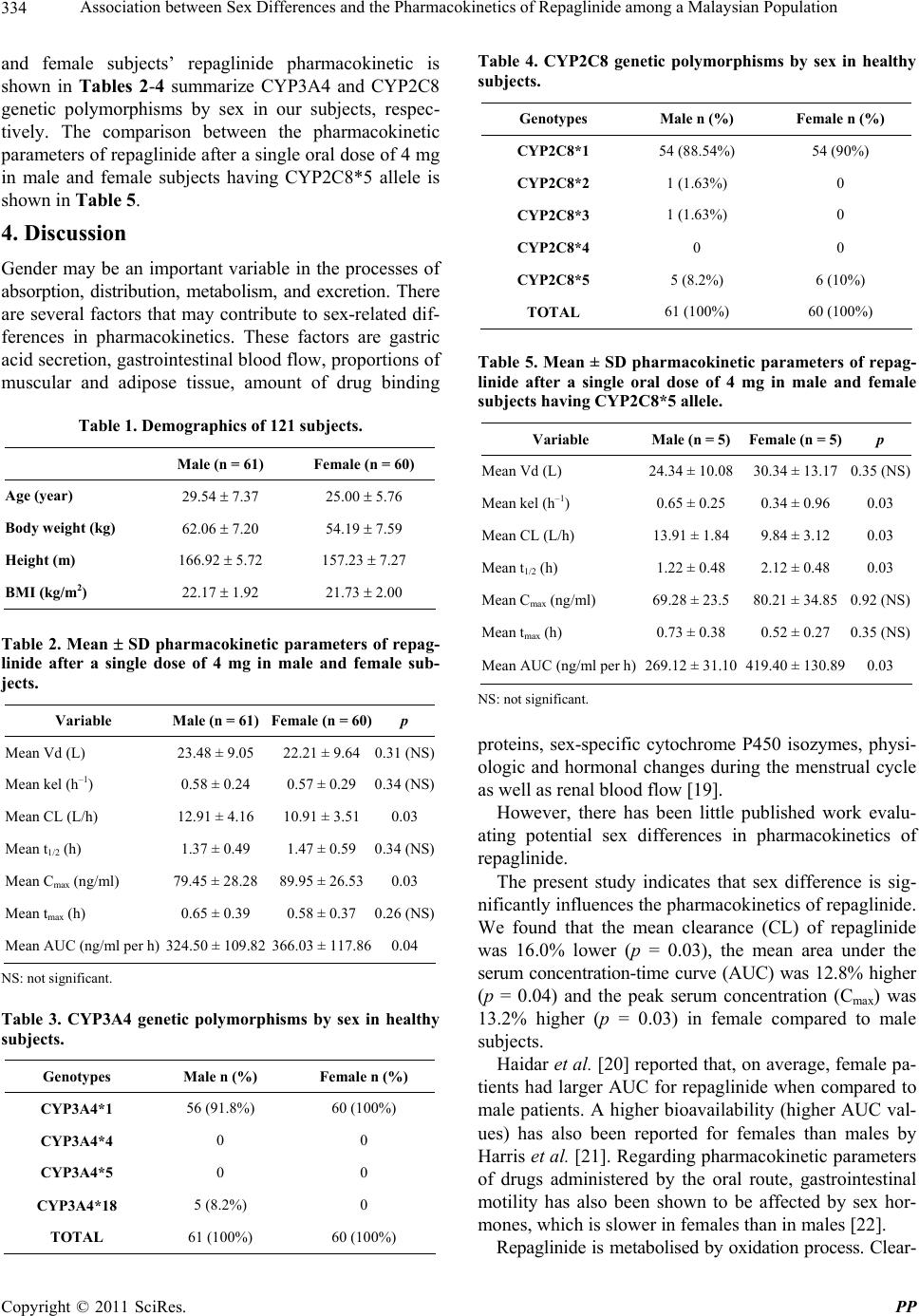 Association between Sex Differences and the Pharmacokinetics of Repaglinide among a Malaysian Population 334 and female subjects’ repaglinide pharmacokinetic is shown in Tables 2-4 summarize CYP3A4 and CYP2C8 genetic polymorphisms by sex in our subjects, respec- tively. The comparison between the pharmacokinetic parameters of repaglinide after a single oral dose of 4 mg in male and female subjects having CYP2C8*5 allele is shown in Table 5. 4. Discussion Gender may be an important variable in the processes of absorption, distribution, metabolism, and excretion. There are several factors that may contribute to sex-related dif- ferences in pharmacokinetics. These factors are gastric acid secretion, gastrointestinal blood flow, proportions of muscular and adipose tissue, amount of drug binding Table 1. Demographics of 121 subjects. Male (n = 61) Female (n = 60) Age (year) 29.54 7.37 25.00 5.76 Body weight (kg) 62.06 7.20 54.19 7.59 Height (m) 166.92 5.72 157.23 7.27 BMI (kg/m2) 22.17 1.92 21.73 2.00 Table 2. Mean SD pharmacokinetic parameters of repag- linide after a single dose of 4 mg in male and female sub- jects. Variable Male (n = 61) Female (n = 60)p Mean Vd (L) 23.48 ± 9.05 22.21 ± 9.64 0.31 (NS) Mean kel (h–1) 0.58 ± 0.24 0.57 ± 0.29 0.34 (NS) Mean CL (L/h) 12.91 ± 4.16 10.91 ± 3.51 0.03 Mean t1/2 (h) 1.37 ± 0.49 1.47 ± 0.59 0.34 (NS) Mean Cmax (ng/ml) 79.45 ± 28.28 89.95 ± 26.530.03 Mean tmax (h) 0.65 ± 0.39 0.58 ± 0.37 0.26 (NS) Mean AUC (ng/ml per h) 324.50 ± 109.82 366.03 ± 117.860.04 NS: not significant. Table 3. CYP3A4 genetic polymorphisms by sex in healthy subjects. Genotypes Male n (%) Female n (%) CYP3A4*1 56 (91.8%) 60 (100%) CYP3A4*4 0 0 CYP3A4*5 0 0 CYP3A4*18 5 (8.2%) 0 TOTAL 61 (100%) 60 (100%) Table 4. CYP2C8 genetic polymorphisms by sex in healthy subjects. Genotypes Male n (%) Female n (%) CYP2C8*1 54 (88.54%) 54 (90%) CYP2C8*2 1 (1.63%) 0 CYP2C8*3 1 (1.63%) 0 CYP2C8*4 0 0 CYP2C8*5 5 (8.2%) 6 (10%) TOTAL 61 (100%) 60 (100%) Table 5. Mean ± SD pharmacokinetic parameters of repag- linide after a single oral dose of 4 mg in male and female subjects having CYP2C8*5 allele. Variable Male (n = 5) Female (n = 5)p Mean Vd (L) 24.34 ± 10.08 30.34 ± 13.170.35 (NS) Mean kel (h–1) 0.65 ± 0.25 0.34 ± 0.96 0.03 Mean CL (L/h) 13.91 ± 1.84 9.84 ± 3.12 0.03 Mean t1/2 (h) 1.22 ± 0.48 2.12 ± 0.48 0.03 Mean Cmax (ng/ml) 69.28 ± 23.5 80.21 ± 34.850.92 (NS) Mean tmax (h) 0.73 ± 0.38 0.52 ± 0.27 0.35 (NS) Mean AUC (ng/ml per h )269.12 ± 31.10 419.40 ± 130.890.03 NS: not significant. proteins, sex-specific cytochrome P450 isozymes, physi- ologic and hormonal changes during the menstrual cycle as well as renal blood flow [19]. However, there has been little published work evalu- ating potential sex differences in pharmacokinetics of repaglinide. The present study indicates that sex difference is sig- nificantly influences the ph armacokin etics of repaglinide. We found that the mean clearance (CL) of repaglinide was 16.0% lower (p = 0.03), the mean area under the serum concentration-time curve (AUC) was 12.8% higher (p = 0.04) and the peak serum concentration (Cmax) was 13.2% higher (p = 0.03) in female compared to male subjects. Haidar et al. [20] reported that, on average, female pa- tients had larger AUC for repaglinide when compared to male patients. A higher bioavailability (higher AUC val- ues) has also been reported for females than males by Harris et al. [21]. Regarding pharmacokinetic parameters of drugs administered by the oral route, gastrointestinal motility has also been shown to be affected by sex hor- mones, which is slower in females than in males [22]. Repaglinide is metabolised by oxidation process. Clear- Copyright © 2011 SciRes. PP 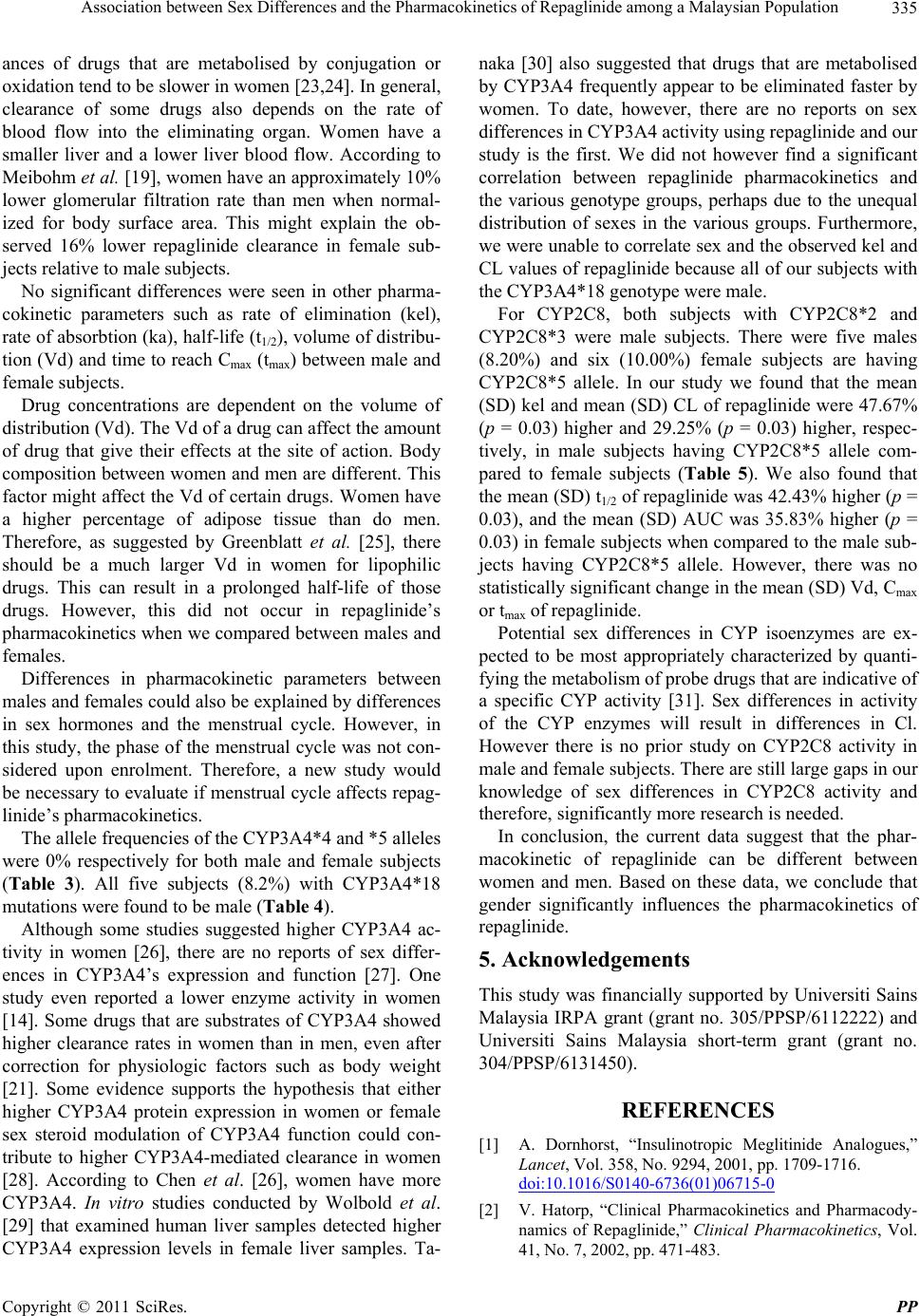 Association between Sex Differences and the Pharmacokinetics of Repaglinide among a Malaysian Population335 ances of drugs that are metabolised by conjugation or oxidation tend to be slower in women [23,24]. In general, clearance of some drugs also depends on the rate of blood flow into the eliminating organ. Women have a smaller liver and a lower liver blood flow. According to Meibohm et al. [19], women have an approximately 10% lower glomerular filtration rate than men when normal- ized for body surface area. This might explain the ob- served 16% lower repaglinide clearance in female sub- jects relative to male subjects. No significant differences were seen in other pharma- cokinetic parameters such as rate of elimination (kel), rate of absorbtion (ka), half-life (t1/2), volume of distribu- tion (Vd) and time to reach Cmax (tmax) between male and female subjects. Drug concentrations are dependent on the volume of distribution (Vd). The Vd of a drug can affect the amount of drug that give their effects at the site of action. Body composition between women and men are different. This factor might affect the Vd of certain drugs. Women have a higher percentage of adipose tissue than do men. Therefore, as suggested by Greenblatt et al. [25], there should be a much larger Vd in women for lipophilic drugs. This can result in a prolonged half-life of those drugs. However, this did not occur in repaglinide’s pharmacokinetics when we compared between males and females. Differences in pharmacokinetic parameters between males and females could also be explained by differences in sex hormones and the menstrual cycle. However, in this study, the phase of the menstrual cycle was not con- sidered upon enrolment. Therefore, a new study would be necessary to evaluate if menstrual cycle affects repag- linide’s pharmacokinetics. The allele frequencies of the CYP3A4*4 and *5 alleles were 0% respectively for both male and female subjects (Table 3). All five subjects (8.2%) with CYP3A4*18 mutations were found to be male (Table 4). Although some studies suggested higher CYP3A4 ac- tivity in women [26], there are no reports of sex differ- ences in CYP3A4’s expression and function [27]. One study even reported a lower enzyme activity in women [14]. Some drugs that are substrates of CYP3A4 showed higher clearance rates in women than in men, even after correction for physiologic factors such as body weight [21]. Some evidence supports the hypothesis that either higher CYP3A4 protein expression in women or female sex steroid modulation of CYP3A4 function could con- tribute to higher CYP3A4-mediated clearance in women [28]. According to Chen et al. [26], women have more CYP3A4. In vitro studies conducted by Wolbold et al. [29] that examined human liver samples detected higher CYP3A4 expression levels in female liver samples. Ta- naka [30] also suggested that drugs that are metabolised by CYP3A4 frequently appear to be eliminated faster by women. To date, however, there are no reports on sex differences in CYP3A4 activity using repaglinide and our study is the first. We did not however find a significant correlation between repaglinide pharmacokinetics and the various genotype groups, perhaps due to the unequal distribution of sexes in the various groups. Furthermore, we were unable to correlate sex and the observed kel and CL values of repaglinide because all of our subjects with the CYP3A4*18 genotype were male. For CYP2C8, both subjects with CYP2C8*2 and CYP2C8*3 were male subjects. There were five males (8.20%) and six (10.00%) female subjects are having CYP2C8*5 allele. In our study we found that the mean (SD) kel and mean (SD) CL of repaglinide were 47.67% (p = 0.03) higher and 29.25% (p = 0.03) higher, respec- tively, in male subjects having CYP2C8*5 allele com- pared to female subjects (Table 5). We also found that the mean (SD) t1/2 of repaglinide was 42.43% higher (p = 0.03), and the mean (SD) AUC was 35.83% higher (p = 0.03) in female subjects when compared to the male sub- jects having CYP2C8*5 allele. However, there was no statistically significan t change in th e mean (SD) Vd, Cmax or tmax of repaglinide. Potential sex differences in CYP isoenzymes are ex- pected to be most appropriately characterized by quanti- fying the metabolism of probe drugs that are indicative of a specific CYP activity [31]. Sex differences in activity of the CYP enzymes will result in differences in Cl. However there is no prior study on CYP2C8 activity in male and female subjects. There are still large gaps in our knowledge of sex differences in CYP2C8 activity and therefore, significantly more research is needed. In conclusion, the current data suggest that the phar- macokinetic of repaglinide can be different between women and men. Based on these data, we conclude that gender significantly influences the pharmacokinetics of repaglinide. 5. Acknowledgements This study was financially supported by Universiti Sains Malaysia IRPA grant (grant no. 305/PPSP/6112222) and Universiti Sains Malaysia short-term grant (grant no. 304/PPSP/6131450). REFERENCES [1] A. Dornhorst, “Insulinotropic Meglitinide Analogues,” Lancet, Vol. 358, No. 9294, 2001, pp. 1709-1716. doi:10.1016/S0140-6736(01)06715-0 [2] V. Hatorp, “Clinical Pharmacokinetics and Pharmacody- namics of Repaglinide,” Clinical Pharmacokinetics, Vol. 41, No. 7, 2002, pp. 471-483 . Copyright © 2011 SciRes. PP  Association between Sex Differences and the Pharmacokinetics of Repaglinide among a Malaysian Population 336 doi:10.2165/00003088-200241070-00002 [3] C. R. Culy and B. Jarvis, “Repaglinide: A Review of Its Therapeutic Use in Treatment of Type 2 Diabetes Melli- tus,” Drugs, Vol. 61, No. 11, 2001, pp. 1625-1660. doi:10.2165/00003495-200161110-00008 [4] T. B. Bidstrup, I. Bjornsdottir, U. G. Sidelmann, M. S. Thamsen and K. T. Hansen, “CYP2C8 and CYP3A4 Are the Principal Enzymes Involved in the Human in Vitro Biotransformation of the Insulin Secretagogue Repag- linide,” British Journal of Clinical Pharmacology, Vol. 56, No. 3, 2003, pp. 301-314. doi:10.1046/j.0306-5251.2003.01862.x [5] S. Rendic and F. J. Carlo, “Human Cytochrome P450 Enzyme: A Status Report Summarizing Their Reaction, Substrates, Inducers and Inhibitors,” Drug Metabolism Reviews, Vol. 29, No. 1-2, 1997, pp. 413-580. doi:10.3109/03602539709037591 [6] D. Dai, C. Darryl, D. C. Zeldin, J. A. Blasidell, B. Chanas, S. J. Coulter, et al., ”Polymorphisms in Human CYP2C8 Decrease Metabolism of the Anticancer Drug Paclitaxel and Arachidonic Acid,” Pharmacogenetics, Vol. 11, No. 7, 2001, pp. 597-607. doi:10.1097/00008571-200110000-00006 [7] H. Yamazaki, A. Shibata, M. Suzuki, M. Nakajima, N. Shimada and F. P. Guengerich, “Oxidation of Troglita- zone to a Quinine-Type Metabolite Catalyzed by Cyto- crome P450 2C8 and P450 3A4 in Human Liver Micro- somes,” Drug Metabolism and Disposition, Vol. 27, No. 11, 1999, pp. 1260-1266. [8] W. Muck, “Clinical Pharmacokinetics of Cerivastatin,” Clinical Pharmacokinetics, Vol. 39, No. 2, 2000, pp. 99-116. doi:10.2165/00003088-200039020-00002 [9] T. Shimada, H. Yamazaki, M. Mimura, Y. Inui and F. P. Guengerich, “Interindividual Variations in Human Liver Cytochrome P450 Enzymes Involved in the Oxidation of Drugs, Carcinogens and Toxic Chemicals,” Journal of Pharmacology and Experimental Therapeutics, Vol. 270, No. 1, 1994, pp. 414-423. [10] P. B. Watkins, “Non-Invasive Tests of CYP3A4 Enzymes,” Pharmacogenetics, Vol. 4, No. 4, 1994, pp. 171-184. doi:10.1097/00008571-199408000-00001 [11] J. Hamilton and B. Parry, “Sex-Related Differences in Clinical Drug Response: Implications for Women’s Heal- th,” Journal of the American Medical Women’s Associa- tion, Vol. 38, No. 5, 1983, pp. 126-132. [12] G. C. Yee, T. P. Lennon and D. J. Gmur, “Age-Dependent Cyclosporine: Pharmacokinetics in Marrow Transplant Re- cipients,” Clinic al Pharmacology & Therapeutics, Vol. 40, No. 4, 1986, pp. 438-443. doi:10.1038/clpt.1986.204 [13] D. J. Greenbalt, J. S. Harmatz and L. L. von Moltke, “Age and Gender Effects on the Pharmacokinetics and Pharma- codynamics of Triazolam, a Cytochrome P450 3A Sub- strate,” Clinical Pharmacology & Therapeutics, Vol. 76, No. 5, 2004, pp. 467-479. doi:10.1016/j.clpt.2004.07.009 [14] M. E. Krecic-Shepard, C. R. Barnas, J. Slimko and J. B. Schwartz, “Faster Clearance of Sustained Release Vera- pamil in Men versus Women: Continuing Observations on Sex-Specific Defferencesafter Oral Administration of Verapamil,” Clinical Pharmacology & Therapeutics, Vol. 68, No. 3, 2000, pp. 286-292. doi:10.1067/mcp.2000.109356 [15] A. B. Ruzilawati, A. W. Suhaimi, A. Imran, Z. Ismail and S. H. Gan, “Method Development and Validation of Repag- linide in Human Plasma by HPLC and Its Application to Pharmacokinetics Study,” Journal of Pharmaceutical and Biomedical Analysis, Vol. 43, No. 5, 2007, pp. 1831-1835. doi:10.1016/j.jpba.2006.12.010 [16] A. B. Ruzilawati, A. W. Mohd Suhaimi and S. H. Gan, “Genetic Polymorphisms of CYP3A4: CYP3A4*18 Allele Is Found in Five Healthy Malaysian Subjects,” Clinica Chimica Acta, Vol. 383, No. 1-2, 2007, pp. 158-162. doi:10.1016/j.cca.2007.05.004 [17] Y. D. Muthiah, W. L. Lee, L. K. Teh, C. E. Ong, M. Z. Salleh and R. Ismail, “A Simple Multiplex PCR Method for the Concurrent Detection of Three CYP2C8 Vari- ants,” Clinica Chimica Acta, Vol. 349, No. 1-2, 2004, pp. 191-198. doi:10.1016/j.cccn.2004.06.024 [18] A. B. Ruzilawati, A. W. Mohd Suhaimi and S. H. Gan, “Population Pharmacokinetic Modeling of Repaglinide in Healthy Subjects by Using Nonparametric Adaptive Grid (NPAG) Algorithm,” Journal of Clinical Pharmacy and Therapeutics, Vol. 35, No. 1, 2010, pp. 105-112. doi:10.1111/j.1365-2710.2009.01042.x [19] B. Meibohm, I. Beierle and H. Derendorf, “How Important Are Gender Differences in Pharmacokinetics?” Clinical Pharmacokinetics, Vol. 41, No. 5, 2002, pp. 329-342. doi:10.2165/00003088-200241050-00002 [20] S. H. Haidar, S. B. Johnson, M. J. Fossler and A. S. Hus- sain, “Modeling the Pharmacokinetics and Pharmacody- namics of a Unique Oral Hypoglycemic Agent Using Neural Networks,” Pharmaceutical Research, Vol. 19, No. 1, 2002, pp. 87-91. doi:10.1023/A:1013611617787 [21] R. Z. Harris, L. Z. Benet and J. B. Schwartz, “Gender Ef- fects in Pharmacokinetics and Pharmacodynamics,” Drugs, Vol. 50, No. 2, 1995, pp. 222-239. doi:10.2165/00003495-199550020-00003 [22] W. R. Hutson, R. L. Roehrkasse and A. Wald, “Influence of Gender and Menopause on Gastric Emptying and Motil- ity,” Gastroenterology, Vol. 96, No. 1, 1989, pp. 617-629. [23] F. Abad-Santos, J. Novalbos, M. A. Galvez-Mugica, S. Gallego-Sandin, S. Almeida and F. Vallee, “Assessment of Sex Differences in Pharmacokinetics and Pharmaco- dynamics of Amlodipine in a Bioequivalence Study,” Pharmaceutical Research, Vol. 51, No. 5, 2005, pp. 445- 452. doi:10.1016/j.phrs.2004.11.006 [24] F. Franconi, S. Brunelleschi, L. Steardo, et al., “Gender Differences in Drug Respo nses,” Pharmaceutical Resea rch, Vol. 55, No. 2, 2007, pp. 81-95. doi:10.1016/j.phrs.2006.11.001 [25] D. J. Greenblatt, M. Divoll and D. R. Abernethy, “Physi- ologic Changes in Old Age: Relation to Altered Drug Disposition,” Journal of the American Geriatrics Society, Vol. 30, Supplement 11, 1982, pp. S6-S10. [26] M. Chen, L. Ma, G. L. Drunsano and A. N. Nafziger, Copyright © 2011 SciRes. PP  Association between Sex Differences and the Pharmacokinetics of Repaglinide among a Malaysian Population Copyright © 2011 SciRes. PP 337 “Sex Differences in CYP3A4 Activity Using Intravenous and Oral Midazolam,” Clinical Pharmacology & Thera- peutics, Vol. 80, No. 5, 2006, pp. 531-538. doi:10.1016/j.clpt.2006.08.014 [27] D. L. Schmucker, K. W. Woodhouse, R. K. Wang, H. Wyne, O. H. Ja mes and M. McManu s, “Effect s of A ge and Gender on in Vitro Properties of Human Liver Microsomal Mono-Oxygenase,” Clinical Pharmacology & Therapeu- tics, Vol. 48, No. 4, 1990, pp. 365-374. doi:10.1038/clpt.1990.164 [28] P. He, M. H. Court, D. J. Greenblatt and L. L. von-Moltke, “Genotype-Phenotype Associations of Cytochrome P450 3A4 and 3A5 Poly morphism with Midazola m Clearance in Vivo,” Clinical Pharmacology & Therapeutics, Vol. 77, No. 5, 2005, pp. 373-387. doi:10.1016/j.clpt.2004.11.112 [29] R. Wolbold, K. Klein, O. Burk, A. K. Nussler, P. Neu- haus and M. Eichelbaum, “Sex Is a Major Determinant of CYP3A4 Expression in Human Liver,” Hepatology, Vol. 38, No. 4, 2003, pp. 978-988. [30] E. Tanaka, “Gender-Related Differences in Pharmacoki- netics and Their Clinical Significance,” Journal of Clini- cal Pharmacy and Therapeutics, Vol. 24, No. 5, 1999, pp. 339-346. doi:10.1046/j.1365-2710.1999.00246.x [31] K. T. Kivisto and H. K. Kroemer, “Use of Probe Drugs as Predictors of Drug Metabolism in Humans,” The Journal of Clinical Pharmacology, Vol. 37, Supplement 1, 1997, pp. 40S-48S. doi:10.1177/009127009703700121 |