

Paper Menu >>
Journal Menu >>
 Pharmacology & Pharmacy, 2011, 2, 233-237 doi:10.4236/pp.2011.24030 Published Online October 2011 (http://www.SciRP.org/journal/pp) Copyright © 2011 SciRes. PP 233 Effects of Levosimendan on Hydrogen Peroxide Induced Contraction in Human Saphenous Vein Burak Cem Soner1, Ayse Saide Sahin1*, Ipek Duman2, Niyazi Gormus3 1Department of Pharmacology, Meram Faculty of Medicine, Selcuk University, Konya, Turkey; 2Pharmacology, Ministry of Health, Konya, Turkey; 3Department of Cardiovascular Surgery, Meram Faculty of Medicine, Selcuk University, Konya, Turkey. Email: *[email protected] Received May 30th, 2011; revised July 28th, 2011; accepted August 5th, 2011. ABSTRACT Aim: Increased oxidative stress plays important roles in vascular dysfunction in patients undergoing coronary artery bypass graft surgery. Hydrogen peroxide (H2O2) is used as an experimental model for oxidative stress. The present study was designed to assess the effects of levosimendan pretreatment on the contractile effects induced by H2O2 in hu- man saphenous vein (HSV) segments. Methods: We studied H2O2 induced contractions of isolated HSV mounted in standard tissue baths. H2O2 (10–6 - 10–3 M) was added cumulatively to the organ bath. Concentration-response curves to H2O2 were repeated in the presence of levosimendan (10–8 M). In the second series of experiments, strips were con- tracted with 5-HT (10–5 M). When the contraction reached a stable plateau, H2O2 was administrated cumula tively into the organ bath. The same procedure was conducted in the presence of levosimendan. Results: Pretreatment of the SV strips with levosimendan significantly reduced the contractile response to each concentration of H2O2. 5-HT produced contractions in SV strips. Further treatment of these strips with H2O2 resulted in statistically significant concentra- tion-dependent increases in tension. Preincubation of the tissues with levosimendan did not significantly influence the maximum amplitude of the 5-HT-induced tone but inh ibited the contra ctile effect of H2O2 on th e 5-HT-induced contrac- tion. Conc lus ion : Pretreatment of HSV with clinical concentrations of levosimendan inhibits the vasoconstriction caused by oxidative stress, indicating its potential preventive effect against oxidative stress induced graft spasm. Keywords: Hy dro ge n Peroxide, Human Saphenous Vein, Levosimendan 1. Introduction Human saphenous vein is frequently used for coronary artery bypass grafting because of ready availability and suppleness [1]. Vasospasm of the graft following coro- nary artery bypass graft (CABG) surgery is a major prob- lem and may cause perioperative and late failure of by- pass conduits. There are ongoing researches on deter- mining the mechanisms causing vasospasm and various vasodilators have been studied to prevent or reverse vasoconstriction in various grafts [2,3]. Increased oxidative stress plays important roles in myocardial and vascular dysfunction in patients under- going CABG [4]. Hydrogen peroxide (H2O2) is an im- portant derivative of oxidative metabolism and is a major contributor in oxidative stress-induced functional and metabolic dysfunction [5]. Although generation of H2O2 may occur under normal physiological conditions and is not restricted to pathological conditions, its formation in the endothelium of blood vessels under stress conditions such as diabetes, hypertension, preeclampsia and extra- corporeal membrane oxygenation holds an important place in CABG surgery [6]. H2O2 is already used as an experimental model for oxidative stress and it has been shown to induce concentration dependent increases in contraction in various blood vessels including saphenous veins [7,8] and potentiates the effects of vasoconstrictor agents [9]. Levosimendan is a new cardiac enhancer that exerts positive inotropic effects on heart failure by calcium sen- sitization of contractile proteins. Recent research has displayed that levosimendan also causes peripheral vaso- dilatation and may also have antioxidant properties [10]. The present study was designed to assess the effects of levosimendan pretreatment on the contractile effects of H2O2 in human saphenous vein (HSV) segments. 2. Methods The study was approved by the ethics committee of Sel- cuk University, Meram Faculty of Medicine and in- 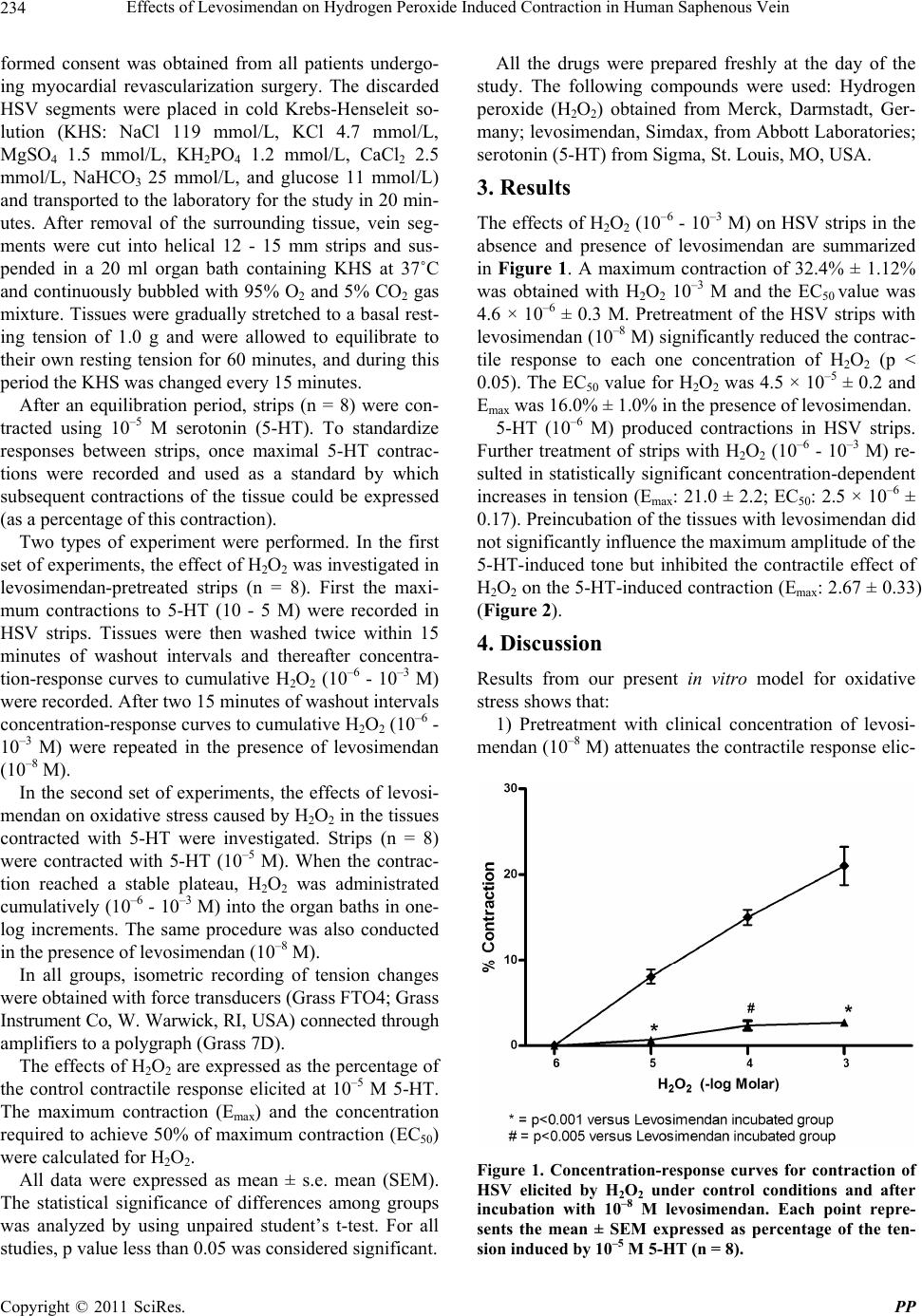 Effects of Levosimendan on Hydrogen Peroxide Induced Contraction in Human Saphenous Vein 234 formed consent was obtained from all patients undergo- ing myocardial revascularization surgery. The discarded HSV segments were placed in cold Krebs-Henseleit so- lution (KHS: NaCl 119 mmol/L, KCl 4.7 mmol/L, MgSO4 1.5 mmol/L, KH2PO4 1.2 mmol/L, CaCl2 2.5 mmol/L, NaHCO3 25 mmol/L, and glucose 11 mmol/L) and transported to the laboratory for the study in 20 min- utes. After removal of the surrounding tissue, vein seg- ments were cut into helical 12 - 15 mm strips and sus- pended in a 20 ml organ bath containing KHS at 37˚C and continuously bubbled with 95% O2 and 5% CO2 gas mixture. Tissues were gradually stretched to a basal rest- ing tension of 1.0 g and were allowed to equilibrate to their own resting tension for 60 minutes, and during this period the KHS was changed every 15 minutes. After an equilibration period, strips (n = 8) were con- tracted using 10–5 M serotonin (5-HT). To standardize responses between strips, once maximal 5-HT contrac- tions were recorded and used as a standard by which subsequent contractions of the tissue could be expressed (as a percentage of this contraction). Two types of experiment were performed. In the first set of experiments, the effect of H2O2 was investigated in levosimendan-pretreated strips (n = 8). First the maxi- mum contractions to 5-HT (10 - 5 M) were recorded in HSV strips. Tissues were then washed twice within 15 minutes of washout intervals and thereafter concentra- tion-response curves to cumulative H2O2 (10–6 - 10–3 M) were recorded. After two 15 minutes of washout intervals concentration-response curves to cumulative H2O2 (10–6 - 10–3 M) were repeated in the presence of levosimendan (10–8 M). In the second set of experiments, the effects of levosi- mendan on oxidative stress caused by H2O2 in the tissues contracted with 5-HT were investigated. Strips (n = 8) were contracted with 5-HT (10–5 M). When the contrac- tion reached a stable plateau, H2O2 was administrated cumulatively (10–6 - 10–3 M) into the organ baths in one- log increments. The same procedure was also conducted in the presence of levosimendan (10–8 M). In all groups, isometric recording of tension changes were obtained with force transducers (Grass FTO4; Grass Instrument Co, W. Warwick, RI, USA) connected through amplifiers to a polygraph (Grass 7D). The effects of H2O2 are expressed as the percentage of the control contractile response elicited at 10–5 M 5-HT. The maximum contraction (Emax) and the concentration required to achieve 50% of maximum contraction (EC50) were calculated for H2O2. All data were expressed as mean ± s.e. mean (SEM). The statistical significance of differences among groups was analyzed by using unpaired student’s t-test. For all studies, p value less than 0.05 was considered significant. All the drugs were prepared freshly at the day of the study. The following compounds were used: Hydrogen peroxide (H2O2) obtained from Merck, Darmstadt, Ger- many; levosimendan, Simdax, from Abbott Laboratories; serotonin (5-HT) from Sigma, St. Louis, MO, USA. 3. Results The effects of H2O2 (10–6 - 10–3 M) on HSV strips in the absence and presence of levosimendan are summarized in Figure 1. A maximum contraction of 32.4% ± 1.12% was obtained with H2O2 10–3 M and the EC50 value was 4.6 × 10⁻⁶ ± 0.3 M. Pretreatment of the HSV strips with levosimendan (10–8 M) significantly reduced the contrac- tile response to each one concentration of H2O2 (p < 0.05). The EC50 value for H2O2 was 4.5 × 10⁻⁵ ± 0.2 and Emax was 16.0% ± 1.0% in the presence of levosimendan. 5-HT (10–6 M) produced contractions in HSV strips. Further treatment of strips with H2O2 (10–6 - 10–3 M) re- sulted in statistically significant concentration-dependent increases in tension (Emax: 21.0 ± 2.2; EC50: 2.5 × 10⁻⁶ ± 0.17). Preincubation of the tissues with levosimendan did not significantly influence the maximum amplitude of the 5-HT-induced tone but inhibited the contractile effect of H2O2 on the 5-HT-induced contraction (Emax: 2.67 ± 0.33) (Figure 2). 4. Discussion Results from our present in vitro model for oxidative stress shows that: 1) Pretreatment with clinical concentration of levosi- mendan (10–8 M) attenuates the contractile response elic- Figure 1. Concentration-response curves for contraction of HSV elicited by H2O2 under control conditions and after incubation with 10–8 M levosimendan. Each point repre- sents the mean ± SEM expressed as percentage of the ten- sion induced by 10–5 M 5-HT (n = 8). Copyright © 2011 SciRes. PP 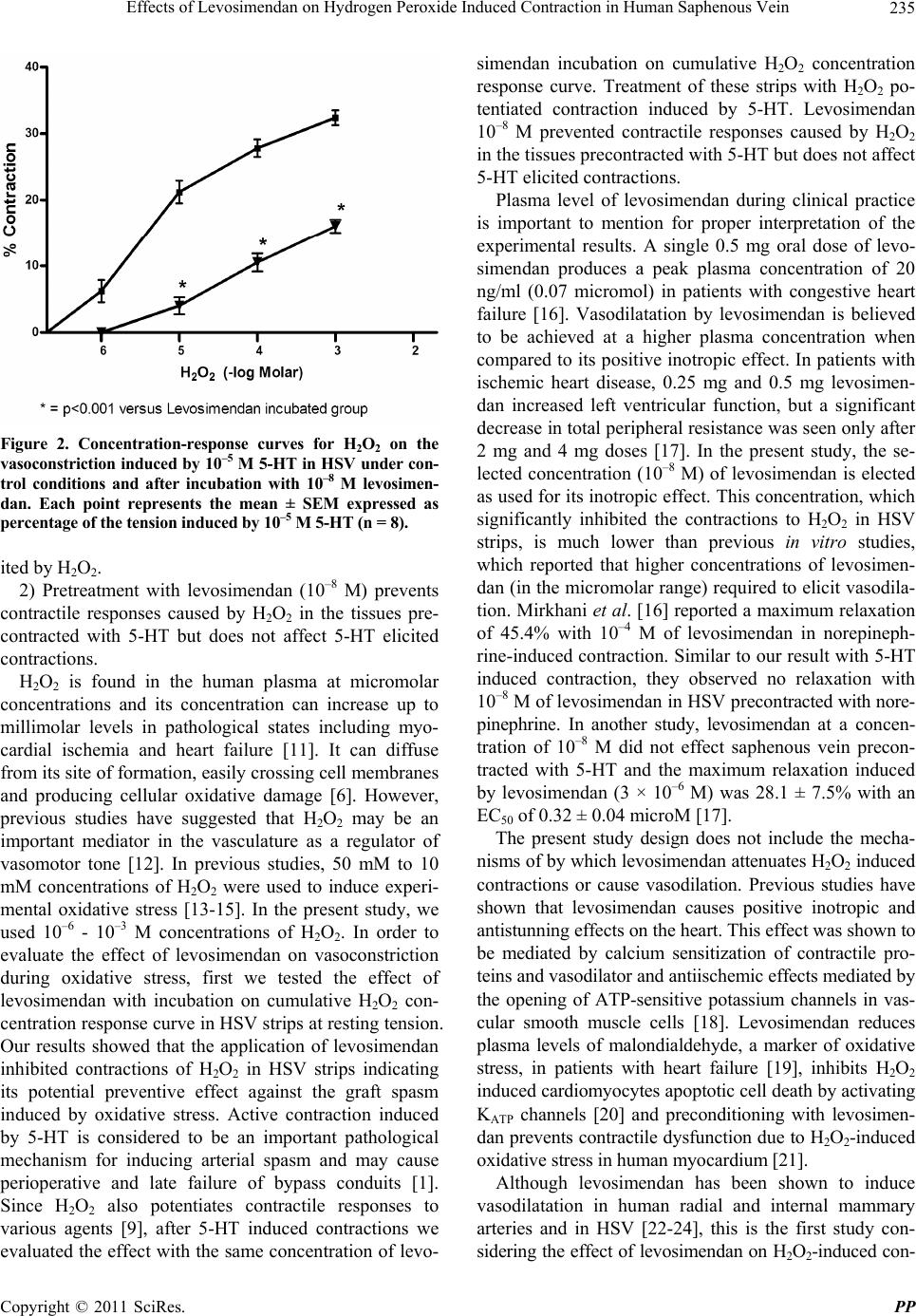 Effects of Levosimendan on Hydrogen Peroxide Induced Contraction in Human Saphenous Vein235 Figure 2. Concentration-response curves for H2O2 on the vasoconstriction induced by 10 –5 M 5-HT in HSV under con- trol conditions and after incubation with 10–8 M levosimen- dan. Each point represents the mean ± SEM expressed as percentage of the tension induced by 10–5 M 5-HT (n = 8). ited by H2O2. 2) Pretreatment with levosimendan (10–8 M) prevents contractile responses caused by H2O2 in the tissues pre- contracted with 5-HT but does not affect 5-HT elicited contractions. H2O2 is found in the human plasma at micromolar concentrations and its concentration can increase up to millimolar levels in pathological states including myo- cardial ischemia and heart failure [11]. It can diffuse from its site of formation, easily crossing cell membranes and producing cellular oxidative damage [6]. However, previous studies have suggested that H2O2 may be an important mediator in the vasculature as a regulator of vasomotor tone [12]. In previous studies, 50 mM to 10 mM concentrations of H2O2 were used to induce experi- mental oxidative stress [13-15]. In the present study, we used 10–6 - 10–3 M concentrations of H2O2. In order to evaluate the effect of levosimendan on vasoconstriction during oxidative stress, first we tested the effect of levosimendan with incubation on cumulative H2O2 con- centration response curve in HSV strips at resting tension. Our results showed that the application of levosimendan inhibited contractions of H2O2 in HSV strips indicating its potential preventive effect against the graft spasm induced by oxidative stress. Active contraction induced by 5-HT is considered to be an important pathological mechanism for inducing arterial spasm and may cause perioperative and late failure of bypass conduits [1]. Since H2O2 also potentiates contractile responses to various agents [9], after 5-HT induced contractions we evaluated the effect with the same concentration of levo- simendan incubation on cumulative H2O2 concentration response curve. Treatment of these strips with H2O2 po- tentiated contraction induced by 5-HT. Levosimendan 10–8 M prevented contractile responses caused by H2O2 in the tissues precontracted with 5-HT but does not affect 5-HT elicited contractions. Plasma level of levosimendan during clinical practice is important to mention for proper interpretation of the experimental results. A single 0.5 mg oral dose of levo- simendan produces a peak plasma concentration of 20 ng/ml (0.07 micromol) in patients with congestive heart failure [16]. Vasodilatation by levosimendan is believed to be achieved at a higher plasma concentration when compared to its positive inotropic effect. In patients with ischemic heart disease, 0.25 mg and 0.5 mg levosimen- dan increased left ventricular function, but a significant decrease in total peripheral resistance was seen only after 2 mg and 4 mg doses [17]. In the present study, the se- lected concentration (10–8 M) of levosimendan is elected as used for its inotropic effect. This concentration, which significantly inhibited the contractions to H2O2 in HSV strips, is much lower than previous in vitro studies, which reported that higher concentrations of levosimen- dan (in the micromolar range) required to elicit vasodila- tion. Mirkhani et al. [16] reported a maximum relaxation of 45.4% with 10–4 M of levosimendan in norepineph- rine-induced contraction. Similar to our result with 5-HT induced contraction, they observed no relaxation with 10–8 M of levosimendan in HSV precontracted with nore- pinephrine. In another study, levosimendan at a concen- tration of 10–8 M did not effect saphenous vein precon- tracted with 5-HT and the maximum relaxation induced by levosimendan (3 × 10⁻⁶ M) was 28.1 ± 7.5% with an EC50 of 0.32 ± 0.04 microM [17]. The present study design does not include the mecha- nisms of by which levosimendan attenuates H2O2 induced contractions or cause vasodilation. Previous studies have shown that levosimendan causes positive inotropic and antistunning effects on the heart. This effect was shown to be mediated by calcium sensitization of contractile pro- teins and vasodilator and antiischemic effects mediated by the opening of ATP-sensitive potassium channels in vas- cular smooth muscle cells [18]. Levosimendan reduces plasma levels of malondialdehyde, a marker of oxidative stress, in patients with heart failure [19], inhibits H2O2 induced cardiomyocytes apoptotic cell death by activating KATP channels [20] and preconditioning with levosimen- dan prevents contractile dysfunction due to H2O2-induced oxidative stress in human myocardium [21]. Although levosimendan has been shown to induce vasodilatation in human radial and internal mammary arteries and in HSV [22-24], this is the first study con- sidering the effect of levosimendan on H2O2-induced con- Copyright © 2011 SciRes. PP  Effects of Levosimendan on Hydrogen Peroxide Induced Contraction in Human Saphenous Vein 236 traction in HSV. In conclusion, according to our results we may specu- late that pretreatment of HSV with clinical concentra- tions of levosimendan inhibit the vasoconstriction caused by oxidative stress, indicating its potential preventive effect against oxidative stress induced graft spasm. Fur- ther research is warranted to assess the exact mechanisms responsible for this effect of levosimendan. REFERENCES [1] E. Nakamura, N. Tanaka N, M. Kuwabara M, A. Yama- shita, Y. Matsuo, T. Kanai, T. Onitsuka, Y. Asada, H. Hisa and R. Yamamoto, “Relative Contributions of 5-Hy- droxytryptamine (5-HT) Receptor Subtypes in 5-HT-In- duced Vasoconstriction of the Distended Human Saphe- nous Vein as a Coronary Artery Bypass Graft,” Biologi- cal & Pharmaceutical Bulletin, Vol. 34, No. 1, 2011, pp. 82-86. doi:10.1248/bpb.34.82 [2] C. A. Hamilton, G. O’Dowd, L. McIntosh, G. Berg, J. But- ler, V. Pathi, R. Williams, J. L. Reid and A. F. Dominiczak, “Vasorelaxant Properties of Isolated Human Radial Arter- ies: Comparison with Internal Mammary Arteries,” Athe- rosclerosi s, Vol. 160, No. 2, 2002, pp. 345-353. doi:10.1016/S0021-9150(01)00605-0 [3] S. Attaran, L. John and A. El-Gamel, “Clinical and Po- tential Use of Pharmacological Agents to Reduce Radial Artery Spasm in Coronary Artery Surgery,” The Annals of Thoracic Surgery, Vol. 85, No. 4, 2008, pp. 1483-1489. doi:10.1016/j.athoracsur.2007.10.042 [4] J. T. Parissis, I. Andreadou, S. L. Markantonis, V. Bistola, A. Louka, A. Pyriochou, I. Paraskevaidis, G. Filippatos, E. K. Iliodromitis and D. T. Kremastinos, “Effects of Levo- simendan on Circulating Markers of Oxidative and Ni- trosative Stress in Patients with Advanced Heart Failure,” Atherosclerosis, Vol. 195, No. 2, 2007, pp. 210-215. doi:10.1016/j.atherosclerosis.2007.07.011 [5] K. H. Konz, M. Haap, K. E. Hill, R. F. Burk and R. A. Walsh, “Diastolic Dysfunction of Perfused Rat Hearts Induced by Hydrogen Peroxide. Protective Effect of Se- lenium,” Journal of Molecular and Cellular Cardiology, Vol. 21, No. 8, 1989, pp. 789-795. doi:10.1016/0022-2828(89)90718-9 [6] M. A. Rodriguez-Martinez, E. C. Garcia-Cohen, A. B. Baena, R. Gonzalez, M. Salaices and J. Marin, “Contrac- tile Responses Elicited by Hydrogen Peroxide in Aorta from Normotensive and Hypertensive Rats. Endothelial Modulation and Mechanism Involved,” British Journal of Pharmacology, Vol. 125, No. 6, 1998, pp.1329-1335. doi:10.1038/sj.bjp.0702200 [7] Z. W. Yang, T. Zheng, A. Zhang, B. T. Altura and B. M. Altura, “Mechanisms of Hydrogen Peroxide-Induced Con- traction of Rat Aorta,” European Journal of Pharmacol- ogy, Vol. 344, No. 2-3, 1998, pp. 169-181. doi:10.1016/S0014-2999(97)01576-8 [8] A. S. Sahin, E. A. Atalik, T. K. Sahin and N. Doğan, “Cooling and Response to Hydrogen Peroxide in Human Saphenous Vein: Role of the Endothelium,” Fundamental & Clinical Pharmacology, Vol. 19, No. 3, 2005, pp. 341- 346. doi:10.1111/j.1472-8206.2005.00330.x [9] K. Watanabe, Y. Okatani and Y. Sagara, “Potentiating Effect of Hydrogen Peroxide on the Serotonin-Induced Vasocontraction in Human Umbilical Artery,” Acta Ob- stetricia et Gynecologica Scandinavica, Vol. 75, No. 9, 1996, pp. 783-789. doi:10.3109/00016349609054704 [10] J. T. Parissis, I. Andreadou, V. Bistola, I. Paraskevaidis, G. Filippatos and D. T. Kremastinos, “Novel Biologic Mechanisms of Levosimendan and Its Effect on the Fail- ing Heart,” Expert Opinion on Investigational Drugs, Vol. 17, No. 8, 2008, pp. 1143-1150. doi:10.1517/13543784.17.8.1143 [11] R. S. Barlow, A. M. El-Mowafy and R. E. White, “H2O2 Opens BKca Channels via the PLA2-Arachidonic Acid Signaling Cascade in Coronary Artery Smooth Muscle,” American Journal of Physiology: Heart and Circulatory Physiology, Vol. 279, No. 2, 2000, pp. H475-H483. [12] T. Suvorava, N. Lauer, S. Kumpf, R. Jacob, W. Meyer and G. Kojda, “Endogenous Vascular Hydrogen Peroxide Regulates Arteriolar Tension in Vivo,” Circulation, Vol. 112, No. 16, 2005, pp. 2487-2495. doi:10.1161/CIRCULATIONAHA.105.543157 [13] A. Hara, T. Suızuki, H. Hashizume, N. Shishido, M. Na- kamura, F. Ushikubi and Y. Abiko, “Effects of CP-060S, a Novel Ca2+ Channel Blocker, on Oxidative Stress in Cultured Cardiac Myocytes,” European Journal of Phar- macology, Vol. 385, No. 1, 1999, pp. 81-88. doi:10.1016/S0014-2999(99)00708-6 [14] S. Shimizu, Y. Saitoh, T. Yamamoto and K. Momose, “Stimulation by Hydrogen Peroxide of L-Arginine Me- tabolism to L-Citrulline Coupled with Nitric Oxide Syn- thesis in Cultured Endothelial Cells,” Research Commu- nications in Chemical Pathology Pharmacology, Vol. 84, No. 3, 1994, pp. 315-329. [15] Z. W. Yang, T. Zheng, J. Wang, A. Zhang, B. T. Altura and B. M. Altura, “Hydrogen Peroxide Induces Contraction and Raises [Ca2+]i in Canine Cerebral Arterial Smooth Muscle: Participation of Cellular Signaling Pathways,” Naunyn-Schmiedeberg’s Archives of Pharmacology, Vol. 360, No. 6, 1999, pp. 646-653. doi:10.1007/s002109900128 [16] H. Mirkhani, M. Shafa and H. Khazraei, “Comparison of the Effects of Levosimendan and Papaverine on Human Internal Mammary Artery and Saphenous Vein,” Car- diovascular Drugs and Therapy, Vol. 23, No. 5, 2009, pp. 355-359. doi:10.1007/s10557-009-6197-0 [17] E. P. Sandell, M. Hayha, S. Antila, P. Heikkinen, P. Ot- toila, L. A. Lehtonen and P. J. Pentikainen, “Pharmaco- kinetics of Levosimendan in Healthy Volunteers and Pa- tients with Congestive Heart Failure,” Journal of Car- diovascular Pharmacology, Vol. 26, Supplement 1, 1995, pp. 557-562. [18] G. Lilleberg, S. Sundberg and M. S. Nieminen, “Dose- range Study of a New Calcium Sensitizier, Levosimendan, in Patients with Left Ventricular Dysfunction,” Journal of Cardiovascular Pharmacology, Vol. 26, Supplement 1, 1995, pp. S563-S569. Copyright © 2011 SciRes. PP  Effects of Levosimendan on Hydrogen Peroxide Induced Contraction in Human Saphenous Vein Copyright © 2011 SciRes. PP 237 [19] O. Pollesello and Z. Papp, “The Cardioprotective Effects of Levosimendan: Preclinical and Clinical Evidence,” Journal of Cardiovascular Pharmacology, Vol. 50, No. 3, 2007, pp. 257-263. doi:10.1097/FJC.0b013e3180986230 [20] C. Avgeropoulou, I. Andreadou, S. Markantonis-Kyrou- dis, M. Demopoulou, P Missovoulos, A. Androulakis and I. Kallikazaros, “The Ca2+-Sensitizer Levosimendan Im- proves Oxidative Damage, BNP and Pro-Inflammatory Cytokine Levels in Patients with Advanced Decompen- sated Heart Failure in Comparison to Dobutamine,” Euro- pean Journal of Heart Failure, Vol. 7, No. 5, 2005, pp. 882-887. doi:10.1016/j.ejheart.2005.02.002 [21] D. M. Kopustinskiene, P. Pollesello and N. E. Saris, “Levo- simendan is a Mitochondrial KATP Channel Opener,” Euro- pean Journal of Pharmacology, Vol. 428, No. 3, 2001, pp. 311-314. doi:10.1016/S0014-2999(01)01350-4 [22] A. S. Sahin, N. Gormus and A. Duman, “Preconditioning with Levosimendan Prevents Contractile Dysfunction Due to H2O2-Induced Oxidative Stress in Human Myo- cardium,” Journal of Cardiovascular Pharmacology, Vol. 50, No. 4, 2007, pp. 419-423. doi:10.1097/FJC.0b013e318123fbf9 [23] J. Pataricza, J. Szolnoky, I. Krassoi, Z. Hegedus, A. Kun, A. Varro and J. G. Papp, “Vazorelaxing Effect of Levosi- Mendan against 5-Hydroxytryptamine-Induced Contrac- tions in Isolated Human Conduit Bypass Grafts,” Journal of Pharmacy and Pharmacology, Vol. 58, No. 8, 2006, pp. 1107-1112. doi:10.1211/jpp.58.8.0012 [24] J. Hohn, J. Pataricza and A. Petri, “Levosimendan Interacts with Potassium Channel Blockers in Human Saphenous Veins,” Basic & Clinical Pharmacology & Toxicology, Vol. 94, No. 6, 2004, pp. 271-273. |