

Paper Menu >>
Journal Menu >>
 Journal of Environmental Protection, 2011, 2, 1113-1117 doi:10.4236/jep.2011.28129 Published Online October 2011 (http://www.scirp.org/journal/jep) Copyright © 2011 SciRes. JEP Surveying of Pesticides Commonly on the Markets of Iran in 2009 Rouhullah Dehghani¹, Seyed Gholamabbas Moosavi², Hadi Esalmi1*, Malihe Mohammadi1, Zahra Jalali1, Nargess Zamini1 1Department of Environment Health, Kashan Medical Sciences University, Kashan, Iran; 2Department of General Health of Kashan Medical Sciences University, Kashan Medical Sciences University, Kashan, Iran. Email: *[email protected] Received July 11th, 2011; revised August 15th, 2011; accepted September 23rd, 2011. ABSTRACT Considering the potential pesticide side effects on environment, their short and long term untoward effects on living creatures, their excessive usage for producing more agricultural products, and also their application to destroy pests of any sort, the present study was carried out to investigate the used amount of common pesticides in Iran markets. A questionnaire was d esigned. Referring to pesticide selling shops and plants preserva tions organizations in Tehran and Isfahan, the sufficient data was collected and then categorized regarding the app lications and the total amoun t of used pesticides in a year. The results demonstrated that there were 60 sorts of used pesticides in Iran. They included Or- ganochlorine (10%), Organophosphorus (28.4%), Pyrethroids derivatives (10%), Carbamate derivatives (10%), and others (41.6%). The common est pesticid e used in a yea r was O rgano phosph o rus and th e least on e was Organoch lorin e. The obtained da ta pointed out that th e most common pe sticide was Organo phosphorus. G iven that Organop hosphorine compounds are poisonous in living creatures and cause short and long term side effects. It is recommended that re- sponsible authorities provide the necessary information for the aimed groups in terms of the allowable using amount of pesticides, the protection strategies and the pesticides hazards on users. Keywords: Pesticide, Organophosphorus, Organochlorine, Carbamate, Pyrethroids, Market, Iran 1. Introduction The increasing population necessitates more agricultural products and foodstuffs that consequently need more pesticide usage to destroy any pests [1,2]. The pesticide compounds include Organophosphorus, Organochlorine, Carbamate and Pyrethroid derivatives [3]. They have some side effects on living creatures; e.g. Organophos- phorus inhibits cholinesterase activity and it makes CNS functional disturbances. Organochlorine accumulates in living creature bodies and also in food chain. Carbamate derivatives cause genetic mutations and CNS functional disturbanc es [4 ] . These pesticides are used widely to improve agricul- tural production and also to prevent arthropod-borne d is- eases. But they are used improperly due to the lake of appropriate knowledge about their applications and un- toward effects. The excessive usage is harmful to eco- system and they contaminate soil, surface and under- ground water resources [5,6]. The relevant fulfilled re- searches have shown that each year 2.5 million tons of pesticides are used in agriculture sector in the world. 50% of them penetrate to soil, water and other sources and also to the bodies of living creatures [7]. Relevant poisoning in many countries, especially in developing countries is considered the second causes of mortalities after infectious diseases [8,9]. Pesticides cause untoward effects on man in two ways. Firstly, they have direct effects on the health of persons who use them; and secondly, their remnants accumulate in foodstuffs which also produce side effects on man [10]. The side effects include short term ones like abdominal cramps, vertigo, headaches, diplopia, nausea, ocular dis- turbances and dermatopathies. Long term adverse effects include increased likelihood of respiratory failures, re- calling disturbance, depression, nervous defects, prostate cancer, leukemia and infertility. These problems are con- sidered the major health problems in the world [10-12]. The various investigations conducted on farmers in terms of their health status demonstrated that pesticides may increase the likelihood of Parkinson d isease [13,14]. 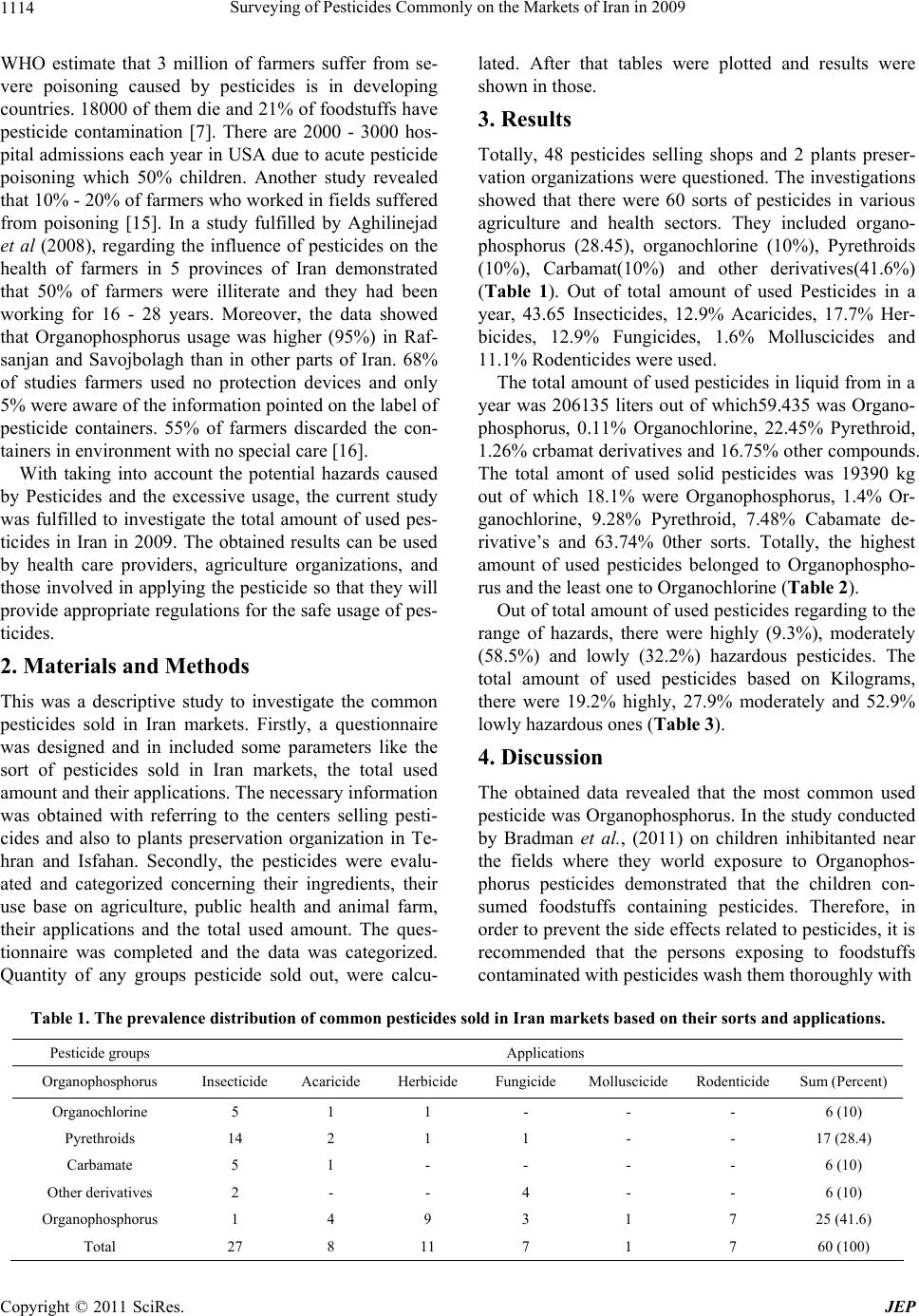 Surveying of Pesticides Commonly on the Markets of Iran in 2009 1114 WHO estimate that 3 million of farmers suffer from se- vere poisoning caused by pesticides is in developing countries. 18000 of them die and 21% of foodstuffs have pesticide contamination [7]. There are 2000 - 3000 hos- pital admissions each year in USA due to acute pesticide poisoning which 50% children. Another study revealed that 10% - 20% of farmers who worked in fields suffered from poisoning [15]. In a study fulfilled by Aghilinejad et al (2008), regarding the influence of pesticides on the health of farmers in 5 provinces of Iran demonstrated that 50% of farmers were illiterate and they had been working for 16 - 28 years. Moreover, the data showed that Organophosphorus usage was higher (95%) in Raf- sanjan and Savojbolagh than in other parts of Iran. 68% of studies farmers used no protection devices and only 5% were aware of the information poin ted on the labe l of pesticide containers. 55% of farmers discarded the con- tainers in environment with no special care [16]. With taking into account the potential hazards caused by Pesticides and the excessive usage, the current study was fulfilled to investigate the total amount of used pes- ticides in Iran in 2009. The obtained results can be used by health care providers, agriculture organizations, and those involved in applying the pesticide so that they will provide appropr iate regulations for th e safe usage of pes- ticides. 2. Materials and Methods This was a descriptive study to investigate the common pesticides sold in Iran markets. Firstly, a questionnaire was designed and in included some parameters like the sort of pesticides sold in Iran markets, the total used amount and their applications. The necessary information was obtained with referring to the centers selling pesti- cides and also to plants preservation organization in Te- hran and Isfahan. Secondly, the pesticides were evalu- ated and categorized concerning their ingredients, their use base on agriculture, public health and animal farm, their applications and the total used amount. The ques- tionnaire was completed and the data was categorized. Quantity of any groups pesticide sold out, were calcu- lated. After that tables were plotted and results were shown in those. 3. Results Totally, 48 pesticides selling shops and 2 plants preser- vation organizations were questioned. The investigations showed that there were 60 sorts of pesticides in various agriculture and health sectors. They included organo- phosphorus (28.45), organochlorine (10%), Pyrethroids (10%), Carbamat(10%) and other derivatives(41.6%) (Table 1). Out of total amount of used Pesticides in a year, 43.65 Insecticides, 12.9% Acaricides, 17.7% Her- bicides, 12.9% Fungicides, 1.6% Molluscicides and 11.1% Rode nt i c i des w ere us ed. The total amount of used pesticides in liq uid from in a year was 206135 liters out of which59.435 was Organo- phosphorus, 0.11% Organochlorine, 22.45% Pyrethroid, 1.26% crbamat derivatives and 16.75% other compounds. The total amont of used solid pesticides was 19390 kg out of which 18.1% were Organophosphorus, 1.4% Or- ganochlorine, 9.28% Pyrethroid, 7.48% Cabamate de- rivative’s and 63.74% 0ther sorts. Totally, the highest amount of used pesticides belonged to Organophospho- rus and the least one to Organochlorine (Table 2). Out of total amount of used pesticides regarding to the range of hazards, there were highly (9.3%), moderately (58.5%) and lowly (32.2%) hazardous pesticides. The total amount of used pesticides based on Kilograms, there were 19.2% highly, 27.9% moderately and 52.9% lowly hazardous ones (Table 3). 4. Discussion The obtained data revealed that the most common used pesticide was Organophosphorus. In the study conducted by Bradman et al., (2011) on children inhibitanted near the fields where they world exposure to Organophos- phorus pesticides demonstrated that the children con- sumed foodstuffs containing pesticides. Therefore, in order to prevent the sid e effects related to pesticides, it is recommended that the persons exposing to foodstuffs contaminated with pesticides wash them thoroug hly with Table 1. The prevalence distribution of common pesticides sold in Iran markets based on their sorts and applications. Pesticide groups Applications Organophosphorus Insecticide Acaricide Herbicide Fungicide MolluscicideRodenticide Sum (Percent) Organochlorine 5 1 1 - - - 6 (10) Pyrethroids 14 2 1 1 - - 17 (28.4) Carbamate 5 1 - - - - 6 (10) Other derivatives 2 - - 4 - - 6 (10) Organophosphorus 1 4 9 3 1 7 25 (41.6) Total 27 8 11 7 1 7 60 (100) C opyright © 2011 SciRes. JEP 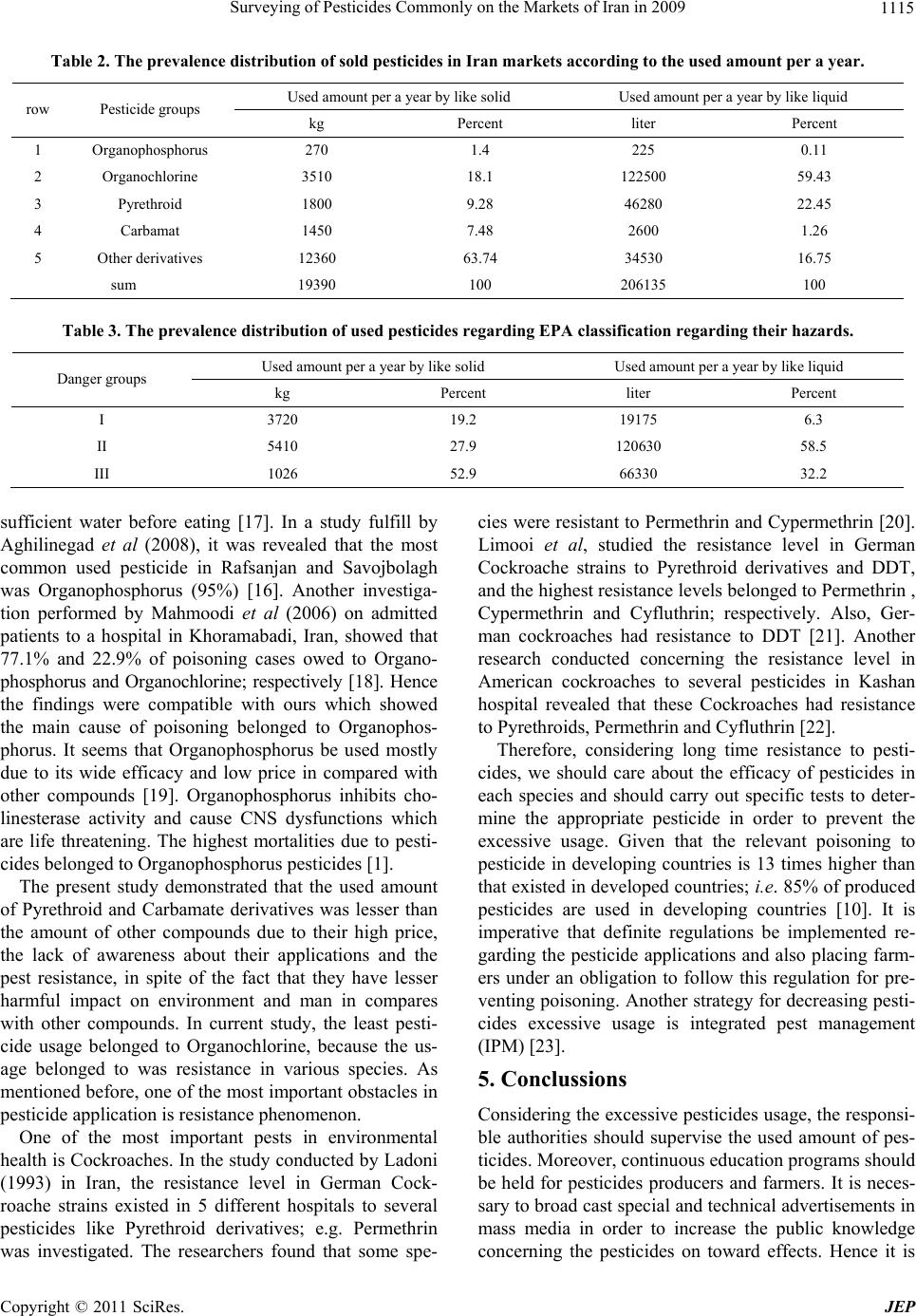 Surveying of Pesticides Commonly on the Markets of Iran in 20091115 Table 2. The prevalence distribution of sold pesticides in Iran markets according to the used amount per a year. Used amount per a year by like solid Used amount per a year by like liquid row Pesticide groups kg Percent liter Percent 1 Organophosphorus 270 1.4 225 0.11 2 Organochlorine 3510 18.1 122500 59.43 3 Pyrethroid 1800 9.28 46280 22.45 4 Carbamat 1450 7.48 2600 1.26 5 Other derivatives 12360 63.74 34530 16.75 sum 19390 100 206135 100 Table 3. The prevalence distribution of used pesticides regarding EPA classification regarding their hazards. Used amount per a year by like solid Used amount per a year by like liquid Danger groups kg Percent liter Percent I 3720 19.2 19175 6.3 II 5410 27.9 120630 58.5 III 1026 52.9 66330 32.2 sufficient water before eating [17]. In a study fulfill by Aghilinegad et al (2008), it was revealed that the most common used pesticide in Rafsanjan and Savojbolagh was Organophosphorus (95%) [16]. Another investiga- tion performed by Mahmoodi et al (2006) on admitted patients to a hospital in Khoramabadi, Iran, showed that 77.1% and 22.9% of poisoning cases owed to Organo- phosphorus and Organochlorine; respectively [18]. Hence the findings were compatible with ours which showed the main cause of poisoning belonged to Organophos- phorus. It seems that Organophosphorus be used mostly due to its wide efficacy and low price in compared with other compounds [19]. Organophosphorus inhibits cho- linesterase activity and cause CNS dysfunctions which are life threatening. The highest mortalities due to pesti- cides belonged to Or ganophosphorus pestic ides [1]. The present study demonstrated that the used amount of Pyrethroid and Carbamate derivatives was lesser than the amount of other compounds due to their high price, the lack of awareness about their applications and the pest resistance, in spite of the fact that they have lesser harmful impact on environment and man in compares with other compounds. In current study, the least pesti- cide usage belonged to Organochlorine, because the us- age belonged to was resistance in various species. As mentioned before, one of the most important obstacles in pesticide application is resistance phenomenon. One of the most important pests in environmental health is Cockroaches. In the study conducted by Ladoni (1993) in Iran, the resistance level in German Cock- roache strains existed in 5 different hospitals to several pesticides like Pyrethroid derivatives; e.g. Permethrin was investigated. The researchers found that some spe- cies were resistant to Permethrin and Cypermethrin [20]. Limooi et al, studied the resistance level in German Cockroache strains to Pyrethroid derivatives and DDT, and the highest resistance levels belonged to Permethrin , Cypermethrin and Cyfluthrin; respectively. Also, Ger- man cockroaches had resistance to DDT [21]. Another research conducted concerning the resistance level in American cockroaches to several pesticides in Kashan hospital revealed that these Cockroaches had resistance to Pyrethroids, Permethrin and Cyfluthrin [22]. Therefore, considering long time resistance to pesti- cides, we should care about the efficacy of pesticides in each species and should carry out specific tests to deter- mine the appropriate pesticide in order to prevent the excessive usage. Given that the relevant poisoning to pesticide in developing countries is 13 times higher than that existed in dev eloped countries; i.e. 85% of produced pesticides are used in developing countries [10]. It is imperative that definite regulations be implemented re- garding the pesticide applications and also placing farm- ers under an obligation to follow this regulation for pre- venting poisoning. Another strategy for decreasing pesti- cides excessive usage is integrated pest management (IPM) [23]. 5. Conclussions Considering the excessive pesticides usage, the responsi- ble authorities should supervise the used amount of pes- ticides. Moreover, continuous education program s shoul d be held for pesticides producers and farmers. It is neces- sary to broad cast special and technical advertisements in mass media in order to increase the public knowledge concerning the pesticides on toward effects. Hence it is Copyright © 2011 SciRes. JEP  Surveying of Pesticides Commonly on the Markets of Iran in 2009 1116 recommended that the complete educational series be provided for farmers in four sections: A- terms o f how to apply pesticides. B- to manage the short and long term adverse effects .C- to use personal masks while applying pesticides in the fields. D- To discard the pesticides con- tainers carefully. Also the responsible authorities should provide proper information about pesticides for someone involved in app lying those. REFERENCES [1] H. Khazaei, N. Korasani, K. H. Talebijahromi, “Survey- ing the Quality and Health Status of Mazandaran Groundwater due to Use of Diazinon Insecticide (Case Study: Mahmoudabad City),” 12th Environmental Health Conference, Tehran, Iran, 2010, pp. 807-815. [2] A. Arjmandi, M. Tavakol and M. Shayeghi, “Determina- tion of Organoposporus Insecticide Residues in the Rice Paddies,” International Environmental science & Tech- nology, Vol. 7, No. 2, 2010, pp.175-82. [3] M. T. Samadi, M. Khodadadi, A. R. Rahmani, A. Al- lahresani and M. H. Saghi, “Comparison of the Efficiency of Simiultaneous Application of UV/O3 for the Removal of Organophosphorus and Carbamat Pesticides in Aque- ous,” Water and wastewater Jornal, in Persian, Vol. 1, 2009, pp. 69-75. [4] M. Khodadadi, M. T. Samadi, A. R. Rahmani, R. Maleki, A. Allahresani and R. Shahidi, “Determination of Or- ganophosphorous and Carbamat Pesticides Residue in Drinking Water Resources of Hamadan in 2007,” Iranian Journal of Health & Environmental, in Persian, Vol. 2, No. 4, 2010, pp.250-257. [5] WHO, “Safe use of Pesticides,” Twentieth Report of the WHO Expert Committee on Insecticides, Geneva, 1973. [6] A. K. Srivastava, D. Mishra, S. Shrivastava, S. K. Sri- vastav and A. A. Srivastav, “Accute Toxicity and Behav- ioural Responses Hetropneustes Fossilis to an Organo- phosphate Insecticides Dimethoate,” International Jour- nal of Pharma and Bio Sciences, Vol. 1, No. 4, 2010, pp. 359-363. [7] G. V. R. Rao, K. l. Sahrawat, C. S. Rao, B. Das, K.K. Reddy, B. S. Bharath, et al., “Insecticide Residues in Vegetable Crops Grown in Kothapalli Watershed Andra Pradesh India,” Indian Journal of Dryland Agricclture & Development, Vol. 24, No. 2, 2009, pp. 21-27. [8] A. Farshad, “Survying the Organochlorine and Organo- phosphorous Poisons in Farms upon Cucumber Pruduct in Fruit and Vegetables Area if Tehran and Health Effects Assessment,” Gonabad University of Medical Science, in Persian, Vol. 6, No. 2, 2000, pp. 50-58. [9] M. S. Yazgan and A. Tanik, “A New Approach for Cal- culating the Relative Risk Level of Pesticides,” Environ- ment International Journal, Vol. 31, pp. 687-692. [10] S. Ghasemi and E. Karam, “Attitudes and Behaviors about Pesticides Use among Greenhouse Workers in Fars Province,” Journal of Economics and Agricultural De- velopment, in Persian, Vol. 23, No. 1, 2009, pp. 28-40. [11] F. Konradsen, R. Pieris, M. Weerasinghe, V. Wander- hoek, M. Eddeleston and A. H. Dawson, “Community Uptake of Safe Storage Boxes to Reduce Self-Poisoning from Pesticides in Rural Sri Lanka,” BMC Public Health, Vol. 7, No. 13, 2007, pp. 1-7. [12] P .Lebailly, V. Bouchart, I. Balidi, Y. Lecluse, N. Heutte, A. Gislard, et al., “Exposure to Pesticide in Open-Field Farming in France,” The Annals of Occpational Hygiene, Vol. 53, No. 1, 2009, pp. 69-81. doi:10.1093/annhyg/men072 [13] F. Kamel, C. M. Tanner, D. M. Umbach, J. A. Hoppin, M. C. Alavanja, A. Blair, et al., “ Pesticide Exposure and Self-Reported Parkinsons Disease in the Agricultural Health Study,” American Journal of Epidemiology, Vol. 165, No. 4, 2006, pp. 364-374. doi:10.1093/aje/kwk024 [14] J. A. Firestone, T. S. Welle r, G. Franklin, P. Swanson, T. Longstreth and H. Chckoway, “Pesticides and Risk of Parkinson Disease,” American Medical Association, Vol. 62, 2005, pp. 91-95. [15] R. Dehghani, “Environmental Toxicology,” Kashan Uni- versity of Medical Science and Takderakht Publisher, Kashan, 2010. [16] M. Aghilinegad, S. Mohamadi, A. S. farshad, “Effecting the Pesticides Consumption upon Agricultural Health,” Journal Research of Shahid Beheshti University of Medi- cal Science, in Persian, Vol. 31, No. 4, 2008, pp. 327-331. [17] A. Bradman, R. Castorina, D. Boydbar, J. Chevrier, M. E. Harnly, E. A. Eisen, et al., “Determinants of Organo- phosphorus Pesticide Urinary Metabolite Levels in Young Children Living in an Agricultural Community,” International Journal of Environmental Research and Public Health, Vol. 8, 2011, pp. 1061-1083. doi:10.3390/ijerph8041061 [18] G. A. Mahmodi and R. Asaei, “Epidemiological Survey- ing the Pesticide Poisoning Cases (Organophosphorus and Organochlorine) in Patients Admitted at Hospitals in Khorram Abad Martyrs Nomads in First Xix Months in 2006,” Yafte Journal in Lorestan University of Medical Sciences, in Persian, Vol. 10, No. 1, 2008, pp. 3-10. [19] M. Shayeghi, M. Khobdel, F. Bagheri and M. Abtai, “Azynphosmethyl and Diazinon Residues in Qarasu River and Gorganrood in Golestan Province,” Journal of Public Health and Health Research Institute, in Persian, Vol. 6, No. 1, 2008, pp. 75-82. [20] H. Ladonni, “Susceptibility of Blattella Germanica to Different Insecticides in Different Hospitals in Tehran- Iran,” Journal of Entomology Society of Iran, in Persian, Vol. 12, No. 13, 1993, pp. 23-28. [21] M. Limoee, H. Ladonni, A. A. Enayati, H. Vatandoost and M. Aboulhasni, “Detectionof Pyrethroid Resistance and Cross-Resitance to DDT in Seven Field-Collected Strains of the German Cockroach Blattella Germanica (L.) (Dictyoptera: Blattellidae),” Journal of Biological Sci- ences, Vol. 6, No. 2, 2006, pp. 382-387. doi:10.3923/jbs.2006.382.387 [22] A. Dorodgar, R. Dehghghani, H. Hooshiar and M. Sayahh, “Sensitivity of American Cockroach in Kashan hospital to insecticides,” Feyz Kashan university Medical C opyright © 2011 SciRes. JEP  Surveying of Pesticides Commonly on the Markets of Iran in 2009 Copyright © 2011 SciRes. JEP 1117 Sciences & Health Services, in Persian, Vol. 2, No. 20, 1998, pp. 89-94. [23] M. G. Calvert, J. Ka rnik, L. Mehle r, J. Be ckman, B. Mor- rissey, J. Sievert, et al., “Acute Pesticide Poisoning among Aggricutural Workers in the United State,” Ameri- can Journal of Industrial Medecine, Vol. 31, 2008, pp. 883-898. doi:10.1002/ajim.20623 |