

Paper Menu >>
Journal Menu >>
 Journal of Environmental Protection, 2011, 2, 1076-1083 doi:10.4236/jep.2011.28124 Published Online October 2011 (http://www.scirp.org/journal/jep) Copyright © 2011 SciRes. JEP Metal Transport Parameters in Residual Soil with an Undisturbed and Remolded Structure Percolated by an Acid Solution Eduardo Pavan Korf1, Antonio Thomé2, Nilo Cesar Consoli1, Rafael de Souza Tímbola2, Gláucia Carine dos Santos1 1Department of Civil Engineering, Federal University of Rio Grande do Sul, Porto Alegre, Brazil; 2University of Passo Fundo, Passo Fundo, Brazil. Email: eduardok[email protected] Received July 18th, 2011; revised August 21st, 2011; accepted September 22nd, 2011. ABSTRACT There is no enough informa tion about metal transport parameters in residual so il. These soils are generally structured and still there is no answer to what happens with the contaminant transport parameters when an acid solution with metal percolates this material with different structure. The objective of this study was to determine the contaminant transport parameters for Cd, Ni, Cu and Zn metals in an acid multispecies solution to a residual soil from south Brazil with an undisturbed and remolded structure. Column tests were carried out to determine the Rd, kd, Dh transport pa- rameters. It was possible conclude that the magnitude of the kd, Rd and Dh parameter did n ot vary sign ificantly with the soil structure. Keywords: Pollutant Transport, Column Equipment, Natural Attenuation, Dissolved Metals, Analytical Simulation 1. Introduction Acidic and inorganic materials in residual water repre- sent a common effluent from industrial activities such as mining (coal and mineral deposits), electroplating, cast- ing and the handling of chemical substances in general. These effluents, if not well managed, may generate en- vironmental pollution and have a negative impact on soil, superficial and underground water and ecosystems [1- 11]. The metals when inserted in the environment may cause serious damage to toxicity in exposed organisms, because metals may be inserted in the food chain due to their high mobility. [12] have claimed that contamination by metals may lead to both acute and chronic high toxi- city, persist in an environment, high mobility and accu- mulate in organisms due to their liposolubility. Addi- tionally, metal compounds, even in small amounts, may be toxic to plants and animals [13,14]. Studies are needed to provide an understanding of the control mechanisms of solution with metallic compounds on the residual soil, mainly from south Brazil. Such studies should be conducted with the objective of moni- toring the contamination plumes migration and carried out environmental models studies. Additional studies might also accelerate immobilization and decontamination pro- jects or suspend such procedures for verifying effective- ness of natural attenuation processes [15]. The migration of pollutants to the subsurface is in- fluenced by several factors that may determine the move- ment of metal through the soil. These factors are de- scribed by physical and biophysical-chemical processes, which are represented by the theoretical model. The physical process, in general, involves diffusion and me- chanical dispersion phenomena, and one may be predo- minant over the other. The summation of those two pro- cesses is called hydrodynamic dispersion (Dh). This phe- nomenon is characterized in the diffusive part by mo- lecular diffusion coefficient (D*), which is represented by the direct relationship between the coefficient diffu- sion in free solution (Do) and a physical-chemical factor called tortuosity (τ). In the dispersive part of transport, the phenomena are represented by the mechanical dis- persion (α) and the percolation speed (vs). The bio- physicochemical processes are related to the physical, chemical and biological interactions that may occur be- tween the soil and the pollutant. In those processes, the interaction between the environmental conditions, the 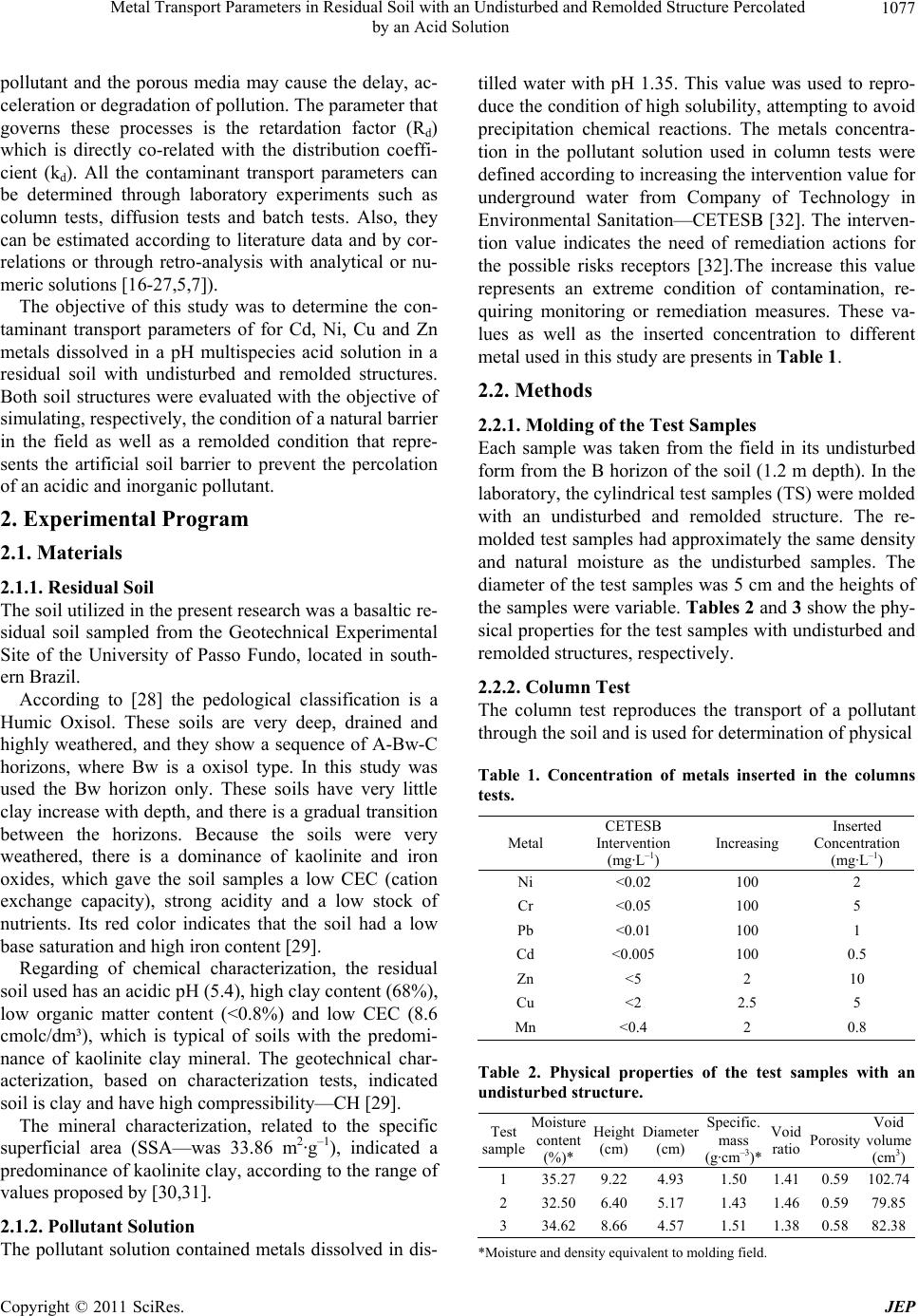 Metal Transport Parameters in Residual Soil with an Undisturbed and Remolded Structure Percolated 1077 by an Acid Solution pollutant and the porous media may cause the delay, ac- celeration or degradation of pollution. The parameter that governs these processes is the retardation factor (Rd) which is directly co-related with the distribution coeffi- cient (kd). All the contaminant transport parameters can be determined through laboratory experiments such as column tests, diffusion tests and batch tests. Also, they can be estimated according to literature data and by cor- relations or through retro-analysis with analytical or nu- meric solutions [16-27,5,7]). The objective of this study was to determine the con- taminant transport parameters of for Cd, Ni, Cu and Zn metals dissolved in a pH multispecies acid solution in a residual soil with undisturbed and remolded structures. Both soil structures were evaluated with the objective of simulating, respectively, the condition of a natural barrier in the field as well as a remolded condition that repre- sents the artificial soil barrier to prevent the percolation of an acidic and inorganic pollutant. 2. Experimental Program 2.1. Materials 2.1.1. Residu a l Soil The soil utilized in the present research was a basaltic re- sidual soil sampled from the Geotechnical Experimental Site of the University of Passo Fundo, located in south- ern Brazil. According to [28] the pedological classification is a Humic Oxisol. These soils are very deep, drained and highly weathered, and they show a sequence of A-Bw-C horizons, where Bw is a oxisol type. In this study was used the Bw horizon only. These soils have very little clay increase with depth, and there is a gradual transition between the horizons. Because the soils were very weathered, there is a dominance of kaolinite and iron oxides, which gave the soil samples a low CEC (cation exchange capacity), strong acidity and a low stock of nutrients. Its red color indicates that the soil had a low base saturation and high iron content [29]. Regarding of chemical characterization, the residual soil used has an acidic pH (5.4), high clay content (68%), low organic matter content (<0.8%) and low CEC (8.6 cmolc/dm³), which is typical of soils with the predomi- nance of kaolinite clay mineral. The geotechnical char- acterization, based on characterization tests, indicated soil is clay and have high compressibility—CH [29]. The mineral characterization, related to the specific superficial area (SSA—was 33.86 m2·g–1), indicated a predominance of kaolinite clay, according to the range of values proposed by [30,31]. 2.1.2. Pollu t ant Solution The pollutant solution contained metals dissolved in dis- tilled water with pH 1.35. This value was used to repro- duce the condition of high solubility, attempting to avoid precipitation chemical reactions. The metals concentra- tion in the pollutant solution used in column tests were defined according to increasing the intervention value for underground water from Company of Technology in Environmental Sanitation—CETESB [32]. The interven- tion value indicates the need of remediation actions for the possible risks receptors [32].The increase this value represents an extreme condition of contamination, re- quiring monitoring or remediation measures. These va- lues as well as the inserted concentration to different metal used in this study are presents in Table 1. 2.2. Methods 2.2.1. Molding of the Test Samples Each sample was taken from the field in its undisturbed form from the B horizon of the soil (1.2 m depth). In the laboratory, the cylindrical test samples (TS) were molded with an undisturbed and remolded structure. The re- molded test samples had approximately the same density and natural moisture as the undisturbed samples. The diameter of the test samples was 5 cm and the heights of the samples were variable. Tabl es 2 and 3 show the phy- sical properties for the test samples with undisturbed and remolded structures, respectively. 2.2.2. Column Test The column test reproduces the transport of a pollutant through the soil and is used for determination of physical Table 1. Concentration of metals inserted in the columns tests. Metal CETESB Intervention (mg·L–1) Increasing Inserted Concentration (mg·L–1) Ni <0.02 100 2 Cr <0.05 100 5 Pb <0.01 100 1 Cd <0.005 100 0.5 Zn <5 2 10 Cu <2 2.5 5 Mn <0.4 2 0.8 Table 2. Physical properties of the test samples with an undisturbed struc ture. Test sample Moisture content (%)* Height (cm) Diameter (cm) Specific. mass (g·cm–3)* Void ratio Porosity Void volume (cm3) 1 35.279.224.93 1.50 1.41 0.59102.74 2 32.506.405.17 1.43 1.46 0.5979.85 3 34.628.664.57 1.51 1.38 0.5882.38 *Moisture and density equivalent to molding field. Copyright © 2011 SciRes. JEP 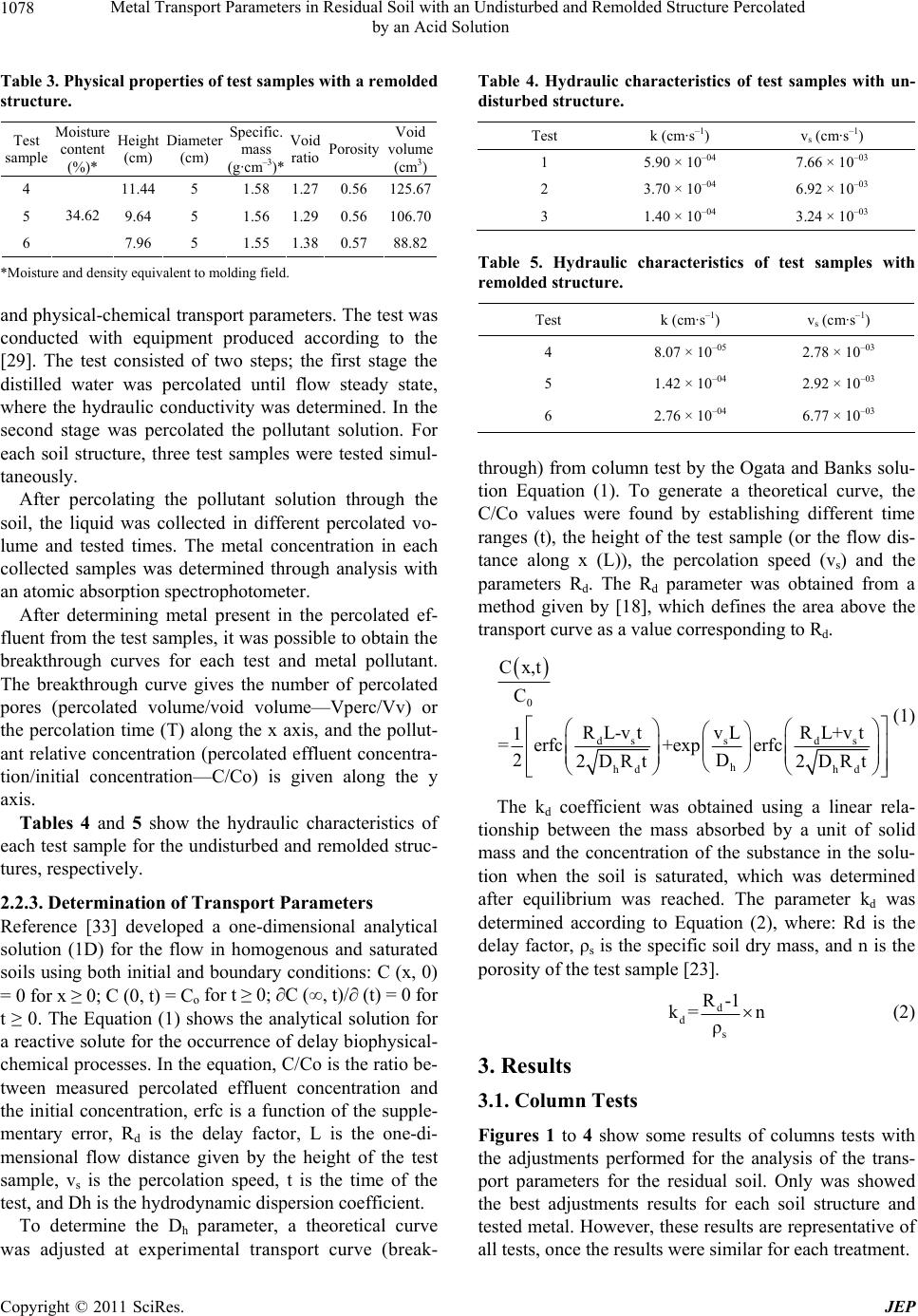 Metal Transport Parameters in Residual Soil with an Undisturbed and Remolded Structure Percolated 1078 by an Acid Solution Table 3. Physical properties of test samples with a r e molded structure. Test sample Moisture content (%)* Height (cm) Diameter (cm) Specific. mass (g·cm–3)* Void ratio Porosity Void volume (cm3) 4 11.44 5 1.58 1.27 0.56 125.67 5 9.64 5 1.56 1.29 0.56 106.70 6 34.62 7.96 5 1.55 1.38 0.57 88.82 *Moisture and density equivalent to molding field. and physical-chemical transport parameters. The test was conducted with equipment produced according to the [29]. The test consisted of two steps; the first stage the distilled water was percolated until flow steady state, where the hydraulic conductivity was determined. In the second stage was percolated the pollutant solution. For each soil structure, three test samples were tested simul- taneously. After percolating the pollutant solution through the soil, the liquid was collected in different percolated vo- lume and tested times. The metal concentration in each collected samples was determined through analysis with an atomic absorption spectrophotometer. After determining metal present in the percolated ef- fluent from the test samples, it was possible to obtain the breakthrough curves for each test and metal pollutant. The breakthrough curve gives the number of percolated pores (percolated volume/void volume—Vperc/Vv) or the percolation time (T) along the x axis, and the pollut- ant relative concentration (percolated effluent concentra- tion/initial concentration—C/Co) is given along the y axis. Tables 4 and 5 show the hydraulic characteristics of each test sample for the undisturbed and remolded struc- tures, respectively. 2.2.3. Deter mi n at ion of Trans po rt Parame t er s Reference [33] developed a one-dimensional analytical solution (1D) for the flow in homogenous and saturated soils using both initial and boundary conditions: C (x, 0) = 0 for x ≥ 0; C (0, t) = Co for t ≥ 0; C (∞, t)/ (t) = 0 for t ≥ 0. The Equation (1) shows the analytical solution for a reactive solute for the occurrence of delay biophysical- chemical processes. In the equation, C/Co is the ratio be- tween measured percolated effluent concentration and the initial concentration, erfc is a function of the supple- mentary error, Rd is the delay factor, L is the one-di- mensional flow distance given by the height of the test sample, vs is the percolation speed, t is the time of the test, and Dh is the hydrodynamic dispersion coefficient. To determine the Dh parameter, a theoretical curve was adjusted at experimental transport curve (break- Table 4. Hydraulic characteristics of test samples with un- disturbed structure . Test k (cm·s–1) vs (cm·s–1) 1 5.90 × 10–04 7.66 × 10–03 2 3.70 × 10–04 6.92 × 10–03 3 1.40 × 10–04 3.24 × 10–03 Table 5. Hydraulic characteristics of test samples with remolded structure. Test k (cm·s–1) vs (cm·s–1) 4 8.07 × 10–05 2.78 × 10–03 5 1.42 × 10–04 2.92 × 10–03 6 2.76 × 10–04 6.77 × 10–03 through) from column test by the Ogata and Banks solu- tion Equation (1). To generate a theoretical curve, the C/Co values were found by establishing different time ranges (t), the height of the test sample (or the flow dis- tance along x (L)), the percolation speed (vs) and the parameters Rd. The Rd parameter was obtained from a method given by [18], which defines the area above the transport curve as a value corresponding to Rd. 0 dssd s h hd hd Cx,t C RL-vtvLRL+vt 1 = erfc+experfc 2D 2DRt 2DRt (1) The kd coefficient was obtained using a linear rela- tionship between the mass absorbed by a unit of solid mass and the concentration of the substance in the solu- tion when the soil is saturated, which was determined after equilibrium was reached. The parameter kd was determined according to Equation (2), where: Rd is the delay factor, ρs is the specific soil dry mass, and n is the porosity of the test sample [23]. d d s R-1 k= n ρ (2) 3. Results 3.1. Column Tests Figures 1 to 4 show some results of columns tests with the adjustments performed for the analysis of the trans- port parameters for the residual soil. Only was showed the best adjustments results for each soil structure and tested metal. However, these results are representative of all tests, once the results were similar for each treatment. C opyright © 2011 SciRes. JEP 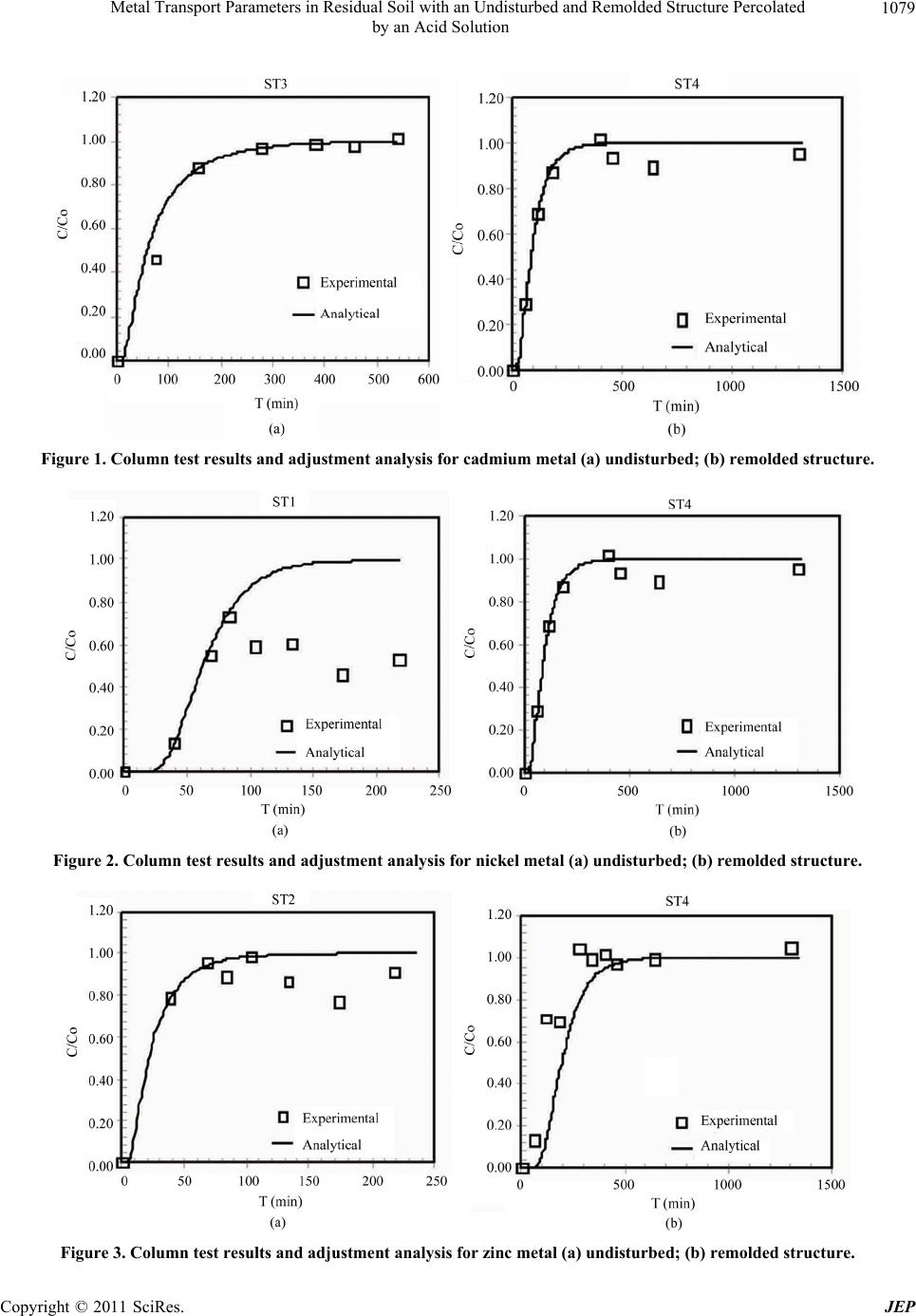 Metal Transport Parameters in Residual Soil with an Undisturbed and Remolded Structure Percolated by an Acid Solution Copyright © 2011 SciRes. JEP 1079 Figure 1. Column test results and adjustment analysis for cadmium metal (a) undisturbed; (b) remolded structure. Figure 2. Column test results and adjustment analysis for nickel metal (a) undisturbed; (b) rem olde d str uc ture . Figure 3. Column test results and adjustment analysis for zinc metal (a) undisturbed; (b) remolded structure. 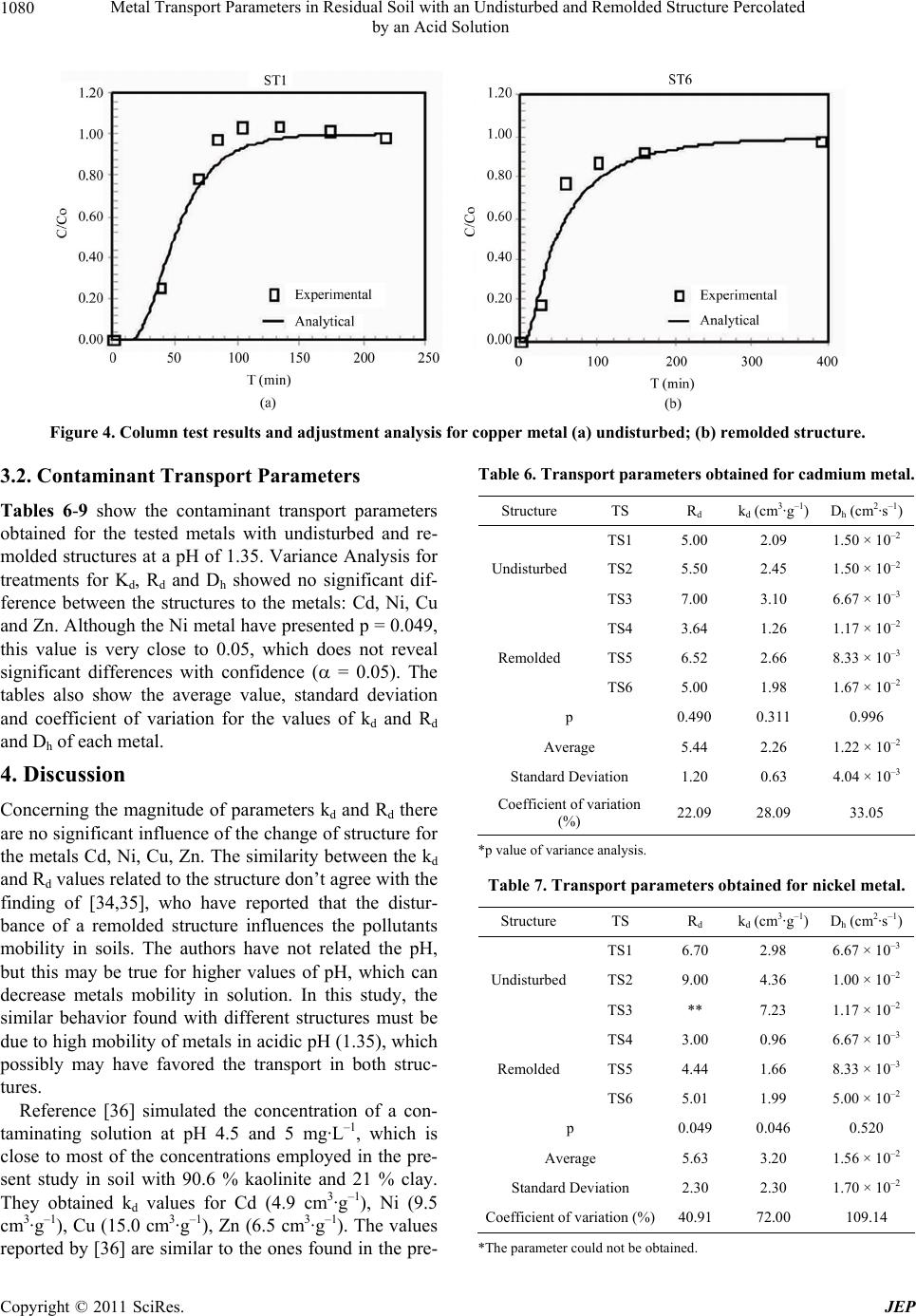 Metal Transport Parameters in Residual Soil with an Undisturbed and Remolded Structure Percolated 1080 by an Acid Solution Figure 4. Column test results and adjustment analysis for copper metal (a) undisturbed; (b) remolded str uctur e . 3.2. Contaminant Transport Parameters Tables 6-9 show the contaminant transport parameters obtained for the tested metals with undisturbed and re- molded structures at a pH of 1.35. Variance Analysis for treatments for Kd, Rd and Dh showed no significant dif- ference between the structures to the metals: Cd, Ni, Cu and Zn. Although the Ni metal have presented p = 0.049, this value is very close to 0.05, which does not reveal significant differences with confidence ( = 0.05). The tables also show the average value, standard deviation and coefficient of variation for the values of kd and Rd and Dh of each metal. 4. Discussion Concerning the magnitude of parameters kd and Rd there are no significant influence of the change of structure for the metals Cd, Ni, Cu, Zn. The similarity between the kd and Rd values related to the structure don’t agree with the finding of [34,35], who have reported that the distur- bance of a remolded structure influences the pollutants mobility in soils. The authors have not related the pH, but this may be true for higher values of pH, which can decrease metals mobility in solution. In this study, the similar behavior found with different structures must be due to high mobility of metals in acidic pH (1.35), which possibly may have favored the transport in both struc- tures. Reference [36] simulated the concentration of a con- taminating solution at pH 4.5 and 5 mg·L–1, which is close to most of the concentrations employed in the pre- sent study in soil with 90.6 % kaolinite and 21 % clay. They obtained kd values for Cd (4.9 cm3·g–1), Ni (9.5 cm3·g–1), Cu (15.0 cm3·g–1), Zn (6.5 cm3·g–1). The values reported by [36] are similar to the ones found in the pre- Table 6. Transport parameters obtained for cadmium metal. Structure TS Rd k d (cm3·g–1) Dh (cm2·s–1) TS1 5.00 2.09 1.50 × 10⁻² TS2 5.50 2.45 1.50 × 10⁻² Undisturbed TS3 7.00 3.10 6.67 × 10⁻³ TS4 3.64 1.26 1.17 × 10⁻² TS5 6.52 2.66 8.33 × 10⁻³ Remolded TS6 5.00 1.98 1.67 × 10⁻² p 0.490 0.311 0.996 Average 5.44 2.26 1.22 × 10⁻² Standard Deviation 1.20 0.63 4.04 × 10⁻³ Coefficient of variation (%) 22.09 28.09 33.05 *p value of variance analysis. Table 7. Transport parameters obtained for nickel metal. Structure TS Rd k d (cm3·g–1) Dh (cm2·s–1) TS1 6.70 2.98 6.67 × 10⁻³ TS2 9.00 4.36 1.00 × 10⁻² Undisturbed TS3 ** 7.23 1.17 × 10⁻² TS4 3.00 0.96 6.67 × 10⁻³ TS5 4.44 1.66 8.33 × 10⁻³ Remolded TS6 5.01 1.99 5.00 × 10⁻² p 0.049 0.046 0.520 Average 5.63 3.20 1.56 × 10⁻² Standard Deviation 2.30 2.30 1.70 × 10⁻² Coefficient of variation (%)40.91 72.00 109.14 *The parameter could not be obtained. C opyright © 2011 SciRes. JEP 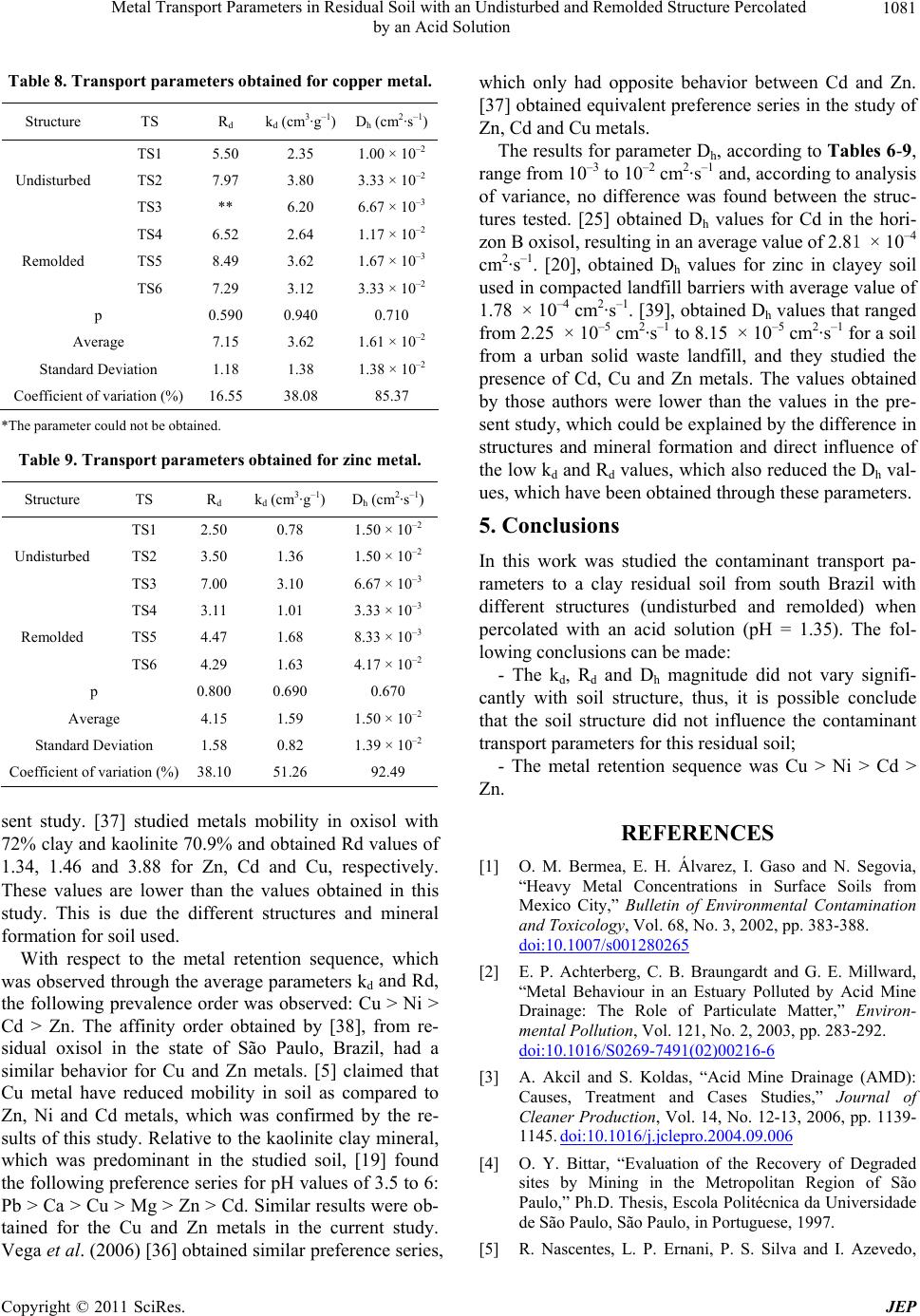 Metal Transport Parameters in Residual Soil with an Undisturbed and Remolded Structure Percolated 1081 by an Acid Solution Table 8. Transport parameters obtained for copper metal. Structure TS Rd k d (cm3·g–1) Dh (cm2·s–1) TS1 5.50 2.35 1.00 × 10⁻² TS2 7.97 3.80 3.33 × 10⁻² Undisturbed TS3 ** 6.20 6.67 × 10⁻³ TS4 6.52 2.64 1.17 × 10⁻² TS5 8.49 3.62 1.67 × 10⁻³ Remolded TS6 7.29 3.12 3.33 × 10⁻² p 0.5900.940 0.710 Average 7.15 3.62 1.61 × 10⁻² Standard Deviation 1.18 1.38 1.38 × 10⁻² Coefficient of variation (%) 16.5538.08 85.37 *The parameter could not be obtained. Table 9. Transport parameters obtained for zinc metal. Structure TS Rd k d (cm3·g–1) Dh (cm2·s–1) TS1 2.500.78 1.50 × 10⁻² TS2 3.501.36 1.50 × 10⁻² Undisturbed TS3 7.003.10 6.67 × 10⁻³ TS4 3.111.01 3.33 × 10⁻³ TS5 4.471.68 8.33 × 10⁻³ Remolded TS6 4.291.63 4.17 × 10⁻² p 0.8000.690 0.670 Average 4.151.59 1.50 × 10⁻² Standard Deviation 1.580.82 1.39 × 10⁻² Coefficient of variation (%) 38.1051.26 92.49 sent study. [37] studied metals mobility in oxisol with 72% clay and kaolinite 70.9% and obtained Rd values of 1.34, 1.46 and 3.88 for Zn, Cd and Cu, respectively. These values are lower than the values obtained in this study. This is due the different structures and mineral formation for soil used. With respect to the metal retention sequence, which was observed through the average parameters kd and Rd, the following prevalence order was observed: Cu > Ni > Cd > Zn. The affinity order obtained by [38], from re- sidual oxisol in the state of São Paulo, Brazil, had a similar behavior for Cu and Zn metals. [5] claimed that Cu metal have reduced mobility in soil as compared to Zn, Ni and Cd metals, which was confirmed by the re- sults of this study. Relative to the kaolinite clay mineral, which was predominant in the studied soil, [19] found the following preference series for pH values of 3.5 to 6: Pb > Ca > Cu > Mg > Zn > Cd. Similar results were ob- tained for the Cu and Zn metals in the current study. Vega et al. (2006) [36] obtained similar preference series, which only had opposite behavior between Cd and Zn. [37] obtained equivalent preference series in the study of Zn, Cd and Cu metals. The results for parameter Dh, according to Tables 6-9, range from 10–3 to 10–2 cm2·s–1 and, according to analysis of variance, no difference was found between the struc- tures tested. [25] obtained Dh values for Cd in the hori- zon B oxisol, resulting in an average value of 2.81 × 10⁻⁴ cm2·s–1. [20], obtained Dh values for zinc in clayey soil used in compacted landfill barriers with average value of 1.78 × 10⁻⁴ cm2·s–1. [39], obtained Dh values that ranged from 2.25 × 10⁻⁵ cm2·s–1 to 8.15 × 10⁻⁵ cm2·s–1 for a soil from a urban solid waste landfill, and they studied the presence of Cd, Cu and Zn metals. The values obtained by those authors were lower than the values in the pre- sent study, which could be explained by the difference in structures and mineral formation and direct influence of the low kd and Rd values, which also reduced the Dh val- ues, which have been obtained through these parameters. 5. Conclusions In this work was studied the contaminant transport pa- rameters to a clay residual soil from south Brazil with different structures (undisturbed and remolded) when percolated with an acid solution (pH = 1.35). The fol- lowing conclusions can be made: - The kd, Rd and Dh magnitude did not vary signifi- cantly with soil structure, thus, it is possible conclude that the soil structure did not influence the contaminant transport parameters for this residual soil; - The metal retention sequence was Cu > Ni > Cd > Zn. REFERENCES [1] O. M. Bermea, E. H. Álvarez, I. Gaso and N. Segovia, “Heavy Metal Concentrations in Surface Soils from Mexico City,” Bulletin of Environmental Contamination and Toxicology, Vol. 68, No. 3, 2002, pp. 383-388. doi:10.1007/s001280265 [2] E. P. Achterberg, C. B. Braungardt and G. E. Millward, “Metal Behaviour in an Estuary Polluted by Acid Mine Drainage: The Role of Particulate Matter,” Environ- mental Pollution, Vol. 121, No. 2, 2003, pp. 283-292. doi:10.1016/S0269-7491(02)00216-6 [3] A. Akcil and S. Koldas, “Acid Mine Drainage (AMD): Causes, Treatment and Cases Studies,” Journal of Cleaner Production, Vol. 14, No. 12-13, 2006, pp. 1139- 1145. doi:10.1016/j.jclepro.2004.09.006 [4] O. Y. Bittar, “Evaluation of the Recovery of Degraded sites by Mining in the Metropolitan Region of São Paulo,” Ph.D. Thesis, Escola Politécnica da Universidade de São Paulo, São Paulo, in Portuguese, 1997. [5] R. Nascentes, L. P. Ernani, P. S. Silva and I. Azevedo, Copyright © 2011 SciRes. JEP 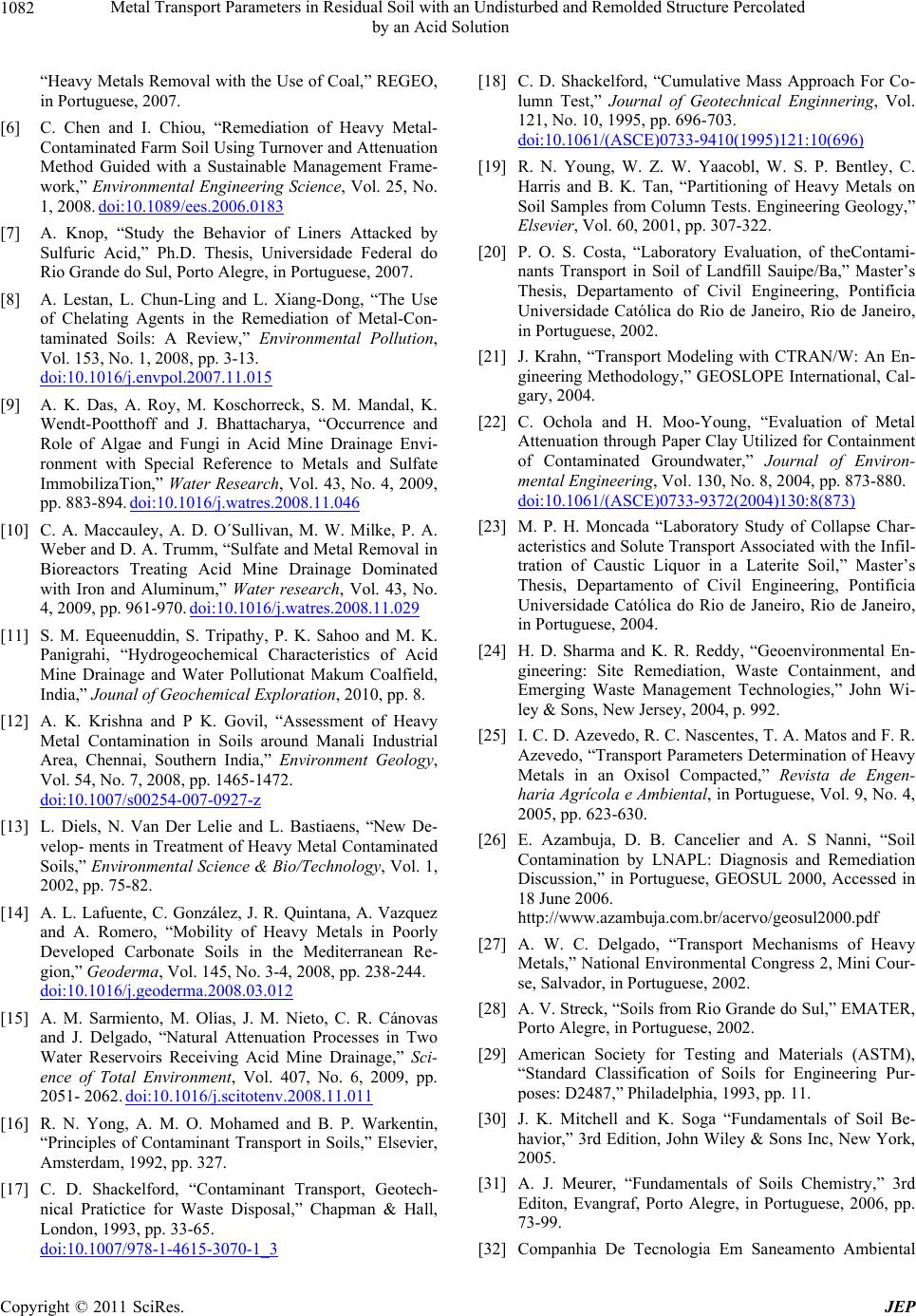 Metal Transport Parameters in Residual Soil with an Undisturbed and Remolded Structure Percolated 1082 by an Acid Solution “Heavy Metals Removal with the Use of Coal,” REGEO, in Portuguese, 2007. [6] C. Chen and I. Chiou, “Remediation of Heavy Metal- Contaminated Farm Soil Using Turnover and Attenuation Method Guided with a Sustainable Management Frame- work,” Environmental Engineering Science, Vol. 25, No. 1, 2008. doi:10.1089/ees.2006.0183 [7] A. Knop, “Study the Behavior of Liners Attacked by Sulfuric Acid,” Ph.D. Thesis, Universidade Federal do Rio Grande do Sul, Porto Alegre, in Portuguese, 2007. [8] A. Lestan, L. Chun-Ling and L. Xiang-Dong, “The Use of Chelating Agents in the Remediation of Metal-Con- taminated Soils: A Review,” Environmental Pollution, Vol. 153, No. 1, 2008, pp. 3-13. doi:10.1016/j.envpol.2007.11.015 [9] A. K. Das, A. Roy, M. Koschorreck, S. M. Mandal, K. Wendt-Pootthoff and J. Bhattacharya, “Occurrence and Role of Algae and Fungi in Acid Mine Drainage Envi- ronment with Special Reference to Metals and Sulfate ImmobilizaTion,” Water Re search, Vol. 43, No. 4, 2009, pp. 883-894. doi:10.1016/j.watres.2008.11.046 [10] C. A. Maccauley, A. D. O´Sullivan, M. W. Milke, P. A. Weber and D. A. Trumm, “Sulfate and Metal Removal in Bioreactors Treating Acid Mine Drainage Dominated with Iron and Aluminum,” Water research, Vol. 43, No. 4, 2009, pp. 961-970. doi:10.1016/j.watres.2008.11.029 [11] S. M. Equeenuddin, S. Tripathy, P. K. Sahoo and M. K. Panigrahi, “Hydrogeochemical Characteristics of Acid Mine Drainage and Water Pollutionat Makum Coalfield, India,” Jounal of Geochemical Exploration, 2010, pp. 8. [12] A. K. Krishna and P K. Govil, “Assessment of Heavy Metal Contamination in Soils around Manali Industrial Area, Chennai, Southern India,” Environment Geology, Vol. 54, No. 7, 2008, pp. 1465-1472. doi:10.1007/s00254-007-0927-z [13] L. Diels, N. Van Der Lelie and L. Bastiaens, “New De- velop- ments in Treatment of Heavy Metal Contaminated Soils,” Environmental Science & Bio/Technology, Vol. 1, 2002, pp. 75-82. [14] A. L. Lafuente, C. González, J. R. Quintana, A. Vazquez and A. Romero, “Mobility of Heavy Metals in Poorly Developed Carbonate Soils in the Mediterranean Re- gion,” Geoderma, Vol. 145, No. 3-4, 2008, pp. 238-244. doi:10.1016/j.geoderma.2008.03.012 [15] A. M. Sarmiento, M. Olías, J. M. Nieto, C. R. Cánovas and J. Delgado, “Natural Attenuation Processes in Two Water Reservoirs Receiving Acid Mine Drainage,” Sci- ence of Total Environment, Vol. 407, No. 6, 2009, pp. 2051- 2062. doi:10.1016/j.scitotenv.2008.11.011 [16] R. N. Yong, A. M. O. Mohamed and B. P. Warkentin, “Principles of Contaminant Transport in Soils,” Elsevier, Amsterdam, 1992, pp. 327. [17] C. D. Shackelford, “Contaminant Transport, Geotech- nical Pratictice for Waste Disposal,” Chapman & Hall, London, 1993, pp. 33-65. doi:10.1007/978-1-4615-3070-1_3 [18] C. D. Shackelford, “Cumulative Mass Approach For Co- lumn Test,” Journal of Geotechnical Enginnering, Vol. 121, No. 10, 1995, pp. 696-703. doi:10.1061/(ASCE)0733-9410(1995)121:10(696) [19] R. N. Young, W. Z. W. Yaacobl, W. S. P. Bentley, C. Harris and B. K. Tan, “Partitioning of Heavy Metals on Soil Samples from Column Tests. Engineering Geology,” Elsevier, Vol. 60, 2001, pp. 307-322. [20] P. O. S. Costa, “Laboratory Evaluation, of theContami- nants Transport in Soil of Landfill Sauipe/Ba,” Master’s Thesis, Departamento of Civil Engineering, Pontifícia Universidade Católica do Rio de Janeiro, Rio de Janeiro, in Portuguese, 2002. [21] J. Krahn, “Transport Modeling with CTRAN/W: An En- gineering Methodology,” GEOSLOPE International, Cal- gary, 2004. [22] C. Ochola and H. Moo-Young, “Evaluation of Metal Attenuation through Paper Clay Utilized for Containment of Contaminated Groundwater,” Journal of Environ- mental Engineer ing, Vol. 130, No. 8, 2004, pp. 873-880. doi:10.1061/(ASCE)0733-9372(2004)130:8(873) [23] M. P. H. Moncada “Laboratory Study of Collapse Char- acteristics and Solute Transport Associated with the Infil- tration of Caustic Liquor in a Laterite Soil,” Master’s Thesis, Departamento of Civil Engineering, Pontifícia Universidade Católica do Rio de Janeiro, Rio de Janeiro, in Portuguese, 2004. [24] H. D. Sharma and K. R. Reddy, “Geoenvironmental En- gineering: Site Remediation, Waste Containment, and Emerging Waste Management Technologies,” John Wi- ley & Sons, New Jersey, 2004, p. 992. [25] I. C. D. Azevedo, R. C. Nascentes, T. A. Matos and F. R. Azevedo, “Transport Parameters Determination of Heavy Metals in an Oxisol Compacted,” Revista de Engen- haria Agrícola e Ambiental, in Portuguese, Vol. 9, No. 4, 2005, pp. 623-630. [26] E. Azambuja, D. B. Cancelier and A. S Nanni, “Soil Contamination by LNAPL: Diagnosis and Remediation Discussion,” in Portuguese, GEOSUL 2000, Accessed in 18 June 2006. http://www.azambuja.com.br/acervo/geosul2000.pdf [27] A. W. C. Delgado, “Transport Mechanisms of Heavy Metals,” National Environmental Congress 2, Mini Cour- se, Salvador, in Portuguese, 2002. [28] A. V. Streck, “Soils from Rio Grande do Sul,” EMATER, Porto Alegre, in Portuguese, 2002. [29] American Society for Testing and Materials (ASTM), “Standard Classification of Soils for Engineering Pur- poses: D2487,” Philadelphia, 1993, pp. 11. [30] J. K. Mitchell and K. Soga “Fundamentals of Soil Be- havior,” 3rd Edition, John Wiley & Sons Inc, New York, 2005. [31] A. J. Meurer, “Fundamentals of Soils Chemistry,” 3rd Editon, Evangraf, Porto Alegre, in Portuguese, 2006, pp. 73-99. [32] Companhia De Tecnologia Em Saneamento Ambiental C opyright © 2011 SciRes. JEP 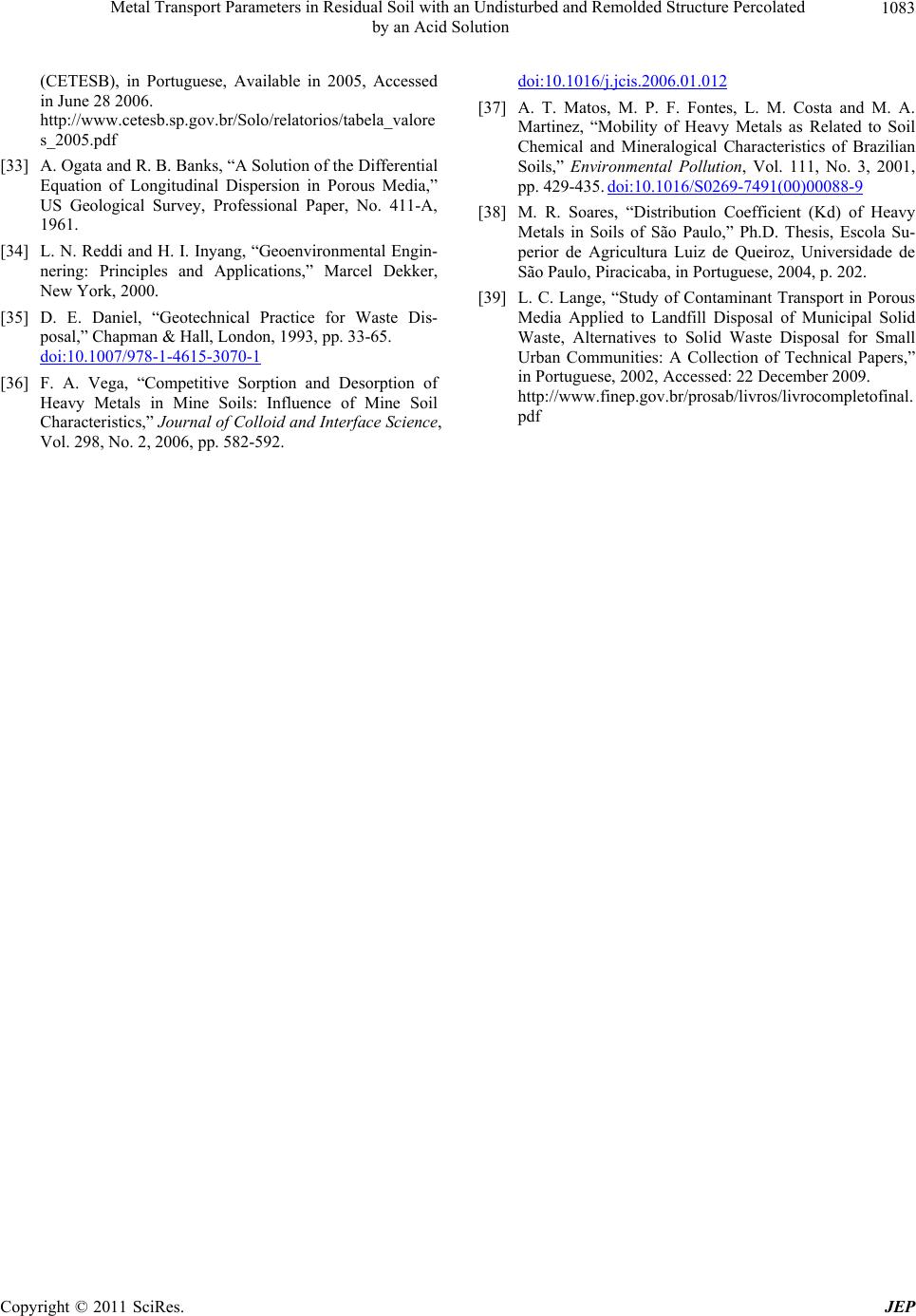 Metal Transport Parameters in Residual Soil with an Undisturbed and Remolded Structure Percolated by an Acid Solution Copyright © 2011 SciRes. JEP 1083 (CETESB), in Portuguese, Available in 2005, Accessed in June 28 2006. http://www.cetesb.sp.gov.br/Solo/relatorios/tabela_valore s_2005.pdf [33] A. Ogata and R. B. Banks, “A Solution of the Differential Equation of Longitudinal Dispersion in Porous Media,” US Geological Survey, Professional Paper, No. 411-A, 1961. [34] L. N. Reddi and H. I. Inyang, “Geoenvironmental Engin- nering: Principles and Applications,” Marcel Dekker, New York, 2000. [35] D. E. Daniel, “Geotechnical Practice for Waste Dis- posal,” Chapman & Hall, London, 1993, pp. 33-65. doi:10.1007/978-1-4615-3070-1 [36] F. A. Vega, “Competitive Sorption and Desorption of Heavy Metals in Mine Soils: Influence of Mine Soil Characteristics,” Journal of Colloid and Interface Science, Vol. 298, No. 2, 2006, pp. 582-592. doi:10.1016/j.jcis.2006.01.012 [37] A. T. Matos, M. P. F. Fontes, L. M. Costa and M. A. Martinez, “Mobility of Heavy Metals as Related to Soil Chemical and Mineralogical Characteristics of Brazilian Soils,” Environmental Pollution, Vol. 111, No. 3, 2001, pp. 429-435. doi:10.1016/S0269-7491(00)00088-9 [38] M. R. Soares, “Distribution Coefficient (Kd) of Heavy Metals in Soils of São Paulo,” Ph.D. Thesis, Escola Su- perior de Agricultura Luiz de Queiroz, Universidade de São Paulo, Piracicaba, in Portuguese, 2004, p. 202. [39] L. C. Lange, “Study of Contaminant Transport in Porous Media Applied to Landfill Disposal of Municipal Solid Waste, Alternatives to Solid Waste Disposal for Small Urban Communities: A Collection of Technical Papers,” in Portuguese, 2002, Accessed: 22 December 2009. http://www.finep.gov.br/prosab/livros/livrocompletofinal. pdf |