

Paper Menu >>
Journal Menu >>
 Journal of Environmental Protection, 2011, 2, 1069-1075 doi:10.4236/jep.2011.28123 Published Online October 2011 (http://www.scirp.org/journal/jep) Copyright © 2011 SciRes. JEP Carbon Storage in Agroecosystems: A Case Study of the Cocoa Based Agroforestry in Ogbese Forest Reserve, Ekiti State, Nigeria David Oke, Ayodeji Olatiilu Department of Forestry and Wood Technology, Federal University of Technology, Akure, Nigeria. Email: [email protected] Received June 8th, 2011; revised August 19th, 2011; accepted September 18th, 2011. ABSTRACT Large areas of the indigenous tro pical forests in the sou thwestern part of Nigeria a re being converted into agricultural lands and this has been repo rted to have serious implication s for biodiversity and the environmen t. Cocoa based agro- forestry is one of the common agricu ltural practices in this region and comparative information on the carbon storage capacity of the cocoa agroforests is generally lacking. In this study the above-ground carbon storage and partitioning in a protected primary forest were evaluated and compared with those of the two categories of cocoa agroforests (sparse and dense) identified in the area. Above-ground biomass accumulation and carbon stock varied significantly with land use type, with the primary rainforest having the highest values and sparse cocoa agroforests having the low- est. A reduction in above-ground carbon stock of 89.82% and 71.20% was observed 10 years after conversion of tropi- cal rainforest to sparse and dense cocoa agroforests respectively. Keywords: Carbon Sequestration, Cocoa, Agroforestry, Forest Conversion, Global Climate Change 1. Introduction Carbon dioxide (CO2) is one of the greenhouse gases and a primary agent of global warming. It constitutes 72% of the total anthropogenic greenhouse gases, causing be- tween 9% - 26% of the greenhouse effect [1]. Reference [2] reported that the amount of carbon dioxide in the atmosphere has increased from 280 ppm in the pre- industrial era (1750) to 379 ppm in 2005, and is increas- ing by 1.5 ppm per year. Dramatic rise of CO2 concen- tration is attributed largely to human activities. Over the last 20 years, majority of the emission is attributed to burning of fossil fuel, while 10% - 30% is attributed to land use change and deforest at i on [3] . Article 4 of the United Nations Framework Conven- tion on Climate Change (UNFCCC) requires preventing and minimizing climate change by “limiting anthropo- genic emissions of greenhouse and protecting and en- hancing greenhouse gas sinks and reservoirs” [4]. Forest ecosystem plays very important role in the global carbon cycle. It stores about 80% of all above-ground and 40% of all below-ground terrestrial organic carbon [3]. How- ever, the state of tropical forests has continued to dete- riorate. Reference [5] reported that the protection of existing forests, regeneration of degraded forests and raising of forest plantations have been contributing to enhanced carbon stock in India. However, the data available on carbon sequestration i.e. net woody biomass accumula- tion in trees for long term storage in tropical forests are extremely limited and incomplete. Thus, the improved quantification of carbon pools and fluxes in tropical for- est ecosystems is important for understanding the con- tribution of these forests to net carbon emissions and their potential for carbon sequestration [6]. Agroecosystems play a central role in the global car- bon cycle and contain approximately 12% of the world terrestrial carbon [7]. From the perspective of climate change and the global carbon cycle, agroforestry is at- tractive because the tree component has the capacity to fix and store carbon from the atmosphere for many years. The amount of carbon sequestered largely depends on the agroforestry system put in place, the structure and function of which are, to a great extent, determined by environmental and socio-economic factors. Other factors influencing carbon storage in agroforestry systems in- clude tree species and system management.  Carbon Storage in Agroecosystems: A Case Study of the Cocoa Based Agroforestry in Ogbese Forest Reserve, 1070 Ekiti State, Nigeria Cocoa agroforests are a common farming system in the humid zone of West and Central Africa, in which forest trees provide shade and other environmental ser- vices as well as marketable products [8]. Traditionally, small holder cocoa farmers establish their farms by re- moving the forest under-storey and thinning the forest canopy so that Coco a seedlings can grow into produ ctive trees, as for example in Cameroon [9]. Many authors [10-14] have described the physiological, environmental and economic values of shade trees in cocoa growing systems. They cited benefits such as shade to cocoa, soil fertility maintenance, biodiversity conservation, protec- tion against drought, bush fires and insect attacks as well as additional income through sales of timber species, fuel wood, and non-wood forest products. The trees in cocoa agroforests can store carbon in their shoots and roots, while performing the aforementioned roles thereby reducing the greenhouse effect. This study was carried out to assess and compare carbon storage in cocoa based agroforestry systems and a relatively un- touched rainforest in Ogbese Forest Reserve, Ekiti State, Nigeria. 2. Materials and Method 2.1. The Study Area The study was carried out in Ogbese Forest Reserve in Ekiti State, (Lat. 7˚31' and 7˚49'N and Lat. 5˚7' and 5˚27'E). The area lies entirely within the pre-Cambrian Basement Complex rock group which underlies much of Nigeria. The elevation reaches 600 m above the sea level and is situated entirely within the upper Ogbese basin. The area experiences a tropical climate with distinct wet and dry seasons. Th e rainy season lasts for 9 months annually between March and November while the dry season lasts for 3 months between December and Febru- ary. The annual mean total rainfall is 1367 mm; the av- erage number of the rainy days is 112 per annum [15]. Temperature is almost uniform throughout the year with very little deviation from the mean annual of 27˚C. The mean annual relative humidity varies between 50% and 95% and is high est in the rainy season months. 2.2. Sampling Ten-year-old cocoa farms established in, and around Ogbese Forest Reserve, Ekiti State were visited to select appropriate sites for this study. Based on the number of shade trees (non cocoa trees) per unit area, the farms were classified into dense and sparse mixtures. Four farms under each category were selected for detailed biomass measurement. Sample plots were also demar- cated within the natural forest whose canopy had not been disturbed by th e activity of a coco a farmer or wher e there is little or no evidence of timber extraction. One plot (25 m × 25 m in size) was located in each of the selected cocoa farms and four at random locations within the natural forest. 2.3. Biomass Estimation All cocoa trees in each plot were measured for stem di- ameter distribution. Two mean cocoa trees with dbh nearest to the mean dbh were located in each of the plots within cocoa farms and selected for destructive sampling after their heights, diameters at the base, at the middle and at the top have been measured and recorded. The biomass measurements were based on the biomass sub- sampling method outlined by [16]. The two mean cocoa trees were felled at the ground level. Each felled tree was sorted into the three main components; bole, branches and foliage and each component was cut into small pieces for easy weight measurement. Samples were taken to the laboratory for dry weight determination. As rec- ommended by [16], stem material removed in saw cuts were also considered as 0.5% of the stem biomass. Vo- lumes of the two (2) mean cocoa trees in each sample plot were calculated using the Newton’s formula by [17]. Diameter and height measurements of all the non co- coa trees in each plot were also taken and their volumes calculated using the Newton’s formula by [17]. However, due to the variety and size of non cocoa tree species en- countered and the difficulty in getting the cocoa farmers to allow felling of such shade trees because of the fear of massive destruction of non target cocoa trees that could accompany such an exercise, the above ground biomass of non cocoa trees in the plots was estimated indirectly from the volume data using the formula: Aboveground biomass = VOB × WD × BEF where: WD = volume-wei g ht ed average wood dens it y BEF = biomass expansion factor (ratio of aboveground oven-dry biomass of trees to the oven-dry biomass of inventoried volume). WD was estimated as described by [18]. The wood density values (Table 1) were obtained from [18]. The biomasses were added for each plot and expanded to biomass in tonnes per hectare. 2.4. Carbon Estimation The carbon concentration of different tree parts is rarely measured directly, but generally assumed to be 50% of dry weight [19]. Hence in this study, the aboveground carbon stock was calculated by assuming that the carbon content is 50% of the total aboveground biomass [5, C opyright © 2011 SciRes. JEP 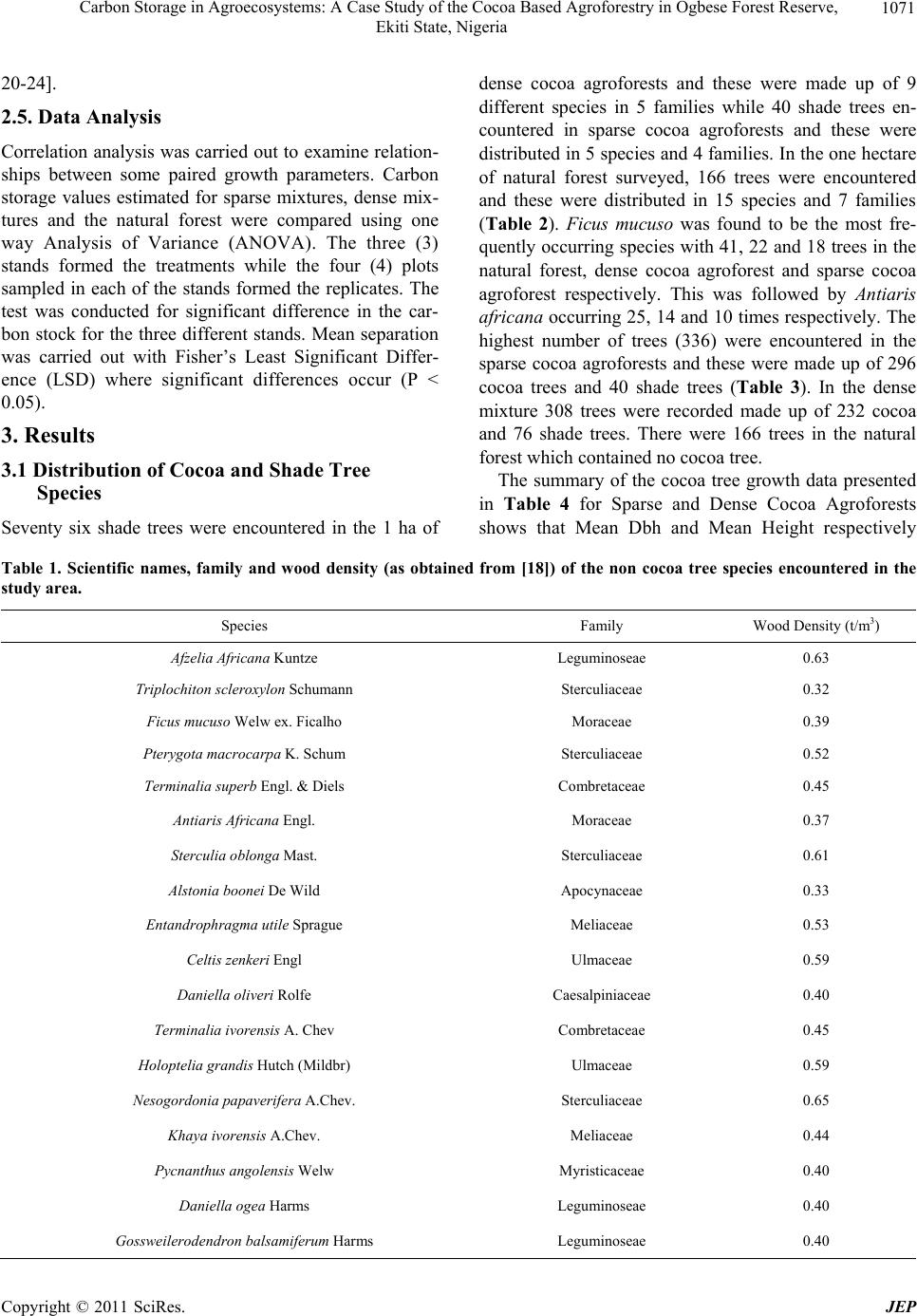 Carbon Storage in Agroecosystems: A Case Study of the Cocoa Based Agroforestry in Ogbese Forest Reserve, Ekiti State, Nigeria Copyright © 2011 SciRes. JEP 1071 20-24]. 2.5. Data Analysis Correlation analysis was carried ou t to examine relation- ships between some paired growth parameters. Carbon storage values estimated for sparse mixtures, dense mix- tures and the natural forest were compared using one way Analysis of Variance (ANOVA). The three (3) stands formed the treatments while the four (4) plots sampled in each of the stands formed the replicates. The test was conducted for significant difference in the car- bon stock for the three different stands. Mean separation was carried out with Fisher’s Least Significant Differ- ence (LSD) where significant differences occur (P < 0.05). 3. Results 3.1 Distribution of Cocoa and Shade Tree Species Seventy six shade trees were encountered in the 1 ha of dense cocoa agroforests and these were made up of 9 different species in 5 families while 40 shade trees en- countered in sparse cocoa agroforests and these were distributed in 5 species and 4 families. In the one hectare of natural forest surveyed, 166 trees were encountered and these were distributed in 15 species and 7 families (Table 2). Ficus mucuso was found to be the most fre- quently occurring species with 41, 22 and 18 trees in the natural forest, dense cocoa agroforest and sparse cocoa agroforest respectively. This was followed by Antiaris africana occurring 25, 14 and 10 times respectively. The highest number of trees (336) were encountered in the sparse cocoa agroforests and these were made up of 296 cocoa trees and 40 shade trees (Table 3). In the dense mixture 308 trees were recorded made up of 232 cocoa and 76 shade trees. There were 166 trees in the natural forest which contained no cocoa tree. The summary of the cocoa tree growth data presented in Table 4 for Sparse and Dense Cocoa Agroforests shows that Mean Dbh and Mean Height respectively Table 1. Scientific names, family and wood density (as obtained from [18]) of the non cocoa tree species encountered in the study area. Species Family Wood Density (t/m3) Afzelia Africana Kuntze Leguminoseae 0.63 Triplochiton scleroxylon Schumann Sterculiaceae 0.32 Ficus mucuso Welw ex. Ficalho Moraceae 0.39 Pterygota macrocarpa K. Schum Sterculiaceae 0.52 Terminalia superb Engl. & Diels Combretaceae 0.45 Antiaris Africana Engl. Moraceae 0.37 Sterculia oblonga Mast. Sterculiaceae 0.61 Alstonia boonei De Wild Apocynaceae 0.33 Entandrophragma utile Sprague Meliaceae 0.53 Celtis zenkeri Engl Ulmaceae 0.59 Daniella oliveri Rolfe Caesalpiniaceae 0.40 Terminalia ivorensis A. Chev Combretaceae 0.45 Holoptelia grandis Hutch (Mildbr) Ulmaceae 0.59 Nesogordonia papaverifera A.Chev. Sterculiaceae 0.65 Khaya ivorensis A.Chev. Meliaceae 0.44 Pycnanthus angolensis Welw Myristicaceae 0.40 Daniella ogea Harms Leguminoseae 0.40 Gossweilerodendron balsamiferum Harms Leguminoseae 0.40 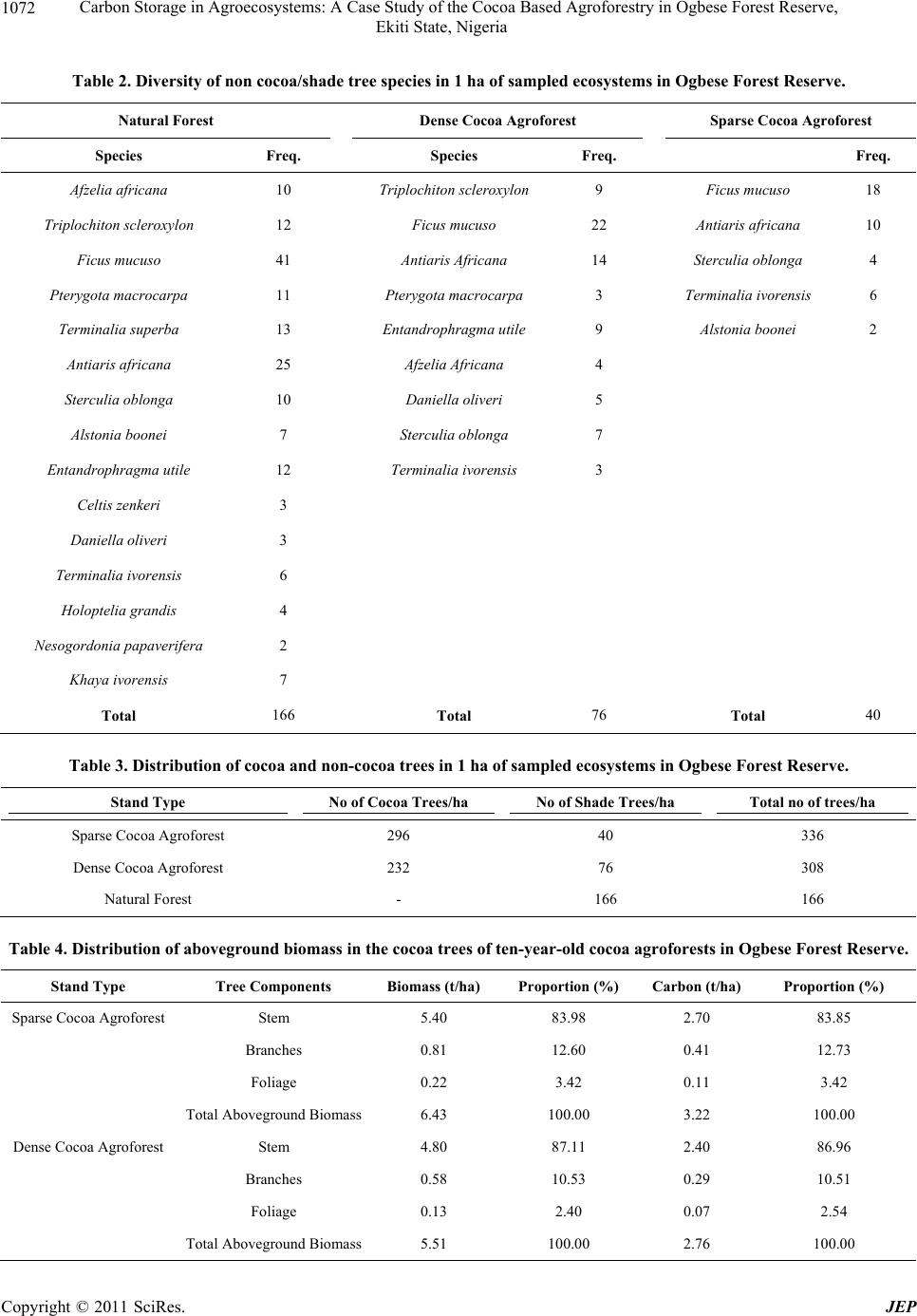 Carbon Storage in Agroecosystems: A Case Study of the Cocoa Based Agroforestry in Ogbese Forest Reserve, 1072 Ekiti State, Nigeria Table 2. Diversity of non cocoa/shade tree species in 1 ha of sampled ecosystems in Ogbese Forest Reserve. Natural Forest Dense Cocoa Agroforest Sparse Cocoa Agroforest Species Freq. Species Freq. Freq. Afzelia africana 10 Triplochiton scleroxylon 9 Ficus mucuso 18 Triplochiton scleroxylon 12 Ficus mucuso 22 Antiaris africana 10 Ficus mucuso 41 Antiaris Africana 14 Sterculia oblonga 4 Pterygota macrocarpa 11 Pterygota macrocarpa 3 Terminalia ivorensis 6 Terminalia superba 13 Entandrophragma utile 9 Alstonia boonei 2 Antiaris africana 25 Afzelia Africana 4 Sterculia oblonga 10 Daniella oliveri 5 Alstonia boonei 7 Sterculia oblonga 7 Entandrophragma utile 12 Terminalia ivorensis 3 Celtis zenkeri 3 Daniella oliveri 3 Terminalia ivorensis 6 Holoptelia grandis 4 Nesogordonia papaverifera 2 Khaya ivorensis 7 Total 166 Total 76 Total 40 Table 3. Distribution of cocoa and non-cocoa trees in 1 ha of sampled ecosystems in Ogbese Forest Reserve. Stand Type No of Cocoa Trees/ha No of Shade Trees/ha Total no of trees/ha Sparse Cocoa Agroforest 296 40 336 Dense Cocoa Agroforest 232 76 308 Natural Forest - 166 166 Table 4. Distribution of aboveground biomass in the c ocoa trees of ten-year-old co c o a agr oforests in Ogbese Forest Reserve. Stand Type Tree Components Biomass (t/ha) Proportion (%) Carbon (t/ha) Proportion (%) Sparse Cocoa Agroforest Stem 5.40 83.98 2.70 83.85 Branches 0.81 12.60 0.41 12.73 Foliage 0.22 3.42 0.11 3.42 Total Aboveground Biomass6.43 100.00 3.22 100.00 Dense Cocoa Agroforest Stem 4.80 87.11 2.40 86.96 Branches 0.58 10.53 0.29 10.51 Foliage 0.13 2.40 0.07 2.54 Total Aboveground Biomass5.51 100.00 2.76 100.00 C opyright © 2011 SciRes. JEP 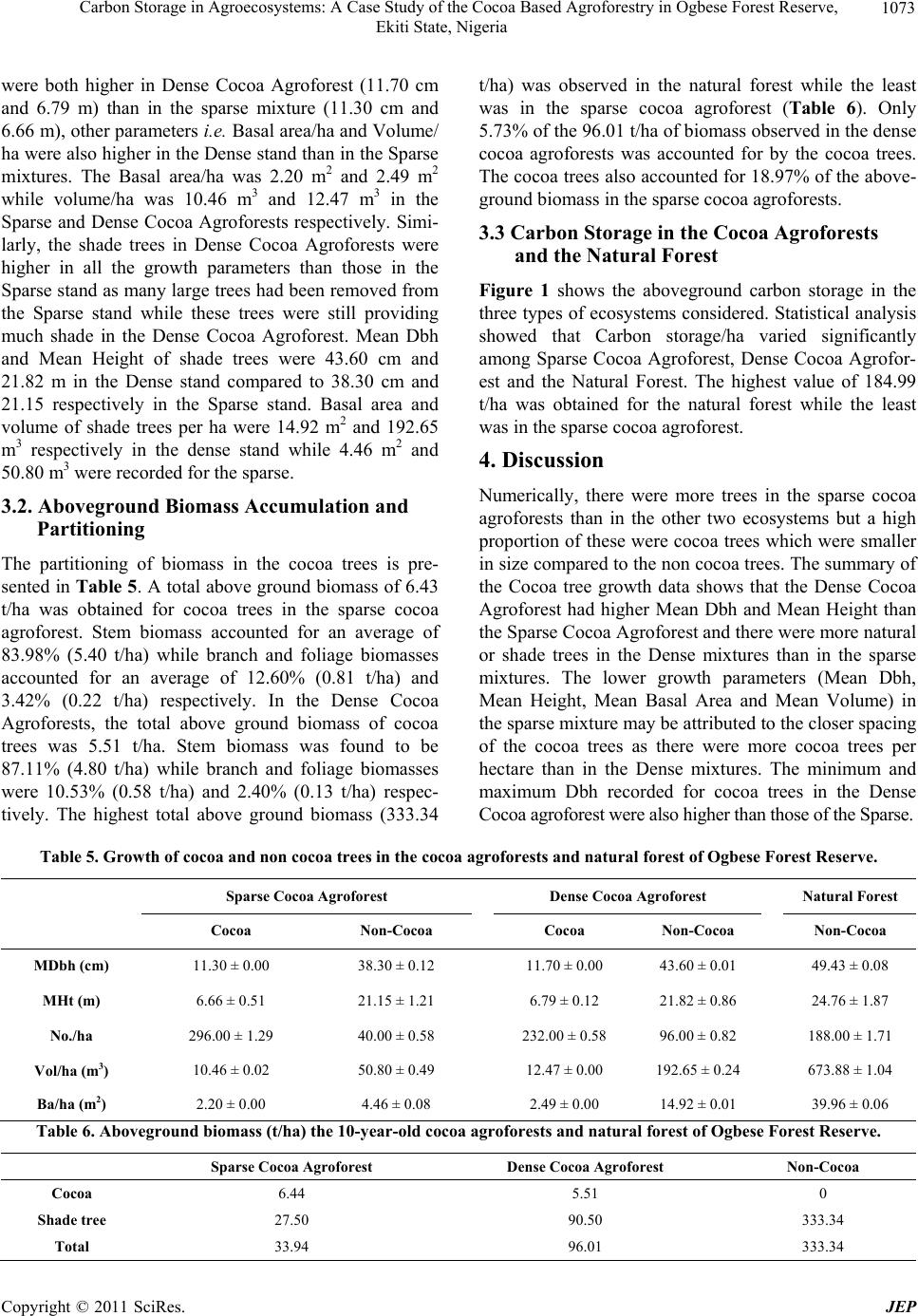 Carbon Storage in Agroecosystems: A Case Study of the Cocoa Based Agroforestry in Ogbese Forest Reserve, Ekiti State, Nigeria Copyright © 2011 SciRes. JEP 1073 were both higher in Dense Cocoa Agroforest (11.70 cm and 6.79 m) than in the sparse mixture (11.30 cm and 6.66 m), other parameters i.e. Basal area/ha and Volume/ ha were also higher in the Dense stand th an in the Sparse mixtures. The Basal area/ha was 2.20 m2 and 2.49 m2 while volume/ha was 10.46 m3 and 12.47 m3 in the Sparse and Dense Cocoa Agroforests resp ectively. Simi- larly, the shade trees in Dense Cocoa Agroforests were higher in all the growth parameters than those in the Sparse stand as many large trees had been removed from the Sparse stand while these trees were still providing much shade in the Dense Cocoa Agroforest. Mean Dbh and Mean Height of shade trees were 43.60 cm and 21.82 m in the Dense stand compared to 38.30 cm and 21.15 respectively in the Sparse stand. Basal area and volume of shade trees per ha were 14.92 m2 and 192.65 m3 respectively in the dense stand while 4.46 m2 and 50.80 m3 were recorded for the sparse. 3.2. Aboveground Biomass Accumulation and Partitioning The partitioning of biomass in the cocoa trees is pre- sented in Table 5. A total abo ve ground biomass of 6.43 t/ha was obtained for cocoa trees in the sparse cocoa agroforest. Stem biomass accounted for an average of 83.98% (5.40 t/ha) while branch and foliage biomasses accounted for an average of 12.60% (0.81 t/ha) and 3.42% (0.22 t/ha) respectively. In the Dense Cocoa Agroforests, the total above ground biomass of cocoa trees was 5.51 t/ha. Stem biomass was found to be 87.11% (4.80 t/ha) while branch and foliage biomasses were 10.53% (0.58 t/ha) and 2.40% (0.13 t/ha) respec- tively. The highest total above ground biomass (333.34 t/ha) was observed in the natural forest while the least was in the sparse cocoa agroforest (Table 6). Only 5.73% of the 96.01 t/ha of biomass observed in the dense cocoa agroforests was accounted for by the cocoa trees. The cocoa trees also accounted for 18.97% of the above- ground biomass in the sparse cocoa agroforests. 3.3 Carbon Storage in the Cocoa Agroforests and the Natural Forest Figure 1 shows the aboveground carbon storage in the three types of ecosystems considered. Statistical analysis showed that Carbon storage/ha varied significantly among Sparse Cocoa Agroforest, Dense Cocoa Agrofor- est and the Natural Forest. The highest value of 184.99 t/ha was obtained for the natural forest while the least was in the sparse cocoa agrofore st. 4. Discussion Numerically, there were more trees in the sparse cocoa agroforests than in the other two ecosystems but a high proportion of these were cocoa trees which were smaller in size compared to the non cocoa trees. The summary of the Cocoa tree growth data shows that the Dense Cocoa Agroforest had higher Mean Dbh and Mean Height than the Sparse Cocoa Agroforest and there were more natural or shade trees in the Dense mixtures than in the sparse mixtures. The lower growth parameters (Mean Dbh, Mean Height, Mean Basal Area and Mean Volume) in the sparse mixture may be attributed to the closer spacing of the cocoa trees as there were more cocoa trees per hectare than in the Dense mixtures. The minimum and maximum Dbh recorded for cocoa trees in the Dense Cocoa agroforest were also higher than those of the Sparse. Table 5. Growth of cocoa and non cocoa trees in the cocoa agroforests and natural forest of Ogbese Forest Reserve. Sparse Cocoa Agroforest De nse Cocoa Agroforest Natural Forest Cocoa Non-Cocoa Cocoa Non-Cocoa Non-Cocoa MDbh (cm) 11.30 ± 0.00 38.30 ± 0.12 11.70 ± 0.00 43.60 ± 0.01 49.43 ± 0.08 MHt (m) 6.66 ± 0.51 21.15 ± 1.21 6.79 ± 0.12 21.82 ± 0.86 24.76 ± 1.87 No./ha 296.00 ± 1.29 40.00 ± 0.58 232.00 ± 0.58 96.00 ± 0.82 188.00 ± 1.71 Vol/ha (m3) 10.46 ± 0.02 50.80 ± 0.49 12.47 ± 0.00 192.65 ± 0.24 673.88 ± 1.04 Ba/ha (m2) 2.20 ± 0.00 4.46 ± 0.08 2.49 ± 0.00 14.92 ± 0.01 39.96 ± 0.06 Table 6. Aboveground biomass (t/ha) the 10-year-old c ocoa agrofore sts and natur al fore st of Ogbese F ore st Reser ve. Sparse Cocoa Agroforest Dense Cocoa Agroforest Non-Cocoa Cocoa 6.44 5.51 0 Shade tree 27.50 90.50 333.34 Total 33.94 96.01 333.34 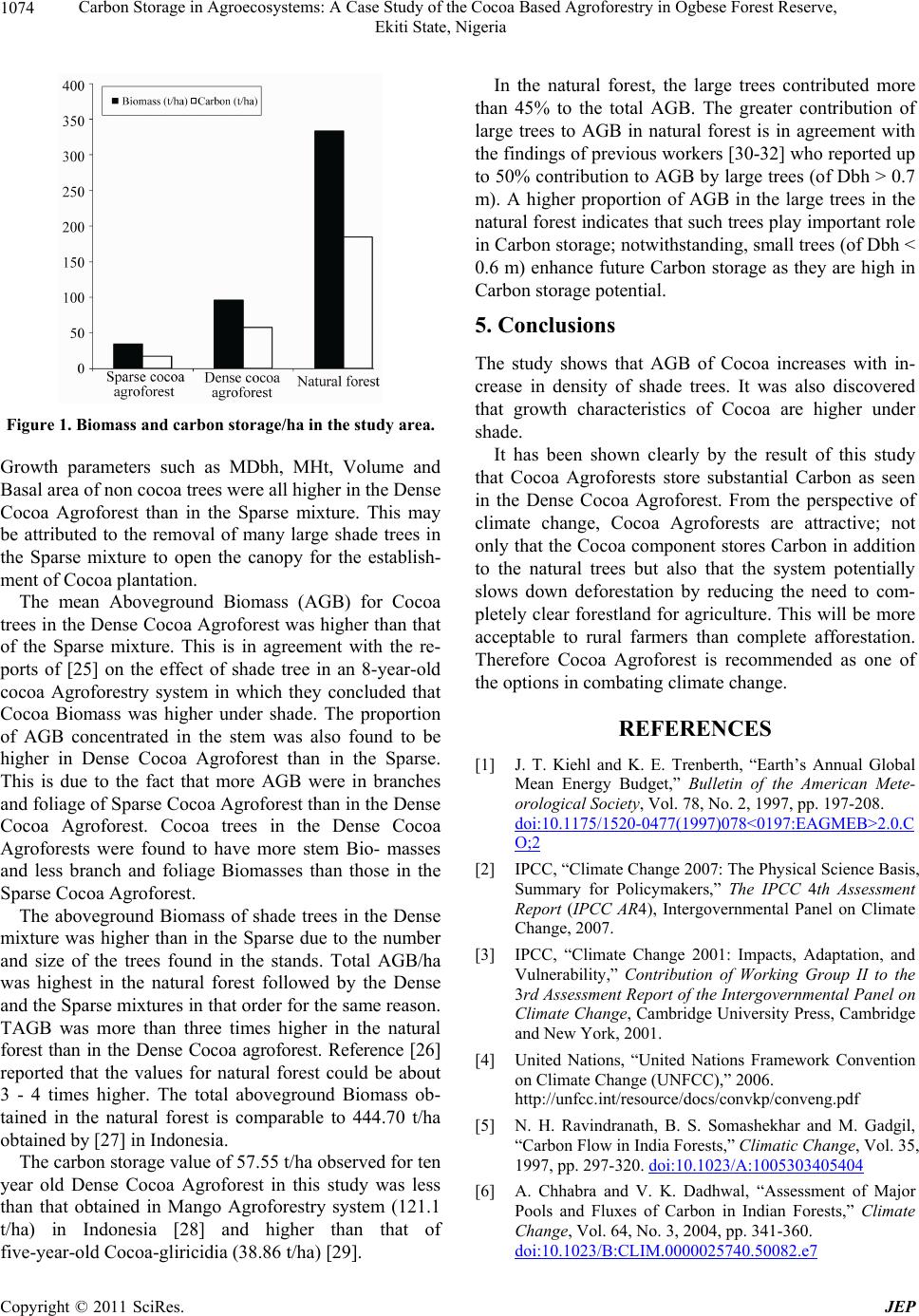 Carbon Storage in Agroecosystems: A Case Study of the Cocoa Based Agroforestry in Ogbese Forest Reserve, 1074 Ekiti State, Nigeria Figure 1. Biomass and carbon storage/ha in the study area. Growth parameters such as MDbh, MHt, Volume and Basal area of non cocoa trees were all higher in the Dense Cocoa Agroforest than in the Sparse mixture. This may be attributed to the removal of many large shade trees in the Sparse mixture to open the canopy for the establish- ment of Cocoa plantation. The mean Aboveground Biomass (AGB) for Cocoa trees in the Dense Cocoa Agroforest was higher than that of the Sparse mixture. This is in agreement with the re- ports of [25] on the effect of shade tree in an 8-year-old cocoa Agroforestry system in which they concluded that Cocoa Biomass was higher under shade. The proportion of AGB concentrated in the stem was also found to be higher in Dense Cocoa Agroforest than in the Sparse. This is due to the fact that more AGB were in branches and foliag e of Sp arse Coco a Agr ofo re st th an in the Den se Cocoa Agroforest. Cocoa trees in the Dense Cocoa Agroforests were found to have more stem Bio- masses and less branch and foliage Biomasses than those in the Sparse Cocoa Agroforest. The aboveground Biomass of shade trees in the Dense mixture was higher than in the Sparse due to the number and size of the trees found in the stands. Total AGB/ha was highest in the natural forest followed by the Dense and the Sparse mixtures in that order for the same reason. TAGB was more than three times higher in the natural forest than in the Dense Cocoa agroforest. Reference [26] reported that the values for natural forest could be about 3 - 4 times higher. The total aboveground Biomass ob- tained in the natural forest is comparable to 444.70 t/ha obtained by [ 2 7] in Indonesia. The carbon storage va lue of 57.5 5 t/h a observ ed for ten year old Dense Cocoa Agroforest in this study was less than that obtained in Mango Agroforestry system (121.1 t/ha) in Indonesia [28] and higher than that of five-year-old Cocoa-gliricidia (38.86 t/ha) [29]. In the natural forest, the large trees contributed more than 45% to the total AGB. The greater contribution of large trees to AGB in natural forest is in agreement with the findings of previous workers [30-32] who reported up to 50% contribution to AGB by large trees (of Dbh > 0.7 m). A higher proportion of AGB in the large trees in the natural forest indicates that such trees play important role in Carbon storage; no twithstand ing, small trees (of Dbh < 0.6 m) enhance future Carbon storage as they are high in Carbon storage potential. 5. Conclusions The study shows that AGB of Cocoa increases with in- crease in density of shade trees. It was also discovered that growth characteristics of Cocoa are higher under shade. It has been shown clearly by the result of this study that Cocoa Agroforests store substantial Carbon as seen in the Dense Cocoa Agroforest. From the perspective of climate change, Cocoa Agroforests are attractive; not only that the Cocoa component stores Carbon in addition to the natural trees but also that the system potentially slows down deforestation by reducing the need to com- pletely clear forestland for agriculture. This will be more acceptable to rural farmers than complete afforestation. Therefore Cocoa Agroforest is recommended as one of the options in combating climate change. REFERENCES [1] J. T. Kiehl and K. E. Trenberth, “Earth’s Annual Global Mean Energy Budget,” Bulletin of the American Mete- orological Society, Vol. 78, No. 2, 1997, pp. 197-208. doi:10.1175/1520-0477(1997)078<0197:EAGMEB>2.0.C O;2 [2] IPCC, “Climate Change 2007: The Physical Science Basis, Summary for Policymakers,” The IPCC 4th Assessment Report (IPCC AR4), Intergovernmental Panel on Climate Change, 2007. [3] IPCC, “Climate Change 2001: Impacts, Adaptation, and Vulnerability,” Contribution of Working Group II to the 3rd Assessment Report of the Intergovernmental Panel on Climate Change, Cambridge University Pre ss, Cambridge and New York, 2001. [4] United Nations, “United Nations Framework Convention on Climate Change (UNFCC),” 2006. http://unfcc.int/resource/docs/convkp/conveng.pdf [5] N. H. Ravindranath, B. S. Somashekhar and M. Gadgil, “Carbon Flow in India Forests,” Climatic Change, Vol. 35, 1997, pp. 297-320. doi:10.1023/A:1005303405404 [6] A. Chhabra and V. K. Dadhwal, “Assessment of Major Pools and Fluxes of Carbon in Indian Forests,” Climate Change, Vol. 64, No. 3, 2004, pp. 341-360. doi:10.1023/B:CLIM.0000025740.50082.e7 C opyright © 2011 SciRes. JEP 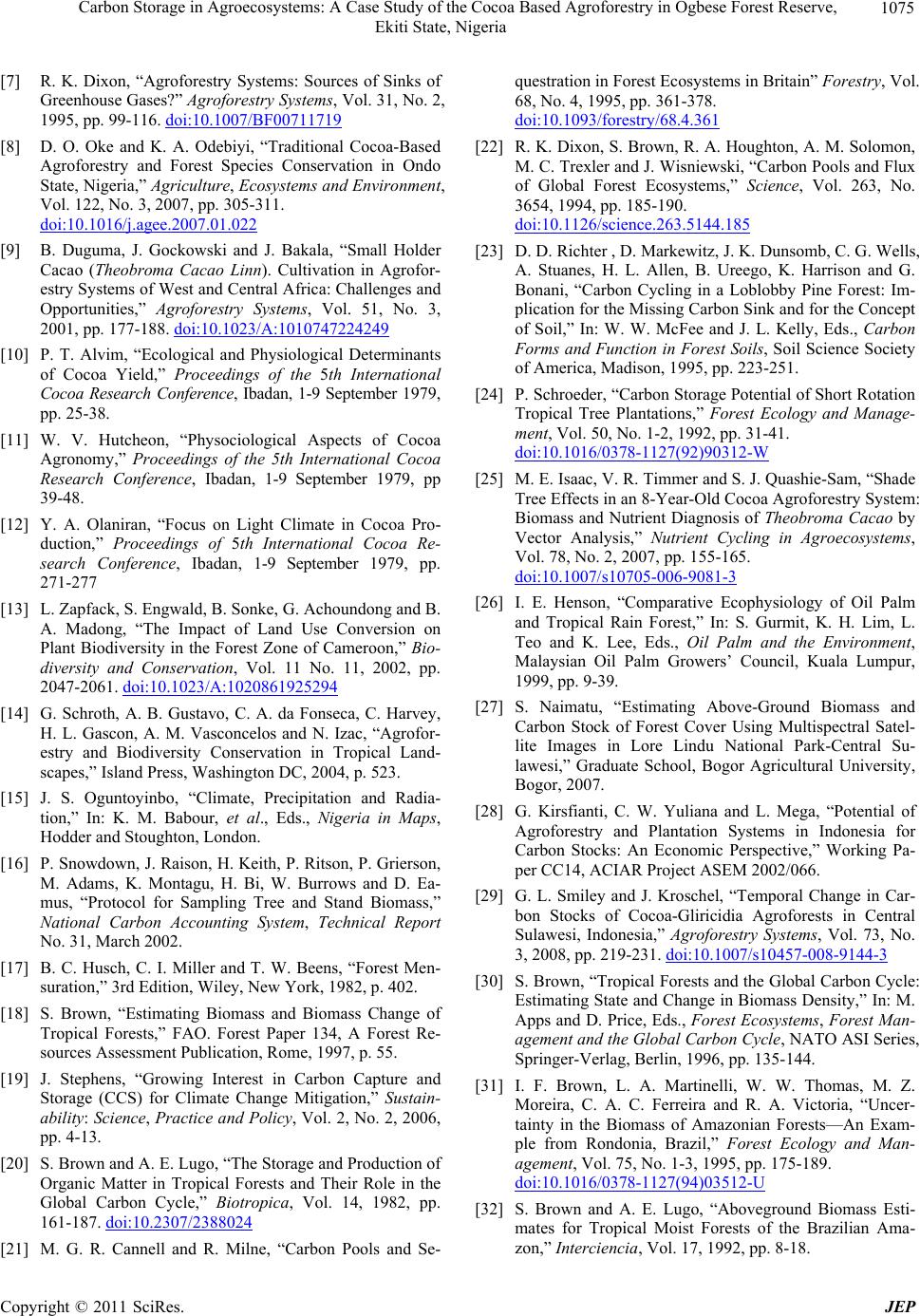 Carbon Storage in Agroecosystems: A Case Study of the Cocoa Based Agroforestry in Ogbese Forest Reserve, 1075 Ekiti State, Nigeria [7] R. K. Dixon, “Agroforestry Systems: Sources of Sinks of Greenhouse Gases?” Agroforestry Systems, Vol. 31, No. 2, 1995, pp. 99-116. doi:10.1007/BF00711719 [8] D. O. Oke and K. A. Odebiyi, “Traditional Cocoa-Based Agroforestry and Forest Species Conservation in Ondo State, Nigeria,” Agriculture, Ecosystems and Environment, Vol. 122, No. 3, 2007, pp. 305-311. doi:10.1016/j.agee.2007.01.022 [9] B. Duguma, J. Gockowski and J. Bakala, “Small Holder Cacao (Theobroma Cacao Linn). Cultivation in Agrofor- estry Systems of West and Central Africa: Challenges and Opportunities,” Agroforestry Systems, Vol. 51, No. 3, 2001, pp. 177-188. doi:10.1023/A:1010747224249 [10] P. T. Alvim, “Ecological and Physiological Determinants of Cocoa Yield,” Proceedings of the 5th International Cocoa Research Conference, Ibadan, 1-9 September 1979, pp. 25-38. [11] W. V. Hutcheon, “Physociological Aspects of Cocoa Agronomy,” Proceedings of the 5th International Cocoa Research Conference, Ibadan, 1-9 September 1979, pp 39-48. [12] Y. A. Olaniran, “Focus on Light Climate in Cocoa Pro- duction,” Proceedings of 5th International Cocoa Re- search Conference, Ibadan, 1-9 September 1979, pp. 271-277 [13] L. Zapfack, S. Engwald, B. Sonke, G. Achoundong and B. A. Madong, “The Impact of Land Use Conversion on Plant Biodiversity in the Forest Zone of Cameroon,” Bio- diversity and Conservation, Vol. 11 No. 11, 2002, pp. 2047-2061. doi:10.1023/A:1020861925294 [14] G. Schroth, A. B. Gustavo, C. A. da Fonseca, C. Harvey, H. L. Gascon, A. M. Vasconcelos and N. Izac, “Agrofor- estry and Biodiversity Conservation in Tropical Land- scapes,” Island Press, Washington DC, 2004, p. 523. [15] J. S. Oguntoyinbo, “Climate, Precipitation and Radia- tion,” In: K. M. Babour, et al., Eds., Nigeria in Maps, Hodder and Stoughton, London. [16] P. Snowdown, J. Raison, H. Keith, P. Ritson, P. Grierson, M. Adams, K. Montagu, H. Bi, W. Burrows and D. Ea- mus, “Protocol for Sampling Tree and Stand Biomass,” National Carbon Accounting System, Technical Report No. 31, March 2002. [17] B. C. Husch, C. I. Miller and T. W. Beens, “Forest Men- suration,” 3rd Edition, Wiley, New York, 1982, p. 402. [18] S. Brown, “Estimating Biomass and Biomass Change of Tropical Forests,” FAO. Forest Paper 134, A Forest Re- sources Assessment Publication, Rome, 1997, p. 55. [19] J. Stephens, “Growing Interest in Carbon Capture and Storage (CCS) for Climate Change Mitigation,” Sustain- ability: Science , Practice and Policy, Vol. 2, No. 2, 2006, pp. 4-13. [20] S. Brown and A. E. Lugo, “The Storage and Production of Organic Matter in Tropical Forests and Their Role in the Global Carbon Cycle,” Biotropica, Vol. 14, 1982, pp. 161-187. doi:10.2307/2388024 [21] M. G. R. Cannell and R. Milne, “Carbon Pools and Se- questration in Forest Ecosystems in Brita i n” Forestry, Vol. 68, No. 4, 1995, pp. 361-378. doi:10.1093/forestry/68.4.361 [22] R. K. Dixon, S. Brown, R. A. Houghton, A. M. Solomon, M. C. Trexler and J. Wisniewski, “Carbon Pools and Flux of Global Forest Ecosystems,” Science, Vol. 263, No. 3654, 1994, pp. 185-190. doi:10.1126/science.263.5144.185 [23] D. D. Richter , D. Markewitz, J. K. Dunsomb, C. G. Wells, A. Stuanes, H. L. Allen, B. Ureego, K. Harrison and G. Bonani, “Carbon Cycling in a Loblobby Pine Forest: Im- plication for the Missing Carbon Sink and for the Concept of Soil,” In: W. W. McFee and J. L. Kelly, Eds., Carbon Forms and Function in Forest Soils, Soil Science Society of America, Madison, 1995, pp. 223-251. [24] P. Schroeder, “Carbon Storage Potential of Short Rotation Tropical Tree Plantations,” Forest Ecology and Manage- ment, Vol. 50, No. 1-2, 1992, pp. 31-41. doi:10.1016/0378-1127(92)90312-W [25] M. E. Isaac, V. R. Timmer and S. J. Quashie-Sam, “Shade Tree Effects in an 8-Year-Old Cocoa Agroforestry System: Biomass and Nutrient Diagnosis of Theobroma Cacao by Vector Analysis,” Nutrient Cycling in Agroecosystems, Vol. 78, No. 2, 2007, pp. 155-165. doi:10.1007/s10705-006-9081-3 [26] I. E. Henson, “Comparative Ecophysiology of Oil Palm and Tropical Rain Forest,” In: S. Gurmit, K. H. Lim, L. Teo and K. Lee, Eds., Oil Palm and the Environment, Malaysian Oil Palm Growers’ Council, Kuala Lumpur, 1999, pp. 9-39. [27] S. Naimatu, “Estimating Above-Ground Biomass and Carbon Stock of Forest Cover Using Multispectral Satel- lite Images in Lore Lindu National Park-Central Su- lawesi,” Graduate School, Bogor Agricultural University, Bogor, 2007. [28] G. Kirsfianti, C. W. Yuliana and L. Mega, “Potential of Agroforestry and Plantation Systems in Indonesia for Carbon Stocks: An Economic Perspective,” Working Pa- per CC14, ACIAR Project ASEM 2002/066. [29] G. L. Smiley and J. Kroschel, “Temporal Change in Car- bon Stocks of Cocoa-Gliricidia Agroforests in Central Sulawesi, Indonesia,” Agroforestry Systems, Vol. 73, No. 3, 2008, pp. 219-231. doi:10.1007/s10457-008-9144-3 [30] S. Brown, “Tropical Forests and the Global Carbon Cycle: Estimating State and Change in Biomass Density,” In: M. Apps and D. Price, Eds., Forest Ecosystems, Forest Man- agement and the Global Carbon Cycle, NATO ASI Series, Springer-Verlag, Berlin, 1996, pp. 135-144. [31] I. F. Brown, L. A. Martinelli, W. W. Thomas, M. Z. Moreira, C. A. C. Ferreira and R. A. Victoria, “Uncer- tainty in the Biomass of Amazonian Forests—An Exam- ple from Rondonia, Brazil,” Forest Ecology and Man- agement, Vol. 75, No. 1-3, 1995, pp. 175-189. doi:10.1016/0378-1127(94)03512-U [32] S. Brown and A. E. Lugo, “Aboveground Biomass Esti- mates for Tropical Moist Forests of the Brazilian Ama- zon,” Interciencia, Vol. 17, 1992, pp. 8-18. Copyright © 2011 SciRes. JEP |