

Paper Menu >>
Journal Menu >>
 Journal of Environmental Protection, 2011, 2, 1021-1031 doi:10.4236/jep.2011.28117 Published Online October 2011 (http://www.scirp.org/journal/jep) Copyright © 2011 SciRes. JEP Determination of the Significance of Environmental Impacts of Development Projects: A Case Study of Environmental Impact Assessment of Indrawati-3 Hydropower Project in Nepal Ram B. Khadka1, Ajay Mathema1, Uttam Sagar Shrestha2 1School of Environmental Science and Management, Pokhara University, Nepal; 2Departments of Geography, Tribhuvan University, Kathmandu, Nepal. Email: [email protected], [email protected] Received May 28th, 2011; revised July 7th, 2011; accepted August 26th, 2011. ABSTRACT The environmental impacts are commonly quantified in the EIA studies by rating, ranking and scaling. The National EIA Guidelines , 1993, Nep al provides a guid eline to score th e impacts in terms of magnitud e, extent, and duration . Th is step is commonly known as impa ct prediction in the EIA process. The predicted scores are multiplied b y the weightage value of the resource likely to be affected. The application of the weightage transforms the predicted values of the im- pacts into their “significanc e”—a concept used in the environmental decision making. In other words the significance value entails assignment of relative judgment values to the impacts. The impacts, thus, can be ranked based on their significance. The impact ranking is more useful in evaluating the socio-economic impacts. Unlike air, water and noise quality, which can be assessed against established standards; the socio-economic impacts do not have standard scale and are difficult to ra nk. Importance weighting of socio-economic impacts are commonly determined by the consensus obtained fro m the interaction with th e local people, agencies, NGOs and experts. The impact ranking in the EIA process is unavoidable, firstly to prioritize the urgent environmental issues and design mitigation measures accordingly and also provide coherent linkages among the issues, and plan monitoring and auditing linkage with the proposed mitiga- tion measures. Furthermore, it also provides strong basis for decision making, and thus facilitates the decision ma kers. The process of impact predictio n, determination of sign ificance and ranking were applied in the EIA of Indrwati-3 Hy- droelectric Project, which is one of the successful cases of EIA in Nepal. The authors believe that the impacts predicted and quantified through this method are focused on the local concerns since it seeks an active involvement of the local people who are likely to be affected. Keywords: Environmental Impact Assessment, Environmental Significance, Ranking, Prediction of Impacts, Importance Weighting, Judgment Values 1. Introduction Environmental Significance is an anthropogenic concept [1] used in decision making of the Environmental As- sessment process. This concept remains undefined and has become a source of controversy among the EA pro- fessionals. Evaluation of the environmental significance requires expert judgment values and scientific criteria [2]. However, EIA legislation of developed and developing countries has catagorically mentioned that the law is en- forcable only if the impact is environmentally significant. The legal definition of environmentally significant in terms of thresholds is usually not available [1]. Duinker and Beanlands [3], Huge et al. [4], Sadler (1996), Gilpin [5] and Thompson [2] have proposed various definition of environmental significance and the common elements of their definitions are following [1]. Environmental significance is a judgment, The degree of environmental significance depends upon the nature of the impacts (type, magnitude, ex- tent and duration), The importance is based on biophysical and socio- economic values, and the amount of changes to the environment perceived to be acceptable to the com-  Determination of the Significance of Environmental Impacts of Development Projects: A Case Study of Environmental Impact Assessment of Indrawati-3 Hydropower Project in Nepal 1022 munity. Determination of the significan ce entails the assign ment of relative judgment values of impact prediction associated with the project and to determine the priority order in which the impacts are to be avoided, mitigated or com- pensated [6]. Evaluation of the significance of the pre- dicted impacts can be made in different ways depending on particular environmental component in question. For example air, water and noise quality can be assessed against the established quality standards whereas changes in socio- economic conditions are more difficult to ev aluate [1]. The major elements of assessing the significant impacts have been described for ecological and socio-economic components and the assessment is mostly based on sub- jective evaluation and includes the following [3]: 1) Ecological Component: This includes the criteria related to ecology and environmental parameters criti- cal to the operation of valued ecosystem such as Plant and animal hab itats, Rare, endangered and threatened species of biodiver- sity, Ecosystem resilience, biodiversity and carrying ca- pacity, and The viability of local species. 2) Social and Economical Components: Effects on biophysical impacts when translated into human con- cerns; the following effects are to be considered: Effect on human health and safety, Loss of commercially productive lands, Loss of public resources such as social services, Loss of transportation and other infrastructures, and Demography. 3) Environmental Standards: The use of national standards enshrined into legislation/rules of the govern- ment/agencies are the most common means to assess the environmental significance. In most nations, standards/ criteria for air/water/noise are available fo r r e f erence [6]. While evaluating the impact significance, the current status of the environment is analyzed. This is followed by identification and prediction of potential impacts of the proposed action. In the third stage, it is determined whether the receiving environment will be able to absorb the effects of the predicted impacts without suffering irreversible change. This requires thorough understand- ing of their resilience of receiving environment. It is also required to evaluate whether the proposed proposal is within the scope of national policy and covered by the existing legislation and regulation and lastly the degree of public interest [7]. 2. Procedures for Determination of Significance Rau and Wooten [8] and Canter [9] have provided some practical tools in evaluating environmental significance of development projects. According to them, the effects should be predicted in terms of magnitude, extent and duration. For the prediction, a number of ways have been pro- posed such as symbolic signs, numerical values, (+) for positive and (–) for negative effects, etc. However, the most convenient way is to develop impact ranking framework as proposed by Canadian Federal Environ- mental Assessment Review [10]. National Environ- mental Impact Assessment Guidelines. Nepal has also adopted similar impact ranking method and applied suc- cessfully in number of cases [11]. The impacts are pre- dicted and classified in terms of: Magnitude: It is determined based on severity of im- pact. In case of high magnitude, the situation turns to be irreversible. Medium and low magnitude is thus consi- dered to be reversible and acceptable by the public. The spatial extent: This is another characteristic of the impact and indicates the zone of influence. The ef- fects of the impacts may be of local or national or re- gional or international scopes. Duration of impact: This is the temporal aspects of impacts, indicating how long the effects can last. Based on the prediction made on the above characteristics of the impacts, the following numerical values are assigned to each of the character and the degree on which they are likely to occur [11] (Table 1). Each impact is predicted with its magnitude, extent and duration and respective sco res. The to tal scores of all three parameters are o ft e n computed. Importance weighting schemes are the most structured approach to impact scaling and permit direct transforma- tion of impact ranking into impact significance. In order to determine the appropriate weightings of the resource expected to be affected, a procedure should be followed. While assigning values for resources the EIA study group, professionals, stakeholders, academicians, and know- ledgeable people from the project area should be in- volved in the series of meetings and discussions. An in- teraction table is usually prepared where resources an- ticipated to be affected should be listed on the vertical column and the importance weighting should be marked in the horizontal column with the degree of importance from 1 to 3 where 1 indicates the least importance and 3 indicates the highest importance. Request should be made to the participants to fill out the table based on their own perceptions. The numerical values of the col- umn are then summed up and individual value in the column is divided by the total value. This gives relative weighting of each resource to be considered [8]. The total score of magnitude, extent and duration is C opyright © 2011 SciRes. JEP 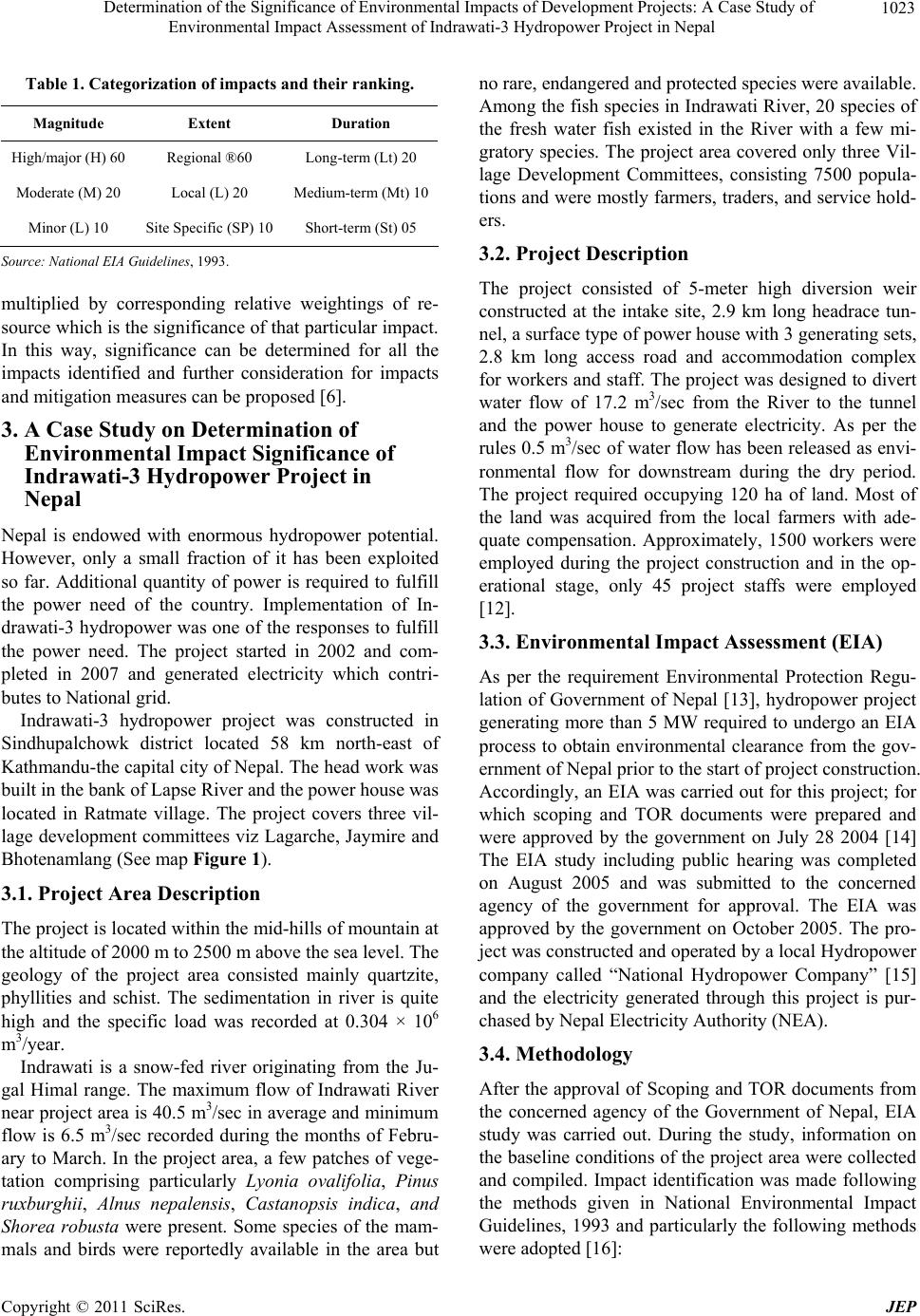 Determination of the Significance of Environmental Impacts of Development Projects: A Case Study of Environmental Impact Assessment of Indrawati-3 Hydropower Project in Nepal 1023 Table 1. Categorization of impacts and their ranking. Magnitude Extent Duration High/major ( H ) 60 Regional ®60 Long-term (L t) 20 Moderate (M) 20 Local (L) 20 Medium-term (Mt) 10 Minor (L) 10 Site Specific (SP) 10 Short-term (St) 05 Source: National EIA Guidelines, 1993. multiplied by corresponding relative weightings of re- source which is the significance of that particular impact. In this way, significance can be determined for all the impacts identified and further consideration for impacts and mitigation measures can be proposed [6]. 3. A Case Study on Determination of Environmental Impact Significance of Indrawati-3 Hydropower Project in Nepal Nepal is endowed with enormous hydropower potential. However, only a small fraction of it has been exploited so far. Additional quantity of power is required to fulfill the power need of the country. Implementation of In- drawati-3 hydropower was one of the responses to fulfill the power need. The project started in 2002 and com- pleted in 2007 and generated electricity which contri- butes to National grid. Indrawati-3 hydropower project was constructed in Sindhupalchowk district located 58 km north-east of Kathmandu-the capital city of Nep al. Th e head work was built in the bank of Laps e River and the power house was located in Ratmate village. The project covers three vil- lage development committees viz Lagarche, Jaymire and Bhotenamlang (See map Figure 1). 3.1. Project Area Description The project is located within the mid-hills of mountain at the altitude of 2000 m to 2500 m above the sea level. The geology of the project area consisted mainly quartzite, phyllities and schist. The sedimentation in river is quite high and the specific load was recorded at 0.304 × 10⁶ m3/year. Indrawati is a snow-fed river originating from the Ju- gal Himal range. The maximum flow of Indrawati River near project area is 40.5 m3/sec in average and minimum flow is 6.5 m3/sec recorded during the months of Febru- ary to March. In the project area, a few patches of vege- tation comprising particularly Lyonia ovalifolia, Pinus ruxburghii, Alnus nepalensis, Castanopsis indica, and Shorea robusta were present. Some species of the mam- mals and birds were reportedly available in the area but no rare, endangered and protected species were available. Among the fish species in Indrawati River, 20 species of the fresh water fish existed in the River with a few mi- gratory species. The project area covered only three Vil- lage Development Committees, consisting 7500 popula- tions and were mostly farmers, traders, and service hold- ers. 3.2. Project Description The project consisted of 5-meter high diversion weir constructed at the intake site, 2.9 km long headrace tun- nel, a surface type of power house with 3 generating sets, 2.8 km long access road and accommodation complex for workers and staff. The project was designed to divert water flow of 17.2 m3/sec from the River to the tunnel and the power house to generate electricity. As per the rules 0.5 m3/sec of water flow has been released as envi- ronmental flow for downstream during the dry period. The project required occupying 120 ha of land. Most of the land was acquired from the local farmers with ade- quate compensation. Approximately, 1500 workers were employed during the project construction and in the op- erational stage, only 45 project staffs were employed [12]. 3.3. Environmental Impact Assessment (EIA) As per the requirement Environmental Protection Regu- lation of Government of Nepal [13], hydropower project generating more than 5 MW required to undergo an EIA process to obtain environmental clearance from the gov- ernment of Nepal prior to the start of project construction. Accordingly, an EIA was carried out for this project; for which scoping and TOR documents were prepared and were approved by the government on July 28 2004 [14] The EIA study including public hearing was completed on August 2005 and was submitted to the concerned agency of the government for approval. The EIA was approved by the government on October 2005. The pro- ject was constructed and operated by a local Hydropower company called “National Hydropower Company” [15] and the electricity generated through this project is pur- chased by Nepal Electricity Authority (NEA). 3.4. Methodology After the approval of Scoping and TOR documents from the concerned agency of the Government of Nepal, EIA study was carried out. During the study, information on the baseline condition s of the project area were collected and compiled. Impact identification was made following the methods given in National Environmental Impact Guidelines, 1993 and particularly the following methods were adopted [16]: Copyright © 2011 SciRes. JEP 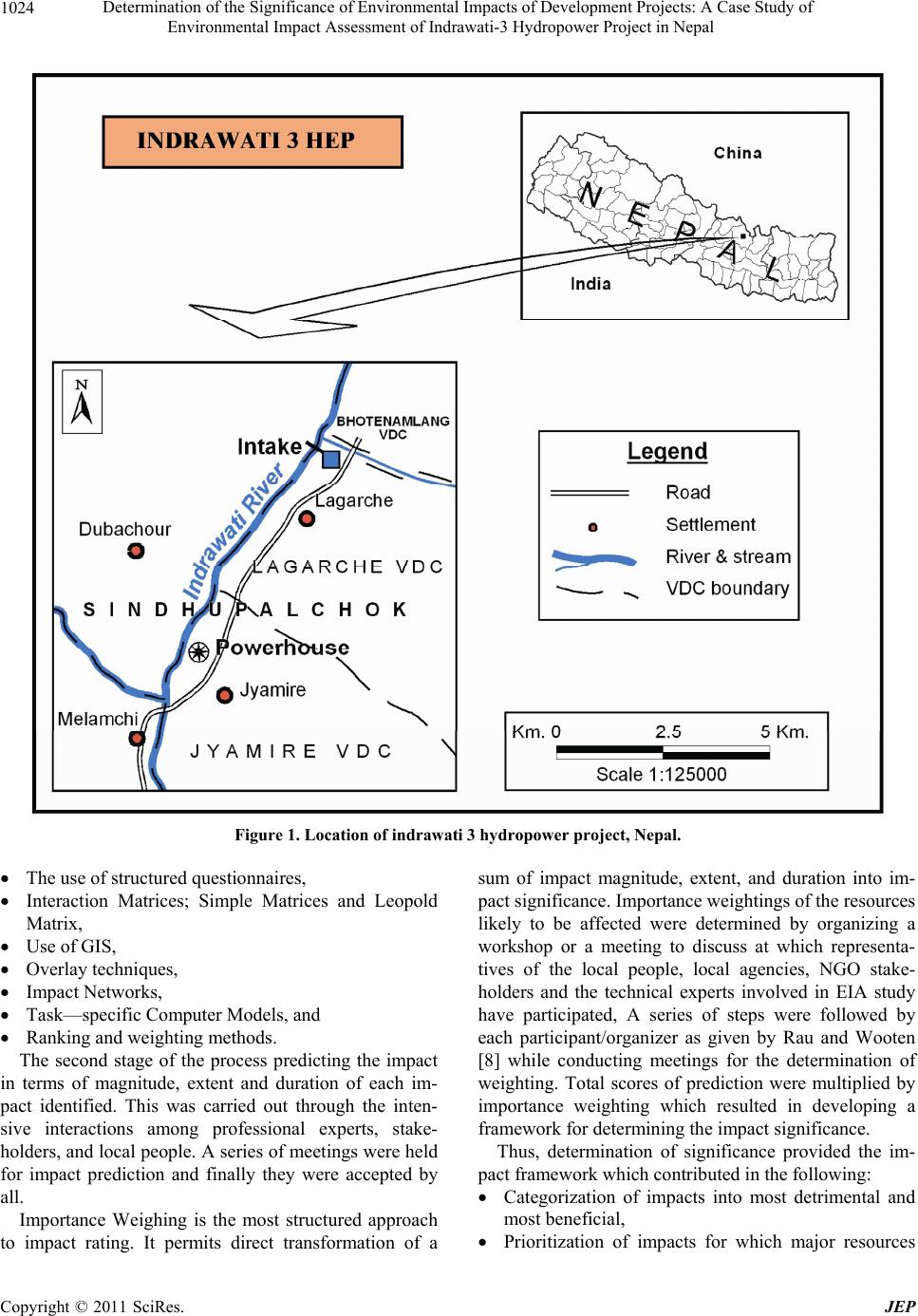 Determination of the Significance of Environmental Impacts of Development Projects: A Case Study of Environmental Impact Assessment of Indrawati-3 Hydropower Project in Nepal Copyright © 2011 SciRes. JEP 1024 Figure 1. Location of indrawati 3 hydropower project, Nepal. The use of structured questionnaires, Interaction Matrices; Simple Matrices and Leopold Matrix, Use of GIS, Overlay techniques, Impact Networks, Task—specific Computer Models, and Ranking and weighting methods. The second stage of the process predicting the impact in terms of magnitude, extent and duration of each im- pact identified. This was carried out through the inten- sive interactions among professional experts, stake- holders, and local people. A series of meetings were held for impact prediction and finally they were accepted by all. Importance Weighing is the most structured approach to impact rating. It permits direct transformation of a sum of impact magnitude, extent, and duration into im- pact significance. Importance weightings of the resources likely to be affected were determined by organizing a workshop or a meeting to discuss at which representa- tives of the local people, local agencies, NGO stake- holders and the technical experts involved in EIA study have participated, A series of steps were followed by each participant/organizer as given by Rau and Wooten [8] while conducting meetings for the determination of weighting. Total scores of prediction were multiplied by importance weighting which resulted in developing a framework for determining the impact significance. Thus, determination of significance provided the im- pact framework which contributed in the following: Categorization of impacts into most detrimental and most beneficial, Prioritization of impacts for which major resources 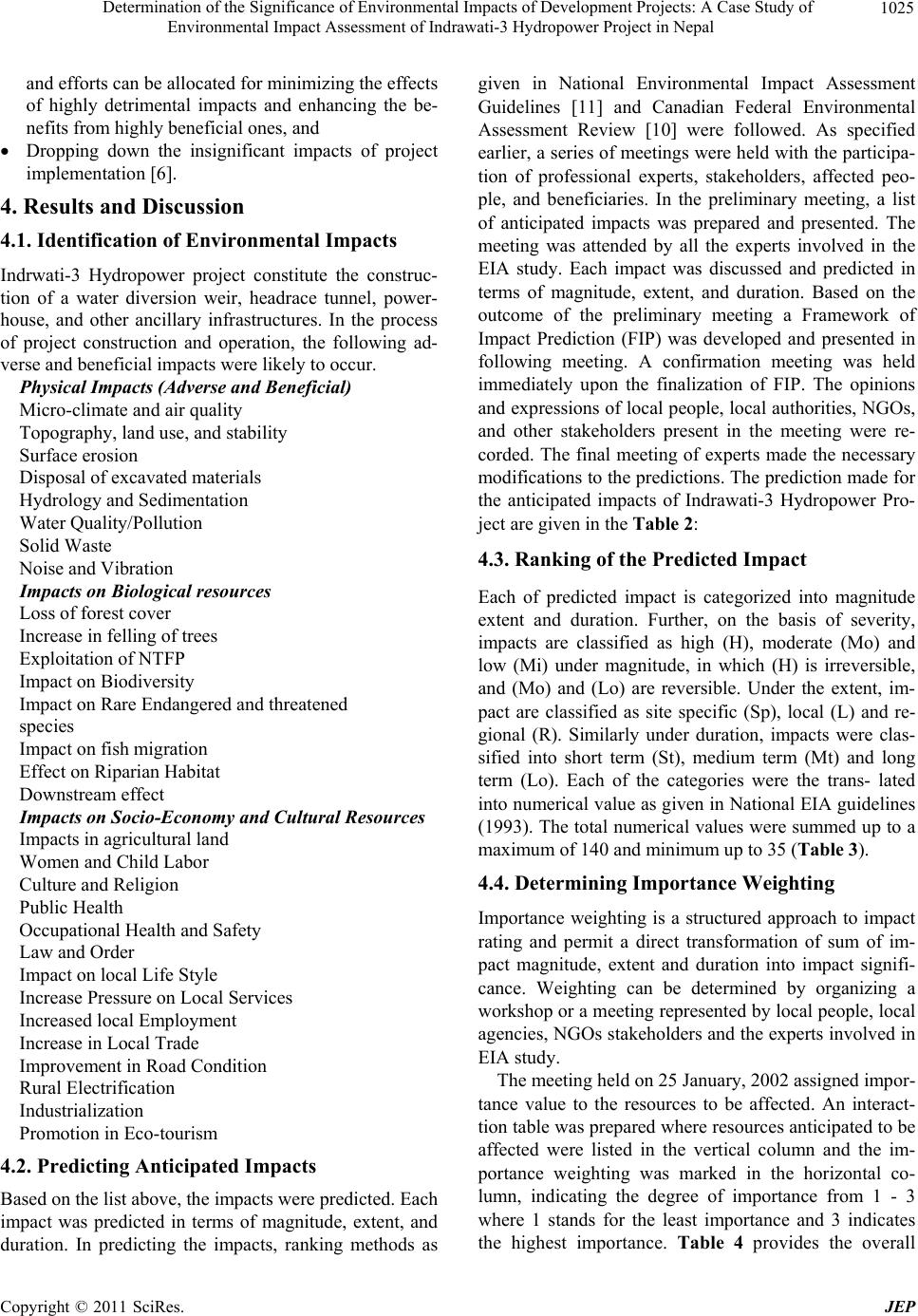 Determination of the Significance of Environmental Impacts of Development Projects: A Case Study of Environmental Impact Assessment of Indrawati-3 Hydropower Project in Nepal 1025 and efforts can be allocated for minimizing the effects of highly detrimental impacts and enhancing the be- nefits from highly beneficial ones, and Dropping down the insignificant impacts of project implementation [6]. 4. Results and Discussion 4.1. Identification of Environmental Impacts Indrwati-3 Hydropower project constitute the construc- tion of a water diversion weir, headrace tunnel, power- house, and other ancillary infrastructures. In the process of project construction and operation, the following ad- verse and beneficial impacts were likely to occur. Physical Impacts (Adverse and Beneficial) Micro-climate and air quality Topography, land use, and stability Surface erosion Disposal of excavated materials Hydrology and Sedimentation Water Quality/Pollution Solid Waste Noise and Vibration Impacts on Biological resources Loss of forest cov er Increase in felling of trees Exploitati on o f NTFP Impact on Biodiversity Impact on Rare Endangered and threatened species Impact on fish migration Effect on Riparian Habitat Downstream effect Impacts on Socio-Economy and Cultural Resources Impacts in agricultural land Women and Child Labor Culture and Religio n Public Health Occupational Health and Safety Law and Order Impact on local Life Style Increase Pressure on Local Services Increased local Employment Increase in Local Trade Improvement in Road Condition Rural Electrification Industrialization Promotion in Eco-tourism 4.2. Predicting Anticipated Impacts Based on the list above, the impacts were predicted. Each impact was predicted in terms of magnitude, extent, and duration. In predicting the impacts, ranking methods as given in National Environmental Impact Assessment Guidelines [11] and Canadian Federal Environmental Assessment Review [10] were followed. As specified earlier, a series of meetings were held with the participa- tion of professional experts, stakeholders, affected peo- ple, and beneficiaries. In the preliminary meeting, a list of anticipated impacts was prepared and presented. The meeting was attended by all the experts involved in the EIA study. Each impact was discussed and predicted in terms of magnitude, extent, and duration. Based on the outcome of the preliminary meeting a Framework of Impact Prediction (FIP) was developed and presented in following meeting. A confirmation meeting was held immediately upon the finalization of FIP. The opinions and expressions of local p eople, local authorities, NGOs, and other stakeholders present in the meeting were re- corded. The final meeting of experts made the necessary modifications to the predictions. The prediction made for the anticipated impacts of Indrawati-3 Hydropower Pro- ject are given in the Table 2: 4.3. Ranking of the Predicted Impact Each of predicted impact is categorized into magnitude extent and duration. Further, on the basis of severity, impacts are classified as high (H), moderate (Mo) and low (Mi) under magnitude, in which (H) is irreversible, and (Mo) and (Lo) are reversible. Under the extent, im- pact are classified as site specific (Sp), local (L) and re- gional (R). Similarly under duration, impacts were clas- sified into short term (St), medium term (Mt) and long term (Lo). Each of the categories were the trans- lated into numerical value as giv en in National EIA guidelines (1993). The total numerical values were summed up to a maximum of 140 and minimum up to 35 (Table 3). 4.4. Determining Importance Weighting Importance weighting is a structured approach to impact rating and permit a direct transformation of sum of im- pact magnitude, extent and duration into impact signifi- cance. Weighting can be determined by organizing a workshop or a meeting represented by local people, local agencies, NGOs stakeholders and the experts involved in EIA study. The meeting held on 25 January, 2002 assigned impor- tance value to the resources to be affected. An interact- tion table was prepared where resources anticipated to be affected were listed in the vertical column and the im- portance weighting was marked in the horizontal co- lumn, indicating the degree of importance from 1 - 3 where 1 stands for the least importance and 3 indicates the highest importance. Table 4 provides the overall Copyright © 2011 SciRes. JEP 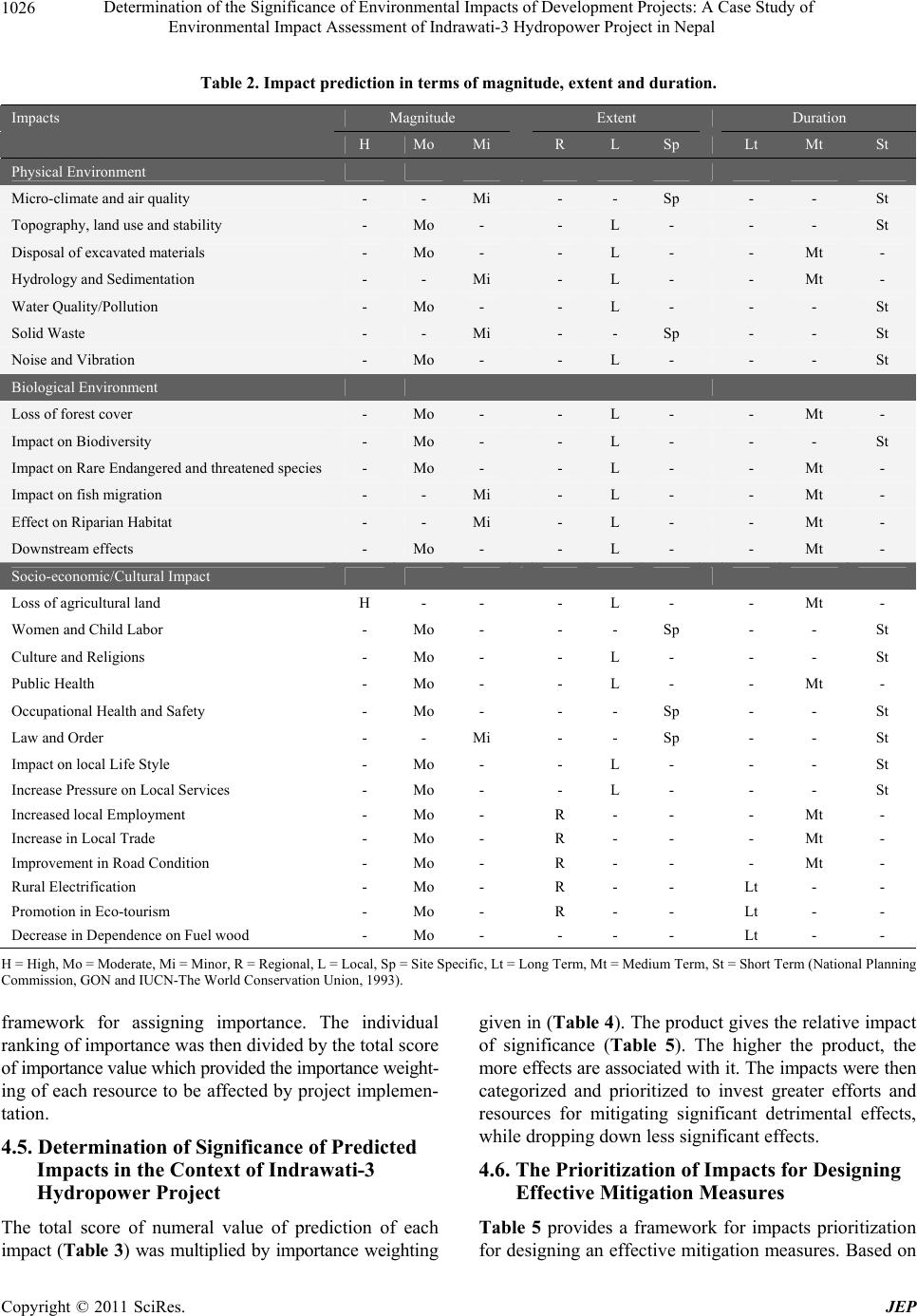 Determination of the Significance of Environmental Impacts of Development Projects: A Case Study of Environmental Impact Assessment of Indrawati-3 Hydropower Project in Nepal Copyright © 2011 SciRes. JEP 1026 Table 2. Impact prediction in terms of magnitude, extent and duration. Impacts Magnitude Extent Duration H Mo Mi R L Sp Lt Mt St Physical Environment Micro-climate and air quality - - Mi - - Sp - - St Topography, land use and stab i li t y - Mo - - L - - - St Disposal of excavated materials - Mo - - L - - Mt - Hydrology and S e d i mentation - - Mi - L - - Mt - Water Quality/Pollution - Mo - - L - - - St Solid Waste - - Mi - - Sp - - St Noise and Vibration - Mo - - L - - - St Biological Environment Loss of forest cover - Mo - - L - - Mt - Impact on Biodiversity - Mo - - L - - - St Impact on Rare Endangered and t hreatened species - Mo - - L - - Mt - Impact on fish migration - - Mi - L - - Mt - Effect on Riparian Habitat - - Mi - L - - Mt - Downstream effects - Mo - - L - - Mt - Socio-economic/Cultural Impact Loss of agricultural land H - - - L - - Mt - Women and Child Labor - Mo - - - Sp - - St Culture and Religions - Mo - - L - - - St Public Health - Mo - - L - - Mt - Occupational Health and Safety - Mo - - - Sp - - St Law and Order - - Mi - - Sp - - St Impact on local Life Style - Mo - - L - - - St Increase Pressure on Local Services - Mo - - L - - - St Increased local Employment - Mo - R - - - Mt - Increase in Local Trade - Mo - R - - - Mt - Improvement in Road Condition - Mo - R - - - Mt - Rural Electrification - Mo - R - - Lt - - Promotion in Eco-tourism - Mo - R - - Lt - - Decrease in Dependence on Fuel wood - Mo - - - - Lt - - H = High, Mo = Moderate, Mi = Minor, R = Regional, L = Local, Sp = Site Specific, Lt = Long Term, Mt = Medium Term, St = Short Term (National Planning Commission, GON and IUCN-The World Conservation Union, 1993). framework for assigning importance. The individual ranking of importance was then divided by the total score of importance value which provided the importance weight- ing of each resource to be affected by project implemen- tation. 4.5. Determination of Significance of Predicted Impacts in the Context of Indrawati-3 Hydropower Project The total score of numeral value of prediction of each impact (Table 3) was multiplied by importance weighting given in (Table 4). The product gives the relative impact of significance (Table 5). The higher the product, the more effects are associated w ith it. The impacts were then categorized and prioritized to invest greater efforts and resources for mitigating significant detrimental effects, while dropping down less significant effects. 4.6. The Prioritization of Impacts for Designing Effective Mitigation Measures Table 5 provides a framework for impacts prioritization for designing an effective mitigation measures. Based on 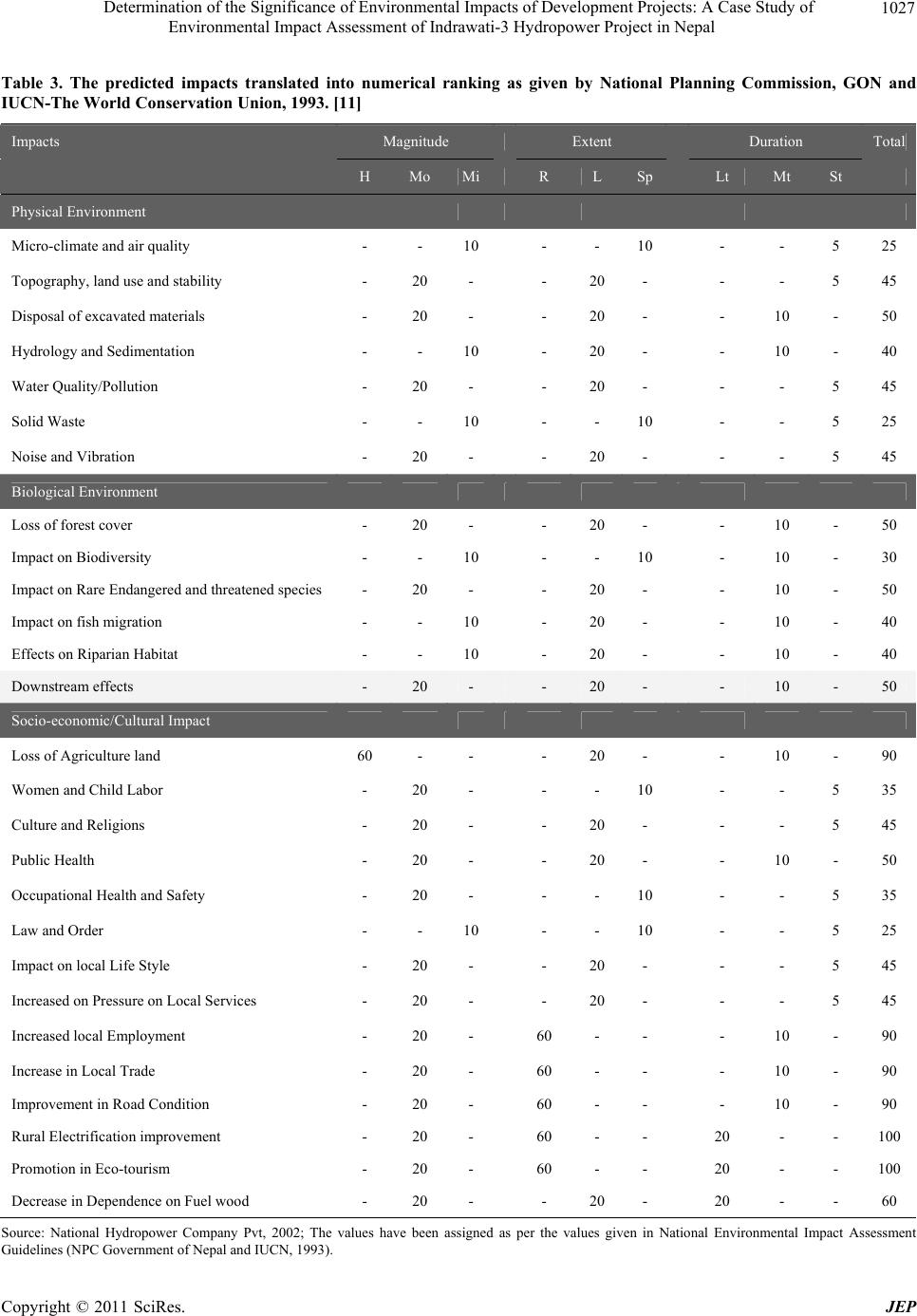 Determination of the Significance of Environmental Impacts of Development Projects: A Case Study of Environmental Impact Assessment of Indrawati-3 Hydropower Project in Nepal 1027 Table 3. The predicted impacts translated into numerical ranking as given by National Planning Commission, GON and IUCN-The World Conservation Union, 1993. [11] Impacts Magnitude Extent Duration Total H Mo MiR L Sp Lt Mt St Physical Environment Micro-climate and air quality - - 10 - - 10 - - 5 25 Topography, land use and stab i li t y - 20 - - 20 - - - 5 45 Disposal of excavated materials - 20 - - 20 - - 10 - 50 Hydrology and S e d i mentation - - 10 - 20 - - 10 - 40 Water Quality/Pollution - 20 - - 20 - - - 5 45 Solid Waste - - 10 - - 10 - - 5 25 Noise and Vibration - 20 - - 20 - - - 5 45 Biological Environment Loss of forest cover - 20 - - 20 - - 10 - 50 Impact on Biodiversity - - 10 - - 10 - 10 - 30 Impact on Rare Endangered and t hreatened species - 20 - - 20 - - 10 - 50 Impact on fish migration - - 10 - 20 - - 10 - 40 Effects on Riparian Habitat - - 10 - 20 - - 10 - 40 Downstream effects - 20 - - 20 - - 10 - 50 Socio-economic/Cultural Impact Loss of Agriculture land 60 - - - 20 - - 10 - 90 Women and Child Labor - 20 - - - 10- - 5 35 Culture and Religions - 20 - - 20 - - - 5 45 Public Health - 20 - - 20 - - 10 - 50 Occupational Health and Safety - 20 - - - 10 - - 5 35 Law and Order - - 10 - - 10 - - 5 25 Impact on local Life Style - 20 - - 20 - - - 5 45 Increased on Pressure on Local Services - 20 - - 20 - - - 5 45 Increased local Employment - 20 - 60 - - - 10 - 90 Increase in Local Trade - 20 - 60 - - - 10 - 90 Improvement in Road Condition - 20 - 60 - - - 10 - 90 Rural Electrification improvement - 20 - 60 - - 20 - - 100 Promotion in Eco-tourism - 20 - 60 - - 20 - - 100 Decrease in Dependence on Fuel wood - 20 - - 20 - 20 - - 60 Source: National Hydropower Company Pvt, 2002; The values have been assigned as per the values given in National Environmental Impact Assessment Guideline s (NPC Government of Nepal and IUCN , 1993). Copyright © 2011 SciRes. JEP 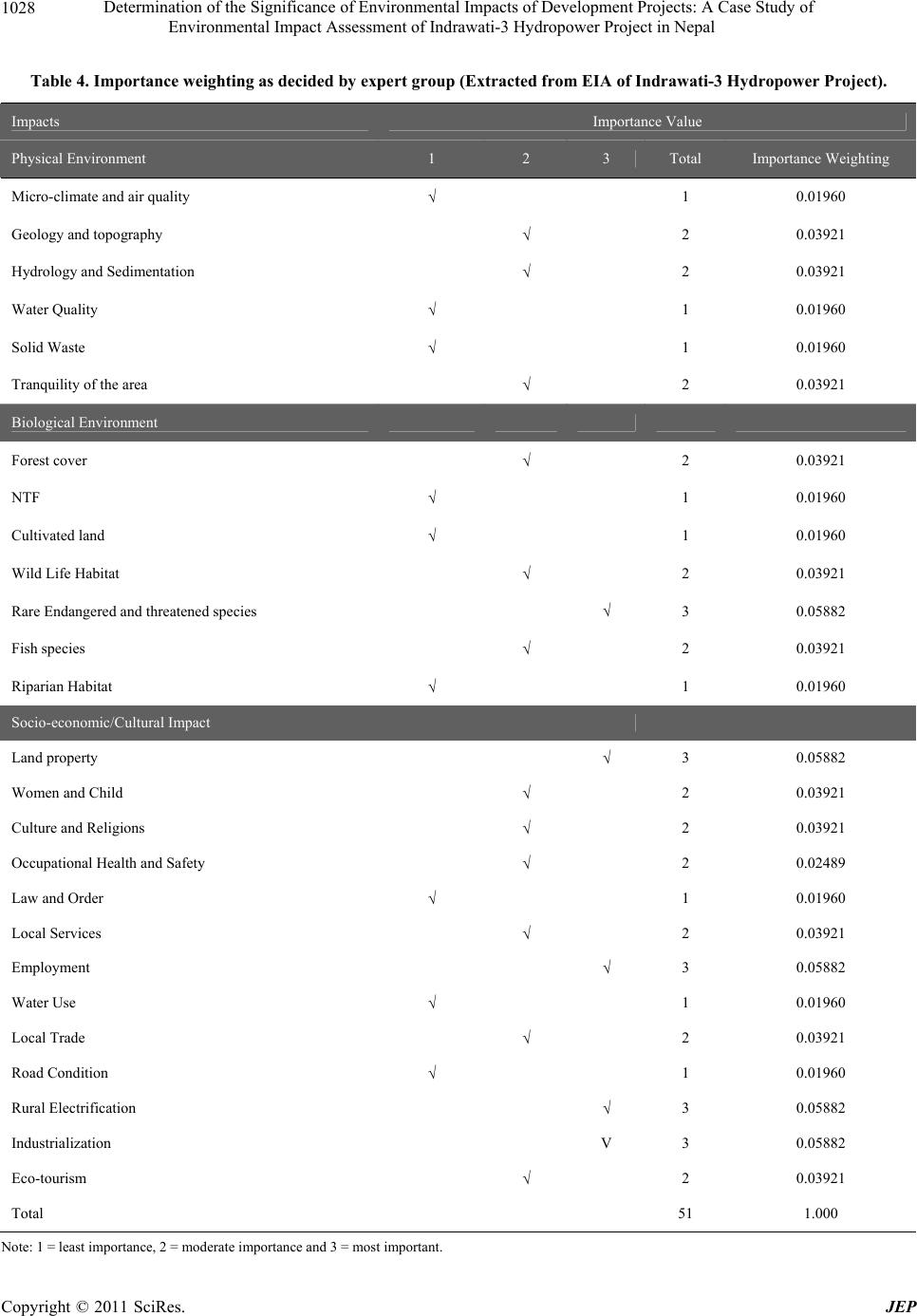 Determination of the Significance of Environmental Impacts of Development Projects: A Case Study of Environmental Impact Assessment of Indrawati-3 Hydropower Project in Nepal 1028 Table 4. Importance weighting as decided by exper t group (Extracted f ro m E IA of Indrawati-3 Hydropower Project). Impacts Importance Value Physical Environment 1 2 3 Total Importance Weighting Micro-climate and air quality 1 0.01960 Geology and topography 2 0.03921 Hydrology and S e d i mentation 2 0.03921 Water Quality 1 0.01960 Solid Waste 1 0.01960 Tranquility of the area 2 0.03921 Biological Environment Forest cover 2 0.03921 NTF 1 0.01960 Cultivated land 1 0.01960 Wild Life Habitat 2 0.03921 Rare Endangered and threatened species 3 0.05882 Fish species 2 0.03921 Riparian Habitat 1 0.01960 Socio-economic/Cultural Impact Land property 3 0.05882 Women and Child 2 0.03921 Culture and Religions 2 0.03921 Occupational Health and Safety 2 0.02489 Law and Order 1 0.01960 Local Services 2 0.03921 Employment 3 0.05882 Water Use 1 0.01960 Local Trade 2 0.03921 Road Condition 1 0.01960 Rural Electrification 3 0.05882 Industrialization V 3 0.05882 Eco-tourism 2 0.03921 Total 51 1.000 Note: 1 = least importance, 2 = moderate importance and 3 = most important. C opyright © 2011 SciRes. JEP  Determination of the Significance of Environmental Impacts of Development Projects: A Case Study of Environmental Impact Assessment of Indrawati-3 Hydropower Project in Nepal Copyright © 2011 SciRes. JEP 1029 Table 5. Impact significance and prioritization for mitigation prescription. Predicted Impacts Total Score from Ranking (Table 3) Importance Weighting (Table 4) Significant Values Impact Prioritization (1 = top priority) Physical Environment Micro-climate and air quality 25 0.01960 0.490 18 Topography, land use and stab i li t y 45 0.03921 1.764 9 Disposal of excavated materials 50 0.03921 1.960 8 Hydrology and S e d i mentation 40 0.01960 0.784 15 Water Quality/Pollution 45 0.01960 0.882 14 Solid Waste 25 0.03921 0.980 13 Noise and Vibration 45 0.03921 1.764 9 Biological Environment Loss of forest cover 50 0.01960 0.980 13 Impact in Biodiversity 30 0.01960 0.588 17 Impact on Rare Endangered and t hreatened species 50 0.03921 1.960 8 Impact on fish migration 40 0.05882 2.352 7 Effect on Riparian Habitat 40 0.03921 1.568 10 Downstream effects 50 0.05882 2.941 5 Socio-economic/Cultural Impact Loss of Agriculture land 90 0.05882 5.293 2 Women and Child Labor 35 0.03921 1.372 11 Culture and Religions 45 0.03921 1.764 9 Occupational Health Hazardous and Safety 35 0.01960 0.686 16 Law and Order 25 0.03921 0.980 13 Impact on local Life Style 45 0.05882 2.646 6 Increase Pressure on Local Services 45 0.01960 0.882 14 Increased in local Employment 90 0.03921 3.528 4 Increase in Local Trade 90 0.01960 1.521 10 Improvement in Road Condition 90 0.05882 5.293 2 Rural Electrification 100 0.05882 5.882 1 Promotion in Eco-tourism 100 0.03921 3.921 3 Decrease in Dependence on Fuel wood 60 M U L T F I C A T I O N O F B Y I M P O R T A N C E W E I G H T I N G 0.01960 1.176 12 Source: N ational Hydropower Company Pvt, 2002. priority and severity the predicted impacts were classi- fied into following three categories: Impacts having significant adverse/beneficial effects Rural Electrification—beneficial Local employment—beneficial Promotion in Ecotourism—beneficial Loss of Agricultural land—adverse Disposal of excavated materials—adverse Decrease in dependence on fuel wood—beneficial Promotion of ecotourism—beneficial Loss of forest cover/forest biomass —a dv erse Impact on rare/endangered/endemic species of plants and animals downstream effects—adverse Topography, land use and stability—adverse Noise and vibration—adverse Habitat encroachment—adverse Effects on culture and religious—adverse Hydrology and sedimentation—adverse Impact on fish migrati on— adverse Impacts with Moderate/Adverse/Beneficial Effects Occupational health hazards—adverse Women and child labor—adverse Exploitati on o f NTFP—adverse Impacts on life style—adverse Water quality / pollution—adverse Effects on ripa ri a n habitat—adv erse Impacts with Less Significant Adverse/Beneficial Ef- fects Improvement in road condition—beneficial Law and order—adverse Micro-climate and air quality—adverse Solid waste—adverse 5. Conclusions The entire process as outlined above for the identifica- tion of significant impacts is a subjective exercises in- volving mostly judgment values of experts, stakeholders, project affected and beneficiaries and other concerned people of the local area. But for those parameters of en- vironment, whose national and international standards or  Determination of the Significance of Environmental Impacts of Development Projects: A Case Study of Environmental Impact Assessment of Indrawati-3 Hydropower Project in Nepal 1030 norms are available, the values anticipated from the study can be compared and the thesholds can be deter- mined. For example, air and water quality and noise level can be compared against national quality standards. For impacts, whose severity is not quantifiable such as social issues, this process of quantification, would be most ap- propriate, since it involves the project affected stake- holders of project areas. The authors believe that the im- pact predicted and quantified through this method would likely to be more closer to the reality of the local area, since it involves the lo cal people likely to be affected by the project implementation [14]. Determination of significance provides the impact framework on categorization of impacts into most detri- mental and most beneficial ones and prioritizes the im- pacts for which major resources and efforts can be allo- cated for reducing highly detrimental effects and en- hancing benefits from highly beneficial impacts [6]. All scores are relative and computation methods are based on subjective judgment value. Therefore, it does not have any scientific foundation [8]. However, in the process of EIA of a development project, many impacts are usually identified; some of them are significantly detrimental or beneficial but most of them are insignificant in terms of their severity, albeit, they are equally treated and wrongly predicted. In such circumstances, the project proponent faces dilemma as to where to place more resources and efforts in order to minimize the detrimental effects or to enhance beneficial effects of project implementation. Therefore, categorization of impacts in terms of severity is more desirable [14] for: Designing the most effective mitigation measures investing adequate amount of time, money and efforts, to minimize the most significant adverse impacts, Paying less attention and efforts on moderate and less significant impacts, Providing a coherent linkage among the various is- sues addressed in EIA report, Providing specific monitoring and aud iting linkage to the specific impacts and mitigation measures pro- posed, and above all, concentrating more on highly significant impacts, thus, avoiding the insignificant ones. Furthermore, the quantification of impacts and their categorization is important because the decision makers usually require a strong basis to make a decision on the proposed project implementation. It would be rather dif- ficult for project proponent to convince the decision maker through descriptive narration; but quantification of the description is likely to ease the decision makers to grasp the essence of the issues to be decided particularly in developing country. 6. Acknowledgements The authors are highly grateful to the Authorities of In- drawati-3 Hydropower Project Nepal for the permission to use their information. The help prov ided by the people responsible for collecting information, the local stake- holders who provided their valuable suggestions, and the experts who examined the validity of the issues are highly appreciated. REFERENCES [1] R. Sippe, “Criteria and Standard for Assessing Significant Impact,” In: J. Petts, Ed., Handbook of Environmental Assessment , Bla c k wel l Sci ence L t D., O xfo r d , V ol. 1, 1999. [2] M. A. Thompson, “Determining Impact Significance in EIA: A Review of 24 Methodologies,” Journal of Envi- ronmental Management, Vol. 30, 1990, pp. 235-250. doi:10.1016/0301-4797(90)90004-G [3] G. E. Beanlands and P. N. Duinker, “An Ecological Framework for Environmental Impact Assessment in Canada,” Dalhousie University and FEARO Canada, Halifax, 1983. [4] P. T. Hauge, et al., “Determining the Significance of Environmental Issue under the National Environmental Policy Act,” Journal of Environmental Management, Vol. 18, 1984, pp. 15-24 [5] A. Gilpin, “Environmental Impact Assessment: Cutting Age for the 21st Century,” Cambridge University Press, London, 1995. [6] M. H. Sadar, “Environmental Impact Assessment,” Carle- ton University Press for Impact Assessment Center, Carleton, 1996. [7] Australian and New Zealand Environment and Conserva- tion Council, “A National Approach to Environmental Impact Assessment in Australia, Anzecc Secretariat,” 1991. [8] G. J. Rau and D. C. Wooten, “Environmental Impact Assessment Handbook,” McGraw-Hill Book Company, New York, 1980. [9] L. W. Canter, “Environmental Impact Assessment,” McGraw-Hill Book Company, New York, 1996. [10] Canadian Federal Environmental Assessment Review Office (REARO), “Environmental Screening and Initial Assessment Guidelines,” FEARO, 1986. [11] National Planning Commission, Government of Nepal and IUCN, “National Environmental Impact Assessment Guidelines,” NCSIP, Kathmandu, 1993. [12] Shah Consult International (P) LtD, “Feasibility Study and Initial Environmental Examination of Indrawati-3 Hydropower project for the Government of Nepal,” 1997. [13] Government of Nepal, “Environmental Protection Regu- lation,” Government Press Nepal, 1997. [14] R. B. Khadka and H. Shrestha, “The Scoping Process for Environmental Impact Assessment of Project: A Case C opyright © 2011 SciRes. JEP  Determination of the Significance of Environmental Impacts of Development Projects: A Case Study of Environmental Impact Assessment of Indrawati-3 Hydropower Project in Nepal Copyright © 2011 SciRes. JEP 1031 Study of Outer-Ring Road Project in Nepal-Based on Local: People’s Perception,” The International Journal of Environmental, Cultural Economic and Social Sustain- ability, Vol. 4, No. 3, 2008, pp. 25-36. [15] National Hydropower Company, Pvt, “Environmental Impact Assessment (EIA) of Indrawati-3 Hydropower Project-Approved by the Government of Nepal,” 2002. [16] R. B. Khadka and S. Gorzula, “Environmental Impact Assessment (EIA),” Pokhara University, Pokhara, 2010, pp. 1-136. |