

Paper Menu >>
Journal Menu >>
 Materials Sciences and Applicatio ns, 2011, 2, 1480-1484 doi:10.4236/msa.2011.210199 Published Online October 2011 (http://www.SciRP.org/journal/msa) Copyright © 2011 SciRes. MSA Synthesis of Sn-3.5Ag Alloy Nanosolder by Chemical Reduction Method Hsin Jen Pan1, Chao Yang Lin1*, Udit Surya Mohanty2*, Jung Hua Chou1 1Department of Engineering Science, National Cheng Kung University, Tainan, Chinese Taipei; 2Department of Materials Science and Engineering, National Cheng Kung University, Chinese Taipei. Email: *[email protected], *[email protected] Received June 6th, 2011; revised August 22nd, 2011; accepted September 20th, 2011. ABSTRACT The synthesis of Sn-3.5Ag alloy nanosolder was investigated by chemical reduction method. In this method, chemical precipitation was achieved by using sodium NaBH4 as a reducing agent and PVP (poly-m-vinyl 2-pyrrolidone) as a stabilizer. The exp erimental results obtained with differen t amounts of NaBH4 and PVP were compared. X-ra y diffrac- tion (XRD) patterns revealed that Ag3Sn was formed due to the successful alloying process. Scanning Electron Micros- copy (SEM) and Transmission Electron Microscopy (TEM) demonstrated a change in the morphology of Sn-3.5Ag alloy nanosolder with increase in the PVP content in the bath. The size of the nanoparticles ranged from 300 to 700 nm. The nanosolder/nanoparticles were thus synthesized successfully under controlled and optimized chemical reduction proc- ess. Keywords: Alloy, Agglomeration, Nanoparticles, Chemical Reduction, Morpho logy, X-Ray Diffraction 1. Introduction The electronics industry has grown rapidly since the 1960s and the corresponding process technology for in- tegrated circuits (IC) has also become more complicated [1]. One of the most important challenges faced by the electronics industry is the technology of IC devices packaging, with regards to the electrical connectivity and environmental protection. Presently, one of the most im- portant package materials is the development of solder alloy. The cost of the solder needs to be low and the per- formance needs to be higher [2] for better reliability. SnPb solders have long been used as interconnect mate- rials in microelectronic packaging. Due to the health threat of lead to human beings, the use of lead-free in- terconnect materials is imperative. In the last few years tin/silver (96.5Sn3.5Ag) has been one of the promising alternatives for Sn/Pb solders [3]. However, the melting point (Tm) of 96.5Sn3.5Ag alloy (222˚C) is more than 30˚C) higher than that of eutectic Sn/Pb solders (183˚C). The high Tm requires a higher reflow temperature in the electronics manufacturing process. This high process temperature in electronics assembly has adverse effects not only on energy consumption, but also on substrate warpage, thermal stress and popcorn cracking in molded components, resulting in poor reliability of the devices. As such, studies on lowering the processing temperature of the lead-free metals are our main interest. The melting point can be dramatically decreased when the size of substances is reduced to nanometer size [4]. At present, the size dependent melting behavior of metal nanoparti- cles has been found both theoretically and experimentally [5-10]. The high ratio of surface area to volume of nano particles has been known as one of the driving forces for the size dependent melting point depression. Duh et al. [11] has demonstrated successfully the synthesis of Sn-3.5Ag-xCu (x = 0.2, 0.5, 1.0) nanoparticles by che- mical precipitation with NaBH4 for lead-free solder ap- plications. They have successfully shown the melting by differential scanning calorimetry (DSC) of their synthe- sized SnAgCu alloy nanoparticles. However, no obvious melting point depression behavior was observed, which might be due to the surface oxidation or heavy agglom- eration of their synthesized nanoparticles. The solder alloy powders have been synthesized by various methods such as solid state melting process [12], electrolytic deposition [13] and chemical reduction [14]. The solid state melting process is a commonly used technique but the limitation is the minimum powder size. The mini- mum size obtained is about 100nm even when treated by 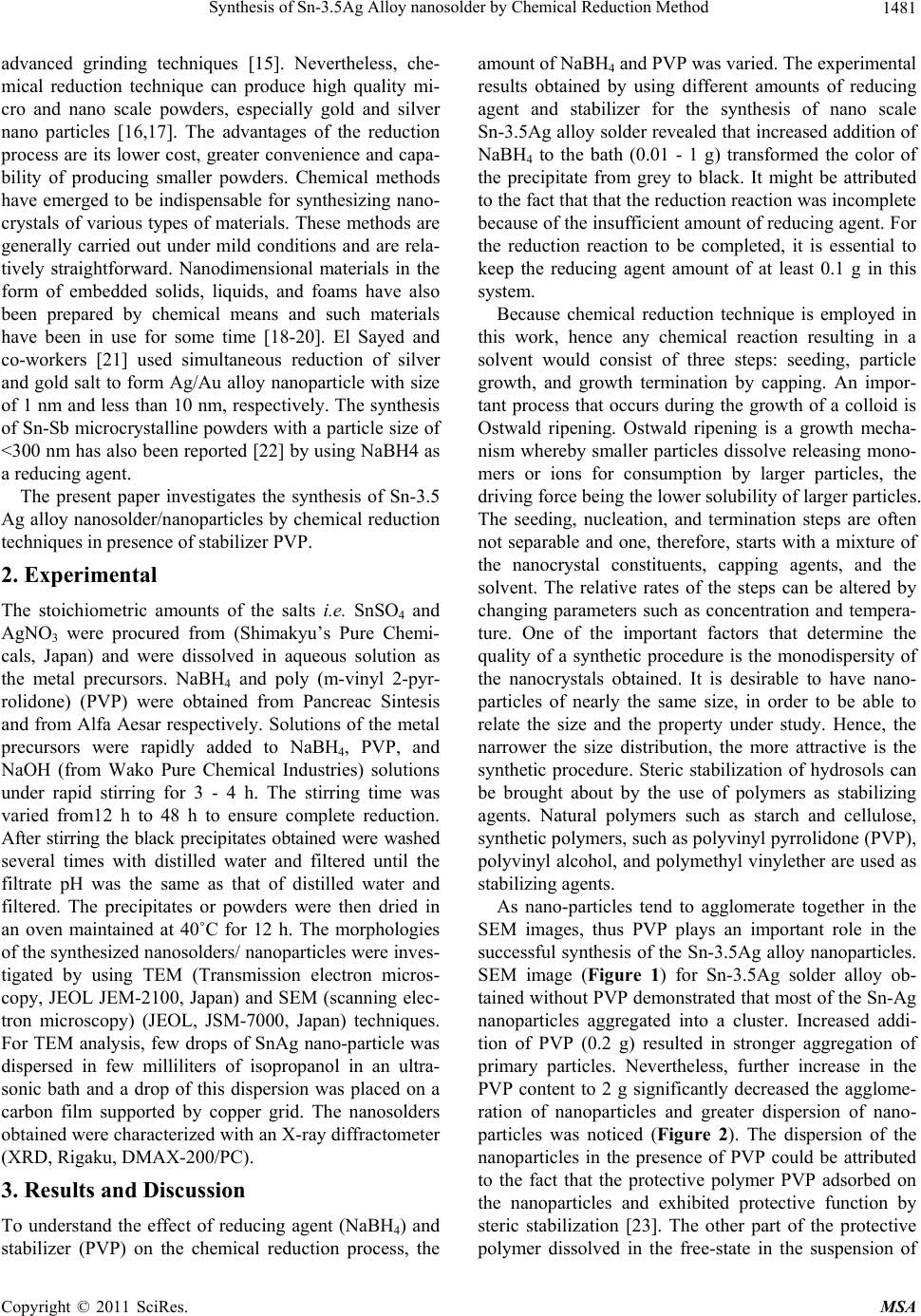 Synthesis of Sn-3.5Ag Alloy nanosolder by Chemical Reduction Method1481 advanced grinding techniques [15]. Nevertheless, che- mical reduction technique can produce high quality mi- cro and nano scale powders, especially gold and silver nano particles [16,17]. The advantages of the reduction process are its lower cost, greater convenience and capa- bility of producing smaller powders. Chemical methods have emerged to be indispensable for synthesizing nano- crystals of various types of materials. These methods are generally carried out under mild conditions and are rela- tively straightforward. Nanodimensional materials in the form of embedded solids, liquids, and foams have also been prepared by chemical means and such materials have been in use for some time [18-20]. El Sayed and co-workers [21] used simultaneous reduction of silver and gold salt to form Ag/Au alloy nanoparticle with size of 1 nm and less than 10 nm, respectively. The synthesis of Sn-Sb microcrystalline powders with a particle size of <300 nm has also been reported [22] by using NaBH4 as a reducing agent. The present paper investigates the synthesis of Sn-3.5 Ag alloy nanosolder/nanoparticles by chemical reduction techniques in presence of stabilizer PVP. 2. Experimental The stoichiometric amounts of the salts i.e. SnSO4 and AgNO3 were procured from (Shimakyu’s Pure Chemi- cals, Japan) and were dissolved in aqueous solution as the metal precursors. NaBH4 and poly (m-vinyl 2-pyr- rolidone) (PVP) were obtained from Pancreac Sintesis and from Alfa Aesar respectively. Solutions of the metal precursors were rapidly added to NaBH4, PVP, and NaOH (from Wako Pure Chemical Industries) solutions under rapid stirring for 3 - 4 h. The stirring time was varied from12 h to 48 h to ensure complete reduction. After stirring the black precipitates obtained were washed several times with distilled water and filtered until the filtrate pH was the same as that of distilled water and filtered. The precipitates or powders were then dried in an oven maintained at 40˚C for 12 h. The morphologies of the synthesized nanosolders/ nanoparticles were inves- tigated by using TEM (Transmission electron micros- copy, JEOL JEM-2100, Japan) and SEM (scanning elec- tron microscopy) (JEOL, JSM-7000, Japan) techniques. For TEM analysis, few drops of SnAg nano-particle was dispersed in few milliliters of isopropanol in an ultra- sonic bath and a drop of this dispersion was placed on a carbon film supported by copper grid. The nanosolders obtained were characterized with an X-ray diffractometer (XRD, Rigaku, DMAX-200/PC). 3. Results and Discussion To understand the effect of reducing agent (NaBH4) and stabilizer (PVP) on the chemical reduction process, the amount of NaBH4 and PVP was varied. The experimental results obtained by using different amounts of reducing agent and stabilizer for the synthesis of nano scale Sn-3.5Ag alloy solder revealed that increased addition of NaBH4 to the bath (0.01 - 1 g) transformed the color of the precipitate from grey to black. It might be attributed to the fact that that the reduction reaction was incomplete because of the insufficient amount of reducing agent. For the reduction reaction to be completed, it is essential to keep the reducing agent amount of at least 0.1 g in this system. Because chemical reduction technique is employed in this work, hence any chemical reaction resulting in a solvent would consist of three steps: seeding, particle growth, and growth termination by capping. An impor- tant process that occurs during the growth of a colloid is Ostwald ripening. Ostwald ripening is a growth mecha- nism whereby smaller particles dissolve releasing mono- mers or ions for consumption by larger particles, the driving force being the lower solubility of larger particles. The seeding, nucleation, and termination steps are often not separable and one, therefore, starts with a mixture of the nanocrystal constituents, capping agents, and the solvent. The relative rates of the steps can be altered by changing parameters such as concentration and tempera- ture. One of the important factors that determine the quality of a synthetic procedure is the monodispersity of the nanocrystals obtained. It is desirable to have nano- particles of nearly the same size, in order to be able to relate the size and the property under study. Hence, the narrower the size distribution, the more attractive is the synthetic procedure. Steric stabilization of hydrosols can be brought about by the use of polymers as stabilizing agents. Natural polymers such as starch and cellulose, synthetic polymers, such as polyvinyl pyrrolidone (PVP), polyvinyl alcohol, and polymethyl vinylether are used as stabilizing agents. As nano-particles tend to agglomerate together in the SEM images, thus PVP plays an important role in the successful synthesis of the Sn-3.5Ag alloy nanoparticles. SEM image (Figure 1) for Sn-3.5Ag solder alloy ob- tained without PVP demonstrated that most of the Sn-Ag nanoparticles aggregated into a cluster. Increased addi- tion of PVP (0.2 g) resulted in stronger aggregation of primary particles. Nevertheless, further increase in the PVP content to 2 g significantly decreased the agglome- ration of nanoparticles and greater dispersion of nano- particles was noticed (Figure 2). The dispersion of the nanoparticles in the presence of PVP could be attributed to the fact that the protective polymer PVP adsorbed on the nanoparticles and exhibited protective function by steric stabilization [23]. The other part of the protective polymer dissolved in the free-state in the suspension of Copyright © 2011 SciRes. MSA 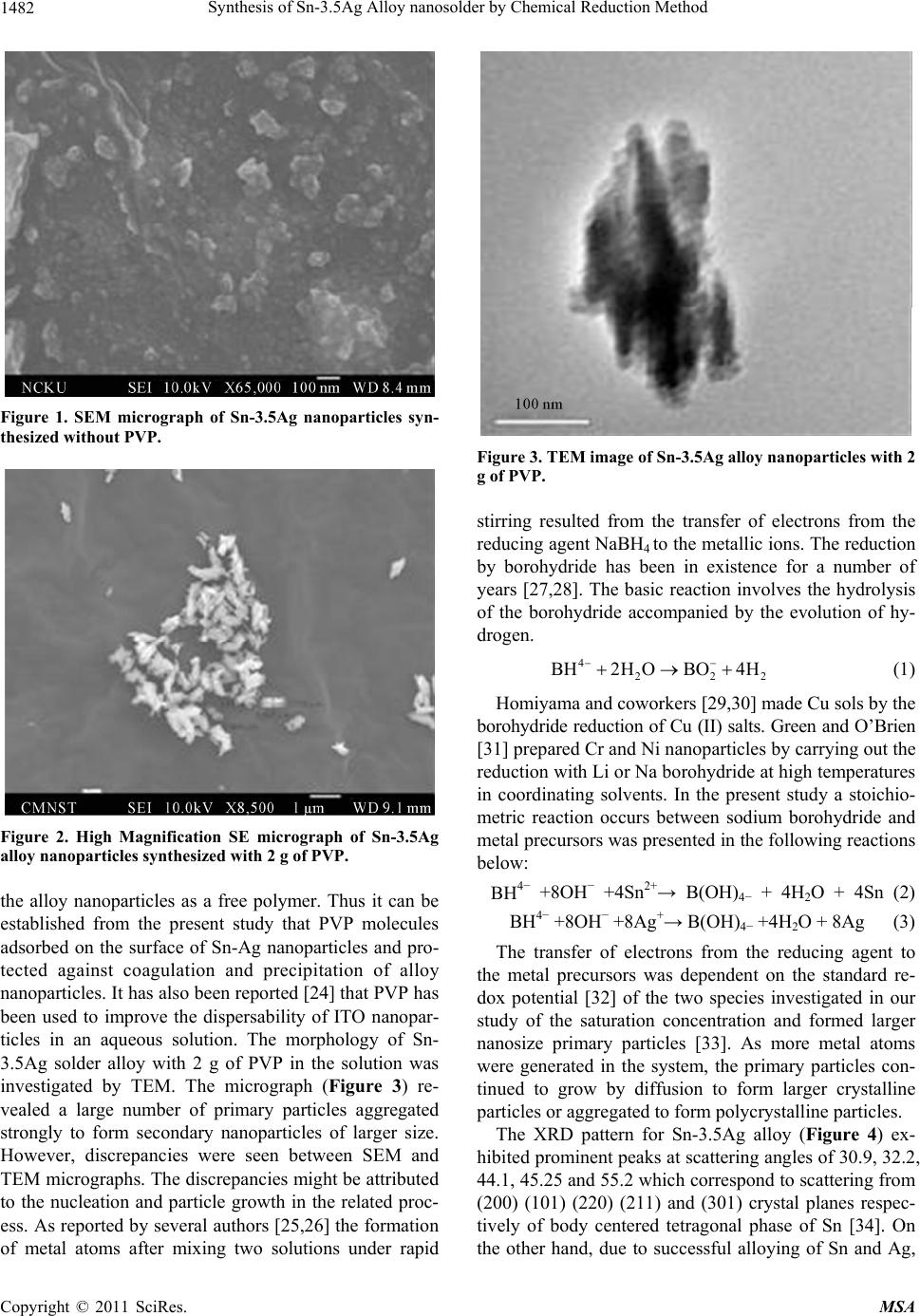 Synthesis of Sn-3.5Ag Alloy nanosolder by Chemical Reduction Method 1482 Figure 1. SEM micrograph of Sn-3.5Ag nanoparticles syn- thesized without PVP. Figure 2. High Magnification SE micrograph of Sn-3.5Ag alloy nanoparticles synthesized wi th 2 g of PVP. the alloy nanoparticles as a free polymer. Thus it can be established from the present study that PVP molecules adsorbed on the surface of Sn-Ag nanoparticles and pro- tected against coagulation and precipitation of alloy nanoparticles. It has also been reported [24] that PVP has been used to improve the dispersability of ITO nanopar- ticles in an aqueous solution. The morphology of Sn- 3.5Ag solder alloy with 2 g of PVP in the solution was investigated by TEM. The micrograph (Figure 3) re- vealed a large number of primary particles aggregated strongly to form secondary nanoparticles of larger size. However, discrepancies were seen between SEM and TEM micrographs. The discrepancies might be attributed to the nucleation and particle growth in the related proc- ess. As reported by several authors [25,26] the formation of metal atoms after mixing two solutions under rapid Figure 3. TEM image of Sn-3.5Ag alloy nanoparticles with 2 g of PVP. stirring resulted from the transfer of electrons from the reducing agent NaBH4 to the metallic ions. The reduction by borohydride has been in existence for a number of years [27,28]. The basic reaction involves the hydrolysis of the borohydride accompanied by the evolution of hy- drogen. 4 2 22 BH2H OBO4H (1) Homiyama and coworkers [29,30] made Cu sols by the borohydride reduction of Cu (II) salts. Green and O’Brien [31] prepared Cr and Ni nanoparticles by carrying out the reduction with Li or Na borohydride at high temperatures in coordinating solvents. In the present study a stoichio- metric reaction occurs between sodium borohydride and metal precursors was presented in the following reactions below: BH4− +8OH− +4Sn2+→ B(OH)4− + 4H2O + 4Sn (2) BH4− +8OH− +8Ag+→ B(OH)4− +4H2O + 8Ag (3) The transfer of electrons from the reducing agent to the metal precursors was dependent on the standard re- dox potential [32] of the two species investigated in our study of the saturation concentration and formed larger nanosize primary particles [33]. As more metal atoms were generated in the system, the primary particles con- tinued to grow by diffusion to form larger crystalline particles or aggregated to form polycrystalline particles. The XRD pattern for Sn-3.5Ag alloy (Figure 4) ex- hibited prominent peaks at scattering angles of 30.9, 32.2, 44.1, 45.25 and 55.2 which correspond to scattering from (200) (101) (220) (211) and (301) crystal planes respec- tively of body centered tetragonal phase of Sn [34]. On the other hand, due to successful alloying of Sn and Ag, Copyright © 2011 SciRes. MSA  Synthesis of Sn-3.5Ag Alloy nanosolder by Chemical Reduction Method1483 XRD (Sn-3.5Ag) 0 200 400 600 800 1000 30 32 34 36 38 40 42 44 46 48 50 2θ Intensity Sn(101 ) Ag3Sn (201) Ag3Sn (020) Ag3Sn (211) Sn (220 ) Sn (211 ) Sn (200 ) Figure 4. XRD analysis results for Sn-3.5Ag alloy nanopar- ticles with 2 g PVP. Ag3Sn peaks were observed in the XRD spectrum. Few unwanted reflections were also observed, indicating some impurities, produced during the reduction reaction. 4. Conclusions With well-controlled process parameters, such as the amount of reducing agent and stabilizer, the Sn-3.5Ag alloy nanoparticle could be synthesized successfully by chemical reduction technique. The advantages of chemi- cal reduction reaction are that not only two-component alloy compounds, but also multi-component alloy nano- particles can be developed by this process. 5. Acknowledgements We are grateful to the Centre of Micro Nanoscience and Technology for providing us the instrumental facilities. REFERENCES [1] S. M. Sze, “VLSI Technology,” McGraw-Hill, Boston, 1988. [2] K. M. Monahan, “Enabling Double Patterning at the 32 nm Node,” IEEE International Symposium on Semicon- ductor Manufacturing, Tokyo, 25-27 September 2006, pp. 126-129. doi:10.1109/ISSM.2006.4493040 [3] I. Artaki, A. M. Jackson and P. T. Vianco, “Evaluation of Lead-Free Solder Joints in Electronic Assemblies,” Jour- nal of Electronic Materials, Vol. 23, No. 8, 1994, pp. 757-764. doi:10.1007/BF02651370 [4] P. Pawlow, “Über Die Abhängigkeit des Schmelzpunktes von der Berflächenenergie Eines Festen Körpers,” Zeits- chrift für Physikalische Chemie, Vol. 65, 1909, pp. 545- 548. [5] S. L. Lai, J. Y. Guo, V. Petrova, G. Ramanath and L. H. Allen. “Size-Dependent Melting Properties of Small Tin Particles: Nanocalorimetric Measurements,” Physical Re- view Letters, Vol. 77, No. 1, 1996, pp. 99-102. doi:10.1103/PhysRevLett.77.99 [6] T. Bachels, H. J. Guntherodt and R. Schafer, “Melting of Isolated Tin Nanoparticles,” Physical Review Letters, Vol. 85, No. 6, 2000, pp. 1250-1253. doi:10.1103/PhysRevLett.85.1250 [7] R. Kofman, P. Cheyssac and F. Celestini, “Comment on Melting of Isolated Tin Nanoparticles,” Physical Review Letters, Vol. 86, No. 7, 2001, p. 1388. doi:10.1103/PhysRevLett.86.1388 [8] M. Schmidt, R. Kusche, B. Issendroff and H. Haberland, “Irregular Variations in the Melting Point of Size-Selected Atomic Clusters,” Nature, Vol. 393, No. 6682, 1998, pp. 238-240. doi:10.1038/30415 [9] S. J. Zhao, S. Q.Wang, D. Y. Cheng and H. Q. Ye, “Three Distinctive Melting Mechanisms in Isolated Nanoparti- cles,” Journal of Physical Chemistry B, Vol. 105, No. 51, 2001, pp. 12857-12860. doi:10.1021/jp012638i [10] F. Baletto, A. Rapallo, G. Rossi and R. Ferrando, “Dy- namical Effects in the formation of Magic Cluster Struc- tures,” Physical Review B, Vol. 69, No. 23, 2004, pp. 235421-235426. doi:10.1103/PhysRevB.69.235421 [11] L. Y. Hsiao and J. G. Duh, “Synthesis and Characterisa- tion of Lead-Free solders by Chemical Reduction Method,” Journal of Electrochemical Society, Vol. 152, No. 9, 2005, pp. J105-J109. doi:10.1149/1.1954928 [12] H. B. Bakoglu, “Circuits, Interconnections and Packaging for VLSI, Chapter 2,” Addison Wesley, Boston, 1990. [13] Y. Gaoa, C. Zou, B. Yang, Q. Zhai, J. Liu, E. Zhuravlevd and C. Schick, “Nanoparticles of SnAgCu Lead-Free Solder Alloy with an Equivalent Melting Temperature of SnPb Solder Alloy,” Journal of Alloy and Compounds, Vol. 484, No. 1-2, 2009, pp. 777-781. doi:10.1016/j.jallcom.2009.05.042 [14] J. Stevanovic, V. Cosovic, J. S. Trosic, B. Jordovic and O. Pesic, Arch Materials Sci, Vol. 28, No. 1, 2007, p. 155. [15] K. S. Chou and C Y. Ren, “Synthesis of Nanosized Silver Particles by Chemical Reduction Method,” Materials Chemistry and Physics, Vol. 64, No. 3, 2000, pp. 241-246. doi:10.1016/S0254-0584(00)00223-6 [16] Y. W. Yen and S. W. Chen, “Phase Equilibria of the Ag- Sn-Cu Ternary System,” Journal of Materials Research, Vol. 19, No. 8, 2004, pp. 2298-2305. doi:10.1557/JMR.2004.0296 [17] T. C. Huang, M. C. Wei and H. I. Chen, “Preparation of Hydrogen-Permselective Palladium-Silver Alloy Com- posite Membranes by Electroless Co-Deposition,” Sepa- ration and Purification Technology, Vol. 32, No. 1-3, 2003, pp. 239-245. doi:10.1016/S1383-5866(03)00063-7 [18] M. C. Daniel and D. Astruc, “Gold Nanoparticles: As- sembly, Supramolecular Chemistry, Quantum-Size-Re- lated Properties, and Applications toward Biology, Ca- talysis, and Nanotechnology,” Chemical Reviews, Vol. 104, No. 1, 2004. pp. 293-346. doi:10.1021/cr030698+ [19] C. Burda, X. Chen, R. Narayanan and M. A. El-Sayed, “The Chemistry and Properties of Nanocrystals of Dif- ferent Shapes,” Chemical Reviews, Vol. 105, No. 4, 2005, pp. 1025-1102. doi:10.1021/cr030063a [20] B. L. Cushing, V. L. Kolesnichenko and C. J. O’Connor, Copyright © 2011 SciRes. MSA  Synthesis of Sn-3.5Ag Alloy nanosolder by Chemical Reduction Method Copyright © 2011 SciRes. MSA 1484 “Recent Advances in the Liquid-Phase Syntheses of In- organic Nanparticles,” Chemi cal Reviews, Vol. 104, No. 2, 2004, pp. 3893-3946. doi:10.1021/cr030027b [21] S. Link, Z. L. Wang and M. A. El Sayed, “Alloy Forma- tion of Gold-Silver Nanoparticles and the Dependence of the Plasmon Absorption on Their Composition,” Journal of Physical Chemistry B, Vol. 103, No. 18, 1999, pp. 3529-3533. doi:10.1021/jp990387w [22] M. A. Yang, M. A. Winter and J. O. Besenhard, “Small Particle Size Multiphase Li-Alloy Anodes for Lithium- Ion-Batteries,” Soli d State Ioni cs, Vol. 90, No. 1-4, 1996, pp. 281-287. doi:10.1016/S0167-2738(96)00389-X [23] B. Yin, H. Ma, S. Wang and S. Chen, “Electrochemical Synthesis of Silver Nanoparticles under Protection of Poly(N-Vinylpyrrolidone),” Journal of Physical Chemis- try B, Vol. 107, No. 34, 2003, pp. 8898-8904. doi:10.1021/jp0349031 [24] J. E. Song, D. K. Lee, Y. H. Kim and Y. S. Kang, “Pre- paration of Water Dispersed Indium Tin Oxide Sol So- lution,” Molecular Crystals and Liquid Crystals, Vol. 444, No. 1. 2006, pp. 247-255. doi:10.1080/15421400500365078 [25] A. Corrias, G. Ennas, G. Licheri, G. Marongiu and G. Paschina, “Amorphous Metallic Alloy Powders Prepared by Chemical Reduction of Metal Ions with Potassium Borohydride in Aqueous Solution,” Chemistry of Materi- als, Vol. 2, No. 4, 1990, pp. 363-366. doi:10.1021/cm00010a010 [26] D. Zeng and M. J. Hampden-Smith, “Synthesis and Characterization of Nanophase Group 6 Metal (M) and Metal Carbide (M2C) Powders by chemical Reduction Methods,” Chemistry of Materials, Vol. 5, No. 5, 1993, pp. 681-689. doi:10.1021/cm00029a018 [27] H. I. Schlesinger, H. C. Brown, A. E. Finholt, J. R. Gil- breath, H. R. Kockstra and E. K. Hyde, “Sodium Boro- hydride, Its Hydrolysis and Its Use as a Reducing Agent and in the Generation of Hydrogen,” Journal of American Chemical Society, Vol. 75, No. 1, 1953, pp. 215-219. doi:10.1021/ja01097a057 [28] H. C. Brown and C. A. Brown, “New Highly Active Metal Catalysts for the Hydrolysis of Borohydride,” Journal of American Chemical Society, Vol. 84, No. 8, 1962, pp. 1493- 1494. doi:10.1021/ja00867a034 [29] H. Hirai, H. Wakabayashi and M. Komiyama, “Poly- mer-Protected Copper Colloids as Catalysts for Selective Hydration of Acrylonitrile,” Chemistry Letters, Vol. 12, No. 7, 1983, pp. 1047-1050. doi:10.1246/cl.1983.1047 [30] H. Hirai, H. Wakabayashi and M. Komiyama, “Prepara- tion of Polymer Protected Colloidal Dispersion of Cop- per,” Bulletin of the Chemical Society of Japan, Vol. 59, No. 2, 1986, pp. 367-372. doi:10.1246/bcsj.59.367 [31] M. Green and P. O. Brien, “The Preparation of Organi- cally Functionalised Chromium and Nickel Nano Par- ticles,” Chemical Communications, Vol. 29, No. 19, 2001, pp. 1912-1913. doi:10.1039/b107108b [32] M. Pourbaix, “Atlas of Electrochemical Equilibria in Aqueous Solutions,” Oxford University Press, New York, 1974. [33] Y. Zhao, Z. Zhang and H. Dang, “Preparation of Tin Nanoparticles by Solution Dispersion,” Materials Science and Engineering A, Vol. 359, No. 1-2, 2003, pp. 405-407. doi:10.1016/S0921-5093(03)00395-2 [34] D. V. Goia, “Preparation and Formation Mechanisms of Uniform Metallic Particles in Homogeneous Solutions,” Journal of Materials Chemistry, Vol. 14, No. 4, 2004, pp. 451-458. |