

Paper Menu >>
Journal Menu >>
 Materials Sciences and Applicatio ns, 2011, 2, 1392-1398 doi:10.4236/msa.2011.210188 Published Online October 2011 (http://www.SciRP.org/journal/msa) Copyright © 2011 SciRes. MSA Lime-Barium and Lime-Zinc Raw Glazes with Raw Materials from Tanzania and Cameroon U. Chinje Melo1,2, Ndigui Billong1,2*, E. C. Kimaro3 1Materials Analysis Laboratory, MIPROMALO, Yaoundé, Cameroon; 2Physico-Chemistry of Mineral Materials Laboratory, Univer- sity of Yaoundé I, Yaoundé, Cameroon; 3Industrial Minerals Laboratory, SEAMIC, Dar-es-Salaam, Tanzania. Email: *[email protected] Received March 1st, 2011; revised April 1st, 2011; accepted April 27th, 2011. ABSTRACT In the paper, the lime-barium and lime-zinc glazes used in Southern and Eastern Africa Mineral Center (SEAMIC) ce- ramic unit in Tanzania were investigated for the production of high temperature raw glazes in Cameroon. The base Seger formula used was 0.3KNaO, 0.3CaO, 0.4ZnO or BaO; xAl2O3 and ySiO2. Different Al2O3/SiO2 formula ratios for glossy and matt glazes were tested with raw materials from Cameroon and Tanzania. In the Cameroonian glazes, a local pegmatite (quartz, microcline, albite) with low coloured oxides replaced an albitic feldspar in the Tanzanian glazes. The other materials were kaolin, limestone, silica and barium carbonate or zinc oxide. Th e glazes were tested at Seger Cone 7 (1240˚C) on stoneware slabs (made up of the same feldspathic glaze material: 18%, silica sand or quartz 27%, ball clay 40% and kaolin 15%) from both Tanzania and Cameroon materials. From results obtained, zinc oxide acted as a more vigorous flux than barium carbonate at cone 7, which is obvious in the glazes with pegmatite (with high quartz content). At a Seger formula of Al2O3/SiO2 1:10, transparent glazes were obtained. In these glazes the alumina content was lower and when increased to higher Seger ratios 1:4.7 - 8.7, the gloss was lowered to matt-luster due to fine crystal formation. Keywords: Lime-Zinc Gl azes, Lime-Bari um Glazes, Raw Glazes, Seger Cone 7 1. Introduction Glazes constitute a fundamental material to the success of the ceramic industry. During recent years, the de- mands of shorter firing cycles and easy control of surface microstructure have called for the use of fritted composi- tions. Raw glazes have to a large extend been replaced by fritted glazes. However, in the case of high temperature ceramic products like tiles, stonewares and sanitarywares fired at temperatures above 1200˚C, raw glazes are still a competitive alternative to fritted formulations [1]. Glaze is similar to glass but with a more complex system be- cause it deals with more components; 7 or 8 oxides in significant amounts are common [1-6]. These compo- nents are divided into the glass network former (SiO2 or B2O3), stabilizer (generally Al2O3) and flux or glass net- work modifier or melter (R2O or RO, where R is an alka- line, alkaline earth or fluxing metal). The complication with glazes is accentuated by the fact that a thin layer is applied to a ceramic body and the glaze body interaction may result in faults. Such faults like cracks (at times voluntary) can affect the aesthetics and technical proper- ties of the product. A glaze is a mixture of materials, powder or suspension in water which when applied as a coating on a body and fired to an appropriate temperature, vitrifies and develops specific properties. For every given body composition, it is important to test the ideal glaze based on aesthetics and properties envisaged. This research was carried out to produce stoneware glazes using Cameroonian raw materials, to replace costly imported stoneware and porcelain glazes com- monly used in Cameroon. The studies were carried out at SEAMIC in Tanzania, investigating the base glaze com- positions used on its decorative stoneware products. These high temperature glazes are of lime-barium (bar- ium glazes) and lime-zinc systems and are raw, not using fritted materials or lead. Barium glazes are recommended for their ability to produce brilliancy and hardness [7]. The base Seger formula for the glazes was 0.3KNaO, 0.3CaO, 0.4ZnO or BaO; x Al2O3 and y SiO2 at cone 7 (1240˚C). The x/y (Al2O3/SiO2) ratio has been reported to have a great influence on the glaze surface as indicated n igure 1 [2,3,8,9]. i F 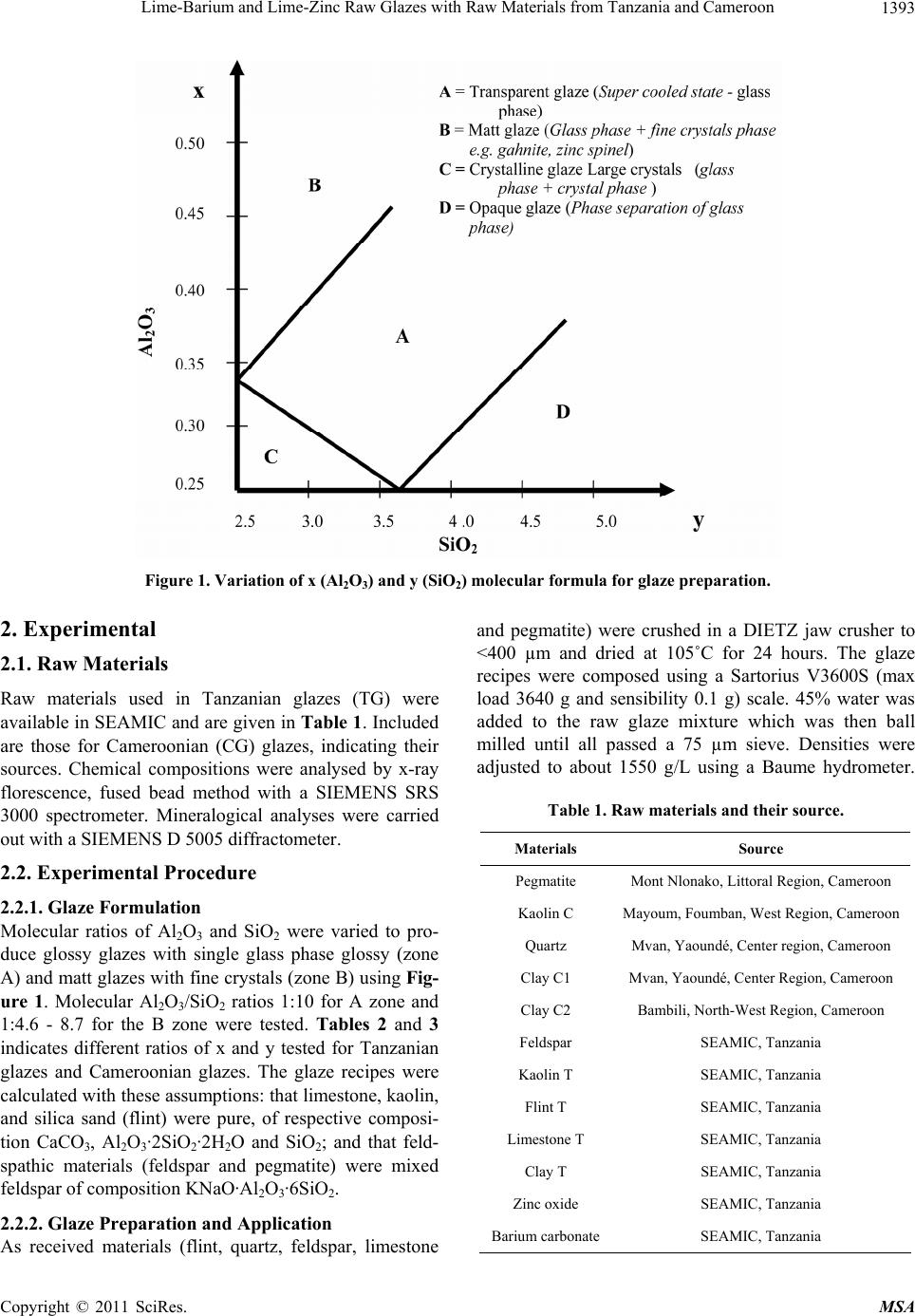 Lime-Barium and Lime-Zinc Raw Glazes with Raw Materials from Tanzania and Cameroon1393 Figure 1. Variation of x (Al2O3) and y (SiO2) molecular formula for glaze preparation. 2. Experimental 2.1. Raw Materials Raw materials used in Tanzanian glazes (TG) were available in SEAMIC and are given in Table 1. Included are those for Cameroonian (CG) glazes, indicating their sources. Chemical compositions were analysed by x-ray florescence, fused bead method with a SIEMENS SRS 3000 spectrometer. Mineralogical analyses were carried out with a SIEMENS D 5005 diffractometer. 2.2. Experimental Procedure 2.2.1. Glaze Form ulation Molecular ratios of Al2O3 and SiO2 were varied to pro- duce glossy glazes with single glass phase glossy (zone A) and matt glazes with fine crystals (zone B) using Fig- ure 1. Molecular Al2O3/SiO2 ratios 1:10 for A zone and 1:4.6 - 8.7 for the B zone were tested. Tables 2 and 3 indicates different ratios of x and y tested for Tanzanian glazes and Cameroonian glazes. The glaze recipes were calculated with these assumptions: that limestone, kaolin, and silica sand (flint) were pure, of respective composi- tion CaCO3, Al2O3·2SiO2·2H2O and SiO2; and that feld- spathic materials (feldspar and pegmatite) were mixed feldspar of composition KNaO·Al2O3·6SiO2. 2.2.2. Glaze Prepa ration a nd Applic ation As received materials (flint, quartz, feldspar, limestone and pegmatite) were crushed in a DIETZ jaw crusher to <400 µm and dried at 105˚C for 24 hours. The glaze recipes were composed using a Sartorius V3600S (max load 3640 g and sensibility 0.1 g) scale. 45% water was added to the raw glaze mixture which was then ball milled until all passed a 75 µm sieve. Densities were adjusted to about 1550 g/L using a Baume hydrometer. Table 1. Raw materials and their source. Materials Source Pegmatite Mont Nlonako, Littoral Region, Cameroon Kaolin C Mayoum, Foumban, West Region, Cameroon Quartz Mvan, Yaoundé, Center region, Cameroon Clay C1 Mvan, Yaoundé, Center Region, Cameroon Clay C2 Bambili, North-West Region, Cameroon Feldspar SEAMIC, Tanzania Kaolin T SEAMIC, Tanzania Flint T SEAMIC, Tanzania Limestone T SEAMIC, Tanzania Clay T SEAMIC, Tanzania Zinc oxide SEAMIC, Tanzania Barium carbonateSEAMIC, Tanzania Copyright © 2011 SciRes. MSA 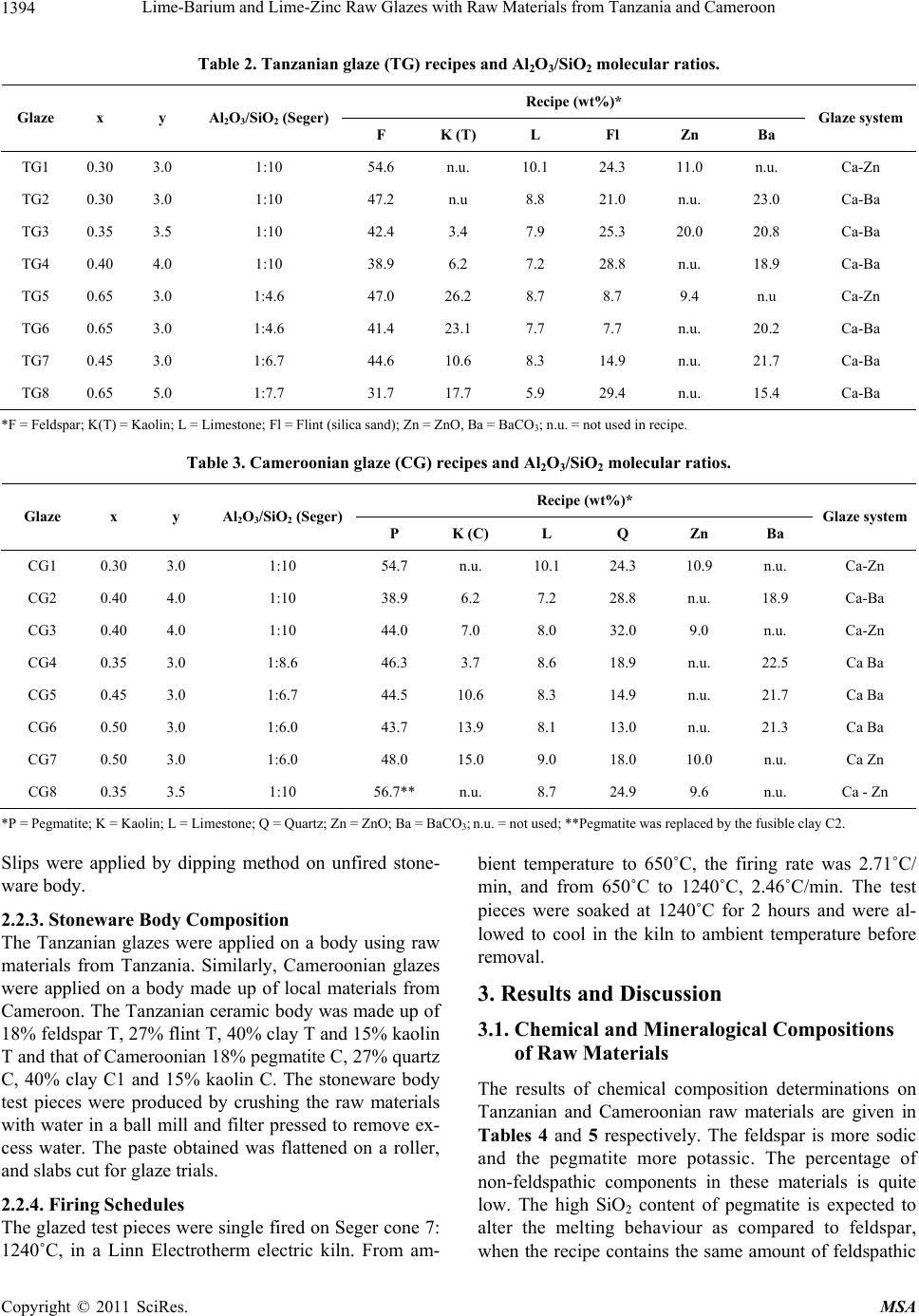 Lime-Barium and Lime-Zinc Raw Glazes with Raw Materials from Tanzania and Cameroon 1394 Table 2. Tanzanian glaze (TG) recipes and Al2O3/SiO2 molecular ratios. Recipe (wt%)* Glaze x y Al2O3/SiO2 (Seger) F K (T) L Fl Zn Ba Glaze system TG1 0.30 3.0 1:10 54.6 n.u. 10.1 24.3 11.0 n.u. Ca-Zn TG2 0.30 3.0 1:10 47.2 n.u 8.8 21.0 n.u. 23.0 Ca-Ba TG3 0.35 3.5 1:10 42.4 3.4 7.9 25.3 20.0 20.8 Ca-Ba TG4 0.40 4.0 1:10 38.9 6.2 7.2 28.8 n.u. 18.9 Ca-Ba TG5 0.65 3.0 1:4.6 47.0 26.2 8.7 8.7 9.4 n.u Ca-Zn TG6 0.65 3.0 1:4.6 41.4 23.1 7.7 7.7 n.u. 20.2 Ca-Ba TG7 0.45 3.0 1:6.7 44.6 10.6 8.3 14.9 n.u. 21.7 Ca-Ba TG8 0.65 5.0 1:7.7 31.7 17.7 5.9 29.4 n.u. 15.4 Ca-Ba *F = Feldspar; K(T) = Kaolin; L = Limestone; Fl = Flint (silica sand); Zn = ZnO, Ba = BaCO3; n.u. = not used in recipe. Table 3. Cameroonian glaze (CG) recipes and Al2O3/SiO2 molecular ratios. Recipe (wt%)* Glaze x y Al2O3/SiO2 (Seger) P K (C) L Q Zn Ba Glaze system CG1 0.30 3.0 1:10 54.7 n.u. 10.1 24.3 10.9 n.u. Ca-Zn CG2 0.40 4.0 1:10 38.9 6.2 7.2 28.8 n.u. 18.9 Ca-Ba CG3 0.40 4.0 1:10 44.0 7.0 8.0 32.0 9.0 n.u. Ca-Zn CG4 0.35 3.0 1:8.6 46.3 3.7 8.6 18.9 n.u. 22.5 Ca Ba CG5 0.45 3.0 1:6.7 44.5 10.6 8.3 14.9 n.u. 21.7 Ca Ba CG6 0.50 3.0 1:6.0 43.7 13.9 8.1 13.0 n.u. 21.3 Ca Ba CG7 0.50 3.0 1:6.0 48.0 15.0 9.0 18.0 10.0 n.u. Ca Zn CG8 0.35 3.5 1:10 56.7** n.u. 8.7 24.9 9.6 n.u. Ca - Zn *P = Pegmatite; K = Kaolin; L = Limestone; Q = Quartz; Zn = ZnO; Ba = BaCO3; n.u. = not used; **Pegmatite was replaced by the fusible clay C2. Slips were applied by dipping method on unfired stone- ware body. 2.2.3. Stonewa re Body C om p osi tion The Tanzanian glazes were applied on a body using raw materials from Tanzania. Similarly, Cameroonian glazes were applied on a body made up of local materials from Cameroon. The Tanzanian ceramic body was made up of 18% feldspar T, 27% flint T, 40% clay T and 15% kaolin T and that of Cameroonian 18% pegmatite C, 27% quartz C, 40% clay C1 and 15% kaolin C. The stoneware body test pieces were produced by crushing the raw materials with water in a ball mill and filter pressed to remove ex- cess water. The paste obtained was flattened on a roller, and slabs cut for glaze trials. 2.2.4. Firing Sc hedules The glazed test pieces were single fired on Seger cone 7: 1240˚C, in a Linn Electrotherm electric kiln. From am- bient temperature to 650˚C, the firing rate was 2.71˚C/ min, and from 650˚C to 1240˚C, 2.46˚C/min. The test pieces were soaked at 1240˚C for 2 hours and were al- lowed to cool in the kiln to ambient temperature before removal. 3. Results and Discussion 3.1. Chemical and Mineralogical Compositions of Raw Materials The results of chemical composition determinations on Tanzanian and Cameroonian raw materials are given in Tables 4 and 5 respectively. The feldspar is more sodic and the pegmatite more potassic. The percentage of non-feldspathic components in these materials is quite low. The high SiO2 content of pegmatite is expected to alter the melting behaviour as compared to feldspar, when the recipe contains the same amount of feldspathic Copyright © 2011 SciRes. MSA 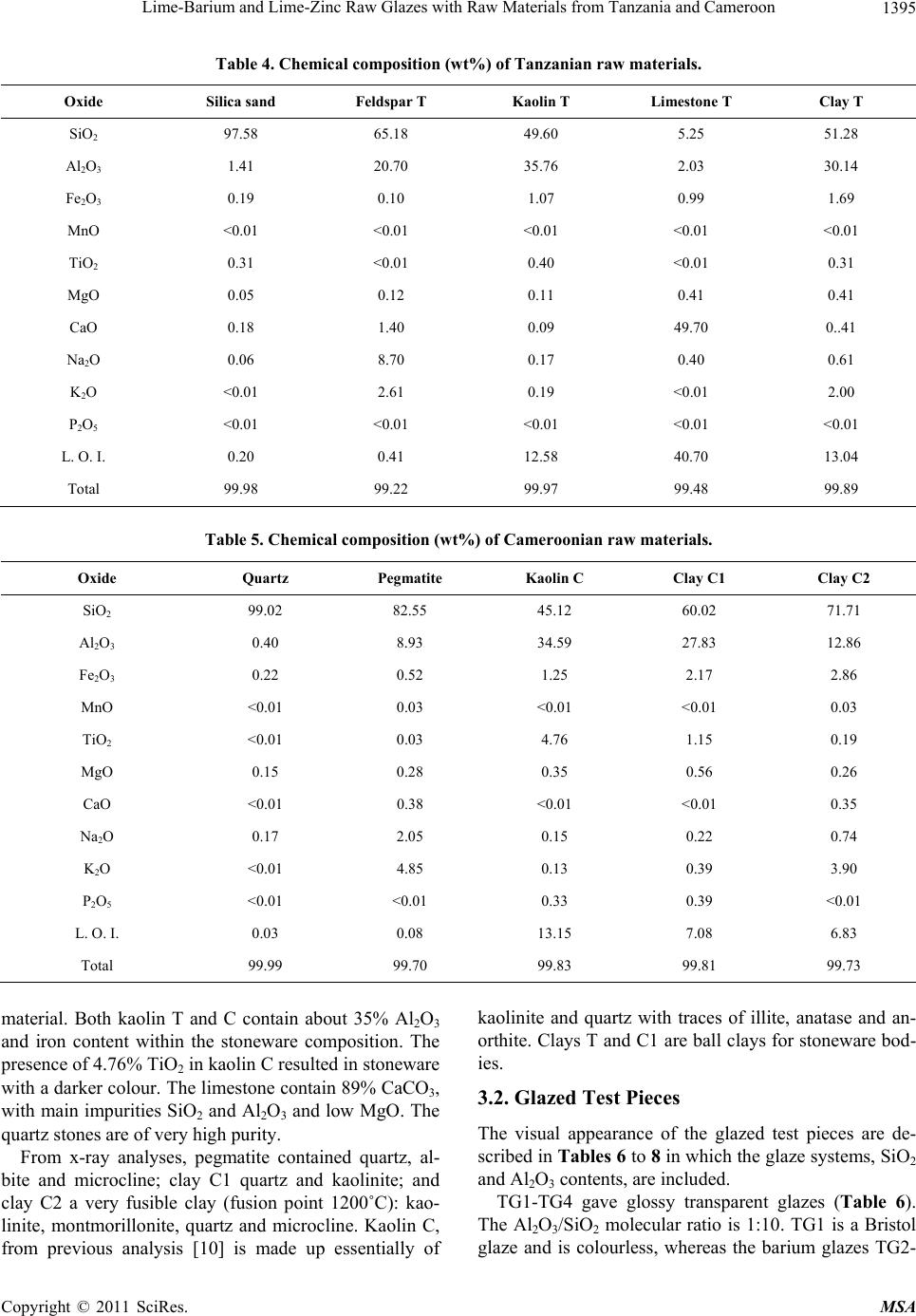 Lime-Barium and Lime-Zinc Raw Glazes with Raw Materials from Tanzania and Cameroon1395 Table 4. Chemical composition (wt%) of Tanzanian raw materials. Oxide Silica sand Feldspar T Kaolin T Limestone T Clay T SiO2 97.58 65.18 49.60 5.25 51.28 Al2O3 1.41 20.70 35.76 2.03 30.14 Fe2O3 0.19 0.10 1.07 0.99 1.69 MnO <0.01 <0.01 <0.01 <0.01 <0.01 TiO2 0.31 <0.01 0.40 <0.01 0.31 MgO 0.05 0.12 0.11 0.41 0.41 CaO 0.18 1.40 0.09 49.70 0..41 Na2O 0.06 8.70 0.17 0.40 0.61 K2O <0.01 2.61 0.19 <0.01 2.00 P2O5 <0.01 <0.01 <0.01 <0.01 <0.01 L. O. I. 0.20 0.41 12.58 40.70 13.04 Total 99.98 99.22 99.97 99.48 99.89 Table 5. Chemical composition (wt%) of Cameroonian raw materials. Oxide Quartz Pegmatite Kaolin C Clay C1 Clay C2 SiO2 99.02 82.55 45.12 60.02 71.71 Al2O3 0.40 8.93 34.59 27.83 12.86 Fe2O3 0.22 0.52 1.25 2.17 2.86 MnO <0.01 0.03 <0.01 <0.01 0.03 TiO2 <0.01 0.03 4.76 1.15 0.19 MgO 0.15 0.28 0.35 0.56 0.26 CaO <0.01 0.38 <0.01 <0.01 0.35 Na2O 0.17 2.05 0.15 0.22 0.74 K2O <0.01 4.85 0.13 0.39 3.90 P2O5 <0.01 <0.01 0.33 0.39 <0.01 L. O. I. 0.03 0.08 13.15 7.08 6.83 Total 99.99 99.70 99.83 99.81 99.73 material. Both kaolin T and C contain about 35% Al2O3 and iron content within the stoneware composition. The presence of 4.76% TiO2 in kaolin C resulted in stoneware with a darker colour. The limestone contain 89% CaCO3, with main impurities SiO2 and Al2O3 and low MgO. The quartz stones are of very high purity. From x-ray analyses, pegmatite contained quartz, al- bite and microcline; clay C1 quartz and kaolinite; and clay C2 a very fusible clay (fusion point 1200˚C): kao- linite, montmorillonite, quartz and microcline. Kaolin C, from previous analysis [10] is made up essentially of kaolinite and quartz with traces of illite, anatase and an- orthite. Clays T and C1 are ball clays for stoneware bod- ies. 3.2. Glazed Test Pieces The visual appearance of the glazed test pieces are de- scribed in Tables 6 to 8 in which the glaze systems, SiO2 and Al2O3 contents, are included. TG1-TG4 gave glossy transparent glazes (Table 6). The Al2O3/SiO2 molecular ratio is 1:10. TG1 is a Bristol glaze and is colourless, whereas the barium glazes TG2- Copyright © 2011 SciRes. MSA 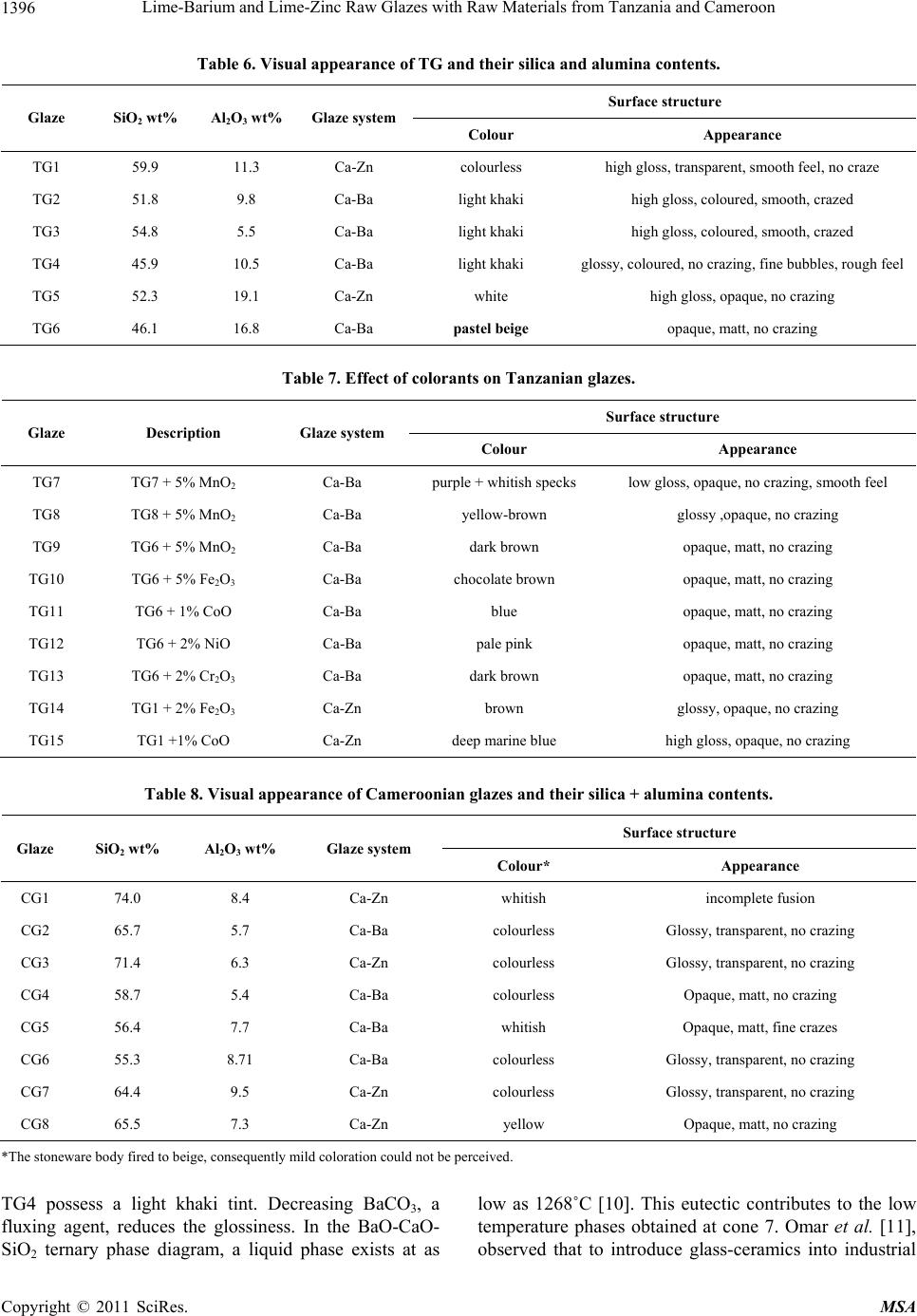 Lime-Barium and Lime-Zinc Raw Glazes with Raw Materials from Tanzania and Cameroon 1396 Table 6. Visual appearance of TG and their silica and alumina contents. Surface structure Glaze SiO2 wt% A l2O3 wt% Glaze system Colour Appearance TG1 59.9 11.3 Ca-Zn colourless high gloss, transparent, smooth feel, no craze TG2 51.8 9.8 Ca-Ba light khaki high gloss, coloured, smooth, crazed TG3 54.8 5.5 Ca-Ba light khaki high gloss, coloured, smooth, crazed TG4 45.9 10.5 Ca-Ba light khaki glossy, coloured, no crazing, fine bubbles, rough feel TG5 52.3 19.1 Ca-Zn white high gloss, opaque, no crazing TG6 46.1 16.8 Ca-Ba pastel beige opaque, matt, no crazing Table 7. Effect of colorants on Tanzanian glazes. Surface structure Glaze Description Glaze system Colour Appearance TG7 TG7 + 5% MnO2 Ca-Ba purple + whitish specks low gloss, opaque, no crazing, smooth feel TG8 TG8 + 5% MnO2 Ca-Ba yellow-brown glossy ,opaque, no crazing TG9 TG6 + 5% MnO2 Ca-Ba dark brown opaque, matt, no crazing TG10 TG6 + 5% Fe2O3 Ca-Ba chocolate brown opaque, matt, no crazing TG11 TG6 + 1% CoO Ca-Ba blue opaque, matt, no crazing TG12 TG6 + 2% NiO Ca-Ba pale pink opaque, matt, no crazing TG13 TG6 + 2% Cr2O3 Ca-Ba dark brown opaque, matt, no crazing TG14 TG1 + 2% Fe2O3 Ca-Zn brown glossy, opaque, no crazing TG15 TG1 +1% CoO Ca-Zn deep marine blue high gloss, opaque, no crazing Table 8. Visual appearance of Cameroonian glazes and their silica + alumina contents. Surface structure Glaze SiO2 wt% Al2O3 wt% Glaze system Colour* Appearance CG1 74.0 8.4 Ca-Zn whitish incomplete fusion CG2 65.7 5.7 Ca-Ba colourless Glossy, transparent, no crazing CG3 71.4 6.3 Ca-Zn colourless Glossy, transparent, no crazing CG4 58.7 5.4 Ca-Ba colourless Opaque, matt, no crazing CG5 56.4 7.7 Ca-Ba whitish Opaque, matt, fine crazes CG6 55.3 8.71 Ca-Ba colourless Glossy, transparent, no crazing CG7 64.4 9.5 Ca-Zn colourless Glossy, transparent, no crazing CG8 65.5 7.3 Ca-Zn yellow Opaque, matt, no crazing *The stoneware body fired to beige, consequently mild coloration could not be perceived. TG4 possess a light khaki tint. Decreasing BaCO3, a fluxing agent, reduces the glossiness. In the BaO-CaO- SiO2 ternary phase diagram, a liquid phase exists at as low as 1268˚C [10]. This eutectic contributes to the low temperature phases obtained at cone 7. Omar et al. [11], observed that to introduce glass-ceramics into industrial Copyright © 2011 SciRes. MSA  Lime-Barium and Lime-Zinc Raw Glazes with Raw Materials from Tanzania and Cameroon1397 applications, crystallizing agents had to be added to Ba- aluminosilicate glasses. With high BaCO3 contents: 23% in TG2 and 21% in TG3, the glazes showed mild crazing, probably due to the high dilatation coefficient of BaO, in addition to the high amount of alkaline feldspar. The dilatation coefficient of BaO is 3.0 × 10⁻⁷/˚C in fritted glazes but can attain 6.0 × 10⁻⁷/˚C in raw glazes [12]. The thermal expansion in these glazes could be lowered by reducing the alkali content, that is, the feldspar con- tent [2,8,13]. ZnO showed a vigorous fluxing action (TG1, 11.0% ZnO) when compared to BaO (TG2, 16% BaO) for the same Al2O3/SiO2 molecular ratio, 1:10. In the ZnO-Al2O3-SiO2 ternary phase diagram, low tem- perature compounds were located at the poor Al2O3 and high (above 50%) SiO2 ends [10]. In TG5 Bristol glaze, a white opacification occurred. ZnO which forms the basis of Bristol glazes has been noted to increase whiteness, especially in zircon glazes. At low Al2O3/SiO2 molecular ratio 1:4.6 (high amount of Al2O3), opacity is probably due to very fine crystals of zinc compound(s), such as gahnite, ZnO·Al2O3. The barium glaze TG6, with Al2O3/SiO2 molecular ra- tio 1:4.6, is the base matt glaze in SEAMIC’s ceramic unit. It has been reported that low barium release (non toxic) could be obtained with up to 20% barium, when the Al2O3 + SiO2 content is high, i.e. above 75% [14]. In this matt lime-barium glaze, the barium content was 14% and the Al2O3 + SiO2 63%. For the other barium glazes tested, the barium contents were between 10.7% and 16.0% with Al2O3 + SiO2 content between 60% and 56%. It is important to study barium release for these glazes when use in dinner ware industry is envisaged. Comparing the Al2O3/SiO2 molecular ratios of the glazes, for Bristol glazes, 1:10 ratio (TG1) gave trans- parent glaze and opacity developed when varied to 1:4.6 (TG5). This confirms the widely accepted Figure 1 and observations that the x-y ratio has a great influence on glaze surface. In Table 6, it is noted that this is directly related to the Al2O3 content; 11.3% Al2O3 in TG1 and 19.1% in TG5. The same is true for the barium glazes; TG2-TG4 of 1:10 molecular ratio are transparent with < 10.5% Al2O3 and a matt glaze is obtained with formula 1:4.6, containing 16.8% Al2O3. Transition metal oxides, when added raw, give colour upon firing of ceramic glazes. The colours obtained with MnO2, Fe2O3, CoO, NiO and Cr2O3 are indicated in Table 7. TG7, TG8 and TG9 (base TG6) all barium glazes contain 5% MnO2. TG7 is matt and purple; TG8 is of low gloss, fine bub- bles and brown, while TG9 is of low gloss, and dark brown. MnO2 generally gives brown but in high alkali glazes, fires to purple [8]. TG7 with the highest feldspar content (45%) fired to purple, while TG9 (base TG6) and TG8 containing 42% and 32% feldspar respectively, gave brown hues. 5% Fe2O3 gave a matt chocolate-brown on barium base glaze TG6, i.e. TG10; while 2% Fe2O3 on Bristol base glaze TG1 (i.e. TG14) gave a high gloss pale brown glaze. With 2% NiO, the barium base TG6 glaze gave pale pink (TG12). 2% Cr2O3 produced a brown coloration on barium base TG6 glaze. The refractoriness of Cr2O3 was obvious as this glaze TG13 did not fuse completely. 1% CoO on both barium and Bristol base TG6 and TG1 glazes gave respectively a matt blue TG11 and high gloss and strong ultramarine coloration, TG15. Cobalt is a very powerful colorant which easily dissolves in glaze matrix (with fluxing action) and enters the structure [8]. Cobalt colours tend to be brighter in Bristol glazes whereas iron colours are duller [4]. Cameroonian glazes CG2 and CG3, Table 8, respect- tively for barium and Bristol glazes with Al2O3/SiO2 molecular ratio 1:10 were uncoloured, transparent and of high gloss. These surface structures were similar to Tan- zanian glazes with same ratio. These glazes can serve as base glazes for transparent stoneware using Cameroonian local materials. Barium glaze CG6 and Bristol CG7 of ratio 1:6 were of mild gloss and showed some opacifica- tion. This was probably due to the formation of very fine barium or zinc aluminosilicate compounds. CG1 of Bris- tol glaze series presented an incomplete fusion at cone 7. The insufficient fluxing action of the 11% ZnO was probably due to the high quartz content: 82% SiO2 in pegmatite (54.7% in the recipe). An increase in tempera- ture to a higher cone, >1240˚C is required. It is worth observing that with 54.6% feldspar in the Tanzanian glaze TG1, a single glass phase was obtained at cone 7. This implies that ZnO had a higher fluxing action on the feldspar (Tanzanian) than on the pegmatite (Cameroo- nian). At lower pegmatite content, 44% in the recipe, the fluxing action of 9.0% ZnO is evident in CG3. Some opacification gave a mid matt glaze in CG4 barium glaze (Al2O3/SiO2 molecular ratio 1:8.6). A matt glaze was obtained with CG5 of ratio 1:6.7. Both CG4 and CG5 are recommended as base glazes for coloured Cameroonian matt glazes. Clay C2 of high fusibility (melts at 1200˚C) replaced pegmatite in glaze CG8. A yellow opacification was obtained on a matt surface. This clay could be ex- plored in the production of glazes in Cameroon. On the recommended base glazes for transparent (CG2 and CG3) and matt glazes (CG4 and CG5), detail investigation of the effect of colorant transition metal oxides should be carried out when required by exploring the results on the Tanzanian glazes. 4. Conclusions Cameroonian materials (pegmatite, kaolin, quartz and limestone) can be used in raw lime-barium and lime-zinc Copyright © 2011 SciRes. MSA  Lime-Barium and Lime-Zinc Raw Glazes with Raw Materials from Tanzania and Cameroon Copyright © 2011 SciRes. MSA 1398 (Bristol) glazes at cone 7 on stoneware when fritting is not possible. The base Seger or molecular formula was 0.3KNaO, 0.3CaO and 0.4ZnO or BaO; x Al2O3 and y SiO2. The influence of Al2O3/SiO2 molecular formula that is x-y variation on the glaze surface structure was evident on both the Tanzanian and Cameroonian glazes. Ratio 1:10 gave transparent glazes and 1:4.6 - 1:8.7 mid matt to matt glazes. The latter, a result of very fine crys- tal formation. Transparent glazes contained lower amounts of Al2O3 than matt glazes, alumina therefore influenced crystallization. Different hues were obtained upon addition of metal oxides MnO2, Fe2O3, Cr2O3, NiO and CoO on the base glazes for both transparent and matt glazes. The glaze recipe and system (lime-barium or lime zinc) influenced the colour and the surface structure for the same colorant metal oxide. REFERENCES [1] L. Fröberg, T. Kronberg and L. Hupa, “Effect of Soaking Time on Phase Composition and Topography and Surface Microstructure in Vitrocrystalline Whiteware Glazes,” Journal of the European Ceramic Society, Vol. 29, No. 11, 2009, pp. 2153-2161. doi:10.1016/j.jeurceramsoc.2009.01.012 [2] W. James and A. W. Norris, “Some Physical Properties of Glazes,” Transactions and Journal of the British Ceramic Society, Vol. 55, 1956, pp. 601-630. [3] H. Norster and J. Danish, “Glazes-for the Self-Reliant Potter,” GATE, Vieweg Publication, 1987. [4] R. Behrens, “Glaze Projects—A Formulary of Leadless Glazes,” Ceramics Monthly Magazine Handbook, Profes- sional Publications, Belmont, 1992. [5] Th. Rehren, “A Review of Factors Affecting the Compo- sition of Early Egyptian Glasses and Faience: Alkali and Alkali Earth Oxides,” Journal of Archéological Science, Vol. 35, No. 5, 2008, pp. 1345-1354. doi:10.1016/j.jas.2007.09.005 [6] H. Desirena, A. Schűlzgen, S. Sabet, G. Ramos-Ortiz, E. de la Rosa and N. Peyghambarian, “Effect of Alkali Metal Oxides R2O (R = Li, Na, K, Rb, and Cs) and Network in- termediate MO (M = Zn, Mg, Ba and Pb) in Tellurite Glasses,” Optical Materials, Vol. 31, No. 6, 2008, pp. 784- 789. doi:10.1016/j.optmat.2008.08.005 [7] J. Malins and K. H. Tonge, “Reduction Lustre Glazes and Pigments,” British Ceramic Transactions, Vol. 92, No. 2, 1993, pp. 83-88. [8] J. R. Taylor and A. C. Bull, “Ceramic Glaze Technology,” Pergamon Press, New York, 1986. [9] E. Tejiogap, “Etude de l’Action du Fluorure de Potassium sur Quelques Argiles Camerounaise du Groupe de la Kaolinite,” PhD Thesis, Université de Yaoundé I, Yaoun- dé, 1996. [10] E. M. Levin, H. F. McMurdie and F. P. Hall, “Phase Dia- gram for Ceramists,” American Ceramic Society, Co- lumbus, 1956. [11] A. A. Omar, A. W. A. El-Sheunawi and G. A. Khater, “The Role of Cr2O3, Li and Their Mixtures on Crystalline Phase Formation and Microstructure in Ba, Ca, Mg Alu- minosilicate Glass,” British Ceramic Transactions and Journal, Vol. 90, No. 6, 1991, pp. 179-183. [12] C. Vittel, “Pâtes et Glaçures Céramiques,” Edition Delta SA, CH-1800 Verey, 1986. [13] J. E. Marquis and R. A. Eppler, “Leadless Glazes for Dinnerware,” American Ceramic Society Bulletin, Vol. 53, No. 5, 1974, pp. 443-449. [14] J. Deboos, “Living Dangerously: Barium Glaze Research Project,” British Ceramic Transactions, Vol. 98, No. 1, 1999, pp. 35-38. doi:10.1179/096797899680228 |