

Paper Menu >>
Journal Menu >>
 Vol.3, No.10, 626-630 (2011) doi:10.4236/health.2011.310106 C opyright © 2011 SciRes. Openly accessible at http://www.scirp.org/journal/HEALTH/ Health Effect of an educative intervention on the clinical ability of physicians in the risk factor identification of metabolic syndrome Carlos E. Cabrera-Pi varal1,2*, Bella ney G. Hobert-Cepeda1,3, Astrid L. Berdugo-Rodriguez3 1Unidad de Investigación en Epidemiología Clínica, Hospital de Especialidades, Centro Médico Nacional de Occidente, Instituto Mexicano del Seguro Social, Guadalajara, México; *Corresponding Author: [email protected] 2Centro de Investigación en Salud, Departamento de Ciencias Sociales, Departamento de Salud Pública; Centro Universitario de Ciencias de la Salud, Universidad de Guadalajara, Guadalajara, México; 3Universidad Autónoma de Guadalajara, Guadalajara, México. Received 14 May 2011; revised 27 June; accepted 29 August 2011. ABSTRACT Aim: To measure the effect of an educative in- tervention on the clinical ability of family physi- cians of two First Contact Units, (UMF, IMSS) from the metropolitan area of Guadalajara, in the Risk Factor Identification of met abolic syndrome. Methodology: A quasi-experimental study was carried out with a control group using basal and final measurements. The educative intervention of the experimental group included one in-the- classroom work and another at the consulting room. Instrument was validated by a panel of experts and consisted of 40 questions of five cases presenting problems, reaching a reliabil- ity index of 0.84. Results: There was no signifi- cant differen ce at base m easu remen t am ong the different levels of clinical ability among groups (p = 0.82). At the end of the follow-up, a signifi- cant increase in the experimental group (29 with 20 - 23 vs. 29 with 24 - 33 in the control group) was observed. Conclusions: The advantage ob- served at the diff ere nt le vels of the experimental group reflects the impact of the alternative edu- cative program which needs to be a program- matic guide for future educative interventions for health workers seeking to transform their own clinical practice. Keywords: Clinical Ability; Metabolic Syndrome; Educative Intervention 1. INTRODUCTION In Mexico, the prevalence of MS among the adult population is higher than in Caucasian populations [1,2]; more than 6 million Mexicans are affected if the criteria of the World Health Organization (WHO) is applied, and more than 14 million if the criteria of the third adult treatment panel (ATP III) of The National Cholesterol Education Program (NCEP) is applied [3]. On the other hand, it has been shown that weight loss is the only intervention that improves all risk factors observed in MS patients. This is a clear sign of the ne- cessity to implement preventative measures as well as prompt attention to MS. This syndrome requires prompt identification and clinical management by the first contact physician. This management ability permits the physician to recognize risk factors, which in the end would be reflected by a reduced risk for diabetes mellitus type 2 and cardiovas- cular disease for patients. The education of health personal on Risk Factors Identification (RFI) requires an adequate means to assess the scope and limitations of clinical ability achieved during formation and its own professional practice. As- sessment of physicians has traditionally been made in a stereotyped manner, memory-oriented, and much of the time centered on questions unrelated to clinical practice. It is occasionally carried out with clinical cases almost always obtained from a book and with multiple choice answers [11]. Being able to assess the ability and competence of phy- sicians in solving clinical problems that they may face has always been a major concern for educators [7-9]. Clinical competence and ability is defined as the per- formance of the physician in problematic clinical situa- tions. A competent medical practitioner is one who pos- sesses the necessary skills, knowledge and attitudes, and able to synthesize these attributes by a complex set of behaviors to deliver high-quality medical care [10]. The aim of the study was to measure the effect of an educative intervention on the clinical ability of family  C. E. Cabrera-Pivaral et al. / Health 3 (2011) 626-630 Copyright © 2011 SciRes. Openly accessible at http://www.scirp.org/journal/HEALTH/ 627627 physicians (FP) of two First Contact Units, (FCU) at the Instituto Mexicano del Seguro Social (IMSS), in the RFI of MS [12]. 2. MATERIALS AND METHODOLOGY This is a quasi-experimental study with a control group using base and final measurements. It was carried out on FP of First Contact Unit (FCU) A and B at the Instituto Mexicano del Seguro Social, Jalisco Delegation, during the period from January to October 2008. 2.1. Sample We performed a non-aleatory selection of two FCUs from the 23 units in the area of Guadalajara. Among other characteristics of these units are the following: both units provided patients diagnosed with MS, and are similar in terms of the number of consulting and support services (laboratory, X-ray, etc.). All family physicians at the FCU who met the criteria were invited to partici- pate in the educative intervention. 2.2. Variables Independent: Participative educative intervention in the experimental group. Intervener: Time of professional activity as family medicine specialist. Dependents: Clinical ability. Risk Factor Identification is defined as the competency which enables the family physician, in the face of a problematic case, to confront difficult situa- tions of clinical experience of variable complexity. 2.3. Stud y Stages 1) Development and validation of an instrument to assess the clinical ability of family physicians in the management of the patient with MS. An instrument to explore the grade of competence and clinical ability was constructed; it measures the family physician’s ability to carry out interpretations, judgments and proposals in the face of four real clinical cases theoretically made up of patients. The instrument was subjected to a panel of 5 experts, that is, 3 endocrinology specialists and 2 inter- nal medicine specialists dedicated to clinical practice for a minimum of 2 years, who conferred to the instrument a validity of concept, contents and criteria. The instrument is made up of 40 questions spread over indicator: identification of risk factors. Taking into account the experts’ observations, 20 questions with true correct answers and 20 with false correct answers, a glossary of terms was created with the precise meanings of the terms utilized in the questions. The instrument reliability had a Kuder-Richardson coefficient of 0.84. [13,14] 2) Development and validation of contents, criteria and management standards for the MS patient. A study guideline that includes explicit criteria and standards in algorithmic form was created for diagnosis and treat- ment. Construction of the algorithm was carried out ba- sed on available scientific literature and was validated through a consensus of experts. [14-16] 3) Implementation of experimental educative strategy. The range of the educative strategy is based on the par- ticipative focus of students through communication; uti- lizing dialog, exchange of ideas, and sharing mutual ac- tions in the diagnosis and treatment of MS patients. The duration of the intervention was 6 months: 5 hours a week (2 weekly sessions of 1.5 hours in the consulting room, and 2 hours in the classroom). This was developed in the following manner: [7] 1) Classroom activities: Based on a previously se- lected program of subjects and readings, during the cla- ssroom sessions the following types of activities were carried out: Theoretical subject presentation by teacher (40 minutes) Discussion in small groups: students discussed the subject presented one session before, including analytical revision of literature. Each group ana- lyzed points of agreement and disagreement (30 minutes). Debate: after the small-group discussion exercise, students presented to the entire group a condensed version of their ideas, comments, discrepancies and arguments, which they contrasted with other ver- sions (30 min). Review of clinical cases. Physicians presented a clinical case in a rotary manner allowing for eve- ryone to have the opportunity to participate. Commented critical review of the literature, discus- sion and analysis of clinical cases. 2) Activities at the medical consulting room: The whole purpose is to provide care to patients with MS to strengthen the risk factor identification. The consulta- tions were carried out by the group of instructors, ensur- ing participation of all physicians included in the study. Diverse scientific texts and articles were reviewed for the construction of theoretical contents and pedagogical materials. The strategy was developed by one physician specialized in Internal Medicine holding a Master’s de- gree in Public Health Sciences, one physician special- ized in Family Medicine holding a Master’s degree in Medical Sciences, one physician specialized in Nutrition holding a Master’s degree in Education, and two general physicians with Master’s degrees in Nutrition; all ex- perienced in investigation projects. 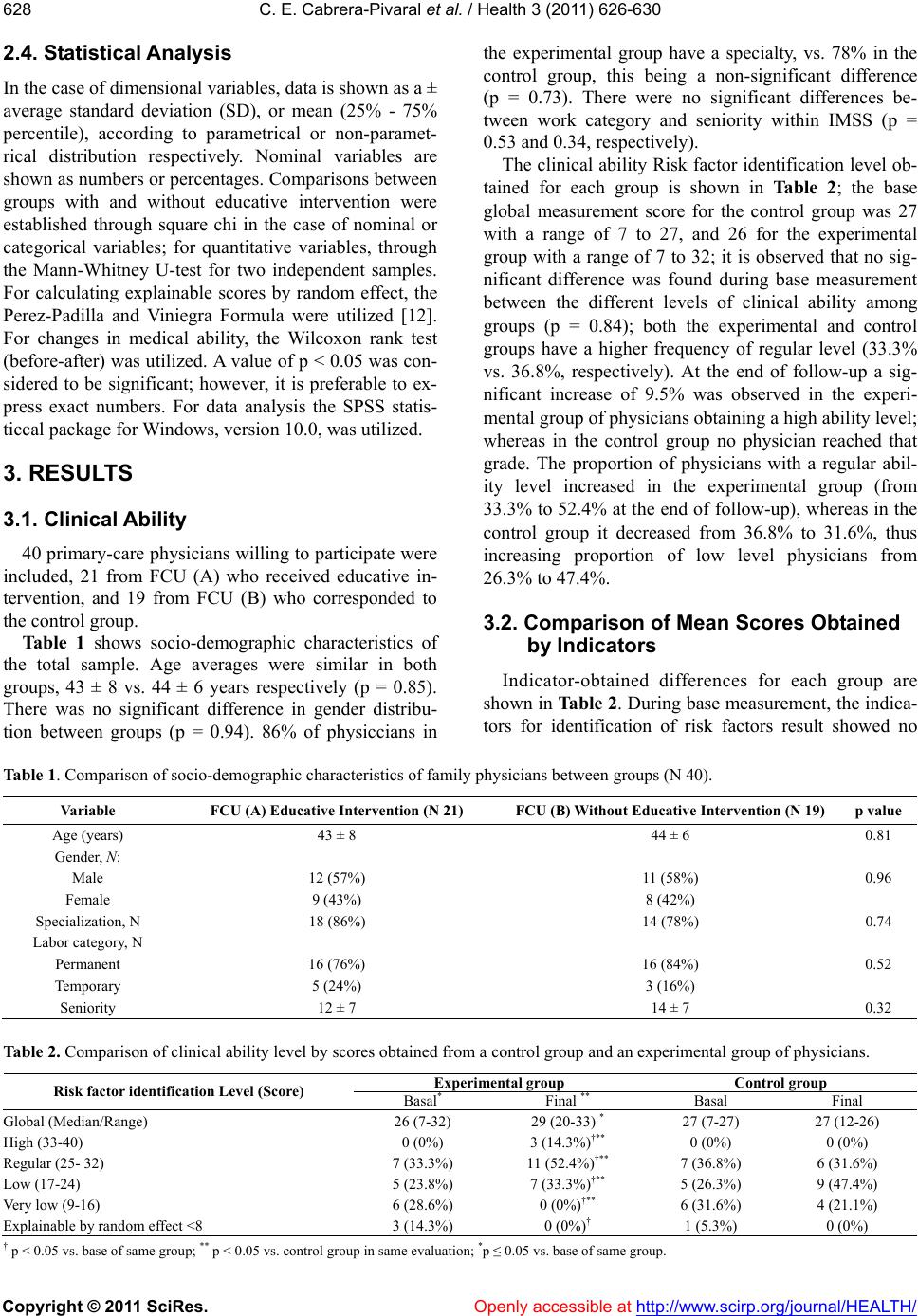 C. E. Cabrera-Pivaral et al. / Health 3 (2011) 626-630 Copyright © 2011 SciRes. http://www.scirp.org/journal/HEALTH/Openly accessible at 628 2.4. Statistical Analysis In the case of dimensional variables, data is shown as a ± average standard deviation (SD), or mean (25% - 75% percentile), according to parametrical or non-paramet- rical distribution respectively. Nominal variables are shown as numbers or percentages. Comparisons between groups with and without educative intervention were established through square chi in the case of nominal or categorical variables; for quantitative variables, through the Mann-Whitney U-test for two independent samples. For calculating explainable scores by random effect, the Perez-Padilla and Viniegra Formula were utilized [12]. For changes in medical ability, the Wilcoxon rank test (before-after) was utilized. A value of p < 0.05 was con- sidered to be significant; however, it is preferable to ex- press exact numbers. For data analysis the SPSS statis- ticcal package for Windows, version 10.0, was utilized. 3. RESULTS 3.1. Clinical Ability 40 primary-care physicians willing to participate were included, 21 from FCU (A) who received educative in- tervention, and 19 from FCU (B) who corresponded to the control group. Table 1 shows socio-demographic characteristics of the total sample. Age averages were similar in both groups, 43 ± 8 vs. 44 ± 6 years respectively (p = 0.85). There was no significant difference in gender distribu- tion between groups (p = 0.94). 86% of physiccians in the experimental group have a specialty, vs. 78% in the control group, this being a non-significant difference (p = 0.73). There were no significant differences be- tween work category and seniority within IMSS (p = 0.53 and 0.34, respectively). The clinical ability Risk factor identification level ob- tained for each group is shown in Table 2; the base global measurement score for the control group was 27 with a range of 7 to 27, and 26 for the experimental group with a range of 7 to 32; it is observed that no sig- nificant difference was found during base measurement between the different levels of clinical ability among groups (p = 0.84); both the experimental and control groups have a higher frequency of regular level (33.3% vs. 36.8%, respectively). At the end of follow-up a sig- nificant increase of 9.5% was observed in the experi- mental group of physicians obtaining a high ability level; whereas in the control group no physician reached that grade. The proportion of physicians with a regular abil- ity level increased in the experimental group (from 33.3% to 52.4% at the end of follow-up), whereas in the control group it decreased from 36.8% to 31.6%, thus increasing proportion of low level physicians from 26.3% to 47.4%. 3.2. Comparison of Mean Scores Obtained by Indicators Indicator-obtained differences for each group are shown in Table 2. During base measurement, the indica- tors for identification of risk factors result showed no Table 1. Comparison of socio-demographic characteristics of family physicians between groups (N 40). Variable FCU (A) Educative Intervention (N 21) FCU (B) Without Educative Intervention (N 19) p value Age (years) 43 ± 8 44 ± 6 0.81 Gender, N: Male 12 (57%) 11 (58%) 0.96 Female 9 (43%) 8 (42%) Specialization, N 18 (86%) 14 (78%) 0.74 Labor category, N Permanent 16 (76%) 16 (84%) 0.52 Temporary 5 (24%) 3 (16%) Seniority 12 ± 7 14 ± 7 0.32 Table 2. Comparison of clinical ability level by scores obtained from a control group and an experimental group of physicians. Experimental group Control group Risk factor identification Level (Score) Basal* Final ** Basal Final Global (Median/Range) High (33-40) Regular (25- 32) Low (17-24) Very low (9-16) Explainable by random effect <8 26 (7-32) 0 (0%) 7 (33.3%) 5 (23.8%) 6 (28.6%) 3 (14.3%) 29 (20-33) * 3 (14.3%)†** 11 (52.4%)†** 7 (33.3%)†** 0 (0%)†** 0 (0%)† 27 (7-27) 0 (0%) 7 (36.8%) 5 (26.3%) 6 (31.6%) 1 (5.3%) 27 (12-26) 0 (0%) 6 (31.6%) 9 (47.4%) 4 (21.1%) 0 (0%) † p 0.05 vs. base of same group; ** p < 0.05 vs. control group in same evaluation; *p ≤ 0.05 vs. base of same group. <  C. E. Cabrera-Pivaral et al. / Health 3 (2011) 626-630 Copyright © 2011 SciRes. Openly accessible at http://www.scirp.org/journal/HEALTH/ 629629 significant difference among groups. At the end of the intervention, the experimental group had increased indicators in the identification of risk fac- tors. For the control group, none of the indicators showed statistically significant differences when relating initial and final measurements. 4. DISCUSSION With regard to the educative process, it is acknowl- edged that both groups at the beginning of the educative intervention showed a homogeneous distribution in rela- tion to competence levels of clinical ability; after the educative intervention in the control group, a downward displacement was observed without presenting any cases explainable by chance, where the control group showed no modifications concerning the levels of product study variables of informative rote learning, characterized within traditional teaching-learning models [7]. In the experimental group, an upward displacement was observed in competence levels of clinical ability concerning decision making in patient management. It is important to recognize that only one physician is at a very low level and/or random and that there exists a 30% increase in regular level and the appearance of two phy- sicians in the high level [17,18]. While the communicative-participative strategy which was offered to the family physicians in the experimental group was marked by reflection-action over the inter- pretation of risk factors, similar data to those reported by Gonzalez C.A. [3], measuring the effect of an educa- tive intervention within critical readings of investigation reports.. This educative strategy, an alternative to the tradi- tional model, allows the advancement of family physic- cians at different levels, because educative methodology fosters physicians’ participation in the construction of their own knowledge generated by confronting difficult, real clinical cases. The advantage observed at the different levels of the experimental group reflects the impact of the alternative educative program which needs to be a programmatic guide for future educative interventions for health work- ers seeking to transform their own clinical practice without forgetting that, to influence behavioral change in patients with MS, the cultural sphere where it is devel- oped should be considered. Of upmost importance is the proposal to modify the educative processes concerning the formation of human resources as well as the continuous education to transfer the clinical practice to higher levels of ability; this de- mands the adequate living reality as the first level of attention with the objective of delivering integral ser- vices. The utilization of human behavior measurement in- struments along with clinical practice have become more and more useful to assess the processes of human re- sources formation and service delivery. These kinds of instruments aim to discriminate dominance over one particular issue, namely, competence of clinical ability, which demands a level of reliability within its construc- tion to avoid information biases; characteristics which this study covers and which allows control of said biases together with discrimination of the diverse levels of clinical ability. It must be recognized, however, that this system does not allow identification of qualitative vari- ables that could be generating a favorable difference which is assumed to be controlled through homogeniza- tion of groups [19,20]. The alternative educative model used led to the in- volvement of family physicians through recognition of the creation of their own knowledge in a mainstream manner and which unchained and directed refined pro- posals in the clinical practice of MS measured by self- criticism. It is acknowledged that the experimental group was formed by family physicians, the majority of whom were specialized in family medicine, and that this could have an impact on the educative strategy in the levels of clinical ability; before the intervention, however, such levels were homogeneous, which reflects the initial con- trol for these variables, thus all improvements in the ex- perimental group were due to the effect of educative intervention and not to a probable confusion variable. The participation of the experimental group leader was due to the learning commitment in the reflection- action mode, and who was responsible for developing strategies to promote the family physicians’ participation with the aim of building their own knowledge from re- flection-action patterns which were lacking in the con- trol group. Finally, the utilization of educative investigation as a learning tool (which allows feedback of educative proc- ess) allows consolidation of educative strategies which directs family physicians’ participation within formative schemes for their clinical practice, which contribute to the development of competence concerning clinical abil- ity in its different levels, and it can be applied not only in the matter of a patient with metabolic syndrome but in any other condition which requires the physician’s clini- cal ability to reach an accurate diagnosis and timely treatment. Because the prevalence of MS in Mexico is high as in other countries; as well as the cardiovascular and meta- bolic consequences of this syndrome, that can be gener- ated by the lack of an early diagnosis and timely treat- ment, it is recommended that the first contact physicians  C. E. Cabrera-Pivaral et al. / Health 3 (2011) 626-630 Copyright © 2011 SciRes. Openly accessible at http://www.scirp.org/journal/HEALTH/ 630 be trained regularly through such educational strategies with the aim of providing the most appropriated tools for increasing their clinical competence as reflected in a better decision making in benefit of their patients. REFERENCES [1] Lerman, G.I., Aguilar-Salinas, C.A., Gómez-Pérez, F.J., Reza, A. A., Hernández, J. S. (2004) El síndrome meta- bólico, posición de la Sociedad Mexicana de nutrición y endocrinología, sobre la definición, fisiopatología y diagnóstico. Características del síndrome metabólico en México. Revista de Endocrinología y Nutrición, 12, 109-122. [2] Luquez, H., De Loredo, L., Madoery, R.J. (2005) Sínd- rome Metabólico: prevalencia en dos comunidades de Cordóba Argentina de acuerdo con definiciones de ATP III y OMS. Revista de la Federacion Argentina de Cardiologia, 43, 80-95. [3] Rodríguez, P.A., Sánchez, L.M., Martínez, V.L. (2002) Síndrome metabólico. Rev Cub Endocrinol, 13, 238-252. [4] Dekker, J. M., Girmain, C., Rhodes, T., Nipjels, G. (2005) Metabolic Síndrome and 10 year cardiovascular disease risk in the Hoorn study. Circulation, 112, 666-673. [5] Gutiérrez, G.S.N., Aguilar, M.E., Viniegra, V.L. (2001) Validación de un instrumento para evaluar la compet- encia clínica del médico familiar. Revista Medica del Instituto Mexicano del Seguro Social, 37, 201-210. [6] Chávez, V., Aguilar, M. (2002) Aptitud clínica en el manejo de la familia, en residentes de Medicina Familiar. Revista Medica del Instituto Mexicano del Seguro Social, 40, 477-481. [7] Burr, W.A. (2004) Diabetes UK. Diabetic Medicine, 21, 1-16 [8] Viniegra, V.L., Pérez-Padilla, J.L., (1991) JR. El desafío de la evaluación de la competencia clínica, Revista Medica del Instituto Mexicano del Seguro Social, 43, 87-95. [9] Larios, M.H., Trejo, M.J.A., Cortés, G.T. (1998) Eva- luación de la competencia clínica. Revista Medica del Instituto Mexicano del Seguro Social, 36, 77-82. [10] Rothman, A. I., Blackmore, D., Cohen, R., Reznic, R. (1996) The consistency and uncertainty in examiners’ definitions of pass/fail performance on OSCE stations. Evaluation & the Health Professions, 16, 322-332. [11] Garfias, G.G., Aguilar, M.E., Viniegra, V.L. (1997) Cómo explorar las aptitudes de los médicos residentes de traumatología y ortopedia en traumatismo cráneo ence- fálico. Revista de la Federacion Argentina de Ca rdiologia, 35, 233-237. [12] Carlos, A.H., Miriam, D., Sánchez, I., Pérez, C.P., Nor- berto, E. (2004) Aptitud clínica durante el internado de pregrado en hospitales generales. Revista de la Fede- racion Argentina de Cardiologia, 42, 469-476. [13] Searle, J. (2000) Defining competency-the role of stan- dard setting. Med Educ, 34, 363-366. [14] Gadner, W., Nutting, P.A., Kelleher, K.J. (1996) Does the family Apgar effectively measure family functioning? Aten Primaria, 17, 338-341. [15] Sánchez, T.E., Pérez, C.L., Navarro, L.M.E., Kum- azagua, I.M., Vázquez-Garibay, E. (1994) Dinámica Familiar: Metodología para su evaluación. American Journal of Disease, 7, 48-52. [16] Lara, E.A., Carrillo, T.J., Carrasco, M.M. (2005) Nutri- ción en el Síndrome Metabólico. Annual Review del Colegio de Medicina Interna de México; 1ª Edición, México, Editorial Intersistemas. [17] González, C.A., Sánchez, Z.M., Elizondo, A.S. Malanco, H.L. (2005) Inflamación y resistencia a la insulina, su papel en el desarrollo del síndrome meta-bólico. Annual Review del Colegio de Medicina Interna de México; 1ª Edición, México, Editorial Intersistemas. [18] Sabido, S.M.C., Viniegra, V.L. (2000) Competencia y desempeño en la evaluación del médico: estudio con pacientes diabéticos en el primer nivel de atención. En: Viniegra VL. La investigación en la educación. Papel de la teoría y de la observación. México, IMSS, 1ª Edición, pp. 251-270. [19] Vázquez-Garibay, E., Sánchez, T.E, Navarro, L.M.E., Romero, V.E., Pérez, C.L., Kumazagua, I.M.R. (2003) Instrumento de Medición de la dinámica de la familia nuclear mexicana. Un enfoque cuantitativo. Boletín médico del Hospital Infantil de México, 60, 33-52. [20] SECRETARIA DE SALUD: Reglamento de la Ley General de Salud en materia de investigación para la salud. (1990) México, D.F. Editorial SSA. http://salud.gob.mx/unidades/cdi/nom/compi/rlgsmis.htl m |