

Paper Menu >>
Journal Menu >>
 Surgical Science, 2011, 2, 422-426 doi:10.4236/ss.2011.28092 Published Online October 2011 (http://www.SciRP.org/journal/ss) Copyright © 2011 SciRes. SS Applicability of Sigmoid Colon Graft for Vaginal Replacement (Colovaginoplasty) at Young Age Mohamed A. Baky Fahmy1, Hanaa Abdel Hamid M. Al Abeissy1, Mohamed M. Abdalla2 1Al Azher University, Cairo, Egypt 2Al Galaa Teaching Hospital, Cairo, Egypt E-mail: [email protected] Received June 9, 2011; revised A ugust 13, 2011; accepted August 25, 2011 Abstract Objective: to evaluate the applicability, feasibility, complications, short and long term results of vagino- plasty by using sigmoid colon graft with stapler assistance for resuming colonic continuity in children with absent vagina. Patients and Methods: records of 15 patients 8 of them had Androgen Insensitivity Syn- drome, 4 had congenital vaginal atresia, and 3 had Congenital Adrenal Hyperplasia, underwent sigmoid graft vaginal reconstruction with the aid of circular stapler during the period from 2005 to 2010 were reviewed retrospectively. Results: a neovagina was constructed in those patients who aged from 3 to 9 years (mean 4 years), where sigmoid colon was used in all patients. Hospital stay ranged from 5 to 12 days (mean 7), op- erative time ranged from 60 min to 120 min (mean 75 min). All patients were followed up 6 monthly in the first year and then yearly, complications occurred in 4 patients: introital stenosis in 2, and another 2 cases had minor wound infection. The need for neovaginal dilation was indicated in 5 out of 15 patients. There was no complications related to bowel anastomosis, no mortality in this group and the cosmetic results were ex- cellent in all cases. Conclusion: sigmoid colovaginoplasty appears to be applicable for remedy of vaginal atresia at any age. It is associated with a less complication rate, the long term results is satisfactory and it seems a better technique, especially in girls who doesn’t expect sexual activity shortly after surgery. Keywords: Vaginal Replacement, Vaginal Atresia, Stapler, Neovagina, Colovaginoplasty and Sigmoid Graft 1. Introduction Surgical management of girls with congenital absent vagina continues to be a major technical problem due to a prospective functional and psychological effect of the outcome. The majority of cases of absent vagina result from abnormality results from congenital adrenal hyper- trophy, müllerian duct failure, androgen insensitivity syndrome and gonadal dysgenesis [1]. Co nst ruction of an artificial vagina had undergone a long evolution from conservative to various surgical methods since 1938 when Frank proposed a nonsurgical approach using various instruments and saddle-like devices that exerted pressure on the vaginal vestibule [2]. This method re- placed the technique proposed by Baldwin in 1904 [3], whereby the vagina was reconstructed using an isolated segment of small intestine, Pratt in 1961 proposed the use of sigmoid colon in vaginal reconstruction [4]. With the same purpose in mind cecum had been used, others proposed a dermatome-collected cutaneous graft, mu- cous membrane flap harvested from the bladder, and peritoneal fragment advanced from the Douglas pouch. Vaginal reconstruction was also performed with skin island flaps created in the perineal and inguinal region [7]. It is widely accepted that staplers use for resuming bowel anastomosis is effective in reducing operating time and potential complications related to their use spe- cially in the pediatric population [8]. In this study the sigmo id graft used fo r vaginal reconstruction winning the advantage of surgical stapler to reduce the time of re- suming bowel continuity and to minimize the complica- tion rate related to bowel anastomosis and the whole procedure. 2. Patients and Method During a period of 5 years, from 2005 to 2010 a total of 15 patients had an indication for vaginal replacement due to different pathology was reviewed. Abdominal ultrasound, chromosomal analysis and hor- 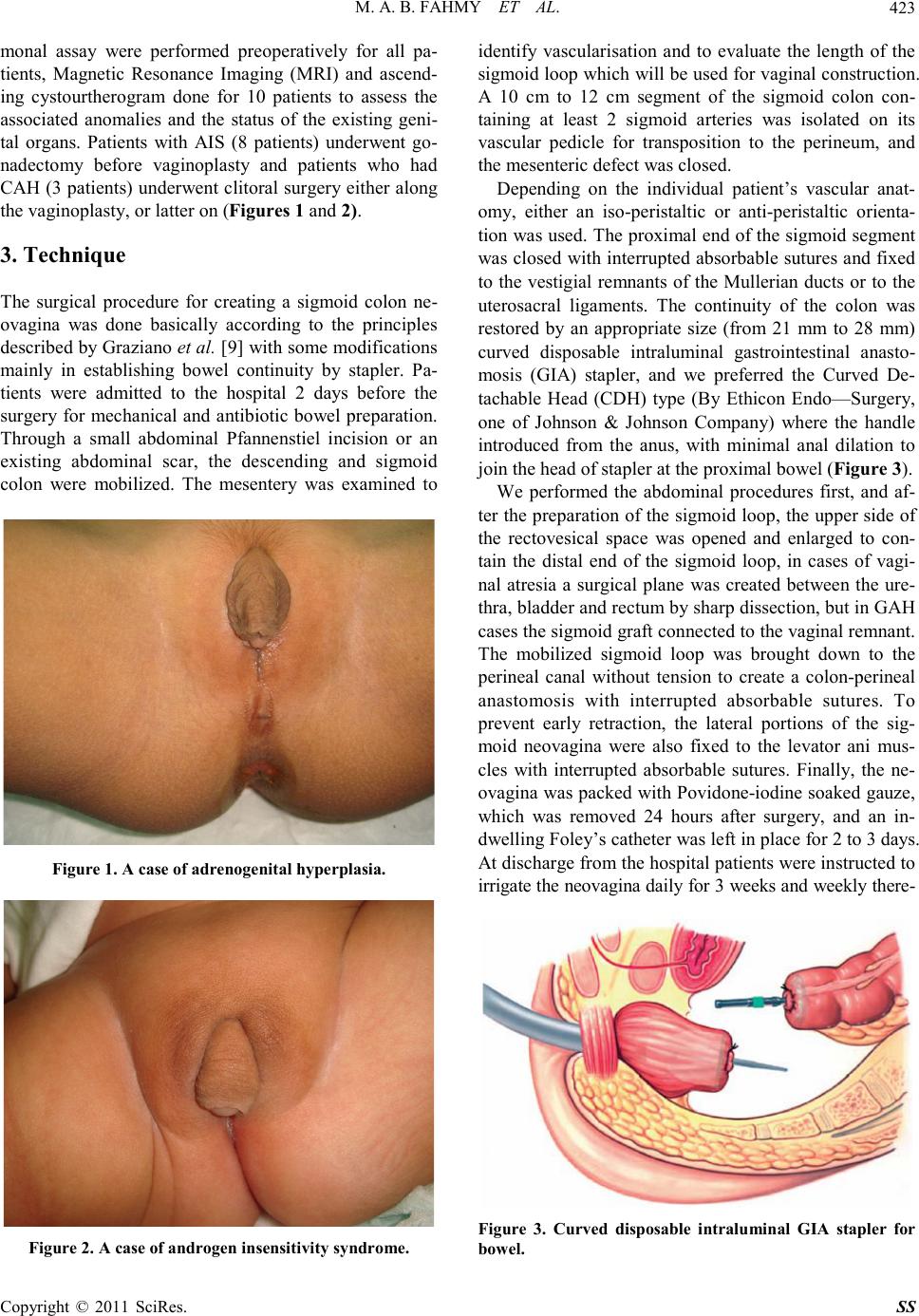 M. A. B. FAHMY ET AL.423 monal assay were performed preoperatively for all pa- tients, Magnetic Resonance Imaging (MRI) and ascend- ing cystourtherogram done for 10 patients to assess the associated anomalies and the status of the existing geni- tal organs. Patients with AIS (8 patients) underwent go- nadectomy before vaginoplasty and patients who had CAH (3 patients) underwent clitoral surgery either along the vaginoplasty, or latter on (Figures 1 and 2). 3. Technique The surgical procedure for creating a sigmoid colon ne- ovagina was done basically according to the principles described by Graziano et al. [9] with some modifications mainly in establishing bowel continuity by stapler. Pa- tients were admitted to the hospital 2 days before the surgery for mechanical and antibiotic bowel preparation. Through a small abdominal Pfannenstiel incision or an existing abdominal scar, the descending and sigmoid colon were mobilized. The mesentery was examined to Figure 1. A case of adrenoge nital hyperplasia. Figure 2. A case of androgen insensitivity syndrome. identify vascularisation and to evaluate the length of the sigmoid loop which will be used for vaginal construction. A 10 cm to 12 cm segment of the sigmoid colon con- taining at least 2 sigmoid arteries was isolated on its vascular pedicle for transposition to the perineum, and the mesenteric defect was closed. Depending on the individual patient’s vascular anat- omy, either an iso-peristaltic or anti-peristaltic orienta- tion was used. The proximal end of the sigmoid segment was closed with interrupted absorbable sutures and fixed to the vestigial remnants of the Mullerian ducts or to the uterosacral ligaments. The continuity of the colon was restored by an appropriate size (from 21 mm to 28 mm) curved disposable intraluminal gastrointestinal anasto- mosis (GIA) stapler, and we preferred the Curved De- tachable Head (CDH) type (By Ethicon Endo—Surgery, one of Johnson & Johnson Company) where the handle introduced from the anus, with minimal anal dilation to join the head of stapler at the proximal bowel (Figure 3). We performed the abdominal procedures first, and af- ter the preparation of the sigmoid loop, the upper side of the rectovesical space was opened and enlarged to con- tain the distal end of the sigmoid loop, in cases of vagi- nal atresia a surgical plane was created between the ure- thra, bladder and rectum by sharp dissection, but in GAH cases the sigmoid graft connec ted to the vaginal remnant. The mobilized sigmoid loop was brought down to the perineal canal without tension to create a colon-perineal anastomosis with interrupted absorbable sutures. To prevent early retraction, the lateral portions of the sig- moid neovagina were also fixed to the levator ani mus- cles with interrupted absorbable sutures. Finally, the ne- ovagina was packed with Povidone-iodine soaked gauze, which was removed 24 hours after surgery, and an in- dwelling Foley’s catheter was left in place for 2 to 3 days. At discharge fro m the hospital pa tients were instr ucted to irrigate the neovagina daily for 3 weeks and weekly there- Figure 3. Curved disposable intraluminal GIA stapler for bowel. Copyright © 2011 SciRes. SS 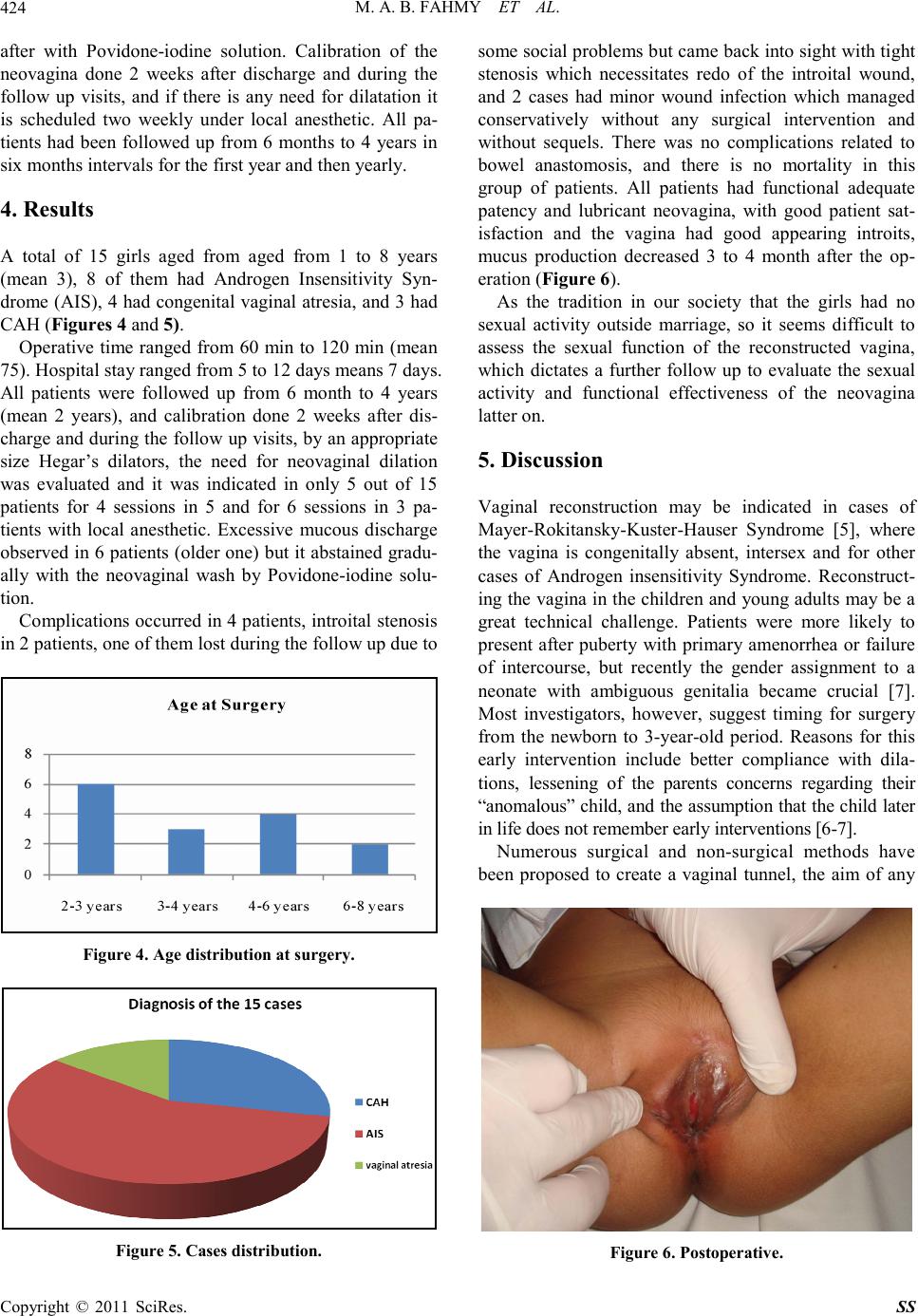 M. A. B. FAHMY ET AL. 424 after with Povidone-iodine solution. Calibration of the neovagina done 2 weeks after discharge and during the follow up visits, and if there is any need for dilatation it is scheduled two weekly under local anesthetic. All pa- tients had been followed up from 6 months to 4 years in six months intervals for the first year and then yearly. 4. Results A total of 15 girls aged from aged from 1 to 8 years (mean 3), 8 of them had Androgen Insensitivity Syn- drome (AIS), 4 had congenital vaginal atresia, and 3 had CAH (Figures 4 and 5). Operative time ranged from 60 min to 120 min (mean 75). Hospital stay ranged from 5 to 12 days means 7 days. All patients were followed up from 6 month to 4 years (mean 2 years), and calibration done 2 weeks after dis- charge and during the follow up visits, by an appropriate size Hegar’s dilators, the need for neovaginal dilation was evaluated and it was indicated in only 5 out of 15 patients for 4 sessions in 5 and for 6 sessions in 3 pa- tients with local anesthetic. Excessive mucous discharge observed in 6 patients (older one) but it abstained gradu- ally with the neovaginal wash by Povidone-iodine solu- tion. Complications occ urred in 4 patients, introital ste nosis in 2 patients, one of them lost during the follow up due to Figure 4. Age distribution at su rgery. Figure 5. Cases distri b utio n. some social pro blems b ut came back into s ight with ti ght stenosis which necessitates redo of the introital wound, and 2 cases had minor wound infection which managed conservatively without any surgical intervention and without sequels. There was no complications related to bowel anastomosis, and there is no mortality in this group of patients. All patients had functional adequate patency and lubricant neovagina, with good patient sat- isfaction and the vagina had good appearing introits, mucus production decreased 3 to 4 month after the op- eration (Figure 6). As the tradition in our society that the girls had no sexual activity outside marriage, so it seems difficult to assess the sexual function of the reconstructed vagina, which dictates a further follow up to evaluate the sexual activity and functional effectiveness of the neovagina latter on. 5. Discussion Vaginal reconstruction may be indicated in cases of Mayer-Rokitansky-Kuster-Hauser Syndrome [5], where the vagina is congenitally absent, intersex and for other cases of Androgen insensitivity Syndrome. Reconstruct- ing the vagina in the children and young adults may be a great technical challenge. Patients were more likely to present after puberty with primary amenorrhea or failure of intercourse, but recently the gender assignment to a neonate with ambiguous genitalia became crucial [7]. Most investigators, however, suggest timing for surgery from the newborn to 3-year-old period. Reasons for this early intervention include better compliance with dila- tions, lessening of the parents concerns regarding their “anomalou s” child, and the assu mption that the child later in life does not remember early interventions [6-7]. Numerous surgical and non-surgical methods have been proposed to create a vaginal tunnel, the aim of any Figure 6. Postoperative. Copyright © 2011 SciRes. SS  M. A. B. FAHMY ET AL.425 method is to provide a canal of adequate length, which is lined with mucous membrane, characterised by a low tendency to stenosis and comfortable during sexual ac- tivity. Although used as a first-line of treatment for dec- ades, skin grafts and dilation techniques are associated with a high incidence of shrinkage, lack of lubrication and dyspareunia [10]. Intestinal transplant methods to create a functioning neovagina were advocated more than 100 years ago; the advantages of these methods include adequate vaginal length, natural lubrication, early intercourse and a low rate of shrinkage [3]. Most segments of the intestinal tract have been used to create a neovagina, but the sig- moid colon is particularly useful because it is anatomi- cally close to t he perineum, it is s ufficiently lon g and the mobility of its vascular pedicle allows it to be brought into the perineum [11]. Also the bowel vaginoplasty utilizing sigmoid colon offers some advantages over skin grafts because of dis- tensibility and sel f lubricating pro perty with no tendency for neovagina stenosis, but it has the drawbacks of a laparotomy with visible scars, possibility of bowel leak- age/obstruction and problem of mucous secretion [12]. Also the sigmoid segments of the colon could be liable for inflammatory bowel disease [13], primary adenocar- cinoma has been reported, so vaginoscopy should be used for any case of postoperative bleeding, pain, or suspected mass .There have been reports of mucosal prolapse, as well as of stenosis [14]. The Vecchietti technique [15] and its laparoscopic varia nt re quir es a va gina l d i mple o f 3 - 4 c m, a long t ime and rigorous cooperation by the patients to achieve ac- ceptable results [15]. In the last decades, due to the progress in anesthesia, antibiotic use and the reduction of risks associated with colorectal anastomosis, the sigmoid graft technique has became the first-line choice for the treatment of vaginal agenesis in both children and adults [16]. A sigmoid ne- ovagina is cosmetically pleasing, offers natural lubrica- tion and during creation can be anchored to prevent prolapse. A collective analysis of 202 patients from 7 recent se- ries of bowel neovaginoplasty found a complication rate of 35% and a re-operation rate of 4%. These rates of complications are not comparable to those reported for skin gr aft vaginoplasties [1 0]. In this study we used the sigmoid graft as a preferable procedure in 15 patients aged from1 to 8 years (mean 3 years), a historical cohort study of those consecutive pa- tients who underwent neovagina reconstruction were presented. A dedicated database was reviewed for the etiology of vaginal malformation, surgical complications and post- operative follow-up, where Androgen Insensitivity Syn- drome (AIS) was the common cause of vaginal atresia (8 pati ents), 4 had congenital vaginal atresi a (Figure 5). In this small series the introduction of surgical stapler for resuming the bowel continuity enabled to shorten the time of surgery (60 min to 120 min, mean 75), to reduce the hospital sta y which ranged from 5 to 12 days means 7 days, and we claim that it is al so li mits the complications of bowel anastomosis to nil. But other complications encountered in 4 patients, in- troital stenosis in 2 patients, one of them had a tight stenosis which necessitates redo of the introital wound, and 2 cases had minor postoperative wound infection which managed conservatively with local wash and sys- temic antibiotic for 5 days without any surgical interven - tion and without sequels. There were no long term com- plications or impediment related to bowel anastomosis, and there is no mortality in this group of patients. All patients had functional adequate patency and lubricant neovagina, with good patient satisfaction and the vagina had fine appearing introits and mucus production de- creased 3 to 4 month after the operation. 6. Conclusions Vagina could be reconstructed with better success rate and low complication rate by using sigmoid colon, it does not require moulds, dilatation, lubricant, and the vagina gro ws with t he child and could be used in differ - ent diagnosed vaginal atresia, especially in girls who doesn’t expect sexual activity shortly after surgery. The use of stapler to reestablish the bowel continuity seems to minimize the time of the technique and decline the rate of complications related to bowel anastomosis. The long-term satisfaction with the sigmoid neovagina for intercourse, especially in girls had their vagina con- structed before puberty, still requires long-term evalua- tion. 7. References [1] D. M. Powell, K. D. Newman and J. Randloph, “A Pro- posed Classification of Vaginal Anomalies and Their Surgical Correction,” Journal of Pediatric Surgery, Vol. 30, No. 2, 199 5 , pp. 271-276 . do i:10.1016/ 0022- 3468( 95)90 573-1 [2] R. T. Frank, “The Formation of an Artificial Vagina with- out Operation,” American Journal of Obstetrics & Gyne- cology, Vol. 35, 1938, pp. 1053-1055. [3] J. F. Baldwin, “The Formation of an Artificial Vagina by Intestinal Transplantation,” Annals of Surgery, Vol. 40, No. 3, 1904, pp. 398-403. [4] J. H. Pratt, “Sigmoidovaginostomy: A New Method of Obtaining Satisfactory Vaginal Depth,” American Jour- Copyright © 2011 SciRes. SS  M. A. B. FAHMY ET AL. Copyright © 2011 SciRes. SS 426 nal of Obstet rics & Gynecolog y, Vol. 81, No. 3, 1961, pp. 535-545. [5] G. E. Griffin, C. Edwards, J. M. Madden, M. J. Harrod, and J. D. Wilson, “Congenital Absence of the Vagina the Mayer-Rokitansky-Kuster-Hauser Syndrome,” Annals of Internal Medicine, Vol. 85, No. 2 , 1976, pp. 2224- 22 3 6 . [6] R. J. Miller and L. L. Breech, “Surgical Correction of Vaginal Anomalies,” Clinical Obstetrics and Gynecology, Vol. 51, No. 2, 2008, pp. 223-236. do i:10.1097/ GRF.0b013e31816 d2181 [7] J. M. Schober, “Long-Term Outcomes and Changing Attitudes to Intersexuality,” BJU International, Vol. 83, No. S3, 1999, pp. 39-50. do i:10.1046/ j.146 4-410 x.1999.0830s3039.x [8] G. Mattioli, M. Castagnetti, P. Repetto, et al., “Co mplica- tions of Mechanical Suturing in Pediatric Patients,” Journal of Pediatric Surgery, Vol. 38, No. 7, 2003, pp. 1051- 10 54. doi:10.1016/S0022-3468(03)00190-8 [9] K. Graziano, D. H. Teitelbaum, R. B. Hirschl and A. G. Coran, “Vaginal Reconstruction for Ambiguous Genitalia and Congenital Absence of the Vagina: A 27-Year Ex- perience,” Journal of Pediatric Surgery, Vol. 37, No. 7, 2002, pp. 955- 960. doi:10.1053/jpsu.2002.33815 [10] A. Rajimwale, P. D. Furness, W. O. Brant and M. A. Koyle, “Vaginal Construction Using Sigmoid Colon in Children and Young Adults,” BJU International, Vol. 94, No. 1, 2004, pp. 115-119. doi:10.1111/j.1464-4096.2004.04911.x [11] W. H. Hendr en and A. Atala, “Use o f Bowel for V aginal Reconstruction,” The Journal of Urology, Vol. 152, No. 2, 1997, pp . 752-755. [12] R. Lenaghan, N. Wilson, C. E. Lucas and A. M. Ledger- wood, “The Role of Rectosigmoid Neocolporrhaphy,” Surgery, Vol. 122, No. 4, 1997 , pp. 856-860. doi:10.1016/S0039-6060(97)90098-2 [13] D. P. Froese, R. Haggitt and W. G. Friend, “Ulcerative Colitis in Autotransplanted Neovagina,” Gastroenterol- ogy, Vol. 100, No. 6, 199 1, pp . 1 749 - 1 7 5 2. [14] M. Urrsic-Vrscaj, J. Lindtner, J. Lavomovec et al., “Adenocarcinoma in Sigmoid Neovagina,” European Journal of Gyneacological/Oncology, Vol. 15, No. 1, 1994, pp. 24- 2 8. [15] F. Borruto, S. T. Chasen, F. A. Chervenak and L. Fedele, “The Vecchietti Procedure for Surgical Treatment of Vaginal Agenesis: Comparison of Laparoscopy and Laparotomy,” International Journal of Gynaecology and Obstetrics, Vol. 64, No. 2, 1999, pp. 1 5 3-158. doi:10.1016/S0020-7292(98)00244-6 [16] J. C. Goligher, “The Use of Pedicled Transplant of Sig- moid for Vaginal Construction,” Annals of the Royal College of Surgeons of England, Vol. 65, No. 6, 1983, pp. 353-355. Appendix Abbreviation Androgen Insensitivity Syndrome (AIS), Congenital Ad- renal Hyperplasia (CAH), Gastrointestinal Anastomosis (GIA), Curved Detachable Head (CDH). |