

Paper Menu >>
Journal Menu >>
 Open Journal of Discrete Mathematics, 2011, 1, 108-115 doi:10.4236/ojdm.2011.13014 Published Online October 2011 (http://www.SciRP.org/journal/ojdm) Copyright © 2011 SciRes. OJDM Bijections between Lattice Paths and Plane Partitions Mateus Alegri1, Eduardo Henrique de Mattos Brietzke2, José Plínio de Oliveira Santos3*, Robson da Silva4 1Departamento de Matemática, UFS, Campus Itabaiana, Itabaiana-SE, Brazil 2Instituto de Matemática, UFRGS, Porto Alegre-RS, Brazil 3IMECC-UNICAMP, Campinas-SP, Brazil 4ICE-UNIFEI, Itaju bá-MG, Brazil E-mail: [email protected], [email protected], *[email protected], [email protected] .br Received July 4, 2011; revised August 5, 2011; accepted August 15, 2011 Abstract By using lattice paths in the three-dimensional space we obtain bijectively an interpretation for the overparti- tions of a positive integer n in terms of a set of plane partitions of n. We also exhibit two bijections between unrestricted partitions of n and different subsets of plane partitions of n. Keywords: Lattice Paths, Plane Partitions, Partitions, q-Analog. 1. Introduction In [1], one of us, Santos, in a joint work with Mondek and Ribeiro, introduced a new combinatorial interpreta- tion for partitions in terms of two-line matrices. In that paper a new way of representing, as two-line matrices, unrestricted partitions and several identities from Slater’s list ([2]) including Rogers-Ramanujan Identities, and Lebesgue’s Partition Identity is described. In [3] we were able to provide a number of bijective proofs for several identities based on the two-line matrix representation, including a new bijective proof for the Lebesgue Identity, as well as a combinatorial proof for an identity related to three-quadrant Ferrers graphs, given by Andrews (see [4]). The possibility of associating a partition of n to a two-line matrix and the two-line matrix to a lattice path from the origin to the line x + y – n was mentioned in [1]. This construction can be done in many different ways. Each one of those provides us with a family of polyno- mials that are, each one, a q-analog for the partition func- tion. In order to construct these families it was employed the same idea of counting the lattice path according to the area limited by the path and the x-axis, as done by Pólya. Our main goal in the present paper is to associate a three-line matrix to a path in the 3-dimensional space, in order to build a volume, which is going to correspond to a plane partition. In this way it is possible to construct bijections from certain classes of plane partitions to overpartitions or unrestricted partitions. In some cases mock theta functions appear as the generating functions for these matrices (see [5]). 2. Background In this section we remember a few definitions and state a theorem that is the base for constructing the bijections. Definition 2.1 A partition of a positive integer n is a collection of positive integers 12 s such that 12 = s n . Each i is called a part of the partition. Definition 2.2 An overpartition is a partition where the first occurrence of a part can be overlined. Example 2.1 There are 14 overpartitions of 4: 4, 4,31,31,31,31,22, 22, 211,2 11,211,211,1111,1111 Definition 2.3 A Plane partition is a left-justified π array of positive integers such that ,,1 πij ij, πij ,1 1, max π,π iji j πij ij . We say that πis a plane partition of n if =n , ,1 . Now, if we stack , cubes over the position of each part of a plane partition , we obtain a geomet- rical figure in the first octant of the 3-dimensional space, which represents in the same way a Ferrers diagram represents a partition. πij ,ij π π Example 2.2 Below (shown in Figures 1 and 2) we have a plane partitions of 43 and its standard geometri- cal representation. 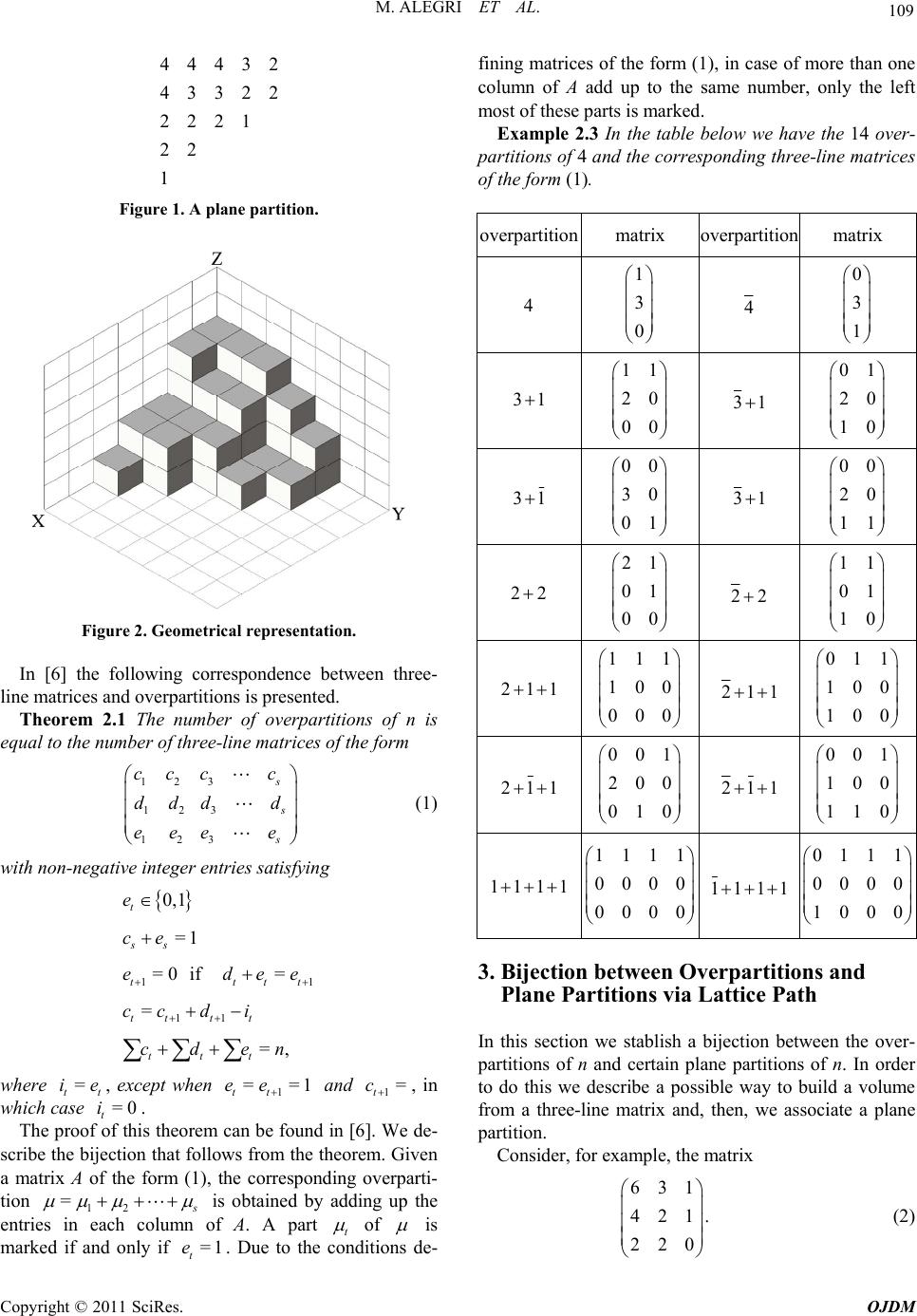 109 M. ALEGRI ET AL. 44432 43322 2221 22 1 Figure 1. A plane partition. Figure 2. Geometrical representation. In [6] the following correspondence between three- line matrices and overpartitions is presented. Theorem 2.1 The number of overpartitions of n is equal to the number o f three-line matrices of the form 123 123 123 s s s ccc c ddd d eee e (1) with non-negative integ er entries satisfying 11 11 0,1 =1 =0 if = = =, t ss ttt ttt t ttt e ce ede cc d i cden t e 1 where , except when and , in which case . = t ie t i t =0 1 == tt ee 1= t c The proof of this theorem can be found in [6]. We de- scribe the bijection that follows from the theorem. Given a matrix A of the form (1), the corresponding overparti- tion 12 = s is obtained by adding up the entries in each column of A. A part t of is marked if and only if . Due to the conditions de- fining matrices of the form (1), in case of more than one column of A add up to the same number, only the left most of these parts is marked. =1 t e Example 2.3 In the table below we have the 14 over- partitions of 4 and the corresp onding three-line matrices of the form (1). overpartitionmatrix overpartition matrix 4 1 3 0 4 0 3 1 31 11 20 00 31 01 20 10 31 00 30 01 31 00 20 11 22 21 01 00 22 11 01 10 211 111 100 000 211 011 100 100 211 001 200 010 211 001 100 110 1111 1111 0000 0000 1111 0111 0000 1000 3. Bijection between Overpartitions and Plane Partitions via Lattice Path In this section we stablish a bijection between the over- partitions of n and certain plane partitions of n. In order to do this we describe a possible way to build a volume from a three-line matrix and, then, we associate a plane partition. Consider, for example, the matrix 631 421. 220 (2) Copyright © 2011 SciRes. OJDM 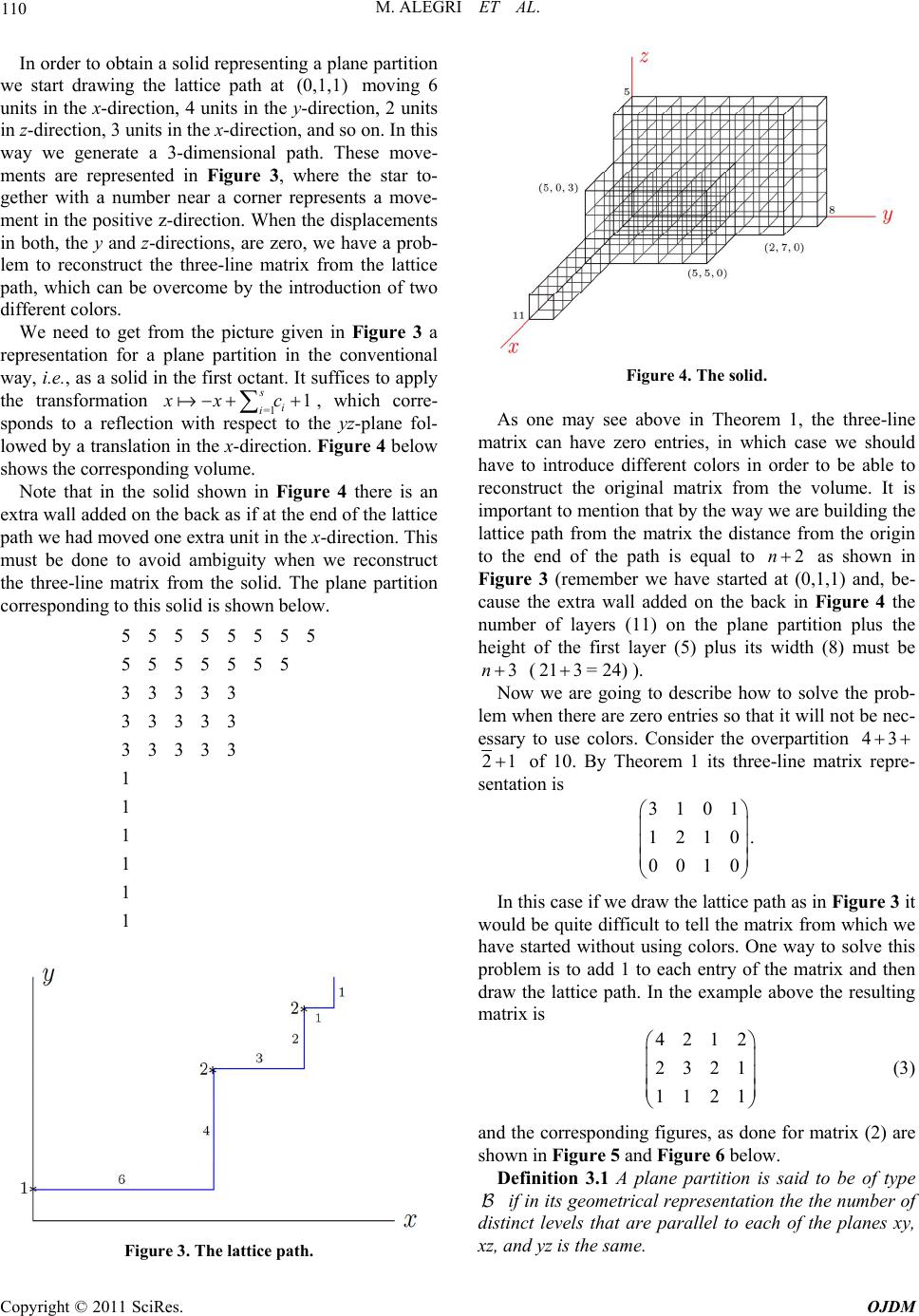 M. ALEGRI ET AL. 110 In order to obtain a solid representing a plane partition we start drawing the lattice path at moving 6 units in the x-direction, 4 units in the y-direction, 2 units in z-direction, 3 units in the x-direction, and so on. In this way we generate a 3-dimensional path. These move- ments are represented in Figure 3, where the star to- gether with a number near a corner represents a move- ment in the positive z-direction. When the displacements in both, the y and z-directions, are zero, we have a prob- lem to reconstruct the three-line matrix from the lattice path, which can be overcome by the introduction of two different colors. (0,1,1) We need to get from the picture given in Figure 3 a representation for a plane partition in the conventional way, i.e., as a solid in the first octant. It suffices to apply the transformation =1 , which corre- sponds to a reflection with respect to the yz-plane fol- lowed by a translation in the x-direction. Figure 4 below shows the corresponding volume. 1 s i i xx c Note that in the solid shown in Figure 4 there is an extra wall added on the back as if at the end of the lattice path we had moved one extra unit in the x-direction. This must be done to avoid ambiguity when we reconstruct the three-line matrix from the solid. The plane partition corresponding to this solid is shown below. 55555555 5555555 33333 33333 33333 1 1 1 1 1 1 Figure 3. The lattice path. Figure 4. The solid. As one may see above in Theorem 1, the three-line matrix can have zero entries, in which case we should have to introduce different colors in order to be able to reconstruct the original matrix from the volume. It is important to mention that by the way we are building the lattice path from the matrix the distance from the origin to the end of the path is equal to as shown in Figure 3 (remember we have started at (0,1,1) and, be- cause the extra wall added on the back in Figure 4 the number of layers (11) on the plane partition plus the height of the first layer (5) plus its width (8) must be 2n 3n (213 =24) ). Now we are going to describe how to solve the prob- lem when there are zero entries so that it will not be nec- essary to use colors. Consider the overpartition 43 21 of 10. By Theorem 1 its three-line matrix repre- sentation is 3101 1210. 0010 In this case if we draw the lattice path as in Figure 3 it would be quite difficult to tell the matrix from which we have started without using colors. One way to solve this problem is to add 1 to each entry of the matrix and then draw the lattice path. In the example above the resulting matrix is 4212 2321 1121 (3) and the corresponding figures, as done for matrix (2) are shown in Figure 5 and Figure 6 below. Definition 3.1 A plane partition is said to be of type if in its geometrical representa tion the the number of distinct levels that are parallel to each of the planes xy, xz, and yz is the same. Copyright © 2011 SciRes. OJDM 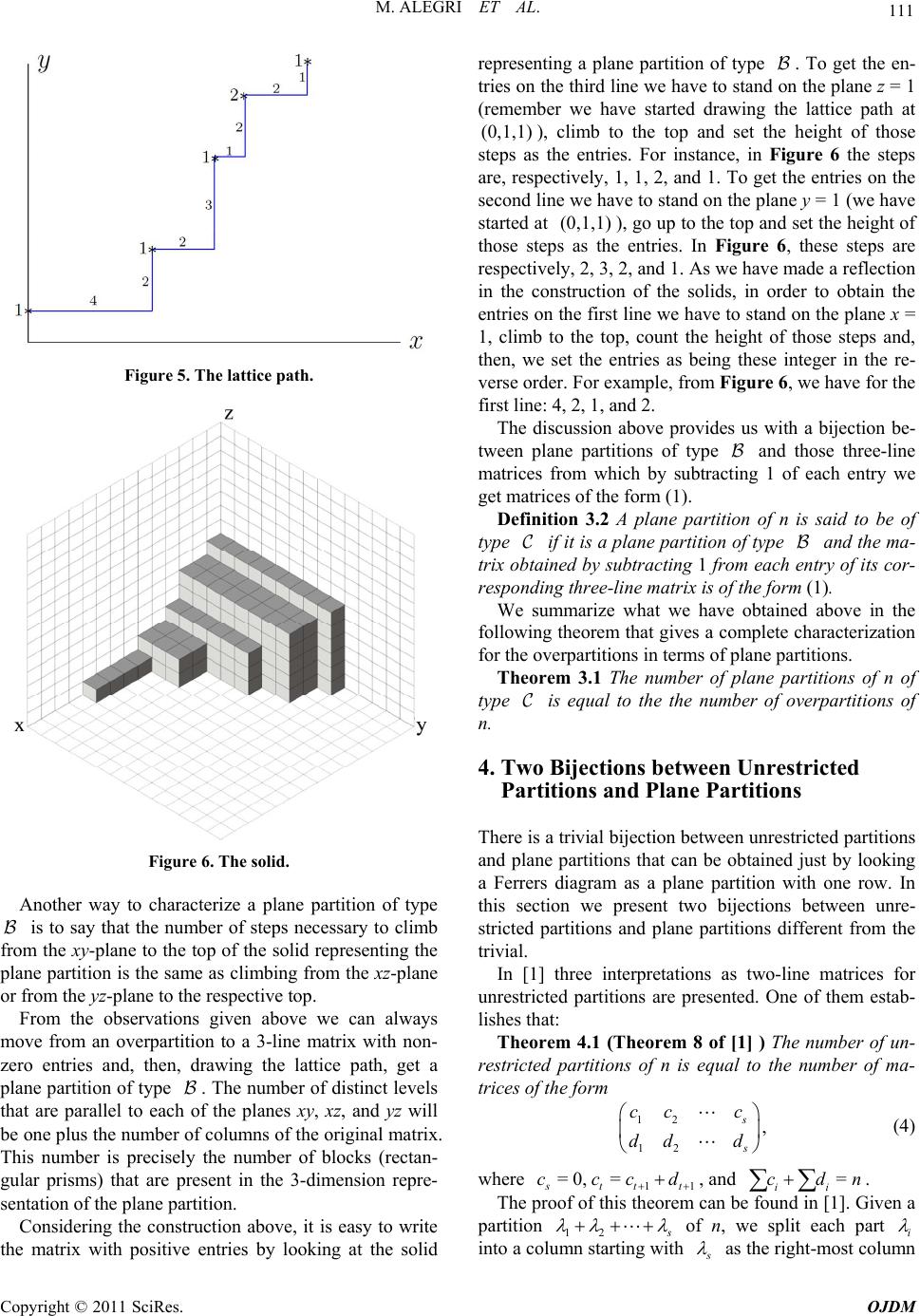 111 M. ALEGRI ET AL. Figure 5. The lattice path. Figure 6. The solid. Another way to characterize a plane partition of type is to say that the number of steps necessary to climb from the xy-plane to the top of the solid representing the plane partition is the same as climbing from the xz-plane or from the yz-plane to the respective top. From the observations given above we can always move from an overpartition to a 3-line matrix with non- zero entries and, then, drawing the lattice path, get a plane partition of type . The number of distinct levels that are parallel to each of the planes xy, xz, and yz will be one plus the number of columns of the original matrix. This number is precisely the number of blocks (rectan- gular prisms) that are present in the 3-dimension repre- sentation of the plane partition. Considering the construction above, it is easy to write the matrix with positive entries by looking at the solid representing a plane partition of type . To get the en- tries on the third line we have to stand on the plane z = 1 (remember we have started drawing the lattice path at ), climb to the top and set the height of those steps as the entries. For instance, in Figure 6 the steps are, respectively, 1, 1, 2, and 1. To get the entries on the second line we have to stand on the plane y = 1 (we have started at ), go up to the top and set the height of those steps as the entries. In Figure 6, these steps are respectively, 2, 3, 2, and 1. As we have made a reflection in the construction of the solids, in order to obtain the entries on the first line we have to stand on the plane x = 1, climb to the top, count the height of those steps and, then, we set the entries as being these integer in the re- verse order. For example, from Figure 6, we have for the first line: 4, 2, 1, and 2. (0,1,1) (0,1,1) The discussion above provides us with a bijection be- tween plane partitions of type and those three-line matrices from which by subtracting 1 of each entry we get matrices of the form (1). Definition 3.2 A plane partition of n is said to be of type if it is a plane partition o f type and the ma- trix obtained by subtracting 1 from each entry of its cor- responding three-line matrix is of the form (1). We summarize what we have obtained above in the following theorem that gives a complete characterization for the overpartitions in terms of plane partitions. Theorem 3.1 The number of plane partitions of n of type is equal to the the number of overpartitions of n. 4. Two Bijections between Unrestricted Partitions and Plane Partitions There is a trivial bijection between unrestricted partitions and plane partitions that can be obtained just by looking a Ferrers diagram as a plane partition with one row. In this section we present two bijections between unre- stricted partitions and plane partitions different from the trivial. In [1] three interpretations as two-line matrices for unrestricted partitions are presented. One of them estab- lishes that: Theorem 4.1 (Theorem 8 of [1] ) The number of un- restricted partitions of n is equal to the number of ma- trices of the form 12 12 , s s cc c dd d (4) where 11 =0, = s tt t cccd , and . = ii cd n The proof of this theorem can be found in [1]. Given a partition 12 s of n, we split each part i into a column starting with s as the right-most column Copyright © 2011 SciRes. OJDM 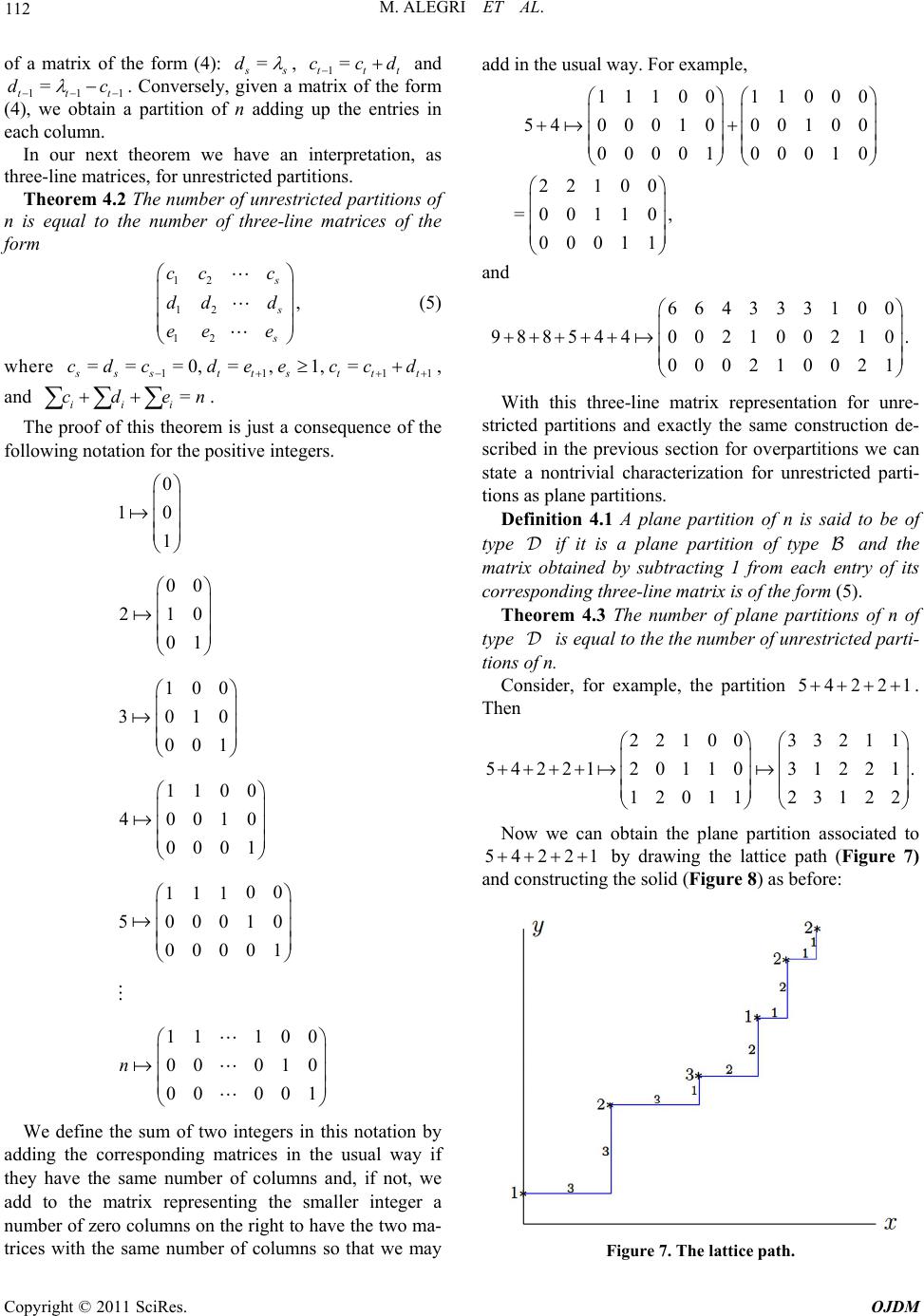 M. ALEGRI ET AL. 112 of a matrix of the form (4): = s s d , 1t = tt ccd and 111 = ttt dc == . Conversely, given a matrix of the form (4), we obtain a partition of n adding up the entries in each column. In our next theorem we have an interpretation, as three-line matrices, for unrestricted partitions. Theorem 4.2 The number of unrestricted partitio ns of n is equal to the number of three-line matrices of the form 12 12 12 , cc dd ee s s s c d e 11 = , 1,= (5) where 1 =0, 1 s ss t c dd tt ee 0 0 1 00 10 1 00 010 0001 10 01 00 s tt cc 0 0 1 cd ii cd n n , and . = i e The proof of this theorem is just a consequence of the following notation for the positive integers. 0 10 1 00 210 01 10 301 00 11 400 000 111 500 0 11 00 00 We define the sum of two integers in this notation by adding the corresponding matrices in the usual way if they have the same number of columns and, if not, we add to the matrix representing the smaller integer a number of zero columns on the right to have the two ma- trices with the same number of columns so that we may add in the usual way. For example, 11100 11000 5400010 00100 0000100010 22100 =0 0 11 0, 00011 and 6643 3310 0 988544 002100210. 000210021 With this three-line matrix representation for unre- stricted partitions and exactly the same construction de- scribed in the previous section for overpartitions we can state a nontrivial characterization for unrestricted parti- tions as plane partitions. Definition 4.1 A plane partition of n is said to be of type if it is a plane partition of type and the matrix obtained by subtracting 1 from each entry of its corresponding three-line matrix is of the form (5). Theorem 4.3 The number of plane partitions of n of type is equal to the the number of unrestricted parti- tions of n. Consider, for example, the partition . Then 54221 22100 33211 54221 2011031221. 1201123122 Now we can obtain the plane partition associated to 54221 by drawing the lattice path (Figure 7) and constructing the solid (Figure 8) as before: Figure 7. The lattice path. Copyright © 2011 SciRes. OJDM 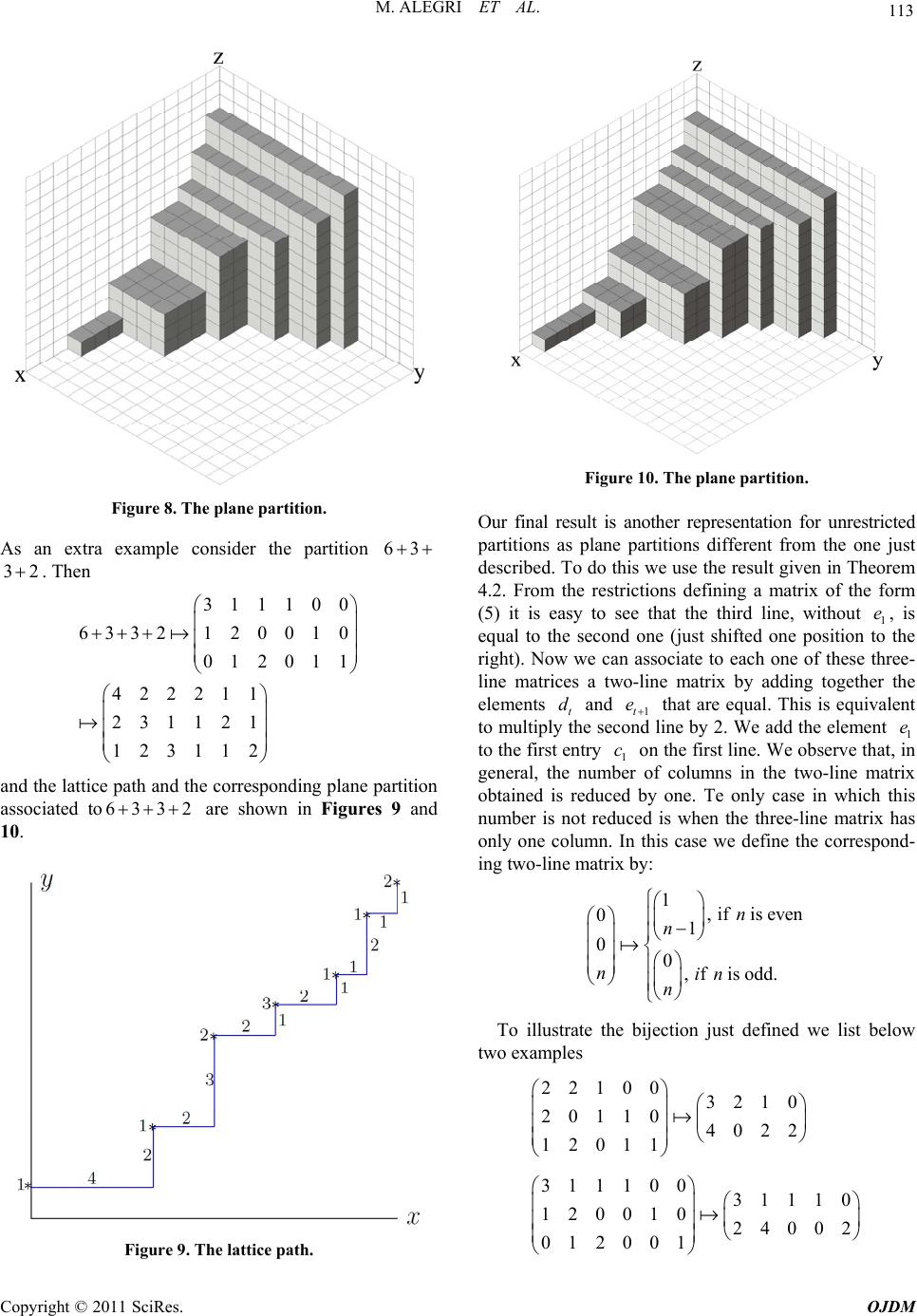 113 M. ALEGRI ET AL. Figure 8. The plane partition. As an extra example consider the partition 63 . Then 32 311100 6332 120010 012011 422211 231121 123112 and the lattice path and the corresponding plane partition associated to are shown in Figures 9 and 10. 6332 Figure 9. The lattice path. Figure 10. The plane partition. Our final result is another representation for unrestricted partitions as plane partitions different from the one just described. To do this we use the result given in Theorem 4.2. From the restrictions defining a matrix of the form (5) it is easy to see that the third line, without 1, is equal to the second one (just shifted one position to the right). Now we can associate to each one of these three- line matrices a two-line matrix by adding together the elements t and 1t e e d that are equal. This is equivalent to multiply the second line by 2. We add the element 1 to the first entry 1 on the first line. We observe that, in general, the number of columns in the two-line matrix obtained is reduced by one. Te only case in which this number is not reduced is when the three-line matrix has only one column. In this case we define the correspond- ing two-line matrix by: e c 1,ifiseven 01 00,fis odd. n n nin n To illustrate the bijection just defined we list below two examples 22100 3210 20110 4022 12011 311100 31110 120010 24002 012001 Copyright © 2011 SciRes. OJDM 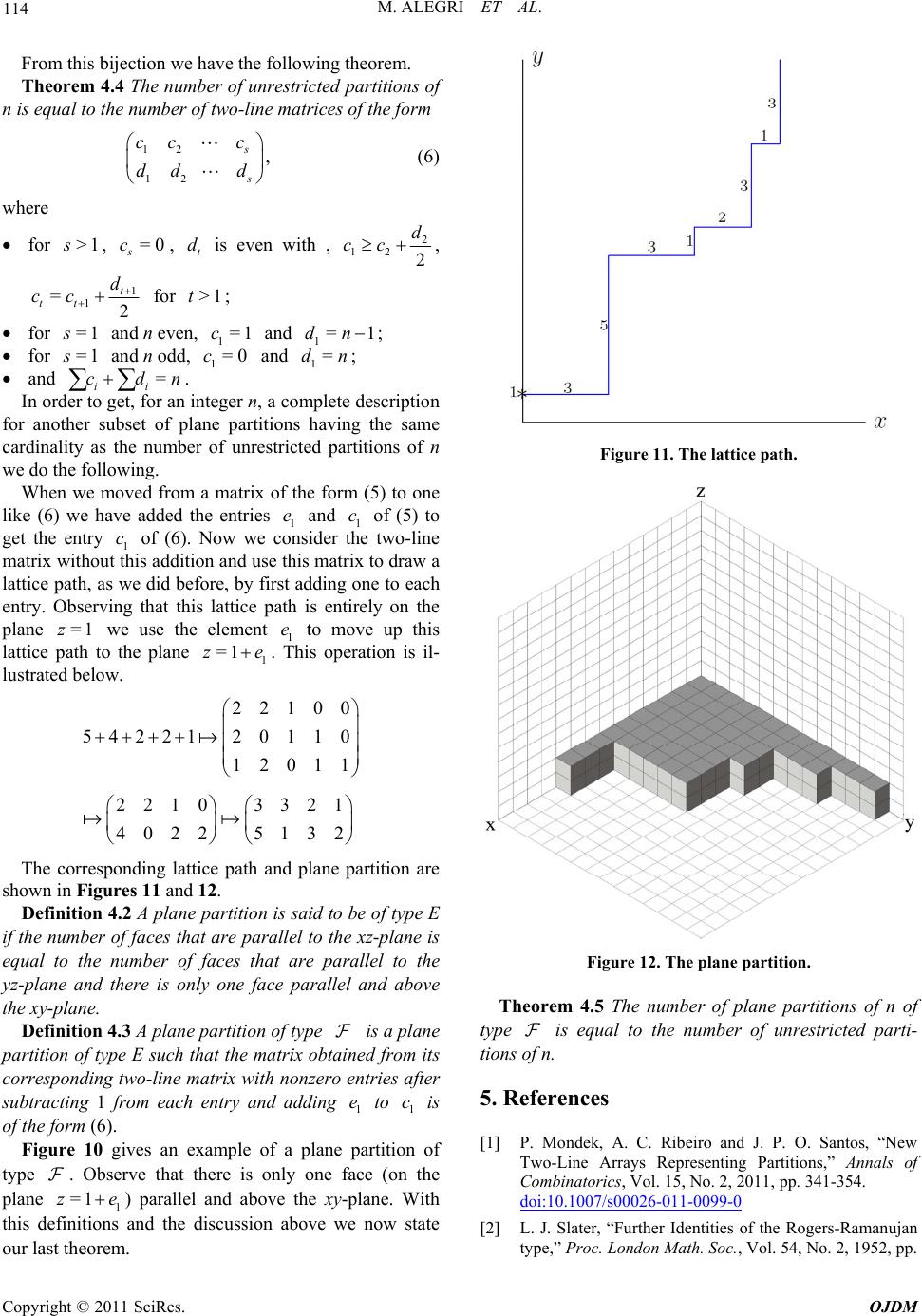 M. ALEGRI ET AL. 114 From this bijection we have the following theorem. Theorem 4.4 The number of unrestricted partitio ns of n is equal to the number of two-line matrices of the form 12 12 , s s cc c dd d (6) where for >1s, =0 s c, t d is even with , 2 12 2 d cc , 1 12 t d for >1t; = tt cc for =1s and n even, 1=1c and =1dn; 1 for =1s and n odd, 1=0c and 1=dn; and =n. ii In order to get, for an integer n, a complete description for another subset of plane partitions having the same cardinality as the number of unrestricted partitions of n we do the following. cd When we moved from a matrix of the form (5) to one like (6) we have added the entries 1 and 1 c of (5) to get the entry 1 of (6). Now we consider the two-line matrix without this addition and use this matrix to draw a lattice path, as we did before, by first adding one to each entry. Observing that this lattice path is entirely on the plane we use the element 1 to move up this lattice path to the plane e e e c =1z 1 =1z . This operation is il- lustrated below. 22100 5422120110 12011 22103321 4022 5132 e The corresponding lattice path and plane partition are shown in Figures 11 and 12. Definition 4.2 A plane partition is said to be of type E if the number of faces that are parallel to th e xz-plane is equal to the number of faces that are parallel to the yz-plane and there is only one face parallel and above the xy-plane. Definition 4.3 A plane partition of type is a plane partition of type E such that the matrix obtained from its corresponding two-lin e matrix with nonzero entries after subtracting 1 from each entry and adding to is of the form (6). 1 e1 c Figure 10 gives an example of a plane partition of type . Observe that there is only one face (on the plane 1) parallel and above the xy-plane. With this definitions and the discussion above we now state our last theorem. =1z Figure 11. The lattice path. Figure 12. The plane partition. Theorem 4.5 The number of plane partitions of n of type is equal to the number of unrestricted parti- tions of n. 5. References [1] P. Mondek, A. C. Ribeiro and J. P. O. Santos, “New Two-Line Arrays Representing Partitions,” Annals of Combinatorics, Vol. 15, No. 2, 2011, pp. 341-354. doi:10.1007/s00026-011-0099-0 [2] L. J. Slater, “Further Identities of the Rogers-Ramanujan type,” Proc. London Math. Soc., Vol. 54, No. 2, 1952, pp. Copyright © 2011 SciRes. OJDM 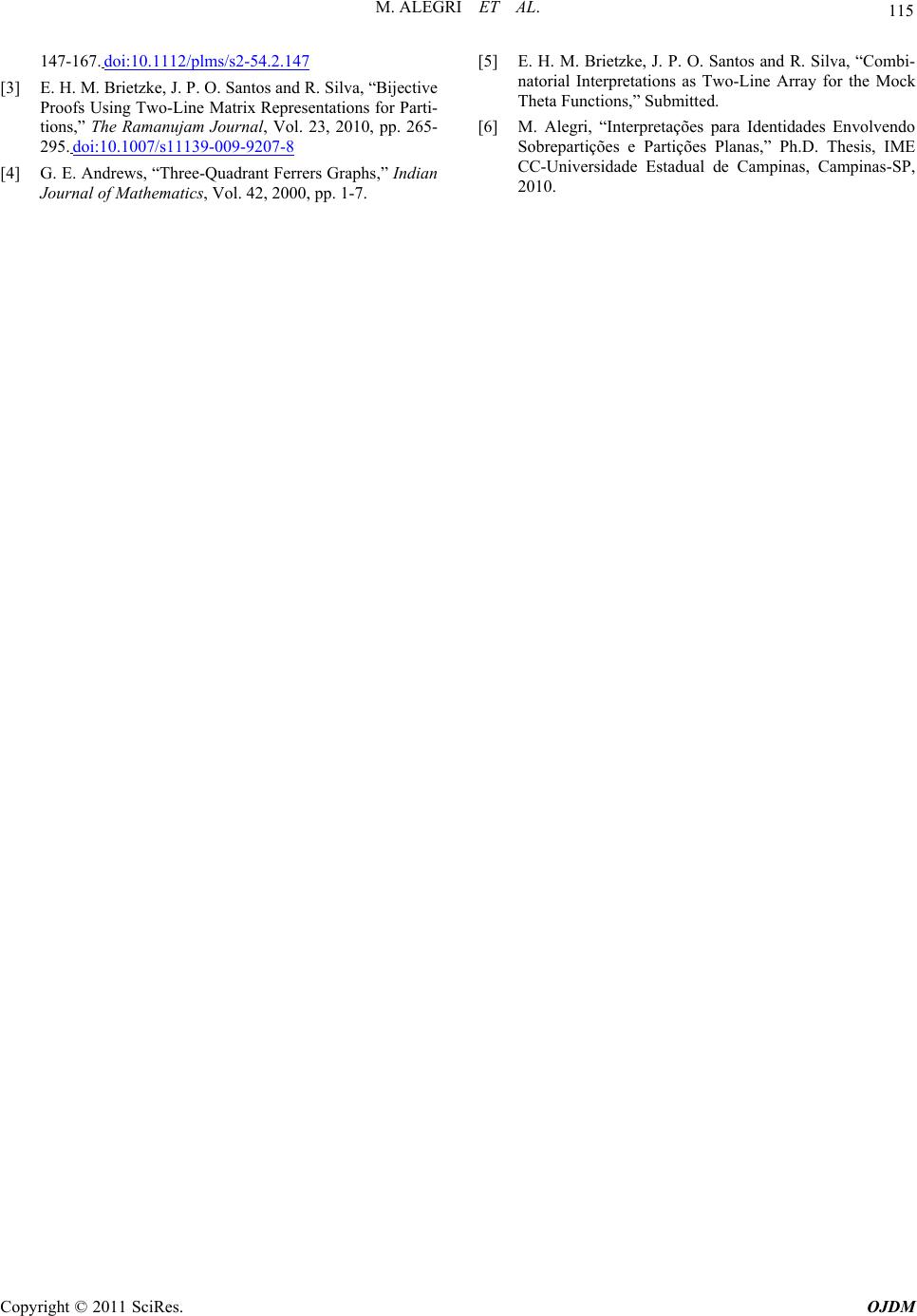 M. ALEGRI ET AL. Copyright © 2011 SciRes. OJDM 115 147-167. doi:10.1112/plms/s2-54.2.147 [3] E. H. M. Brietzke, J. P. O. Santos and R. Silva, “Bijective Proofs Using Two-Line Matrix Representations for Parti- tions,” The Ramanujam Journal, Vol. 23, 2010, pp. 265- 295. doi:10.1007/s11139-009-9207-8 [4] G. E. Andrews, “Three-Quadrant Ferrers Graphs,” Indian Journal of Mathematics, Vol. 42, 2000, pp. 1-7. [5] E. H. M. Brietzke, J. P. O. Santos and R. Silva, “Combi- natorial Interpretations as Two-Line Array for the Mock Theta Functions,” Submitted. [6] M. Alegri, “Interpretações para Identidades Envolvendo Sobrepartições e Partições Planas,” Ph.D. Thesis, IME CC-Universidade Estadual de Campinas, Campinas-SP, 2010. |