

Paper Menu >>
Journal Menu >>
 Vol.1, No.3, 106-111 (2011) doi:10.4236/ojas.2011.13014 C opyright © 2011 SciRes. Openly accessible at http://www.scirp.org/journal/OJAS/ Open Journal of Animal Sciences Utilization of sun-dried maize offal with blood meal in diets for broiler chickens Olukayode A. Makinde*, Emmanuel B. Sonaiya Department of Animal Sciences, Obafemi Awolowo University, Ile-Ife, Nigeria; *Corresponding Author: [email protected] Received 9 August 2011; revised 15 September 2011; accepted 28 September 2011. ABSTRACT Sun-dried blend of maize offal and blood (SDMBM) was analyzed and its effect on the per- formance of broiler chickens (Anak-2000 strain) evaluated. Fresh blood prevented from coagu- lation, mixed with maize offal, was sun-dried, ground, mixed again with blood and ground into a meal after drying again. The crude protein, fat, fibre, ash, ADF and gross energy contents of SDMBM were, 362.0, 45.5, 31.8, 69.3, 52.3 g/kg DM and 4.245 kcal/g, respectively. It was ade- quate in all essential amino acids for growing broiler chickens except methionine. Eighty 14- day-old commercial broiler chicks were ran- domly allocated to four dietary treatments (fed ad libitum; four replicates each) consisting the control diet (0 g SDMBM/kg diet), which con- tained fishmeal, groundnut cake and soybean meal, and three other diets (50, 100 and 150 g SDMBM/kg diet). In a feeding trial, the st arter (14 to 35 d) and finisher (35 to 49 d) dietary treat- ments did not have significant impact (P > 0.05) on body weight gain, efficiency of feed conver- sion, mortality and final body weights. The con- trol diet was inferior (P < 0.05) to 50, 100 and 150 g SDMBM/kg diets for feed cost per unit weight gain in the starter phase, 100 g SDMBM/kg diet in the finisher phase, and 100 and 150 g SDMBM/ kg diet s for the whole period (14 to 49 d). Ov erall, the 100 and 150 g superior (P < 0.05) to the con- trol diet in cost of production per unit weight gain and all the SDMBM diets greater than con- trol in economic benefit per unit weight gain. Results suggest that dietary SDMBM up to 150 g/kg diet has a positive effect on broiler per- formance and can totally replace more expen- sive fishmeal. Keywords: A lternative Feedstuff; Blood Meal; Fishmeal Replacement; Maize Offal 1. INTRODUCTION In Nigeria, as in most other developing countries in the tropics, the transformation and use of agricultural by-products in livestock diets may have become more imperative due to increasing prices of grains (especially maize and oil seeds) globally and environmental pollu- tion issues. However, many agricultural crop by-pro- ducts in the tropics are fibrous (Abdelsamie et al. 1983; Longe and Fagbenro -Byron 1990) and this limits utiliza- tion in poultry production (Onifade 1993; Bolarinwa 1998). Nevertheless, the focus of current research is on fibre nutrition because of the issue of removal of antibi- otics from feed and diversion of grains for ethanol and biodiesel production (Leeson 2008; Farrell 2008). The attraction is the suggested prebiotic attribute of fibrous feedstuffs (Sundu et al. 2006) and need to reduce feed costs by utilizing alternatives to maize as source of feed energy (Leeson 2008). An example of such alternatives is maize offal or maize bran. Maize offal is a by-product of maize milling processes, second to wheat offal as the most preferred and utilized conventionally in livestock feeds in Nigeria (Babatunde et al. 2002). Maize offal contains about 110 to 120 g/kg crude protein and 80 to 90 g /kg crude fibr e (Onifad e and Babatunde 1998; Makinde 2006). The relatively low crude fibre content compared to other by-products could be an advantage in fibre nutrition whereas the low pro- tein content appears to be a limitation. Cattle blood is an abattoir by-product that directly af- fects the environment in Nigeria. Most of the blood from a considerable number of slaughter-cattle is wasted, not efficiently utilized, and pollutes the environment on a daily basis (A deniji 1995; Mak inde 2006). Paradoxically, blood meal, obtainable from cattle blood after drying, contains 80% - 90% crude protein high in the essential amino acids, especially lysine (NRC 1994). Nevertheless, blood is very difficult to dry and is a good medium for  O. A. Makinde et al. / Open Journal of Animal Sciences 1 (2011) 106-111 Copyright © 2011 SciRes. Openly accessible at http://www.scirp.org/journal/OJAS/ 107 microbial spoilage due to its high moisture content (Don- koh et al. 1999). Drying of blood requires high cost equipment coupled with facilities for central blood col- lection, which may be unaffordable and/or not applicable because the abattoir structure in Nigeria exists as small- scattered units. Moreover, previous work with blood involving sun drying in the development of alternative feedstuffs for poultry reported a long drying time of about three days (Adeniji 1995; Donkoh et al. 2002; Odunsi et al. 2004). However, previous studies by Sonaiya (1988) suggested the use of crop by-product materials as absorbents for blood in order to increase the surface area for quicker sun drying. Makinde and Sonaiya (2007, 2010) have reported a simple processing procedure, nutrient composition and optimum mixing ratios for crop by-products with blood including maize offal. The procedure resulted in quicker sun drying of blood (<4 h), enhancement of the crude protein content of maize offal by the blood mixed and a way to contribute towards reduction of environmental pollution from abattoirs. However, nutritional information on the utilization of such a sun-dried maize offal blood meal (SDMBM) by broiler chickens was unavailable. Consequently, the ob- jective was to provide da ta on the utilisation of SDMBM by broiler chickens when fed diets with in creasing quan- tities of SDMBM. 2. MATERIALS AND METHODS 2.1. Preparation of SDBM and Nutrient Composition Sun-dried maize offal blood meal was prepared and analysed for nutrient composition according to the pro- cedures previously described by Makinde and Sonaiya (2007, 2010). Briefly, maize offal (source, Eagle Flour Mills, Ibadan, Nigeria) was hand-mixed (1:1 w/w) with fresh blood (prevented from coagulating for at least 6 hours by mixing with 18 g common salt/litre blood) col- lected from several slaughtered cattle at a commercial abattoir. This mixture was sun-dried for between 3 to 4 h, ground, mixed again with blood (5:4 w/w) and ground into a meal after drying again. Nutrient composition (proximate composition and acid detergent fibre (ADF) inclusive of residual ash) of maize offal and SDMBM were determined using standard pro- cedures of AOAC (1990). Gross energy was determined by oxygen bomb calorimeter (Gallenkamp Ballistic Bomb Calorimeter, Cambridge Instrument Co. Ltd, England). Meal samples were prepared and analysed for mineral concentrations following the methods described by Fick et al. (1979). Amino acid composition of SDMBM was determined following acid hydrolysis using a Techni- con® Sequential Multisample Amino Acid Analyzer (TSM-1, model DNA 0209, Swords Co., Dublin , Ireland; reproducibility, ±3%) at the Zoology Department, Uni- versity of Jos, Jos, Nigeria. Between 30-50mg of the defatted sample was weighed into glass ampoule. Seven millilitres of 6 N HCl was added and oxygen was ex- pelled by passing nitrogen into the ampoule (this was to avoid or reduce possible oxidation of sulphur amino acids during hydrolysis). The glass ampoule was then sealed with bunsen burner flame and put in an oven pre- set at 105˚C + 5˚C for 22 hours. 2.2. Experimental Procedure and Management of Birds The experiment was in two phases, starter and finisher phases. Eighty 14-day-old commercial broiler chicks (Anak-2000 strain) were randomly allocated to one of four dietary treatments (Table 1) in a completely ran- domized block design. Each treatment was replicated four times with five birds per replicate. The dietary treat- ments consisted of the control diet, which contained fishmeal (starter diet only), groundnut cak e and soybean meal as the main protein sources, and three other diets, which contained varying levels of SDMBM at 50, 100, and 150 g/kg diet. Two control diets were formulated, one for the starter phase containing no SDMBM but fishmeal at 30 g/kg diet, and the other for the finisher phase with no fishmeal or any other animal protein source. The test diets for the starter phase were formulated to be isocaloric and isonitrogenous containing 3000 kcal ME/kg and 22% crude protein (PTF 1992), and the fin- isher phase formula ted to contain 2950 kcal ME /kg and 18% crude protein (PTF 1992). The starter diet was fed for 3 weeks, and the finisher diet for 2 weeks. The birds were confined in 20 floor pens (each measuring 1.52 m2) which provided a floor space of 0.3 m2 per bird. The pens were in a poultry house constructed from wood and wire gauze, with asbestos roof and concrete floor. Pens were covered with wood shavings for bedding. Plastic water drinkers and suspended metallic conical feeders were used to provide drink and feed, respectively, and were cleaned daily. Birds were fed ad libitum with free access to water. Newcastle disease vaccine (NDV), infectious bursal dis- ease vaccine (IBDV), coccidiostat (Embazin-Forte®: Sul- faquinoxaline-Diaveridine-Vitamin K complex), antibi- otic (Keproceryl®: water-soluble mix of the antibiotics- oxytetracycline, erythromycin, and streptomycin with fat- and water-soluble vitamins), and a B-vitamin complex solution (Biovit®) as antistress were used to maintain chicks in good health. The coccidiostat, antibiotic, and B-vitamins drug were administered via the drinking water. All five chickens in each pen were weighed individu- 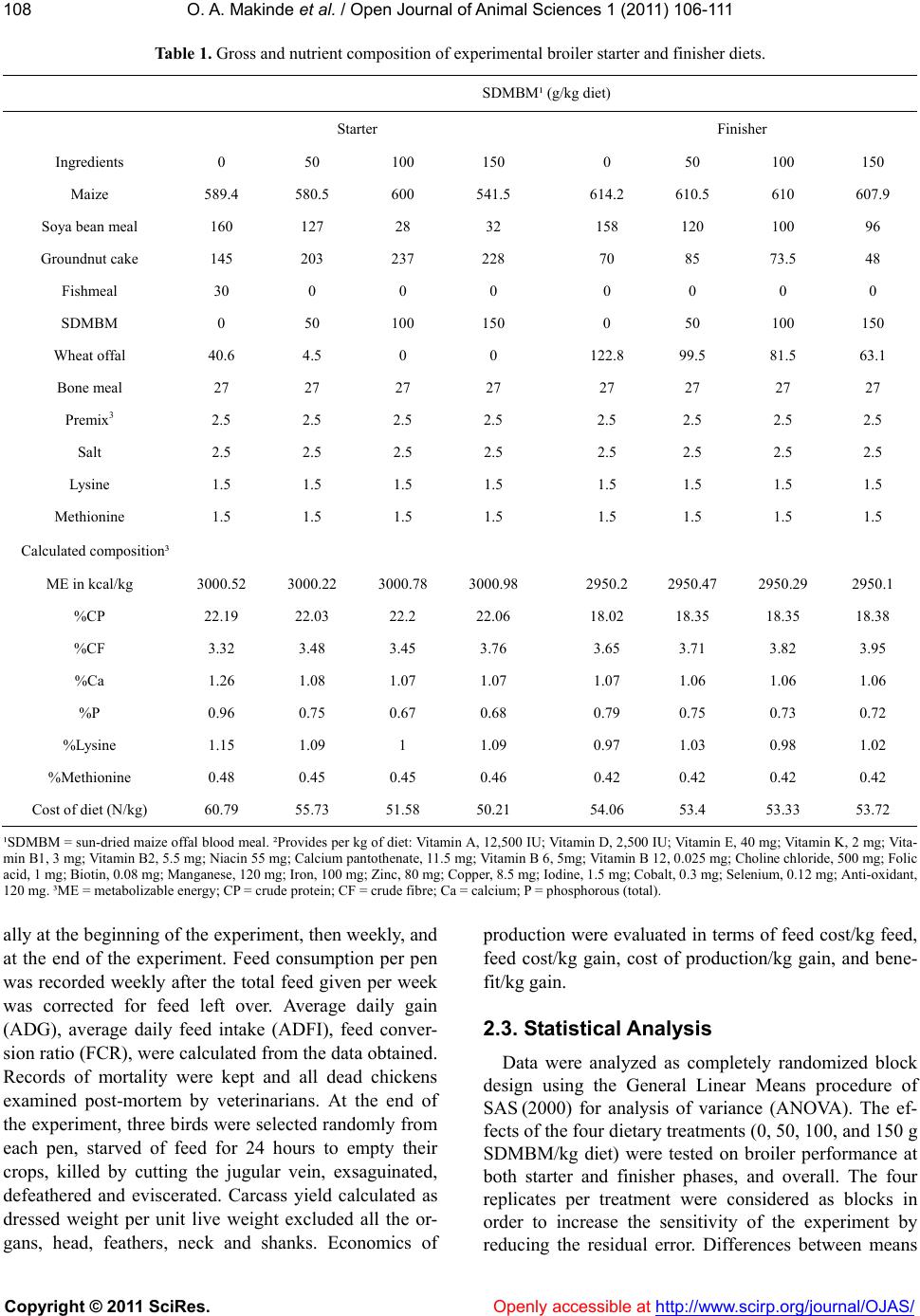 O. A. Makinde et al. / Open Journal of Animal Sciences 1 (2011) 106-111 Copyright © 2011 SciRes. http://www. scirp.org/journal/OJAS/Openly accessible at 108 Table 1. Gross and nutrient composition of experimental broiler starter and finisher diets. SDMBM¹ (g/kg diet) Starter Finisher Ingredients 0 50 100 150 0 50 100 150 Maize 589.4 580.5 600 541.5 614.2 610.5 610 607.9 Soya bean meal 160 127 28 32 158 120 100 96 Groundnut cake 145 203 237 228 70 85 73.5 48 Fishmeal 30 0 0 0 0 0 0 0 SDMBM 0 50 100 150 0 50 100 150 Wheat offal 40.6 4.5 0 0 122.8 99.5 81.5 63.1 Bone meal 27 27 27 27 27 27 27 27 Premix3 2.5 2.5 2.5 2.5 2.5 2.5 2.5 2.5 Salt 2.5 2.5 2.5 2.5 2.5 2.5 2.5 2.5 Lysine 1.5 1.5 1.5 1.5 1.5 1.5 1.5 1.5 Methionine 1.5 1.5 1.5 1.5 1.5 1.5 1.5 1.5 Calculated composition³ ME in kcal/kg 3000.52 3000.22 3000.7 8 3000.98 2950.2 2950.47 2950. 29 2950.1 %CP 22.19 22.03 22.2 22.06 18.02 18.35 18.35 18.38 %CF 3.32 3.48 3.45 3.76 3.65 3.71 3.82 3.95 %Ca 1.26 1.08 1.07 1.07 1.07 1.06 1.06 1.06 %P 0.96 0.75 0.67 0.68 0.79 0.75 0.73 0.72 %Lysine 1.15 1.09 1 1.09 0.97 1.03 0.98 1.02 %Methionine 0.48 0.45 0.45 0.46 0.42 0.42 0.42 0.42 Cost of diet (N/kg) 60.79 55.73 51.58 50.21 54.06 53.4 53.33 53.72 ¹SDMBM = sun-dried maize offal blood meal. ²Provides per kg of diet: Vitamin A, 12,500 IU; Vitamin D, 2,500 IU; Vitamin E, 40 mg; Vitamin K, 2 mg; Vita- min B1, 3 mg; Vitamin B2, 5.5 mg; Niacin 55 mg; Calcium pantothenate, 11.5 mg; Vitamin B 6, 5mg; Vitamin B 12, 0.025 mg; Choline chloride, 500 mg; Folic acid, 1 mg; Biotin, 0.08 mg; Manganese, 120 mg; Iron, 1 00 mg; Zinc, 80 mg; Copper, 8.5 mg; Iodine, 1.5 mg; Cobalt, 0.3 mg; Selenium, 0.12 mg; Anti-oxidant, 120 mg. ³ME = metabolizable energy; CP = crude protein; C F = crude fibre; Ca = calcium; P = phosphorous (total). ally at the beginning of the experiment, then weekly, and at the end of the experiment. Feed consumption per pen was recorded weekly after the total feed given per week was corrected for feed left over. Average daily gain (ADG), average daily feed intake (ADFI), feed conver- sion ratio (FCR), were calculated from the data obtained. Records of mortality were kept and all dead chickens examined post-mortem by veterinarians. At the end of the experiment, three birds were selected randomly from each pen, starved of feed for 24 hours to empty their crops, killed by cutting the jugular vein, exsaguinated, defeathered and eviscerated. Carcass yield calculated as dressed weight per unit live weight excluded all the or- gans, head, feathers, neck and shanks. Economics of production were evaluated in terms of feed cost/kg feed, feed cost/kg gain, cost of production/kg gain, and bene- fit/kg gai n. 2.3. Statistical Analysis Data were analyzed as completely randomized block design using the General Linear Means procedure of SAS (2000) for analysis of variance (ANOVA). The ef- fects of the four dietary treatments (0, 50, 100, and 150 g SDMBM/kg diet) were tested on broiler performance at both starter and finisher phases, and overall. The four replicates per treatment were considered as blocks in order to increase the sensitivity of the experiment by reducing the residual error. Differences between means 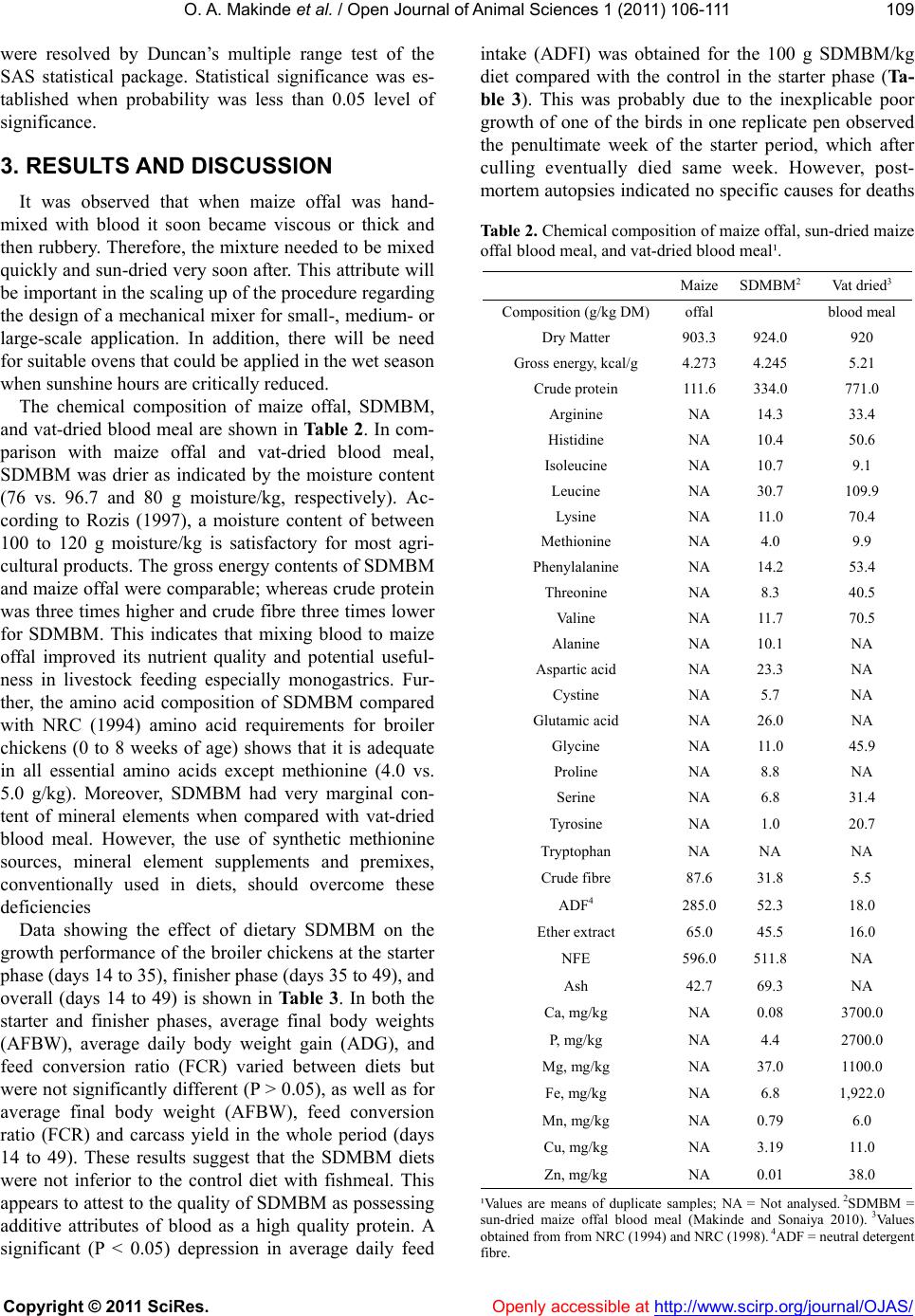 O. A. Makinde et al. / Open Journal of Animal Sciences 1 (2011) 106-111 Copyright © 2011 SciRes. Openly accessible at http://www.scirp.org/journal/OJAS/ 109 were resolved by Duncan’s multiple range test of the SAS statistical package. Statistical significance was es- tablished when probability was less than 0.05 level of significance. 3. RESULTS AND DIS CUSSION It was observed that when maize offal was hand- mixed with blood it soon became viscous or thick and then rubbery. Therefore, the mixture needed to be mixed quickly and sun-dried very soon after. This attrib ute will be important in the scaling up of the procedure regarding the design of a mechanical mixer for small-, medium- or large-scale application. In addition, there will be need for suitable ovens that could be applied in the wet season when sunshine hours are critically reduced. The chemical composition of maize offal, SDMBM, and vat-dried blood meal are shown in Tab le 2. In com- parison with maize offal and vat-dried blood meal, SDMBM was drier as indicated by the moisture content (76 vs. 96.7 and 80 g moisture/kg, respectively). Ac- cording to Rozis (1997), a moisture content of between 100 to 120 g moisture/kg is satisfactory for most agri- cultural products. The gross energy contents of SDMBM and maize offal were comparable; whereas crude protein was three times higher and crude fibre three times lower for SDMBM. This indicates that mixing blood to maize offal improved its nutrient quality and potential useful- ness in livestock feeding especially monogastrics. Fur- ther, the amino acid composition of SDMBM compared with NRC (1994) amino acid requirements for broiler chickens (0 to 8 weeks of age) shows that it is adequate in all essential amino acids except methionine (4.0 vs. 5.0 g/kg). Moreover, SDMBM had very marginal con- tent of mineral elements when compared with vat-dried blood meal. However, the use of synthetic methionine sources, mineral element supplements and premixes, conventionally used in diets, should overcome these deficiencies Data showing the effect of dietary SDMBM on the growth performance of the broiler chickens at the starter phase (days 14 to 35), finisher phase (days 35 to 49), and overall (days 14 to 49) is shown in Tab le 3 . In both the starter and finisher phases, average final body weights (AFBW), average daily body weight gain (ADG), and feed conversion ratio (FCR) varied between diets but were not significantly different (P > 0.05), as well as for average final body weight (AFBW), feed conversion ratio (FCR) and carcass yield in the whole period (days 14 to 49). These results suggest that the SDMBM diets were not inferior to the control diet with fishmeal. This appears to attest to the quality o f SDMBM as possessing additive attributes of blood as a high quality protein. A significant (P < 0.05) depression in average daily feed intake (ADFI) was obtained for the 100 g SDMBM/kg diet compared with the control in the starter phase (Ta- ble 3). This was probably due to the inexplicable poor growth of one of the birds in one replicate pen observed the penultimate week of the starter period, which after culling eventually died same week. However, post- mortem autopsies indicated no specific causes for deaths Table 2. Chemical composition of maize offal, sun-dried maize offal blood meal, and vat-dried blood meal¹. Maize SDMBM2 Vat dried3 Composition (g/kg DM) offal blood meal Dry Matter 903.3 924.0 920 Gross ener gy, kcal/g 4.273 4.245 5.21 Crude protein 111. 6 334.0 771.0 Arginine NA 14.3 33.4 Histidine NA 10.4 50.6 Isoleucine NA 10.7 9.1 Leucine NA 30.7 109.9 Lysine NA 11.0 70.4 Methionine NA 4.0 9.9 Phenylalanine NA 14.2 53.4 Threonine NA 8.3 40.5 Valine NA 11.7 70.5 Alanine NA 10.1 NA Aspartic acid NA 23.3 NA Cystine NA 5.7 NA Glutamic acid NA 26.0 NA Glycine NA 11.0 45.9 Proline NA 8.8 NA Serine NA 6.8 31.4 Tyrosine NA 1.0 20.7 Tryptophan NA NA NA Crude fibre 87.6 31.8 5.5 ADF4 285.0 52.3 18.0 Ether extract 65.0 45.5 16.0 NFE 596.0 511.8 NA Ash 42.7 69.3 NA Ca, mg/kg NA 0.08 3700.0 P, mg/kg NA 4.4 2700.0 Mg, mg/kg NA 37.0 1100.0 Fe, mg/kg NA 6.8 1,922.0 Mn, mg/kg NA 0.79 6.0 Cu, mg/kg NA 3.19 11.0 Zn, mg/kg NA 0.01 38.0 ¹Values are means of duplicate samples; NA = Not analysed. 2SDMBM = sun-dried maize offal blood meal (Makinde and Sonaiya 2010). 3 Values obtained from from NRC (1994) and NRC (1998). 4ADF = neutral detergent ibre. f  O. A. Makinde et al. / Open Journal of Animal Sciences 1 (2011) 106-111 Copyright © 2011 SciRes. http://www. scirp.org/journal/OJAS/ 110 Ta b le 3 . Live performance (14 to 35, 35 to 49, and 14 to 49 d) of broiler chickens fed diets with graded levels of sun-dried maize offal blood meal. Starte r (14 to35 d) Finisher (35 to 4 9 d) Overall (14 to 49 d) Levels of SDMBM¹ (g/kg diet) Levels of SDMBM (g/kg diet) Levels of SDMBM (g/kg diet) Parameters 0 50 100 150 SE² 0 50 100150SE0 50 100 150SE AIB (g/bird)3 227.25 212.35 221 210.55-948.18936.54858.6941.7- 227.25 212.35 221 210.55- AFBW (g/bird)4 948.18 936.54 858.6 941.79.101639.161715.241549.71667.317.501639.16 1715.24 1549.7 1667.317.50 ADG (g/bird)5 34.33 34.49 30.36 34.820.3049.3655.6249.3651.831.3040.34ab 42.94a 37.96b 41.62ab 0.55 ADFI (g/bird)6 81.20a 76.98ab 72.47b 76.55ab 0.58 163.80a163.45a139.86b154.11a1.44 110.82a 111.57a 99.43b 107.56a0.86 FCR7 2.37 2.25 2.4 2.21 0.023.322.952.882.980.082.75 2.61 2.64 2.590.03 Carcass yield (%) - - - - -- - - - - 62.01 65.54 64.16 63.710.41 Mortality (number) 1 0 1 0 -0 0 0 0 - 1 0 1 0 - FC/kg (N)8 60.79 55.73 51.58 50.21-54.0653.453.3353.72- 57.43 54.57 52.46 51.97- FC/kg gain (N) 143.88a 125.6b 123.89b 111.08b1.90 179.75a157.69ab 157.18b160ab 2.70 157.83a 142.49ab 138.40b 134.42b1.7 CP/kg gain9 (N) - - - - -- - - - - 341.83a 326.49ab 322.40b 318.42b1.7 Benefit/kg10gain (N) - - - - -- - - - - 58.17b 73.03a 77.60a 81.56a1.7 abMeans on the same row with the same superscripts are not significantly different (P > 0.05). 1SDMBM = sun-dried maize offal blood meal. 2SE= standard error of means. 3AIB = average initial body weight. 4AFBW = average final bod y weigh t. 5ADG = av erage d aily gain. 6ADFI = averag e dai ly feed in tak e. 7FCR = feed conversion ratio (g feed/g gain). 8FC = feed cost (N = Naira). 9CP = cost of production/kg gain(N) = FC/kg gain + Total common costs for 49 days (brooded chicks; drugs; equipment; wood shavings; transportation; poultry house repair and maintainnance; labour and miscellaneous-10% of total common costs). 10Benefit/kg gain (N) = price of broiler/kg (N) when study was conduct ed (N400.00) mi nus cost of production/kg gain (N); 1 US$ = N150. that can be attributable to the diet. The depression in feed consumption for the 100 g SDMBM/kg dietary treatment in the finisher phase is obscured to this study. It is possible that the birds in the pen where mortality occurred had unidentified sub-clinical level infection, which depressed feed intake. The same reason could be advanced for the feed consumption that was significantly (P < 0.05) depressed and the least ADG overall for the 100 g SDMBM/kg diet compared with other diets. Openly accessible at Economically, the SDMBM diets were generally su- perior to the control for all growth periods in terms of feed cost per kg (FC/kg), feed cost per kg live weight gain (FC/kg gain), cost of production per kg live weight gain (CP/kg gain), and profit or benefit per bird. The 150 g SDMBM/kg dietary treatment had the highest profit compared with the control, which was least (P < 0.05). Khawaja et al. (2007) and Don koh et al. (2003) ob tained similar results on superior economic benefits for blood meal and a blend of blood and ground maize cob in broil- ers, respectively. 4. CONCLUSIONS The findings under the conditions of this study show that there are no adverse effects on growth performance by incorporating SDMBM, a simple suitable alternative protein source to fishmeal, up to 150 g SDMBM/kg in the starter and finisher diets of broiler chickens. Further investigations are needed concerning a scaling up of the production process and possible effects of mechanical drying on nutritional qu ality of SDMBM. 5. ACKNOWLEDGEMENTS Raw Materials Research and Development Council (RMRDC), Abuja, Nigeria provided funding for the research reported in this arti- cle. Mr J. O. S. Adeyeye and the workers at the Araromi Abattoir, Ile-Ife, Osun State, Nigeria are also appreciated for their cooperation and assistance. REFERENCES [1] Abdelsamie, R. E, Ranaweera, K. N. P. and Nano, W. E. (1983) The influence of fibre content and physical tex- ture of the diet on the performance of broilers in the tropics. British Poultry Science, 24, 383-390. doi:10.1080/00071668308416752 [2] Adeniji, A. A. (1995) The value of bovine blood-rumen content meal as a feedstuff for pullets. Ph.D Thesis, Uni- versity of Ilorin, Ilorin, Nigeria. [3] AOAC (1990) Asssociation of Official Analytical Chem- ists. Official Methods of Analysis, 15th Edition, AOAC, Arlington Virginia, USA. [4] Babatunde, B. B., Oluyemi, J. A., Adejinmi, O. O. and Olupona, J. A. (2002) Preference of commercial feed millers and poultry farmers for fibrous ingredients and  O. A. Makinde et al. / Open Journal of Animal Sciences 1 (2011) 106-111 Copyright © 2011 SciRes. Openly accessible at http://www.scirp.org/journal/OJAS/ 111 their dietary levels. In: Aletor, V. A. and Onibi, G. E., Eds., Increasing household protein consumption through im- proved livestock production. Proceedings of the 27th An- nual Conference of the Nigerian Society for Animal Pro- duction, Federal University of Technology, Akure, Ondo State, Nigeria, 264-266. [5] Bolarinwa, B. B. (1998) Evaluation and optimum use of fibrous ingredients in the diets of broilers. Ph.D. Thesis, University of Ibadan, Ibadan, Nigeria. Giambastiani, B.M.S. (2007) Evoluzione idrologica ed idrogeologica della pineta di San Vitale (Ravenna). Ph.D. Thesis, Bo- logna University, Bologna. [6] Donkoh, A., Atuahene, C.C., Anang, D. M. and Ofori, S. K. (1999) Chemical composition of solar-dried blood meal and its effect on performance of broiler chickens. Animal Feed Science and Technology, 81, 299-307. doi:10.1016/S0377-8401(99)00069-3 [7] Donkoh, A., Atuahene, C.C., Anang, D. M. and Hagan, M. A. S. (2002) Influence of processing temperature on chemical composition of solar-dried blood meal and on performance of broiler chickens. Journal of Animal and Feed Sciences, 11, 299-307. [8] Donkoh, A., Otchere, S., Asare, U. O., Okyere-Boakye, E., Tawiah, R. Y. and Nyannor, E. K. D. (2003) A note on nutritive value of blend of blood and ground maize cob for broiler chickens. Journal of Animal and Feed Sci- ences, 12, 597-603. [9] Farrell, D. (2008) Future eaters. World’s Poultry Science Journal, 64, 102. [10] Fick, K. R., McDowell, L. R., Miles, P. H., Wi lkinson, N. S., Funk, J. D. and Conrad, J. H. (1979) Methods of Min- eral Analysis for Plant and Animal Tissues, 2nd Edition, Department of Animal Science, University of Florida, Gainesville, FL, USA. [11] Khawaja, T., Khan, S. H. and Ansari, N. A. (2007) Effect of different levels of blood meal on broiler performance during two phases of growth. International Journal of Poultry Science, 6, 860-865. doi:10.3923/ijps.2007.860.865 [12] Leeson, S. (2008) Poultry nutrition, future prospects. World’s Poultry Science Journal, 64, 99. [13] Longe, O. G. and Fagbenro-Byron, J. O. (1990) Compo- sition and physical characteristics of some fibrous wastes and by-products for pig feeds in Nigeria. Journal of Tropical Agriculture and Veterinary Science, 28, 1- 99-205. [14] Makinde, O. A. (2006) Processing of vegetable-carried bovine blood meal and its utilization by poultry and fish. Ph.D. Thesis, Obafemi Awolowo University, Ile-Ife, Ni- geria. [15] Makinde, O. A. and Sonaiya, E. B. (2007) Determination of water, blood and rumen fluid absorbencies of some fi- brous feedstuffs. Livestock Research for Rural Develop- ment, 19. http://www.lrrd.org/lrrd19/10/maki19156.htm [16] Makinde, O. A. and Sonaiya, E. B. (2010) A simple tech- nology for production of vegetable-carried blood or ru- men fluid meals from abattoir wastes. Animal Feed Sci- ence and Technology, 162, 12-19. doi:10.1016/j.anifeedsci.2010.08.011 [17] NRC (1994) National Research Council. Nutrient re- quirements of domestic animals. Nutrient requirements of poultry, 9th revised Edition, National Academy Press. Washington, DC., USA. [18] NRC (1998) National Research Council. Nutrient re- quirements of domestic animals. Nutrient requirements of swine, 10th revised Edition, National Academy Press, Washington, DC., USA. [19] Odunsi, A. A., Akingbade, A. A. and Farinu, G. O. (2004) Effect of bovine blood-rumen digesta mixture on growth performance, nutrient retention and carcass characteris- tics of broiler chickens. Journal of Animal and Veterinary Advances, 3, 663-667. [20] Onifade, A. A. (1993) Comparative utilization of three dietary fibres in broiler chickens. Ph.D. Thesis, Univer- sity of Ibadan, Ibadan, Nigeria. [21] Onifade, A. A. and Babatunde, G. M. (1998) Comparison of the utilization of palm kernel meal, brewers dried grains and maize offal by broiler chicks. British Poultry Science, 39, 245-250. doi:10.1080/00071669889204 [22] PTF (1992) Presidential Task Force on Alternative For- mulations of Livestock Feeds. Report on livestock num- bers, feed resources, inventory and supplies, Office of the Secretary to the government of the Federal Republic of Nigeria, Abuja, FCT , 2. [23] Rozis, Jean-Francois. (1997) Drying foodstuffs-tech- niques, processes, equipment technical guidebook. Geres- French Ministry of Co-operation-Neda-CTA. Bachuys Publishers Leiden, The Netherlands. [24] SAS (2000) Statistical Analysis Systems. Guide for per- sonal computers. Release 8.1. SAS institute Inc., Cary, NC, USA. [25] Sonaiya, E. B. (1988) Animal by-products and their po- tential for commercial livestock feed production. In: Ba- batunde G. M., Eds., Proceedings of a National Workshop on Alternative Feeds in Nigeria, ARMTI, Ilorin, Kwara State, Nigeria, 298-315. [26] Sundu, B., Kumar, A. and Dingle, J. (2006) Palm kernel meal in broiler diets: Effect on chicken performance and health. World’s Poultry Science Journal, 62, 316-337. doi:10.1079/WPS2005100 |