

Paper Menu >>
Journal Menu >>
 Vol.1, No.3, 93-96 (2011) doi:10.4236/ojas.2011.13012 C opyright © 2011 SciRes. Openly accessible at http://www.scirp.org/journal/OJAS/ Open Journal of Animal Sciences Effects of replacement of soya bean meal by bambara nut sievate on the carcass and organ parameters of finisher broiler chicks B. U. Ekenyem1, Brendan I. Odo2* 1Department of Animal Science and Fisheries, Imo State University, P. M. B. 2000, Owerri, Nigeria; 2Department of Animal/Fisheries Science and Management, Enugu State University of Science and Technology, P.M.B. 01660, Enugu, Enugu State, Nigeria; *Corresponding Author: [email protected] Received 25 June 2011; revised 29 August 2011; accepted 12 September 2011. ABSTRACT Eighty 4-weeks old broiler chicks (Anak 2000 strain) were used in a 28 days feeding trial to determine the effects of replacement of soya bean meal (SBM) by bambara nut sievate (BNS) on the carcass and organ characteristics of fin- isher broiler chicks. BNS replaced soya bean meal by w eight for weight at levels 0%, 5%, 10 % and 15% for treatments 1,2, 3 and 4; re spectiv ely which were replicate d four times in a comp letely randomized design. Feed and potable water were supplied ad libitum to the birds. Also, ap- propriate medication, sanitation and other stan- dard management practices were strictly adopt- ed. At the 28th day, one bird was randomly picked from each replicate, starved of food for 24 hours and then slaughtered and eviscerated for carcass and organ evaluation. Weights were measured with digit al weighing scale. Result s of analysis of variance of carcass parameters showed significant (P < 0.05) difference in the final live weight, carcass weight and dressed weight. Birds on 0% BNS and 5% BNS were not statistically different (P > 0.05) in the values above but only varied with birds on 10% and 15% BNS. Other carcass parameters were simi- lar (P > 0.05) in value between treatments. The liver, heart, gizzard and intestine significantly varied (P < 0.05) between their treatments. How- ever, kidney values did not differ significantly. From the results, it appeared that 5% BNS in- clusion is optimal for carcass and organ char- acteristics of finisher broilers. Keywords: Bambara Nut Sievate; Soya Bean Meal; Broiler; Carcass 1. INTRODUCTION High cost of feed is a recurring limitation to mono- gastric animal production in Nigeria which has been rated at 70 - 80 percent of total cost of production [1]. Consequently, the cost of poultry production is so high that the products are so dear and unaffordable by con- sumers thus, predisposing Nigerians to abject animal protein malnutrition. Reference [2] has further blamed this nutritional adversity on geometric increase in the Nigeria human population without a commensurate in- crease in livestock production, over-dependence on im- ported livestock products, ignorance, inadequate techni- cal skills, diseases and parasitism, environmental stress and high cost of ingredients. Also, the competition be- tween man and livestock for feed grains [3,4,5] and in- adequate production of farm crops to meet human and livestock needs [6] have been implicated as re mote causes of poor animal protein intake among Nigerians. Conse- quently, the fight to reduce the cost of poultry production becomes critically urgent in order to salvage Nigerians from the scourge of sub-optimal animal protein intake and malnutrition. Soya bean meal is widely used as source of protein for poultry because of its ability to produce indispensable amino acids, high digestibility and low toxic substances. However, it is very exp ensive. BNS a cheaper ingredient with seemingly good nutritional po tentials may therefore be considered for replacement of soya bean meal. References [7] and [2] have defined bambara nut sievate as a by-product from the processing of bambara nut into its flour for human use. They further stated that BNS has no direct food use by man and are also care- lessly disposed within and around the processing plants and thus constitute environmental pollutants. However, recent studies have confirmed their potentials as feed in- gredient in poultry production, reducing the cost of pro- ducts and making them affordable to consumers [8]. 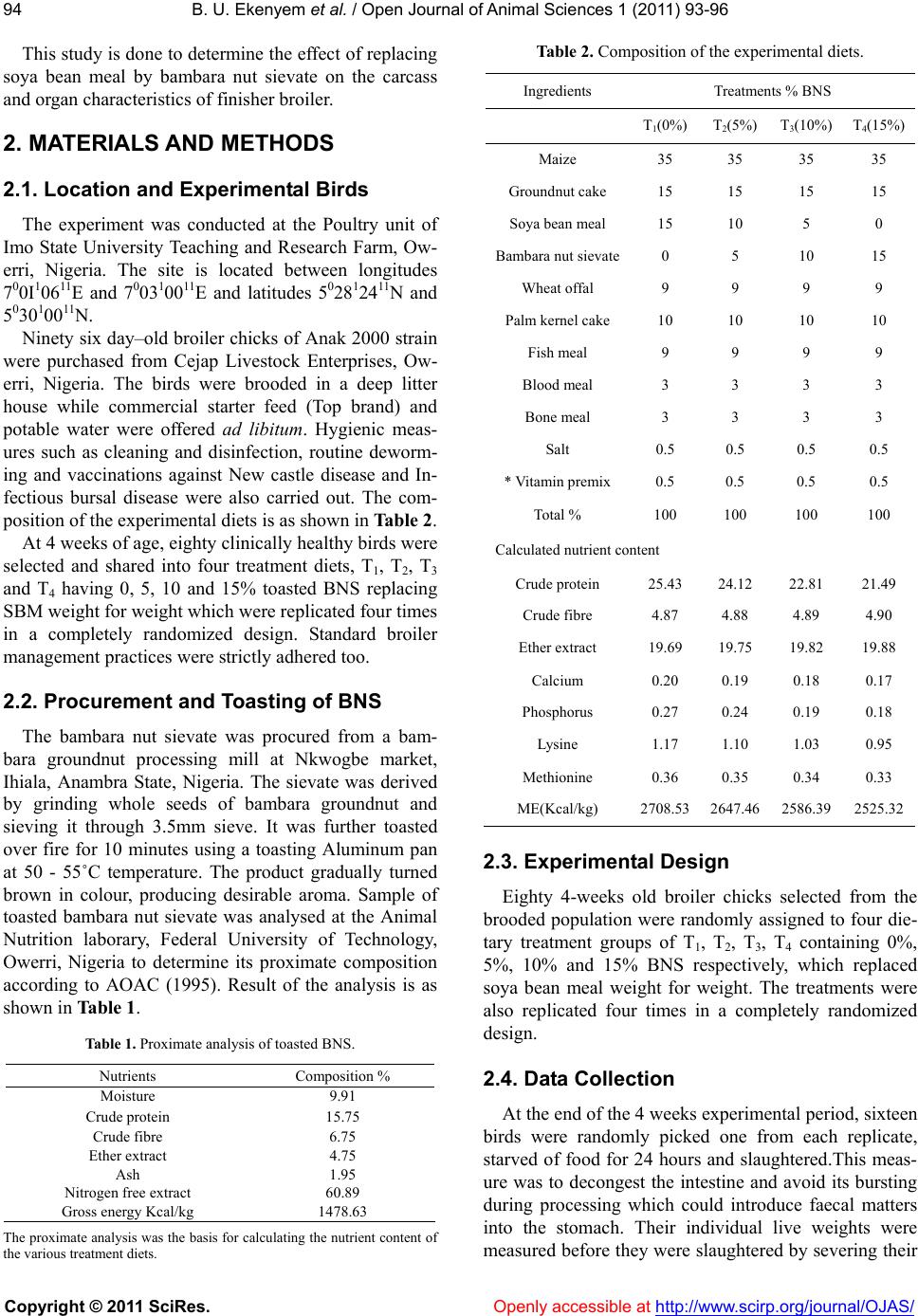 B. U. Ekenyem et al. / Open Journal of Anim al Sciences 1 (2011) 93-96 Copyright © 2011 SciRes. Openly accessible at http://www.scirp.org/journal/OJAS/ 94 This study is done to determine the effect of replacing soya bean meal by bambara nut sievate on the carcass and organ characteristics of finisher broiler. 2. MATERIALS AND METHODS 2.1. Location and Experimental Birds The experiment was conducted at the Poultry unit of Imo State University Teaching and Research Farm, Ow- erri, Nigeria. The site is located between longitudes 700I10611E and 700310011E and latitudes 502812411N and 503010011N. Ninety six day–old broiler chicks of Anak 2000 strain were purchased from Cejap Livestock Enterprises, Ow- erri, Nigeria. The birds were brooded in a deep litter house while commercial starter feed (Top brand) and potable water were offered ad libitum. Hygienic meas- ures such as cleaning and disinfection, routine deworm- ing and vaccinations against New castle disease and In- fectious bursal disease were also carried out. The com- position of the experimental diets is as shown in Table 2. At 4 weeks of age, eighty clinically healthy birds were selected and shared into four treatment diets, T1, T2, T3 and T4 having 0, 5, 10 and 15% toasted BNS replacing SBM weight for weight which were replicated four times in a completely randomized design. Standard broiler management practices were strictly adhered too. 2.2. Procurement and Toasting of BNS The bambara nut sievate was procured from a bam- bara groundnut processing mill at Nkwogbe market, Ihiala, Anambra State, Nigeria. The sievate was derived by grinding whole seeds of bambara groundnut and sieving it through 3.5mm sieve. It was further toasted over fire for 10 minutes using a toasting Aluminum pan at 50 - 55˚C temperature. The product gradually turned brown in colour, producing desirable aroma. Sample of toasted bambara nut sievate was analysed at the Animal Nutrition laborary, Federal University of Technology, Owerri, Nigeria to determine its proximate composition according to AOAC (1995). Result of the analysis is as shown in Table 1. Table 1. Proximate analysis of toasted BNS. Nutrients Composition % Moisture 9.91 Crude protein 15.75 Crude fibre 6.75 Ether extract 4.75 Ash 1.95 Nitrogen free extract 60.89 Gross energy Kcal/kg 1478.63 The proxi mate analysis was the basis fo r calculating the nutrient co ntent of the various treatment diets. Table 2. Composition of the experimental diets. Ingredients Treatments % BNS T1(0%) T2(5%) T3(10%) T4(15%) Maize 35 35 35 35 Groundnut cake 15 15 15 15 Soya bean meal 15 10 5 0 Bambara nut sievate0 5 10 15 Wheat offal 9 9 9 9 Palm kernel cake 10 10 10 10 Fish meal 9 9 9 9 Blood meal 3 3 3 3 Bone meal 3 3 3 3 Salt 0.5 0.5 0.5 0.5 * Vitamin premix 0.5 0.5 0.5 0.5 Total % 100 100 100 100 Calculated nutrient content Crude protein 25.43 24.12 22.81 21.49 Crude fibre 4.87 4.88 4.89 4.90 Ether extract 19.69 19.75 19.82 19.88 Calcium 0.20 0.19 0.18 0.17 Phosphorus 0.27 0.24 0.19 0.18 Lysine 1.17 1.10 1.03 0.95 Methionine 0.36 0.35 0.34 0.33 ME(Kcal/kg) 2708.532647.46 2586.392525.32 2.3. Experimental Design Eighty 4-weeks old broiler chicks selected from the brooded population were randomly assigned to four die- tary treatment groups of T1, T2, T3, T4 containing 0%, 5%, 10% and 15% BNS respectively, which replaced soya bean meal weight for weight. The treatments were also replicated four times in a completely randomized design. 2.4. Data Collection At the end of the 4 weeks experimental period, sixteen birds were randomly picked one from each replicate, starved of food for 24 hours and slaughtered.This meas- ure was to decongest the intestine and avoid its bursting during processing which could introduce faecal matters into the stomach. Their individual live weights were measured before they were slaughtered by severing their 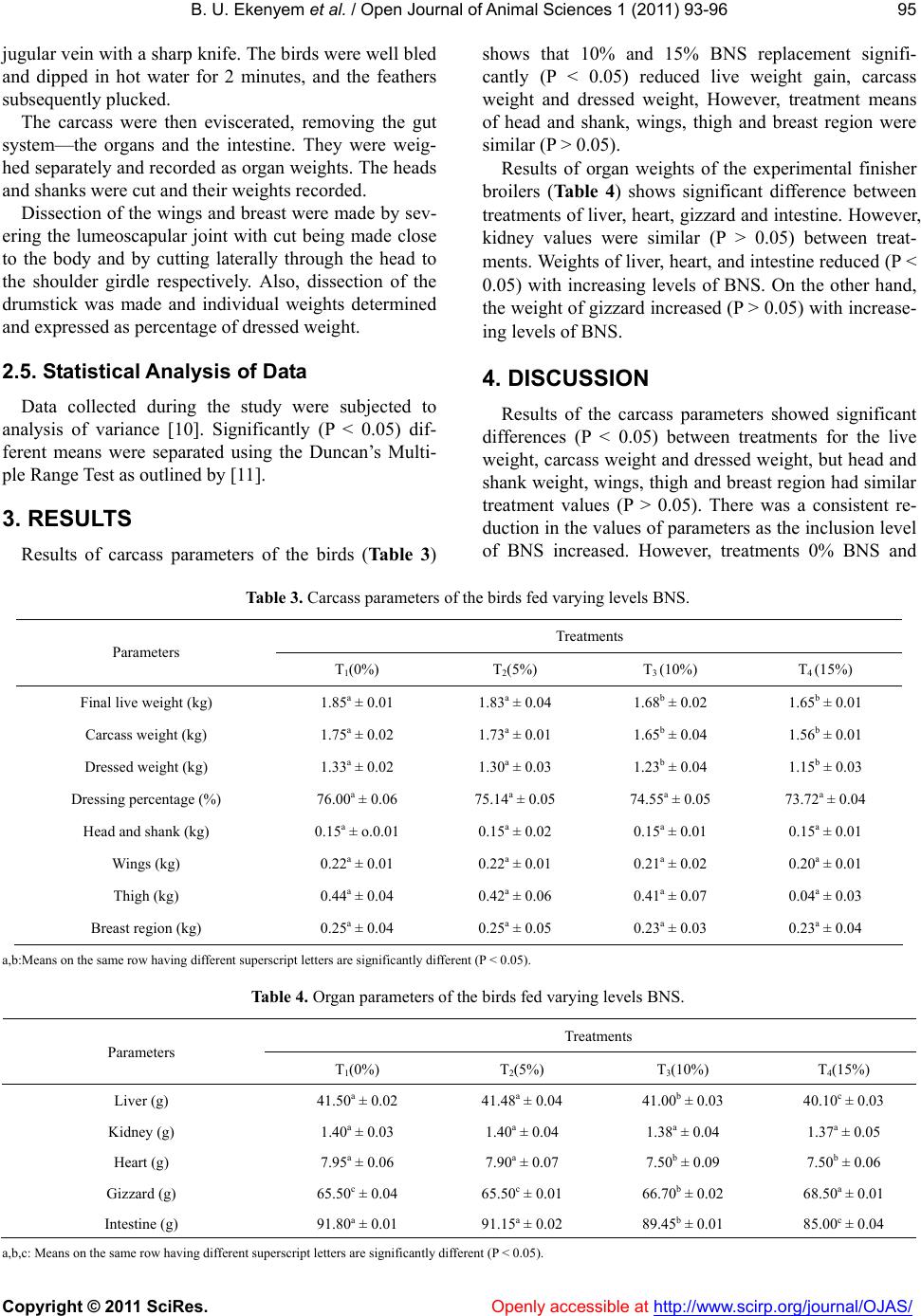 B. U. Ekenyem et al. / Open Journal of Anim al Sciences 1 (2011) 93-96 Copyright © 2011 SciRes. http://www.scirp.org/journal/OJAS/Openly accessible at 95 jugular vein with a sharp knife. The birds were well b led and dipped in hot water for 2 minutes, and the feathers subsequently plucked. The carcass were then eviscerated, removing the gut system—the organs and the intestine. They were weig- hed separately and recorded as organ weights. The heads and shanks were cut and their weights recorded. Dissection of the wings and breast were made by sev- ering the lumeoscapular joint with cut being made close to the body and by cutting laterally through the head to the shoulder girdle respectively. Also, dissection of the drumstick was made and individual weights determined and expressed as percentage of dressed weight. 2.5. Statistical Analysis of Data Data collected during the study were subjected to analysis of variance [10]. Significantly (P < 0.05) dif- ferent means were separated using the Duncan’s Multi- ple Range Test as outlined by [11]. 3. RESULTS Results of carcass parameters of the birds (Table 3) shows that 10% and 15% BNS replacement signifi- cantly (P < 0.05) reduced live weight gain, carcass weight and dressed weight, However, treatment means of head and shank, wings, thigh and breast region were similar (P > 0.05). Results of organ weights of the experimental finisher broilers (Tab le 4) shows significant difference between treatments of liver, heart, gizzard and intestine. Howev er, kidney values were similar (P > 0.05) between treat- ments. Weights of liver, heart, and intestin e reduced (P < 0.05) with increasing levels of BNS. On the other hand, the weight of gizzard increased (P > 0.05) with increase- ing levels of BNS. 4. DISCUSSION Results of the carcass parameters showed significant differences (P < 0.05) between treatments for the live weight, carcass weight and dressed weight, but head and shank weigh t, wings, thigh and breast region had similar treatment values (P > 0.05). There was a consistent re- duction in the valu es of parameters as the inclusion lev el of BNS increased. However, treatments 0% BNS and Table 3. Carcass parameters of the birds fed varying levels BNS. Treatments Parameters T1(0%) T2(5%) T3 (10%) T4 (15%) Final live weight (kg) 1.85a ± 0.01 1.83a ± 0.04 1.68b ± 0.02 1.65b ± 0.01 Carcass weight (kg) 1.75a ± 0.02 1.73a ± 0.01 1.65b ± 0.04 1 .56b ± 0.01 Dressed weight (kg) 1.33a ± 0.02 1.30a ± 0.03 1.23b ± 0.04 1.15b ± 0.03 Dressing percentage (%) 76.00a ± 0.06 75.14a ± 0.05 74.55a ± 0.05 73.72a ± 0.04 Head and shank (kg) 0.15a ± o.0.01 0.15a ± 0.02 0.15a ± 0.01 0.15a ± 0.01 Wings (kg) 0.22a ± 0.01 0.22a ± 0.01 0.21a ± 0.02 0.20a ± 0.01 Thigh (kg) 0.44a ± 0.04 0.42a ± 0.06 0.41a ± 0.07 0.04a ± 0.03 Breast region (kg) 0.25a ± 0.04 0.25a ± 0.05 0.23a ± 0.03 0.23a ± 0.04 a,b:Means on the same row having different superscript letters are significantly different (P < 0.05). Table 4. Organ parameters of the birds fed varying levels BNS. Treatments Parameters T1(0%) T2(5%) T3(10%) T4(15%) Liver (g) 41.50a ± 0.02 41.48a ± 0.04 41.00b ± 0.03 40.10c ± 0.03 Kidney (g) 1.40a ± 0.03 1.40a ± 0.04 1.38a ± 0.04 1.37a ± 0.05 Heart (g) 7.95a ± 0.06 7.90a ± 0.07 7.50b ± 0.09 7 .50b ± 0.06 Gizzard (g) 65.50c ± 0.04 65.50c ± 0.01 66.70b ± 0.02 68.50a ± 0.01 Intestine (g) 91.80a ± 0.01 91.15a ± 0.02 89.45b ± 0.01 85.00c ± 0.04 a,b, Means on the same row having different superscr ipt letters are significantly different (P < 0.05). c:  B. U. Ekenyem et al. / Open Journal of Anim al Sciences 1 (2011) 93-96 Copyright © 2011 SciRes. Openly accessible at http://www.scirp.org/journal/OJAS/ 96 5% BNS were observed to be similar (P > 0.05) in all the carcass parameters. The result partly varies with that of [7] who reported increase in carcass values with up to 10% inclusion of BNS which declined afterwards with increasing values. Also the carcass weights 1.75 kg, 1.73 kg, 1.65 kg and 1.56 kg for treatments 0%, 5%, 10% and 15% BNS re- spectively reflected a direct relationship with the live weights (Table 3). The results of dressed weight, 1.33, 1.30, 1.23 and 1.15 kg varied significantly (P < 0.05). The dressed weight of birds fed 0% BNS weighing 1.33 kg were similar to birds fed 5% BNS which weighed 1.30 kg but significantly varied from those fed 10% BNS with 1.23 kg which in turn was significantly (P < 0.05) heavier than bird s fed 15% BNS which weig hed 1.15 kg. This finding agreed with that of [7] who stated that eviscerated weight of birds fed BNS followed same pat- tern as final body weight. The dressing percentage of 76.00%, 75.14%, 74.55% and 73.72% for values on birds fed 0%, 5%, 10% and 15% BNS respectively also revealed similarity with the results on live weight, car- cass weight and dressed weight. This result appears to agree with [12], who stated that the distribution of mus- cle is influenced by total carcass muscle and not by nu- tritional treatment. This is typical o f the results on wings, thigh and breast r egion s, thoug h no sign if ican t difference (P > 0.05) was realized. Reference [13] had also stated that eviscerated weight and weight of broiler carcass changes as brewers dried grain, corn brain or palm ker- nel cake increased in diets. This is likely because of in- creasing levels of crude fibre with increasing levels of BNS in the diets [9,7]. Thus, results sh ow that 5% inclu- sion of BNS is optimum considering the outstanding performances of this treatment relative to the control. This however differs from [7] mainly because of age difference of the birds as they used older birds (layers), who had higher capacity to digest the increasing fibre levels for which 10% leve l was their optimum. The results of organ weights (Table 4) showed that the weights of liver 41.50, 41.48, 41.00 g and 41.10 for treatments 0, 5, 10 and 15% BNS respectively differed significantly (P < 0.05) between treatments while those of 0 and 5% were similar (P > 0.05). Values of the kid- ney, heart and intestine followed same trend as they re- duced with increasing levels of BNS. Higher weights were however observed for gizzard which is attributable to muscle expansion arising from the stress of chunning of food materials. 5. CONCLUSIONS Varying levels of BNS in diets of finisher broilers sig- nificantly (P < 0.05) affect the values of carcass and or- gan parameters. From the result, it appears that 5% level of inclusion of BNS is optimal for carcass and organ parameters of finisher broiler chicken. REFERENCES [1] Madubuike, F. N. and Ekenyem, B. U. (2001) Non-Ru- minant livestock production in the tropics Gust-Chuks Graphic Centre, Owerri, Nigeria, 196. [2] Ekenyem, B. U., Obih, T.K.O., Odo, B. I. and Mba, F. I. A. (2010) Performance of finisher broiler chicks fed varying replacement levels of Chromolaena oderata leaf for soya bean mean, Pakistan Journal of Nutrition, 9, 501-558. [3] Tegbe, T. S., Atta, B. and Gregede, J. O. (1984) Utiliza- tion of agro-industrial by-product (rice and wheat offal) in diet of pigs. Proceedings of 9th Annual Conference of the Nigeria Society for Animal Production, Nsukka, Ni- geria. [4] Madubuike, F. N. (1992) Bridging the animal protein gap for rural development in Nigeria: The potential for pig. Journal of Agriculture and Rural Development, 5, 5-12. [5] Akinmutimi, A. H. (2001) The effect of potash cooked lima bean Phaseolus lunatus on broiler starter diets. The Nigerian Agricu ltural Journal , 32, 109-118. [6] Babatunde, G.M., Pond, W.G. and Ped Jr., E.R. (1990) Nutritive value of rubber seed hevea brasiliences meals utilization by growing pigs fed semi-putrified diets in which rubber seed meals partially replaced soya bean meal. Journal of Animal Science, 51, 692-697. [7] Ugwu, S.O.C. and Onyimonyi, A. E. (2008) Carcass, organ and organoleptic characteristics of spent layers fed bambara nut sievate. International Journal of Poultry Science, 7, 81-84. doi:10.3923/ijps.2008.81.84 [8] Ekenyem, B. U. and Onyeagoro, C. P. (2006) Replace- ment value of Bambara nut Voundzeia substeerrenea sievate for soya bean meal glycine max on the perform- ance of finisher gfbroilers chicken. International Journal of Po ultry Science, 5, 381-384. doi:10.3923/ijps.2006.381.384 [9] AOAC (1995) Association of official analytical chemists. Official Methods of Analysis, 6th Edition, Washington D. C. [10] Steel, R. G. D. and Torrie, J. H. (1980) Principles and procedures of statistics a biometrical approach. Mc- Graw-Hill Book Publishing Company, New York. [11] Onuh, M. O. and Igwemma, A. A. (1998) Applied statis- tical techniques for business and basic sciences. Skill Mark Media Ltd., Owerri, Nigeria. [12] Musa, H. H., Chen, G. H., Cheng, J. H., Li, B. C. and Mekki, D.M. (2006) Study on carcass characteristics of chicken breeds raised under the intensive condition. In- ternational Journal of Poultry Science, 5, 530-533. doi:10.3923/ijps.2006.530.533 [13] Iyayi, E. A., Ogunsola, O. and Nair, V. (2005) Effects of sources of fibre and period of feeding on the performance, carcass measures, organ relative weight and meat quality in broilers. International Journal of Poultry Science, 4, 695-700. doi:10.3923/ijps.2005.695.700 |