

Paper Menu >>
Journal Menu >>
 Int. J. Communications, Network and System Sciences, 2011, 4, 648-655 doi:10.4236/ijcns.2011.410079 Published Online October 2011 (http://www.SciRP.org/journal/ijcns) Copyright © 2011 SciRes. IJCNS Reliable Battery-Aware Cooperative Multicasting for MBS WiMAX Traffic Sara Moftah Elrabiei1, Moohamed Hadi Habaebi1,2 1Department of Computer Engineering, University of Tripoli (Formally Known as Alfateh), Tripoli, Libya 2Department of Electrical and Computer Engineering, International Islamic University Malaysia, Kuala Lumpur, Malaysia E-mail: [email protected], [email protected] Received August 22, 2011; revised September 14, 2011; accepted September 26, 2011 Abstract Recently, relay agents selection schemes were introduced to support downlink multicasting in WiMAX sin- gle frequency networks. Such schemes were devised to work cooperatively in order to facilitate reliable Mul- ticast Broadcast Multimedia Services (MBMS) traffic delivery over wireless channels without any consid- eration to mobile relay agents’ battery energy levels. In this paper, we introduce a battery-aware balancing algorithm to operate in conjunction with these relay agents selection schemes proposed in the open literature. A simulation model, used to present the effect of “before” and “after” the battery-awareness selection crite- rion, highlighted the benefit of using such algorithms in prolonging network lifetime with emphasis on reli- able delivery. Keywords: Reliability, Multicasting, WiMAX, MBMS, Battery 1. Introduction Cooperative communication, has gained momentum nowadays, due to its effectiveness and importance in assisting the communication among wireless subscrib- ers, and its ability to enhance capacity of the mobile wireless broadband through multi-hop forward capabil- ity. Different users can act as cooperative partners or relay agents (RAs) to assist each other in information transmission, to combat fading in wireless networks, leading to improvement in overall system performance [1-6]. Power consumption is a significant issue and key performance indicator in such a cooperative mobile environment, because of the limited battery power available for mobile termnals that constrains the con- tinuous operation time of wireless devices [7]. Fur- thermore, multimedia mobile application software nowadays is more processor intensive, and most of the WiMAX MBMS applications last for long durations of time. Therefore, a critical challenge is how to make efficient use of energy, and to extend the battery life- time for those cooperative relays without jeopardizing their QoS such as throughput and system reliability. In [5], three different re-multicasting schemes were pro- posed and studied, for IPTV traffic, in conjunction with other schemes available in the open literature. All pro- posed schemes divide the downlink frame into 2-phases (e.g., the first phase is used to receive multicast data from the base station (BS) and the second phase is used to re-multicast it to neighboring mobile subscriber sta- tions (SSs)) but they differ in how to select the RAs to perform such process. Furthermore, none of the selec- tion schemes considered the effect of battery drainage on selected RAs throughout the re-multicasting duration. The contribution of this paper is two-folds. At first, we study the effect of using such re-multicasting schemes without any consideration to the SS battery state and highlight the effect of the selection process on average node energy consumption levels in the network. Sec- ondly, we propose a selection criteria energy level bal- ancing algorithm and implement it into the three dif- ferent RAs selection schemes and evaluate its effect on system reliability. The rest of this paper is organized as follows. Section 2 introduces the effect of battery drainage of RAs in battery unaware network using our MATLAB built simulator. Section 3 discusses the bat- tery aware RA selection optimization schemes. Section 4 introduces the simulation model used. Section 5 evaluates the performance of the proposed schemes and discusses the simulation results, and Section 6 con- cludes the paper.  S. M. ELRABIEI ET AL.649 2. Battery Drain of RAs in Battery Unaware Network To achieve a reliable downlink transmission for MBMS traffic and to extend the coverage outside the trans- mission area, three energy efficient re-multicasting techniques were proposed in [5] for properly selecting RAs in a two phase cooperative transmission model. At phase I, the BS multicasts data to all SSs at high transmission rate R1, where only subscribers in a good channel state (SSGCS), e.g., as defined by their CINR threshold, can successfully receive the data, and the remaining group of subscribers in a bad channel state (SSsBCS) fail to receive the data. BS preselects some of SSGCS to be RAs using one of the selection algorithms in Elrabiei et al. [5]. Upon receiving signals from BS, each RA decodes the received signals and then forwards them to SSsBCS at a proper rate R2 in phase II. By exploiting the channel state information (CSI) and the location based service (LBS), a Nearest-Neighbor Discovery Protocol (NNP), and two other optimized versions of it, based on RA’s transmission range and instantaneous CSI, were simulated and studied in the context of WiMAX single frequency networks. These protocols are described brief- ly below as follow: 2.1. NNP RA Selection Scheme The proposed relay agent selection protocol is based on geographical positioning of users and on the instanta- neous channel condition of the SSs. Since we have as- sumed that BS knows the location of each SS, the as- signed RA is chosen to be the nearest located SSGCS (neighbor) to the SSBCS of interest, independently of other SSsBCS. The NNP can be executed periodically according to the mobility of the users and how often they change their locations. 2.2. Transmission Radius RA Selection Scheme The proposed NNP selects a RA for each SSBCS inde- pendently of other RAs selection, by finding the nearest SSGCS to the SSBCS from the same MGroup. In worst case scenario, there is independent RA for each SSBCS, (i.e., number of RAs equal number of SSsBCS). Therefore, to reduce the number of RAs selected, a scheme optimiza- tion is proposed. If there are two or more SSsBCS, which are in close proximity to each other, the BS can select one RA for all of them if they are located within the RA’s transmission radius. In other words, BS chooses the RA with Transmission Radius arg min x di to the SSsBCS. For instance, if we consider da1, da2, are the distances between RAa and SS1BCS, SS2BCS respectively, and db1, db2, are the distances between RAb and SS1BCS, SS2BCS respectively, then we select the RA which has: min(da1 + da2, db1 + db2). The objective of the optimiza- tion is to minimize the number of RAs as much as possi- ble, by selecting the SSsGCS that can support re-mul- ti- casting to the largest number of SSsBCS within its cover- age transmission range, and not necessary be the nearest SSGCS neighbor to each SSBCS. The template is used to format your paper and style the text. All margins, column widths, line spaces, and text fonts are prescribed; please do not alter them. You may note peculiarities. For example, the head margin in this template measures proportionately more than is customary. This measure- ment and others are deliberate, using specifications that anticipate your paper as one part of the entire journals, and not as an independent document. Please do not re- vise any of the current designations. 2.3. SS-SS Inter-Link CSI RA Selection Algrithm The proposed Transmission Radius RA selection algo- rithm proposed in 2.2 section above reduces further the number of RAs involved in the re-multicasting process but at the expense of algorithm reliability. This is be- cause some of the SSs previously enjoying their own nearby RA are now located at the edge of transmission range of the new RA. Adding that to the varying channel state, it would result into less reliable delivery. In order to compensate for that and to further reduce the number of RAs involved, each SS in the cell is assumed to report also its instantaneous channel quality between itself and its neighboring SSs (i.e., SS-SS inter-link CSI) that can overhear in the cell. Such SS-SS inter-link CSI aggrega- tion can help the BS to select the proper SSsGCS, that have maximum number of SSsBCS within in its transmis- sion range and have good inter-link CSI, to support the re-multicasting. Such technique requires further modify- cations to the Wimax Channel Quality Indicator Channel (CQICH) but the implementation is out of the scope of this paper. The RAs are selected so that channel condition between them and all SSsBCS has to be in a good state. Using SS-SS instantaneous Inter-link CSI, R2 in phase II is determined based on computing the sum of the instan- taneous received power from all corresponding RAs using the large-scale and small-scale fading channel model, by selecting the Adaptive Modulation and Coding (AMC) level that support the worst CSI between SSsBCS and the RAs. Further details can be found in [5]. The above presented schemes were found to consid- erably reduce the amount of energy consumed [5], provi- ding a lower cost coverage solution with no dereliction in achieved throughput for all multicast group members. In this study, we have assumed throughout our proposed Copyright © 2011 SciRes. IJCNS  S. M. ELRABIEI ET AL. 650 work that in each frame, the BS selects the proper RAs for re-multicasting depending on one of the selection techniques discussed above and that the RA’s battery capacity reduces due to re-multicasting process only. But no prior formulation was made to estimate the energy consumption levels or to predict the network energy map. There have been several attempts to address the above issue mentioned especially in the context of wireless sensor networks, where the main source of energy is bat- teries. Nevertheless, tackling the process of estimating the energy levels at all SSs in the network required in a quantitative closed formula is, somewhat, cumbersome. However, we decided to use qualitative simulation to highlight the effect of our proposed re-multicasting tech- niques or energy consumption levels. The notations used throughout the paper are listed in Table 1. 3. Proposed Battery-Aware RA Selection Scheme The power consumption and the duration of how long the SS should work as a RA can be adjusted dynamically by the BS. The accurate knowledge of the available energy levels in each SS in the network (i.e., energy map of the whole network) is important information for the BS to make its selection. This can be implemented either by allowing the SS to report its battery energy level as extra information sent to the BS, or estimated by default as the BS runs the RA selection algorithms and has a priori knowledge of the RAs selection frequency rate. We have resorted to the first assumption in our simulation study. All SSs are involved in aggregating the CSI map of the network to the BS. Therefore, it is similarly possible to Table 1. Notations definitions (true unless stated otherwise). Notation Description RA Relay agent SSBCS Subscriber station with bad channel state SSGCS Subscriber station with good channel state SSi,j The j-th group member in MGroupi 1 i R The rate of the BS in Phase I for MGroupi 2 i R The rate of each cooperative transmitter in Phase II for MGroupi 1 i T The transmission time of Phase I for MGroupi 2 i T The transmission time of Phase II for MGroupi i Service probability for MGroupi 1 ,ij E The received signal power for SSi,j in Phase I p The power di Distance between SSi and BS bn The lower boundaries of signal to noise ratio (SNR) for MCS level n N0 The noise power map the network mobile SSs battery draining levels at least in a coarse grained fashion. Selected RAs can be considered based on their CSI, geographic locations in the cell, and their battery draining levels. SSsGCS that have low battery levels can be spared from the down-link phase II re-multicasting process until recharged. SSs with stationery position and infinite power supply can act as RAs similarly to stationary RSs proposed in 16j standard, although they don’t have to re-multicast continuously on every frame. Similar schemes are used extensively in routing network traffic over wireless links. Therefore we proposed the following battery aware RA selection algo- rithm described in the following pseudo-code: Pseudo Code for Battery-Aware RA Selection Algorithm S chedule the appropriate MGroupi using algorithm described in [6] L ocate all the SSsBCS L ocate all the SSsGCS F or each frame, collect the battery capacity levels in all SSsGCS Compute the average battery available in all mobile SSsGCS. E liminate all SSGCS that have battery capacity less than the computed average battery capacity (e.g., average battery capacity of the cell is computed by taking the average of battery capacity counter values of all mobile SSsGCS involved in the RA selection process only) from RAs s elections S elect the RAs from the new set of S S GCS based on one of the proposed R A selection algorithms described in [5] D etermine T1, R1, T2, R2 described in [5] A t phase I : BS transmits with R1 at T1 A t phase I I : All RAs retransmit with R2 at T2 D ecremen t the capacity counter value of the battery (drain_level) for each RA selected based on the formula drain_level = T2/(T1 + T2) Once battery capacity levels of all SSsGCS are aggre- gated to the BS, the algorithm simply excludes certain SSsGCS, which have battery energy levels below the av- erage battery capacity of all mobile SSsGCS in the cell, from the RA’s selection process. Such approach relieves these SSsGCS from draining their batteries and averages out the RA selection process, thus, prolonging the net- work lifetime and, consequently, improving network reliability in general. Once battery capacity levels of all SSsGCS are aggre- gated to the BS, the algorithm simply excludes certain SSsGCS, which have battery energy levels below the av- erage battery capacity of all mobile SSsGCS in the cell, from the RA’s selection process. Such approach relieves these SSsGCS from draining their batteries and averages out the RA selection process, thus, prolonging the net- work lifetime and, consequently, improving network reliability in general. We have formulated a general term for the probability Copyright © 2011 SciRes. IJCNS  S. M. ELRABIEI ET AL. Copyright © 2011 SciRes. IJCNS 651 . Table 2. System parameters. of any randomly picked SSj becoming a RA in the MGroupi that is updated in the battery-aware network [8], and can be estimated using the following formula: PRA(SSij) =· i 1 , () ij n PE b 1 ,12 min, , , BCS i jSSN Pdddd . P (battery power > threshold) (1) where PRA(SSij) is the probability of a SSi to be a RA in MGroupi, i is the Service Probability for MGroupi given by [6, Equation (6)], 1 ,0ij n PE bN j = SSGC 1 ,d is the prob- ability that SS has a good CSI (i.e. SS ), the term ,12 BCS i jSSN is the probability that SSj is nearest neighbor to the SSBCS, and the term P(battery power > threshold) is probability that the battery capacity at the SSj is above a threshold value set by the BS to ensure the ability of re-multicasting. Further details on the mathematical formulation are presented in [8]. j S n, ,Pdd d mi Number of cells 1 Carrier frequency & BW 2.5 GHz, 10 MHz Cell radius 2.56 Km The total number of SSs in the system 200 The number of MGroups M 16 The number of group members in each MGroup Ni Varying BS maximum transmission power 20 W SS maximum transmission power 3 W Noise power −99 dBm Path loss exponent α 4.375 Close-in reference distance d0 100 m Lognormal Shadowing 8.9 dB std Coverage ratio C 50% Transmitter antenna gain Gt 1 Receiver antenna gain Gr 1 System loss L 1 DL/UL sub-frame duration 1.25 ms/1.25 ms OFDMA symbol duration τ 102.9 μs Frame duration 5 ms Time ratio for multicasting 25% 4. Simulation Model Table 3. Modulation and coding schemes for IEEE 802.16. Level Modulation and coding bn (dB) rn (Mbps) Surface ratio % 0 No Tx 0 0 27.0782 % 1 BPSK (1/2) 3 2.52 19.7459 % 2 QPSK (1/2) 6 5.04 12.3036 % 3 QPSK (3/4) 8.5 7.56 11.0675 % 4 16 QAM (1/2) 11.5 10.08 9.1849 % 5 16 QAM (3/4) 15 15.12 6.3544 % 6 64 QAM (2/3) 18.5 20.16 3.3007 % 7 64 QAM (3/4) 21 22.68 10.9648 % We have used in this work a channel model that incorporates both large-scale and small-scale fadings that are represented by propagation path-loss, shadowing, and random Rayleigh fading channel [9,10], and no mutual interference is assumed because the SSs use the orthogonal channel. As for the adaptive modulation and coding, the combinations of modulation and coding set (MCS) levels for the IEEE 802.16 air-interface are shown in Table 3 in the first four columns, where bn represents the lower boundaries of SNR (receiver minimum sensitivity level), and rn is the corresponding discrete peak transmission rate for the state n used in this work for 10 MHz system. State 0 represents the state that no transmission is allowed, which occurs when there is poor channel condition. 5. Performance Evaluation 5.1. Battery Energy-Unaware System Performance When analyzing our results it appeared that some mobile SSs are selected as RAs more often than their counter- parts especially when these SSs were located at places with line of sight connection from the BS and/or have always good channel state. This frequent selection re- sulted in the depletion of their limited energy sources faster than the average depletion rate of the network. We compare the performance for the three systems, before and after battery-awareness situations, using extensive simulations with Matlab. In our simulated system, the network is composed of one BS and a number of SSs which are randomly and uniformly distributed over the coverage area of the BS (i.e., a circle centered at the BS with a radius of ≈ 2.5 km). There are different MGroups in the network and each group includes some members which are randomly selected from the whole SSs set. Channel model described in above is applied, and the scheduling scheme for MGroups proposed in [4] is utilized so that the throughput performance and fair scheduling is not jeopardized. The main system simulation parameters are listed in Table 2 and their descriptions are discussed in [5]. We have repeated the simulation several times with different random seeds to calculate the average results. In Figure 1, the histogram illustrates the number of times a 50 SSs sample were selected as RAs through 600 frames duration time. Increasing the SS density in the cell, resulted in reduction of their severed energy consumption levels but the general trend persisted. Over time, the discharging process drained their batteries and they were automatically eliminated from the network population. Thus, reducing the system reliability in general and bringing the network lifetime to a lesser reach. In order to investigate the effect of battery levels on 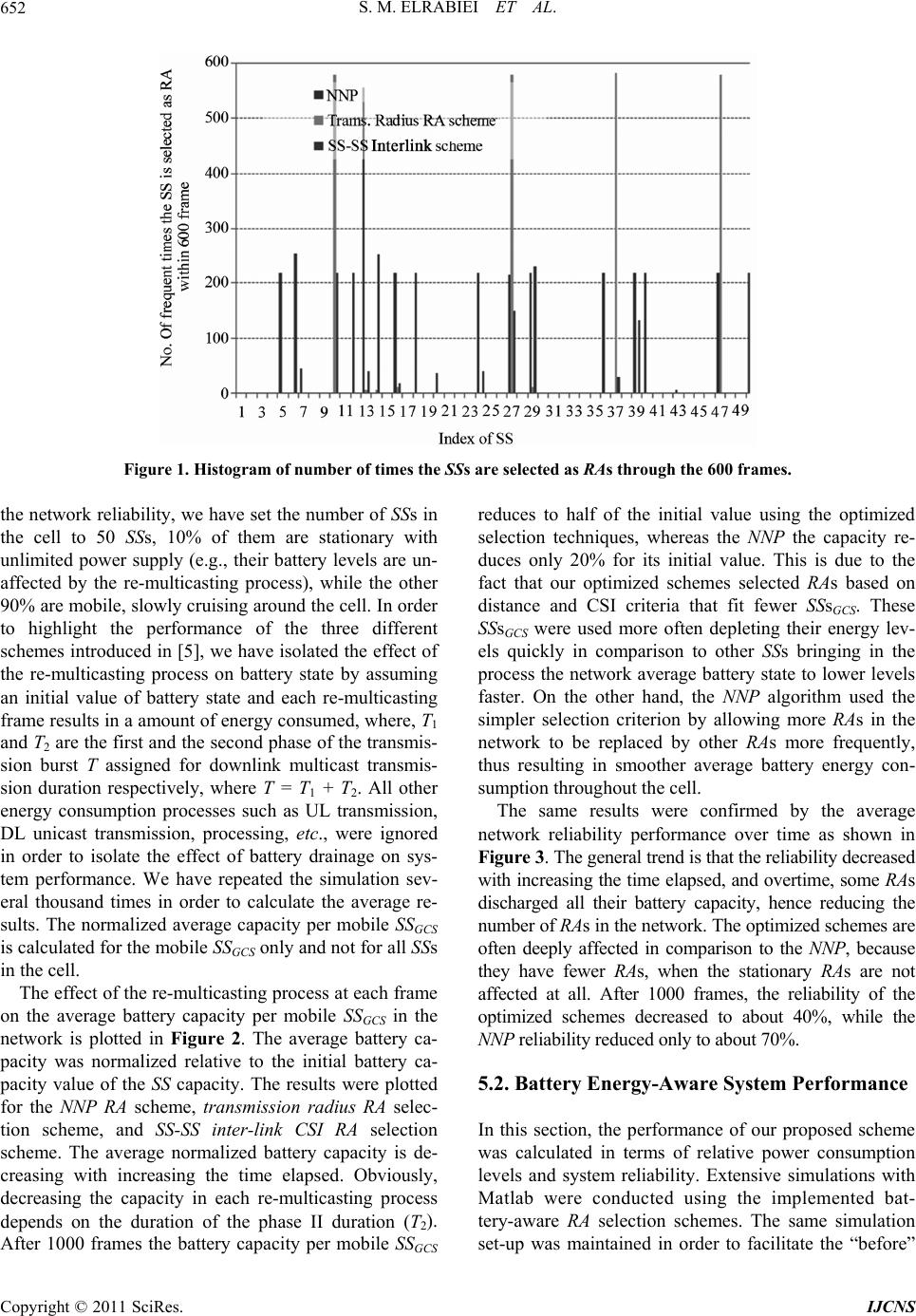 S. M. ELRABIEI ET AL. 652 Figure 1. Histogram of number of times the SSs are selected as RAs through the 600 frames. the network reliability, we have set the number of SSs in the cell to 50 SSs, 10% of them are stationary with unlimited power supply (e.g., their battery levels are un- affected by the re-multicasting process), while the other 90% are mobile, slowly cruising around the cell. In order to highlight the performance of the three different schemes introduced in [5], we have isolated the effect of the re-multicasting process on battery state by assuming an initial value of battery state and each re-multicasting frame results in a amount of energy consumed, where, T1 and T2 are the first and the second phase of the transmis- sion burst T assigned for downlink multicast transmis- sion duration respectively, where T = T1 + T2. All other energy consumption processes such as UL transmission, DL unicast transmission, processing, etc., were ignored in order to isolate the effect of battery drainage on sys- tem performance. We have repeated the simulation sev- eral thousand times in order to calculate the average re- sults. The normalized average capacity per mobile SSGCS is calculated for the mobile SSGCS only and not for all SSs in the cell. The effect of the re-multicasting process at each frame on the average battery capacity per mobile SSGCS in the network is plotted in Figure 2. The average battery ca- pacity was normalized relative to the initial battery ca- pacity value of the SS capacity. The results were plotted for the NNP RA scheme, transmission radius RA selec- tion scheme, and SS-SS inter-link CSI RA selection scheme. The average normalized battery capacity is de- creasing with increasing the time elapsed. Obviously, decreasing the capacity in each re-multicasting process depends on the duration of the phase II duration (T2). After 1000 frames the battery capacity per mobile SSGCS reduces to half of the initial value using the optimized selection techniques, whereas the NNP the capacity re- duces only 20% for its initial value. This is due to the fact that our optimized schemes selected RAs based on distance and CSI criteria that fit fewer SSsGCS. These SSsGCS were used more often depleting their energy lev- els quickly in comparison to other SSs bringing in the process the network average battery state to lower levels faster. On the other hand, the NNP algorithm used the simpler selection criterion by allowing more RAs in the network to be replaced by other RAs more frequently, thus resulting in smoother average battery energy con- sumption throughout the cell. The same results were confirmed by the average network reliability performance over time as shown in Figure 3. The general trend is that the reliability decreased with increasing the time elapsed, and overtime, some RAs discharged all their battery capacity, hence reducing the number of RAs in the network. The optimized schemes are often deeply affected in comparison to the NNP, because they have fewer RAs, when the stationary RAs are not affected at all. After 1000 frames, the reliability of the optimized schemes decreased to about 40%, while the NNP reliability reduced only to about 70%. 5.2. Battery Energy-Aware System Performance In this section, the performance of our proposed scheme was calculated in terms of relative power consumption levels and system reliability. Extensive simulations with Matlab were conducted using the implemented bat- tery-aware RA selection schemes. The same simulation set-up was maintained in order to facilitate the “before” C opyright © 2011 SciRes. IJCNS 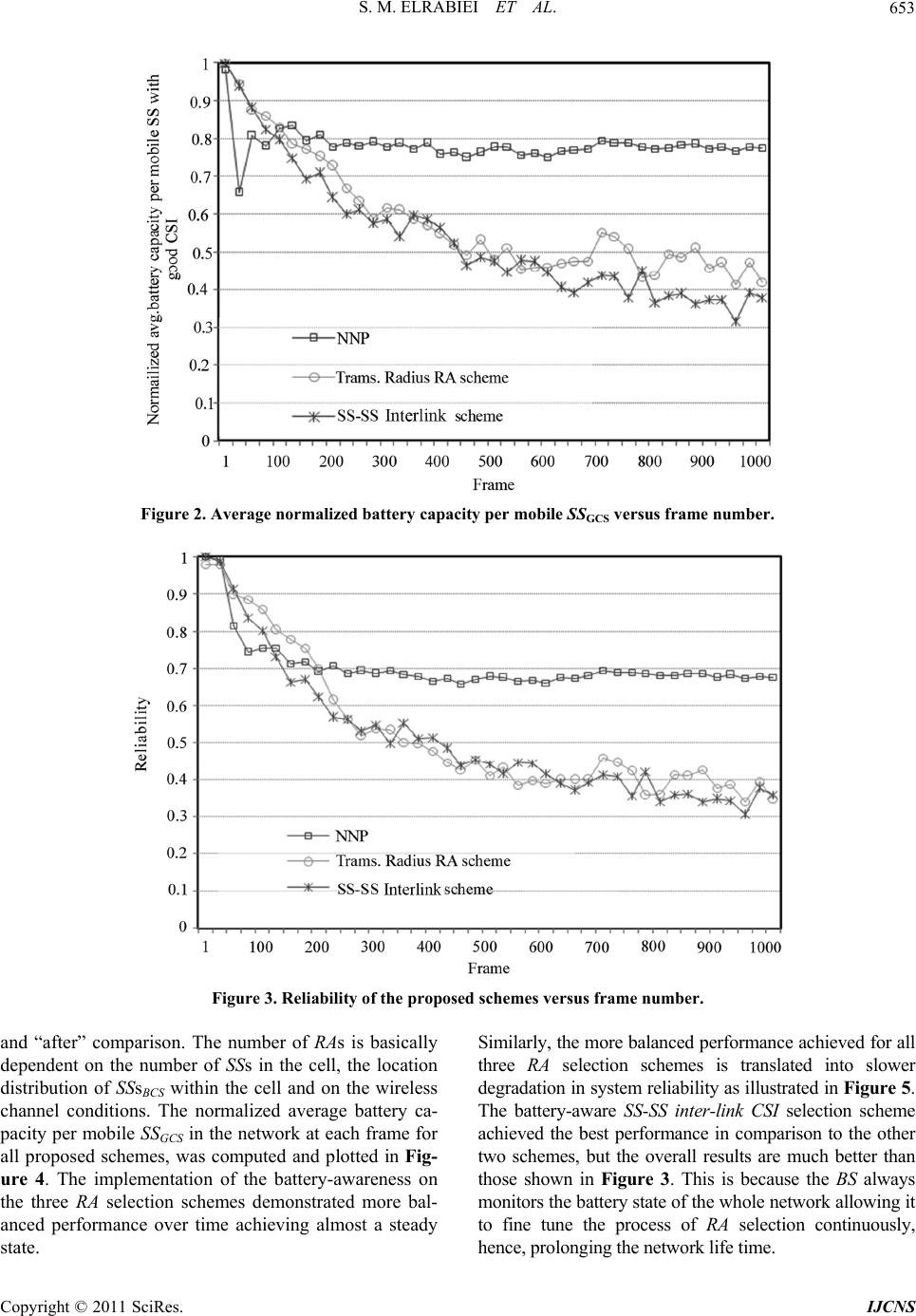 S. M. ELRABIEI ET AL. 653 Figure 2. Average normalized battery capacity per mobile SSGCS versus frame number. Figure 3. Reliability of the proposed schemes versus frame number. and “after” comparison. The number of RAs is basically dependent on the number of SSs in the cell, the location distribution of SSsBCS within the cell and on the wireless channel conditions. The normalized average battery ca- pacity per mobile SSGCS in the network at each frame for all proposed schemes, was computed and plotted in Fig- ure 4. The implementation of the battery-awareness on the three RA selection schemes demonstrated more bal- anced performance over time achieving almost a steady state. Similarly, the more balanced performance achieved for all three RA selection schemes is translated into slower degradation in system reliability as illustrated in Figure 5. The battery-aware SS-SS inter-link CSI selection scheme achieved the best performance in comparison to the other two schemes, but the overall results are much better than those shown in Figure 3. This is because the BS always monitors the battery state of the whole network allowing it to fine tune the process of RA selection continuously, hence, prolonging the network life time. C opyright © 2011 SciRes. IJCNS 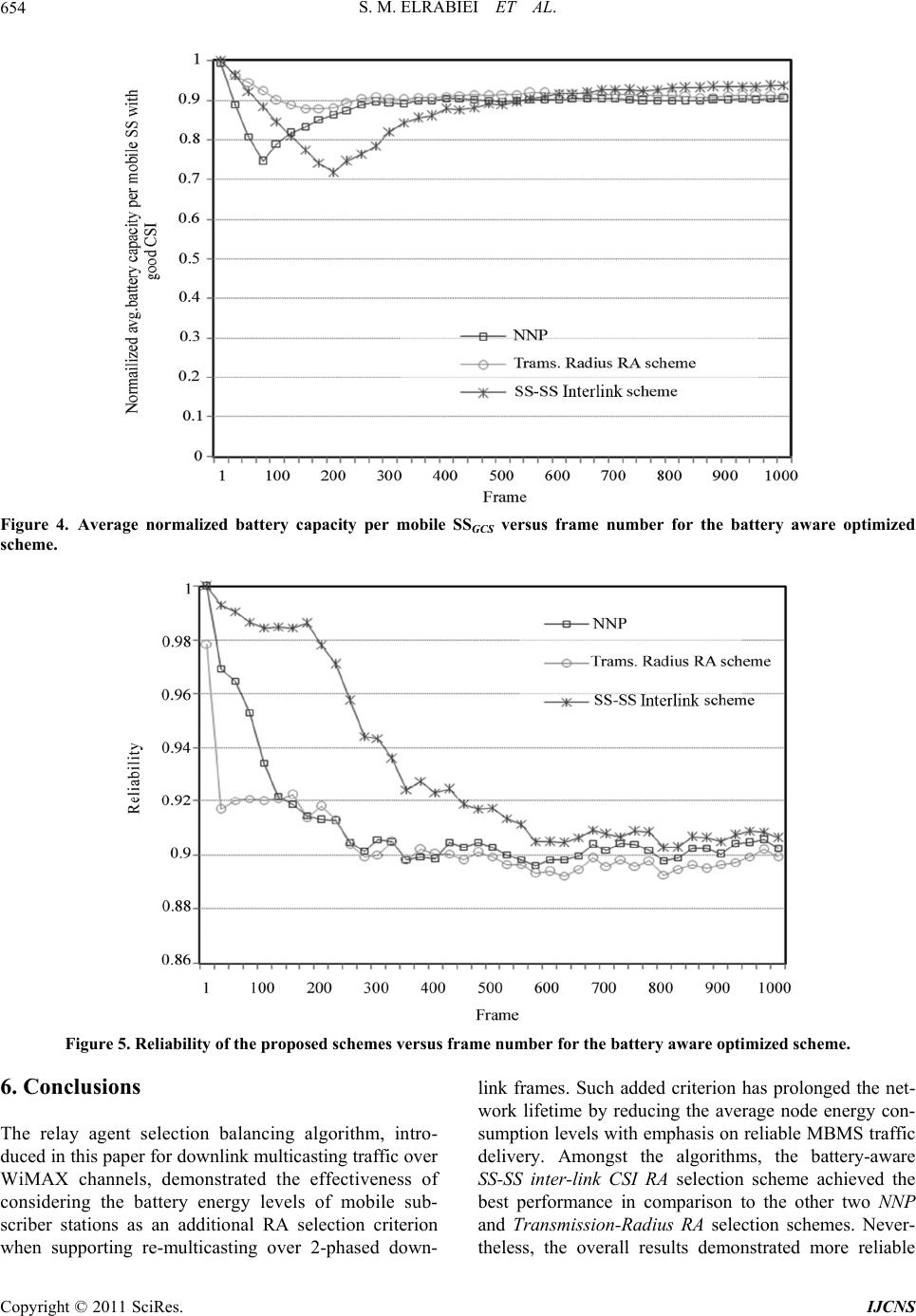 S. M. ELRABIEI ET AL. 654 Figure 4. Average normalized battery capacity per mobile SSGCS versus frame number for the battery aware optimized scheme. Figure 5. Reliability of the proposed schemes versus frame number for the battery aware optimized scheme. 6. Conclusions The relay agent selection balancing algorithm, intro- duced in this paper for downlink multicasting traffic over WiMAX channels, demonstrated the effectiveness of considering the battery energy levels of mobile sub- scriber stations as an additional RA selection criterion when supporting re-multicasting over 2-phased down- link frames. Such added criterion has prolonged the net- work lifetime by reducing the average node energy con- sumption levels with emphasis on reliable MBMS traffic delivery. Amongst the algorithms, the battery-aware SS-SS inter-link CSI RA selection scheme achieved the best performance in comparison to the other two NNP and Transmission-Radius RA selection schemes. Never- theless, the overall results demonstrated more reliable C opyright © 2011 SciRes. IJCNS 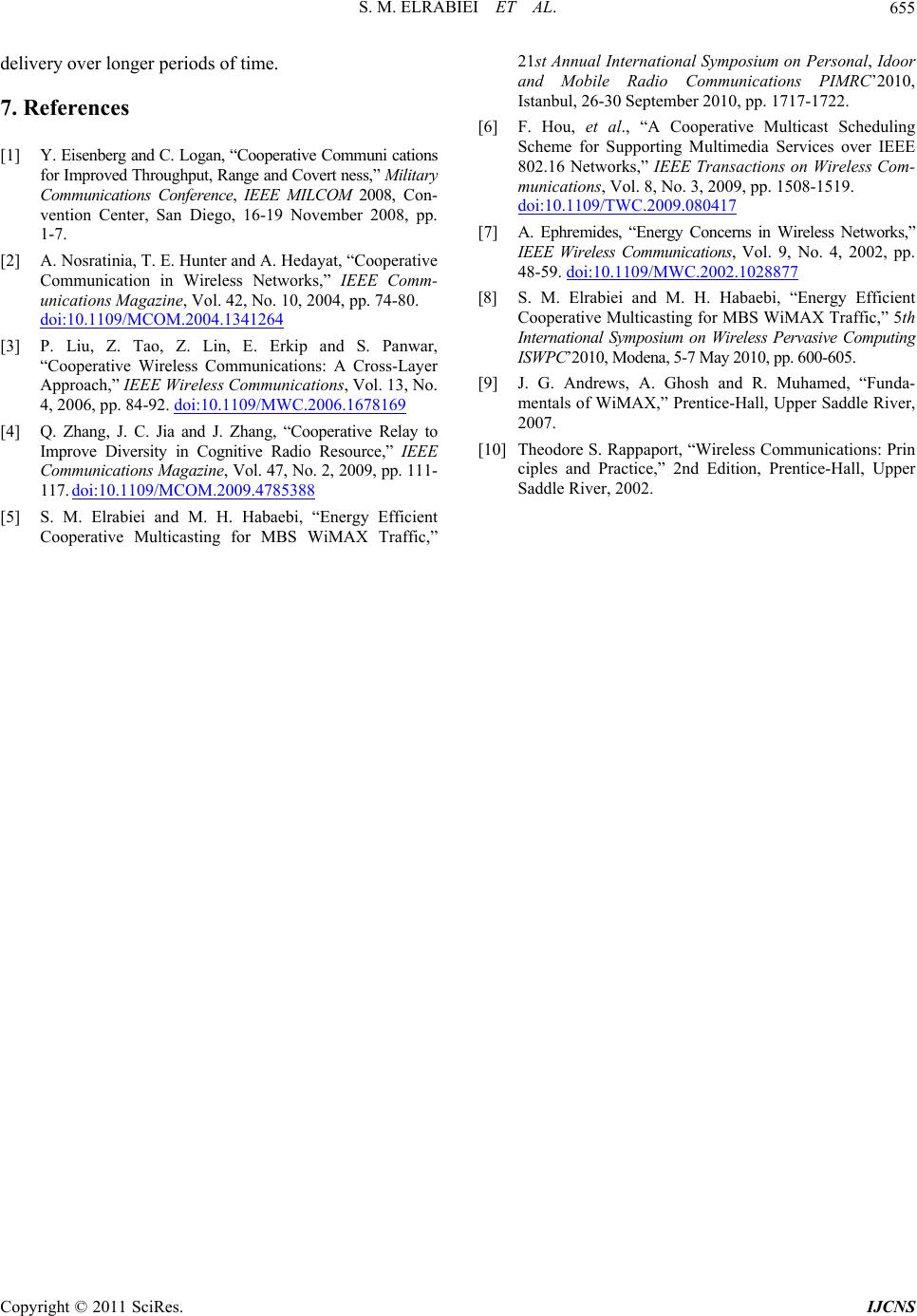 S. M. ELRABIEI ET AL.655 delivery over longer periods of time. 7. References [1] Y. Eisenberg and C. Logan, “Cooperative Communi cations for Improved Throughput, Range and Covert ness,” Military Communications Conference, IEEE MILCOM 2008, Con- vention Center, San Diego, 16-19 November 2008, pp. 1-7. [2] A. Nosratinia, T. E. Hunter and A. Hedayat, “Cooperative Communication in Wireless Networks,” IEEE Comm- unications Magazine, Vol. 42, No. 10, 2004, pp. 74-80. doi:10.1109/MCOM.2004.1341264 [3] P. Liu, Z. Tao, Z. Lin, E. Erkip and S. Panwar, “Cooperative Wireless Communications: A Cross-Layer Approach,” IEEE Wireless Communications, Vol. 13, No. 4, 2006, pp. 84-92. doi:10.1109/MWC.2006.1678169 [4] Q. Zhang, J. C. Jia and J. Zhang, “Cooperative Relay to Improve Diversity in Cognitive Radio Resource,” IEEE Communications Magazine, Vol. 47, No. 2, 2009, pp. 111- 117. doi:10.1109/MCOM.2009.4785388 [5] S. M. Elrabiei and M. H. Habaebi, “Energy Efficient Cooperative Multicasting for MBS WiMAX Traffic,” 21st Annual International Symposium on Personal, Idoor and Mobile Radio Communications PIMRC’2010, Istanbul, 26-30 September 2010, pp. 1717-1722. [6] F. Hou, et al., “A Cooperative Multicast Scheduling Scheme for Supporting Multimedia Services over IEEE 802.16 Networks,” IEEE Transactions on Wireless Com- munications, Vol. 8, No. 3, 2009, pp. 1508-1519. doi:10.1109/TWC.2009.080417 [7] A. Ephremides, “Energy Concerns in Wireless Networks,” IEEE Wireless Communications, Vol. 9, No. 4, 2002, pp. 48-59. doi:10.1109/MWC.2002.1028877 [8] S. M. Elrabiei and M. H. Habaebi, “Energy Efficient Cooperative Multicasting for MBS WiMAX Traffic,” 5th International Symposium on Wireless Pervasive Computing ISWPC’2010, Modena, 5-7 May 2010, pp. 600-605. [9] J. G. Andrews, A. Ghosh and R. Muhamed, “Funda- mentals of WiMAX,” Prentice-Hall, Upper Saddle River, 2007. [10] Theodore S. Rappaport, “Wireless Communications: Prin ciples and Practice,” 2nd Edition, Prentice-Hall, Upper Saddle River, 2002. Copyright © 2011 SciRes. IJCNS |