

Paper Menu >>
Journal Menu >>
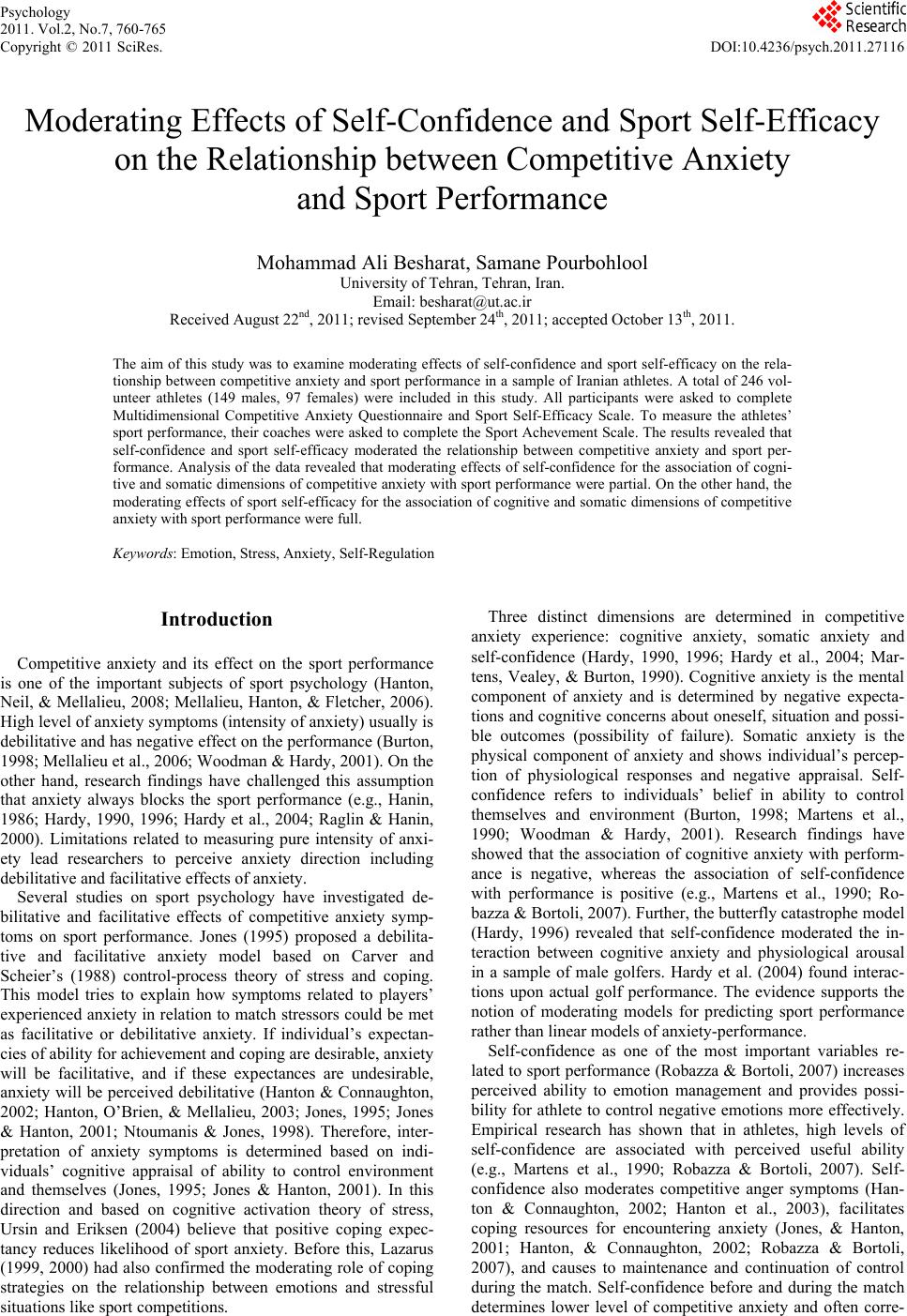 Psychology 2011. Vol.2, No.7, 760-765 Copyright © 2011 SciRes. DOI:10.4236/psych.2011.27116 Moderating Effects of Self-Confidence and Sport Self-Efficacy on the Relationship between Competitive Anxiety and Sport Performance Mohammad Ali Besharat, Samane Pourbohlool University of Tehran, Tehran, Iran. Email: [email protected] Received August 22nd, 2011; revised September 24th, 2011; accepted October 13th, 2011. The aim of this study was to examine moderating effects of self-confidence and sport self-efficacy on the rela- tionship between competitive anxiety and sport performance in a sample of Iranian athletes. A total of 246 vol- unteer athletes (149 males, 97 females) were included in this study. All participants were asked to complete Multidimensional Competitive Anxiety Questionnaire and Sport Self-Efficacy Scale. To measure the athletes’ sport performance, their coaches were asked to complete the Sport Achevement Scale. The results revealed that self-confidence and sport self-efficacy moderated the relationship between competitive anxiety and sport per- formance. Analysis of the data revealed that moderating effects of self-confidence for the association of cogni- tive and somatic dimensions of competitive anxiety with sport performance were partial. On the other hand, the moderating effects of sport self-efficacy for the association of cognitive and somatic dimensions of competitive anxiety with sport performance were full. Keywords: Emotion, Stress, Anxiety, Self-Regulation Introduction Competitive anxiety and its effect on the sport performance is one of the important subjects of sport psychology (Hanton, Neil, & Mellalieu, 2008; Mellalieu, Hanton, & Fletcher, 2006). High level of anxiety symptoms (intensity of anxiety) usually is debilitative and has negative effect on the performance (Burton, 1998; Mellalieu et al., 2006; Woodman & Hardy, 2001). On the other hand, research findings have challenged this assumption that anxiety always blocks the sport performance (e.g., Hanin, 1986; Hardy, 1990, 1996; Hardy et al., 2004; Raglin & Hanin, 2000). Limitations related to measuring pure intensity of anxi- ety lead researchers to perceive anxiety direction including debilitative and facilitative effects of anxiety. Several studies on sport psychology have investigated de- bilitative and facilitative effects of competitive anxiety symp- toms on sport performance. Jones (1995) proposed a debilita- tive and facilitative anxiety model based on Carver and Scheier’s (1988) control-process theory of stress and coping. This model tries to explain how symptoms related to players’ experienced anxiety in relation to match stressors could be met as facilitative or debilitative anxiety. If individual’s expectan- cies of ability for achievement and coping are desirable, anxiety will be facilitative, and if these expectances are undesirable, anxiety will be perceived debilitative (Hanton & Connaughton, 2002; Hanton, O’Brien, & Mellalieu, 2003; Jones, 1995; Jones & Hanton, 2001; Ntoumanis & Jones, 1998). Therefore, inter- pretation of anxiety symptoms is determined based on indi- viduals’ cognitive appraisal of ability to control environment and themselves (Jones, 1995; Jones & Hanton, 2001). In this direction and based on cognitive activation theory of stress, Ursin and Eriksen (2004) believe that positive coping expec- tancy reduces likelihood of sport anxiety. Before this, Lazarus (1999, 2000) had also confirmed the moderating role of coping strategies on the relationship between emotions and stressful situations like sport competitions. Three distinct dimensions are determined in competitive anxiety experience: cognitive anxiety, somatic anxiety and self-confidence (Hardy, 1990, 1996; Hardy et al., 2004; Mar- tens, Vealey, & Burton, 1990). Cognitive anxiety is the mental component of anxiety and is determined by negative expecta- tions and cognitive concerns about oneself, situation and possi- ble outcomes (possibility of failure). Somatic anxiety is the physical component of anxiety and shows individual’s percep- tion of physiological responses and negative appraisal. Self- confidence refers to individuals’ belief in ability to control themselves and environment (Burton, 1998; Martens et al., 1990; Woodman & Hardy, 2001). Research findings have showed that the association of cognitive anxiety with perform- ance is negative, whereas the association of self-confidence with performance is positive (e.g., Martens et al., 1990; Ro- bazza & Bortoli, 2007). Further, the butterfly catastrophe model (Hardy, 1996) revealed that self-confidence moderated the in- teraction between cognitive anxiety and physiological arousal in a sample of male golfers. Hardy et al. (2004) found interac- tions upon actual golf performance. The evidence supports the notion of moderating models for predicting sport performance rather than linear models of anxiety-performance. Self-confidence as one of the most important variables re- lated to sport performance (Robazza & Bortoli, 2007) increases perceived ability to emotion management and provides possi- bility for athlete to control negative emotions more effectively. Empirical research has shown that in athletes, high levels of self-confidence are associated with perceived useful ability (e.g., Martens et al., 1990; Robazza & Bortoli, 2007). Self- confidence also moderates competitive anger symptoms (Han- ton & Connaughton, 2002; Hanton et al., 2003), facilitates coping resources for encountering anxiety (Jones, & Hanton, 2001; Hanton, & Connaughton, 2002; Robazza & Bortoli, 2007), and causes to maintenance and continuation of control during the match. Self-confidence before and during the match determines lower level of competitive anxiety and often corre- 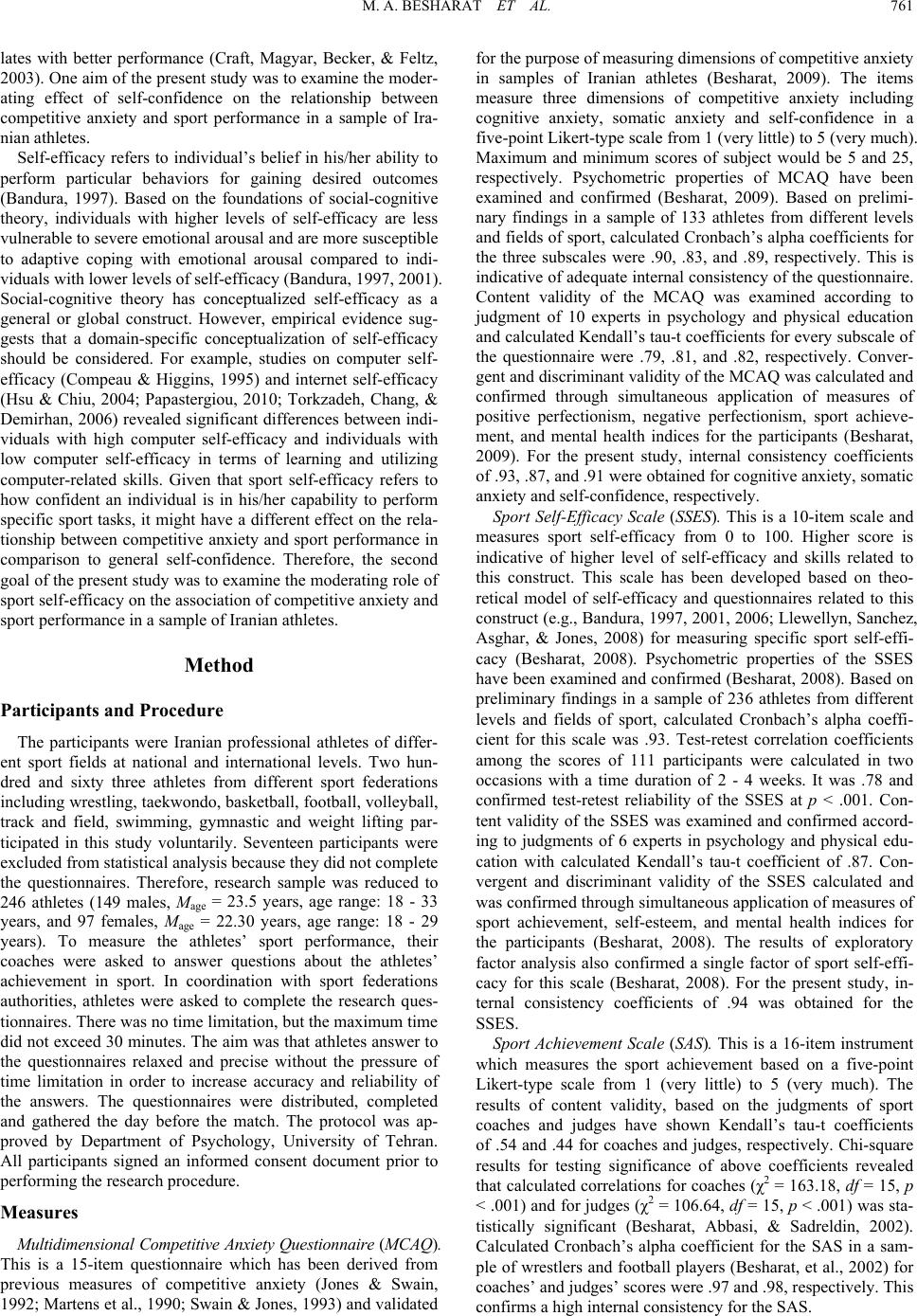 M. A. BESHARAT ET AL. 761 lates with better performance (Craft, Magyar, Becker, & Feltz, 2003). One aim of the present study was to examine the moder- ating effect of self-confidence on the relationship between competitive anxiety and sport performance in a sample of Ira- nian athletes. Self-efficacy refers to individual’s belief in his/her ability to perform particular behaviors for gaining desired outcomes (Bandura, 1997). Based on the foundations of social-cognitive theory, individuals with higher levels of self-efficacy are less vulnerable to severe emotional arousal and are more susceptible to adaptive coping with emotional arousal compared to indi- viduals with lower levels of self-efficacy (Bandura, 1997, 2001). Social-cognitive theory has conceptualized self-efficacy as a general or global construct. However, empirical evidence sug- gests that a domain-specific conceptualization of self-efficacy should be considered. For example, studies on computer self- efficacy (Compeau & Higgins, 1995) and internet self-efficacy (Hsu & Chiu, 2004; Papastergiou, 2010; Torkzadeh, Chang, & Demirhan, 2006) revealed significant differences between indi- viduals with high computer self-efficacy and individuals with low computer self-efficacy in terms of learning and utilizing computer-related skills. Given that sport self-efficacy refers to how confident an individual is in his/her capability to perform specific sport tasks, it might have a different effect on the rela- tionship between competitive anxiety and sport performance in comparison to general self-confidence. Therefore, the second goal of the present study was to examine the moderating role of sport self-efficacy on the association of competitive anxiety and sport performance in a sample of Iranian athletes. Method Participants and Procedure The participants were Iranian professional athletes of differ- ent sport fields at national and international levels. Two hun- dred and sixty three athletes from different sport federations including wrestling, taekwondo, basketball, football, volleyball, track and field, swimming, gymnastic and weight lifting par- ticipated in this study voluntarily. Seventeen participants were excluded from statistical analysis because they did not complete the questionnaires. Therefore, research sample was reduced to 246 athletes (149 males, Mage = 23.5 years, age range: 18 - 33 years, and 97 females, Mage = 22.30 years, age range: 18 - 29 years). To measure the athletes’ sport performance, their coaches were asked to answer questions about the athletes’ achievement in sport. In coordination with sport federations authorities, athletes were asked to complete the research ques- tionnaires. There was no time limitation, but the maximum time did not exceed 30 minutes. The aim was that athletes answer to the questionnaires relaxed and precise without the pressure of time limitation in order to increase accuracy and reliability of the answers. The questionnaires were distributed, completed and gathered the day before the match. The protocol was ap- proved by Department of Psychology, University of Tehran. All participants signed an informed consent document prior to performing the research procedure. Measures Multidimensional Competitive Anxiety Questionnaire (MCAQ). This is a 15-item questionnaire which has been derived from previous measures of competitive anxiety (Jones & Swain, 1992; Martens et al., 1990; Swain & Jones, 1993) and validated for the purpose of measuring dimensions of competitive anxiety in samples of Iranian athletes (Besharat, 2009). The items measure three dimensions of competitive anxiety including cognitive anxiety, somatic anxiety and self-confidence in a five-point Likert-type scale from 1 (very little) to 5 (very much). Maximum and minimum scores of subject would be 5 and 25, respectively. Psychometric properties of MCAQ have been examined and confirmed (Besharat, 2009). Based on prelimi- nary findings in a sample of 133 athletes from different levels and fields of sport, calculated Cronbach’s alpha coefficients for the three subscales were .90, .83, and .89, respectively. This is indicative of adequate internal consistency of the questionnaire. Content validity of the MCAQ was examined according to judgment of 10 experts in psychology and physical education and calculated Kendall’s tau-t coefficients for every subscale of the questionnaire were .79, .81, and .82, respectively. Conver- gent and discriminant validity of the MCAQ was calculated and confirmed through simultaneous application of measures of positive perfectionism, negative perfectionism, sport achieve- ment, and mental health indices for the participants (Besharat, 2009). For the present study, internal consistency coefficients of .93, .87, and .91 were obtained for cognitive anxiety, somatic anxiety and self-confidence, respectively. Sport Self-Efficacy Scale (SSES). This is a 10-item scale and measures sport self-efficacy from 0 to 100. Higher score is indicative of higher level of self-efficacy and skills related to this construct. This scale has been developed based on theo- retical model of self-efficacy and questionnaires related to this construct (e.g., Bandura, 1997, 2001, 2006; Llewellyn, Sanchez, Asghar, & Jones, 2008) for measuring specific sport self-effi- cacy (Besharat, 2008). Psychometric properties of the SSES have been examined and confirmed (Besharat, 2008). Based on preliminary findings in a sample of 236 athletes from different levels and fields of sport, calculated Cronbach’s alpha coeffi- cient for this scale was .93. Test-retest correlation coefficients among the scores of 111 participants were calculated in two occasions with a time duration of 2 - 4 weeks. It was .78 and confirmed test-retest reliability of the SSES at p < .001. Con- tent validity of the SSES was examined and confirmed accord- ing to judgments of 6 experts in psychology and physical edu- cation with calculated Kendall’s tau-t coefficient of .87. Con- vergent and discriminant validity of the SSES calculated and was confirmed through simultaneous application of measures of sport achievement, self-esteem, and mental health indices for the participants (Besharat, 2008). The results of exploratory factor analysis also confirmed a single factor of sport self-effi- cacy for this scale (Besharat, 2008). For the present study, in- ternal consistency coefficients of .94 was obtained for the SSES. Sport Achievement Scale (SAS). This is a 16-item instrument which measures the sport achievement based on a five-point Likert-type scale from 1 (very little) to 5 (very much). The results of content validity, based on the judgments of sport coaches and judges have shown Kendall’s tau-t coefficients of .54 and .44 for coaches and judges, respectively. Chi-square results for testing significance of above coefficients revealed that calculated correlations for coaches (χ2 = 163.18, df = 15, p < .001) and for judges (χ2 = 106.64, df = 15, p < .001) was sta- tistically significant (Besharat, Abbasi, & Sadreldin, 2002). Calculated Cronbach’s alpha coefficient for the SAS in a sam- ple of wrestlers and football players (Besharat, et al., 2002) for coaches’ and judges’ scores were .97 and .98, respectively. This confirms a high internal consistency for the SAS. 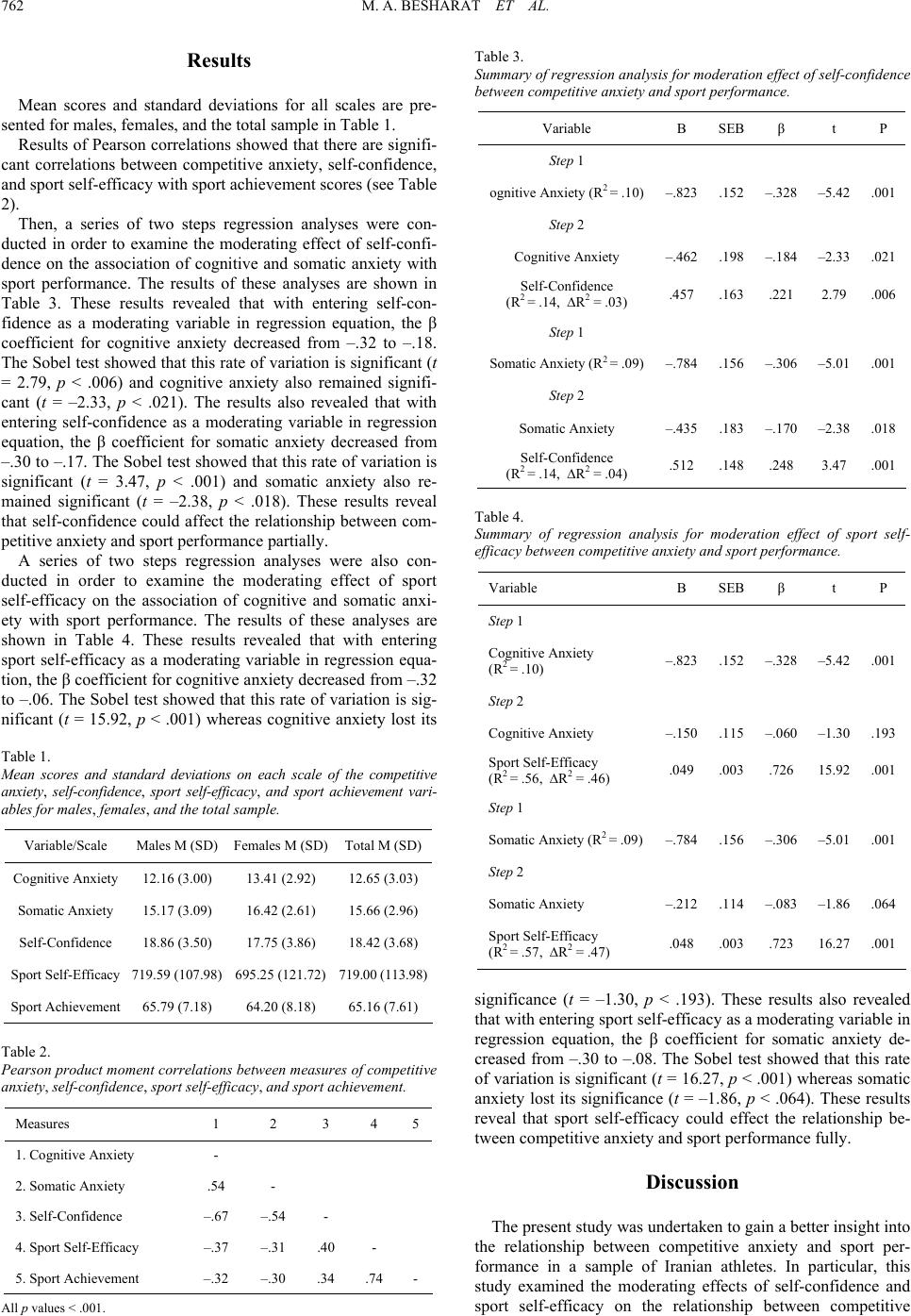 M. A. BESHARAT ET AL. 762 Results Mean scores and standard deviations for all scales are pre- sented for males, females, and the total sample in Table 1. Results of Pearson correlations showed that there are signifi- cant correlations between competitive anxiety, self-confidence, and sport self-efficacy with sport achievement scores (see Table 2). Then, a series of two steps regression analyses were con- ducted in order to examine the moderating effect of self-confi- dence on the association of cognitive and somatic anxiety with sport performance. The results of these analyses are shown in Table 3. These results revealed that with entering self-con- fidence as a moderating variable in regression equation, the β coefficient for cognitive anxiety decreased from –.32 to –.18. The Sobel test showed that this rate of variation is significant (t = 2.79, p < .006) and cognitive anxiety also remained signifi- cant (t = –2.33, p < .021). The results also revealed that with entering self-confidence as a moderating variable in regression equation, the β coefficient for somatic anxiety decreased from –.30 to –.17. The Sobel test showed that this rate of variation is significant (t = 3.47, p < .001) and somatic anxiety also re- mained significant (t = –2.38, p < .018). These results reveal that self-confidence could affect the relationship between com- petitive anxiety and sport performance partially. A series of two steps regression analyses were also con- ducted in order to examine the moderating effect of sport self-efficacy on the association of cognitive and somatic anxi- ety with sport performance. The results of these analyses are shown in Table 4. These results revealed that with entering sport self-efficacy as a moderating variable in regression equa- tion, the β coefficient for cognitive anxiety decreased from –.32 to –.06. The Sobel test showed that this rate of variation is sig- nificant (t = 15.92, p < .001) whereas cognitive anxiety lost its Table 1. Mean scores and standard deviations on each scale of the competitive anxiety, self-confidence, sport self-efficacy, and sport achievement vari- abl es for males, females, and the to ta l sa m p le . Variable/Scale Males M (SD) Females M (SD) Total M (SD) Cognitive Anxiety 12.16 (3.00) 13.41 (2.92) 12.65 (3.03) Somatic Anxiety 15.17 (3.09) 16.42 (2.61) 15.66 (2.96) Self-Confidence 18.86 (3.50) 17.75 (3.86) 18.42 (3.68) Sport Self-Efficacy 719.59 (107.98) 695.25 (121.72) 719.00 (113.98) Sport Achievement 65.79 (7.18) 64.20 (8.18) 65.16 (7.61) Table 2. Pearson product moment correlations between measures of competitive anxiety, self-confidence, sport self-efficacy, and sport achievem ent. Measures 1 2 3 4 5 1. Cognitive Anxiety - 2. Somatic Anxiety .54 - 3. Self-Confidence –.67 –.54 - 4. Sport Self-Efficacy –.37 –.31 .40 - 5. Sport Achievement –.32 –.30 .34 .74 - All p values < .001. Table 3. Summary of regression analysis for moderation effect of self-confidence between competitive anxiety and sport performa nce. Variable B SEB β t P Step 1 ognitive Anxiety (R2 = .10) –.823 .152 –.328 –5.42.001 Step 2 Cognitive Anxiety –.462 .198 –.184 –2.33.021 Self-Confidence (R2 = .14, ∆R2 = .03) .457 .163 .221 2.79 .006 Step 1 Somatic Anxiety (R2 = .09) –.784 .156 –.306 –5.01.001 Step 2 Somatic Anxiety –.435 .183 –.170 –2.38.018 Self-Confidence (R2 = .14, ∆R2 = .04) .512 .148 .248 3.47 .001 Table 4. Summary of regression analysis for moderation effect of sport self- efficacy between competitive anxiety and sport performance. Variable B SEB β t P Step 1 Cognitive Anxiety (R2 = .10) –.823 .152 –.328 –5.42.001 Step 2 Cognitive Anxiety –.150 .115 –.060 –1.30.193 Sport Self-Efficacy (R2 = .56, ∆R2 = .46) .049 .003 .726 15.92.001 Step 1 Somatic Anxiety (R2 = .09)–.784 .156 –.306 –5.01.001 Step 2 Somatic Anxiety –.212 .114 –.083 –1.86.064 Sport Self-Efficacy (R2 = .57, ∆R2 = .47) .048 .003 .723 16.27.001 significance (t = –1.30, p < .193). These results also revealed that with entering sport self-efficacy as a moderating variable in regression equation, the β coefficient for somatic anxiety de- creased from –.30 to –.08. The Sobel test showed that this rate of variation is significant (t = 16.27, p < .001) whereas somatic anxiety lost its significance (t = –1.86, p < .064). These results reveal that sport self-efficacy could effect the relationship be- tween competitive anxiety and sport performance fully. Discussion The present study was undertaken to gain a better insight into the relationship between competitive anxiety and sport per- formance in a sample of Iranian athletes. In particular, this study examined the moderating effects of self-confidence and sport self-efficacy on the relationship between competitive 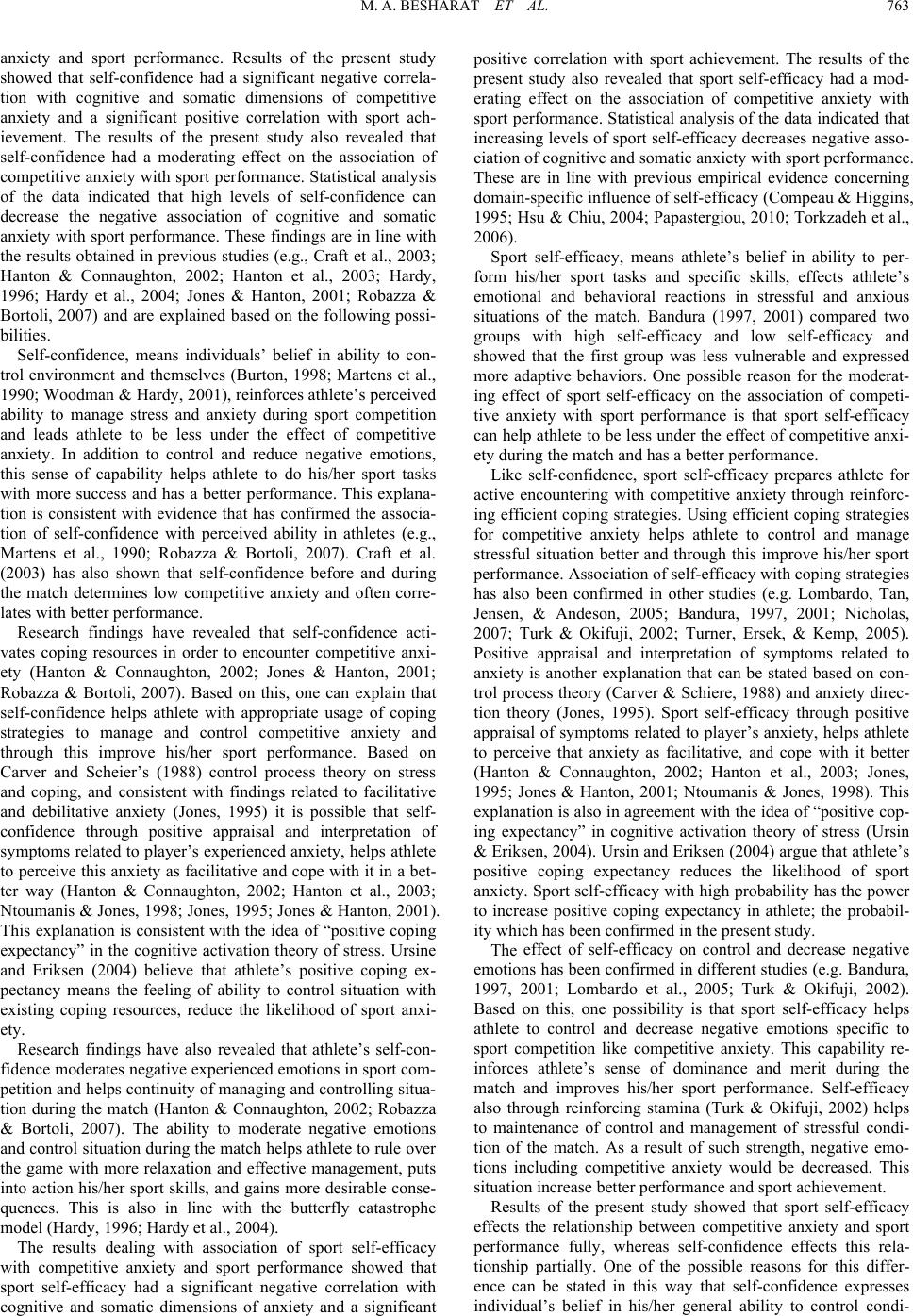 M. A. BESHARAT ET AL. 763 anxiety and sport performance. Results of the present study showed that self-confidence had a significant negative correla- tion with cognitive and somatic dimensions of competitive anxiety and a significant positive correlation with sport ach- ievement. The results of the present study also revealed that self-confidence had a moderating effect on the association of competitive anxiety with sport performance. Statistical analysis of the data indicated that high levels of self-confidence can decrease the negative association of cognitive and somatic anxiety with sport performance. These findings are in line with the results obtained in previous studies (e.g., Craft et al., 2003; Hanton & Connaughton, 2002; Hanton et al., 2003; Hardy, 1996; Hardy et al., 2004; Jones & Hanton, 2001; Robazza & Bortoli, 2007) and are explained based on the following possi- bilities. Self-confidence, means individuals’ belief in ability to con- trol environment and themselves (Burton, 1998; Martens et al., 1990; Woodman & Hardy, 2001), reinforces athlete’s perceived ability to manage stress and anxiety during sport competition and leads athlete to be less under the effect of competitive anxiety. In addition to control and reduce negative emotions, this sense of capability helps athlete to do his/her sport tasks with more success and has a better performance. This explana- tion is consistent with evidence that has confirmed the associa- tion of self-confidence with perceived ability in athletes (e.g., Martens et al., 1990; Robazza & Bortoli, 2007). Craft et al. (2003) has also shown that self-confidence before and during the match determines low competitive anxiety and often corre- lates with better performance. Research findings have revealed that self-confidence acti- vates coping resources in order to encounter competitive anxi- ety (Hanton & Connaughton, 2002; Jones & Hanton, 2001; Robazza & Bortoli, 2007). Based on this, one can explain that self-confidence helps athlete with appropriate usage of coping strategies to manage and control competitive anxiety and through this improve his/her sport performance. Based on Carver and Scheier’s (1988) control process theory on stress and coping, and consistent with findings related to facilitative and debilitative anxiety (Jones, 1995) it is possible that self- confidence through positive appraisal and interpretation of symptoms related to player’s experienced anxiety, helps athlete to perceive this anxiety as facilitative and cope with it in a bet- ter way (Hanton & Connaughton, 2002; Hanton et al., 2003; Ntoumanis & Jones, 1998; Jones, 1995; Jones & Hanton, 2001). This explanation is consistent with the idea of “positive coping expectancy” in the cognitive activation theory of stress. Ursine and Eriksen (2004) believe that athlete’s positive coping ex- pectancy means the feeling of ability to control situation with existing coping resources, reduce the likelihood of sport anxi- ety. Research findings have also revealed that athlete’s self-con- fidence moderates negative experienced emotions in sport com- petition and helps continuity of managing and controlling situa- tion during the match (Hanton & Connaughton, 2002; Robazza & Bortoli, 2007). The ability to moderate negative emotions and control situation during the match helps athlete to rule over the game with more relaxation and effective management, puts into action his/her sport skills, and gains more desirable conse- quences. This is also in line with the butterfly catastrophe model (Hardy, 1996; Hardy et al., 2004). The results dealing with association of sport self-efficacy with competitive anxiety and sport performance showed that sport self-efficacy had a significant negative correlation with cognitive and somatic dimensions of anxiety and a significant positive correlation with sport achievement. The results of the present study also revealed that sport self-efficacy had a mod- erating effect on the association of competitive anxiety with sport performance. Statistical analysis of the data indicated that increasing levels of sport self-efficacy decreases negative asso- ciation of cognitive and somatic anxiety with sport performance. These are in line with previous empirical evidence concerning domain-specific influence of self-efficacy (Compeau & Higgins, 1995; Hsu & Chiu, 2004; Papastergiou, 2010; Torkzadeh et al., 2006). Sport self-efficacy, means athlete’s belief in ability to per- form his/her sport tasks and specific skills, effects athlete’s emotional and behavioral reactions in stressful and anxious situations of the match. Bandura (1997, 2001) compared two groups with high self-efficacy and low self-efficacy and showed that the first group was less vulnerable and expressed more adaptive behaviors. One possible reason for the moderat- ing effect of sport self-efficacy on the association of competi- tive anxiety with sport performance is that sport self-efficacy can help athlete to be less under the effect of competitive anxi- ety during the match and has a better performance. Like self-confidence, sport self-efficacy prepares athlete for active encountering with competitive anxiety through reinforc- ing efficient coping strategies. Using efficient coping strategies for competitive anxiety helps athlete to control and manage stressful situation better and through this improve his/her sport performance. Association of self-efficacy with coping strategies has also been confirmed in other studies (e.g. Lombardo, Tan, Jensen, & Andeson, 2005; Bandura, 1997, 2001; Nicholas, 2007; Turk & Okifuji, 2002; Turner, Ersek, & Kemp, 2005). Positive appraisal and interpretation of symptoms related to anxiety is another explanation that can be stated based on con- trol process theory (Carver & Schiere, 1988) and anxiety direc- tion theory (Jones, 1995). Sport self-efficacy through positive appraisal of symptoms related to player’s anxiety, helps athlete to perceive that anxiety as facilitative, and cope with it better (Hanton & Connaughton, 2002; Hanton et al., 2003; Jones, 1995; Jones & Hanton, 2001; Ntoumanis & Jones, 1998). This explanation is also in agreement with the idea of “positive cop- ing expectancy” in cognitive activation theory of stress (Ursin & Eriksen, 2004). Ursin and Eriksen (2004) argue that athlete’s positive coping expectancy reduces the likelihood of sport anxiety. Sport self-efficacy with high probability has the power to increase positive coping expectancy in athlete; the probabil- ity which has been confirmed in the present study. The effect of self-efficacy on control and decrease negative emotions has been confirmed in different studies (e.g. Bandura, 1997, 2001; Lombardo et al., 2005; Turk & Okifuji, 2002). Based on this, one possibility is that sport self-efficacy helps athlete to control and decrease negative emotions specific to sport competition like competitive anxiety. This capability re- inforces athlete’s sense of dominance and merit during the match and improves his/her sport performance. Self-efficacy also through reinforcing stamina (Turk & Okifuji, 2002) helps to maintenance of control and management of stressful condi- tion of the match. As a result of such strength, negative emo- tions including competitive anxiety would be decreased. This situation increase better performance and sport achievement. Results of the present study showed that sport self-efficacy effects the relationship between competitive anxiety and sport performance fully, whereas self-confidence effects this rela- tionship partially. One of the possible reasons for this differ- ence can be stated in this way that self-confidence expresses individual’s belief in his/her general ability to control condi-  M. A. BESHARAT ET AL. 764 tions and situations, but sport self-efficacy expresses athlete’s belief in his/her ability to perform specific sport tasks and skills. This means that belief in just general ability might have a weak effect on control and decrement of stress and negative emotions in particular situation (sport competition), whereas belief in specific ability would have a decisive effect on that particular behavior. One can conclude from this probable explanation that although self-confidence and self-efficacy are in the same di- rection (Hardy, 1996; Hardy et al., 2004), they are different in the intensity of their effects. Self-efficacy in a specific field cause to a decisive effect on behaviors related to that specific field and its accompaniment and coordination with self-con- fidence reinforces this effect. Based on this, it can be said that athlete’s self-confidence provides general framework for con- trol and management of stress and sport self-efficacy particu- larly helps athlete in specific field related to management and control of sport stresses, better performance, and sport achie- vement. In other words, self-confidence is a general construct and self-efficacy is a specific construct. The present findings may have important theoretical and practical implications. At the practical level, research findings can suggest the importance and necessity for noticing to mod- erating variables such as self-confidence and sport self-efficacy as effective factors on competitive anxiety-sport performance in athletes. Understanding these psychological constructs as mod- erating variables in athletes can be considered as an effective step in preventing undesirable consequences of sport competi- tion. Formulating training and intervention programs in order to increase self-confidence and sport self-efficacy, particularly in national and international competitions, is another action that can be applied to moderate levels of competitive anxiety and improve sport performance. At the theoretical level, the results of the present study can be at the service of theories related to emotions, emotion regulation, coping strategies and stress management particularly in the field of sport psychology. The findings of this study have several limitations. The cross-sectional design of this study does not allow us to draw conclusions about the directions of causality between variables investigated. These data were based upon a sample of volunteer athletes. This further undermines the generalizability of the results. It must be pointed out that self-confidence and sport self-efficacy might have different effects through their interac- tions with other variables, such as type of sport (e.g., individ- ual-team, contact-noncontact), to produce positive or negative consequences. Future research needs to address this issue. References Bandura, A. (1997). Self-efficacy: The exercise of control. New York: Freeman. Bandura, A. (2001). Social cognitive theory: An agentic perspective. Annual Review of Psychology, 52, 1-26. doi:10.1146/annurev.psych.52.1.1 Bandura, A. (2006). Guid for constructing self-efficacy scales. In F. Pajares, & T. Urdan (Eds.), Self-efficacy beliefs of adolescents (pp. 307-337). Greenwich, CT: Information Age Publishing. Besharat, M. A. (2008). Reliability and Validity of the Sport Self-Effi- cacy Scale. Tehran: University of Tehran. Unpublished. Besharat, M. A. (2009). Devalopment and validation of the multidi- mensional competitive anxiety questionnaire. Tehran: University of Tehran. Unpublished. Besharat, M. A., Abbasi, Q. R., & Shojaoldin, S (2002). An investiga- tion of the relationship between self-esteem and sport achievement among footbalers and wrestlers. Harakat, 12, 31-44. Burton, D. (1998). Measuring competitive state anxiety. In J. L. Duda (Ed.), Advances in sport and exrecise psychology measurement (pp. 129-148). Morgantown, WV: Fitness Information Technology, Inc. Carver, C. S., & Scheier, M. F. (1988). A control-process perspective on anxiety. Anxiety Research, 1, 17-22. doi:10.1080/10615808808248217 Compeau, D., & Higgins, C. (1995). Computer self-efficacy: Develop- ment of a measure and initial test. MIS Quarterly, 19, 189-211. doi:10.2307/249688 Craft, L. L., Magyar, T. M., Becker, B. J., & Feltz, D. L. (2003). The relationship between the Competitive State Anxiety Inventory-2 and sport performance: A meta-analysis. Journal of Sport and Exercise Psychology, 25, 44-65. Hanin, Y. L. (1986). State-trait anxiety research on sport in the USSR. In C. D. Spielberger, & R. Diaz-Guerrero (Eds.), Cross-cultural anxiety (Vol. 2, pp. 45-64). Washington, DC: Hemisphere Publish- ing. Hanton, S., & Connaughton, D. (2002). Perceived control of anxiety and its relationship with self-confidence performance: A qualitative explanation. Resear c h Q u a r t e r l y f o r Exercise and Sport, 73, 87-97. Hanton, S., Neil, R., & Mellalieu, S. D., (2008). Recent developments in competitive anxiety direction and competition stress research. In- ternational Review of Sport and Exercise Psychology, 1, 45-57. Hanton, S., O’Brien, M., & Mellalieu, S. D., (2003). Individual differ- ences, perceived control and competitive trait anxiety. Journal of Sport Behavior, 26, 39-55. Hardy, L. (1990). A catastrophe model of anxiety and performance. In J. G. Jones, & L. Hardy (Eds.), Stress and performance in sport (pp. 81-106). Chichester: Wiley. Hardy, L. (1996). A test of catastrophe models of anxiety and sport performance against multidimensional theory models using the method of dynamic differences. Anxiety, Stress, and Coping: An In- ternational Journal, 9, 69-86. Hardy, L., Woodman, T., & Carrington, S. (2004). Is self-confidence a bias factor in higher-order catastrophe models? An exploratory analysis. Journal of Sport and Exercise Psychology, 26, 359-368. Hsu, M., & Chiu, C. (2004). Internet self-efficacy and electronic ser- vice acceptance. Decision Support Systems, 38, 369-381. doi:10.1016/j.dss.2003.08.001 Jones, G. (1995). More than just a game: Research developments and issues in competitive anxiety in sport. British Journal of Psychology, 86, 449-478. doi:10.1111/j.2044-8295.1995.tb02565.x Jones, G., & Hanton, S. (2001). Pre-competitive feeling states and directional anxiety interpretation. Journal of Sports Sciences, 19, 385-395. doi:10.1080/026404101300149348 Jones, G., & Swain, A. B. J. (1992). Intensity and direction dimensions of competitive state anxiety and relationships with competitiveness. Perceptual and Motor Skills, 74, 467-472. doi:10.1080/02640419308730023 Jones, G., Swain, A. B. J., & Hardy, L. (1993). Intensity and direction dimensions of competitive state anxiety and relationship with per- formance. Journal of Sport Sciences, 11, 533-542. Lazarus, R. S. (1999). Stress and emotion: A new synthesis. London: Free Association. Lazarus, R. S. (2000). How emotions influence performance in com- petitive sports. The Sp or t Psychologist, 14, 229-252. Llewellyn, D. J., Sanchez, X., Asghar, A., & Jones, G. (2008). Self- efficacy, risk taking and performance in rock climbing. Personality and Individual Differe n ces, 45, 75-81. doi:10.1016/j.paid.2008.03.001 Lombardo, E. R., Tan, G., Jensen, M. P., & Anderson, K. O. (2005). Anger management style and association with self-efficacy and pain in male veterans. The Journal of Pain, 6, 765-770. doi:10.1016/j.jpain.2005.07.003 Martens, R., Vealey, R. S., & Burton, D. (1990). Competitive anxiety in sport. Champaign, IL: Human Kinetics. Mellalieu, S. D., Hanton, S., & Fletcher, D (2006). A competitive anxi- ety review: Recent directions in sport psychology research. In S. Hanton and S. D. Mellalieu (Eds.), Literature reviews in sport psy- chology (pp. 1-45). Hauppage, NY: Nova Science. Nicholas, M. K. (2007). The pain self-efficacy questionnaire: Taking pain into account. European Journal of Pain, 11, 153-163. doi:10.1016/j.ejpain.2005.12.008 Ntoumanis, N., & Jones, G. (1998). Interpretations of competitive trait anxiety symptoms as a function of locus of control beliefs. Interna-  M. A. BESHARAT ET AL. 765 tional Journal of Sport Psychology, 29, 99-114. Papastergiou, M. (2010). Enhancing physical education and sport sci- ence students’ self-efficacy and attitudes regarding information and communication technologies through a computer literacy course. Computers and Education, 54, 298-308. doi:10.1016/j.compedu.2009.08.015 Raglin, J., & Hanin, Y. (2000). Competitive anxiety and athletic per- formance. In Y. L. Hanin (Ed.), Emotions in sport (pp. 93-112). Champaign, IL: Human Kinetics. Robazza, C., & Bortoli, L. (2007). Perceived impact of anger and anxi- ety on performance in rugby players. Psychology of Sport and Exer- cise, 8, 875-890. doi:10.1016/j.psychsport.2006.07.005 Swain, A. B. J., & Jones, G. (1993). Intensity and frequency dimen- sions of competitive state anxiety. Journal of Sports Sciences, 11, 533-542. doi:10.1080/02640419308730024 Torkzadeh, G., Chang, J., & Demirhan, D. (2006). A contingency model of computer and internet self-efficacy. Information and Man- agement, 43, 541-550. doi:10.1016/j.im.2006.02.001 Turk, D. C., & Okifuji, A. (2002). Psychilogical factors in chronic pain: Evolution and Revolution. Journal of Consulting and Clinical Psy- chology, 70, 678-690. doi:10.1037/0022-006X.70.3.678 Turner, J. A., Ersek, M., & Kemp, C. (2005). Self-efficacy for manag- ing pain is associated with disability, depression, and pain coping among retirement community residents with chronic pain. Journal of Pain, 6, 471-479. doi:10.1016/j.jpain.2005.02.011 Ursin, H., & Eriksen, H. R. (2004). The cognitive activation theory of stress. Psychoneuroendocrinology, 29, 567-592. doi:10.1016/S0306-4530(03)00091-X Woodman, T., & Hardy, L. (2001). Stress and anxiety. In R. Singer, H. A. Hausenblas, & C. M. Janelle (Eds.), Handbook of research on sport psychology (pp. 290-318). New York: Wiley. |