

Paper Menu >>
Journal Menu >>
 Psychology 2011. Vol.2, No.7, 721-726 Copyright © 2011 SciRes. DOI:10.4236/psych.2011.27110 Correlations between Impulsivity and Technical Performance in Handball Female Athletes Guilherme M. Lage1, Lívia G. Gallo1, Gabriela J. M. Cassiano1, Ingrid L. B. Lobo1, Marcus V. Vieira2, João V. Salgado3, Daniel Fuentes4, Leandro F. Malloy-Diniz5 1College of Health Sciences, Universidade FUMEC, Belo Horizonte, Brazil; 2Helena Antipoff Fundation, Ibirité, Brazil; 3Institute of Biological Sciences, Universidade Federal de Minas Gerais, Belo Horizonte, Brazil; 4Psychiatry Institute, Universidade de São Paulo, Sao Paulo, Brazil; 5Faculty of Philosophy and Human Sciences, Universidade Federal de Minas Gerais, Belo Horizonte, Brazil. Email: [email protected] Received July 13th, 2011; revised August 24th, 2011; accepted September 27th, 2011. A complex and dynamic environment where impulsivity probably interferes in the human behavior is the sport context. The aim of this exploratory study was to investigate the possible relationship between impulsivity and technical performance in handball athletes. Eleven junior female athletes on a handball team were submitted to a neuropsychological assessment of impulsivity using Conner’s CPT-II and the Iowa Gambling Task. In 11 matches, participants’ handball performance was analyzed. We adopted the resampling statistical approach to correlate the measures of technical performance with the neuropsychological measures. IGT net score was posi- tively correlated with technical faults. Omission errors on the CPT-II were positively correlated with the number of fouls suffered, the number of fouls committed, and the number of offensive fouls. Commission errors on the CPT-II were negatively correlated with rebounds with defense ball possession. Our results support the idea of relationships between impulsivity and technical performance in specific match situations. Keywords: Impulsivity, Sports, Handball, Motor Behavior, Attention, Decision Making, Response Inhibition Introduction Impulsivity is a behavioral pattern characterized by several types of manifestations. For instance, Barratt (Patton, Stanford, & Barrat, 1995) proposed the existence of three classes of im- pulsivity: motor (acting without thinking), attentional (lack of focus on the task at hand), and non-planning (focus on the pre- sent without accounting for the consequences of the future out- comes). The impulsive behavior is a core symptom in a large number of psychiatric disorders but, nonetheless, there is also a growing interest in the role of impulsivity among healthy populations engaging in different activities (Stanford, Mathias, Dougherty, Lake, Anderson, & Patton, 2009). For example, a complex and dynamic environment where impulsiveness probably inter- feres in the human behavior is the sportive context. Previous research in this area has focused on demonstrating the relation- ship between impulsivity and the involvement in particular types of sports. Svebak and Kerr (1989), for example, com- pared the impulsiveness of athletes involved in sports defined as “endurance sports” (i.e., those involving sustained activity) and “explosive sports” (i.e., those involve short, intense bursts of activity). They found that athletes who engaged in explosive sports (e.g., football) scored higher on impulsivity measures than endurance participants (e.g., marathon runners). Impulsivity may be an important factor in motor performance interference in open-skill sports (e.g., soccer, basketball and handball). Due to constant changes in the environment (e.g., alterations in opponents positioning), the player is forced to inhibit pre-planned responses, anticipate actions and coordinate corporal segments based on the complex and dynamic flow of sensorial information. Previous studies using motor laboratory tasks have shown that motor control is affected by the degree of the subject’s impulsivity (Enticott, Ogloff, & Bradshaw, 2006; Lemke, Fischer, Wendorff, Fritzer, Rupp, & Tetzlaff, 2005). For instance, healthy individuals with higher impulsivity scores present shorter relative time to achieve the peak velocity than the low-impulsives in manual aiming movements (Lemke et al., 2005). In addition, high-impulsive subjects tend to inhibit their responses at a slower pace than low-impulsive subjects (Lijffit, Bekker, Quik, Bakker, Kenemans, & Verbaten, 2004). High- impulsive subjects also present higher reaction time than low- impulsives in conditions of low compatibility stimulus-re- sponse (Expósito & AndrésPueyo, 1997) and are less accurate than low-impulsives in tapping at a specified rate (Barrat, 1981). In spite of some controversial findings (cf. Dickman, 1993), the general pattern over the course of these studies has indicated that high-impulsive subjects are faster in their responses but less accurate than their less impulsive counterparts (Lage, Malloy-Diniz, Neves, Moraes, & Corrêa, in press). Although generally viewed as counterproductive (Stanford et al., 2009), it is possible that impulsivity had a positive role on motor behavior in some specific circumstances. This may be true in cases in which there is limited time available to: 1) rec- ognize the opponent’s action; 2) process a decision; and 3) organize the motor system to initiate a response. In such situa- tions, it is probable that some degree of impulsivity helps the player to achieve his/her goal successfully. An explanation for this hypothesis might be based on the concept of functional impulsivity characterized by a tendency or ability to think, act and speak rapidly (Dickman, 1990, Reeve, 2007). Recently, Lage et al. (in press) found that in situations in which the tem- poral and spatial demands to the motor system were high, the impulsivity had a functional, adaptive effect on manual motor control.  G. M. LAGE ET AL. 722 Although several evidences suggest an influence of impul- sivity on motor control, to our knowledge, there are no studies investigating this relation in the context of competitive sports. Therefore, we aimed to investigate the relationships between different impulsivity dimensions and technical performance in an open-skill sport. Handball was chosen because it is a fast and dynamic game that is played in a confined area where a high degree of temporal and spatial pressure is involved. The very intense physical contact among players often creates moments of forceful behaviors, and the close proximity of coaches, offi- cials and spectators to the court may represent an increased psychological demand. Although our approach was mainly exploratory, on the basis of previous evidence found in laboratory studies, an association between impulsivity dimensions and technical performance was predicted. In match situations in which both speed and accuracy are categorically involved (e.g., when a shot on goal is taken), motor impulsivity should be a factor of possible interference. In match conditions that require high decisional demand (e.g., when the player holds the ball and has a second or two to de- cide what to do next), non-planning impulsivity may be related to the quality of motor response. In situations in which the at- tentional demands are high (e.g., a direct confrontation with the opponent), attentional impulsivity might be related to the player’s level of success. Methods Participants Twenty-two junior female athletes (between 17 and 18 years of age; mean age = 17.45 ± 0.5 years) from a three-time state champion handball team were invited to participate in this study. All of them were court players. Seven players decided to not participate, resulting in a sample of fifteen athletes. On average, participants had 6 ± 1.8 years of handballs experience. The local ethics review committee approved the study protocol. All participants and their parents (only for the 17-year-old par- ticipants) signed informed consent forms before participating in this study. Instruments The neuropsychological assessment has been described elsewhere (see in Malloy-Diniz et al., 2007). Briefly, we used Conner’s Continuous Performance Task (CPT-II; omission and commission errors as measures of attentional and motor impul- sivity) and the Iowa Gambling Task (IGT; the net score was used as a measure of non-planning, decision-making, -related impulsivity). Unlike CPT-II scores, high scores on the IGT indicate a low level of impulsivity (Lage, Malloy-Diniz, Matos, Bastos, Abrantes, & Corrêa, 2010). Handball Technical Performance Evaluation. To scrutinize the technical performance of the 15 court players, some pa- rameters of a handball scout were used (Vieira, Greco, & Cha- gas, 1990). The performance parameters investigated were divided into technical faults, throwing and other measures. The technical faults of each player were analyzed based on the number of times any of the following occurred: 1) passing error; 2) reception error; 3) touching the ball with the foot; 4) double dribble; 5) loss of ball possession; 6) entering the goal area; 7) carrying the ball for more than three steps; 8) holding the ball for more than three seconds; and 9) offensive foul. The technical performance related to the throwing was ana- lyzed through the number of: 1) shots scored (goals); 2) shots missed (ball was out of the court or ball hit the goalpost or crossbar); 3) shots caught by the goalkeeper; 4) shots that resulted in rebounds with defense ball possession (goalkeeper rebounded and ball possession was returned to the defense); 5) shots that resulted in rebounds with attack ball possession (goalkeeper rebounded and the ball possession stayed with the attack); 6) shots blocked with defense ball possession (shot blocked and the defense stayed with the ball possession); and 7) shots blocked with attack ball possession (shot blocked and the ball returned to the attack players). Other performance measures analyzed were: 1) gaining possession of the ball (“stolen” the ball of opponent); 2) passive play; 3) fouls committed; and 4) fouls suffered. In each match, all of these technical aspects were analyzed for each player throughout the handball scout. Procedure Eleven matches in the regional championship (during the first semester of 2007) were analyzed. During the same period (first semester of 2007, before the championship), the CPT-II and IGT were administered to all players. Two trained physical education professionals were responsible for watching and filling the scouts during the matches. A third experimenter filmed the matches in case of doubt in the posterior analyses. Two trained neuropsychologists administered the neuropsy- chological tests (tests were applied individually in a quiet room. See detailed procedures in Malloy-Diniz, 2007). The order of CPT-II and IGT application was randomized among partici- pants. The entire procedure was blinded since the neuronpsy- chologists did not watch the matches and the physical edu- cation professionals did not have access to neuropsychological results. Analyses Before the contest, we conducted a pilot study that consisted of the analysis of three handball matches. The purpose of the study was to analyze the coefficient of concordance among the three physical education professionals. Kendall’s W test indi- cated a significant degree of concordance (W = .9193, p < .0001) on the filling of the scout. After the championship, the match analysis showed that three players did not play any of the 11 matches. One athlete played for only a very short time during matches (mean of 11.25 min- utes). Thus, we decide to exclude this player from the final analysis. Therefore, the final sample was composed of 11 ath- letes who played a mean of 7.58 (SD = 2.7) matches with a mean time on court of 33.24 (SD = 10.6) minutes. Due to the small sample size of this study we adopted the re- sampling statistical approach (Stergiou, 2004), more specifi- cally, a correlation with random data permutation (see the pro- cedures in Edginton & Onghena, 2007: p.178). We correlated the measures of technical performance (the mean for each player during the 11 matches) with the neuropsychological measures (scores obtained in each test). The number of re- samples of the original data was equal to 1000, and the level of significance adopted in all analyses was .05. The software used was RT4win (Edginton & Onghena, 2007). Results Neuropsychological data of each player are presented in Ta- 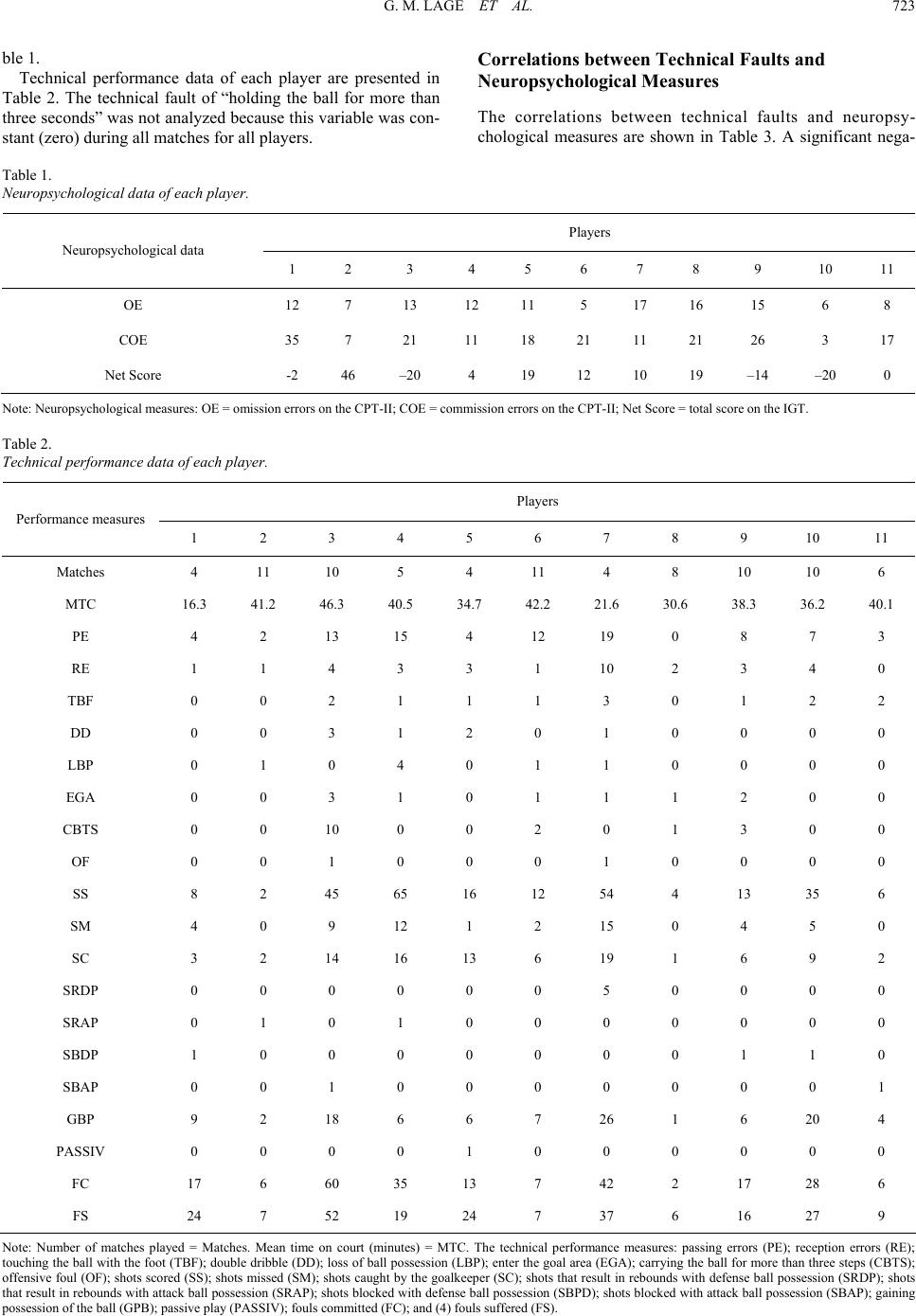 G. M. LAGE ET AL. 723 ble 1. Technical performance data of each player are presented in Table 2. The technical fault of “holding the ball for more than three seconds” was not analyzed because this variable was con- stant (zero) during all matches for all players. Correlations between Technical Faults and Neuropsychological Measures The correlations between technical faults and neuropsy- chological measures are shown in Table 3. A significant nega- Table 1. Neuropsychological data of ea ch p layer. Players Neuropsychological data 1 2 3 4 5 6 7 8 9 10 11 OE 12 7 13 12 11 5 17 16 15 6 8 COE 35 7 21 11 18 21 11 21 26 3 17 Net Score -2 46 –20 4 19 12 10 19 –14 –20 0 Note: Neuropsychological measures: OE = omission errors on the CPT-II; COE = commission errors on the CPT-II; Net Score = total score on the IGT. Table 2. Technical performance data of ea c h player. Players Performance measures 1 2 3 4 5 6 7 8 9 10 11 Matches 4 11 10 5 4 11 4 8 10 10 6 MTC 16.3 41.2 46.3 40.5 34.7 42.2 21.6 30.6 38.3 36.2 40.1 PE 4 2 13 15 4 12 19 0 8 7 3 RE 1 1 4 3 3 1 10 2 3 4 0 TBF 0 0 2 1 1 1 3 0 1 2 2 DD 0 0 3 1 2 0 1 0 0 0 0 LBP 0 1 0 4 0 1 1 0 0 0 0 EGA 0 0 3 1 0 1 1 1 2 0 0 CBTS 0 0 10 0 0 2 0 1 3 0 0 OF 0 0 1 0 0 0 1 0 0 0 0 SS 8 2 45 65 16 12 54 4 13 35 6 SM 4 0 9 12 1 2 15 0 4 5 0 SC 3 2 14 16 13 6 19 1 6 9 2 SRDP 0 0 0 0 0 0 5 0 0 0 0 SRAP 0 1 0 1 0 0 0 0 0 0 0 SBDP 1 0 0 0 0 0 0 0 1 1 0 SBAP 0 0 1 0 0 0 0 0 0 0 1 GBP 9 2 18 6 6 7 26 1 6 20 4 PASSIV 0 0 0 0 1 0 0 0 0 0 0 FC 17 6 60 35 13 7 42 2 17 28 6 FS 24 7 52 19 24 7 37 6 16 27 9 Note: Number of matches played = Matches. Mean time on court (minutes) = MTC. The technical performance measures: passing errors (PE); reception errors (RE); touching the ball with the foot (TBF); double dribble (DD); loss of ball possession (LBP); enter the goal area (EGA); carrying the ball for more than three steps (CBTS); offensive foul (OF); shots scored (SS); shots missed (SM); shots caught by the goalkeeper (SC); shots that result in rebounds with defense ball possession (SRDP); shots that result in rebounds with attack ball possession (SRAP); shots blocked with defense ball possession (SBPD); shots blocked with attack ball possession (SBAP); gaining possession of the ball (GPB); passive play (PASSIV); fouls committed (FC); and (4) fouls suffered (FS). 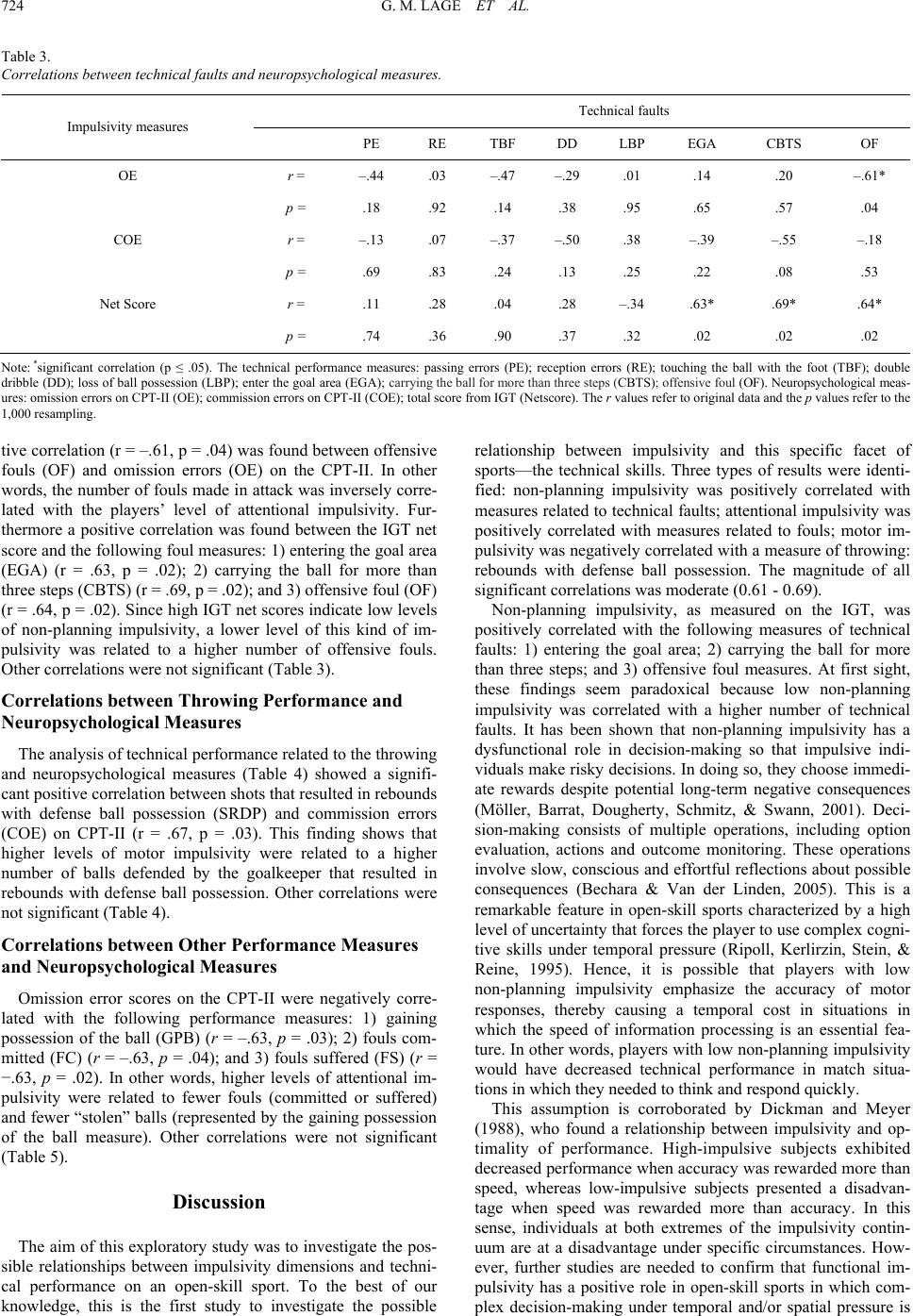 G. M. LAGE ET AL. 724 Table 3. Correlations between technic a l f a u l t s a n d n e u r opsychological measures. Technical faults Impulsivity measures PE RE TBF DD LBP EGA CBTS OF OE r = –.44 .03 –.47 –.29 .01 .14 .20 –.61* p = .18 .92 .14 .38 .95 .65 .57 .04 COE r = –.13 .07 –.37 –.50 .38 –.39 –.55 –.18 p = .69 .83 .24 .13 .25 .22 .08 .53 Net Score r = .11 .28 .04 .28 –.34 .63* .69* .64* p = .74 .36 .90 .37 .32 .02 .02 .02 Note: *significant correlation (p ≤ .05). The technical performance measures: passing errors (PE); reception errors (RE); touching the ball with the foot (TBF); double dribble (DD); loss of ball possession (LBP); enter the goal area (EGA); carrying the ball for more than three steps (CBTS); offensive foul (OF). Neuropsychological meas- ures: omission errors on CPT-II (OE); commission errors on CPT-II (COE); total score from IGT (Netscore). The r values refer to original data and the p values refer to the 1,000 resampling. tive correlation (r = –.61, p = .04) was found between offensive fouls (OF) and omission errors (OE) on the CPT-II. In other words, the number of fouls made in attack was inversely corre- lated with the players’ level of attentional impulsivity. Fur- thermore a positive correlation was found between the IGT net score and the following foul measures: 1) entering the goal area (EGA) (r = .63, p = .02); 2) carrying the ball for more than three steps (CBTS) (r = .69, p = .02); and 3) offensive foul (OF) (r = .64, p = .02). Since high IGT net scores indicate low levels of non-planning impulsivity, a lower level of this kind of im- pulsivity was related to a higher number of offensive fouls. Other correlations were not significant (Table 3). Correlations between Throwing Performance and Neuropsychological Measures The analysis of technical performance related to the throwing and neuropsychological measures (Table 4) showed a signifi- cant positive correlation between shots that resulted in rebounds with defense ball possession (SRDP) and commission errors (COE) on CPT-II (r = .67, p = .03). This finding shows that higher levels of motor impulsivity were related to a higher number of balls defended by the goalkeeper that resulted in rebounds with defense ball possession. Other correlations were not significant (Table 4). Correlat ions betwee n O t h er Perform ance Measure s and Neuropsychological Measures Omission error scores on the CPT-II were negatively corre- lated with the following performance measures: 1) gaining possession of the ball (GPB) (r = –.63, p = .03); 2) fouls com- mitted (FC) (r = –.63, p = .04); and 3) fouls suffered (FS) (r = −.63, p = .02). In other words, higher levels of attentional im- pulsivity were related to fewer fouls (committed or suffered) and fewer “stolen” balls (represented by the gaining possession of the ball measure). Other correlations were not significant (Table 5). Discussion The aim of this exploratory study was to investigate the pos- sible relationships between impulsivity dimensions and techni- cal performance on an open-skill sport. To the best of our knowledge, this is the first study to investigate the possible relationship between impulsivity and this specific facet of sports—the technical skills. Three types of results were identi- fied: non-planning impulsivity was positively correlated with measures related to technical faults; attentional impulsivity was positively correlated with measures related to fouls; motor im- pulsivity was negatively correlated with a measure of throwing: rebounds with defense ball possession. The magnitude of all significant correlations was moderate (0.61 - 0.69). Non-planning impulsivity, as measured on the IGT, was positively correlated with the following measures of technical faults: 1) entering the goal area; 2) carrying the ball for more than three steps; and 3) offensive foul measures. At first sight, these findings seem paradoxical because low non-planning impulsivity was correlated with a higher number of technical faults. It has been shown that non-planning impulsivity has a dysfunctional role in decision-making so that impulsive indi- viduals make risky decisions. In doing so, they choose immedi- ate rewards despite potential long-term negative consequences (Möller, Barrat, Dougherty, Schmitz, & Swann, 2001). Deci- sion-making consists of multiple operations, including option evaluation, actions and outcome monitoring. These operations involve slow, conscious and effortful reflections about possible consequences (Bechara & Van der Linden, 2005). This is a remarkable feature in open-skill sports characterized by a high level of uncertainty that forces the player to use complex cogni- tive skills under temporal pressure (Ripoll, Kerlirzin, Stein, & Reine, 1995). Hence, it is possible that players with low non-planning impulsivity emphasize the accuracy of motor responses, thereby causing a temporal cost in situations in which the speed of information processing is an essential fea- ture. In other words, players with low non-planning impulsivity would have decreased technical performance in match situa- tions in which they needed to think and respond quickly. This assumption is corroborated by Dickman and Meyer (1988), who found a relationship between impulsivity and op- timality of performance. High-impulsive subjects exhibited decreased performance when accuracy was rewarded more than speed, whereas low-impulsive subjects presented a disadvan- tage when speed was rewarded more than accuracy. In this sense, individuals at both extremes of the impulsivity contin- uum are at a disadvantage under specific circumstances. How- ever, further studies are needed to confirm that functional im- pulsivity has a positive role in open-skill sports in which com- plex decision-making under temporal and/or spatial pressure is 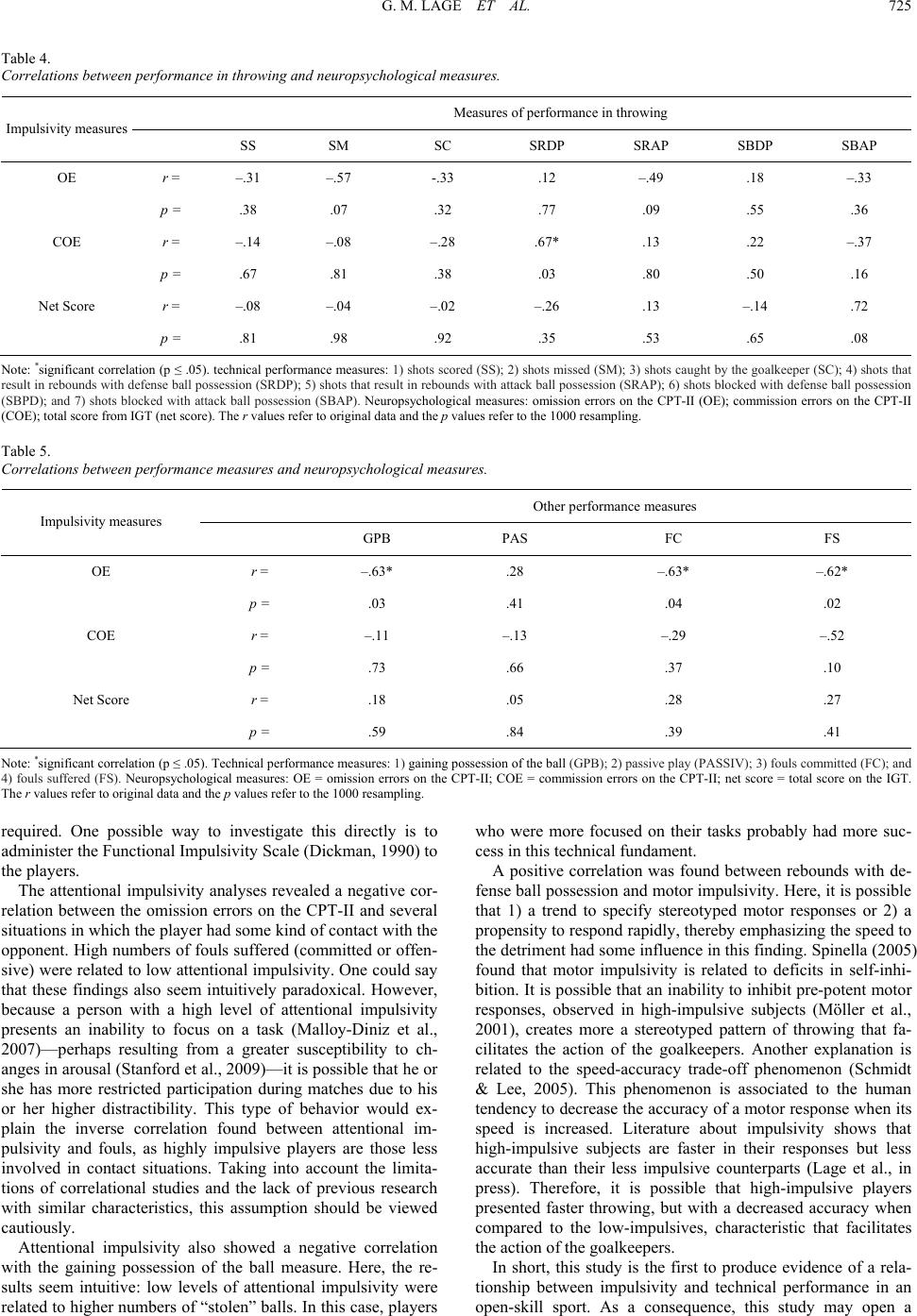 G. M. LAGE ET AL. 725 Table 4. Correlations between performanc e i n th r ow i n g and neuropsycho l og i c al measures. Measures of performance in throwing Impulsivity measures SS SM SC SRDP SRAP SBDP SBAP OE r = –.31 –.57 -.33 .12 –.49 .18 –.33 p = .38 .07 .32 .77 .09 .55 .36 COE r = –.14 –.08 –.28 .67* .13 .22 –.37 p = .67 .81 .38 .03 .80 .50 .16 Net Score r = –.08 –.04 –.02 –.26 .13 –.14 .72 p = .81 .98 .92 .35 .53 .65 .08 Note: *significant correlation (p ≤ .05). technical performance measures: 1) shots scored (SS); 2) shots missed (SM); 3) shots caught by the goalkeeper (SC); 4) shots that result in rebounds with defense ball possession (SRDP); 5) shots that result in rebounds with attack ball possession (SRAP); 6) shots blocked with defense ball possession (SBPD); and 7) shots blocked with attack ball possession (SBAP). Neuropsychological measures: omission errors on the CPT-II (OE); commission errors on the CPT-II (COE); total score from IGT (net score). The r values refer to original data and the p values refer to the 1000 resampling. Table 5. Correlations between performance measures and neurop sy ch ol ogical measures. Other performance measures Impulsivity measures GPB PAS FC FS OE r = –.63* .28 –.63* –.62* p = .03 .41 .04 .02 COE r = –.11 –.13 –.29 –.52 p = .73 .66 .37 .10 Net Score r = .18 .05 .28 .27 p = .59 .84 .39 .41 Note: *significant correlation (p ≤ .05). Technical performance measures: 1) gaining possession of the ball (GPB); 2) passive play (PASSIV); 3) fouls committed (FC); and 4) fouls suffered (FS). Neuropsychological measures: OE = omission errors on the CPT-II; COE = commission errors on the CPT-II; net score = total score on the IGT. The r values refer to original data and the p values refer to the 1000 resampling. required. One possible way to investigate this directly is to administer the Functional Impulsivity Scale (Dickman, 1990) to the players. The attentional impulsivity analyses revealed a negative cor- relation between the omission errors on the CPT-II and several situations in which the player had some kind of contact with the opponent. High numbers of fouls suffered (committed or offen- sive) were related to low attentional impulsivity. One could say that these findings also seem intuitively paradoxical. However, because a person with a high level of attentional impulsivity presents an inability to focus on a task (Malloy-Diniz et al., 2007)—perhaps resulting from a greater susceptibility to ch- anges in arousal (Stanford et al., 2009)—it is possible that he or she has more restricted participation during matches due to his or her higher distractibility. This type of behavior would ex- plain the inverse correlation found between attentional im- pulsivity and fouls, as highly impulsive players are those less involved in contact situations. Taking into account the limita- tions of correlational studies and the lack of previous research with similar characteristics, this assumption should be viewed cautiously. Attentional impulsivity also showed a negative correlation with the gaining possession of the ball measure. Here, the re- sults seem intuitive: low levels of attentional impulsivity were related to higher numbers of “stolen” balls. In this case, players who were more focused on their tasks probably had more suc- cess in this technical fundament. A positive correlation was found between rebounds with de- fense ball possession and motor impulsivity. Here, it is possible that 1) a trend to specify stereotyped motor responses or 2) a propensity to respond rapidly, thereby emphasizing the speed to the detriment had some influence in this finding. Spinella (2005) found that motor impulsivity is related to deficits in self-inhi- bition. It is possible that an inability to inhibit pre-potent motor responses, observed in high-impulsive subjects (Möller et al., 2001), creates more a stereotyped pattern of throwing that fa- cilitates the action of the goalkeepers. Another explanation is related to the speed-accuracy trade-off phenomenon (Schmidt & Lee, 2005). This phenomenon is associated to the human tendency to decrease the accuracy of a motor response when its speed is increased. Literature about impulsivity shows that high-impulsive subjects are faster in their responses but less accurate than their less impulsive counterparts (Lage et al., in press). Therefore, it is possible that high-impulsive players presented faster throwing, but with a decreased accuracy when compared to the low-impulsives, characteristic that facilitates the action of the goalkeepers. In short, this study is the first to produce evidence of a rela- tionship between impulsivity and technical performance in an open-skill sport. As a consequence, this study may open a 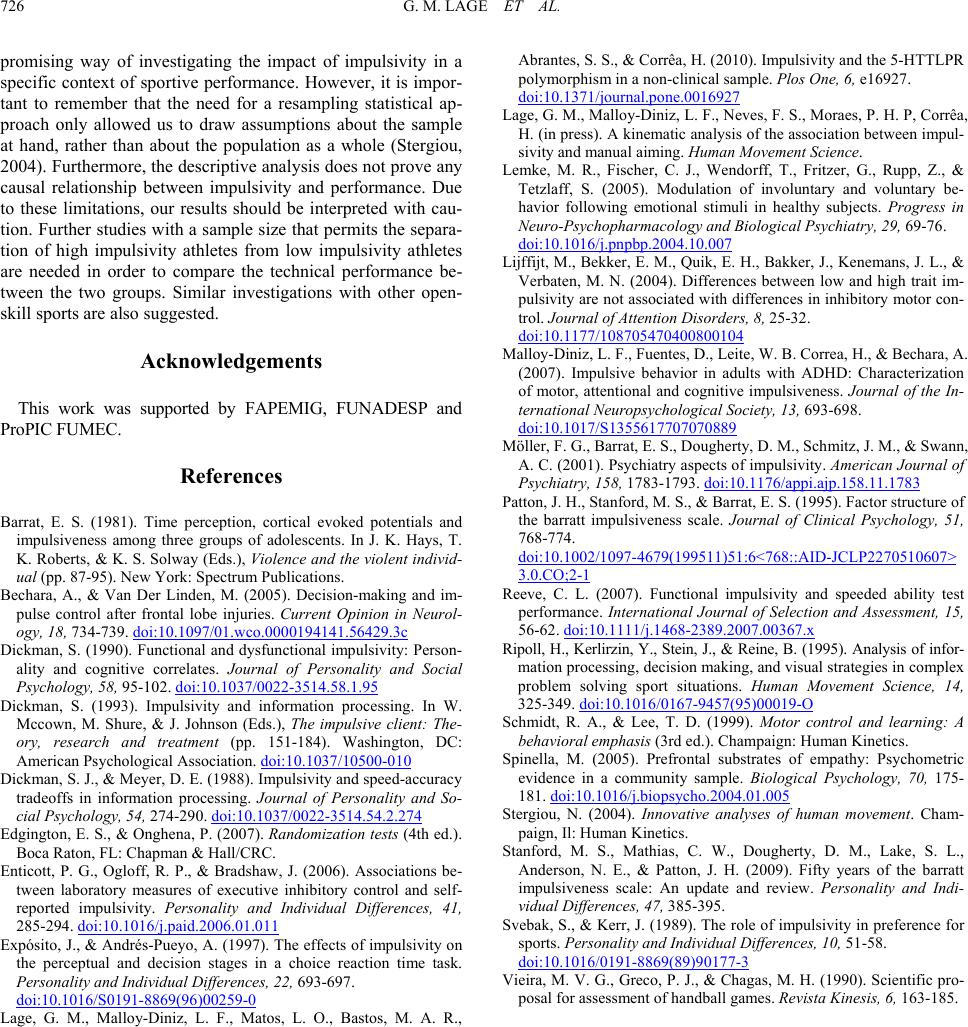 G. M. LAGE ET AL. 726 promising way of investigating the impact of impulsivity in a specific context of sportive performance. However, it is impor- tant to remember that the need for a resampling statistical ap- proach only allowed us to draw assumptions about the sample at hand, rather than about the population as a whole (Stergiou, 2004). Furthermore, the descriptive analysis does not prove any causal relationship between impulsivity and performance. Due to these limitations, our results should be interpreted with cau- tion. Further studies with a sample size that permits the separa- tion of high impulsivity athletes from low impulsivity athletes are needed in order to compare the technical performance be- tween the two groups. Similar investigations with other open- skill sports are also suggested. Acknowledgements This work was supported by FAPEMIG, FUNADESP and ProPIC FUMEC. References Barrat, E. S. (1981). Time perception, cortical evoked potentials and impulsiveness among three groups of adolescents. In J. K. Hays, T. K. Roberts, & K. S. Solway (Eds.), Violence and the violent individ- ual (pp. 87-95). New York: Spectrum Publications. Bechara, A., & Van Der Linden, M. (2005). Decision-making and im- pulse control after frontal lobe injuries. Current Opinion in Neurol- ogy, 18, 734-739. doi:10.1097/01.wco.0000194141.56429.3c Dickman, S. (1990). Functional and dysfunctional impulsivity: Person- ality and cognitive correlates. Journal of Personality and Social Psychology, 58, 95-102. doi:10.1037/0022-3514.58.1.95 Dickman, S. (1993). Impulsivity and information processing. In W. Mccown, M. Shure, & J. Johnson (Eds.), The impulsive client: The- ory, research and treatment (pp. 151-184). Washington, DC: American Psychological Association. doi:10.1037/10500-010 Dickman, S. J., & Meyer, D. E. (1988). Impulsivity and speed-accuracy tradeoffs in information processing. Journal of Personality and So- cial Psychology, 54, 274-290. doi:10.1037/0022-3514.54.2.274 Edgington, E. S., & Onghena, P. (2007). Randomization tests (4th ed.). Boca Raton, FL: Chapman & Hall/CRC. Enticott, P. G., Ogloff, R. P., & Bradshaw, J. (2006). Associations be- tween laboratory measures of executive inhibitory control and self- reported impulsivity. Personality and Individual Differences, 41, 285-294. doi:10.1016/j.paid.2006.01.011 Expósito, J., & Andrés-Pueyo, A. (1997). The effects of impulsivity on the perceptual and decision stages in a choice reaction time task. Personality and Individual Differences, 22, 693-697. doi:10.1016/S0191-8869(96)00259-0 Lage, G. M., Malloy-Diniz, L. F., Matos, L. O., Bastos, M. A. R., Abrantes, S. S., & Corrêa, H. (2010). Impulsivity and the 5-HTTLPR polymorphism in a non-clinical sample. Plos One, 6, e16927. doi:10.1371/journal.pone.0016927 Lage, G. M., Malloy-Diniz, L. F., Neves, F. S., Moraes, P. H. P, Corrêa, H. (in press). A kinematic analysis of the association between impul- sivity and manual aiming. Human Movement Science. Lemke, M. R., Fischer, C. J., Wendorff, T., Fritzer, G., Rupp, Z., & Tetzlaff, S. (2005). Modulation of involuntary and voluntary be- havior following emotional stimuli in healthy subjects. Progress in Neuro-Psychopharmacology and Biological Psychiatry, 29 , 69-76. doi:10.1016/j.pnpbp.2004.10.007 Lijffijt, M., Bekker, E. M., Quik, E. H., Bakker, J., Kenemans, J. L., & Verbaten, M. N. (2004). Differences between low and high trait im- pulsivity are not associated with differences in inhibitory motor con- trol. Journal of Attention Disorders, 8, 25-32. doi:10.1177/108705470400800104 Malloy-Diniz, L. F., Fuentes, D., Leite, W. B. Correa, H., & Bechara, A. (2007). Impulsive behavior in adults with ADHD: Characterization of motor, attentional and cognitive impulsiveness. Journal of the In- ternational Neuropsychological Society, 13 , 693-698. doi:10.1017/S1355617707070889 Möller, F. G., Barrat, E. S., Dougherty, D. M., Schmitz, J. M., & Swann, A. C. (2001). Psychiatry aspects of impulsivity. American Journal of Psychiatry, 158, 1783-1793. doi:10.1176/appi.ajp.158.11.1783 Patton, J. H., Stanford, M. S., & Barrat, E. S. (1995). Factor structure of the barratt impulsiveness scale. Journal of Clinical Psychology, 51, 768-774. doi:10.1002/1097-4679(199511)51:6<768::AID-JCLP2270510607> 3.0.CO;2-1 Reeve, C. L. (2007). Functional impulsivity and speeded ability test performance. International Journal of Selection and Assessment, 15, 56-62. doi:10.1111/j.1468-2389.2007.00367.x Ripoll, H., Kerlirzin, Y., Stein, J., & Reine, B. (1995). Analysis of infor- mation processing, decision making, and visual strategies in complex problem solving sport situations. Human Movement Science, 14, 325-349. doi:10.1016/0167-9457(95)00019-O Schmidt, R. A., & Lee, T. D. (1999). Motor control and learning: A behavioral emphasis (3rd ed.). Champaign: Human Kinetics. Spinella, M. (2005). Prefrontal substrates of empathy: Psychometric evidence in a community sample. Biological Psychology, 70, 175- 181. doi:10.1016/j.biopsycho.2004.01.005 Stergiou, N. (2004). Innovative analyses of human movement. Cham- paign, Il: Human Kinetics. Stanford, M. S., Mathias, C. W., Dougherty, D. M., Lake, S. L., Anderson, N. E., & Patton, J. H. (2009). Fifty years of the barratt impulsiveness scale: An update and review. Personality and Indi- vidual Differences, 47, 385-395. Svebak, S., & Kerr, J. (1989). The role of impulsivity in preference for sports. Personality and Individual Differences, 10, 51-58. doi:10.1016/0191-8869(89)90177-3 Vieira, M. V. G., Greco, P. J., & Chagas, M. H. (1990). Scientific pro- posal for assessment of handball games. Revista K inesis, 6, 163-185. |