

Paper Menu >>
Journal Menu >>
 American Journal of Anal yt ical Chemistry, 2011, 2, 726-730 doi:10.4236/ajac.2011.26083 Published Online October 2011 (http://www.SciRP.org/journal/ajac) Copyright © 2011 SciRes. AJAC Spectrophotometric Determination of Kelthane in Environmental Samples Etesh K. Janghel1, Y. Pervez2 1Department of Applied Chemistry, Ashoka Institute of Technology & Management, Gram-Torankatta, Post-Somni, Rajnandgaon, India 2 Department of Applied Chemistry, Chhatrapati Shivaji Institute of Technology, Durg, India E-mail: [email protected] Received September 27, 2010; revised January 10, 2011; accepted January 20, 2011 Abstract Sensitive spectrophotometric method for determination of kelthane in sub parts per million level is described, which is based on Fujiwara reaction. Kelthane on alkaline hydrolysis gives chloroform, which can be reacted with pyridine to produce red colour. The colour is discharged by addition of glacial acetic acid. Then Ben- zidine (4,4’-Bianiline) reagent is added due to which a yellowish-red colour is formed which has an absorp- tion maximum at 490nm. Beer’s law is obeyed in the range of 3.3 - 26.0 µg (0.13 - 1.04 ppm) of Kelthane per 25ml of final solution. The molar absorptivity and Sandell’s sensitivity were found to be 4.32 × 10⁵ L·mol–1·cm–1 and 0.022 µg·cm–2 respectively. The method is found to be free from interferences of other or- ganochlorine pesticides and various co-pollutants and can be successfully applied for the determination of kelthane in environmental samples. Keywords: Spectrophotometry, Kelthane, Acaricide, Benzidine, Environmental Samples 1. Introduction Kelthane is a well known acaricide of organochlorine group of pesticides, chemically it is known as 4-4’di- chloro-alpha trichloromethyl benzhydrol [1] Kelthane appears to be effective against a wide range of mite spe- cies and is a well known miticide. It is also effective against tetrachid, mites, cydamen, broad, mites, Euro- pean red spider, apple-rust, cherry-rust, tomato-rust, and various other fruits and vegetable rusts [2]. Field studies indicate that dicofol persists in soil for at least four years after application. The residue of kelthane accumulates in rotational crops. Due to very long persis- tency of residue of this material, the use of kelthane is recommended on slow growing crops, i.e. citrus fruits. It has been proved that kelthane is a sever irritant [3,4]. The National Cancer Institute suggests the possibility of kelthane as oncogen. The toxic effect of kelthane shows general weakness, comma, affects sex hormones, inhibi- tion of aromatose activity and death in animal. It is a contact herbicide with initial toxicity. It has a moderate acute oral toxicity. The oral LD50 in rat is 809 mg/kg and 1870 mg/kg body weights for rabbit [2]. The tolerance level of dicofol in vegetable is 1 mg/kg [5-7]. Several instrumental techniques i.e. GLC with Elec- tron Capture detector [8], Voltammery [9] Neutron acti- vation analysis [10], Gas chromatography [11], Liquid chromatography [12], matrix solid—phase dispersion [13], solid—phase extraction [14], and Spectrophotome- try [15-18] are available in literature, but most of these techniques are costly and require trained staff. Spectro- photometry is a simple, sensitive rapid and versatile technique for quick determination of analyte. A few spectrophotometric methods based on the hydrolysis of kelthane to chloroform and determination of chloroform by Fujiwara method [15-18] are available, but all these methods require specially constructed apparatus and have poor sensitivity than the present method. In the present a simple and more sensitive method is developed for the determination of kelthane. The reagent used in the present method is benzidine which increases sensitivity of the Fujiwara reaction. The method has been successfully applied for the determination of kelthane in environmental samples. 2. Experimental Apparatus. A Systronics spectrophotometer 104 with 1 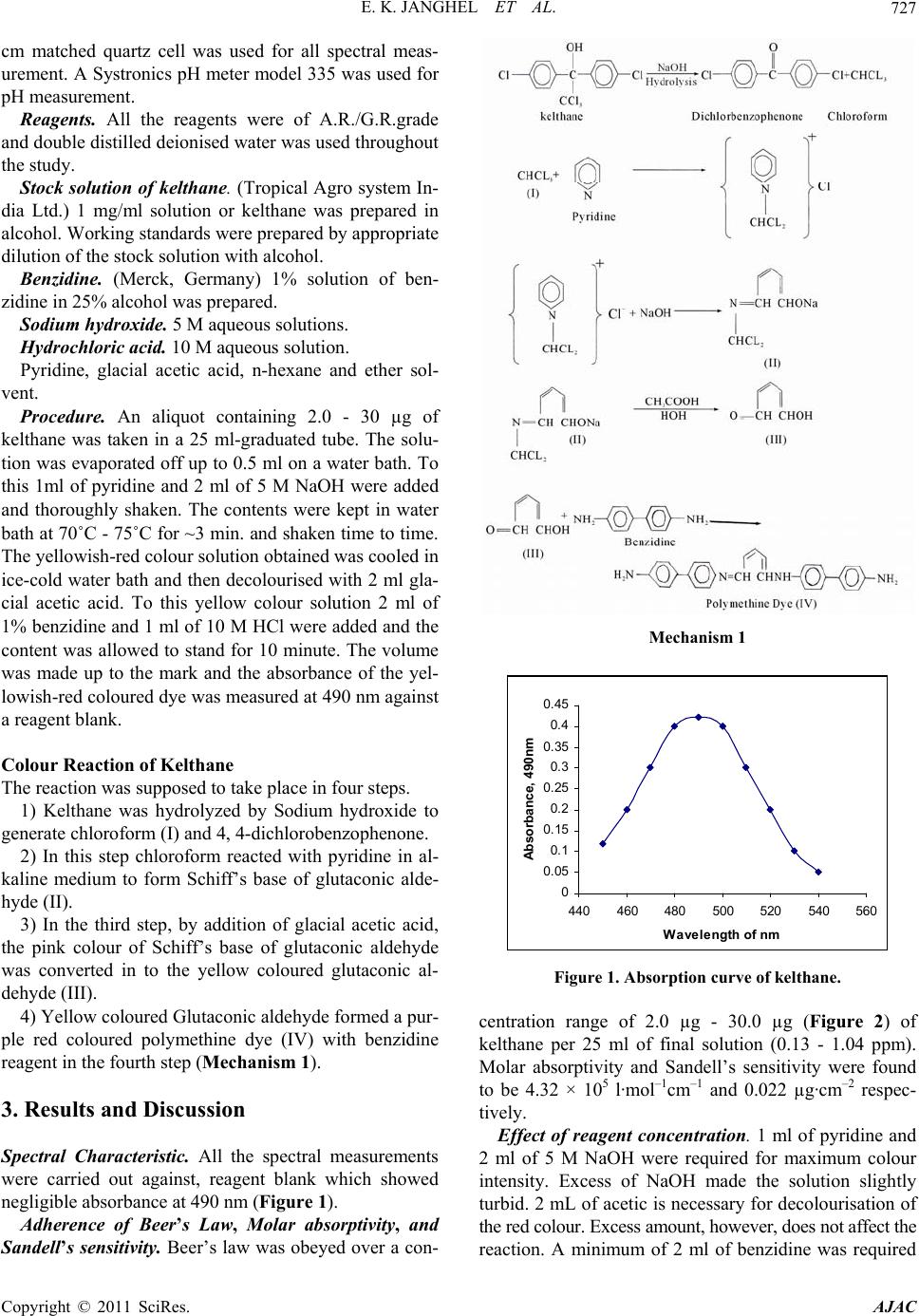 E. K. JANGHEL ET AL.727 cm matched quartz cell was used for all spectral meas- urement. A Systronics pH meter model 335 was used for pH measurement. Reagents. All the reagents were of A.R./G.R.grade and double distilled deionised water was used throughout the study. Stock solution of kelthane. (Tropical Agro system In- dia Ltd.) 1 mg/ml solution or kelthane was prepared in alcohol. Working standards were prepared by appropriate dilution of the stock solution with alcohol. Benzidine. (Merck, Germany) 1% solution of ben- zidine in 25% alcohol was prepared. Sodium hydroxide. 5 M aqueous solutions. Hydrochloric aci d. 10 M aqueous solution. Pyridine, glacial acetic acid, n-hexane and ether sol- vent. Procedure. An aliquot containing 2.0 - 30 µg of kelthane was taken in a 25 ml-graduated tube. The solu- tion was evaporated off up to 0.5 ml on a water bath. To this 1ml of pyridine and 2 ml of 5 M NaOH were added and thoroughly shaken. The contents were kept in water bath at 70˚C - 75˚C for ~3 min. and shaken time to time. The yellowish-red colour solution obtained was cooled in ice-cold water bath and then decolourised with 2 ml gla- cial acetic acid. To this yellow colour solution 2 ml of 1% benzidine and 1 ml of 10 M HCl were added and the content was allowed to stand for 10 minute. The volume was made up to the mark and the absorbance of the yel- lowish-red coloured dye was measured at 490 nm against a reagent blank. Colour Reaction of Kel thane The reaction was supposed to take place in four steps. 1) Kelthane was hydrolyzed by Sodium hydroxide to generate chloroform (I) and 4, 4-dichlorobenzophenone. 2) In this step chloroform reacted with pyridine in al- kaline medium to form Schiff’s base of glutaconic alde- hyde (II). 3) In the third step, by addition of glacial acetic acid, the pink colour of Schiff’s base of glutaconic aldehyde was converted in to the yellow coloured glutaconic al- dehyde (III). 4) Yellow coloured Glutaconic aldehyde formed a pur- ple red coloured polymethine dye (IV) with benzidine reagent in the fourth step (Mechanism 1). 3. Results and Discussion Spectral Characteristic. All the spectral measurements were carried out against, reagent blank which showed negligible absorbance at 490 nm (Figure 1). Adherence of Beer’s Law, Molar absorptivity, and Sandell’s sensitivity. Beer’s law was obeyed over a con- Mechanism 1 0 0.05 0.1 0.15 0.2 0.25 0.3 0.35 0.4 0.45 440460 480500 520540 560 W a ve l e ngth of nm Absorb an ce, 490n m Figure 1. Absorption curve of kelthane. centration range of 2.0 µg - 30.0 µg (Figure 2) of kelthane per 25 ml of final solution (0.13 - 1.04 ppm). Molar absorptivity and Sandell’s sensitivity were found to be 4.32 × 10⁵ l·mol–1cm–1 and 0.022 µg·cm–2 respec- tively. Effect of reagent concentration. 1 ml of pyridine and 2 ml of 5 M NaOH were required for maximum colour intensity. Excess of NaOH made the solution slightly turbid. 2 mL of acetic is necessary for decolourisation of the red colour. Excess amount, however, does not affect the reaction. A minimum of 2 ml of benzidine was required Copyright © 2011 SciRes. AJAC 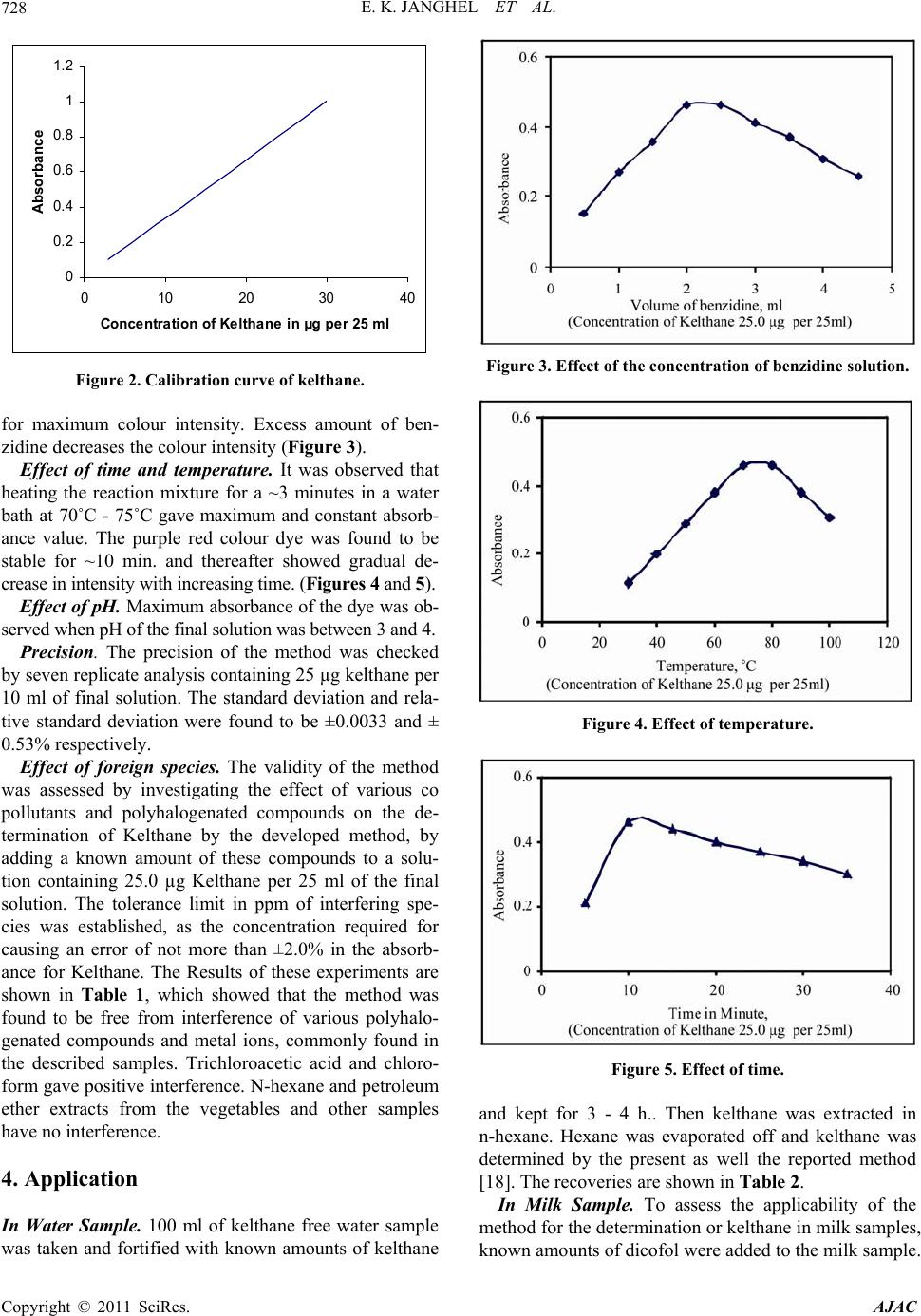 E. K. JANGHEL ET AL. 728 0 0.2 0.4 0.6 0.8 1 1.2 0102030 Conce ntration of Kel tha ne in µg pe r 25 ml Absorbance 40 Figure 2. Calibration curve of kelthane. for maximum colour intensity. Excess amount of ben- zidine decreases the colour intensity (Figure 3). Effect of time and temperature. It was observed that heating the reaction mixture for a ~3 minutes in a water bath at 70˚C - 75˚C gave maximum and constant absorb- ance value. The purple red colour dye was found to be stable for ~10 min. and thereafter showed gradual de- crease in intensity with increasing time. (Figures 4 and 5). Effect of pH. Maximum absorbance of the dye was ob- served when pH of the final solution was between 3 and 4. Precision. The precision of the method was checked by seven replicate analysis containing 25 µg kelthane per 10 ml of final solution. The standard deviation and rela- tive standard deviation were found to be ±0.0033 and ± 0.53% respectively. Effect of foreign species. The validity of the method was assessed by investigating the effect of various co pollutants and polyhalogenated compounds on the de- termination of Kelthane by the developed method, by adding a known amount of these compounds to a solu- tion containing 25.0 µg Kelthane per 25 ml of the final solution. The tolerance limit in ppm of interfering spe- cies was established, as the concentration required for causing an error of not more than ±2.0% in the absorb- ance for Kelthane. The Results of these experiments are shown in Table 1, which showed that the method was found to be free from interference of various polyhalo- genated compounds and metal ions, commonly found in the described samples. Trichloroacetic acid and chloro- form gave positive interference. N-hexane and petroleum ether extracts from the vegetables and other samples have no interference. 4. Application In Water Sample. 100 ml of kelthane free water sample was taken and fortified with known amounts of kelthane Figure 3. Effect of the concentration of benzidine solution. Figure 4. Effect of temperature. Figure 5. Effect of time. and kept for 3 - 4 h.. Then kelthane was extracted in n-hexane. Hexane was evaporated off and kelthane was determined by the present as well the reported method [18]. The recoveries are shown in Table 2. In Milk Sample. To assess the applicability of the method for the determination or kelthane in milk samples, known amounts of dicofol were added to the milk sample. Copyright © 2011 SciRes. AJAC  E. K. JANGHEL ET AL. Copyright © 2011 SciRes. AJAC 729 Kelthane was extracted in n-hexane as reported [6] and determined by present as well as reported method [18]. The recoveries are shown in Table 2. In Vegetables and Fruits Samples. Various vegetables and fruits samples such as tomato, beans grapes were weighed, crushed and then spiked with known amounts of kelthane and kept for 3 - 4 h. Kelthane was extracted in n-hexane. Hexane was evaporated off and kelthane was determined by the present as well as reported method [18].The recoveries are shown in Table 2. The comparison of the present method with other re- ported [15-18] method is shown in Table 3. Table 1. Effect of foreign species: (Concentration of kelthane 25 µg/25 ml). Foreign species Tolerance limit ppm* Foreign species Tolerance limit ppm* DDT 1000 Cu2+, Cd2+ 1100 Carbaryl, Propoxur 600 Pb2+ 550 2,4-D, 2,4,5-T 450 NO2-, Sn2+, Ca2+, Ni2+ 430 Paraquat BHC 200 150 Zn2+, Fe2+ 400 Malathion, CCl4 100 Hg2+ 300 Parathion 50 PO43- 150 * - The amount of foreign species causing error of ±2%. Table 2. Recoveries of kelthane in various environmental samples. S.N. Sample Kelthane added µg Kelthane found* µg % Recovery Proposed method Reported method [18] Proposed method Reported method [18] 1. Watera A B 15 25 14.25 23.75 13.867 22.50 95.00 95.00 92.50 90.00 2. Milka A B 15 25 14.12 23.46 13.13 20.63 94.13 93.84 87.50 82.50 3. Tomatob A B 15 25 14.42 24.26 14.25 24.375 96.13 97.44 95.00 97.50 4. Beansb A B 15 25 13.95 24.70 13.867 24.688 94.33 98.80 92.50 98.75 5. Grapesb A B 15 25 14.23 24.13 13.99 23.75 94.80 96.52 93.26 95.00 *Mean of three replicate analysis; aSize of sample 100 ml. bSize of Sample 50 gm. Table 3. Comparison of the proposed method with other spectrophotometric method. S.N. Methods/Reagents µmax-nm Beer’s law ppmAmount of pyridine used mlRemarks 1. Fujiwara method pyridine/NaOH (15) 530 12.4 - 124 5.0 Methods require special type of distillation apparatus. 2. Modified Fujiwara method/Pyridine/NaOH (16) 530 200 - Poor sensitivity 3. Sulphanilicacid + Formic acid (18) 505 1.48-11.8 1.0 Less sensitive 4. Benzidine (Present method) 490 0.13-1.04 1.0 Method is simple, more sensitive free from inter-ference of other chlorinated hydrocarbon.  E. K. JANGHEL ET AL. Copyright © 2011 SciRes. AJAC 730 5. Conclusions The data shown in Tables 2 and 3 clearly indicate that the present method is simple, rapid and more sensitive than other reported method for determination of kelthane. It can be successfully applied for the determination of kelthane in various environmental samples. 6. Acknowledgements Authors are thankful to the Principal and Head, Chha- trapati Shivaji Institute of Technology Durg, Principal & Head, Ashoka institute of Technology & Management, Rajnandgaon for providing laboratory facilities and fi- nancial assistance. 7. References [1] F. A. Gunther and L. R. Jeppson, “Modern Insecticide and World Food Production,” Chapman and Hall, London, 1960, p. 129. [2] R. F. Black, G. P. Kurtz and H. Baum, Association of Official Analytical Chemists Journal, Vol. 54, 1971, p. 1237. [3] D. E. Ott, F. E. Hearth and A. Francis, “Determination of Kelthane and Its Dichlorobenzophenone Degradation Product by Thin-Layer Chromatography and Oscillopo- larography,” Bulletin of Environmental Contamination and Toxicology, Vol. 1, No. 5, 1966, pp. 181-186. doi:10.1007/BF01684095 [4] K. N. R. Rao and P. Surendranath, “Effect of Kelthane on pH Dependency of Lipases in Tissues of the Penaeid Prawn, Metapenaeus Monoceros (Fabricius) under Sub- lethal Exposure,” Pesticide Biochemistry and Physiology, Vol. 39, No. 3, 1991, pp. 205-209. doi:10.1016/0048-3575(91)90115-3 [5] F. A. Gunther and J. D. Gunther, “Residue Reviews. Residues of Pesticides and Other Contaminants in the Total Environment,” Zeitschrift für Allgemeine Mikrobi- ologie, Springer Verlag, New York, Vol. 21, No. 3, 1981, pp. 564-565. [6] Z. Gunther, “Pesticides plant Growth Regulators and Food Additive,” Academic Press, New York, 1964, pp. 263-271. [7] F. A. Patty, “Industrial Hygiene and Toxicology,” Inter- sciente Willey, New York, 1963, p. 1350. [8] N. L. Morgan, “The Identification and Relative Retention Times of p,p’-kelthane and Its Breakdown Product p,p’-dichlorobenzophenone Using GLC,” Bulletin of En- vironmental Contamination and Toxicology, Vol. 2, No. 5, 1967, pp. 306-313. doi:10.1007/BF01684379 [9] P. Manishankar, S. Viswanathan, M. A. Pustplatha and C. Rani, “Electrochemical Studies and Square Wave Strip- ping Voltammetry of Five Common Pesticides on Poly 3,4-Ethylenedioxythiophene Modified Wall-Jet Elec- trode,” Analytica Chimica Acta, Vol. 528, No. 2, 2005, pp. 157-163. doi:10.1016/j.aca.2004.08.027 [10] D. D. Xu, L. L. Deng, Z. F. Chai and X. Y. Mao, “Or- ganohalogenated Compounds in Pine Needles from Bei- jing City, China,” Chemosphere, Vol. 57, No. 10, 2004, pp. 1343-1353. doi:10.1016/j.chemosphere.2004.09.016 [11] M. Kateina and S. J. Lehotay, “Evaluation of Common Organic Solvents for Gas Chromatographic Analysis and Stability of Multiclass Pesticide Residues,” Journal of Chromatography A, Vol. 1040, No. 2, 2004, pp. 259-272. doi:10.1016/j.chroma.2004.04.017 [12] A. Jose, G. Jimena, P. J. Jimenez and J. M. Pavon, “De- termination of Active Components in Insecticide Formu- lations by Liquid Chromatography and Resolution of Overlapped Peaks by Multivariate Analysis and Deriva- tive Spectrophotometry,” Analytica Chimica Acta, Vol. 321, No. 2-3, 1996, pp. 273-278. doi:10.1016/0003-2670(95)00578-1 [13] C. M. Torres, Y. Pico, M. J. Redonodo and J. Manes, “Matrix Solid-Phase Dispersion Extraction Procedure for Multiresidue Pesticide Analysis in Oranges,” Journal of Chromatography A, Vol. 719, No. 1, 1996, pp. 95-103. doi:10.1016/0021-9673(95)00467-X [14] J. Beltran, F. J. Lopez and F. Hernandez, “Solid-Phase Extraction of Pesticide Residues from Ground Water: Comparison between Extraction Cartridges and Extrac- tion Discs,” Analytica Chimica Acta, Vol. 283, No. 1, 1993, pp. 297-303. doi:10.1016/0003-2670(93)85235-C [15] J. T. Hughes, “Notes,” Analyst, Vol. 86, 1961, pp. 756-757. doi:10.1039/an9618600756 [16] H. P. Eduson, Association of Official Analytical Chemists Journal, Vol. 44, 1961, p. 183. [17] I. Rosenthal, G. J. Frisone and F. A. Gunther, Journal of Agricultural and Food Chemistry, Vol. 5, 1957, p. 514. [18] P. Shivhare and V. K. Gupta, “Pesticide Determination, Colorimetric Microdetermination of the Acaricide 4,4’- Dichloro-α-(trichloromethyl)benzhydrol (FW-293),” Fre- senius’ Journal of Analytical Chemistry, Vol. 343, 1992, p. 612. doi:10.1021/jf60077a003 |