

Paper Menu >>
Journal Menu >>
 Vol.1, No.2, 50-55 (2011) doi:10.4236/oji.2011.12006 C opyright © 2011 SciRes. Openly accessible at http://www.scirp.org/journal/OJI/ Open Journal of Immunology One-month immunotherapy trial in treatment-failed TB patients Olga V. Arjanova1, Dmitry A. Butov2, Natalia D. Prihoda1,Svetlana I. Zaitzeva2, Larisa V. Yurchenko1, Nina I. Sokolenko1, Anna L. Stepanenko2, Tatyana S. Butova2, Elena A. Grinishina3, Olga A. Maksimenko4, Vichai Jirathitikal5, Aldar S. Bourinbaiar6, Valery M. Frolov7, Galyna A. Kutsyna7* 1Lisichansk Regional Tuberculosis Dispensary, Lisichan sk, Ukraine; 2Department of Phtysiatry and Pulmonology, Kharkov National Medical University; Kharkov, Ukraine; 3Zmeev Regional Tuberculosis Dispensary, Zmeev, Ukraine; 4Izyum Regional Tuberculosis Dispensary, Izyum, Ukraine; 5Immunitor Thailand Co., LLC, Bangpakong Industrial Park, Chachoengsao, Thailand; 6Immunitor USA Inc., College Park, USA; 7Luhansk State Medical University, Luhansk, Ukraine; *[email protected]. Received 17 August 2011; revised 1 September 2011; accepted 9 September 2011. ABSTRACT Treatment failed TB patients have very limited chances of s urv ival. Open label trial of daily oral pill of V-5 Immunitor (V5) was conducted in 48 treatment-failed TB patie nts on palliative support consisting of isoniazid (H) and rifampicin (R). The subjects had the following forms of TB; cavit ary : disseminated: MDR-TB: DR-TB: TB/HIV at 35:13:7:4:1 ratio. After 1 month 62.5% of V5- treated patients experienced negative sputum smear conversion (P < 0.0001), comprising 11 out of 12 (91.7%) converted among those who had drug-resistant TB an d TB/HIV. TB-associated inflammation was downregulated as evidenced by normalization of leukocy tosis 7.4 vs. 6.7 x 10⁹ L (P = 0.01) and decr eas e d erythrocyte sedimen- tation rate 20.5 vs. 14.9 mm/h (P < 0.0001). The mean body temperature normalized from 37.25˚ ± 0.6˚ to 36.98˚ ± 0.4˚ (P = 0.0002). The average body weight gain and body mass index (BMI) increased by 0.8 ± 0.7 kg and from 18.9 to 19.6 kg/m2 respectively (P < 0.0001). Two patients (4.2%) died from illicit drug- and alcohol-abuse related causes. No adverse effects or reactiva- tion of disease due to im mune interv ention were seen at any time. V5 is safe and in combination with a simple two-drug regimen was highly effective as an immune adjunct to produce favorable outcome among treatment-failed and/ or drug-resis tant TB patients. Keywords: Biomarker; HIV; Inflammat ion; MDR-TB; Mycobacterium; Survival; Treatment Failure; Vaccine; 1. INTRODUCTION Mycobacterium tuberculosis is responsible for the largest number of deaths attributable to a single micro- organism. Nearly 9 million people develop TB each year and 2 million die from the disease [1]. Currently avail- able chemotherapies for treatment of TB are not ideal - they require multiple tuberculosis drugs to be taken for long periods of time. The length of therapy, co upled with side effects, often results in poor patient adherence, treatment failure, and the emergence of drug resistance [2]. Current so-called directly observed short-course (DOTS) chemotherapy requires 6 months; with isoniazid, rifampicin, pyrazinamide and ethambutol during first 2 months of intensive phase and isoniazid and rifampicin for continuation phase. The WHO global target for suc- cessful DOTS is set at 85% or higher, however the worsening epidemic of drug resistant TB converging with HIV reduces the likelihood of attaining this goal. Patients who failed treatment have very few therapeutic options and mortality and morbidity in this category is extremely high. If left untreated one year fatality esti- mate is 70% for smear-positive and 20% for culture- positive but smear-negative tuberculosis [2]. In a study involving patients resistant to isoniazid and rifampicin 65% became culture negative but treatment failure, de- fined as the inability of chemotherapy to sterilize cul- tures, occurred in almost half of patients (46%) [3]. The idea that immunotherapy might improve TB treatment outcomes started gaining consensus in recent years [4]. 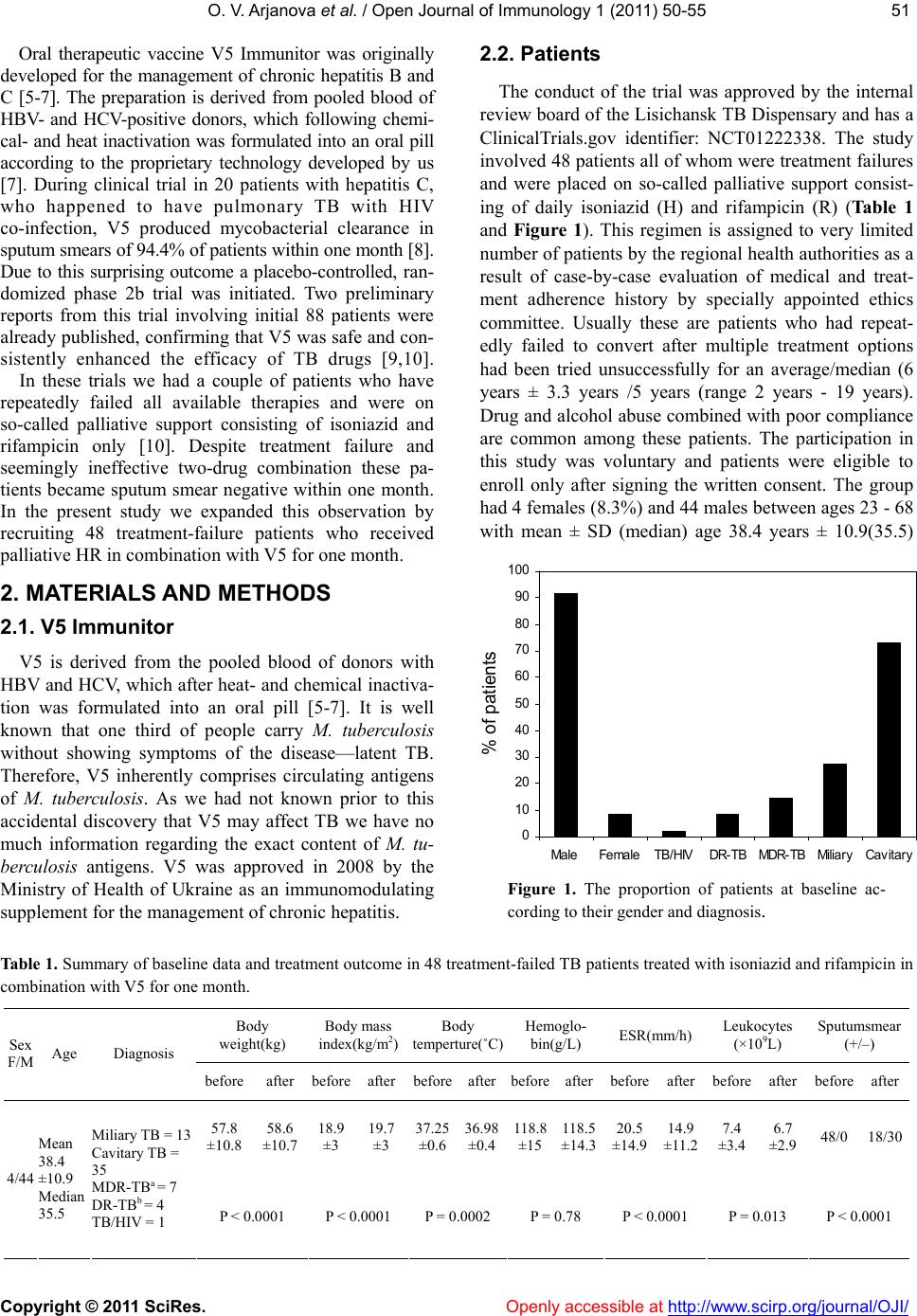 O. V. Arjanova et al. / Open Journal of Immunology 1 (2011) 50-55 Copyright © 2011 SciRes. Openl y accessible at http://www.scirp.org/journal/OJI/ 5151 Oral therapeutic vaccine V5 Immunitor was originally developed for the management of chronic hepatitis B and C [5-7]. The preparation is derived from pooled blood of HBV- and HCV-positive donors, which following chemi- cal- and heat inactivation was formulated into an oral pill according to the proprietary technology developed by us [7]. During clinical trial in 20 patients with hepatitis C, who happened to have pulmonary TB with HIV co-infection, V5 produced mycobacterial clearance in sputum smears of 94.4% of patients within one month [8]. Due to this surprising outcome a placebo-controlled, ran- domized phase 2b trial was initiated. Two preliminary reports from this trial involving initial 88 patients were already published, confir ming that V5 was safe and con- sistently enhanced the efficacy of TB drugs [9,10]. In these trials we had a couple of patients who have repeatedly failed all available therapies and were on so-called palliative support consisting of isoniazid and rifampicin only [10]. Despite treatment failure and seemingly ineffective two-drug combination these pa- tients became sputum smear negative within one month. In the present study we expanded this observation by recruiting 48 treatment-failure patients who received palliative HR in combination with V5 for one month. 2. MATERIALS AND METHODS 2.1. V5 Immunitor V5 is derived from the pooled blood of donors with HBV and HCV, which after heat- and chemical inactiva- tion was formulated into an oral pill [5-7]. It is well known that one third of people carry M. tuberculosis without showing symptoms of the disease—latent TB. Therefore, V5 inherently comprises circulating antigens of M. tuberculosis. As we had not known prior to this accidental discovery that V5 may affect TB we have no much information regarding the exact content of M. tu- berculosis antigens. V5 was approved in 2008 by the Ministry of Health of Ukraine as an immunomodulating supplement for the management of chronic hepatitis. 2.2. Patients The conduct of the trial was approved by the internal review board of th e Lisich ansk TB Disp ensary a nd has a ClinicalTrials.gov identifier: NCT01222338. The study involved 48 patients all of whom were treatment failures and were placed on so-called palliative support consist- ing of daily isoniazid (H) and rifampicin (R) (Table 1 and Figure 1). This regimen is assigned to very limited number of patients by the regional h ealth authorities as a result of case-by-case evaluation of medical and treat- ment adherence history by specially appointed ethics committee. Usually these are patients who had repeat- edly failed to convert after multiple treatment options had been tried unsuccessfully for an average/median (6 years ± 3.3 years /5 years (range 2 years - 19 years). Drug and alcohol abuse combined with poor compliance are common among these patients. The participation in this study was voluntary and patients were eligible to enroll only after signing the written consent. The group had 4 females (8.3%) and 44 males between ages 23 - 68 with mean ± SD (median) age 38.4 years ± 10.9(35.5) 0 10 20 30 40 50 60 70 80 90 100 Male FemaleTB/HIVDR-TBMDR-TBMiliaryCavitary % of patients Figure 1. The proportion of patients at baseline ac- cording to their gender and diagnosis . Table 1. Summary of baseline data and treatment outcome in 48 treatment-failed TB patients treated with isoniazid and rifampicin in combination with V5 for one month. Body weight(kg) Body mass index(kg/m2)Body temperture(˚C) Hemoglo- bin(g/L) ESR(mm/h) Leukocytes (×109L) Sputumsmear (+/–) Sex F/M Age Diagnosis before after before afterbeforeafterbeforeafterbeforeafter before after beforeafter 57.8 ±10.8 58.6 ±10.7 18.9 ±3 19.7 ±3 37.25 ±0.6 36.98 ±0.4 118.8 ±15 118.5 ±14.3 20.5 ±14.9 14.9 ±11.2 7.4 ±3.4 6.7 ±2.9 48/0 18/30 4/44 Mean 38.4 ±10.9 Median 35.5 Miliary TB = 13 Cavitary TB = 35 MDR-TBa = 7 DR-TBb = 4 TB/HIV = 1 P < 0.0001 P < 0.0001 P = 0.0002 P = 0.78 P < 0.0001 P = 0.013 P < 0.0001 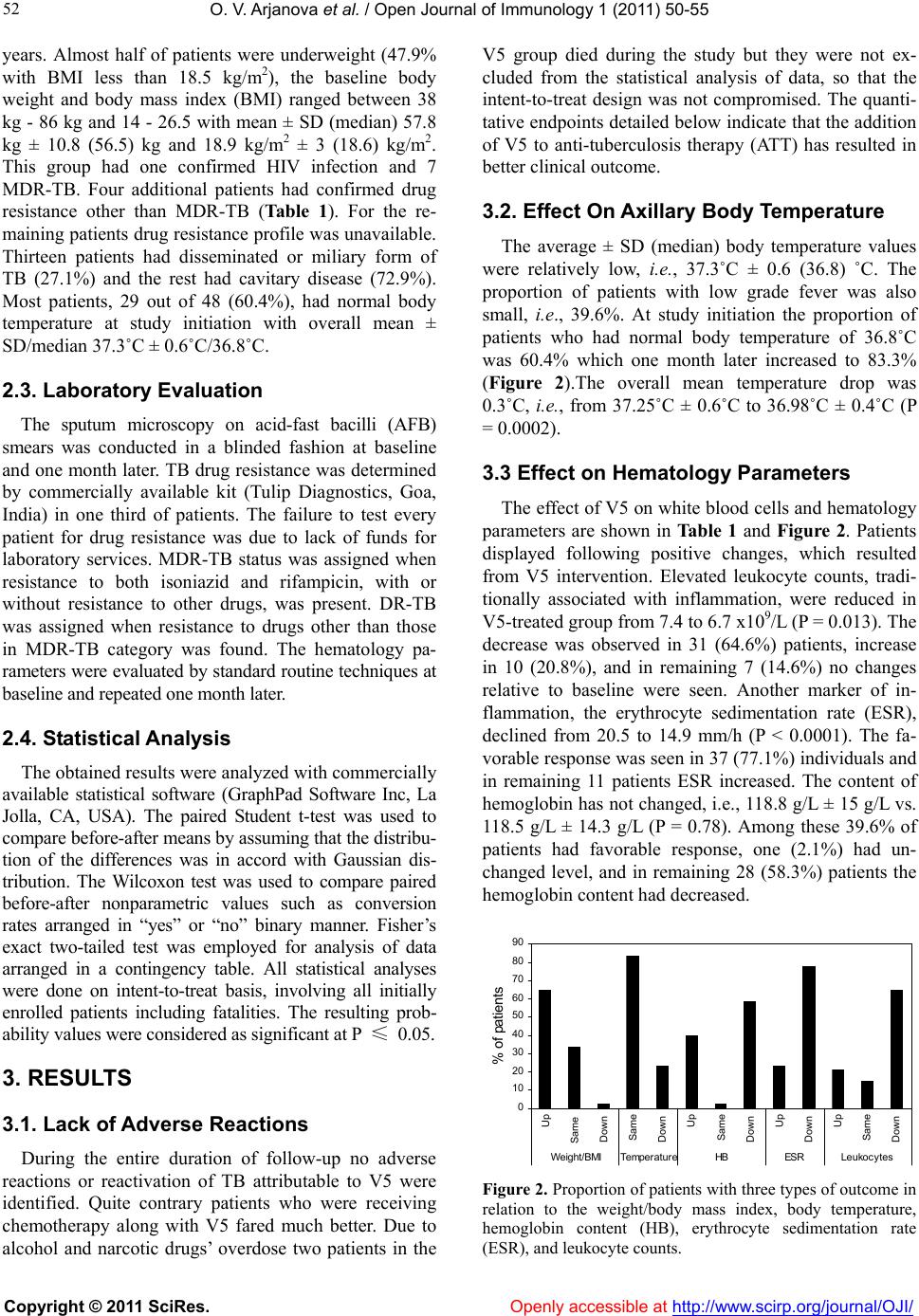 O. V. Arjanova et al. / Open Journal of Immunology 1 (2011) 50-55 Copyright © 2011 SciRes. Openl y accessible at http://www.scirp.org/journal/OJI/ 52 years. Almost half of patients were underweight (47.9% with BMI less than 18.5 kg/m2), the baseline body weight and body mass index (BMI) ranged between 38 kg - 86 kg and 14 - 26.5 with mean ± SD (median) 57.8 kg ± 10.8 (56.5) kg and 18.9 kg/m2 ± 3 (18.6) kg/m2. This group had one confirmed HIV infection and 7 MDR-TB. Four additional patients had confirmed drug resistance other than MDR-TB (Table 1). For the re- maining patients drug resistance profile was unavailable. Thirteen patients had disseminated or miliary form of TB (27.1%) and the rest had cavitary disease (72.9%). Most patients, 29 out of 48 (60.4%), had normal body temperature at study initiation with overall mean ± SD/median 37.3˚C ± 0.6˚C/36.8˚C. 2.3. Laboratory Evaluation The sputum microscopy on acid-fast bacilli (AFB) smears was conducted in a blinded fashion at baseline and one month later. TB drug resistance was deter mined by commercially available kit (Tulip Diagnostics, Goa, India) in one third of patients. The failure to test every patient for drug resistance was due to lack of funds for laboratory services. MDR-TB status was assigned when resistance to both isoniazid and rifampicin, with or without resistance to other drugs, was present. DR-TB was assigned when resistance to drugs other than those in MDR-TB category was found. The hematology pa- rameters were evaluated by standard routine techniques at baseline and repeated one month later. 2.4. Statistical Analysis The obtained results were analyzed with commercially available statistical software (GraphPad Software Inc, La Jolla, CA, USA). The paired Student t-test was used to compare before-after means by assuming that the distribu- tion of the differences was in accord with Gaussian dis- tribution. The Wilcoxon test was used to compare paired before-after nonparametric values such as conversion rates arranged in “yes” or “no” binary manner. Fisher’s exact two-tailed test was employed for analysis of data arranged in a contingency table. All statistical analyses were done on intent-to-treat basis, involving all initially enrolled patients including fatalities. The resulting prob- ability values were considered as significant at P ≤ 0.05. 3. RESULTS 3.1. Lack of Adverse Reactions During the entire duration of follow-up no adverse reactions or reactivation of TB attributable to V5 were identified. Quite contrary patients who were receiving chemotherapy along with V5 fared much better. Due to alcohol and narcotic drugs’ overdose two patients in the V5 group died during the study but they were not ex- cluded from the statistical analysis of data, so that the intent-to-treat design was not compromised. The quanti- tative endpoints detailed below indicate that the addition of V5 to anti-tuberculosis therapy (ATT) has resulted in better clinical outcome. 3.2. Effect On Axillary Body Temperature The average ± SD (median) body temperature values were relatively low, i.e., 37.3˚C ± 0.6 (36.8) ˚C. The proportion of patients with low grade fever was also small, i.e., 39.6%. At study initiation the proportion of patients who had normal body temperature of 36.8˚C was 60.4% which one month later increased to 83.3% (Figure 2).The overall mean temperature drop was 0.3˚C, i.e., from 37.25˚C ± 0.6˚C to 36.98˚C ± 0.4˚C (P = 0.0002). 3.3 Effect on Hematology Parameters The effect of V5 on white blood cells and hematology parameters are shown in Tab l e 1 and Figure 2. Patients displayed following positive changes, which resulted from V5 intervention. Elevated leukocyte counts, tradi- tionally associated with inflammation, were reduced in V5-treated group from 7.4 to 6.7 x10⁹/L (P = 0.013). The decrease was observed in 31 (64.6%) patients, increase in 10 (20.8%), and in remaining 7 (14.6%) no changes relative to baseline were seen. Another marker of in- flammation, the erythrocyte sedimentation rate (ESR), declined from 20.5 to 14.9 mm/h (P < 0.0001). The fa- vorable response was seen in 37 (77.1%) individuals and in remaining 11 patients ESR increased. The content of hemoglobin has not changed, i.e., 118.8 g/L ± 15 g/L vs. 118.5 g/L ± 14.3 g/L (P = 0.78). Among these 39.6% of patients had favorable response, one (2.1%) had un- changed level, and in remaining 28 (58.3%) patients the hemoglobin content had decreased. 0 10 20 30 40 50 60 70 80 90 Up Same Down Sam e Down Up Sam e Down Up Down Up Sam e Down Weight/BMI TemperatureHBESRLeukocytes % of patien ts Figure 2. Proportion of patients with three types of outcome in relation to the weight/body mass index, body temperature, hemoglobin content (HB), erythrocyte sedimentation rate (ESR), and leukocyte counts. 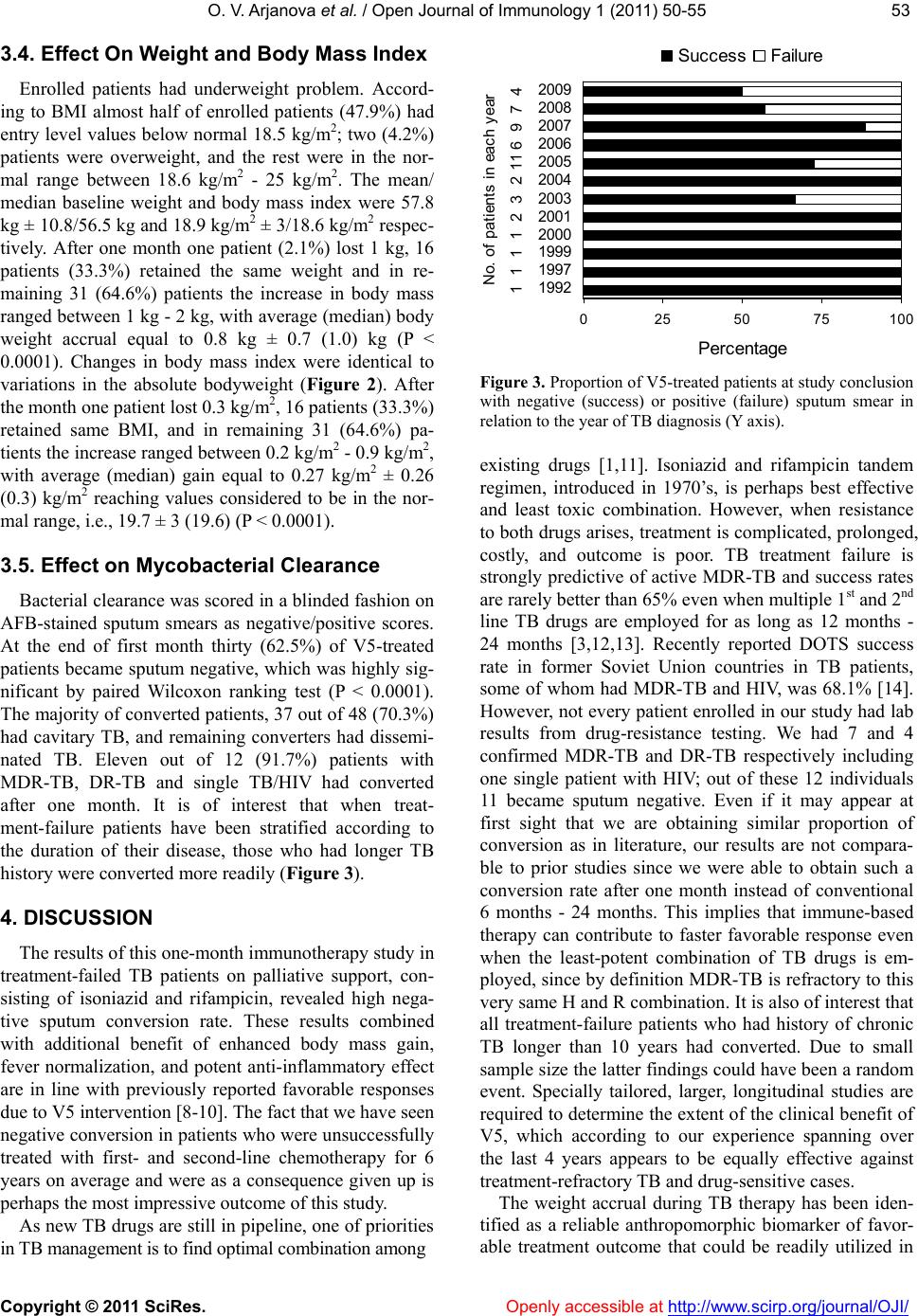 O. V. Arjanova et al. / Open Journal of Immunology 1 (2011) 50-55 Copyright © 2011 SciRes. Openl y accessible at http://www.scirp.org/journal/OJI/ 5353 3.4. Effect On Weight and Body Mass Index Enrolled patients had underweight problem. Accord- ing to BMI almost half of enrolled patients (47.9%) had entry level values below normal 18.5 kg/m2; two (4 .2%) patients were overweight, and the rest were in the nor- mal range between 18.6 kg/m2 - 25 kg/m2. The mean/ median baseline weight and body mass index were 57.8 kg ± 10.8/56.5 kg and 18.9 kg/m2 ± 3/18.6 kg/m2 respec- tively. After one month one patient (2.1%) lost 1 kg, 16 patients (33.3%) retained the same weight and in re- maining 31 (64.6%) patients the increase in body mass ranged between 1 kg - 2 kg, with average (median) body weight accrual equal to 0.8 kg ± 0.7 (1.0) kg (P < 0.0001). Changes in body mass index were identical to variations in the absolute bodyweight (Figure 2). After the month one patient lost 0.3 kg/m2, 16 patients (33.3%) retained same BMI, and in remaining 31 (64.6%) pa- tients the increase ranged b etween 0.2 kg/m2 - 0.9 kg/m2, with average (median) gain equal to 0.27 kg/m2 ± 0.26 (0.3) kg/m2 reaching values considered to be in the nor- mal range, i.e., 19.7 ± 3 (19.6) (P < 0.0001). 3.5. Effect on Mycobacterial Clearance Bacterial clearance was scored in a blinded fashion on AFB-stained sputum smears as negative/positive scores. At the end of first month thirty (62.5%) of V5-treated patients became sputum negative, which was highly sig- nificant by paired Wilcoxon ranking test (P < 0.0001). The majority of conver ted patients, 37 out of 48 (70.3%) had cavitary TB, and remaining converters had dissemi- nated TB. Eleven out of 12 (91.7%) patients with MDR-TB, DR-TB and single TB/HIV had converted after one month. It is of interest that when treat- ment-failure patients have been stratified according to the duration of their disease, those who had longer TB history were converted more readily (Figure 3). 4. DISCUSSION The results of this one-month immunotherapy study in treatment-failed TB patients on palliative support, con- sisting of isoniazid and rifampicin, revealed high nega- tive sputum conversion rate. These results combined with additional benefit of enhanced body mass gain, fever normalization, and potent anti-inflammatory effect are in line with previously reported favorable responses due to V5 intervention [8-10]. The fact that we have seen negative conversion in patients who were unsuccessfully treated with first- and second-line chemotherapy for 6 years on average and w ere as a consequence giv en up is perhaps the most impressive outcome of this study. As new TB drugs are still in pipeline, one of priorities in TB managem ent i s to find opt im al combinati on am ong 0 255075 1992 1997 1999 2000 2001 2003 2004 2005 2006 2007 2008 2009 1111232116974 No. of patients in each y ear P ercenta ge 100 Success Failure Figure 3. Proportion of V5-treated patients at study conclusion with negative (success) or positive (failure) sputum smear in relation to the year of TB diagnosis (Y axis). existing drugs [1,11]. Isoniazid and rifampicin tandem regimen, introduced in 1970’s, is perhaps best effective and least toxic combination. However, when resistance to both drugs arises, treatment is complicated, prolonged, costly, and outcome is poor. TB treatment failure is strongly predictive of active MDR-TB and success rates are rarely better than 65% even when multiple 1st and 2nd line TB drugs are employed for as long as 12 months - 24 months [3,12,13]. Recently reported DOTS success rate in former Soviet Union countries in TB patients, some of whom had MDR-TB and HIV, was 68.1% [14]. However, not every patient enrolled in our study had lab results from drug-resistance testing. We had 7 and 4 confirmed MDR-TB and DR-TB respectively including one single patient with HIV; out of these 12 individuals 11 became sputum negative. Even if it may appear at first sight that we are obtaining similar proportion of conversion as in literature, our results are not compara- ble to prior studies since we were able to obtain such a conversion rate after one month instead of conventional 6 months - 24 months. This implies that immune-based therapy can contribute to faster favorable response even when the least-potent combination of TB drugs is em- ployed, since by definition MDR-TB is refractor y to this very same H and R combination. It is also of interest th at all treatment-failure patients who had history of chronic TB longer than 10 years had converted. Due to small sample size the latter findings could have been a random event. Specially tailored, larger, longitudinal studies are required to determine the extent of the clinical benefit of V5, which according to our experience spanning over the last 4 years appears to be equally effective against treatment-refractory TB and drug-sensitive cases. The weight accrual during TB therapy has been iden- tified as a reliable anthropomorphic biomarker of favor- able treatment outcome that could be readily utilized in  O. V. Arjanova et al. / Open Journal of Immunology 1 (2011) 50-55 Copyright © 2011 SciRes. Openl y accessible at http://www.scirp.org/journal/OJI/ 54 resource-limited settings [15]. Bernabe-Ortiz et al., [ 16] have shown that after adjustment for baseline differences, patients with good outcome gained, after the first month of treatment, mean 0.9 kg (P < 0.001), whereas those with poor outcome lost 1.9 kg (P = 0.003). Present re- sults with V5 closely match findings from Peru study suggesting that the trend in bodyweight can predict suc- cess of tuberculosis therapy. The correlation between body weight and BMI was not surprising either. Body mass index is equally reflective of severity of disease and is a risk factor closer associated with death than even MDR-TB diagnosis. Its improvement in parallel with weight gain indicates that the benefit of V5 therapy can be predicted by both categories of wasting meas- urement. Alcohol and substance abuse have been associ- ated with poor TB outcome in many studies [17,18] and was the cause of death in two patients during this study. We suspect that practically every patient in our group had this problem but the exact extent of abuse is not known since most patients were reluctant to disclose their addictions. Leukocytosis and high erythrocyte sedimentation rate are common during active pulmonary TB [19]. These biomarkers of tuberculosis which reflect the inflamma- tory response have been predictable of outcome of V5 immunotherapy in this and prior studies. In our patient population favorable responses were seen when values of both markers declined. These results are further sup- ported by the effect of V5 on defervescence. In contrast, the hemoglobin content, which does not seem to be re- lated to inflammation, has not been affected by V5. It has been commonly argued that immunotherapy can boost TB drugs’ activity and shorten treatment duration [4,20-23]. As conventional TB drugs have been of little value in failure cases are there immune-based intervene- tions that were successful in such a situation? The search of the medical literature failed to produce any notewor- thy evidence except our own published study in which 40 end-stage patients with TB and HIV were treated with multi-herbal immunomodulator, Dzherelo (Immunoxel) [24]. This intervention resulted in 65% negative sputum conversion r ate as opposed to 5% in the contro l. Despite best possible care 6 patients had died in Immunoxel arm. Remaining 14 patients experienced clinical improve- ments and one patient was discharged due to full recov- ery. Among 20 matched subjects on conventional TB regimen, 12 died and only one had shown some clinical improvement (P = 0.001; OR 2.6 at 95% CI 1.5 - 4.7). While patient population in th at study was not compara- ble to ours and sample sizes were small, we and our col- laborators in Uk raine h ave work ed o n immuno th erapy o f TB and HIV over the past 10 years, which resulted in a dozen published trials involving about 1,200 individuals [25]. This extensive experience is summarized as fol- lows. Typical sputum conversion rate among MDR, XDR and TB/HIV patients after 2 months - 4 months of herbal immunotherapy was in 85% - 100% range, while in chemotherapy controls it took 6 months - 24 months to reach 48% - 85%. What is remarkable is that very same clinical manifestations, i.e., inflammation, fever, and wasting improved in a manner strikingly similar to V5. This suggests to us that a successful immunotherapy of any kind ought to produce clinical response that dis- plays similar, if not identical trend, with these endpoints. This conclusion is supported by results of numerous trials of Mycobacterium vaccae, the WH O recommende d immunotherapy for TB [4], in which sputum conversion was invariably accompanied by weight gain and de- creased ESR [26]. Despite many limitations of this study it is clear that the combination of V5 with stripped-down TB regimen, consisting of isoniazid and rifampicin only, produces favorable outcome in treatment-failed TB including drug-resistant TB and TB/HIV. V5 was safe; no reactiva- tion of TB was seen at any time, which perhaps is due to potent anti-inflammatory activity. Immune intervention such as V5 needs to be tried independently by investiga- tors in other countries so that simple and safe treatment for TB is available sooner, especially to those who have exhausted all treatment options. 5. ACKNOWLEDGEMENTS We thank all volunteers who participated in this study. The whole- hearted support of clinicians, nurses and lab personnel who contributed their effort made this study possible. Our gratitude is expressed to too-many-to-list experts in TB who kindly shared with us their opin- ions and critique s prior to and after this study was completed. REFERENCES [1] Lienhardt, C., Vernon, A. and Raviglione, M.C. (2010) New drugs and new regimens for the treatment of tuber- culosis: Review of the drug development pipeline and implications for national programmes. Current Opinion in Pulmonary Medicine, 16, 186-193. doi:10.1097/MCP.0b013e328337580c [2] Tiemersma, E.W., van der Werf, M.J., Borgdorff, M.W., Williams, B.G. and Nagelkerke, N.J. (2011) Natural his- tory of tuberculosis: duration and fatality of untreated pulmonary tuberculosis in HIV negative patients: A sys- tematic review. PLoS One, 6, e17601. doi:10.1371/journal.pone.0017601 [3] Goble, M., Iseman, M.D., Ma dsen, L.A., Waite, D., Ack- erson, L. and Horsburgh, C.R. Jr. (1993) Treatment of 171 patients with pulmonary tuberculosis resistant to isoniazid and rifampin. New England Journal of Medi- cine, 328, 527-532. doi:10.1056/NEJM19930225328080 [4] Churchyard, D.J. (2007) Report of the expert consultation on immunotherapeutic interventions for tuberculosis. TDR/World Health Organization, Geneva, Switzerland.  O. V. Arjanova et al. / Open Journal of Immunology 1 (2011) 50-55 Copyright © 2011 SciRes. http://www.scirp. org/journal/OJI/Openly accessible at 5555 http://apps.who.int/tdr/publications/tdr-research-publicati ons/immunotherapeutic-interventions-tb/pdf/intervention s-tb.pdf [5] Batdelger, D., Dandii, D., Jirathitikal, V. and Bourinbaiar, A.S. (2007) Open label trial of therapeutic hepatitis B vaccine V-5 Immunitor (V5) delivered by oral route. Letters in Drug Design and Discovery, 4, 540-544, 2007. doi:10.2174/157018007782794545 [6] Batdelger, D., Dandii, D., Jirathitikal, V. and Bourinbaiar, A.S. (2008) Open label trial of therapeutic immunization with oral V-5 Immunitor (V5) vaccine in patients with chronic hepatitis C. Vaccine, 26, 2733-2737. doi:10.1016/j.vaccine.2008.03.021 [7] Batdelger, D., Dandii, D., Dahgwahdorj, Ya., Erdenetsogt, E., Oyunbileg, J., Tsend, N., Bayarmagnai, B., Jirathitikal, V. and Bourinbaiar, A.S. (2009) Clinical experience with therapeutic vaccines designed for patients with hepatitis. Current Pharmaceutical Design, 15, 1159-1171. doi:10.2174/138161209787846793 [8] Arjanova, O.V., Prihoda, N.D., Yurchenko, L.V., Sokolenko, N.I., Frolov, V.M., Tarakanovskaya, M.G., Jirathitikal, V. and Bourinbaiar, A.S. (2010) Phase 2 trial of V-5 Immunitor (V5) in patients with chronic hepatitis C co-infected with HIV and Mycobacterium tuberculosis. Journal of Vaccines and Vaccination, 1, 103. doi:10.4172/2157-7560.1000103 [9] Butov, D.A., Pashkov, Y.N., Stepanenko, A.L., Cho- porova, A.I., Butova, T.S., Batdelger, D., Jirathitikal, V., Bourinbaiar, A.S. and Zaitzeva, S.I. (2011) Phase IIb randomized trial of adjunct immunotherapy in patients with first-diagnosed tuberculosis, relapsed and multi- drug-resistant (MDR) TB. Journal of Immune Based Therapies and Vaccines, 9, 3. doi:10.1186/1476-8518-9-3 [10] Arjanova, O.V., Prihoda, N.D., Yurchenko, L.V., Sokolenko, N.I., Frolov, V.M., Tarakanovskaya, M.G., Batdelger, D., Jirathitikal, V. and Bourinbaiar, A.S. (2011) Adjunct oral immunotherapy in patients with re-treated, multidrug-resistant or HIV-coinfected TB. Immunotherapy, 3, 181-191. doi:10.2217/imt.10.96 [11] Nuermberger, E.L., Spigelman, M.K. and Yew, W.W. (2010) Current development and future prospects in chemotherapy of tubercul osi s. Respirology, 15, 764-778. d oi:10. 1111/j.1 440-1843.2010.01775.x [12] Becerra, M.C., Freeman, J., Bayona, J., Shin, S.S., Kim, J.Y., Furin, J.J., Werner, B., Sloutsky, A., Timperi, R., Wilson, M.E., Pagano, M. and Farmer, P. E. (2000) Using treatment failure under effective directly observed short-course chemotherapy programs to identify patients with multidrug-resistant tuberculosis. International Journal of Tuberculosis and Lung Diseases, 4, 108-114. PMid:10694087 [13] Johnston, J.C., Shahidi, N.C., Sadatsafavi, M. and Fitz- gerald, J.M. (2009) Treatment outcomes of multidrug- resistant tuberculosis: a systematic review and meta- analysis. PLoS One, 4, e6914. doi:10.1371/journal.pone.0006914 [14] Faustini, A., Hall, A.J. and Perucci, C.A. (2005) Tuber- culosis treatment outcomes in Europe: a systematic re- view. European Respiratory Journal, 26, 503-510. doi:10.1183/09031936.05.00103504 [15] Khan, A., Sterling, T.R., Reves, R., Vernon, A. and Horsburgh, C.R. (2006) Lack of weight gain and relapse risk in a large tuberculosis treatment trial. American Journal of Respiratory and Critical Care Medicine, 174, 344-348. doi:10.1164/rccm.200511-1834OC [16] Bernabe-Ortiz, A., Carcamo, C.P., Sanchez, J.F. and Rios, J. (2011) Weight variation over time and its association with tuberculosis treatment outcome: a longitudinal analysis. PLoS One, 6, e18474. doi:10.1371/journal.pone.0018474 [17] Zafran, N., Heldal, E., Pavlovic, S., Vuckovic, D. and Boe, J. (1994) Why do our patients die of active tuber- culosis in the era of effective therapy? Tuberculosis and Lung Disease, 75, 329-333. doi:10.1016/0962-8479(94)90077-9 [18] Franke, M.F., Appleton, S.C., Bayona, J., Arteaga, F., Palacios, E., Llaro, K., Shin, S.S., Becerra, M.C., Murray, M.B. and Mitnick, C.D. (2008) Risk factors and mortal- ity associated with default from multidrug-resistant tu- berculosis treatment. Clinical Infectious Diseases, 46, 1844-1851. doi:10.1086/588292 [19] Akintunde, E.O., Shokunbi, W.A. and Adekunle, C.O. (1995) Leucocyte count, platelet count and erythrocyte sedimentation rate in pulmonary tuberculosis. African Journal of Medicine and Medical Science, 24, 131-134. PMid:8669390 [20] Barnes, P.F. (2003) Immunotherapy for tuberculosis: wave of the future or tilting at windmills? American Journal of Respiratory and Critical Care Medicine, 168, 142-143. doi:10.1164/rccm.2305001 [21] Churchyard, GJ, Kaplan, G, Fallows, D, Wallis, RS, On- yebujoh, P. and Rook, GA. (2009) Advances in immuno- therapy for tuberculosis treatment. Clinical Chest Medi- cine, 30, 769-782. doi:10.1016/j.ccm.2009.08.009 [22] Dheda, K., Schwander, S.K., Zhu, B., van Zyl-Smit, R.N. and Zhang, Y. (2010) The immunology of tuberculosis: from bench to bedside. Respirology, 15, 433-450. d oi:10. 1111/j.1 440-1843.2010.01739.x [23] Grange, J.M., Brunet, L.R. and Rieder, H.L. (2011) Im- mune protection against tuberculosis-when is immuno- therapy preferable to vaccination? Tuberculosis, 91, 179-185. doi:10.1016/j.tube.2010.12.004 [24] Silin, D.S., Lyubomska, O.V., Ershov, F.I., Frolov, V.M. and Kutsyna, G.A. (2009) Immunomodulators with in- terferon inducing properties. Current Pharmaceutical Design, 15, 1238-1247. doi:10.2174/138161209787846847 [25] Arjanova, O.V., Prihoda, N.D., Sokolenko, N.I., Yurchenko, L.V., Vihrova, L.A., Pylypchuk, V.S., Frolov, V.M. and Kutsyna, G.A. (2009) Impact of adjunct im- munotherapy with multi-herbal supplement Dzherelo (Immunoxel) on treatment outcomes in end-stage TB/HIV patients. Journal of Antiviral s and Antiretroviral s, 1, 86-88. doi:10.4172/jaa.1000013 [26] Stanford, J., Stanford, C. and Grange, J. (2004) Immu- notherapy with Mycobacterium vaccae in the treatment of tuberculosis. Frontiers in Bioscience, 9, 1701-1719. doi:10.2741/1292 |