

Paper Menu >>
Journal Menu >>
 Optics and Photonics Journal, 2011, 1, 110-115 doi:10.4236/opj.2011.13019 Published Online September 2011 (http://www.SciRP.org/journal/opj) Copyright © 2011 SciRes. OPJ XUV and Soft X-Ray Laser Radiation from Ni-Like Au Wessameldin S. Abdelaziz1, Hamed Mahmoud Hamed Ibrahim2 1Laser Metrology Department, National Institute of Laser Enhanced Sciences (NILES), Cairo University, Giza, Egypt 2Laser Sciences and Interactions Department, National Institute of Laser Enhanced Sciences (NILES), Cairo University, Giza, Egypt E-mail: [email protected] Received May 27, 2011; revised July 2, 2011; accepted July 11, 2011 Abstract Atomic structure data and effective collision strengths from literature for 1s2 2s2 2p6 3s2 3p63d10 and 34 fine- structure levels contained in the configurations 1s2 2s2 2p6 3s2 3p63d9 4l (l = s, p, d) for the nickel-like Au ion are used in the determination of the reduced population for these levels over a wide range of electron densi- ties and at various electron plasma temperatures. The gain coefficient for those transitions with positive population inversion factor are determined and plotted against the electron density. Keywords: Atomic Structure Data, Effective Collision Strengths, Reduced Population, Ni-Like Au 1. Introduction Experimentally there exist in the literature some studies trying to develop high-efficiency X-ray laser with sig- nificant gain. For example Vinogradov et al. and Norton et al. [1,2] proposed the original mechanism for demon- strating X-ray lasing by resonant photopumping. Several authors during the past three decades [3-8] have studied this lasing mechanism experimentally and theoretically, in the hope of developing high-efficiency X-ray laser. In another study by N. Qi and M. Krishnan [9], the shortest wavelength at which the significant gain has been measured using the resonant photopumping was in the beryllium-like carbon at 2163 Å, which is far from the X-ray spectral region. Nickel-like ions are of considerable interest in la- ser-plasma interaction because of the large gain in the EUV and X-ray regions. Their ground state (1s2 2s2 2p6 3s2 3p6 3d10 1S0) is analogous to the (1s2 2s2 2p6 1S0) ground state of neon-like ions, which have already shown significant amplification in a number of elements such as selenium, germanium, and titanium. Similar laser gain has been predicted and observed by Goldstein et al. [10] in a number of nickel-like ions, including tin, neo- dymium, samarium, gadolinium, europium, tantalum, and tungsten. Theoretical calculations are needed to approve these observations. Recently, Zeng et al. [11] calculated the energy levels, the spontaneous radiative decay rates, and the electron impact collisional strengths for Ni-like Gold ion. But no much work has been done to predict the laser gain of Ni-like Au theoretically. In this paper, we present the gain predicted for the Ni-like Au ion by a steady- state model of Ni-like ions, our model treats the kinetic of the Ni-like charge state in isolation from other ioniza- tion stages. The present gain calculations included the ground state 1s2 2s2 2p6 3s2 3p63d10 and 34 fine-structure levels contained in the configurations 1s2 2s2 2p6 3s2 3p63d9 4l (l = s, p, d) for the nickel-like Au ion. The model includes all radiative transitions as well as elec- tron-impact transitions between all levels. 2. Computation of Gain Coefficient The possibility of laser emission from plasma of Au51+ ion via electron collisional pumping, in the XUV and soft X-ray spectral regions is investigated at different plasma temperatures and plasma electron densities. The reduced population densities are calculated by solving the coupled rate equations [12-15]. de jji ejiji ijijc ij ed ei ijiiji ij ij ijij NANC C NNC NCNA (1) where Nj is the the population of level j, j i A is the spontaneous decay rate from level j to level i, e j i C is the 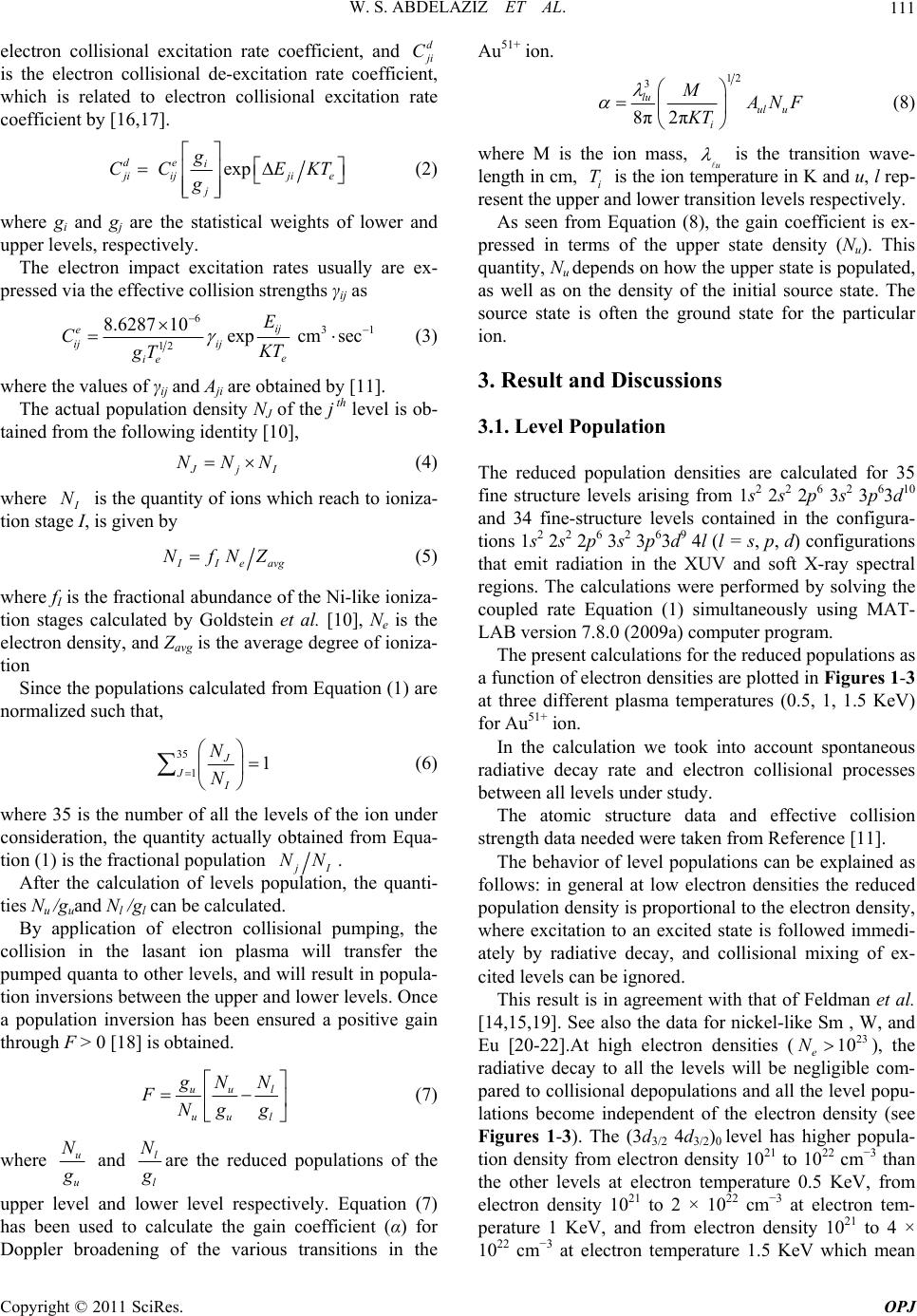 W. S. ABDELAZIZ ET AL.111 electron collisional excitation rate coefficient, and d j i C is the electron collisional de-excitation rate coefficient, which is related to electron collisional excitation rate coefficient by [16,17]. exp de i j iij jie j g CC EKT g (2) where gi and gj are the statistical weights of lower and upper levels, respectively. The electron impact excitation rates usually are ex- pressed via the effective collision strengths γij as 6 3 12 8.6287 10exp cmsec ij e ij ij e ie E CKT gT 1 (3) where the values of γij and Aji are obtained by [11]. The actual population density NJ of the j th level is ob- tained from the following identity [10], J j NNN I (4) where I N is the quantity of ions which reach to ioniza- tion stage I, is given by I Ie avg NfNZ (5) where fI is the fractional abundance of the Ni-like ioniza- tion stages calculated by Goldstein et al. [10], Ne is the electron density, and Zavg is the average degree of ioniza- tion Since the populations calculated from Equation (1) are normalized such that, 35 11 J J I N N (6) where 35 is the number of all the levels of the ion under consideration, the quantity actually obtained from Equa- tion (1) is the fractional population j I NN. After the calculation of levels population, the quanti- ties Nu /guand Nl /gl can be calculated. By application of electron collisional pumping, the collision in the lasant ion plasma will transfer the pumped quanta to other levels, and will result in popula- tion inversions between the upper and lower levels. Once a population inversion has been ensured a positive gain through F > 0 [18] is obtained. uu l uul g NN FNg g (7) where u u N g and l l N g are the reduced populations of the upper level and lower level respectively. Equation (7) has been used to calculate the gain coefficient (α) for Doppler broadening of the various transitions in the Au51+ ion. 12 3 8π2π lu ul u i M A NF KT (8) where M is the ion mass, u is the transition wave- length in cm, i is the ion temperature in K and u, l rep- resent the upper and lower transition levels respectively. T As seen from Equation (8), the gain coefficient is ex- pressed in terms of the upper state density (Nu). This quantity, Nu depends on how the upper state is populated, as well as on the density of the initial source state. The source state is often the ground state for the particular ion. 3. Result and Discussions 3.1. Level Population The reduced population densities are calculated for 35 fine structure levels arising from 1s2 2s2 2p6 3s2 3p63d10 and 34 fine-structure levels contained in the configura- tions 1s2 2s2 2p6 3s2 3p63d9 4l (l = s, p, d) configurations that emit radiation in the XUV and soft X-ray spectral regions. The calculations were performed by solving the coupled rate Equation (1) simultaneously using MAT- LAB version 7.8.0 (2009a) computer program. The present calculations for the reduced populations as a function of electron densities are plotted in Figures 1-3 at three different plasma temperatures (0.5, 1, 1.5 KeV) for Au51+ ion. In the calculation we took into account spontaneous radiative decay rate and electron collisional processes between all levels under study. The atomic structure data and effective collision strength data needed were taken from Reference [11]. The behavior of level populations can be explained as follows: in general at low electron densities the reduced population density is proportional to the electron density, where excitation to an excited state is followed immedi- ately by radiative decay, and collisional mixing of ex- cited levels can be ignored. This result is in agreement with that of Feldman et al. [14,15,19]. See also the data for nickel-like Sm , W, and Eu [20-22].At high electron densities (), the radiative decay to all the levels will be negligible com- pared to collisional depopulations and all the level popu- lations become independent of the electron density (see Figures 1-3). The (3d3/2 4d3/2)0 level has higher popula- tion density from electron density 1021 to 1022 cm−3 than the other levels at electron temperature 0.5 KeV, from electron density 1021 to 2 × 1022 cm−3 at electron tem- perature 1 KeV, and from electron density 1021 to 4 × 1022 cm−3 at electron temperature 1.5 KeV which mean 23 10 e N Copyright © 2011 SciRes. OPJ 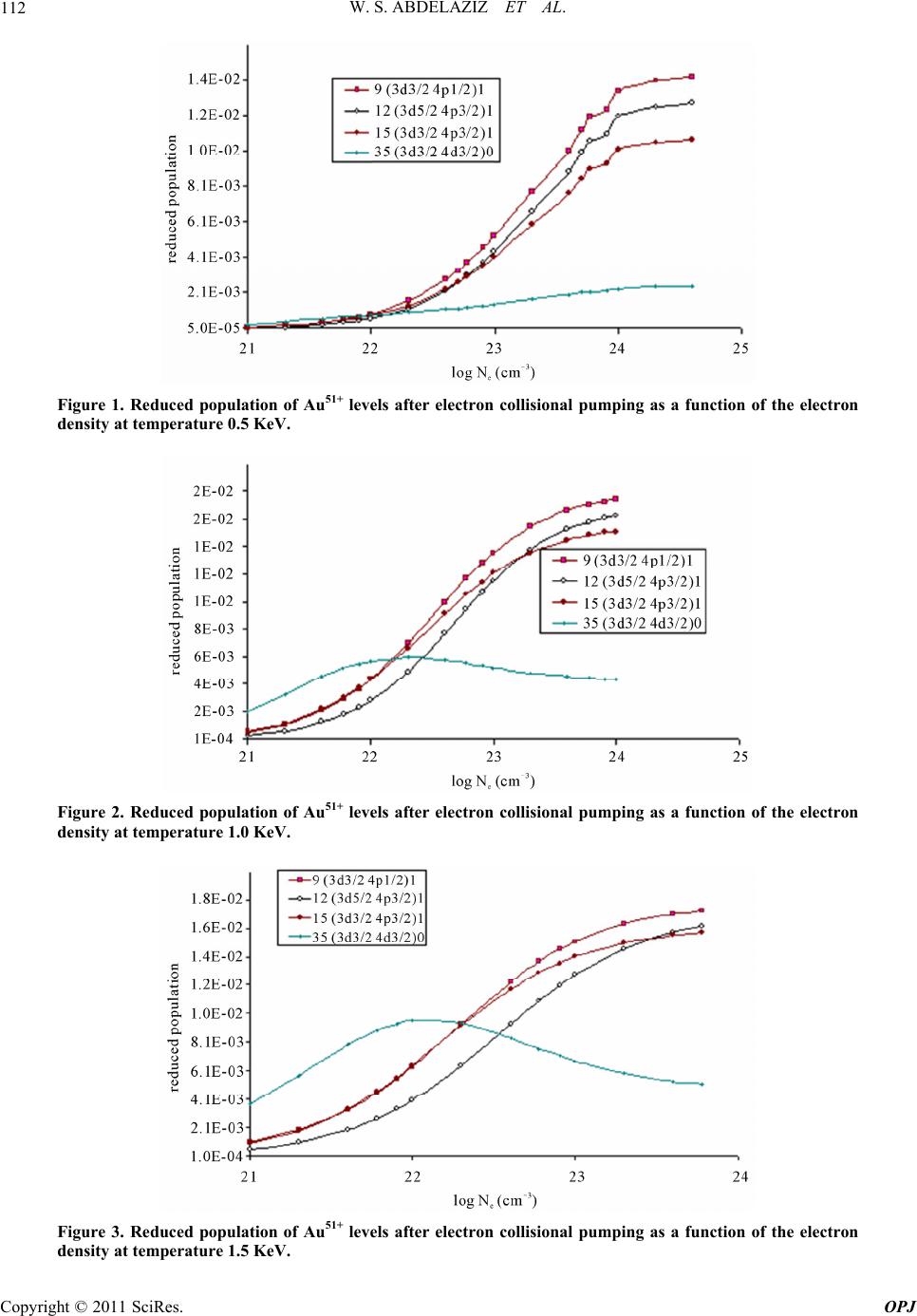 W. S. ABDELAZIZ ET AL. Copyright © 2011 SciRes. OPJ 112 Figure 1. Reduced population of Au51+ levels after electron collisional pumping as a function of the electron density at temperature 0.5 KeV. Figure 2. Reduced population of Au51+ levels after electron collisional pumping as a function of the electron density at temperature 1.0 KeV. Figure 3. Reduced population of Au51+ levels after electron collisional pumping as a function of the electron density at temperature 1.5 KeV. 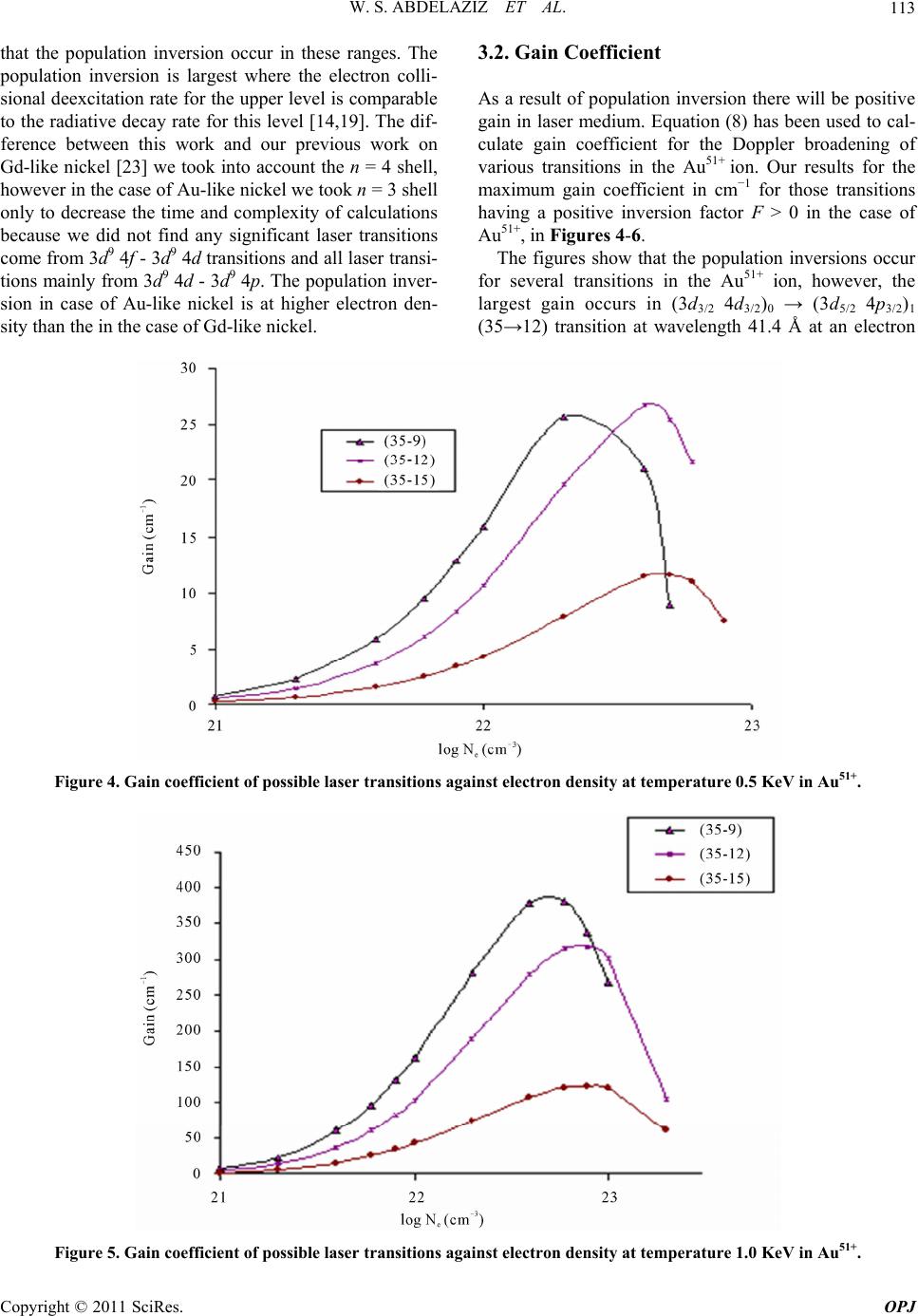 W. S. ABDELAZIZ ET AL. Copyright © 2011 SciRes. OPJ 113 that the population inversion occur in these ranges. The population inversion is largest where the electron colli- sional deexcitation rate for the upper level is comparable to the radiative decay rate for this level [14,19]. The dif- ference between this work and our previous work on Gd-like nickel [23] we took into account the n = 4 shell, however in the case of Au-like nickel we took n = 3 shell only to decrease the time and complexity of calculations because we did not find any significant laser transitions come from 3d9 4f - 3d9 4d transitions and all laser transi- tions mainly from 3d9 4d - 3d9 4p. The population inver- sion in case of Au-like nickel is at higher electron den- sity than the in the case of Gd-like nickel. 3.2. Gain Coefficient As a result of population inversion there will be positive gain in laser medium. Equation (8) has been used to cal- culate gain coefficient for the Doppler broadening of various transitions in the Au51+ ion. Our results for the maximum gain coefficient in cm−1 for those transitions having a positive inversion factor F > 0 in the case of Au51+, in Figures 4-6. The figures show that the population inversions occur for several transitions in the Au51+ ion, however, the largest gain occurs in (3d3/2 4d3/2)0 → (3d5/2 4p3/2)1 (35→12) transition at wavelength 41.4 Å at an electron Figure 4. Gain coefficient of possible laser transitions against electron density at temperature 0.5 KeV in Au51+. Figure 5. Gain coefficient of possible laser transitions against electron density at temperature 1.0 KeV in Au51+.  W. S. ABDELAZIZ ET AL. 114 Figure 6. Gain coefficient of possible laser transitions against electron density at temperature 1.5 KeV in Au51+. Table 1. Parameters of the most intense laser transitions. Transition Atomic data Au XXXXXII Wavelength λ (Å) 35.1 Maximum gain α (cm−1) 572 Electron density Ne (cm−3) 6.00E+22 (3d3/24d3/2)0→ (3d3/24p1/2)1 Electron temperature Te (KeV ) 1.5 Wavelength λ (Å) 41.4 Maximum gain α (cm−1) 442 Electron density Ne (cm−3) 1.00E+23 (3d3/24d3/2)0→ (3d5/24p3/2)1 Electron temperature Te (KeV) 1.5 Wavelength λ (Å) 51 Maximum gain α (cm−1) 166 Electron density Ne (cm−3) 8.00E+22 (3d3/24d3/2)0→ (3d3/24p3/2)1 Electron temperature Te (KeV) 1.5 temperature 0.5 KeV, and in (3d3/2 4d3/2)0 → (3d3/2 4p1/2)1 (35→9) transition at wavelength 35.1 Å at an electron temperatures 1.0, and 1.5 KeV For Ni-like Au, the population inversion is due to strong monopole excitation from the 3d10 ground state to the 3d9 4d configuration and also the radiative decay of the 3d9 4d level to the ground level is forbidden, while the 3d9 4p level decays very rapidly to the ground level. This short wavelength laser transitions was produced using plasmas created by optical lasers as the lasing me- dium. For electron densities and electron temperatures that are typical of laboratory high-density plasma sources, such as laser produced plasmas, it is possible to create a quasi-stationary population inversion between the 3d94d and 3d94p in Au51+ ion. Our calculations have shown that under favorable conditions large laser gain for these transitions in the XUV and soft X-ray regions of the spectrum can be achieved in the nickel like Au51+ ion. It is obvious that the gain increases with the temperature. 4. Conclusions The analysis that have been presented in this work shows that electron collisional pumping (ECP) is suitable for attaining population inversion and offering the potential Copyright © 2011 SciRes. OPJ 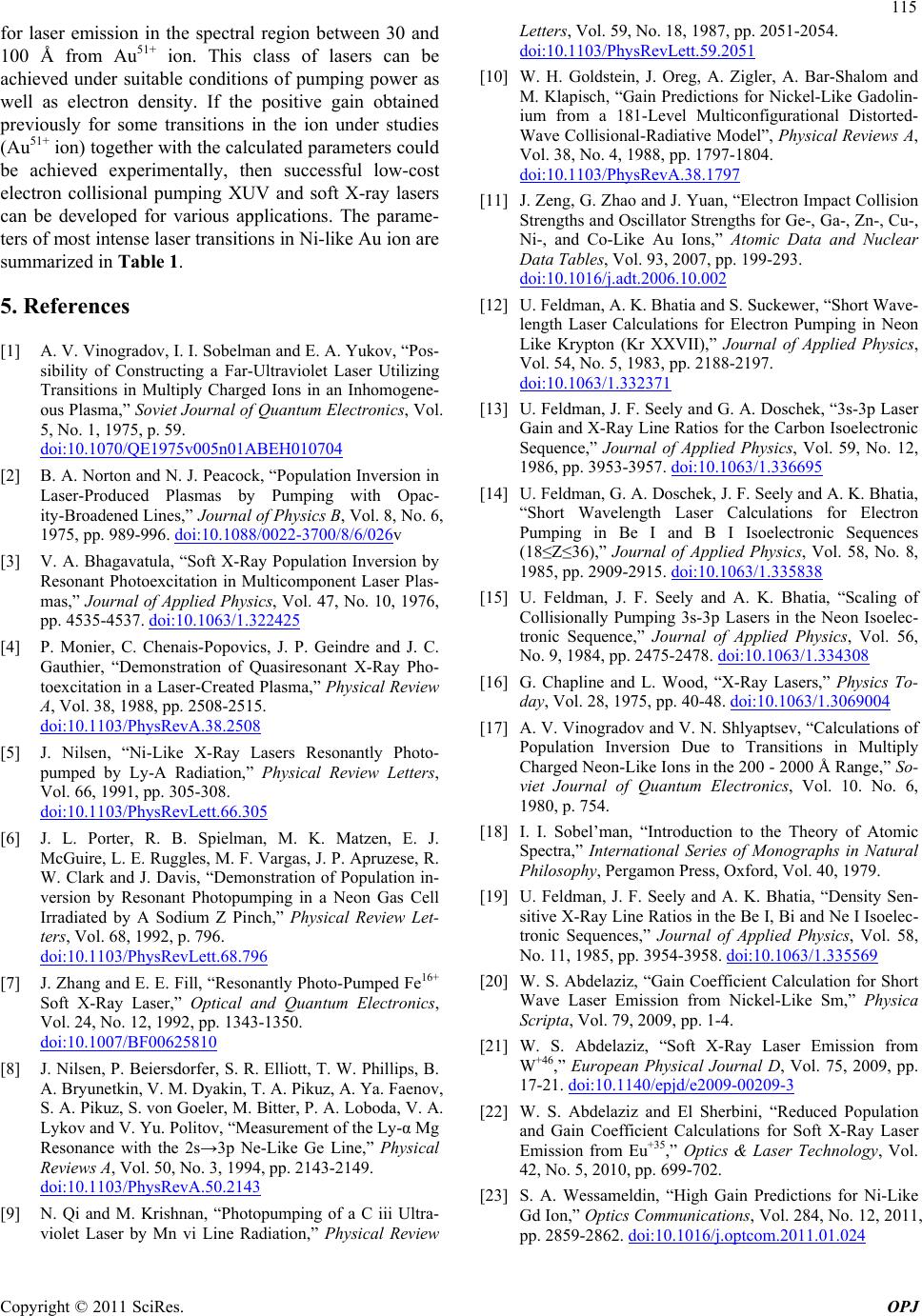 115 for laser emission in the spectral region between 30 and 100 Å from Au51+ ion. This class of lasers can be achieved under suitable conditions of pumping power as well as electron density. If the positive gain obtained previously for some transitions in the ion under studies (Au51+ ion) together with the calculated parameters could be achieved experimentally, then successful low-cost electron collisional pumping XUV and soft X-ray lasers can be developed for various applications. The parame- ters of most intense laser transitions in Ni-like Au ion are summarized in Table 1. 5. References [1] A. V. Vinogradov, I. I. Sobelman and E. A. Yukov, “Pos- sibility of Constructing a Far-Ultraviolet Laser Utilizing Transitions in Multiply Charged Ions in an Inhomogene- ous Plasma,” Soviet Journal of Quantum Electronics, Vol. 5, No. 1, 1975, p. 59. doi:10.1070/QE1975v005n01ABEH010704 [2] B. A. Norton and N. J. Peacock, “Population Inversion in Laser-Produced Plasmas by Pumping with Opac- ity-Broadened Lines,” Journal of Physics B, Vol. 8, No. 6, 1975, pp. 989-996. doi:10.1088/0022-3700/8/6/026v [3] V. A. Bhagavatula, “Soft X-Ray Population Inversion by Resonant Photoexcitation in Multicomponent Laser Plas- mas,” Journal of Applied Physics, Vol. 47, No. 10, 1976, pp. 4535-4537. doi:10.1063/1.322425 [4] P. Monier, C. Chenais-Popovics, J. P. Geindre and J. C. Gauthier, “Demonstration of Quasiresonant X-Ray Pho- toexcitation in a Laser-Created Plasma,” Physical Review A, Vol. 38, 1988, pp. 2508-2515. doi:10.1103/PhysRevA.38.2508 [5] J. Nilsen, “Ni-Like X-Ray Lasers Resonantly Photo- pumped by Ly-Α Radiation,” Physical Review Letters, Vol. 66, 1991, pp. 305-308. doi:10.1103/PhysRevLett.66.305 [6] J. L. Porter, R. B. Spielman, M. K. Matzen, E. J. McGuire, L. E. Ruggles, M. F. Vargas, J. P. Apruzese, R. W. Clark and J. Davis, “Demonstration of Population in- version by Resonant Photopumping in a Neon Gas Cell Irradiated by A Sodium Z Pinch,” Physical Review Let- ters, Vol. 68, 1992, p. 796. doi:10.1103/PhysRevLett.68.796 [7] J. Zhang and E. E. Fill, “Resonantly Photo-Pumped Fe16+ Soft X-Ray Laser,” Optical and Quantum Electronics, Vol. 24, No. 12, 1992, pp. 1343-1350. doi:10.1007/BF00625810 [8] J. Nilsen, P. Beiersdorfer, S. R. Elliott, T. W. Phillips, B. A. Bryunetkin, V. M. Dyakin, T. A. Pikuz, A. Ya. Faenov, S. A. Pikuz, S. von Goeler, M. Bitter, P. A. Loboda, V. A. Lykov and V. Yu. Politov, “Measurement of the Ly-α Mg Resonance with the 2s→3p Ne-Like Ge Line,” Physical Reviews A, Vol. 50, No. 3, 1994, pp. 2143-2149. doi:10.1103/PhysRevA.50.2143 [9] N. Qi and M. Krishnan, “Photopumping of a C iii Ultra- violet Laser by Mn vi Line Radiation,” Physical Review Letters, Vol. 59, No. 18, 1987, pp. 2051-2054. doi:10.1103/PhysRevLett.59.2051 [10] W. H. Goldstein, J. Oreg, A. Zigler, A. Bar-Shalom and M. Klapisch, “Gain Predictions for Nickel-Like Gadolin- ium from a 181-Level Multiconfigurational Distorted- Wave Collisional-Radiative Model”, Physical Reviews A, Vol. 38, No. 4, 1988, pp. 1797-1804. doi:10.1103/PhysRevA.38.1797 [11] J. Zeng, G. Zhao and J. Yuan, “Electron Impact Collision Strengths and Oscillator Strengths for Ge-, Ga-, Zn-, Cu-, Ni-, and Co-Like Au Ions,” Atomic Data and Nuclear Data Tables, Vol. 93, 2007, pp. 199-293. doi:10.1016/j.adt.2006.10.002 [12] U. Feldman, A. K. Bhatia and S. Suckewer, “Short Wave- length Laser Calculations for Electron Pumping in Neon Like Krypton (Kr XXVII),” Journal of Applied Physics, Vol. 54, No. 5, 1983, pp. 2188-2197. doi:10.1063/1.332371 [13] U. Feldman, J. F. Seely and G. A. Doschek, “3s-3p Laser Gain and X-Ray Line Ratios for the Carbon Isoelectronic Sequence,” Journal of Applied Physics, Vol. 59, No. 12, 1986, pp. 3953-3957. doi:10.1063/1.336695 [14] U. Feldman, G. A. Doschek, J. F. Seely and A. K. Bhatia, “Short Wavelength Laser Calculations for Electron Pumping in Be I and B I Isoelectronic Sequences (18≤Z≤36),” Journal of Applied Physics, Vol. 58, No. 8, 1985, pp. 2909-2915. doi:10.1063/1.335838 [15] U. Feldman, J. F. Seely and A. K. Bhatia, “Scaling of Collisionally Pumping 3s-3p Lasers in the Neon Isoelec- tronic Sequence,” Journal of Applied Physics, Vol. 56, No. 9, 1984, pp. 2475-2478. doi:10.1063/1.334308 [16] G. Chapline and L. Wood, “X-Ray Lasers,” Physics To- day, Vol. 28, 1975, pp. 40-48. doi:10.1063/1.3069004 [17] A. V. Vinogradov and V. N. Shlyaptsev, “Calculations of Population Inversion Due to Transitions in Multiply Charged Neon-Like Ions in the 200 - 2000 Å Range,” So- viet Journal of Quantum Electronics, Vol. 10. No. 6, 1980, p. 754. [18] I. I. Sobel’man, “Introduction to the Theory of Atomic Spectra,” International Series of Monographs in Natural Philosophy, Pergamon Press, Oxford, Vol. 40, 1979. [19] U. Feldman, J. F. Seely and A. K. Bhatia, “Density Sen- sitive X-Ray Line Ratios in the Be I, Bi and Ne I Isoelec- tronic Sequences,” Journal of Applied Physics, Vol. 58, No. 11, 1985, pp. 3954-3958. doi:10.1063/1.335569 [20] W. S. Abdelaziz, “Gain Coefficient Calculation for Short Wave Laser Emission from Nickel-Like Sm,” Physica Scripta, Vol. 79, 2009, pp. 1-4. [21] W. S. Abdelaziz, “Soft X-Ray Laser Emission from W+46,” European Physical Journal D, Vol. 75, 2009, pp. 17-21. doi:10.1140/epjd/e2009-00209-3 [22] W. S. Abdelaziz and El Sherbini, “Reduced Population and Gain Coefficient Calculations for Soft X-Ray Laser Emission from Eu+35,” Optics & Laser Technology, Vol. 42, No. 5, 2010, pp. 699-702. [23] S. A. Wessameldin, “High Gain Predictions for Ni-Like Gd Ion,” Optics Communications, Vol. 284, No. 12, 2011, pp. 2859-2862. doi:10.1016/j.optcom.2011.01.024 Copyright © 2011 SciRes. OPJ |